
Hybrid silica materials derived from proline sulfonamides, imidazolium salts and (NHC)AuX complexes as supported catalysts
251
0
0
Texto completo
(2)
(3) Memòria presentada per aspirar al Grau de Doctor per:. Meritxell Ferré Romeu. Vist i plau:. Roser Pleixats i Rovira. Bellaterra, 28 d'Abril de 2015.
(4)
(5) ACKNOWLEDGEMENTS The present work has been carried out at the Unitat de Química Orgànica of Departament de Química from Universitat Autònoma de Barcelona under. the. supervision of Prof. Roser Pleixats i Rovira whom I will always be grateful of her confidence, her availability for meeting me and giving me advice as well as all the time she has dedicate me to follow up my work. Furthermore, a collaboration with the group of Architectures Moléculaires et Matériaux Nanostructurés at Institut Charles Gerhardt de Montpellier in ENSCM has been done during these years where Dr. Michel Wong Chi Man offered me the chance of working in his research group. In the same manner, Dr. Xavier Cattoën taught me everything I needed to do the experiments. Thus, I would like to thank them all the help and guidance that they gave me during my stages. Likely, I would like to thank all the Professors of our group who have contributed to develop this thesis with their suggestions and recommendations. I would also like to thank all my labmates from C7/423, C7/419, C7/415 and C7/416 who have contributed to this work with their companionship and their kindness, specially Dra. Amàlia Monge who helped me from my first day in the group and taught me all the tricks she knew and she still gives me advice. Likewise, I would like to thank Achraf and Ana all their hospitality while I was in France. També vull agrair a tots els meus amics del grup "Il Cazzo": la Roser, el Joseju, el Marc i el Nico per compartir aquests anys amb mi; junts hem viscut viatges i moments que recordaré sempre i espero que en vinguin molts més. D'altra banda, als meus amics Bea, Lídia, Toni, Marta, Jess, Ana, Lara i Cris que sempre et fan somriure i t'animen a seguir endavant. No hi ha prous paraules per agrair a tota la meva família el seu suport i interès per saber com va tot i en què et poden ajudar, sobretot a la meva mare, a la meva àvia i a l'Àlex, ells són casa meva i sempre estan disposats a fer el que calgui, incondicionalment. Gràcies per estimar-me tant i dedicar-me tant d'esforç. No puc deixar d'esmentar com m'agradaria que el meu pare fos aquí i poder-li agrair tot el que em va donar i ensenyar. Gràcies per ajudar-me a arribar fins aquí, per a mi, sempre seràs un referent i el motiu de fer les coses bé. Finalment, li he de donar gràcies al Jordi, per estar cada dia al meu costat, saber-me escoltar i donar-me ànims per continuar avançant. Gràcies per fer-me tan feliç i voler compartir aquest temps amb mi. Thank you all very much! / Moltes gràcies a tots!.
(6) FINANCIAL AND TECHNICAL SUPPORT I would like to thank Universitat Autònoma de Barcelona for giving me the Personal Investigador en Formació scholarship as well as the financial support received from Spain (Projects CTQ2009-07881, CTQ2011-22649 and Consolider Ingenio 2010 (CSD2007-0006)) which have done this thesis possible. Finally, the technical support from Servei d'Anàlisi Química de la UAB, Servei de Ressonància Magnètica Nuclear de la UAB, Serveis Científico-Tècnics de la UB and University of Montpellier II is acknowledged as well..
(7) Als meus pares.
(8)
(9) Preface TABLE OF CONTENTS. PREFACE........................................................................................................................ i Abbreviations.....................................................................................................viii Abstract................................................................................................................x Resum.................................................................................................................xi Resumen............................................................................................................xii. CHAPTER 1. INTRODUCTION TO ORGANIC-INORGANIC HYBRID SILICA MATERIALS ............. 3 1. Hybrid silica materials ............................................................................................... 3 2. Preparation of organic-inorganic hybrid silica materials ............................................ 5 Synthetic strategies towards hybrid materials ............................................................... 5 2.1 Post-functionalization methods (building block approach)............................ 5 2.2 The Sol-Gel process (in situ formation of the components) .......................... 7 2.2.1 The Sol-Gel process ......................................................................................... 7 2.2.2 Co-condensation and bridged silesquioxanes .............................................. 9 2.2.3 Mesostructuring of organosilicas .................................................................. 10 3. Characterization of hybrid silica materials ............................................................... 15 3.1 29Si and 13C Solid State Nuclear Magnetic Resonance (SSNMR) .............. 15 3.2 Vibrational Spectroscopy (IR and Raman) ................................................. 18 3.3 Thermogravimetric analysis ....................................................................... 19 3.4 Elemental Analysis .................................................................................... 20 3.5 Surface area analysis ................................................................................ 20 3.6 Powder X-Ray Diffraction .......................................................................... 24 3.7 Electron Microscopy .................................................................................. 26. CHAPTER 2. ORGANOSILICAS DERIVED FROM PROLINE SULFONAMIDES AND PROLINE TETRAZOLES. APPLICATIONS IN ASYMMETRIC ORGANOCATALYSIS..............29 1. INTRODUCTION .................................................................................................... 31 1.1 Introduction to asymmetric organocatalysis ............................................... 31 1.2 Organocatalysis classification. Activation modes. ...................................... 33. i.
(10) Table of Contents 1.3 Enamine catalysis in α-functionalization of carbonyl compounds. .............. 37 1.4 Organocatalysts based on proline derivatives ............................................ 40 1.4.1 Proline sulfonamides as asymmetric organocatalysts ........................... 42 1.4.2 Proline tetrazoles as asymmetric organocatalysts ................................ 45 1.5 Supported organocatalysts based on proline derivatives. Catalyst recovery and recycling. .................................................................................................. 46 2. OBJECTIVES ......................................................................................................... 54 3.. RESULTS AND DISCUSSION ............................................................................. 55 3.1. Preparation and catalytic applications of hybrid silica materials M1 and M2 derived from a silylated proline sulfonamide .................................................... 55 3.1.1 Preparation of hybrid silica material M1 ................................................ 55 3.1.2 Assay of M1 in asymmetric organocatalysis ......................................... 58 3.1.2.1 Catalytic tests of M1 in the direct aldol reaction ............................... 58 3.1.2.2 Catalytic tests of M1 in the aza-Diels Alder reaction ........................ 64 3.1.3 Preparation of organosilica M2 ............................................................. 65 3.1.4 Assay of M2 in asymmetric organocatalysis ......................................... 66 3.1.4.1 Catalytic tests of M2 in the direct aldol reaction ............................... 66 3.1.5 Immobilization effect on the supported catalysts .................................. 68 3.2 Preparation and catalytic applications of hybrid silica materials M3, M4, and M6 derived from monosilylated trans-4-hydroxyproline sulfonamide ......... 69 3.2.1 Preparation of the organosilicas M3, M4 and M6 .................................. 69 3.2.2 Assay of M3, M4 and M6 in asymmetric organocatalysis ...................... 72 3.2.2.1 Catalytic tests of M3, M4 and M6 in the direct aldol reaction ............. 72 3.2.2.2 Catalytic tests of M3 and M6 in the aza-Diels Alder reaction ............. 77 3.3 Attempts to prepare an organosilica derived from a proline tetrazole ......... 78. 4. CONCLUSIONS ..................................................................................................... 83 5. EXPERIMENTAL SECTION ................................................................................... 85 5.1 General remarks. ....................................................................................... 85 5.2 Preparation of hybrid silica materials derived from proline sulfonamides ... 87 5.2.1 Synthesis of (S)-1-((benzyloxy)carbonyl)pyrrolidine2-carboxylic acid, 4. ...................................................................................... 87 5.2.2 Synthesis of (S)-1-benzyl 2-(4-nitrophenyl) pyrrolidine1,2-dicarboxylate, 5... .................................................................................... 87 5.2.3 Synthesis of 4-vinylbenzenesulfonamide, 6. ......................................... 88 5.2.4 Synthesis of (S)-benzyl 2-(((4-vinylphenyl)sulfonyl)carbamoyl) pyrrolidine-1-carboxylate, 7.............................................................................89. ii.
(11) Preface 5.2.5 Synthesis of (S)-benzyl 2-(((4-(2-(triethoxysilyl)ethyl)phenyl) sulfonyl)carbamoyl)pyrrolidine-1-carboxylate, 8..............................................90 5.2.6 Synthesis of (S)-N-((4-(2-(triethoxysilyl)ethyl)phenyl)sulfonyl) pyrrolidine-2-carboxamide,1...........................................................................91 5.2.7 Preparation of the hybrid silica material M1. ....................................... ..91 5.2.8 Preparation of hybrid silica material M2 ............................................. ...92 5.2.9 Synthesis of (2S,4R)-1-benzyl 2-(4-nitrophenyl) 4-hydroxypyrrolidine1,2-dicarboxylate, 20.......................................................................................93 5.2.10 Synthesis of (2S,4R)-benzyl 4-hydroxy-2-(tosylcarbamoyl) pyrrolidine-1-carboxylate, 21...........................................................................94 5.2.11 Synthesis of (2S,4R)-benzyl 2-(tosylcarbamoyl)-4-(((3(triethoxysilyl)propyl)carbamoyl)oxy)pyrrolidine-1-carboxylate, 22..................95 5.2.12 Synthesis of (3R,5S)-5-(tosylcarbamoyl)pyrrolidin-3-yl (3(triethoxysilyl)propyl)carbamate, 2...................................................................95 5.2.13 Preparation of hybrid silica material M3 .............................................. 96 5.2.14 Preparation of hybrid silica material M4 .............................................. 97 5.2.15 Preparation of mesostructured silica of SBA-15 type, M5. .................. 97 5.2.16 Preparation of hybrid silica material M6 .............................................. 98 5.2.17 Preparation of (S)-benzyl 2-(tosylcarbamoyl)pyrrolidine1-carboxylate, 9............................................................................................. 98 5.2.18 Preparation of (S)-N-tosylpyrrolidine-2-carboxamide, 10. ................... 99 5.3 Catalytic tests with proline sulfonamide derived organosilicas ................. 100 5.3.1 Intermolecular aldol reactions ............................................................. 100 5.3.2 Intramolecular aldol condensation (Robinson annulation)................... 102 5.3.3 Aza-Diels Alder reaction ..................................................................... 103 5.3.3.1 Preparation of N-(4-chlorobenzylidene)-4-methoxyaniline, 18. ...... 103 5.3.3.2 Catalytic tests ................................................................................ 104 5.4 Attempt to prepare a monosilylated proline tetrazole 3 ............................ 105 5.4.1 Preparation of (2S,4R)-1-benzyl 2-(prop-2-yn-1-yl) 4-(prop-2-yn-1yloxy)pyrrolidine-1,2-dicarboxylate, 23. ....................................................... 105 5.4.2 Preparation of (2S,4R)-1-((benzyloxy)carbonyl)-4-(prop-2-yn-1yloxy)pyrrolidine-2-carboxylic acid, 24. ........................................................ 106 5.4.3 Preparation of (2S,4R)-benzyl 2-carbamoyl-4-(prop-2-yn-1yloxy)pyrrolidine-1-carboxylate, 25. ............................................................. 107 5.4.4 Preparation of (2S,4R)-benzyl 2-cyano-4-(prop-2-yn-1-yloxy)pyrrolidine1-carboxylate, 26......................................................................................... 108 5.4.5 Preparation of (2S,4R)-benzyl 4-(prop-2-yn-1-yloxy)-2-(1H-tetrazol-5yl)pyrrolidine-1-carboxylate, 27. .................................................................. 108 5.4.6 Preparation of (3-azidopropyl)triethoxysilane, (Az-PTES). .................. 109 iii.
(12) Table of Contents 5.4.7 General procedure for click reactions under microwave heating. ........ 110 5.4.8 Procedure for Bn protection of NH groups of proline tetrazole 27. ...... 110. CHAPTER 3. ORGANOSILICAS DERIVED FROM IMIDAZOLIUM AND IMIDAZOLINIUM SALTS. APPLICATIONS IN CATALYSIS...............................................................................113 1. INTRODUCTION .................................................................................................. 115 1.1 Introduction to NHC carbenes as organocatalysts ................................... 115 1.2 NHC-catalyzed transformations ............................................................... 116 1.2.1 Ambiphilicity or Umpolung .................................................................. 117 1.2.1.1 Classical Umpolung (a1 to d1) ........................................................ 119 1.2.1.2 Conjugate umpolung (a3 to d3) ...................................................... 121 1.2.2 Basicity............................................................................................... 126 1.3 Organocatalysis by 1-alkyl-3-methylimidazolium cation ........................... 127 1.4 Supported NHC pre-catalysts .................................................................. 128 1.5 Imidazolium and imidazolinium derived organosilicas. Precedents in the group ................................................................................ 133 2. OBJECTIVES ....................................................................................................... 136 3. RESULTS AND DISCUSSION .............................................................................. 138 3.1 Immobilization of imidazolium and imidazolinium salts............................. 138 3.1.1 Hybrid silica material derived from a mono-silylated N-mesityl imidazolium salts ......................................................................... 138 3.1.1.1 Preparation of the hybrid silica material M7 ................................... 138 3.1.1.2 Capping of surface silanol groups of hybrid silica material M7 ...... 141 3.1.2 Hybrid silica materials derived from a bis-silylated N,N’-dimesityl imidazolinium salt ........................................................................................ 143 3.1.2.1 Preparation of the hybrid silica material M9 ................................... 143 3.1.2.2 Capping of surface silanol groups of hybrid silica material M9 ...... 146 3.2 Catalytic tests of materials M7, M8 and M10. .......................................... 146 3.2.1 Catalytic tests of materials M8 and M10 in NHC type reactions .......... 147 3.2.1.1 Benzoin condensation ................................................................... 147 3.2.1.2 Annulation reactions of enals and vinyl ketones ............................ 149 3.2.2 Assay of M7 in imidazolium-based catalysis ....................................... 150 3.2.2.1 Chemoselective N-tert-butyloxycarbonylation of amines ............... 150 4. CONCLUSIONS ................................................................................................... 154 5. EXPERIMENTAL SECTION ................................................................................. 155 iv.
(13) Preface 5.1. General remarks ..................................................................................... 155 5.2 Preparation of hybrid silica materials ....................................................... 157 5.2.1 Preparation of 1-mesitylimidazole, 35. ................................................ 157 5.2.2 Preparation of 1-mesityl-3-[3-(triethoxysilyl)propyl]-1H-imidazol-3-ium chloride, 33. ................................................................................................ 157 5.2.3 Preparation of hybrid silica material M7 .............................................. 158 5.2.4 Preparation of hybrid silica material M8 .............................................. 158 5.2.5 Preparation of N,N'-(1E,2E)-(ethane-1,2-diylidene)bis(2,4,6-trimethylaniline), 36. ..................................................................... 159 5.2.6 Preparation of (4R, 5S)-N,N'-dimesitylocta-1,7-diene4,5-diamine, 37. .......................................................................................... 159 5.2.7 Preparation of (4S, 5R)-4,5-diallyl-1,3-dimesityl-4,5-dihydroimidazolium chloride, 38....................................................................................................160 5.2.8 Preparation of (4R, 5S)-1,3-dimesityl-4,5-bis[3-(triethoxysilyl)propyl]-4,5-dihidroimidazolium chloride, 34..................................................161 5.2.9. Preparation of organosilica M9 .......................................................... 161 5.2.10. Preparation of organosilica M10 ...................................................... 162 5.3 Catalytic tests .......................................................................................... 163 5.3.1 Assays in NHC-based catalytic reactions ........................................... 163 5.3.1.1 Benzoin condensation ................................................................... 163 General procedure for homogeneous catalysis. .......................................... 163 General procedure for heterogeneous catalysis.. ........................................ 163 5.3.1.2 Annulation of enals and vinyl ketones ........................................... 164 General procedure for homogeneous catalysis. .......................................... 164 5.3.2 Assays in imidazolium-based catalytic reactions ................................ 164 5.3.2.1 Chemoselective N-tert-butyloxycarbonylation of amines. .............. 164. CHAPTER 4. HYBRID SILICA MATERIAL DERIVED FROM A [(NHC)AuCl] COMPLEX. APPLICATIONS AS RECYCLABLE CATALYST.....................................................167 1. INTRODUCTION .................................................................................................. 169 1.1 Gold catalysis .......................................................................................... 169 1.2 General mechanism of gold(I) catalysis ................................................... 170 1.3 NHC-Au(I) complexes .............................................................................. 171 1.4 Reactivity of NHC-Au(I) complexes.......................................................... 174 1.4.1 Allylic ester rearrangement (alkene activation) ................................... 174. v.
(14) Table of Contents 1.4.2 NHC-Au-OH as precatalyst ................................................................ 176 1.4.3 NHC-Au(I) catalysis in aqueous media ............................................... 177 1.4.4 Catalytic cycloisomerization of γ-alkynoic acids into enol-lactones in aqueous media ........................................................................................... 179 1.5 Supported NHC-Au(I) catalysts................................................................ 180 1.6 Precedents in the research group on the immobilization of NHC-metal complexes. .................................................................................................... 182 2. OBJECTIVES ....................................................................................................... 184 3. RESULTS AND DISCUSSION .............................................................................. 186 3.1 Immobilization of NHC-Au(I) complexes .................................................. 186 3.1.1 Hybrid silica material M11 derived from a disilylated bis-mesityl NHC-Au complex ...................................................................................................... 186 3.1.1.1. Preparation of the disilylated NHC-Au-Cl monomer 46................... 186 3.1.1.2 Preparation of hybrid silica material M11 ........................................ 189 3.1.2 Studies towards the formation of hybrid silica material M13 derived from a disilylated bis-SIPr (NHC)-Au complex ..................................................... 191 3.1.2.1 Attempts for the preparation of the disilylated NHC-Au-Cl monomer 53.............................................................................................. 192 3. 2 Applications of M11 as recyclable catalyst .............................................. 194 3.2.1. Rearrangement of allylic acetates ..................................................... 194 3.2.2 Cycloisomerization of γ-alkynoic acids ............................................... 199 4. CONCLUSIONS ................................................................................................... 206 5. EXPERIMENTAL SECTION ................................................................................. 207 5.1. General remarks ..................................................................................... 207 5.2 Immobilization of (NHC)AuCl complexes ................................................. 209 5.2.1 Synthesis of ((4R,5S)-4,5-diallyl-1,3-dimesitylimidazolidin-2-yl)gold(I) chloride, 47 ................................................................................................. 209 5.2.2 Preparation of ((4R,5S)-1,3-dimesityl-4,5-bis(3(triethoxysilyl)propyl)imidazolidin-2-yl)gold(I) chloride, 46, from gold complex 47 ......................................................................................... 210 5.2.3 First preparation of ((4R,5S)-1,3-dimesityl-4,5-bis(3(triethoxysilyl)propyl)imidazolidin-2-yl)gold(I) chloride, 46, from silylated dihydroimidazolium salt 34. ......................................................................... 211 5.2.4 Synthesis of [Au(tht)Cl], 48. ............................................................... 211 5.2.5 Second preparation of ((4R,5S)-1,3-dimesityl-4,5-bis(3(triethoxysilyl)propyl)imidazolidin-2-yl)gold(I) chloride, 46, from silylated dihydroimidazolium salt 34.......................................................................... 212 5.2.6 Preparation of hybrid silica material M11 ........................................... 212 5.2.7 Preparation of glyoxal bis[(2,6-diisopropylphenyl)imine], 49. .............. 213 vi.
(15) Preface 5.2.8 Preparation of (4R, 5S)-N,N'-dimesitylocta-1,7-diene4,5-diamine, 50. .......................................................................................... 213 5.2.9 First attempt to prepare (4S,5R)-4,5-diallyl-1,3-bis(2,6diisopropylphenyl)-4,5-dihydro-1H-imidazol-3-ium chloride, 51. .................. 214 5.2.10 Second attempt to prepare (4S,5R)-4,5-diallyl-1,3-bis(2,6diisopropylphenyl)-4,5-dihydro-1H-imidazol-3-ium chloride, 51. .................. 214 5.3 Catalytic tests with homogeneous [(NHC)Au] complexes and with silicasupported [(NHC)AuCl], M11 ......................................................................... 215 5.3.1 Rearrangement of allylic esters .......................................................... 215 5.3.1.1 Preparation of the substrates ........................................................ 215 Preparation of 1-phenylallyl acetate, 54. ................................................... 215 Preparation of 1-Phenylallyl benzoate, 60. ................................................ 216 General procedure for the preparation of substrates 56,57 and 62. .......... 216 5.3.1.2 General procedures for catalytic tests ........................................... 218 5.3.3 Cycloisomerization of γ-alkynoic acids ............................................... 220 5.3.3.1 Preparation of the substrates ........................................................ 220 Preparation of dimethyl 2,2-di(prop-2-yn-1-yl)malonate, 75....................... 220 Preparation of dimethyl 2,2-di(but-2-yn-1-yl)malonate, 76 and dimethyl 2-(but-2-yn-1-yl)malonate, 77...................................................... 221 Preparation of dimethyl 2-(but-2-yn-1-yl)-2-(prop-2-yn-1-yl)malonate, 78. . 222 General procedure for the monohydrolysis of dimethyl 2,2-disubstituted malonates (GP 3) ...................................................................................... 223 5.3.3.2 General procedures for catalytic tests ........................................... 224 GENERAL CONCLUSIONS ..................................................................................... 226 FORMULA INDEX .................................................................................................... 228. vii.
(16) Abbreviations ABBREVIATIONS T. DMAP:. N,N’-dimethyl-4-. [α] λ:. Specific optical rotation. Ac2O:. acetic anhydride. AcOEt:. ethyl acetate. DMF:. dimethylformamide. AcOH:. acetic acid. DMSO:. dimethylsulfoxide. anh.:. anhydrous. dr. diastereomeric ratio. aq.:. aqueous. DSC:. Differential Scanning. Ar:. aryl. atm:. atmosphere. ATR (for IR): Attenuated Total Reflectance. aminopyridine. Calorimetry EA:. elemental analysis. EDX:. energy-dispersive X-ray spectroscopy. AzPTES:. (3-azidopropyl)triethoxysilane. Bn:. benzyl. ee:. enantiomeric excess. BnCl:. benzyl chloride. er:. enantiomeric ratio. Boc2O:. di-tert-butyl dicarbonate. equiv.:. equivalent. BET:. Brunauer-Emmett-Teller. ESI:. Electrospray Ionization. BJH :. Barrett-Joyner-Halenda. Et3N:. triethylamine. cat.:. catalyst. EtO:. ethoxy. Cbz:. benzyloxycarbonyl. Et2O:. diethyl ether. CF:. chemical formula. EtOH:. ethanol. ChCl:. choline chloride. Exp.:. experiment. 13. 13-Carbon Nuclear Magnetic. FAB:. Fast Atom Bombardment. Resonance. GC:. Gas Chromatography. Cross-Polarization Magic. GC-MS:. Gas Chromatography with. C-NMR:. CP-MAS:. Mass spectrometry detector. Angle Spinning CP-TOSS:. CuAAC:. HAr:. aromatic hydrogen. Suppression of Spinning. HMPA:. hexamethylphosphoramide. Sidebands. 1. Proton Nuclear Magnetic. Cross-Polarization with Total. H-NMR:. copper-catalyzed azide alkyne cycloaddition. Cy:. cyclohexyl. d (NMR):. doublet. dd (NMR):. double doublet. δ (NMR):. chemical shift. DBU:. 1,8-diazabicyclo[5.4.0]undec-. Resonance HOMO:. Highest-Occupied Molecular Orbital. HR-MS:. High Resolution Mass Spectrometry. G-H I:. st. 1 generation HoveydaGrubbs’ catalyst. 7-ene. ICP:. Inductively Coupled Plasma. N,N’-. IL:. Ionic Liquid. dicyclohexylcarbodiimide. IMes:. Imidazole Mesityl. dichloroethane. i. Pr:. isopropyl. DCM:. dichloromethane. i. PrOH:. isopropanol. DES:. deep eutectic solvent. J (NMR):. coupling constant. DCC: DCE:. viii.
(17) Preface KHDMS:. potassium. ROMP:. Ring-Opening Metathesis Polymerization. bis(trimethylsilyl)amide λ:. wavelength. r.t.:. room temperature. lit.:. literature. s (NMR):. singlet. LUMO :. Lowest-Occupied Molecular. SBET:. surface area measured by. Orbital. BET. M:. molar. m (NMR):. multiplet. MCR:. multicomponent reaction. SIMes:. Saturated Imidazole Mesityl. Me:. methyl. SIPr:. [1,3-bis-(2,6-. MeO:. methoxy. diisopropylphenyl)imidazolin-. MeOH:. methanol. ylidene]. Mes:. Mesityl. Me2S:. dimethylsulfide. min:. minutes. mol%:. molar percentage. m.p.:. melting point. t (NMR):. triplet. MS:. Mass Spectrometry. TBAF:. tetrabutylammonium fluoride. MW:. molecular weight. t. Bu:. tert-butyl. NHC:. N-heterocyclic carbene. TBOS:. tetrabutoxysilane. Np:. nanoparticles. TBTA:. (tris(benzyltriazolylmethyl)-. ν (IR):. frequency. o:. orto. TEC:. thiol-ene coupling. OAc:. acetate. TEM:. transmisson electron. OBz:. benzoate. P123:. Pluronic®, poly(ethylene. TEOS:. tetraethoxysilane. oxide)-poly(propylene oxide). TGA:. thermogravimetry. triblock copolymer. tht:. tetrahydrothiophene. PEO20PPO70PEO20. TLC:. Thin Layer Chromatography. p:. para. TMEOS:. tetramethoxysilane. PMO:. periodic mesoporous. TMS:. trimethylsilyl. organosilica. TMSBr:. trimethylbromosilane. PMP:. p-methoxyphenyl. TMSCl:. trimethylchlorosilane. POP:. porous organic polymer. TOF:. turn over frequency. PSS:. polyhedral silesquioxane. TON:. turn over number. p-XRD:. Powder X-Ray Diffraction. TPOS:. tetrapropoxysilane. q (NMR):. quartet. THF:. tetrahydrofuran. ®:. registered brand. μW:. microwave. Rf:. retention factor. VOC:. volatile organic compound. w/w:. weight percentage. SEM:. scanning electron microscopy. SOMO:. Singly Occupied Molecular Orbital. SSNMR:. Solid State Nuclear Magnetic Resonance. amine). microscopy. ix.
(18) Preface ABSTRACT The search for organic reactions proceeding with efficiency, selectivity and atom economy has emerged as a major goal in synthetic chemistry. In addition to these increasing concerns on sustainable characteristics of chemical processes, the use of supported catalysts in synthetic chemistry has considerably increased in recent years. In this manner, the covalent immobilization of catalytic species offers important advantages. However, the catalytic activity of supported species is greatly determined by the accessibility of the catalytic site to the reactants. Therefore, the choice of the support is an essential issue because its structure and properties can have an important influence on the course of chemical reactions mediated by catalysts immobilized onto it. Organic-inorganic hybrid silica materials are silica gels modified with some organic moieties, which have been applied as versatile supports for a great variety of catalytic systems. In the present work, several organosilicas derived from proline sulfonamides, imidazolium and imidazolinium salts and a [(NHC)AuCl] complex have been prepared by sol-gel procedures and a grafting method. These materials have been tested as supported catalysts in several organic processes. In particular, asymmetric organocatalysis has been approached by supported proline sulfonamides which have shown good performances in direct asymmetric aldol reactions under mild conditions (in water at room temperature) allowing its recycling up to 5 consecutive runs. Silica-immobilization of imidazolium and imidazolinium salts has not enabled the generation of NHC species to catalyze the benzoin condensation or the annulation reaction of an enal with a vinyl ketone. However, a silica-supported imidazolium salt has been used as a recyclable organocatalyst for the chemoselective N-tertbutyloxycarbonylation of aromatic amines. Finally, supported [(NHC)AuCl] complex represents the first example of an [(NHC)Au] derived silica material which has been prepared by sol-gel process. It has been successfully applied as an [(NHC)Au]+ supported catalyst, facilitating transformations such as the rearrangement of allylic esters or the cycloisomerization of γ-alkynoic acids to 5-membered enol-lactones. It has been reused up to 6 consecutive cycles in the last reaction. Moreover, the hybrid silica material displays better catalytic performance than the corresponding homogeneous analogue.. x.
(19) Preface RESUM La recerca de reaccions orgàniques que procedeixin amb eficiència, selectivitat i economia atòmica s'ha convertit en un objectiu important per la química sintètica. A més de la conscienciació sobre la sostenibilitat dels processos químics, l'ús de catalitzadors suportats en la química sintètica ha augmentat considerablement en els últims anys. D'aquesta manera, la immobilització covalent d'espècies catalítiques ofereix avantatges importants. No obstant, l'activitat catalítica de les espècies suportades està fortament determinada per l'accessibilitat del reactius al centre actiu. Per tant, l'elecció del suport és una qüestió essencial donat que la seva estructura i propietats poden influir de manera important en el curs de les reaccions químiques facilitades pels catalitzadors immobilitzats en aquest suport. Els materials híbrids orgànico-inorgànics derivats de sílice són gels de sílice modificats amb components orgànics, que s'han aplicat com a suports versàtils per a una gran varietat de sistemes catalítics. En el present treball, diverses organosíliques derivades de prolinsulfonamides, de sals d'imidazoli i d'imidazolini i d'un complex [(NHC)AuCl] han estat preparades mitjançant procediments sol-gel, així com també pel mètode de grafting. Aquests materials han estat assajats com a catalitzadors suportats en diversos processos orgànics. Concretament, l'organocatàlisi asimètrica ha estat abordada per prolinsulfonamides suportades que han mostrat bons resultats en les reacció aldòlica asimètrica directa en condicions suaus (en aigua a temperatura ambient ) i han permès el seu reciclatge fins a 5 cicles consecutius . La immobilització de sals d'imidazoli i d’imidazolini no ha permès la generació d’espècies NHC per catalitzar la condensació benzoïnica o la reacció d’anelació d'un enal amb una vinil-cetona. No obstant això, una sal imidazoli suportada s'ha pogut utilitzar com a organocatalitzador reciclable per a la protecció quimioselectiva amb Boc d'amines aromàtiques . Finalment, un complex suportat de tipus [(NHC)AuCl] representa el primer exemple de material de sílice derivat d'un complex de [(NHC)-Au(I)] que s'ha preparat mitjançant el procés sol-gel. S'ha aplicat amb èxit com a catalitzador suportat [(NHC)Au]+, facilitant transformacions com ara la transposició d'èsters al·lílics o la cicloisomerització d'àcids γ-alquinoics per donar lloc a enol-lactones de 5 membres, i permetent la seva reutilització fins a 6 cicles consecutius en l'última reacció. A més, aquest material híbrid de sílice mostra un millor comportament catalític que l'anàleg homogeni corresponent.. xi.
(20) Preface RESUMEN La búsqueda de reacciones orgánicas que procedan con eficiencia, selectividad y economía atómica se ha convertido en un objetivo importante para la química sintética. Además de la concienciación sobre la sostenibilidad de los procesos químicos, el uso de catalizadores soportados en química sintética ha aumentado considerablemente en los últimos años. De esta manera, la inmovilización covalente de especies catalíticas ofrece ventajas importantes. Sin embargo, la actividad catalítica de las especies soportadas se encuentra fuertemente determinada por la accesibilidad de los reactivos al centro activo. Por lo tanto, la elección del soporte es una cuestión esencial debido a que su estructura y propiedades pueden influir de forma importante en el curso de las reacciones químicas mediadas por catalizadores inmovilizados en este soporte. Los materiales híbridos orgánico-inorgánicos derivados de sílice son geles de sílice modificados con componentes orgánicos, que se han aplicado como soportes versátiles para una gran variedad de sistemas catalíticos. En el presente trabajo, varias organosílicas derivadas de prolinsulfonamidas, de sales de imidazolio y de imidazolinio y de un complejo [(NHC)AuCl] han sido preparados mediante el proceso sol-gel así como por el método de grafting. Estos materiales han sido ensayados como catalizadores soportados en diversos procesos orgánicos. Concretamente, la organocatálisis asimétrica ha sido abordada por prolinsulfonamidas soportadas, que han mostrado buenos resultados en la reacción aldólica asimétrica directa en condiciones suaves (en agua a temperatura ambiente) y han permitido su reciclaje hasta 5 ciclos consecutivos. La inmovilización de sales de imidazolio y de imidazolinio no ha permitido la generación de especies NHC para catalizar la condensación benzoínica o la reacción de anelación de un enal con una vinil-cetona. Sin embargo, la sal de imidazolio soportada se ha utilizado como organocatalizador reciclable para la protección quimioselectiva con Boc de aminas aromáticas. Por último, un complejo soportado de tipo [(NHC)AuCl] representa el primer ejemplo de material de sílice derivado de un complejo de [(NHC)-Au(I)] que ha sido preparado mediante el proceso sol-gel. Se ha aplicado con éxito como catalizador [(NHC)Au]+, facilitando transformaciones tales como la transposición de ésteres alílicos o la cicloisomerización de ácidos γ-alquinoicos para dar lugar a enol-lactonas de 5 miembros, permitiendo su reutilización hasta 6 ciclos consecutivos en la última reacción. Además, el material híbrido derivado de sílice muestra un mejor comportamiento catalítico que el análogo homogéneo correspondiente. xii.
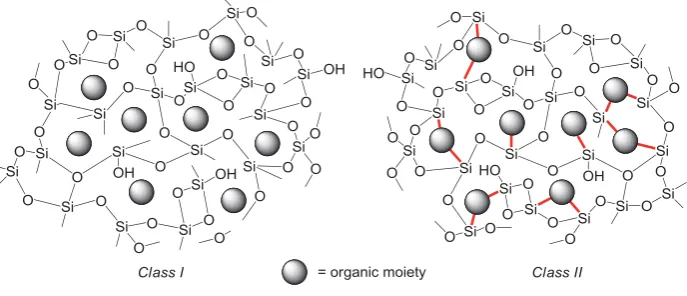
(21) CHAPTER 1 Introduction to organic-inorganic hybrid silica materials.
(22)
(23) Chapter 1. Introduction to organic-inorganic hybrid materials CHAPTER 1. INTRODUCTION TO ORGANIC-INORGANIC HYBRID SILICA MATERIALS 1. Hybrid silica materials Technological advances generate a constantly demand for novel materials. Many of the well-established materials, such as metals, ceramics or plastics, cannot fulfill all technological desires for the various new applications. Mixtures of materials can show superior properties compared with their pure counterparts.1 Research in functional hybrid materials is trying to exploit the chance for creating smart materials that benefit from the best of the individual components. The term hybrid material is used for many different systems spanning a wide area of different materials, such as crystalline highly ordered coordination polymers, amorphous sol-gel derived materials, with and without interactions between the inorganic and the organic units, etc.2 Organic-inorganic hybrid materials can be roughly defined as molecular or nanocomposites with organic components intimately mixed with an inorganic skeleton (metal oxides and metal-oxo polymers) at the range from a few Å to several nanometers. The main advantage of organic-inorganic hybrids is that their properties are not only the sum of the individual contributions of both phases. Because of the many possible combinations of the components, this field is very creative, since it provides the opportunity to invent an almost unlimited set of new materials with a large spectrum of known and, as yet, unknown properties. Material properties of these hybrids can be tuned by modifications of the composition on the molecular scale. If, for example, more hydrophobicity of a material is desired, the amount of hydrophobic molecular components should be increased. Since the compositional variations are carried out on the molecular scale, a gradual fine tuning of the material properties is possible. Innumerable examples of these materials have been prepared over the past decades,3 offering an enormous variety of applications in diverse fields such as optics,4 electronics,5 membranes,6 protective coatings,7 sensors,8 controlled drug delivery9 and 1. Hybrid Materials. Synthesis, Characterization, and Applications. ed. Kickelbick, G. WILEYVCH. Weinheim, Germany, 2007. 2 Judeinstein, P.; Sanchez, C. J. Mater. Chem. 1996, 6, 511. 3 Special issue on hybrid materials: Sanchez, C.; Shea, K. J.; Kitagawa, S. Guest Ed. Chem. Soc. Rev., 2011, 40, 471. 4 (a) Carlos, L. D.; Ferreira, R. A. S.; Bermudez, V. R.; Ribeiro, S. J. L. Adv. Mater., 2009, 21, 509. (b) Tani, T.; Mizoshita, N.; Inagaki, S. J. Mater. Chem. 2009, 19, 4451. 5 (a) Zhang, Y.; Tang, Q.; Li, H.; Hu, W. Appl. Phys. Lett., 2009, 94, 203304.(b) Lu, M.; Xie, B. H.; Kang, J. H.; Chen, F. C.; Yang, Y.; Peng, Z. H. Chem. Mater. 2005, 17, 402. 6 (a) Mistry, M. K.; Choudhury, N. R.; Dutta, N. K.; Knott, R.; Shi, Z. Q.; Holdcroft, S. Chem. Mater. 2008, 20, 6857. (b) Wang, B. Q.; Li, B.; Deng, Q.;Dong, S. J. Anal. Chem. 1998, 70, 3170. 7 Zheludkevich, M. L.; Salvado, I. M.; Ferreira, M. G. S. J. Mater. Chem. 2005, 15, 5099.. 3.
(24) Chapter 1. Introduction to organic- inorganic hybrid materials catalysis.10 Concerning the latter application, supported catalysts based on hybrid silica materials have been an intense research field as they can be easily separated from the reaction mixture and to be reused for further reaction runs offering eco-friendly advantages with less consumption of costly and/or toxic catalysts. A more detailed definition distinguishes between the possible interactions connecting the inorganic and the organic species for silica-based hybrid materials:11 - Class I hybrid silica materials are those that show weak interactions between the two phases, such as van der Waals, hydrogen bonding or weak electrostatic interactions (Figure 1.1). - Class II hybrid silica materials are those that show strong chemical interactions between the components, mainly through covalent bonds (Figure 1.1).. Figure 1.1. Hybrid silica material classification.. Blends are formed if no strong chemical interactions exist between the inorganic and organic building blocks, hence, Class I materials can be separated by classical techniques (e.g organic solvent extraction). Class II materials are more convenient to 8. (a) Coti, K. K.; Belowich, M. E.; Liong, M.; Ambrogio, M. W.; Lau, Y. A.; Khatib, H. A.; Zink, J. I.; Khashab, N. M.; Stoddartd, J. F. Nanoscale 2009, 1, 16. (b) Grate, J. W.; Kaganove, S. N.; Patrash, S. J.; Craig, R.; Bliss, M. Chem. Mater, 1997, 9, 1201. 9 (a) Yang, P.; Gai, S.; Lin, J. Chem. Soc. Rev. 2012, 41, 3679. (b) Giret, S.; Théron, C.; Gallud, A.; Maynadier, M.; Gary-Bobo, M.; Garcia, M.; Wong Chi Man, M.; Carcel, C. Chem. Eur. J. 2013, 19, 12806. (c) Botella, P.; Corma, A.; Quesada, M. J. Mat. Chem. 2012, 22, 6394. (d) Zhang, H.; Pan, D. K.; Zou, K.; He, J.; Duan, X. J. Mater. Chem. 2009, 19, 3069. (c) 10 (a) Ciriminna, R.; Carà, P. D.; Sciortino, M.; Pagliaro, M. Adv. Synth. Catal. 2011, 353, 677. (b) Elias, X.; Pleixats, R.; Wong Chi Man, M. Tetrahedron, 2008, 64, 6770 (c) Yin, L.; Liebscher, J. Chem. Rev. 2007, 107, 133. (d) Corma, A.; García, H. Adv. Synth. Catal., 2006, 348, 1391. (e) Hoffmann, F.; Cornelius, M.; Morell, J.; Fröba, M. Angew. Chem. Int. Ed., 2006, 45, 3216. (f) Wight, A. P.; Davis, M. E. Chem. Rev. 2002, 102, 3589. (g) De Vos, D. E.; Dams, M.; Sels, B. F.; Jacobs, P. A. Chem. Rev, 2002, 102, 3615. (h) Lindner, E.; Schneller, T., Auer, F.; Mayer, H. A. Angew. Chem. Int. Ed., 1999, 38, 2155. (i) Ying, J. Y.; Mehnert, C. P.; Wong, M. S. Angew. Chem. Int. Ed., 1999, 38, 56. (j) Moreau, J. J. E.; Wong Chi Man, M. Coord. Chem. Rev., 1998, 178-180, 1073. 11 Sanchez, C.; Ribot, F.; New. J. Chem. 1994, 18, 2007.. 4.
(25) Chapter 1. Introduction to organic-inorganic hybrid materials be used as supported catalysts as the catalytic units are covalently anchored to the matrix avoiding their leaching.12 2. Preparation of organic-inorganic hybrid silica materials Synthetic strategies towards hybrid materials In principle two different approaches can be used for the formation of hybrid materials: -Building block approach. One structural unit (the building block) is well-defined and it can also be found in the final material, as usually does not undergo significant structural changes during the material formation. Consequently, better structureproperty predictions are possible. -In situ formation of the components. Contrary to the building block approach, it is based on the chemical transformation of the precursors used throughout material's preparation. Well-defined discrete molecules are transformed to multidimensional structures which often show totally different properties from the original precursors. 2.1 Post-functionalization methods (building block approach) In this method, the silica matrix is formed in a first step, applying well-established procedures, and the functionalization with organic groups is applied in a second step. In the grafting process, surface free -OH groups (silanols) are reacted with the socalled silane coupling agents of the general composition R4-nSiXn (n= 1-3; R= functional or nonfunctional organic group; X= OR' or halide), to form stable Si-O-Si covalent bonds (Scheme 1.1). Usually, molecules involved are organosilanes RSi(OR')3, or less frequently chlorosilanes R3SiCl or silazanes HN(SiR3)2.. Scheme 1.1. Post-synthesis functionalization of a silica gel by grafting.. Alternatively, other surface reactions can also be applied, for example organosilicas bearing thiol, amine, chloride, azide or propargyl groups can be reacted with organocatalysts derivatized with an appropriate organic function. Furthermore, 12. Zamboulis, A.; Moitra, N.; Moreau, J.J.E.; Cattoën, X.; Wong Chi Man, M. J. Mater. Chem. 2010, 20, 9322.. 5.
(26) Chapter 1. Introduction to organic- inorganic hybrid materials new methodologies derived from click chemistry13 represent a set of transformations that facilitate the preparation of such materials. Scheme 1.2 depicts an example of thiol-ene coupling (TEC) to afford a supported catalyst.14. Scheme 1.2. Immobilization of a proline derivative via thiol-ene coupling.. In the same manner, the copper-catalyzed azide-alkyne cycloaddition (CuAAC) represents another widely used methodology to functionalize a silica matrix. 15 Homogeneous catalysts have been immobilized on silica supports.16 Scheme 1.3 shows an example of immobilization of a pyrrolidine organocatalyst by Ma and coworkers.17. Scheme 1.3. Immobilization of a pyrrolidine organocatalyst through CuAAC.. Equally important, surface organometallic chemistry18 can be used for the preparation of hybrid silica materials containing an organometallic moiety. This 13. Kolb, H. C. ; Finn, M. G. ; Sharpless, K. B. Angew. Chem. Int. Ed., 2001, 40, 2004. (a) Massi, A.; Cavazzini, A.; Del Zoppo, L.; Pandoli, O.; Costa, V.; Pasti, L.; Giovannini, P. P. Tet. Lett. 2011, 52, 619. (b) Boldolini, O.; Cacioll, L.; Cavazzini, A.; Costa, V.; Greco, R.; Massi, A.; Luisa, P. Green Chem. 2012, 14, 992. 15 Cattoën, X.; Noureddine, A.; Croissant, J.; Moitra, N.; Bürglová, K.; Hodačová, J.; De los Cobos, O.; Lejeune, M.; Rossignol, F.; Toulemon, D.; Bégin-Colin, S.; Pichon, B.; Raehm, L.; Durand, J.-O.; Wong Chi Man, M. J. Sol-Gel Sci. Technol., 2014, 70, 245. 16 Fernandes, A. E.; Jonas, A. M.; Riant, O. Tetrahedron, 2014, 70, 1709. 17 Zhao, Y.-B.; Zhang, L.-W.; Wu, L.-Y.; Li, R.; Ma,J.-T. Tetrahedron: Asymmetry 2008, 19, 1352. 18 (a) Copéret, C.; Basset, J.-M. Adv. Synth. Catal., 2007, 349, 78. (b) Copéret, C.; Chabanas, M.; Petroff Saint-Arroman, R.; Basset, J.-M. Angew. Chem. Int. Ed., 2003, 42, 156. (c) Yermakov, Y. I.; Kuznetsov, B. N.; Zakharov, V. A. Stud. Surf. Sci. Catal., 1981, 8, 1. 14. 6.
(27) Chapter 1. Introduction to organic-inorganic hybrid materials methodology is based on the attachment of the complex to the oxide support. It should be taken into account that, in this case, the surface is directly involved in the coordination sphere of the metal (Scheme 1.4).19. Scheme 1.4. Immobilization of a molybdenum complex by surface organometallic chemistry.. 2.2 The Sol-Gel process (in situ formation of the components) 2.2.1 The Sol-Gel process This methodology allows the preparation of homogeneous and pure inorganic materials in a reproducible way. It consists of the hydrolysis and polycondensation of a metal alkoxide or, occasionally, halides, nitrates or sulphates. The process occurs under very mild conditions (atmospheric pressure and low temperature <100ºC). From the physical point of view, the process starts from a solution of molecular precursors and goes through a dispersion of colloidal particles (sol) which acts as the precursor for an integrated network. The process typically starts when a tetralkoxysilane such as tetraethoxysilane (TEOS) is catalytically hydrolyzed in a convenient solvent (ethanol, THF, DMF...) to give colloidal silanol and siloxane species, oligomers and other small clusters (sol, Scheme 1.5 (a)). These clusters condense to form more siloxane bridges, then small particles, and eventually tridimensional networks that entrap the solvent to form a gel. On the macroscopic scale, gelation is the thickening of the initial solution into an elastic solid (gel) which is not fluid. The gel point is not the end of the process. During the aging period of the gel, hydrolysis and condensation reactions continue (Scheme 1.5 (b)) and the network stiffens restraining the flow of the pores liquid. Although the system seems virtually unaffected, polymerization, coarsening and the phase transformation occur. Finally, the gel is dried and, after thermal or mechanical treatment, the hybrid material is obtained as a powder, called xerogel.. 19. Blanc, F.; Chabanas, M.; Copéret, C.; Fenet, B.; Herdweck, E. J. Organomet. Chem., 2005, 690, 5014.. 7.
(28) Chapter 1. Introduction to organic- inorganic hybrid materials. hydrolysis and condensation. networks building and thickening. thermal or mechanical treatment. (a). sol (solvent containing oligomers). solution of the precursor. gel (oligomers containing solvent). solid material. (b) Hydrolysis and condensation reactions:. Scheme 1.5. a) Physics and b) Chemistry of the sol-gel process.. For tetraethoxysilanes, the nucleophilic attack of water to the silicon atom in the first step takes place through a different mechanism depending on the catalyst used,20 acidic, basic or nuclephilic (Fˉ, N-methylimidazole, HMPA). It is important to notice that the change of one parameter (temperature, solvent, concentration or catalyst) can often lead to two very different materials. For example, the change from base to acid catalysis would affect the internal structure. Hence, the final performance of the derived materials is strongly dependent on their processing and its optimization. The mechanism of hydrolysis for each type of catalyst can be summarized as follows: (a) Acidic catalysis: first, the reversible protonation of an alkoxy group gives better leaving character. Then a pentacoordinate intermediate is formed by the nucleophilic attack of water (or silanol) and an alcohol molecule is eliminated (Scheme 1.6).. Scheme 1.6. Hydrolysis of tetralkoxysilane promoted by acidic catalysis. 20. 8. Corriu, R.J.P.; Leclerq, D. Angew. Chem. Int. Ed. 1996, 35, 1420..
(29) Chapter 1. Introduction to organic-inorganic hybrid materials (b) Basic catalysis: in the presence of hydroxide anions, a nucleophilic attack to the tetralkoxysilane occurs through an anionic pentacoordinate intermediate, which is able to lose an alkoxide group (Scheme 1.7).. Scheme 1.7. Hydrolysis of tetralkoxysilane promoted by basic catalysis.. (c) Nucleophilic catalysis: nucleophile coordination to the silicon centre of a tetraalkoxysilane generates an anionic pentacoordinate intermediate. This intermediate shows higher reactivity towards the nucleophilic substitution. Water or silanol coordinate this intermediate and form a hexacoordinated transition state which evolves to give an alcohol, a silanol and the regenerated catalyst. Many bases, even the hydroxide anion, can act as nucleophilic catalysts (Scheme 1.8).. Scheme 1.8. Hydrolysis of tetralkoxysilane promoted by nucleophilic catalysis.. 2.2.2 Co-condensation and bridged silesquioxanes The organic fragment can be directly incorporated during the sol-gel process by co-gelification of an organotrialkoxysilane and a tetraalkoxysilane (Scheme 1.9 (a)). After hydrolysis and polycondensation, the final solid will contain organic groups dispersed in the silica matrix.21 On the other hand, if the organic compound bears two or more trialkoxysilyl groups, the sol-gel process can be performed without the addition. 21. Baney, R.H.; Itoh, M.; Sakakibra, A.; Suzuki, T. Chem. Rev. 1995, 95, 1409.. 9.
(30) Chapter 1. Introduction to organic- inorganic hybrid materials of tetralkoxysilane.22 These organosilicas are also called bridged silsesquioxanes, and are inherently homogeneous solids (Scheme 1.9 (b)).23. Scheme 1.9. (a) Cogelification and (b) Synthesis of bridged silsesquioxanes.. 2.2.3 Mesostructuring of organosilicas According to IUPAC, materials can be classified according to their pore size in three categories:24 - Microporous (pore size < 20 Å) - Mesoporous (20-500 Å) - Macroporous (> 500 Å) Materials prepared by simple co-condensation or polycondensation sol-gel processes in common organic solvents (ethanol, THF, DMF...) are usually amorphous with a wide pore distribution despite of their homogeneity. This lack of control on pore size, pore size distribution and other drawbacks can be overcome with the use of a structure directing agent. Surfactants are the most common molecules used to achieve pore organization in the final material. Due to their nature, in aqueous media, these molecules can organize in micelles. Initially, spherical micelles are formed in aqueous solution with the hydrophobic and non-polar chains at the inner side of the sphere and. 22. Dieudonné, P.; Wong Chi Man, M.; Pichon, B.P.; Vellutini, L.; Bantignies, J.-L.; Blanc, C.; Creff, G.; Finet, S.; Sauvajol, J.-L.; Bied, C.; Moreau, J.J.E. Small 2009, 5, 503. 23 (a) Corriu, R.J.P. Eur. J. Inorg. Chem. 2001, 1109. (b) Loy, D.A.; Shea, K.J. Chem. Mater. 2001, 13, 3306. (c) Corriu, R.J.P. Angew. Chem. Int. Ed. 2000, 39, 1376. (d) Loy, D. A.; Shea, K.J. Chem. Rev. 1995, 95, 1431. 24 Rouquerol, J.; Avnir, d.; Fairbridge, C.W.; Everett, D. H.; Haynes, J.H.; Pernicone, N.; Ramsay, J.D.F., Sing, K.S.W.; Unger, K.K. Pure & Appl. Chem. 1994, 66, 1739.. 10.
(31) Chapter 1. Introduction to organic-inorganic hybrid materials the polar heads oriented towards the exterior. These micelles act as a template, with hydrolysis and condensation reactions occurring at their surface due to electrostatic interactions (Scheme 1.10). At the end of the process the surfactant can be removed by calcination, affording materials with high surface area (>500 m2/g), regular pore distribution and pore diameter in the mesoporous range (20-100 Å) (Scheme 1.10).. micelle formation tetraalkoxysilane addition. surfactant. polycondensation on the micelle surface. material with the templating agent after polymerization surfactant removal. structured material Scheme 1.10. Surfactant assisted formation of a mesoporous material.. Depending on their concentration, micelles interact with each other to form spherical, cylindrical, tubular or bilayer type structures, which can pack in tridimensional structures with different patterns (spherical, hexagonal, cubic, lamellar...) depending on the surfactant nature, its concentration and the temperature of the solution. Polymerization occurs at the micelle's surface because of the electrostatic interaction between surfactant or template (T) and charged silicon species (I). This interaction is strongly affected by the medium. Therefore, depending on the conditions used in the sol-gel process (basic, acidic or neutral medium) the selected surfactant will have to present the corresponding opposed charge to achieve the mentioned interaction (T+Iˉ or TˉI+). Neutral poly(ethylene oxide)-poly(propylene oxide) block copolymers such as PEO20PPO70PEO20 (P123) are also used as templates in acidic 11.
(32) Chapter 1. Introduction to organic- inorganic hybrid materials media. In this case electrostatic interactions occur between protonated surfactant and protonated silicon precursor through halide anion (TºH+)(XˉI+).25 Porosity and other textural parameters can be tuned by controlling the surfactant concentration or its alkyl chain length. After the removal of the structure-directing agent by calcination or by extraction with an organic solvent, the final material presents pores in the places previously occupied by the architectural assemblies of the surfactant. Taking into account the above-mentioned considerations, there are three synthetic approaches for the preparation of mesostructured organic-inorganic hybrid silica materials.26 The properties of the final hybrid silica material considerably differ depending on the synthetic method used. (a) The grafting method is based on a post-synthetic functionalization of a preformed mesostructured silica through anchoring the organic moiety (Scheme 1.11). This method has the advantage that, under the synthesis conditions used, the mesostructure of the starting phase is usually retained. However, the organosilanes react preferably at the external surface and at the pore openings, which leads to an irregular distribution of the organic groups in the material, reducing the porosity, or even blocking the pores (Scheme 1.11).. toluene, reflux. = organic fragment. Scheme 1.11. Schematic pathway of the grafting method for the mesostructured organosilica.. 25. (a) Schmidt-Winkel, P.; Yang, P.; Margolese, D.I.; Chmelka,B.F.; Stucky, G.D. Adv. Mater. 1999, 11, 303. (b) Zhao, D.; Huo, Q.; Melosh, N.; Fredickson, G.H.; Chmmelka, B.F.; Stucky, G.D. Science 1998, 179, 548. 26 Hoffman, F.; Fröba, M. Chem. Soc. Rev. 2011, 40, 608.. 12.
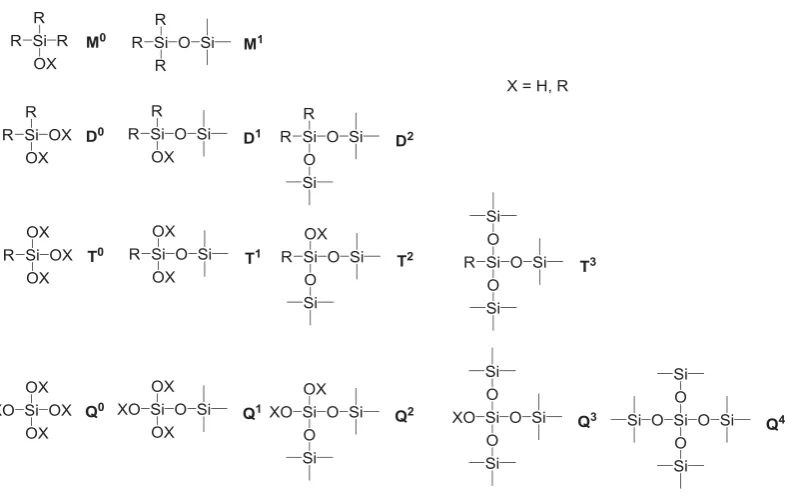
(33) Chapter 1. Introduction to organic-inorganic hybrid materials (b) The co-condensation approach (direct synthesis) consists in a co-gelification between a tetraalkoxysilane and an organotrialkoxysilane in the presence of a structure-directing agent. With this method, the organic functions are more homogeneously distributed and are mainly located at the surface of the pores (instead of being part of the pore wall) due to the incompatibility of the hydrophobic organic residue with the highly polar siloxane network (Scheme1.12). The organotrialkoxysilane is oriented according to the micelle polarity, that is to say, the organic group towards the hydrophobic inner space and the polar silylated head group towards the surface. Moreover, the condensation rate of the organosilane component is lower than that of the pure tetraalkoxysilane, leading to a delayed participation in the polycondensation process and explaining the fact that organic groups remain on the pore surface. At the end of the process, the structure-directing agent is better removed by extraction with a solvent, as the calcination at high temperatures would destroy the organic fragment.. Si(OR)4 +. surfactant catalyst hydrolysis and condensation on the micelle. surfactant extraction. = organic f ragment. Scheme 1.12. Co-condensation method assisted by surfactant.. (c) Periodic mesoporous organosilicas (PMO).27 In this case a structure-directing agent is also used, but instead of starting from tetraalkoxysilanes, bridged organosilanes of the type (R'O)3Si-R-Si(OR')3 are involved (Scheme 1.13). They are 27. (a) Mizoshita, N.; Tani, T.; Inagaki, S. Chem. Soc. Rev., 2011, 40, 789. (b) Gu, S.; Jaroniec, M. J. Mater. Chem., 2011, 21, 6389. (c) Wang. W.; Lofgreen, J. E.; Ozin, G. A. Small, 2010, 6, 2634. (d) Yang, Q.; Liu, J.; Zhang, L. J. Mater. Chem., 2009, 19, 1945. (e) Yuan, P.; Zhao, L.; Liu, N. Chem. Eur. J., 2009, 15, 11319. (f) Mohanty, P.; Landskron, K. Nanoscale Res. Lett., 2009, 4, 1524. (g) Tani, T.; Mizoshira, N.; Inagaki, S. J. Mater. Chem., 2009, 19, 4451.. 13.
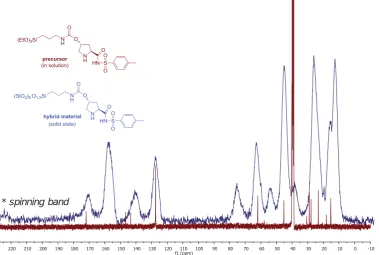
(34) Chapter 1. Introduction to organic- inorganic hybrid materials capable of undergoing cross-linking reactions carrying the organic functionality R on and leading to materials whose density of organic groups cannot be higher. In the final hybrid material, organic groups are an integral part of the pore walls, meaning that the framework itself is modified. However, it is also possible to apply this approach starting with two or more bridged silsesquioxane precursors. Furthermore, this method can be combined with the co-condensation method employing mixtures of bridged bis(trialkoxysilyl)organosilanes with terminal organotrialkoxysilanes or tetralkoxysilanes.. surfactant catalyst. = organic f ragment. surfactant extraction hydrolysis and polycondensation on the micelle. Scheme 1.13. General pathway to construct PMO from bis-silylated organic bridging units.. (d) Self-directed assembly. 28,29 In this approach the organic precursor contains a self-assembling organic unit which confers the regular structure to the final material, acting as an internal templating agent. The self-structuring can result from weak intermolecular interactions such as π-stacking, hydrophobic interactions or hydrogen bonds. This kind of materials displays interesting properties, particularly for the nanostructure field, even though they are generally non-porous.,30 Nevertheless, self28. (a) Díaz, U.; García, T.; Velty, A.; Corma, A. J. Mater. Chem. 2009, 19, 5970. (b) Pichon, B. P.; Wong Chi Man, M.; Dieudonné, P.; Bantignies, J.-L.; Bied, C.; Sauvajol, J.-L.; Moreau, J. J. E. Adv. Funct. Mater. 2007, 17, 2349. (c) Alauzun, J.; Mehdi, A.; Reyé, C.; Corriu, R. J. P. J. Mater. Chem. 2005, 15, 841. (d) Cerveau, G.; Chappellet, S.; Corriu, R. J. P. J. Mater. Chem. 2003, 13, 2885. (e) Boury, B.; Corriu, R. J. P. Chem. Commun. 2002, 795. (f) Moreau, J. J. E.; Vellutini, L.; Wong Chi Man, M.; Bied, C. J. Am. Chem. Soc. 2001, 123, 1509.(g) Moreau,J. J. E.; Vellutini, L.; Wong Chi Man, M.; Bied, C.; Bantignies, J.-L.; Dieudonné, P.; Sauvajol, J.-L. J. Am. Chem.Soc. 2001, 123, 7957. 29 Nobre, S. S.; Cattoën, X.; Ferreira, R. A. S.; Carcel, C.; de Zea Bermúdez, V.; Wong Chi Man, M.; Carlos, L. D. Chem. Mater. 2010, 22, 3599. 30 Moreau, J. J. E.; Pichon, B. P.; Arrachart, G., Wong Chi Man, M.; Bied, C. New J. Chem. 2005, 29, 653.. 14.
(35) Chapter 1. Introduction to organic-inorganic hybrid materials assembly is not restricted to non-porous materials, it has been described in the pore wall region of highly ordered mesoporous materials prepared using surfactants. In these cases, π-stacking, hydrophobic and hydrophilic interactions direct the selfassembly of phenyl or biphenylene bridged precursors with lamellar arrangement.31 3. Characterization of hybrid silica materials The determination of the physical and chemical properties is of considerable importance for an improved understanding of interfacial phenomena in various fields, such as catalysis, electrochemistry, chromatography... As it has already been mentioned, the properties of the materials obtained by the sol-gel process strongly depend on the experimental conditions. Surface area or porosity are significantly affected by some polymerization parameters such as substrate concentration, catalyst, solvent, temperature, ageing time, presence or not of a templating agent, ... Consequently, there is an important need of different techniques, which provide their characterization in order to understand the activity of the prepared materials.32 Chemical analyses provide information about the amount of organic fragments loaded in the material. Physical parameters like surface area, pore size distribution, material morphology or texture are very important in catalysis, as they affect reagent and product diffusion or the accessibility of the catalytic centre. A brief summary of the different material characterization methods is presented here. 3.1 29Si and 13C Solid State Nuclear Magnetic Resonance (SSNMR) Solid State Nuclear Magnetic Resonance (SS NMR) spectroscopy is a widely employed physical method, since it provides similar information to that obtained in solution. While molecular substances in solution give spectra characterized by sharp peaks, the spectra in the solid state, by contrast, are broad owing to various internal and external interactions. The. 29. Si-SSNMR confirms the existence of a covalent bond between silicon and. the organic component and it provides information about the degree of condensation in the hybrid silica material. In fact, during the sol-gel process a great variety of silicon species is formed containing different numbers of Si-O-Si bonds. These species lead to structures giving signals with different chemical shifts in the. 29. Si-SSNMR spectrum. depending on the alkoxy groups bonded to the silicon atom (Figure 1.2).. 31. (a) Kapoor, M. P.; Yang, Q.; Inagaki, S. J. Am. Chem. Soc. 2002, 124, 15176. (b) Inagaki, S.; Guan, S.; Ohsuna, T.; Terasaki, O. Nature 2002, 416, 304. 32 Corma, A. Chem. Rev., 1995, 95, 559.. 15.
(36) Chapter 1. Introduction to organic- inorganic hybrid materials According to this, signals are classified as Q, D, T and M. We can differentiate between monofunctional silicon (M) coming from monoalkoxysilanes; difunctional (D) from dialkoxysilanes; trifunctional (T) from trialkoxysilanes; and quadrifunctional (Q) from tetraalkoxysilanes. Furthermore, these signals are complemented with numeric superscripts (from 0 to 4) which are used to indicate the degree of condensation; 0 if condensation did not occur; 1 if only one alkoxy group has condensed; 2 if two alkoxy groups have condensed and so on (Figure 1.3). The nature of the organic moiety (alkyl, aryl,…) or of the catalyst used in the sol-gel process can also affect the chemical shift.. Q3 Q4 T3. T2. Q2. Figure 1.2. Example of 29Si-SSNMR of material M3 (See Chapter 2).. Figure 1.3. Silicon environments and their corresponding label in the 29Si-SSNMR.. 16.
(37) Chapter 1. Introduction to organic-inorganic hybrid materials The. 13. C-SSNMR is quite useful to check that the organic functionality has been. loaded in the final material. It provides qualitative information for the identification of organic functional groups. The common. 13. C-SSNMR spectrum appears to be similar to the. 13. C-NMR in solution but with broader peaks (Figure 1.4). However, in solid. state signals of different carbon atoms easily overlap. Different acquisition modes have been developed for recording. 13. C-SSNMR,. among them Cross Polarized Magic Angle Spinning (CP-MAS) and Cross-Polarized with Total Suppression of Spinning Sidebands (CP-TOSS) are mainly used. The CPMAS has higher sensitivity and better resolution but when the spinning rate is not fast enough undesired spinning bands appear in the spectrum. This phenomenon is overcome when using CP-TOSS. It must be taken into account that solid state from low sensitivity.. 33. 13. C and. 29. Si solid state NMR suffer. Actually, in many cases, functionalized silicon sites Tn are too. diluted to be readily observed in the. 29. Si-SSNMR. Generally, for high dilution of the. organic component in the hybrid material (tetraalkoxysilane/organotrialkoxysilane ratio higher than 10), the spectrum provides mainly information about the Qn and proton-rich sites (Si-OH). The. 13. C-SSNMR suffers from similar drawback and, therefore, for high. dilution of organic component, little evidence of the organic moiety incorporation is often obtained.. 33. Lelli, M.; Gajan, D.; Lesage, A.; Caporini, M. A.; Vitzthum, V.; Miéville, P.; Héroguel, F.; Rascón, F.; Roussey, A.; Thieleux, C.; Boualleg, M.; Veyre, L.; Bodenhause, G.; Copéret, C.; Emsley, L. J. Am. Chem. Soc. 2011, 133, 2104.. 17.
(38) Chapter 1. Introduction to organic- inorganic hybrid materials. * spinning band. Figure 1.4. Comparison of 13C-NMR of compound 2 in CDCl3 solution (red) and 13C-CP-MAS-NMR of material M4 (blue, See Chapter 2).. 3.2 Vibrational Spectroscopy (IR and Raman) Infrared and Raman spectroscopy give complementary information. Infrared spectroscopy (IR) allows the qualitative identification of functional groups present in the material which have representative signals (i.e. carbonyl, nitrile, isonitrile, sulfonyl or azide). It is worth noting that the use of this technique is limited to hybrid materials with low organic fragment dilution in the inorganic framework, as when the ratio tetraalkoxysilane/organosilane is higher than 10, the IR spectrum shows mainly bands corresponding to Si-O-Si vibrations (around 1100 cm-1), surface adsorbed water and silanol species (3500 – 3200 cm-1).34 Laser Raman spectroscopy can be used to observe some weak or inactive vibrations in the infrared range. Besides, some bands can be observed without the interference of intense bands such as Si-O-Si vibrations. However, some processes are difficult to detect (i.e. the protonation of Brønsted bases) in the Raman spectrum as the observed bands arise from changes in the polarizability associated with skeletal and stretching vibrations.32,34. 34. Sassi, Z.; Bureau, J. C.; Bakkali, A. Vibrational Spectroscopy, 2002, 28, 251.. 18.
(39) Chapter 1. Introduction to organic-inorganic hybrid materials 3.3 Thermogravimetric analysis This technique gives an idea of thermal stability of a given material, including structural decomposition, oxidation, corrosion or moisture adsorption/desorption. Specifically, it determines changes in the mass of the a material as a function of temperature.35 In hybrid materials, is commonly used for the determination of the loading of inorganic and organic components. The record is the thermogravimetric or TG curve, where the mass is plotted on the ordinate decreasing downwards and temperature (T) or time (t) on the abcissa increasing from left to right (Figure 1.5).. Figure 1.5. Thermogravimetric curve.. In the TG curve of hybrid materials the first region (A-B) presents a slightly negative slope (temperatures in the range of 20-200ºC) and it corresponds to the thermodesorption of physically adsorbed water molecules from the silica surface.36 The second weight loss region occurs between B and C; it can be divided in two parts, each one associated with a different process. The first part (normally in the range 200-400 ºC) can be attributed to the condensation of silanol groups and the cross-linking of surface silanol with some organic functionalities. The second part between 400 and 600 ºC can be attributed to the thermal decomposition of the chemically bonded organic groups. At temperatures exceeding 700ºC (region after point C) the organic component of hybrid materials is destroyed completely and thus, from the residual mass the inorganic content of the hybrid material can be determined. Simultaneous TGA-DSC (Differencial Scanning Calorimetry) measures both heat flow and weight changes in a material as a function of temperature or time in a controlled atmosphere. The simultaneous measurement of these properties simplifies 35 36. Mannsfield, E.; Kar, A.; Quinn, T.P.; Hooker, A. Anal. Chem. 2010, 82, 9977. Jaroniec, C.P.; Gilpin, R.K.; Jaroneic, M. J. Phys. Chem. B. 1997, 101, 6861.. 19.
(40) Chapter 1. Introduction to organic- inorganic hybrid materials the interpretation of the results as complementary information is obtained (for instance, if certain events are endothermic or exothermic). 3.4 Elemental Analysis The chemical composition of hybrid materials (carbon, hydrogen, nitrogen, sulphur, chlorine, bromine or iodine) coming from the organic fragment can be analysed by combustion. The amount of other elements such as silicon or metals (gold) can be determined by inductively coupled plasma (ICP) analysis. The theoretical and experimental contents can considerably differ and, generally, less organic functionality than expected is loaded in the hybrid silica material. This fact can be rationalized taking into account that the hydrolysis rate is lower for organotrialkoxysilanes with respect to tetraalkoxysilanes. Within the group of tetraalkoxysilanes,. the. hydrolysis. rate. decreases. in. the. following. order:. tetramethoxysilane (TMOS) > tetraethoxysilane (TEOS) > tetrapropoxysilane (TPOS) > tetrabutoxysilane (TBOS). The degree of condensation also contributes to the difference between theoretical and experimental values, since some alkoxy groups are not hydrolyzed or some silanol groups do not condense. Discrepancy between the two values may also come from traces of surfactant or high-boiling point solvent remaining in the material after the processing. 3.5 Surface area analysis Gas adsorption-desorption measurements allow the determination of surface area, the pore volume and the pore size distribution. This technique is one of the most powerful tools for the determination of porosity in solid materials. Adsorption is the process in which atoms or molecules are weakly bound to the surface of a solid, and form a layer at the interface. Its counterpart, desorption, denotes the reverse process, in which the amount of adsorbed atoms or molecules decreases. The amount of gas (usually N2) adsorbed to the material as a function of relative pressure is measured at a constant temperature (77 K) from thoroughly degassed samples. The adsorption isotherm is built by adding controlled doses of nitrogen gas on the cold sample, and monitoring the corresponding relative pressure in the surrounding environment (p/p0). When p/p0 reaches 1, spontaneous liquefaction of N2 occurs. Under these conditions consecutive molecular layers of nitrogen can be adsorbed on the solid surface. In the monolayer adsorption all the adsorbed molecules are in contact with the surface layer of the sample, whereas in multilayer adsorption, the adsorption space accommodates more than one layer of molecules, so that not all adsorbed molecules 20.
(41) Chapter 1. Introduction to organic-inorganic hybrid materials are in direct contact with the surface layer of the sample. The surface area of a given sample, for example a hybrid material, may be calculated from monolayer adsorption. Therefore, it is necessary to identify the amount of N2 adsorbed in an unimolecular layer. The graphic representing the relationship, at constant temperature, between the amount adsorbed and the equilibrium pressure of the gas is known as the adsorptiondesorption isotherm.37 The shape of the isotherm contains information about interactions between adsorbent and adsorptive. In some cases, a hysteresis loop is observed when adsorption and desorption curves do not coincide. In 1985 the International Union of Pure and Applied Chemistry (IUPAC) classified isotherms in six types,38 types I, II and IV being the most frequently observed (Figure 1.6).. Figure 1.6. Types of isotherm according to the IUPAC rules (reference 38).. (a) Type I isotherms are given by microporous solids having relatively small external surfaces, where adsorption takes place at low relative pressure. (b) Type II is the isotherm for non-porous or macroporous materials. Some mesoporous solids also give this adsorption curve, where a monolayer adsorption is observed at low relative pressure and saturation at high relative pressure, but without hysteresis loop. The interaction between adsorbate and adsorbent is strong. Point B represents the beginning of the almost linear. 37. 38. Gas adsorption equilibria. Experimental methods and adsorptive isotherms. Ed. Keller, J. U. SPRINGER: Boston, 2005. Sing, K. S. W.; Everett, D. H.; Haul, R. A. W.; Moscou, L.; Pierotti, R. A.; Rouquérol, J.; Siemieniewska, T. Pure Appl. Chem., 1985, 4, 603.. 21.
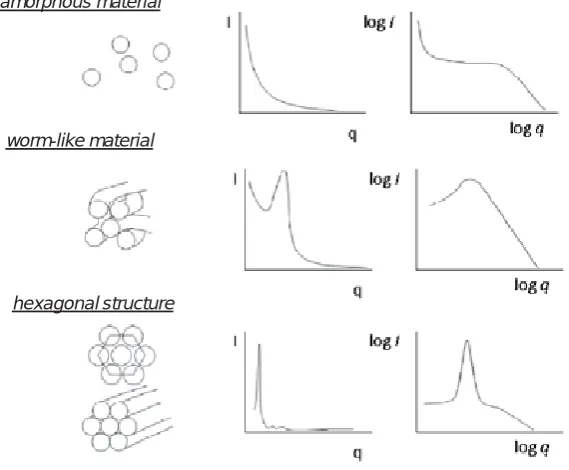
Figure

+7


Documento similar
CWPO of bisphenol A with iron catalysts supported on microporous carbons from grape seeds activation
The catalytic wet peroxide oxidation (CWPO) of bisphenol A (BPA) with Fe catalysts supported on activated carbon from grape seeds (GS) has been studied.. Oxidized samples
These results indicate that the emission mechanisms of Eu III , Dy III and Tb III compounds correspond to a ligand sensitized photo- luminescence process, the so called
Bimetallic Pt:Pd catalysts with different molar ratios and 0.5 wt% overall metal load supported on sulfated zirconia catalysts (SZ) were synthesized and tested in
Promoting light hydrocarbons yield by catalytic hydrodechlorination of residual chloromethanes using palladium supported on zeolite
The simulation results look very similar to the experimental results observed for the PBDB-T:ITIC device (see Figure 5-3).. Results from the drift-diffusion simulations. In this
In order to obtain single-fired glazes with biocidal activity, materials were prepared in which the silver was protected by a silica capsule, a refractory
In metal supported on active carbon, the dispersion of the metal is apparently related to the surface chemistry of the support, concretely, to the oxygen-containing groups [21,
Currently, Cu(I)-I CPs are starting to be used for the fabrication of new hybrid materials with organic polymers such as poly(methyl methacrylate) (PMMA), to modify their physical
