This is the peer reviewed version of the following article:
Zurika Blanco‐Garcia, Oscar Rosas‐Ortiz, Kevin Zelaya. Interplay between Riccati, Ermakov, and Schrödinger equations to produce complex‐valued potentials with real energy spectrum. In: Mathematical Methods in the Applied Sciences, 2018. which has been published in final form at https://doi.org/10.1002/mma.5069
Interplay between Riccati, Ermakov and Schr¨
odinger
equations to produce complex-valued potentials with
real energy spectrum
Zurika Blanco-Garcia, Oscar Rosas-Ortiz
∗, and Kevin Zelaya
Physics Department, Cinvestav, AP 14-740, 07000 M´exico City, Mexico
Abstract
Nonlinear Riccati and Ermakov equations are combined to pair the energy spec-trum of two different quantum systems via the Darboux method. One of the systems is assumed Hermitian, exactly solvable, with discrete energies in its spectrum. The other system is characterized by a complex-valued potential that inherits all the energies of the former one, and includes an additional real eigenvalue in its discrete spectrum. If such eigenvalue coincides with any discrete energy (or it is located between two discrete energies) of the initial system, its presence produces no singu-larities in the complex-valued potential. Non-Hermitian systems with spectrum that includes all the energies of either Morse or trigonometric P¨oschl-Teller potentials are introduced as concrete examples.
1
Introduction
The search for new integrable models in quantum mechanics has been the subject of intense activity during the last decades. The trend was firmly stimulated by the Wit-ten formulation of supersymmetry published in 1981, where a quantum mechanical ‘toy model’ was introduced as the simplest example of what occurs in quantum field theo-ries [1]. The model evolved successfully into a thriving discipline that is nowadays known as supersymmetric quantum mechanics (Susy QM) [2,3]. Sustained by the factorization method [4], the supersymmetric approach is basically algebraic [5–8] and permits the pairing between the spectrum of a given (well known) Hamiltonian to the spectrum of a second (generally unknown) Hamiltonian. In position-representation, such pairing is ruled by a transformation introduced by Darboux in 1882 [9]. The latter implies that the involved potentials differ by an additive term, which in turn is the derivative of a function
that solves a Riccati equation. Surprisingly, the origin of what later became known as Ric-cati’s equation can be traced back to 1694, closely related to Bessel’s equation, although the work of Riccati was published in 1724 [10,11]. Besides Susy QM and soliton theory (where the Darboux transformation finds applications other than supersymmetry [12]), the presence of the Riccati equation is unavoidable in a lot of branches of physics and mathematics [13]. Its features in the complex domain [14] are the source of new challenges in controlling the time-evolution of quantum wave packets [15–17] as well as the paraxial propagation of structured light in optical media with quadratic index profile [18]. The complex version of the Riccati equation is also useful to strengthen the systematic search for non-Hermitian quantum systems with real spectrum [19].
On the other hand, the stationary form of Schr¨odinger equation for one-dimensional systems is also connected with a nonlinear second-order differential equation introduced by Ermakov in 1880 [20], and revisited by Milne fifty years after [21]. As in the Darboux approach, the Ermakov method implies that solving either of the two equations for any eigenvalue will provide a solution for the other. However, the Ermakov equation is usu-ally linked to the time-evolution of systems like the isotonic oscillator [22,23], which is isochronous to the harmonic one in the classical picture [24] and isospectral to it in the quantum case [25]. Arnold [26,27] and point [28,29] transformations facilitate the study of such systems. Nevertheless, the association of Ermakov with Schr¨odinger in spatial coor-dinates is rarely reported in the literature. Besides the monograph [13], some exceptions can be found in [18,19,30–38]. Quite remarkably, only recently such relationship has been exploited to obtain integrable quantum models with real energy spectrum but described by non-Hermitian Hamiltonians [19]. A generalization of the oscillation theorem applies to study the zeros of the real and imaginary parts of the corresponding eigenfunctions [31], and the introduction of bi-orthogonal bases permits to work with these systems in much the same way as for the Hermitian ones [32]. The non-Hermitian models so constructed are either PT-symmetric [39] or not. The main purpose of this work is to increase the number of solvable models in this direction and to bring to light the repercussion of com-bining nonlinear Riccati and Ermakov equations in the construction of new integrable models in quantum mechanics.
used [40]. The paper ends with some concluding remarks.
2
Basic formalism
Within the Darboux approach [9], the second-order differential equation
−ϕ00+V0(x)ϕ=Eϕ (1)
can be transformed into a new one
−ψ00+V(x)ψ =Eψ (2)
through the functions
V(x) =V0(x) + 2β0, ψ =ϕ0+βϕ, (3)
where f0 denotes the derivative of f with respect to x and β is defined by the nonlinear Riccati equation
−β0+β2 =V0(x)−. (4)
Using
β =−(lnu)0, (5)
the latter equation is linearized
−u00+V0(x)u=u. (6)
In other words, u is a solution of (1) with E = . The link (5) between the nonlinear first order differential equation (4) and the linear second order one (6) is well known in the literature [10,14]. This can be also written as the first order differential equation
u0 +βu= 0. Thus, provided a solution of (4), the function
u(x) = const×exp
−
Z x
β(y)dy
(7)
solves (6). One can go a step further by adding 2β0 to both sides of (4), then β0 +β2 =
V(x)− , where (3) has been used. Instead of (5) we now make β = (lnψ)0, so the latter Riccati equation is also linearized: −ψ00 + V(x)ψ = ψ. The straightforward
calculation shows that ψ ∝ u−1. In summary, the covariance (1)-(2) revealed by the
Darboux transformation (3) allows new integrable models if the spectrum properties of either V0(x) or V(x) are already known.
2.1
Schr¨
odinger-Riccati interplay
eigenfunctions ϕrepresenting bound states. As indicated above, the method introduced by Darboux is very useful to construct new solvable potentials V(x). Indeed, if the solutions of the Schr¨odinger equation (1) are already known, the energy spectrum of
V0(x) is entirely inherited to V(x) for the appropriate solution of the Riccati equation
(4) [5,6]. Besides, if ψ ∝ u−1 is physically admissible, the spectrum of V(x) includes
also the eigenvalue [5]. In algebraic form, the Darboux transformation (3) results from the factorization of the Hamiltonians defined by V0(x) andV(x) [5,7], and represents the
kernel of Susy QM [2–4]. Typically, real-valued functions β are used to construct new Sturm-Liouville integrable equations (2). In such case ≤ E0, where E0 is the ground
state energy ifV0(x) has discrete spectrum and the low bound of the continuum spectrum
when the bound states are absent [40]. Therefore, the new potential V(x) is real-valued and defines a Hermitian Hamiltonian. However, this is not the only option permitted by the method [4]. Indeed, interesting non-Hermitian models arise if β is allowed to be complex-valued since the entire spectrum of V0(x) is still inherited to V(x) [41–46].
In the following we show that the relationship between β and u is not uniquely de-termined by the logarithmic derivative (5). Our approach brings to light some nonlinear connections between the systems associated with V0(x) and those defined by V(x) that
are hidden in the conventional way of dealing with Eqs. (1)-(3).
2.2
Riccati-Ermakov interplay
Let us look for complex-valued solutions β = βR+iβI of the Riccati equation (4) with ∈R. HereβR and βI are real-valued functions to be determined. Following [19] we see
that the real and imaginary parts of Eq. (4) lead to the coupled system
−βR0 +βR2 −βI2+−V0(x) = 0, (8)
−βI0 + 2βIβR= 0. (9) Rewriting (9) as (lnβI)0 = 2βR, one immediately notice that βR = −(lnα)0 gives rise to
the expression βI = αλ2, whereλ∈Ris a constant of integration andα is a function to be determined. To avoid singularities in βR and βI we shall consider real-valued α-functions
with no zeros in DomV0 ⊆R. Notice however that αis permitted to be purely imaginary
also. The introduction of βR and βI into (8) gives the nonlinear second order differential equation
α00 = [V0(x)−]α+
λ2
α3, (10)
which is named after Ermakov [20]. Provided a solution of (10), the complex-valued function we are looking for is
βλ =−(lnα)0+i λ
α2. (11)
2.3
Ermakov-Schr¨
odinger interplay
Hereafter we take λ6= 0 and assume that up is a particular solution of (6). To construct α we follow [20] and eliminateV0(x)− from (10) and (6). It yields the equation
W0(up, α) = λ2up
α3 , (12)
where W(up, α) = upα0 −u0pα is the Wronskian of up and α. Multiplying both sides of
(12) by 2W(up, α), and making a simple integration we have
J =W2(up, α) +
λup α
2
, (13)
where J is an integration constant1. As we have no way to fix the value of J a priori, let
us consider J = 0 andJ 6= 0 separately. In the former case Eq. (13) is reduced to
W(up, α0) =±i
λup α0
. (14)
The sub-label of α means J = 0. Solving (14) forup we obtain (remember λ6= 0):
up(x) = c0α0(x) exp
∓iλ
Z x
α−02(y)dy
, (15)
withc0 an integration constant. This result is consistent with [37,38]. To get new insights
on the properties of Eq. (14) let us rewrite it in simpler form
d dx α0 up 2
=±i2λ u2
p
, (16)
where we have used
W(u, α) =u2α u
0
. (17)
After integrating (16) we arrive at
α20(x) =±i2λ[up(x)q(x)]up(x) +cαu2p(x), (18)
with cα an integration constant, and
q(x) =
Z x
u−p2(y)dy. (19)
Equation (18) reveals that α0 is not only connected with the particular solution up, but
it is indeed associated with a fundamental pair of solutions of (6). For if the wronskian
W(up, v) = ω0 is a constant different from zero, it may be proven thatv(x) = ω0up(x)q(x)
is a second linearly independent solution of (6) [47]. Therefore, α0 is expressed in terms
of the basis up and v as follows
α0(x) =±
±i2λ ω0
v(x)up(x) +cαu2p(x)
1/2
. (20)
On the other hand, for J 6= 0 it is convenient to rewrite Eq. (13) as
± 2 u2 p " J α up 2
−λ2
#1/2
= d dx α up 2 , (21)
where we have used (17). The proper rearrangements and a simple integration produce
J q(x) +I0 =±
" J α up 2
−λ2
#1/2
, (22)
with I0 a new integration constant. Now we can solve (22) for α to get
α(x) =±
av2(x) +bv(x)up(x) +cu2p(x)
1/2
. (23)
A simple calculation shows that the set
a = J
ω2 0
, b= 2I0
ω0
, c= λ
2+I2 0
J , (24)
satisfies 4ac− b2 = 4(λ/ω
0)2 [19]. Although the structure of (20) and (23) is quite
similar, some caution is necessary to recover α0 from α since c may be ill defined for
J = 0. To get some insight on the matter consider the limit J → 0 in (22); this yields
I0 → ±iλ. Consequently b → ±i2ωλ0, which is the coefficient of v(x)up(x) in (20), and a →0. Therefore, if c→const asJ →0, we can takec→cα to get α→α0.
For simplicity, in the sequel we takea, b, c∈R (equivalently, the integration constants
J 6= 0,I0, as well asω0, are real). Sinceλ6= 0 we immediately see thatac >(b/2)2. Thus,
a and c will have the same sign (which is determined by J 6= 0) and both are different from zero. In turn, b is permitted to be any real number. As indicated above, the α -function can be purely imaginary in (11). This occurs if, for instance, b = 0 and J <0. Although it is not necessary, we shall take J >0 to have real-valuedα-functions (for the examples discussed in the next sections the sign of I0 does not affect such a condition).
In addition, without loss of generality, we shall take the root ‘+’ of (23) as the α-function of our approach.
2.4
Properties of the fundamental solutions
Provided α, the new potential V(x) is complex-valued and parameterized by λ,
Vλ(x) = V0(x)−2(lnα)00+i2
λ α2
0
To show that α is free of zeros in DomV0 let us suppose that α = 0 in any interval
I ⊂ DomV0, which may be of measure zero. From (23) we see that this implies v = 1
2a(−b±i
2λ
ω0)up for x ∈ I. In other words, v should differ from up by a multiplicative constant in I. However, this is not possible since up and v are linearly independent in
DomV0. On the other hand, given a bound state ψ of potential (25), the conventional
notions of probability density ρ=|ψ|2 and probability current J =i ψ∂ψ∗ ∂x −
∂ψ ∂xψ
∗
lead to the continuity equation ∂∂xJ +∂ρ∂t = 2ImVλ(x) [30]. Integrating over DomV0 (at timet0)
we see thatJ is twice the area defined by ImVλ(x). If such area is reduced to zero then the
total probability is conserved, although spatial variations of J may be not compensated by temporal variations of ρ locally. In this context the condition of zero total area [31],
Z
DomV0
ImVλ(x)dx=
2λ α2 DomV0
= 0, (26)
ensures conservation of total probability.
We would like to emphasize that one-dimension potentials featuring the parity-time (PT) symmetry represent a particular case of the applicability of (26). Such potentials are invariant under parity (P) and time-reversal (T) transformations in quantum mechanics [39]. The former corresponds to spatial reflection p → −p, x → −x, and the latter to
p→ −p,x→x, together with complex conjugation i→ −i. Thus, a necessary condition for PT-symmetry is V(x) = V∗(−x), where ∗ stands for complex conjugation. For initial potentials V0(x) such that V0(x) = V0(−x), one can show that making b = 0 in (23)
is sufficient to get Vλ(x) = Vλ∗(−x); some examples are given in Section 3. In other
words, PT-symmetry is a consequence of (26) in our approach, so this symmetry is not a necessary condition to get complex-valued potentials with real spectrum in general. Therefore, potentials Vλ(x) that satisfy (26) can be addressed to represent open quantum
systems with balanced gain (acceptor) and loss (donor) profile [48], no matter if they are PT-symmetric or not.
In our model condition (26) is satisfied by usingα-functions that diverge at the edges of DomV0. In such case the complex-valued eigenfunctions ψ(x) that are obtained from
the transformation of bound states ϕ(x) can be normalized in conventional form [19]. Then, |ψ(x)|2 defines a finite area in any interval of DomV
0 and the distribution of its
maxima is quite similar to that of the conventional probability densities [31]. Moreover, it can be shown that the real and imaginary parts of ψ(x) obey interlacing theorems that are very close to those satisfied byϕ(x) [31]. The latter permits a bi-orthogonal approach in which the spectral properties of Vλ(x) can be studied in much the same way as in the
real-valued case [32]. For practical purposes, instead of the conventional normalization, we shall use the bi-normalization introduced in [32] for the eigenfunctions ψ(x) that are associated with discrete energies (the quantitative difference is short). In the sequel, all the eigenfunctions of Vλ(x) will be written as ψλ(x). Additional labels may be included
to distinguish between bound and other kind of energy states.
To conclude this section let us introduce (11) into (7), the result is a seed function u
that is now labeled by λ. As indicated above, the reciprocal of uλ gives ψλ ∝u
−1
is a solution of (2) forE =. Using Eq. 2.172 of [49], after some simplifications, we obtain
ψλ(x) = c
α2(x)
1
c
λ ω0
−ib
2
v(x)−iup(x)
, (27)
where the constant c may be fixed by normalization.
3
Examples
The following examples consider potentialsV0(x) that include discrete eigenvalues in their
energy spectra. We shall focus on the discrete energies of the new potentials Vλ(x); the study of scattering states, if they are included in the spectrum of V0(x), will be reported
elsewhere. Two cases of V0(x) are analyzed: the Morse potential, which is defined over
all the real line and allows discrete as well as scattering energies, and the trigonometric P¨oschl-Teller potential, which is finite in a concrete interval of R, and admits discrete spectrum only. Our purpose is to illustrate that the method introduced in the previous sections works very well in any domain DomV0 ⊆R.
3.1
Morse potentials
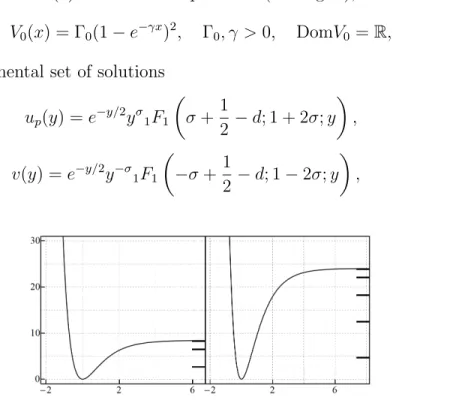
The eigenvalue equation (1) for the Morse potential (see Fig. 1),
V0(x) = Γ0(1−e−γx)2, Γ0, γ >0, DomV0 =R, (28)
admits the fundamental set of solutions
up(y) =e−y/2yσ1F1
σ+ 1
2−d; 1 + 2σ;y
, (29)
v(y) = e−y/2y−σ1F1
−σ+1
2 −d; 1−2σ;y
, (30)
where 1F1(a,c;z) stands for the hypergeometric confluent function [50], and
y= 2de−γx, d2 = Γ0
γ2, σ =
Γ2 0−E
γ2 . (31)
A straightforward calculation shows that W(up, v) ≡w0 = 2
√
Γ0−E. To determine the
bound states it is convenient to rewrite the potential depth Γ0 as
Γ0 =γ2(N +δ+ 1/2)2, N ∈Z+∪ {0}, 0< δ <1. (32)
Potentials (28) with depth (32) are depicted in Fig.1 for N = 2 andN = 4.
The set of discrete energies is therefore finite and defined by the expression
En=γ2
(2n+ 1)(N +δ+ 1/2)−(n+ 1/2)2, n= 0,1, . . . , N. (33) The corresponding eigenfunctions are obtained from up with σ+ 12 −d=n∈Z+∪ {0},
ϕn(y) =Cne−y/2yαnLn(2αn)(y), n= 0,1, . . . , N, (34)
where L(nα)(z) stands for the associated Laguerre polynomials [50], and
αn=d−1/2−n, Cn2 =
γ(2d−1−2n)n!
Γ(2d−n) . (35)
Note that we have fixed N = nmax = bd−1/2c, with bac the floor function [50]. The
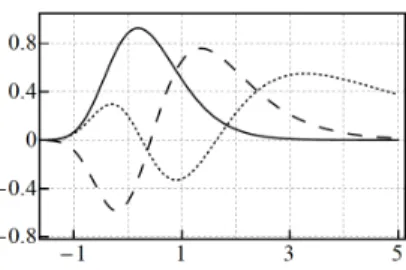
bound states for N = 2 are shown in Fig. 2.
Figure 2: The bound states (34) of the Morse potential depicted in Fig.1 (N = 2) with n= 0 (solid),
n= 1 (dashed), andn= 2 (dotted).
Now, to construct a complex-valued potential Vλ(x) from the Morse family (28) we
may make < E0 = γ2(N +δ + 1/4). The discrete energy spectrum of such system is
also finite, and includes N + 2 eigenvalues
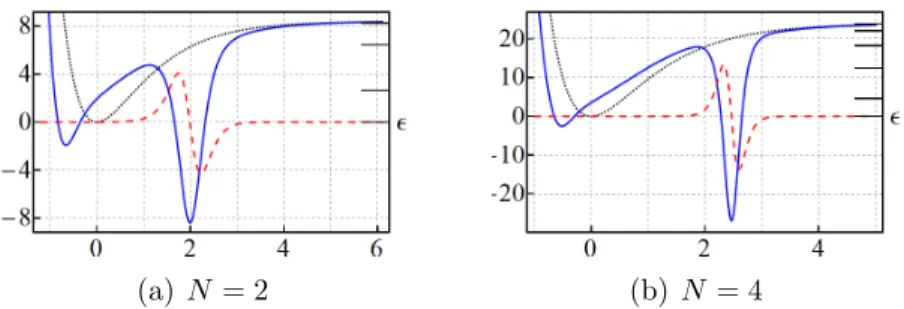
E0λ =, Enλ+1 =γ2(2n+ 1)(N +δ+ 1/2)−(n+ 1/2)2, n = 0,1, . . . , N. (36) The new potential is shown in Fig. 3for = 0 and two different values ofN. Notice that ReVλ(x) is very close to the Morse potential at the edges of R. Besides, such a function
exhibits a very localized deformation that serves to host the additional energy E0λ = 0. In turn, ImVλ(x) satisfies the condition of zero total area (26). Clearly, these potentials
(a) N = 2 (b)N = 4
Figure 3: (Color online) Real (blue-solid) and imaginary (red-dashed) parts ofVλ(x), which is generated
from the Morse potentials (black-dotted) of Fig.1. Here,λ=J =I0= 1, and= 0. The ticks on the right-vertical scale refer to the discrete energies (36).
The related bi-normalized complex-valued eigenfunctionsψλ
n(x) are depicted in Fig.4.
These new functions do not form an orthogonal set but the zeros of their real and imag-inary parts are interlaced according to the theorems reported in [31]. Namely, between two zeros of Reψλ
n+1 there is always a zero of Imψnλ+1, withn = 0,1, . . . , N.
• Oscillator potentials. Departing from the ‘mathematical’ oscillator V0(x) = x2, one
recovers the family of complex-valued oscillators Vλ(x) introduced in [19] and studied
in [30–32]. Since the Morse potential (28) converges to x2, it may be shown that the complex-valued potentials derived in this section converge to the oscillators reported in [19] at the appropriate limit.
3.2
Trigonometric P¨
oschl-Teller potentials
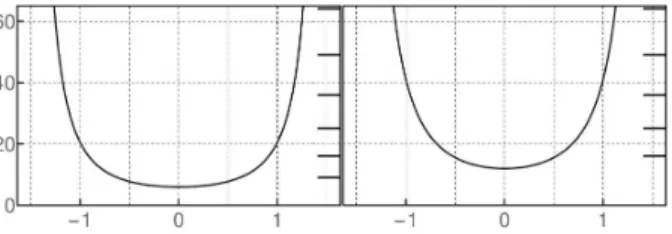
The eigenvalue equation (1) for the trigonometric P¨oschl-Teller potential (see Fig. 5),
V0(x) =
U2 0
r(r−1) cos2(U
0x) x∈
− π
2U0,
π
2U0
+∞ otherwise
, r >1, U0 >0, (37)
is solved by the linearly independent functions
up(x) = cosr(U0x)2F1
a,b,c; sin2(U0x)
, (38)
v(x) = cosr(U0x) sin(U0x)2F1
a + 1 2,b +
1
2,c + 1; sin
2
(U0x)
, (39)
where 2F1(a,b,c;z) is the hypergeometric function [50], with
a = 1 2 r+
√
E U0
!
, b = 1 2 r−
√
E U0
!
, c = 1
2. (40)
(a) ψλ
0(x) (b)ψ1λ(x) (c) ψλ2(x)
(d) ψλ
0(x) (e) ψ1λ(x) (f) ψ2λ(x)
Figure 4: (Color online) Real (blue-solid) and imaginary (red-dashed) parts of the eigenfunctionsψn(x)
associated with potentials of Fig.3 for the indicated values ofn, with N= 2 (upper row), N = 4 (lower row). For the sake of visibility, the plots of the imaginary parts in (b), (e), and (f) have been rescaled by a factor of 10, 100 and 10, respectively. The insets in (c), (e), and (f) show the interlacing of zeros for the corresponding functions.
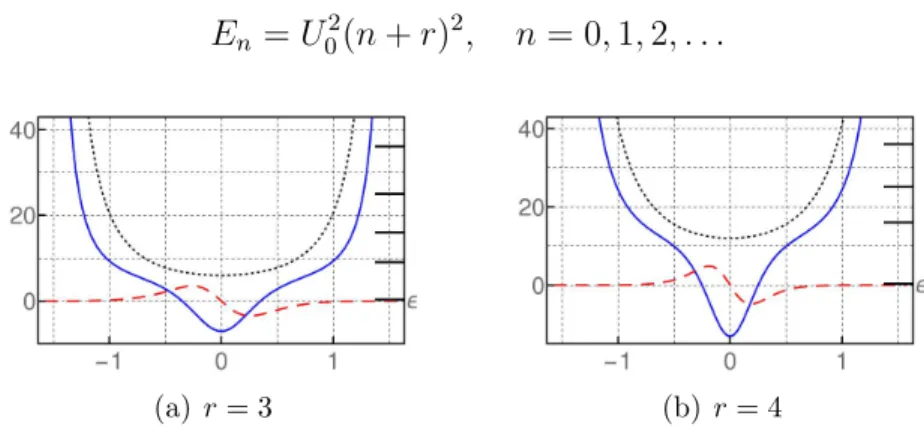
Figure 5: Trigonometric P¨oschl-Teller potential (37) forU0= 1 withr= 3 (left) andr= 4 (right). In each case the ticks on the right-vertical scale refer to the discrete energies (43).
is analytic at z = 0. For the function defining v(x) in (39), z = 0 is a branch point. Using the Wronskian of such functions (c.f. Eq. 15.10.3 of [50]) it can be proven that
W(up, v)≡ω0 =U0. Then, the physical solutions are obtained by studying the behavior
of 2F1(a,b,c;z) with argument unity. As c−a−b < 0, we use Eq. 15.8.4 of [50] and
realize that up(x) satisfies the boundary conditions if either a or b is a negative integer.
The latter leads to the even bound states (see Fig. 6),
ϕ2n(x) = ν2ncosr(U0x)2F1
−n, r+n,12; sin2(U0x)
. (41)
In turn, if either a +12 or b +12 is a negative integer, the functionv(x) gives the odd bound states (see Fig. 6),
ϕ2n+1(x) = ν2n+1cosr(U0x) sin(U0x)2F1
−n, r+n+ 1,32; sin2(U0x)
. (42)
The symbolνnin the above expressions stands for the normalization constant. The energy
Figure 6: First eigenfunctions (41)-(42) of the trigonometric P¨oschl-Teller potential depicted in Fig.5
(r= 3) withn= 0 (solid),n= 1 (dotted), andn= 3 (dashed).
set
En=U02(n+r)2, n= 0,1,2, . . . (43)
(a) r= 3 (b)r= 4
Figure 7: (Color online) Real (blue-solid) and imaginary (red-dashed) parts of the PT-symmetric version of potentials depicted in Fig.5 (black-dotted). HereJ =π/4,I0= 0, and λ=
p
π/4. The ticks on the right-vertical scale refer to energies (44), with= 1/4.
In the present case we use < E0 =U02r2 to generate complex-valued potentialsVλ(x)
that include the set (43) in their energy spectrum. That is, the energy eigenvalues of
Vλ(x) are defined by the denumerable set
E0λ =, Enλ+1 =U02(n+r)2, n= 0,1,2, . . . (44)
(a) ψλ
0(x) (b)ψ1λ(x) (c) ψλ2(x)
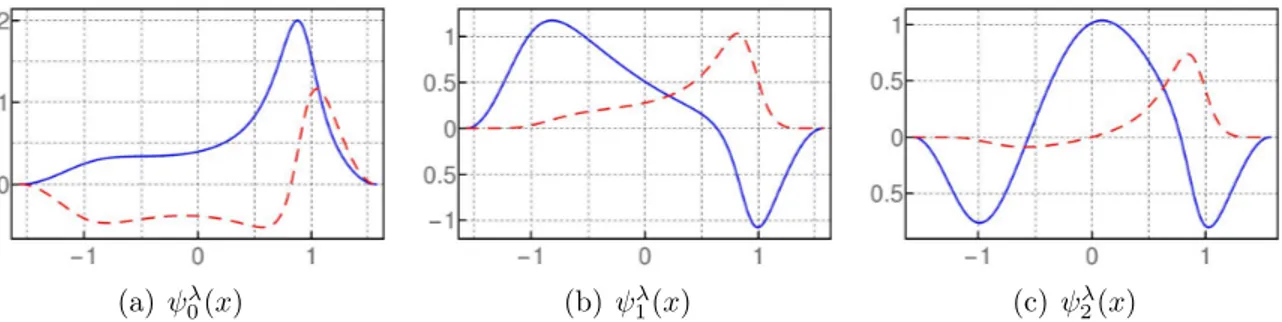
Figure 8: (Color online) Real (blue-solid) and imaginary (red-dashed) parts of the first three eigenfunc-tions belonging to the PT-symmetric potential (r= 3) depicted in Fig.7.
values of the parameter r. In both cases ReVλ(x) is even, with a very localized symmetric
deformation that permits the presence of the new energy (in the figure, = 1/4). In turn, ImVλ(x) is odd and satisfies the condition of zero total area (26). That is, the spatial reflection of ImVλ(x) is compensated by the complex conjugation (i → −i). The
first three eigenfunctions of such potential are depicted in Figure 8for r= 3. Notice that they satisfy the interlacing theorems indicated in [31].
(a) r= 3 (b)r= 4
Figure 9: (Color online) Real (blue-solid) and imaginary (red-dashed) parts of the complex-valued potentialsVλ(x) associated with those of Fig.5(black-dotted). The parameters areJ = 1.34,I0=−2.13, andλ=√1.34. The ticks on the right-vertical scale refer to energies (44), with= 8.075.
On the other hand, Figure 9 includes two examples of complex-valued P¨oschl-Teller potentials Vλ(x) that are not invariant under PT-transformations. In this case the
defor-mation of ReVλ(x) is asymmetrical, although this continues to host the new energy level (in the figure, = 8.075). In addition, ImVλ(x) still satisfies the condition of zero total
area (26) but it is also asymmetrical.
(a) ψλ
0(x) (b)ψ1λ(x) (c) ψλ2(x)
Figure 10: (Color online) Real (blue-solid) and imaginary (red-dashed) parts of the first three eigen-functions of the complex-valued potential (r= 3) depicted in Fig.9.
The first three eigenfunctions of these non PT-symmetric potentials are depicted in Fig. 10 for r = 3 and the parameters of Fig. 9. We can appreciate that Reψn+1 has a
zero between two zeros of Imψn+1, so the theorems presented in [31] are satisfied.
4
The quest of new models
In such a trend it is necessary to take λ 6= 0. However, the method is general enough to include conventional transformations and produce new integrable potentials of real value as well. Indeed, as indicated above, λ = 0 brings βλ=0 to its conventional form (5) since
Imβλ =λ/α2 becomes zero in (11). Remarkably, even in this case theα-function is defined
by (23), with creduced to c=I2
0/J in (24). In turn, the relationship between a, b and c
becomes simpler b=±2√ac, so α is reduced to the linear superposition
α(x) =√av(x)±√cup(x) =
q
aω2 0up(x)
Z x
u−p2(y)dy± I0
J
. (45)
(a) γM = 1.35 (b) γM = 0.74
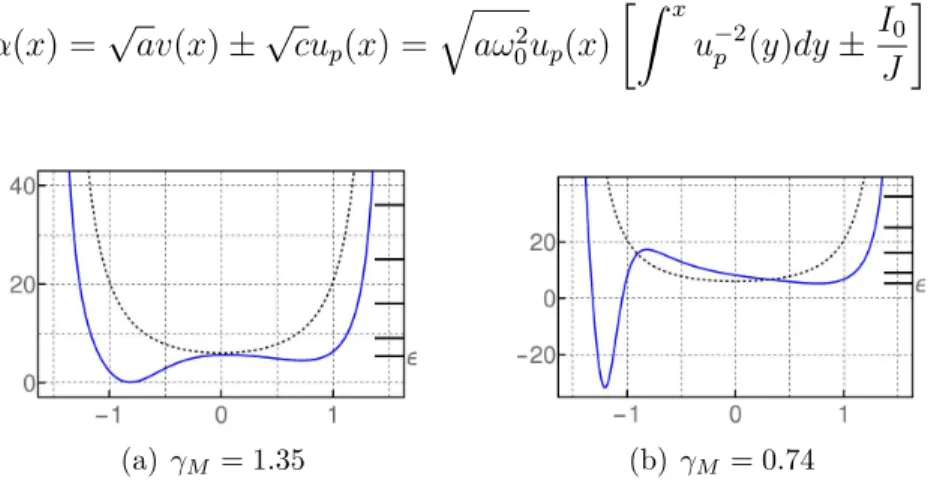
Figure 11: (Color online) Real-valued Darboux deformations (blue-solid) of the trigonometric P¨ oschl-Teller potential (black-dotted) for r = 3 and U0 = 1, with λ = 0, = 5.26. The indicated values of
γM =I0/J correspond toI0= 3.701, withJ= 2.74 (a) andJ = 5 (b).
The last result verifies that our approach includes the one-step Darboux deformations introduced in [5] to construct one-parameter families of solvable real-valued potentials. That is, (45) gives rise to the general real-valued solution of the Riccati equation (4), where the quotient ±I0/J corresponds to the integration constant associated with two
successive quadratures [10]. In the Milenik’s approach [5], the quantity γM = |I0/J| is
defined such that (45) is free of zeros in DomV0, and parameterizes the family of
real-valued potentials Vλ=0(x;γM) that is constructed from V0(x) [4,51,52]. As immediate
example we show in Fig.11a pair of real-valued potentialsVλ=0(x;γM), constructed from
the trigonometric P¨oschl-Teller system (37). The spectrum of these potentials is still given by (44) and their eigenfunctions are also constructed from (41)-(42) with the help of (3).
On the other hand, our method permits also the construction of complex-valued poten-tials Vλ(x) for which the ‘new’ energy is added at any position of the discrete spectrum
of V0(x). To be precise, in conventional one-step approaches (Darboux transformations,
intertwining techniques, factorization method, Susy QM, etc) the seed function u satis-fies (6) with ≤ E0, where E0 is either the ground state energy or the low bound of
the continuum spectrum of V0(x) [40]. However, if En < ≤ En+1, the seed function u
has nodes in DomV0 that produce singularities in the new potential V(x) =V0(x) + 2β0.
The problem has been circumvented by introducing irreducible second-order (two-step Darboux) transformations where two different energies fulfilling En ≤ 1 < 2 ≤ En+1
are added [40]. Yet, the limit 2 → 1 permits to avoid the problem in elegant form
order approach, the oscillation theorems satisfied by the seed function u with eigenvalue
En ≤ ≤ En+1 prohibit the construction of real-valued potentials V(x) that are free of
singularities in DomV0 [40]. The situation is different for the complex-valued potentials
Vλ(x) since the nonlinear superposition of up and v removes the possibility of zeros in
(23), so the function (25) is regular on DomV0 ⊂R.
(a) = E1+E0
2 (b) =
E1+E0
2 , λ= 0
(c) =E1 (d) =E1, λ= 0
Figure 12: (Color online) Potentials generated from the Morse system (28) by embedding the ‘new’ energy in the intervalE0≤≤EN, defined by theN + 1 discrete energies (33) of bound states (34), at the indicated positions. In all cases γ= 1,δ= 0.4,N = 2 andJ =I0= 1. The left column includes complex-valued potentials with λ= 1 and the right one shows the real valued potentials withλ= 0.
As example consider the potentials shown in Fig. 12. In all cases we have used the Morse system (28) with N = 2 as the initial potential V0(x). The upper row includes
potentials generated with = E1+E0
2 and either λ 6= 0 or λ = 0, Figs. 12(a) and 12(b)
respectively. In both cases the energy spectrum is given by Eλ
0 = E0, E2λ = E1, E3λ =
E2, plus the new eigenvalue E1λ = that is located between the ground (E0) and first
excited (E1) energies of the initial system. The real-valued potential Vλ=0(x;γM) shown
in Fig. 12(b) is singular at two different points of DomV0. This is a consequence of the
oscillation theorem obeyed by the general solution (45) of Eq. (6) with E0 ≤ ≤ E1. In
Susy QM one says that such a potential is ill defined since DomV0 is not preserved by the
Darboux transformation of V0(x) [57]. Clearly, this is not the case of the complex-valued
potential Vλ(x) depicted in Fig.12(a) since it is regular on R. In this case, the nonlinear superposition (23) regularizes the behavior of ReVλ(x) and ImVλ(x). Besides, at the points
where Vλ=0(x;γM) is singular, the α–function (23) produces only local deformations in
ReVλ(x) and ImVλ(x).
A similar situation holds for the potentials depicted on the lower row of Fig.12. There the ‘new’ energy is located exactly at the position of the first excited energy of V0(x),
in DomV0. In contrast, the complex-valued potential shown in Fig. 12(c) is regular on R
with local variations of its real and imaginary parts.
The above examples show that our method produces results that are not available in the conventional one-step Darboux approaches. The complex-valued potentials Vλ(x)
are regular even if is embedded in the discrete spectrum of V0(x), located at arbitrary
positions of En ≤ ≤ En+1 for any n = 0,1, . . . However, some caution is necessary
since the state ψ(x), although normalizable in the conventional form, may be of zero
binorm [19]. The latter is neither accidental nor rare in physics [58], so it deserves special attention [59] and will be discussed in detail elsewhere.
5
Summary and outlook
We demonstrated that the combination of nonlinear complex-Riccati and Ermakov equa-tions brings out some subtleties of the Darboux theory that are hidden in the conventional studies of integrable models in quantum mechanics. Within this generalized Darboux ap-proach, we have constructed complex-valued potentials that represent non-Hermitian sys-tems with real energy spectrum, no matter if they are PT-symmetric or not. We provided new systems with the discrete energy spectrum of either Morse or trigonometric P¨ oschl-Teller potentials as concrete examples. The conventional one-step Darboux approach, giving rise to new solvable Hermitian models, is easily recovered from that introduced here by the proper choice of parameters.
A striking feature of our method is the possibility of adding a real eigenvalue that may coincide with the energy En of any excited bound state of V0(x) without producing
singularities in the new complex-valued potential Vλ(x). Remarkably, this is not possible
in conventional one-step Darboux approaches since the oscillation theorem prevent the use of discrete energies, other thanE0, to produce new potentials with no singularities. In
this context, it is to be expected that our method can be applied to study the emergence of exceptional points [60] in the scattering energies of complex-valued potentials.
Other applications may include the study of electromagnetic signals propagating in waveguides, where the Helmholtz equation is formally paired with the Schr¨odinger one [61, 62]. In such a picture the complex-valued potentialVλ(x) can be identified with a refractive index of balanced gain/loss profile [48]. The study of non-Hermitian coherent states associated with finite-dimensional systems [63] is also available. Finally, the approach can be extended either by applying conventional one-step Darboux transformations on the complex-valued potential Vλ(x) or by iterating the procedure presented in this work.
Acknowledgments
We acknowledge the financial support from the Spanish MINECO (Project MTM2014-57129-C2-1-P) and Junta de Castilla y Le´on (VA057U16). KZ and ZBG gratefully ac-knowledge the funding received through the CONACyT Scholarships 45454 and 489856, respectively.
References
[1] E. Witten, Dynamical breaking of supersymmetry, Nucl. Phys.B 185 (1981) 513.
[2] B.K. Bagchi, Supersymmetry in Quantum and Classical Mechanics, FL: Chapman and Hall, CRC Press, London, Boca Raton, 2000.
[3] F. Cooper, A. Khare and U. Sukhatme, Supersymmetry in Quantum Mechanics, World Scientific, Singapore, 2001.
[4] B. Mielnik and O. Rosas-Ortiz, Factorization: little or great algorithm?, J. Phys. A:
Math. Gen. 37 (2004) 10007.
[5] B. Mielnik, Factorization method and new potentials with the oscillator spectrum,
J. Math. Phys. 25 (1984) 3387.
[6] A.A. Andrianov, N.V. Borisov and M.V. Ioffe, Quantum systems with identical en-ergy spectra, JETP Lett. 39 (1984) 93.
[7] A.A. Andrianov, N.V. Borisov and M.V. Ioffe, The factorization method and quan-tum systems with equivalent energy spectra, Phys. Lett. A 105 (1984) 19.
[8] A.A. Andrianov, N.V. Borisov, M.V. Ioffe and M.I. Eides, Supersymmetric mechan-ics: a new look at the equivalence of quantum systems,Theor. Math. Phys.61(1984) 965.
[9] G. Darboux, Sur une proposition relative aux ´equations lin´eares, C.R. Acad. Sci.
Paris 94 (1882) 1456.
[10] E.L. Ince, Ordinary Differential Equations, Dover, New York, 1956.
[11] G.N. Watson, A Treatise on the Theory of Bessel Functions, Second Edition, Cam-bridge University Press, London, 1966.
[12] C. Rogers and W.K. Schief, B¨acklund and Darboux Transformations. Geometry and
Modern Applications in Soliton Theory, Cambridge University Press, United
King-dom, 2012.
[14] E. Hille,Ordinary Differential Equations in the Complex Domain, Dover, New York, 1997.
[15] O. Casta˜nos, D. Schuch and O. Rosas-Ortiz, Generalized coherent states for time-dependent and nonlinear Hamiltonians via complex Riccati equations, J. Phys. A:
Math. Theor. 46 (2013) 075304.
[16] H. Cruz, D. Schuch, O Casta˜nos and O. Rosas-Ortiz, Time-evolution of quantum systems via a complex nonlinear Riccati equation I. Conservative systems with time-independent Hamiltonian, Ann. Phys. 360 (2015) 44.
[17] H. Cruz, D. Schuch, O Casta˜nos and O. Rosas-Ortiz, Time-evolution of quantum systems via a complex nonlinear Riccati equation II. Dissipative systems, Ann. Phys.
373 (2016) 609.
[18] S. Cruz y Cruz and Z. Gress, Group approach to the paraxial propagation of Hermite-Gaussian modes in a parabolic medium, Ann. Phys. 383 (2017) 257.
[19] O. Rosas-Ortiz, O Casta˜nos, and D. Schuch, New supersymmetry-generated complex potential with real spectra, J. Phys. A: Math. Theor. 48 (2015) 445302.
[20] V. Ermakov, Second order differential equations. Conditions of complete integrability,
Kiev University Izvestia, Series III 9 (1880) 1 (in Russian). English translation by Harin A.O. in Appl. Anal. Discrete Math. 2 (2008) 123.
[21] W.E. Milne, The numerical determination of characteristic numbers, Phys. Rev. 35
(1930), 863.
[22] E. Pinney, The nonlinear differential equation y00+p(x)y+cy−3 = 0, Proc. Amer.
Math. Soc. 1 (1950), 681.
[23] H.R. Lewis, Classical and quantum systems with time-dependent harmonic-oscillator-type Hamiltonians, Phys. Rev. Lett. 18 (1967) 510.
[24] O.A. Chalykh and A.P. Vesselov, A remark on rational isochronous potentials, J.
Nonlin. Math. Phys. 12 (2005) 179.
[25] M. Asorey, J.F. Cari˜nena, G. Marmo and A.M. Perelomov, Isoperiodic classical sys-tems and their quantum counterparts, Ann. Phys.322 (2007) 1444.
[26] J. Guerrero and F.F. L´opez-Ruiz, The quantum Arnold transformation and the Ermakov-Pinney equation, Phys. Scr.87 (2013) 038105.
[27] J. Guerrero and F.F. L´opez-Ruiz, On the Lewis-Riesenfeld (Dodonov-Man’ko) in-variant method, Phys. Scr. 90 (2015) 074046.
[29] J.F. Cari˜nena, F. G¨ungor and P.J. Torres, Invariance of second order ordinary differential equations under two-dimensional affine subalgebras of EP Lie algebra, arXiv:1712.00286.
[30] K.D. Zelaya and O. Rosas-Ortiz, Optimized Binomial Quantum States of Complex Oscillators with Real Spectrum, J. Phys.: Conf. Ser. 698 (2016) 012026.
[31] A. Jaimes-Najera and O. Rosas-Ortiz, Interlace properties for the real and imaginary parts of the wave functions of complex-valued potentials with real spectrum, Ann.
Phys. 376 (2017) 126.
[32] O. Rosas-Ortiz and K. Zelaya, Bi-Orthogonal Approach to Non-Hermitian Hamil-tonians with the Oscillator Spectrum: Generalized Coherent States for Nonlinear Algebras, Ann. Phys. 388 (2018) 26.
[33] R.S. Kaushal and D. Parashar, Can quantum mechanics and supersymmetric quan-tum mechanics be the multidimensional Ermakov theories?, J. Phys. A: Math. Gen.
29 (1996) 889.
[34] R.S. Kaushal, Quantum Analogue of Ermakov Systems and the Phase of the Quan-tum Wave Function, Int. J. Theor. Phys. 40 (2001) 835.
[35] L.M. Berkovich, Factorization and transformations of linear and nonlinear ordinary differential equations, Nucl. Instr. Meth. Phys. Res. A 502 (2003) 646.
[36] L.M. Berkovich, Method of factorization of ordinary differential operators and some of its applications, Appl. An. Discr. Math. 1 (2007) 122.
[37] R.S. Kaushal, Possibility of a geometric constraint in the Schr¨odinger quantum me-chanics, Mod. Phys. Lett. A 15 (2000) 1391.
[38] A. Mostafazadeh, Comment on the possibility of a geometric constraint in the Schr¨odinger quantum mechanics, Mod. Phys. Lett. A 15 (2000) 2129.
[39] C.M. Bender, Introduction to PT-symmetric quantum theory, Cont. Phys.46(2005) 277.
[40] B.F. Samsonov, New possibilities for supersymmetry breakdown in quantum mechan-ics and second-order irreducible Darboux transformations, Phys. Lett.A 263(1999) 274.
[41] F. Cannata, G. Junker and J. Trost, Schr¨odinger operators with complex potential but real spectrum, Phys. Lett. A 246 (1998) 219.
[43] B. Bagchi, S. Mallik and C. Quesne, Generating complex potentials with real eigen-values in supersymmetric quantum mechanics, Int. J. Mod. Phys.A 16 (2001) 2859.
[44] O. Rosas-Ortiz and R. Mu˜noz, Non-Hermitian SUSY hydrogen-like Hamiltonians with real spectra, J. Phys. A: Math. Gen.36 (2003) 8497.
[45] O. Rosas-Ortiz, Gamow vectors and supersymmetric quantum mechanics, Rev. Mex. Fis. 53 (2007) 103.
[46] N. Fern´andez-Garc´ıa and O. Rosas-Ortiz, Gamow-Siegert functions and Darboux-deformed short range potentials, Ann. Phys. 323 (2008) 1397.
[47] G.B. Arfken and H.J. Weber, Mathematical Methods for Physicist, 5th Edn, Aca-demic, San Diego, California, 2001.
[48] H. Eleuch and I. Rotter, Gain and loss in open quantum systems, Phys. Rev. E 95
(2017) 062109 .
[49] I.S. Gradshteyn and I.M. Ryzhik, Table of Integrals, Series, and Products, Seventh Edition, Academic Press, USA, 2007.
[50] F.W.J. Olver, D.W. Lozier, R.F. Boisvert and C.W. Clark (Ed), NIST Handbook of
Mathematical Functions, Cambridge University press, New York, 2010.
[51] L.J. Boya, H. Rosu, A.J. Segui-Santonja, and F.J. Vila, Strictly isospectral super-symmetry and Schroedinger general zero modes, Nuovo Cim. B 113 (1998) 209.
[52] J.O. Rosas-Ortiz, On the factorization method in quantum mechanics, in Proceed-ings of the First International Workshop on Symmetries in Quantum Mechanics and
Quantum Optics, Burgos (Spain) 21-24 September 1998, A. Ballesteros et al (Eds.),
Servicio de Publicaciones de la Universidad de Burgos, pp. 285-299; arXiv:quant-ph/9812003.
[53] B. Mielnik, L.M. Nieto and O. Rosas-Ortiz, The finite difference algorithm for higher order supersymmetry, Phys. Lett. A 269 (2000) 70.
[54] M.S. Berger and N.S. Ussembayev, Isospectral potentials from modified factorization,
Phys. Rev. A 82 (2010) 022121.
[55] M.S. Berger and N.S. Ussembayev, Second-order supersymmetric operators and ex-cited states, J. Phys. A: Math. Theor. 43 (2010) 385309.
[56] B. Midya, Nonsingular potentials from excited state factorization of a quantum sys-tem with position-dependent mass, J. Phys. A: Math. Theor. 44 (2011) 435306.
[58] E. Narevicius, P. Sierra P and N. Moiseyev, Critical phenomenon associated with self-orthogonality in non-Hermitian quantum mechanics, Europhys. Lett. 62 (2003) 789.
[59] A.V. Sokolov, A.A. Andrianov and F. Cannata, Non-Hermitian quantum mechanics of non-diagonalizable Hamiltonians: puzzles with self-orthogonal states, J. Phys. A:
Math. Gen. 39 (2006) 10207.
[60] T. Kato, Perturbation Theory of Linear Operators, Springer, Berlin 1966.
[61] S. Cruz y Cruz and R. Razo, Wave propagation in the presence of a dielectric slab: The paraxial approximation, J. Phys.: Conf. Ser. 624 (2015) 012018.
[62] S. Cruz y Cruz and O. Rosas-Ortiz, Leaky Modes of Waveguides as a Classical Optics Analogy of Quantum Resonances, Adv. Math. Phys. 2015 (2015) 281472.