UNIVERSIDAD TÉCNICA PARTICULAR DE LOJA
La Universidad Católica de Loja
AREA SOCIO HUMANÍSTICA
TITULACIÓN DE LICENCIADO EN CIENCIAS DE LA EDUCACIÓN
MENCIÓN INGLÉS
Teachers and
students’ perceptions of teaching English in small classes in
Ecuador
TRABAJO DE FIN DE TITULACIÓN
AUTOR:
Angulo Cárdenas, Marcelo Iván
DIRECTORA:
Ulehlova Eva, MSc.
CENTRO UNIVERSITARIO QUITO CARCELÉN
ii APROBACIÓN DEL DIRECTOR DEL TRABAJO DE FIN DE TITULACIÓN
MSc.
Eva Ulehlova.
DIRECTORA DEL TRABAJO DE FIN DE TITULACIÓN
De mi consideración:
Que el presente trabajo, denominado: “Teachers and students’ perceptions of teaching English in small classes in Ecuador” realizado por el profesional en formación: Angulo Cárdenas Marcelo Iván; cumple con los requisitos establecidos en las normas generales para la Graduación en la Universidad Técnica Particular de Loja, tanto en el aspecto de forma como de contenido, por lo cual me permito autorizar su presentación para los fines pertinentes.
Loja, noviembre de 2014
f)……….
iii DECLARACIÓN DE AUTORÍA Y CESIÓN DE DERECHOS
“Yo, Marcelo Iván Angulo Cárdenas, declaro ser autor del presente trabajo: Teachers and students’ perceptions of teaching English in small classes in Ecuador, de la Titulación de Ciencias de la Educación mención Inglés, siendo MSc. Eva Ulelhova directora del presente trabajo; y eximo expresamente a la Universidad Técnica Particular de Loja y a sus representantes legales de posibles reclamos o acciones legales.
Adicionalmente declaro conocer y aceptar la disposición del Art. 67 del Estatuto
Orgánico de la Universidad Técnica Particular de Loja que en su parte pertinente dice: “Formar
parte del patrimonio de la Universidad la propiedad intelectual de investigaciones, trabajos científicos o técnicos y tesis de grado que se realicen a través, o con el apoyo financiero,
académico o institucional operativo de la Universidad”.
f.………
Marcelo Iván Angulo Cárdenas
iv DEDICATION
v ACKNOWLEDGEMENT
vi CONTENTS
APROBACIÓN DEL DIRECTOR DEL TRABAJO DE FIN DE TITULACIÓN ... ii
DECLARACIÓN DE AUTORÍA Y CESIÓN DE DERECHOS ...iii
DEDICATION... iv
ACKNOWLEDGEMENT ... v
CONTENTS ... vi
ABSTRACT ... 1
RESUMEN ... 2
INTRODUCTION ... 3
METHOD ... 7
DISCUSSION ... 9
Literature Review... 9
Description, Analysis, and Interpretation of Results ... 27
Conclusions ... 46
Recommendations ... 47
REFERENCES ... 48
1 ABSTRACT
The aim of this research was to find out the teachers and students’ perceptions of
teaching and learning English in small classes in order to determine if some problems in English learning have to do with the number of students that the teachers have to deal with.
A class size research study was conducted based on several previous and reliable studies and theories provided by different authors through the years. A quantitative and qualitative methods have been postulated. The research sample was of 50 high school students between the age of 12 and 16 as well as 5 teachers basically in private high
schools located in Quito – Ecuador.
Teachers and students filled out a twenty-one question survey whose results were then analyzed through statistical charts to reveal that most teachers and students strongly
agreed or agreed that smaller class sizes increase student’s achievement.
Based on literature findings and previous studies as well as well as on the results that surveys, note- taking and observation class sheets supplied, it could be concluded that
smaller class sizes do increase students’ achievement.
2 RESUMEN
El objetivo de esta investigación fue conocer la percepción de los maestros y los estudiantes sobre la enseñanza y el aprendizaje del Inglés en clases pequeñas con el fin de determinar si algunos problemas en el aprendizaje de este idioma tienen que ver con el número de estudiantes que los profesores tienen en sus aulas.
Un estudio de investigación sobre el tamaño de la clase se llevó a cabo sobre la base de varios estudios y teorías proporcionadas por diferentes autores a través de los años anteriores. Los métodos utilizados para el efecto fueron tanto cuantitativos como cualitativo. Para el diseño de la investigación se utilizó una muestra de 50 estudiantes de secundaria entre las edades de 12 y 16, así como 5 profesores, misma que fue realizada
principalmente en instituciones educativas privadas de la ciudad de Quito – Ecuador.
Con base en los hallazgos de la literatura y los estudios anteriores, así como los resultados que las encuestas, registro de notas y observaciones de clase suministraron, se podría concluir que el tamaño de las clases más pequeñas permite aumentar el rendimiento estudiantil.
3 INTRODUCTION
The impact of class size on teaching and learning has had a long and vigorous research history. Indeed, this topic was probably the first pedagogical issue researched in American higher education and Ecuador is not the exception.
Nowadays, there is an intense debate about class sizes in Ecuadorian schools. On one side of the discussion, are the enthusiasts who feel very strongly that smaller classes lead to a better teaching and more effective learning. On the other side, there are the sceptics who argue that the evidence for the efficacy of class size reductions is in doubt and that there are likely to be other more strategies for improving educational standards.
The present research project: “Teachers and students’ perceptions of teaching English in small classes in Ecuador” has the main purpose of seeking for answers from teachers and students when it comes to the topic of class size. As a result, four research questions have been proposed:
- What are the benefits of teaching and learning English in small classes?
- What teaching strategies and resources benefit the teaching of English in small
classes?
- How do students feel about learning English in small classes?
- Are there any limitations when teaching English in small classes?
4 The current investigation has been based on different opinions from a variety of authors who describe the advantages and the challenges that teaching English in small classes represents.
It was also necessary to do some searching in various studies which have confirmed or rejected authors’ beliefs about the benefits of small classes.
One of the most recognized studies is the Tennessee STAR Project on class size which initiated in 1985 with the purpose of determine the effects of reduced class sizes on short and long term students’ performance in the earliest grades.
This research in which 80 schools participated, consisted of three phases with some limitations throughout the whole study that mainly involved the validity of the study, noticing not only that the size of scientific research on small-class sizes shows no or statistically insignificant effects, but that Project STAR produced an achievement gain that was apparent in only the first year.
Using both standardized and curriculum based testing, the initial study concluded that small classes produced substantial improvement in early learning and cognitive studies with the effect about double for minority students.
A second relevant study comprised in this research with the name of “The Impact
of Class Size Reduction on Student Achievement in English Class” which was published
by Fidler (2002) focused on four research questions as following:
5 2. Will 4th grade students with two prior years of CSR and 5th grade students with one prior year of CSR, have similar gains to those of 3rd grade students?
3. Will there be a “persistence” of CSR effects for 4th and 5th grade students?
4. Will participation in CSR have a differential effect on achievement due to language classification?
The results presented in this paper regarding the impact of CSR on achievement are mixed. It is believed that CSR will help to increase student achievement, especially for students who need it the most. Therefore, it can be concluded that CSR does help to increase language achievement gains, especially for ELL students.
As any other study, the limitations found in this one were that achievement scores were compared with other cohorts who completed one and two years of CSR. Another threat to the validity of this study is the underrepresentation of ELL students taking the SAT/9 in spring 1997.
Finally, a third study investigated was the SAGE project which took place in Wisconsin in 2002, based on three hypotheses:
1) Class size implementation alone is insufficient to promote student achievement. Changes in teaching methods that take full advantage of smaller class sizes will also be needed.
(2) Class size reduction may have unintended consequences.
(3) Generalization requires careful adaptation. Every classroom has a unique and specific context.
Results from the study demonstrated increased teachers’ satisfaction with their
6 increases in student graduation rates and admission into college. Although no significant differences were observed in the gains of both male and female students, improved outcomes were again larger amongst minority and disadvantaged students.
The current work of investigation will benefit teachers who are constantly looking for some new teaching strategies that in small classes are more applicable. Also students will be the beneficiaries of the current research because of the desire they have expressed to have more opportunities to participate in it and practice which is not the same when learning in groups of 40 or 50 students. Based on the survey that was applied to them, the answers have been mostly inclined to the fact that it would be very beneficial to learn English in small groups which responds to the third research question. The majority of students affirm they feel more confident and more importantly with higher possibilities of learning this language without the necessity of hiring private teachers or attending to extra classes which represents for some of them a double investment in time and money.
The suggestions provided in this study might additionally be a good referring to the authorities of schools who are currently thinking of reducing the size of the classes in the institutions that are in their charge. And last but not least, governmental authorities may take this research into consideration for future changes in order to make important decisions.
A research has always limitations that have to do more importantly with data collection, time constraints, and even people who are reticent to respond surveys or who do not take the topic seriously.
7 METHOD
Setting and Participants
Students’ survey was performed from eight grades to second high school grades. Every class counted with an average of 10 students per class. The sample used in this research consists of 50 students and 5 teachers from some private high schools in Quito
– Ecuador, who responded the provided questionnaires.
Procedures
The research initiated with the collection of information in the previous semester. It consisted of carrying out a bibliographical research which included five record cards with information about some relevant contents that support the literature review part of the current study as well as five previous studies about the researched topic to corroborate or deny the questions presented in the investigation.
Once the data was gathered, this contributed to redact the Literature review which serves as the main support in the study.
The methods that were applied for this research are quantitative and qualitative. Qualitative methods were used because they provide information only on the particular cases studied, and any more general conclusions are only propositions or informed assertions. Quantitative methods with the purpose of seeking empirical support for such research hypotheses.
8 The techniques applied in the data collection were the application of the surveys to 50 students and 5 teachers and also with the observation of the classes with its correspondent note-taking sheets. The observation was done in a period of two hours of class in order to obtain a more detailed information about the activities assigned by the observed teachers. Once the information of the surveys and the observation was collected, the next step to be followed was the tabulation of results which is presented in Tables and Statistical Bars. The process of tabulation was done according to the parameters of the surveys which included four indicators: Very Satisfactory, Satisfactory, Less Satisfactory, and Unsatisfactory. After the data was transferred into numbers, it was necessary to change them into percentages for a subsequent analysis. The final step was to transfer the numbers into statistical graphics.
The final step in this chapter was the interpretation and the analysis of the results. Having elaborated the Tables for each of the questions and their respective percentages
and graphics, it was established a comparison between students and teachers’ answers
and the data collected during the observation process.
9 DISCUSSION
Literature Review
Some teachers in the world affirm that the number of students in a class is one of the most important factors when it comes to get better results in teaching English. Some others state that it depends on the methodology that every teacher uses more than considering the class size. In Ecuador, this aspect: class size, is a topic that can be analyzed and discussed very deeply due to the diversity of schools that contain classrooms of fifteen students and others thirty five to forty.
The current Literature Review explores the different contributions that some authors and researchers have done so far, in order to confirm if class size is one of the aspects that should be considered very seriously, and if it has a very strict relationship with getting better achievements in teaching English. In this review, five main topics extracted from different books and five studies will be described and used for further conclusions.
Managing learning
According to Kelly and Stafford (1991, p.197) “small classes work provides
opportunities for intellectual and personal growth which cannot be achieved so easily in the standard lecture situation”. Because the small group constitutes a more personal
situation, it provides opportunities for interaction between tutor or lecturer and students and among students. Such interaction can encourage active learning and learning at a high conceptual level, and can help students to achieve a sense of independence and responsibility for their own learning.
10 instruction from their teachers and from interaction with each other. The group also provides opportunities for individuals to speak in front of others and to receive feedback from teachers and peers.
Welty (1989, p.74), states that most teachers would agree that teaching a small class comes with many benefits. The author observed:
Teachers can offer one-on-one assistance at times and are more likely to meet the individual needs of their students. Some teachers, however, find it quite challenging to keep their students interested and excited about learning and participating in small classes.
In addition, when the author refers to the ideal number, he affirms that depending on the location somebody is teaching in, small classes range from about three to seven students.
11 to blending into a large class may feel uncomfortable. As a result, teachers will have to take special measures to help them gain confidence. One last challenging component refers to inadequate activities, some tasks in textbooks, such as debates or role-playing, may not be possible if a class is very small.
Class size
Anderson (2000) summarizes some benefits of small classes as following:
First of all, teachers and students often feel more relaxed when the class size is smaller. Students generally feel more comfortable voicing their questions and opinions. A second benefit has to do with teachers designing customized lessons to meet the needs and interests of all of the class members. In small groups, teaching is student centered and often more communicative than in large classes, for this reason, students also have more opportunities to speak. Having spoken about space, it is mentioned that students have plenty of space to move around in the classroom so teachers can also arrange excursions (or suggest spontaneous ones) outside of the classroom where students can be exposed to real world English.
12 According to another author, Blatchford (2003), |most teachers agree that teaching a small group of students is easier, more enjoyable, and less time consuming than teaching a large group. But he shows some downsides when saying that due to budgets, space, or lack of teachers, many ESL schools only offer large classes. In some schools, large classes may consist of up to 50 or more students. While some classes may look more like a University lecture hall, teachers’ job is not to lecture. Blatchford (2003, p.112) states: “Just like teaching a small class, you must come up with engaging activities that keep all of your students interested and participating with the goal of improving their communication skills”.
Teacher – student interaction and student – student interaction
13 take the first shout-out answers to questions (often from the same few students) or answer their own questions too quickly.
In contrast, Chi argues, more student-centered classes provide adequate time during activities for students thinking about concepts, receiving feedback, and/or participating in discussions that may guide the objective of the lesson. Some activities may allow students to engage freely in their own learning, for instance, online search for relevant information, and/or may involve the students using the instructor as a resource to provide information as needed. This "guide-on-the-side" model is indicative of highly reformed, student-centered classrooms.
Aronson, Elliot and Patnoe (1997) agree that teacher-student relationships provide
an essential foundation for effective classroom management—and classroom
management is a key to high student achievement. Teacher-student relationships should not be left to chance or dictated by the personalities of those involved. Instead, by using strategies supported by research, teachers can influence the dynamics of their classrooms and build strong teacher-student relationships that will support student learning.
Aronson, Elliot and Patnoe (1997, p.96) say: "Teachers who love their students are of course by that very fact teaching their students the nature of love, although the
course may in fact be chemistry or computer science”. They thoroughly endorse out
-of-class contacts between students and reveal something to the student about reality that can be learned just in one way. Such contracts demonstrate that ideas are 'embodied.' They do not exist apart from a person, remote or near at hand, who enunciates, who takes responsibility for them by declaring them, by speaking about them. Otherwise in Wilson’s
14 On the other hand, when it comes to analyze interaction between students when learning, Chi (2009) affirms:
Classes where students have opportunities to communicate with each other help students effectively construct their knowledge. By emphasizing the collaborative and cooperative nature of scientific work, students share responsibility for learning with each other, discuss divergent understandings, and shape the direction of the class. The Pedagogy in Action module on Cooperative Learning is a great place to learn more about structuring student-student interactions both in and out of the classroom. The Cutting Edge teaching method module on using Concept Tests in the classroom also has tips for integrating think-pair-share activities into even large classrooms. (p. 72)
Following Chi’s thoughts, classes that have low interaction among students are
15 Aronson, Elliot and Patnoe (1997), state some aspects that are relevant in student
– student interaction. To begin with, learners need to practice as much as possible if they
aspire to be successful. Interaction through pair and group work maximizes the opportunities to practice as more learners speak most frequently. Secondly, Collaborative learning, particularly through the use of collaborative tasks, has been shown to foster language development since learners can see a reason to use language in order to interact. Related to the concept of collaboration it is relevant to name socialization. Interaction does not only promote language development but it also promotes the development of social skills (e.g. politeness, respect for others) that people need to operate successfully in any culture. And last but not least one element that cannot be missed is motivation. Interaction gives learners the opportunity to use language successfully and to measure their progress which in turn should lead to an increase in motivation.
Teaching techniques, strategies or activities for teaching English to small classes
According to Bonwell (1995), there are some effective strategies for coping with small classes. He mentions the importance of having plenty of fillers (such as puzzles and games) ready in case activities finish quickly. The author suggests to keep a list of games or warm ups on hand and to use them when energy gets low. Some may need to be adapted slightly if the class is very small.
Another fact that reviews relevance is taking the time to make sure that students understand the lessons and material.
Bonwell (1995, p.93), emphasizes to encourage confidence, which means, to help shy students to feel more comfortable by trying not to put them on the spot. He suggests, “Let
16 The same author suggests to change the dynamics by inviting students from other classes once in a while. He also recommends to prearrange pair group and getting acquainted to activities with other teachers who teach in small classes. Bonwell (1995) also affirms that when having students with high level knowledge of English, it is advisable to pair them with lower level students.
One final stage has to do with asking for feedback. Taking time to find out whether or not students are happy with the class besides asking for suggestions regarding activities they want to do or skills they would like to improve. Some teachers put a question box or envelope out so that students can remain anonymous if they want to.
Brookfield (1995) suggests some other activities that can be used when teaching small classes. One of these is to use English newspapers. He advises to ask students to bring in a daily paper and then assign one story to each student to read and present.
The use of music in the classroom is another interesting activity to be considered because of the variety of tasks: having students listen to English songs, using cloze exercises and teaching vocabulary and idioms.
Storytelling, the idea of letting students tell stories from their own cultures or childhood is a very attractive task which can be fun as well teachers take students to a new location to do this, such as a park or a coffee shop.
The very popular “Chain writing” can be pretty much suitable in small groups: Each
student writes one sentence on a piece of paper and then passes it on until each story is completed.
17 Additionally, Brookfield suggests board games because small groups are great for playing board games such as Word Up. Card games are a great way for students to practice asking questions.
The use of Internet is a very relevant and appropriate resource, for example online lessons, small classes can make use of computer labs easily. If a class does not have a computer lab, it’s easier to take students to the local library regularly to introduce them
to the online learning sites.
Films are the most common tasks used in small and large classes too. There are numerous lessons online for incorporating film into class lessons. This can be done at all levels with great success, especially in a small class. One way of teaching with the help of movies could be to stop the film quite often in order to check comprehension and keep students focused on the video activities.
Class Excursions is an exclusive small class activity because according to Brookfield, it’s so useful to take advantage of the class size, by getting out of the school as often as possible. Exposing students to real English outside of the classroom is a very interesting method teachers can try if they speak with natives who come from foreign countries.
Last but not least is the “Guest speakers “class, which consists of inviting people
into the classroom to speak or participate in a lesson. This can be other students who have a special interest or understanding about a topic the teacher is working with, or other people from the community who would be willing to come into the class. Students will appreciate a new face from time to time in a class that has limited numbers.
Learning environment in small classes
18 make the class both attractive and functional. Some physical aspects to consider are room arrangement, seating, bulletin boards, white board displays, and lighting and temperature of the room. A clean, safe, attractive, and comfortable classroom will help to build a classroom community and stimulate learning. Plants are a great way to make the room more welcoming and to take care of them can become as a shared learning experience.
It is important to have adequate and organized places for students where to put their belongings (coats, lunches, book bags, etc.). Display class rules, student work, art work, calendars. Teachers may need different room arrangements for whole group and small group activities. It is nice to incorporate some small group work/instruction areas in the classroom. Then teachers can designate a “quiet zone” or independent working area
for those who work better with fewer distractions or students who need to do make-up work, store or place used materials and equipment in close proximity to the students. A
relevant thing is to maximize the proximity to the students – it will minimize some
classroom behavior issues.
A physical setting that is safe, attractive, comfortable, and well-designed helps children to be engaged in the offered activities. Such an environment can support goals for children and allow teachers to observe and interact with them in a positive way. A physical space divided into interest areas is an ideal setting for students who want to explore, make things, experiment, and pursue their own interests. Separate interest areas with varied materials offer students plenty of choices. Sometimes they want to work quietly, either alone or with other classmates.
According to Cohen’s point of view, teachers have to make sure that the classroom
19 an arrangement with students dispersed around the classroom. For a small discussion section, it may be useful to arrange chairs in a circle or a U shape.
Another important suggestion is to feel free to change the seating arrangement in the classroom according to the method of instruction that is being used. Students will be less likely to become bored if they are shown that the classroom is not a static but a changing environment. Switching seats can make them interact with more classmates. However, it is not recommendable to experiment with the seating arrangement so often, because students might feel uncomfortable.
When talking about the environment, Cohen says that is necessary to create a safe one for a student participation. Teachers can foster a safe climate by insuring that classmates never ridicule a student's questions or remarks. It takes only one or two instances of "that's a stupid comment. Haven’t you prepared yourself for class?" to discourage participation. It is relevant to always remember to dignify learners' responses by restating their valid points or crediting the thoughtfulness of their contributions as well as confront students who attack other students.
Cohen states that when a teacher confronts students who treat their classmates disrespectfully, he or she models for his or her students proper classroom etiquette. Students will take things more seriously next time.
As mentioned in the introductorypart of this review, some studies have been done
20 Biddle & Berliner (2002) analyzed the research done in the Tennessee STAR Project which its main goal was to determine the effects of reduced class sizes on short and long term pupil performance in the earliest grades.
Recapitulating, the methodology of this study which focused on the effectiveness of small classes and of teachers’ aides can be summed up in three phases. A first phase which assessed the effectiveness of small classes compared with regular-sized classes and of teachers’ aides in regular-sized classes on improving cognitive achievement in kindergarten and in the first, second, and third grades. A second phase which consisted of an observational study of the consequences of the experimental program on children when they returned to regularized classes in the fourth, fifth, and sixth grades and beyond. This research phase asked whether the children who started in the smaller classes performed better in later grades. Only students who had been in the experiment (Phase 1) could contribute data to this second phase. And the last phase which implemented the small classes in kindergarten and in the first, second, and third grades in the 17 districts of Tennessee where children are highly at risk of dropping out early. These districts had the lowest average incomes in the state.
21 and why parents whose children had been assigned to standard and supplemented classes did not then demand that their children were reassigned to small classes.
Another conclusion the authors came to is that schools participating in STAR had volunteered to do so, and it is possible that the teachers and principals in those schools had particularly strong interests in new ideas and innovations.
Questions such as these do not imply that the project should be rejected, but they serve to remind that this study was not enough researched and that other evidence would also be needed to nail down class-size effects.
A second study presented in this review is the one examined by Harfitt (2011) based on the research made about Class Size in Hong Kong in which two research questions were put on the map as following:
1. How do students perceive the differences, if any, between teaching and learning in a large class with teaching and learning in a reduced-size class?
2. How do these differences, if any, influence cultural and social aspects of learning? The focal methodology of this study was the environment of the classroom in its entirety. Each teacher was responsible for teaching one large class and one reduced-size class of the same grade. Three local secondary school English teachers volunteered to have their lessons observed and video recorded which ensured a naturalistic setting for the study. The observed classes formed part of the teacher’s existing teaching schedule, and participants were not asked or required to make any amendments to their lessons, subject content or teaching methods. The participating teachers in the study were all female reflecting the gender bias of the teaching profession in Hong Kong.
22 small class teaching with a view to expand the initiative to other grades. In the other two
schools, the reduced-size classes were seen as a potential solution to individual teachers’
workload and timetabling issues. None of the students had experienced learning in reduced-size classes prior to this study. Each case study was conducted in the second semester of the school timetable because it was believed that relationships in class (between students and teachers) would have been well established by that time. The data set for this paper includes semi-structured interviews with 191 students and 48 lesson observations conducted in 3 different secondary schools.
Multiple interviews were conducted with students in large and reduced-size classes to elicit qualitative data on how they perceived their learning and teaching in their respective cohorts. Group and individual interviews were conducted by a total of 191 students.
Observation of student behavior in the English language classroom generated data on classroom events and discourse in both large and reduced-size classes. Every lesson was subsequently transcribed. Classroom transcriptions were carefully analyzed, and focus was placed on the interaction patterns between class and teacher, as well as student and student. This was done to determine whether there were any differences between the reduced-size and large classes in this crucial area of language development.
The study conclusions launched a lot of assertions. Authors concluded that research on class size in Hong Kong and Asia is limited by economic factors and the three case studies reported, contribute to the knowledge base by placing new emphasis on secondary school contexts and, in particular, on the all-important student voice.
23 varying size would provide a valuable opportunity to determine if the classroom processes identified in the study might lead to concrete and measurable academic benefits.
Based on Harfitt (2011) view, findings from the smaller classes in this study, also point out the importance of taking a sociocultural perspective towards any examination of class size. He states that this study has revealed that social and psychological dimensions of learning may be equally powerful elements in helping to understand how class size might mediate learning.
The third study in question is a compendium made by Fidler (2002) who based his analysis in Class Size Reduction with four main questions detailed below:
1. Will 3rd grade students who participated for three years in CSR (Class Size Reduction) have higher achievement gains than 3rd grade students who have participated for one year in CSR?
2. Will 4th grade students with two prior years of CSR and 5th grade students with one prior year of CSR, have similar gains to those of 3rd grade students? _
3. Will there be a “persistence” of CSR effects for 4th and 5th grade students?
4. Will participation in CSR have a differential effect on achievement due to language classification?
24 The results presented in this paper regarding the impact of CSR on achievement are mixed. Fidler (2002) believes that reducing the size of a class will help to increase students’ achievement, especially for students who need it the most.
There are some other authors who broke down this study, for instance and according to Stecher (2000), there have been small, but consistent achievement gains in students of all backgrounds. The findings presented in the study agreed with those presented by Stecher.
Moving on to a fourth study, Haimson (2000) proposed two statements. The first one is that hypothesizing than lowering class size, particularly in grades K-3, is the most effective way to improve student performance, narrowing the achievement gap, and decreasing the number of students who drop out of school or are held back.
The second statement was that the benefits of being placed in a smaller class in the early grades continue through the high school years and beyond.
The first step in the method consisted of researchers carrying out 17 in-depth interviews at five schools currently implementing class size reduction. They interviewed the principal and at least two teachers at every school. The choice of schools was partly random and partly based on suggestions from superintendents. The investigation ended up seeing a range of schools, some in overcrowded districts, and some in less crowded districts. Some of these schools were high achieving, and others were not. Many different models of class size reduction were used in the various schools that were visited.
25 This report is based on on-site interviews with these principals and teachers in February and early March 2000, using open-ended questions that could elicit both negative and positive responses.
Haimson (2000) concludes with some affirmations remarked below:
First of all, smaller classes are better than having push-in teachers or special programs. With a smaller class, they can get to the children who need it, particularly in early childhood. A second conclusion was that the class size reduction program had allowed them to provide their students with something closer to a high-quality private school experience. The smaller class size program, on the other hand, is an opportunity to prevent children from becoming “at-risk” in the first place. In addition, the program should not be used as a convenient excuse to take low-achieving students out of a heterogeneous class where they might otherwise benefit from contact with higher-achieving peers.
The last study in this review involves the analysis of one of the first studies made by Molnar (2000) which is called the SAGE project.
Once again, the study was based on three statements in order to lead the entire investigation:
1) Class size implementation alone is insufficient to promote student achievement. Changes in teaching methods that take full advantage of smaller class sizes will also be needed.
(2) Class size reduction may have unintended consequences.
(3) Generalization requires careful adaptation. Every classroom has a unique and specific context.
26 implementation of an educator and staff professional development program. The last step of SAGE was the application of what was called the lighted schoolhouse program. Molnar (1999) and Graue and Oen (2009) explained that the lighted schoolhouse program included not only activities at school but some tasks at home.
Molnar said that this project used a quasi-experimental design in which the teachers and students were not randomly assigned. Therefore, the author criticized the study because it did not employ matched pair SAGE and non-SAGE comparison schools.
These critics concluded that the SAGE project suffered from potential selection bias which reduced its internal validity.
Another conclusion was that schools which were submitted to this program, might have had favorable predisposition for treatment.
27 Description, Analysis, and Interpretation of Results
Once the survey has been completed by the students and teachers, it is possible to analyze the results in order to provide the appropriate conclusions and recommendations for the four questions proposed at the beginning of the research.
28
[image:34.595.87.535.181.486.2]Qualitative and Quantitative Analysis
Table 1
What are the benefits of teaching and learning English in small clases?
Teachers’ perceptions
Nº In classes with a small number of students: T ot a ll y a gre e Ag re e P a rt ia ll y a gre e D is a gre e T O T AL
f % f % f % f % f %
1 The activities done in class help to apply what students learn.
2 40 3 60 0 0 0 0 5 100
2 The students are attentive and participate in class activities.
4 80 1 20 0 0 0 0 5 100
3 Classroom space allows students to properly do the activities assigned
3 60 1 20 1 20 0 0 5 100
4 Appropriate feedback can be given.
4 80 1 20 0 0 0 0 5 100
5 Activities that allow more interaction among students are performed.
5 100 0 0 0 0 0 0 5 100
6 There is more interaction between the teacher and the students.
5 100 0 0 0 0 0 0 5 100
7 It is easier to remember stude ts’ a e.
5 100 0 0 0 0 0 0 5 100
Author: Marcelo Angulo C.
29 Table 2
Students’ perceptions
Nº In classes with a small number of students: T ot a ll y a gre e Ag re e P a rt ia ll y a gre e D is a gre e T O T AL
f % f % f % f % f %
1 The activities done in class help to apply what students learn.
30 60 20 40 0 0 0 0 50 100
2 The students are attentive and participate in class activities.
24 48 24 48 2 4 0 0 50 100
3 The students can better concentrate because there is less noise in the classroom.
30 60 18 36 2 4 0 0 50 100
4 The classroom space allows students to carry out the activities assigned by the teacher.
28 56 19 38 3 6 0 0 50 100
5 Students receive proper feedback from the teacher.
24 48 19 38 7 14 0 0 50 100
6 There is interaction between the students.
27 54 20 40 3 6 0 0 50 100
7 There is interaction between the teacher and students.
35 70 12 24 3 6 0 0 50 100
8 The teacher remembers the stude ts’ a es.
42 84 7 14 0 0 1 2 50 100
Author: Marcelo Angulo C.
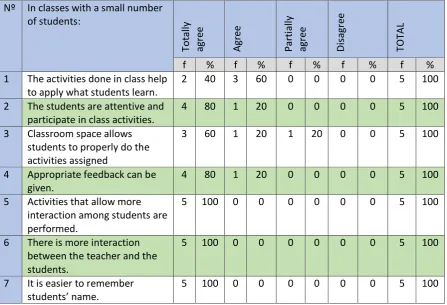
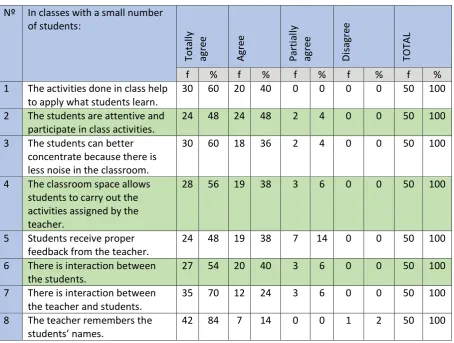
30 According to Table 1, 60% of teachers responded that working in small classes allow to apply what students have learned. For instance, some grammar topics and extra activities such as role plays, debates and interviews. This percentage means they agree, while 40% are totally agree with the statement mentioned above. On the other hand, 60% of students opined they can entirely put into practice the activities done in class. Although, there is a higher number in case of students, both points of view go in the direction of preferring working in small classes. These opinions match with Kelly and Stafford’s
opinion (1991) when they mention that small classes work provides opportunities for intellectual growth. In the observation done, this parameter was confirmed as the five teachers had the enough time to do some activities with each student including the evaluation part in the majority of the cases.
Continuing with question 2, 4 teachers (80%) stated when working with few students, they pay more attention and are more willing to participate in a diversity of activities that teachers had planned previously which include more tasks focused on the
students talking time. In case of students’ opinions, there are divided opinions into 48%
that totally agree, 48% that agree, and 4% that partially agree, but always being more partial to agree with small classes. The interesting fact in this question is the statement that Welty (1989) says, when he affirms that some students can get distracted easily since they can hear what other classmate is saying. However, in the observation, teachers were able to control the discipline, therefore there were no situations of distractions which contrast with what Welty stated above.
Question 3 displays that 60% of teachers think that the space of the classroom permits to develop the activities in the correct way. However, 20% of them agreed and
the other 20% partially agreed. The first parameter is quite similar in case of students’
31 When they were asked about noise and concentration relationship, 60% completely
agreed. Students’ affirmation coincides with Blatchford’s (2003) when he says that the
noise level plays a major role due to the fact that large classes can become uncontrollable and that teachers sometimes may feel more like a disciplinarian than a teacher. The results of the surveys as well as the author’s opinion match with the observation done due to the fact that the activities planned by the teachers were developed in calm with a minimum of noise that allow to execute them in almost a hundred percent.
Following with question 4 in teachers’ perceptions and question 5 of students’
perception, 80% of teachers believe that is really possible to provide a suitable feedback while a marked contrast can be seen due to students’ opinions. Answers are split into 48%
(totally agree), 38% (agree) and 14% (partially agree). Teachers’ conception matches
with Welty’s (1989) as the author states that in small groups, teachers have time to provide detailed feedback, so students get a better sense of how they are improving and where they need to work harder. During the observation phase, opposite to what students responded; the majority of the activities for instance, grammar explanations, listening and reading activities could be reinforced by the teachers.
32 prepared by the teachers led to a very important interaction between students at least when it had to do with organizing the students for pair work or group work activities.
Speaking of teacher-student interaction, teachers manifested a complete agreement with the fact that in small groups, there is a higher interaction between teachers and students. Referring to students, 70% completely agreed with this statement, whereas 24% tended to agree and 6% partially disagreed. Some authors coincide with what teachers and some students think. Just to mention some, Aronson, Elliot and Patnoe (1997) say that teacher-student relationship provide and essential foundation for effective classroom management. Once more, the observation stage helped to determine that many things in students-teachers relationship have certainly changed because of the total confidence that it could be seen in situations of doubt by students and the excellent predisposition of the teachers to solve each and every one of them.
The last question refers to the capacity of the teacher to remember the students’
names. 100% of the interviewed teachers responded that for them it is easy to recall their students’ names. On the other hand, students did not answer so overwhelmingly but the
majority (84%) which represents totally agree, aligned with teachers’ affirmation.
According to the observation done in class, it was easy to confirm that teachers remembered each and every one of the names, which is an aspect that has changed a lot too even though when the observed teachers had maximally fifteen students per class.
33 Table 3
What teaching strategies and resources benefit the teaching of English in small classes?
Teachers’ perceptions
Nº In classes with a small number of students: T ot a ll y a gre e Ag re e P a rt ia ll y a gre e D is a gre e T O T AL
f % f % F % f % f %
8 Design and apply activities that allow student to practice listening skills.
3 60 2 40 0 0 0 0 5 100
9 Design and apply activities that allow student to practice speaking skills.
4 80 1 20 0 0 0 0 5 100
10 Design and apply activities that allow student to practice reading skills.
5 100 0 0 0 0 0 0 5 100
11 Design and apply activities that allow student to practice writing skills.
5 100 0 0 0 0 0 0 5 100
12 Design and apply group work activities.
4 80 1 20 0 0 0 0 5 100
13 Design and apply individual activities.
5 100 0 0 0 0 0 0 5 100
14 Use technological tools. 5 100 0 0 0 0 0 0 5 100
15 Use didactic materials. 5 100 0 0 0 0 0 0 5 100
Author: Marcelo Angulo C.
34 Table 4
Students’ perceptions
Nº In classes with a small number of students: T ot a ll y a gre e Ag re e P a rt ia ll y a gre e D is a gre e T O T AL
f % f % f % f % f %
9 The activities done allow students to practice listening skills.
30 60 20 40 0 0 0 0 50 100
10 The activities done allow students to practice speaking skills.
38 76 11 22 1 2 0 0 50 100
11 The activities done allow students to practice reading skills.
32 64 15 30 3 6 0 0 50 100
12 The activities done allow students to practice writing skills.
28 56 21 42 1 2 2 0 50 100
13 Group work activities are used. 19 38 22 44 8 16 1 2 50 100
14 Individual activities are used. 26 52 24 48 0 0 0 0 50 100
15 Technological tools are used. 33 66 12 24 4 8 1 2 50 100
16 Didactic materials are used. 23 46 17 34 9 18 1 2 50 100
Author: Marcelo Angulo C.
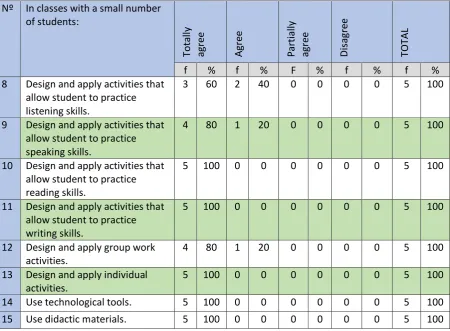
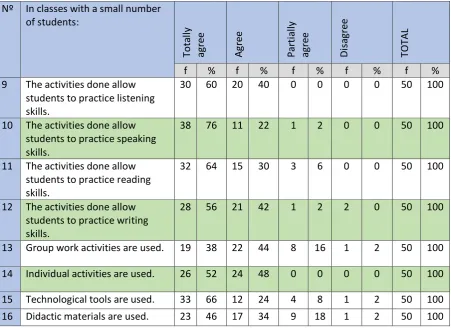
35 Questions 8 (teachers) and 9 (students) on Table 3 refer to the possibility of designing activities that can contribute to practice listening skills in a better way. 60% of teachers affirm that it is absolutely possible while 40% say just agreed with the statement. In a similar form, 60% of students coincide with teachers’ perception. Brookfield (1995),
confirms the opinions mentioned above when he says that the use of music is an interesting activity in small classes because of the variety of tasks in this case. Based on the class observation, this asseveration was proved when four of the five teachers applied different tasks using listening material for instance, songs, real conversations and pronunciation activities.
Analyzing questions 9 (teachers) and 10 (students), 80% of surveyed teachers and 76% of students represent the majority in case of affirming that in small groups, speaking activities are more likely to be developed. In the observation made in class, teachers proposed topics for debate and some others assigned themes for oral presentations which was a significant way of motivation as students showed their enthusiasm when it was their turn to speak. The opinions match with Brookfield theory (1995), who states that the idea of having students tell stories is a very attractive task which can be fun.
36 phrasal verbs with an extra activity that had to do with interesting discussions which headed to the speaking part.
The next part of the survey: questions 11 for teachers and 12 for students, allowed to notice some difference in opinions as 100% of teachers aligned with the idea of developing writing in small groups. On the contrary, 56% (a little bit more than the half), opined the same as teachers, whereas 42% marked just with the agreed indicator. Referring to class observation, four teachers had planned writing activities for their class. They commented that although with small groups it is still difficult to assess essays and some other kind of writing tasks, this type of assignments are much easier to grade than to correct thirty or thirty five papers. Brookfield (1995), suggests that in classes with few students activities such as “Chain writing” are very appropriate to be done as well as it is really important to stablish some parameters in the writing assessment.
Speaking of group activities responses to questions 12 (teachers) and 13 (students), displayed an 80% of teachers aligned with the totally agreement parameter and astonishingly 44% of students agreed over the 38% who aligned with the first indicator. The observation showed that the totality of teachers assigned one activity that was about pairing or group working which in most cases it focused on speaking exercises such as role plays and interviews. Aronson, Elliot and Patnoe (1997), state the idea of collaborative learning, particularly by using collaborative tasks. This interaction promotes not only language development but the growth of social skills.
37 Nevertheless, working with small groups permitted to assess the students through oral presentations which quoting teachers’ opinions in large groups it turns into a very “tiring and humdrum activity”.
100% of teachers responded that they use technological resources in class. Students’ thoughts vary because 66% affirmed this fact, while 24% answered with agree, 8% with partially agree and for the first time 2% that is a minimum responded that teachers never use technological devices for teaching. Meanwhile, during the observation it could be confirmed that two teachers used projectors to explain the lesson but students never attended to a lab at all. The teachers who did not use technology were very clear as they said one of the reasons why they did not teach with the usage of projectors, computers and digital boards was the lack of knowledge in basic aspects of computer science. On the other hand, the opposite part was visibly remarked as teachers who did use technology, indicated an evident advantage when they explained their lessons and also when their students performed their presentations without mentioning the benefits in case of movie activities as well as listening exercises. The whole analysis made above, confirms what Brookfield (1995) states, when he points out that the use of Internet is a very relevant resource, for instance, online lessons and the use of computer labs.
38 reduce of time in lesson planning and the interaction that the Internet and some applications offered to students.
In response to the question proposed, there are some strategies and techniques that can be applied more easily when teaching in small groups while the use of didactical material is being left aside by a great amount of teachers.
39 Table 5
How do students feel about learning English in small classes?
Teachers’ perceptions
Nº In classes with a small number of students: T ot a ll y a gre e Ag re e P a rt ia ll y a gre e D is a gre e T O T AL
f % f % f % f % f %
16 They are relaxed when speaking in front of their classmates.
3 60 2 40 0 0 0 0 5 100
17 They are taken into account by the teacher because they have more opportunities to
participate in class.
5 100 0 0 0 0 0 0 5 100
18 They are motivated to
participate because of the small number of students.
3 60 2 40 0 0 0 0 5 100
19 They are at ease because they can healthy compete with their classmates.
4 80 1 20 0 0 0 0 5 100
Author: Marcelo Angulo C.
40 Table 6
Students’ perceptions
Nº In classes with a small number of students: T ot a ll y a gre e Ag re e P a rt ia ll y a gre e D is a gre e T O T AL
f % f % f % f % f %
17 I am relaxed when speaking in front of my classmates.
27 54 17 34 5 10 1 2 50 100
18 I am taken into account by the teacher because I have more opportunities to participate in class.
27 54 21 42 1 2 1 2 50 100
19 I am motivated to participate because of the small number of classmates.
30 60 19 38 1 2 0 0 50 100
20 I am at ease because I can healthy compete with my classmates.
23 46 24 48 3 6 0 0 50 100
Author: Marcelo Angulo C.
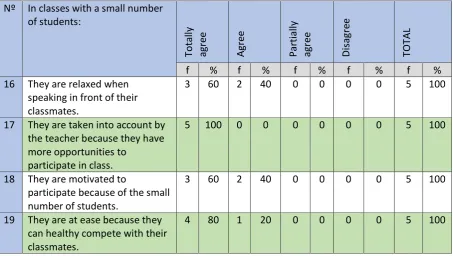
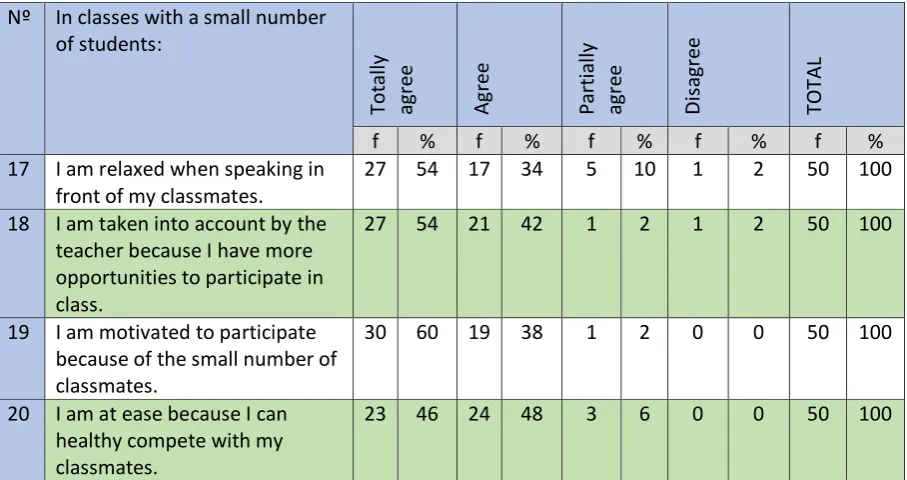
41 The next section of the current analysis contains the results of Tables 5 and 6. Questions 16 (teachers) and 17 (students) displays that 60% of teachers say that students feel relaxed when it comes to speaking in front of their classmates whereas 40% agreed
with this affirmation. There is a variety of opinions in case of students’ responses as a
54% feel no tense and the remaining 10% partially agreed by saying the contrary. In the observation class, students felt really comfortable and everybody did their best when they had to participate in front of their friends in activities such as oral presentations and role plays that teacher assigned previously. This situation can be matched with David and Weinstein’s (1989) advice as they affirm teachers have to try to make the class both attractive and functional considering some physical aspects like room arrangement, seating, etc.
In the following questions: 17 for teachers and 18 for students, 100% of the educators confirmed that in small classes every student is being taken into account and given the same attention. Almost half of the students (54%) affirmed that they are considered to be treated in the same way, nonetheless 42% stated just with the agree factor. In this case, it was so easy to confirm that during the class, the teachers paid close attention to any question of their students sorting out any doubt they had; more importantly, they were able to respond any question that came out in every moment of
the class. This confirms Bonwell’s thoughts (1995) when he observes the idea of
encouraging confidence and helping shy students to feel more comfortable.
42 them felt kind of shy and intimidated because of the greater level of some of their classmates. According to Aronson, Eliot and Patnoe (1997), one element that cannot be missed when working in small groups is motivation. They say that students feel motivated when they interact and are given the opportunity to measure their progress from time to time.
The final questions in this section (19-teachers and 20-students), which talk about that there is a better possibility to develop a fair competition between students in small
classes. Teachers’ perceptions display 80% (totally agree) while 20% show they agreed
with that point of view. According to students, the higher percentage is concentrated on the agree option with 48% followed by a 46% which totally agreed. During the observation class, there was no feeling of competition among classmates, the activities were more focused on the collaborative aspect. The class was surrounded by a group and pair work environment more than checking who had a better level.
It is interesting the way in which answers to questions on Tables 6 and 7 were done. Students affirm they feel better when they learn English in small groups because they feel more relaxed, they say there is a greater opportunity to participate and last but not least they feel motivated to fairly compete against each other.
43 Table 7
Are there any limitations when teaching English in small classes?
Teachers’ perceptions
Nº In classes with a small number of students: T ot a ll y a gre e Ag re e P a rt ia ll y a gre e D is a gre e T O T AL
f % f % f % f % f %
20 There is anxiety among
students because there is more control from the part of the teacher.
1 20 4 80 0 0 0 0 5 100
21 Students are attentive and participate in the activities done in class.
2 40 2 40 1 20 0 0 5 100
Author: Marcelo Angulo C.
Source: Teacher’s questionnaire
Table 8
Students’ perceptions
Nº In classes with a small number of students: T ot a ll y a gre e Ag re e P a rt ia ll y a gre e D is a gre e T O T AL
f % f % f % f % f %
21 There is anxiety among
students because there is more control on the part of the teacher.
9 18 22 44 18 36 1 2 50 100
22 Listening and speaking skills are more difficult to develop.
6 12 18 36 19 38 7 14 50 100
Author: Marcelo Angulo C.
44 The final section which contains Tables 7 and 8, shows questions 20 (teachers) and 21 (students) that refer to the existence of anxiety among students because of a major control by the teacher, 80% of teachers marked they agree with 80% of their answers. This means teachers consider there is a high level of inquietude between classmates. In case of students, responses are divided into: agree (44%) and partially agree (18%) which represents a contrast between teachers and students thoughts. In class, there was a minimum amount of students that showed nervousness at the time of participating in class. On the contrary, it could be said that 98% of them felt really enthused in class.
Welty (1989), suggests that teachers have to deal with anxiety in small classes due to the fact that shy students who are accustomed to large classes may feel uncomfortable, so teachers will have to take special measures to help those students gain confidence.
In teachers’ perceptions Table, question 21 refers to the level of attention and participation of students in small groups. Combining the second and third parameters, teachers state with 60% that some students get distracted and few of them participate actively in class. Welty (1989) corroborates that one of the challenges teachers have to deal with, is precisely distraction, because some pairs, for example, can be distracted by some other classmates as they hear what each other is saying. In the observation part, there was no such a considerable form of distraction of students. Instead, the majority were very willing to participate during the lesson. This happened because the teachers established some disciplinary rules since the beginning of the class, consequently, the students got acquainted about what they could do or what they couldn’t. The interesting
45 In the last question of students’ survey, 38% of them marked with partially agree by saying that in small groups is difficult to practice the speaking and listening activities. Despite the fact what numbers show in this question, the most important activities that were developed during the observation in class were the speaking and listening as teachers applied discussions and debates as well as exercises with songs.
It is undisputed that there are limitations when teaching English in small groups,
what authors’ state, and according to the meticulous observations made in every class,
there are more benefits than disadvantages when teachers work in classes with less than 20 students.
46 Conclusions
Smaller classes enable teachers to teach in a different, more effective way and to spend proportionately more time with each student in their charge.
Most of the analyzed studies show that teachers of smaller classes report that these are quieter and more easily managed than larger ones. Therefore, potential discipline problems can be prevented. This was confirmed by the note-taking and some conversation hold with the observed teachers as they reported that smaller classes are easier to manage and that they are less concerned about discipline than in larger classes.
The majority of teachers and students believe that class size impacts on students’
learning. Teachers claim that smaller classes enable more opportunities to get to know
children and devote more time to students’ individual learning needs.
Observation performed in class show great evidence of collaborative learning taking place amongst students; few appear to learn individually while sitting within groups.
Answers to research questions proposed for this study show that most of the
participants agreed with the theory that smaller class sizes increase student’s achievement
and help reduce the accomplishment breach. There is no doubt that teaching to small groups offer ways that students become more involved in learning and develop skills in working with others.
47 Recommendations
There is a great deal of schools in Ecuador where the number of students exceeds to 30 or more learners per class. According to the results and conclusions in this research class sizes should be reduced. Government officials, administrators, and educators should work together and implement class size reductions.
Teachers and educators should be trained on how class-size reductions have progressed and improved student scores throughout the years. Once changes have been implemented, student scores should be monitored and assessed on at least a yearly basis. Information should be then generated to provide evidence that class size reductions make a difference in the learning process.
No more than 20 students should be permitted in any class. Ideally, classes should be limited to 15 students maximally.
Any reduction in class size should be accompanied by other efforts, such as training for teachers on teaching techniques, which take full advantage of the increased student-teacher interaction that according to the results of this research was possible in smaller classes.
If schools want to apply reductions in class size, this should be phased gradually as well as it ought to be accompanied by adequate financial support so as to avoid unintended consequences.
48 REFERENCES
Achilles, C. (1996). Response: Students Achieve More in Smaller Classes, New York:
53 Educational Leadership.
Anderson, L. W. (2000). How small classes help teachers do their best. Philadelphia:
Temple University Center for Research in Human Development.
Aronson., Elliot., & Patnoe, S. (1997). Cooperation in the Classroom: The Jigsaw
Method. New York: Longman. Orlando.
Bain, H., & Achilles, C. (1986). Interesting Developments in Class Size. Boston: Phi
Delta Kappan.
Biddle, B. J., & Berliner, D.C. (2002). What research says about small classes and their
effects. Policy Perspectives, 10, 60-64.
Blatchford, P. (2003a). The class size debate: Is small better? Maidenhead, U.K. and
Philadelphia, U.S.A: Open University Press.
Bonwell, C. C. (1995) Active Learning: Creating Excitement in the Classroom. Center
for Teaching and Learning, St. Louis College of Pharmacy.
Brookfield, S. D. (1995). Becoming a Critically Reflective Teacher. San Francisco:
Jossey-Bass.
Browning, M., & Heinesen, E. (2007). Class Size, teacher hours and educational
49
Chi, M.T.H., (2009). Active-constructive-interactive: A conceptual framework for
differentiating learning activities. Topics in Cognitive Science.
Cohen, Elizabeth G. (1994). Designing Groupwork: Strategies for the Heterogeneous
Classroom. Second Edition. Teachers College Press, Columbia University, N.Y.
Connor, K. & Day, R. (1989). Class Size: When Less is More. Sacramento: Senate
Office of Research California Legislature, Sacramento.
David, T.G. & Weinstein, C.S. (1987). The built environment and children's
development. New York: Plenum Press.
Fidler, P. (2002). The Impact Of Class Size Reduction On Student Achievement in
English Class. Planning, Assessment and Research Division Publication, 109,
22-35.
Finn, J., & Achilles, C. (1990). Answers and Questions about Class Size. American
Educational Research Journal, 27.
Finn, J., DeWayne F., Zaharias J., & Nye B. (1992). Carry-Over Effects of Small
Classes. Peabody Journal of Education, 67.
Finn, J., Pannozzo, G., & Achilles, C. (2003). The ‘why’s’ of class size: Student
behavior in small classes. Review of Educational Research, 73(3), 321-368.
Graue, E., Hatch, K., Rao, K., & Oen, D. (2007). The wisdom of class size reduction.
American Educational Research Journal, 44(3), 670-700.
Haimson, L. (2000). First-hand reports of early grade class size reduction in language
50 Harfitt, G. (2011). How class size reduction mediates secondary students’ learning:
hearing the pupil voice. Springer, 13, 299–310.
Hoxby, C. (2000). The Effects of Class Size on Student Achievement: New Evidence
from Population Variation. Quarterly Journal of Economics, 115(4), 1239-
1285.
Kelly, M., & Stafford, K. (1991). Teaching and Learning in Small Groups: An
Introduction, Professional Development Unit. Honk Kong.
Molnar, A. (2000). Wisconsin’s student achievement guarantee in education (sage) class
size reduction program: achievement effects, teaching and classroom
implications. Temple University Center for Research in Human Development
and Education, 15, 227-237.
Slavin, R. (1989). Class Size and Student Achievement: Small Effects of Small Classes.
California: Educational Psychology Publishers.
Welty, W. (1989). “Discussion Method Teaching: A Practical Guide”.216.
Wilson, V. (2001) Classroom Assistant: Lessons from the pilot projects – Preliminary
report. Edinburgh: SCRE.
Woessman, L., & Martin, R. (2006). Class-Size Effects in School Systems around the
World: Evidence from Between-Grade Variation. European Economic Review,