Potential Programming Plan and Domain Concept
Detection Supported by Slicing Technique
Gustavo Villavicencio Facultad de Matem´atica Aplicada Universidad Cat´olica de Santiago del Estero 4200 Campus de la UCSE, Santiago del Estero, Argentina
Abstract
Little has been written about the component provision problem (programming plans and domain concepts) for the repositories of knowledge in program understanding systems and reports that specifically address this issue are unknown. Model-driven and plan-driven approaches use repositories where construction and evolution are informal and depend on the experts. In domains where the expert is not available the only valid source of infor-mation is the source code. But, domain concept design and programming plans from the source code by non-expert professionals is not a trivial task.
In this paper, a hybrid top-down/bottom-up approach based on algorithmic pattern matching and slicing techniques has begun to be defined in order to provide plans or con-cepts (termed activities in the model-driven approaches) to the knowledge base. Initially, the exploration area is restricted by slicing techniques, and then, software inspection tools are used to further limit the relevant areas. Finally, the initially hypothesized pattern is matched with these segments.
1
Introduction
The construction and evolution of the knowledge repositories of the plan-driven [29, 7] and model-driven [11, 12] approaches have always been dependent on the software engineer’s expe-rience on the domain problem. Regarding this topic, [13] describes the problems in the model-driven approach; and the situation isn’t much better in the plan-model-driven approach as it is argued in [21].
So, both model-driven and plan-driven approaches have the same problem: their main knowledge repository is constructed and evolves in an intuitive manner. Therefore, we have a great problem in our hands: The main component of the system understanding is constructed and maintained in a deficient way; what can we expect on effectiveness, precision, etc.?. The situation is even worse in areas where the expert is not available. Must we resign the use of these technologies in those cases?
Here we are providing a more pragmatic approach to the potential programming plan (PPP hereafter) detection problem than those in [25, 26]. It is a combination of those described briefly in [21] and in [25, 26]. Besides, this technique has a strong automatic support that enormously increases process agility.
The proposed technique allows engineers, maintainers, etc. to explore the source code for detecting PPPs and domain concepts (DCs hereafter)1 in the domain. The scope of the source code to analyze is reduced by applying slicing technique [28]. The detected PP instance pro-vides the information to scale-up to the DC.
The present work is continuation of [25, 26] where slice-to-slice matching2 is performed to design PPPs from the source code. However, the number of slices calculated in real-world systems makes the technique very hard to apply. So, a more pragmatic approach is required.
On the other hand, [13] relate DCs toExecutable Concept Slicing(ECS). Essentially, the information in the domain model is used to construct high level slicing criteria to obtain the ECS (top-down approach).
The present work tries to combine both top-down and bottom-up approaches to program un-derstanding. On one side, the imprecise knowledge of the domain problem and the applications in it, is expressed as PPP (top-down). On the other side, a useful program slice is calculated (bottom-up). The PPP is matched with the slice and, starting from here, the PPP is improved and the involved DC detected. A graphical view is shown in fig. 1.
The contributions of this paper are:
1. According to the bibliographical information available, no other technique has been pro-posed to “feed” PPs and/or action concepts (activities) [11, 12] to the repositories of knowledge.
2. It is the first attempt of combining concept assignment and PPs with slicing technique.
3. Slicing techniques are used for a purpose they have never been used before.
4. In [20, 21] et al. a code-driven approach is presented as an improvement of the library-driven approach [15] et al. The present technique, would lead a plan/slice-driven
ap-proachto recover programming plans and also action concepts.
1
In our context DC will be synonymous to action concept [11, 12] or domain activities.
✬
✫
✩
✪
(Top−down) Harman et al.
Domain concept (Top−down/Bottom−up) Conceptual level Implementation level Structural level Plan 0 0 0 0 0 0 0 0 0 0 0 0 0 0 0 1 1 1 1 1 1 1 1 1 1 1 1 1 1 1 Slice Slice concept Domain This paper
Figure 1: Approaches to relate DCs to slices
The rest of this paper is organized as follows: Section 2 gives a very quick overview on PP concepts and its relation to DC. Section 3 analyzes how the slicing technique is used in this approach. The strategy is presented in section 4. Then, an example is developed in section 5. Finally, future directions and conclusions are presented in sections 6 and 7 respectively.
2
Background
2.1 Plan Recognition
In general, there is a uniform criterion among the authors in the program understanding area about what concepts likeclich´e,PP,pattern, andprogram templatemean. So, in [19] a pattern is defined as solutions to recurring problems at different levels of abstraction (e.g. code pattern, design pattern, and architectural pattern). In [30], the clich´es are defined as commonly used data structures and algorithms that implement higher level abstractions. In [8] a plan denotes a description or representation of a computational structure that the designer has proposed as a way of achieving some purpose or goal in a program. But, a plan is not necessarily stereotypical or repeatedly used; it may be novel or idiosyncratic [8].
Therefore, a PP represents a scheme in which a problem can usually be solved by compu -tational means. The scheme is mainly represented in terms of structural information, data and control flow. The PPs are stored in libraries. Pattern matching algorithms explore the libraries in order to detect instances of PPs in the source code. A pattern can be structural if it is only based on syntactical structure, or behavioral if its components have restrictions based on control and data flow. Here we are interested in the last kind of PPs, i.e. based onconstrain satisfaction algorithms[21, 20] et al.
In [5], Biggerstaff claims that programming plan technologies cannot be applied to real-world systems. However, [20] claim the opposite.
2.2 PPs and DCs
(. . .) Such concepts are encoded as plans, which are abstract representations em -bodying the knowledge about program concept components and constraints.
Based on this evidence, we can argue that the PPPs can supplystructural evidencefor the design of concepts (activities) at the domain model. We also argue that, in order to scale-up to action concepts, a great part of the information can be obtained from the detected PPP, or at most, from the surrounding code (the slice).
But, can we include slicing technique in the previous context? We argue that it is possible. On one side, [13] relate DCs to ECS. This is a refined idea of that presented in [7] which talks aboutconceptual slices. On the other side, [25, 26] relate slicing technique to PPs. In this paper we are trying to “close the circle” arguing that PPs provide structural evidence for constructing a DC in a domain model. However, the same programming plan can be shared by more than one DC. Therefore, further analyses of the surrounding source code (the slice) would have to be carried out to find the concept to which the plan is linked.
Thus, the importance of detecting a PP first is that it defines the surrounding source code from which to obtain evidence to scale-up to the DC.
3
Slicing Technique Role
Astatic sliceis calculated with respect to aslicing criterionwhich includes a program location
(usualy a line number) and a variable of interest. Then, a sub-program is computed performing a dependency analysis (data and control flow analyses). It includes all sentences to which the variable in the slicing criterion is related. For an overview on this technique see [6] et al.
In our approach, we will try to exploit thereducing power of the slicing technique to limit the space of the PPP search. To achieve this, the calculation of a useful slice will be necessary. But [13], talking about how to detect the segment that executes themortgage calculation concept, said
Unfortunately, pure slicing cannot help unless the engineer knows which variables are important for this computation.
We agree that it is so, but we cannot ignore the informal information utility [2, 3, 4] et al. which combined with astring pattern matchingtechnique, can quickly solve this problem. We must also consider that a program understanding process cannot be possible without any pre-existing knowledge on the subject program and domain problem as it is argued in [22].
4
Detecting PPPs and DCs
The strategy that will be described in this section has an important automatic support, not only to inspect the source code but also the specifically calculated slice. The matching phase also has automatic means.
✬
✫
✩
✪
domainof the Knowledge
Source code
Design
Tool Design
Tool
Design Tool Browser
Reduce a plan
Hypothesize
scope analysis
Dependency
Constraints
Slicer Abstraction
plan
Concept
Abstraction Browser
PPP concept domain Design
MatcherPlan
Browser Abstraction string
Match Calculate slice
Improve Partially
match
[image:5.595.89.530.96.232.2]Browser String pattern matcher
Figure 2: The process in SADT format
4.1 Hypothesized Plan
When a DC is searched, the reverse engineer has in mind, among other things, some kind of
abstract algorithmical morphology, which should be present in the concept. But if this ideal
representation does not have a concrete existence, its utility decreases.
Thus, based on the pre-existing knowledge of the domain and the applications in it, the reverse engineer proposes a PPP related to the DC. This activity is similar to that proposed in [21]. But in our case, the PPP leaves the programmer’s mind and has a real existence. This plan expresses the imprecise knowledge the reverse engineer has regarding the pattern searched. It will only be composed of basic components and some restrictions among them. In order to adopt the terminology used in [21], the PPP designed here will be termed plan example or
hypothesized plan.
We use this kind of imprecise knowledge because we propose an automatic support to handle it: Algorithms ofpartial constraint satisfaction problems(PCSP) [10, 27].
4.2 String Matching
Based on the limited knowledge about the subject application, the reverse engineer searches for significant character sequences in the source code. The aim here is to focus the reverse engi-neer’s attention on the significant segments. The tools used can be diverse, simple like grep
or more complex like ESPaRT [19]. Actually, this last tool can detect very complex syntactical patterns. However,CodeSurfer[1] andProgram Slice Browser(PSB) [9] can also provide string searching mechanisms.
Commonly, the request is focused on the data, but it will not always be so. Some cases will require to explore comments; others will require typical sentences, procedure names, etc. These alternative heuristic searches can be used to approximate us to the sentences we are interested in and study the surrounding code. The aim is to gather evidence on a specific data item; that which is the output of the plan example. This kind of variables are calledprincipal variables
in [13] where they are used to detect the key statements of the concept by slicing technique. Similarly, here we are trying to detect the principal variables, and then, by means of slicing technique, gather the sentences that instance a plan.
4.3 Slicing
Once relevant data items are detected, a slice is calculated based on them. Obviously, the smaller the slice, the better. So, it is important to specify theslicing criterionbased on correct data.
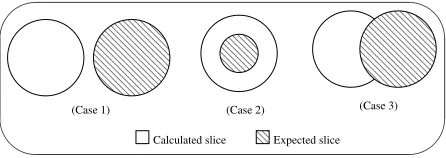
But several cases can happen when the data item in the slicing criterion is not the required one:
• Case 1: The specified data item has no relation with the data item it is looking for. So, the
calculated slice will not bring the plan instance we are interested in.
• Case 2: The computations on the specified data item request computations on the relevant
data item. Therefore, the calculated slice will be greater than necessary.
• Case 3: The computations on the specified data item request some computations on the
relevant data item. In this case, the calculated slice can only bring some or none instances (computations) of the plan we are interested in.
★
✧
✥
✦
000 000 000
111 111 111
0000 0000 0000 0000
1111 1111 1111 1111
0000 0000 0000 0000
1111 1111 1111 1111
0 0
1 1
(Case 1) (Case 2) (Case 3)
[image:6.595.186.409.351.430.2]Expected slice Calculated slice
Figure 3: Relation between slices
Figure 3 depicts these situations. Obviously, the second case is the most usual and there are different levels of closeness between calculated and expected slices. However, the third case (fig. 3) can also be successful but it depends on the presence of all the relevant computations in the intersection region.
A slice is calculated at the end of the program because it is not possible to knowa prioriin which segments of the slice the hypothesized PP components are. They can also be delocalized [16].
4.4 Reduced Scope
The main target of this phase is detecting those segments in the slice, usually procedures or functions, where the presence of PP components is expected. In fact, this activity can be omit -ted depending on the size of the calcula-ted slice. If the slice has a moderate size, the next task
ofPartial Matching can be executed successfully. At this point, what was previously said in
section 1 acquires importance. That is, the approach we have taken can also be used to define a
plan/slice-driven approachbased on constraint satisfaction algorithms.
sentences that affect directly the data items in the slicing criterion, but also those sentences that modify variables that affect the items in the criterion and so on. Therefore, the calculated slice can contain algorithmical structures indirectly related to the PP that has been searched, and, consequently, are secondary for our purposes. Therefore, the next task ofPartial Matchingcan have problems.
The slice inspection (orReduced Scopephase) can be driven by the informal information in the source code. Thus, for example, the function or procedure names are very significant [2] and can help us detect relevant segments. Obviously, here we are consideringinter-procedural slicing[14], which, in our context, is related todelocalized PPs[16].
However, in other cases, the informal information is not sufficient and further analyses would be needed to detect relevant segments. A heuristic to use in this situation is to obtain those segments where the variables in the slicing criterion have been assigned or printed (key
statementsin the context of [13]). Other segments where the variables are only used would be
less relevant because they would not have a direct relation with the components and restrictions of the hypothesized PP. This task can be supported by a tool likeThe FinderinCodeSurfer.
Once these sentences are found, the relations with other sentences are analyzed. The tar -get is to detect some clues of the components and restriction of the hypothesized PP presence. These observations must be confirmed afterward in thePartial Matchingphase.
Both,PSBandCodeSurferprovide tools for supporting this slice inspection task.
Up to a degree, during this phase, the reverse engineer obtains a detailed view of the com-ponents and constraints present in the instance as described by [21] (recall section 1), but differ-ently; here we have a slice in the background!.
4.5 Partial Matching
At this point, the source code obtained would have been reduced. The plan example would have been confronted with the critical areas selected in the previous Reduced Scope activity. The target of this phase is not “understanding” the slice segments obtained by reduction, but “marking” the zone where there is evidence of the hypothesized PP presence.
Depending on the precision with which the hypothesized PP was described, algorithms of
constraint satisfaction problems (CSP) [20] et al. or PCSP can be applied. The first kind of
algorithms can be used when the reverse engineer relies on a highly accurate plan example. However, the imprecision introduced during the hypothesizing phase can make the problem insoluble by CSP algorithms. Therefore, a PCSP algorithm can also be applied. See a formal description and application example of this last algorithm in [26].
We can say that at this phase we are trying out an “imprecise understanding” as suggested by [21], but in an entirely different way.
4.6 Improving PP
Since the hypothesized PP is still incomplete, many components and restrictions which were not considered before can become evident at this moment.
Here, the reverse engineer focuses his attention on algorithmical structures and tries to leave aside the relations among them, and with those components that already exist in the hypothe-sized PP. The exploration area in the slice is restricted to those identified in theReduced Scope
A browser combined with abstraction mechanisms supplied by a reverse engineer is in -tensely used at this phase. Cross reference capacities are applied to detect the relations among relevant sentences. In PSB also, irrelevant segments in the slice can be encapsulated in blocks to reduce the information shown. Emphasizing the important components (sentences and relations among them) and hiding the irrelevant ones would be very useful capacities at this phase.
4.7 Domain Concept Design
As in the previous activity, the search area for evidence has been restricted by theReduced scope
activity.
Because the main target at this phase is to find action concepts, the reverse engineer’s atten-tion would be focused on sentences. Specifically, the sentences that instance the PP where the concept indicators are expected to be found. Usually, there is an object on which the action is performed. It would be extracted from the data items that handle the sentences that instance the PPP. Again, the main “tool” at this phase is the reverse engineer’s abstraction.
These last two activities are entirely manual and there is not any way to replace the reverse engineer’s abstraction capacity. In an approach as the one just described, technology can only help to guide and focus the reverse engineer’s attention towards significant segments.
5
An Example
This case study has been achieved on a small, but real-world program. Due to lack of space, the program source code is not listed. Only the calculated static slice is shown in appendix A. In order to save space, all the calculated slice commentaries have been omitted.
Suppose, for instance, that we have some source code analyzing tools in the software doc-umentation area. Specifically, we have a program that extracts and counts the number of com-ments from C and C++ programs.
Let us suppose, in addition, that we are interested in the pattern thatextracts a C comment. The final output of this PP would be a comment on the standard output. We suppose a vague knowledge about the components of the PP and the relations among them. This knowledge can be depicted as shown in fig. 4.
✬
✫
✩
✪
Extract−c−comment
Detect−begin Outputting−comment
Get−out−char Loop−through−comment
Read−ch
putc Read−next−ch loop
getc Check−ch
Decomposition
Specialization
test−eof ’/’ ’*’
The main restrictions in the plan example are:
1. The OUTPUTTING-COMMENT component has a control dependency on the DETECT
-BEGINcomponent.
2. The GET-OUT-CHAR component has a control dependency on the LOOP-THROUGH
-COMMENTcomponent.
3. The GET-OUT-CHAR component has a data dependency with READ-NEXT-CH
compo-nent.
4. The READ-NEXT-CHARcomponent has a data dependency on the TEST-EOFcomponent.
Now, we will try to extract the slice related to this PP. First, we can execute some kind of string pattern matching to detect those source code segments where the output variable of the activity modeled by the PP is defined or used. However, we have no evidence on which is the string to search on the data items. But, we know that two macros may be applied on it:
putchar orputc. The search ofputchar by means of grep putchar GETCMT.Cis negative.
But, positive result is obtained by means ofgrep putc GETCMT.C. Specifically, analyzing the context of the sentence
putc(chi,stdout)
(executed sentences, comments, etc.) we conclude that the chivariable is the data item which we are searching, the principal variable (recall section 4.2). Therefore, we use this variable in theslicing criterion to calculate the slice where we hope to find an instance ofCOMMENT -EXTRACTIONpattern. At the end of this paper we show the calculated slice.
Although the slice has an acceptable size executing Partial Matching successfully, we as-sumed it was not so, and achieved some detailed observations. If we were using CodeSurfer
we would have many ways (using the System Dependency Graph, for instance) to see that both
putcsentences ininside c cmtshave a control dependency on thewhile()sentence (perhaps re-striction 2). The secondgetcsentence has a data dependency on the conditional in thewhile() sentence (perhaps restrictions 4). Theputc()sentence has a data dependency on bothgetcin the
while()sentence (perhaps restriction 3). All these sentences are executed becauseinside c cmt
is called by extract c cmtswhere there are sentences that detect the beginning of a comment (perhaps restriction 1).
Based on this evidence, we can propose extract c cmts and inside c cmt as relevant seg-ments on which to execute thePartial Matchingtask.
Once the exploration space is reduced, the process continues in thePartial Matching task. Here, the hypothesized plan is confronted with the sentences inextract c cmtandinside c cmt. The result of the matching is shown in fig. 5.
This is a nice view of the results obtained by the partial matching activity. However, in larger slices this representation can be impractical. For solving this problem, those sentences in the source code that instance a component in the plan can be annotated with the component name.
✬ ✫ ✩ ✪ Detect−begin Read−ch Check−ch Outputting−comment Extract−comment Get−out−char Loop−through−comment Loop Test−eof Read−next−ch
if(cht == EOF) int extract_c_cmts() {
register int chi, cht; chi = getc(infile); while(chi != EOF) {
if (chi == ’/’) {
cht = getc(infile);
return(); inside_c_cmt(cht); else ungetc(cht,infile); } } return; } }
void inside_c_cmt(int ch) {
register int chi, cht; if(ch == ’/’) ch = ’\n’; chi = getc(infile); while(chi != EOF) {
if(chi == ch) {
if(ch == ’\n’) return; cht = getc(infile); if(cht == ’/’) return; else {
putc(chi, stdout); ungetc(cht, infile);
chi = getc(infile); else } putc(chi, stdout); } return; } chi = getc(infile);
if(cht == ’*’ || cht == ’/’)
Figure 5: Matching result of the program plan example and the selected segments in the slice
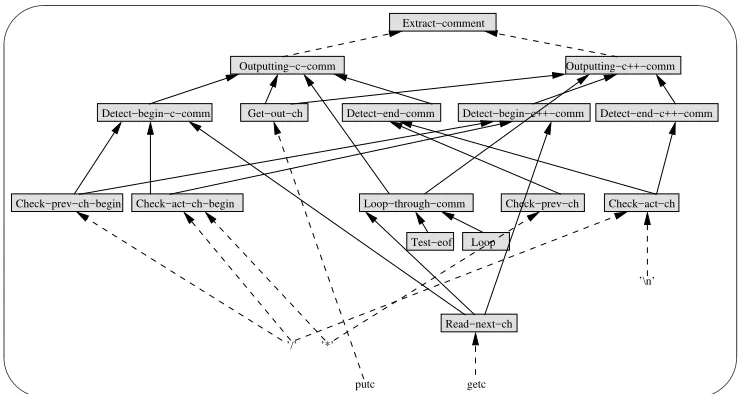
library in fig. 4, is that of providing evidence of a plan that extracts C++ comments. Therefore, the library must be reestructured to introduce this specialisation. At the same time, there are algorithmical components that are shared by both programming plans that must also be modeled in the library. The final result is depicted in fig. 6.
Finally, based on the structural evidence provided by the PP, plus the detailed information in the surrounding source code, we design the corresponding segment of the domain model as shown in fig. 7. The notation used in this fig. was taken from [13].
Like theplan exampleimprovement task, the design of concepts is also a manual activity. The reverse engineer must observe, detect, and abstract from the surrounding code the elements composing the concepts and how they will be arranged in the library.
Therefore, from the instance of the PP components the reverse engineer obtains the indica-tors3which are evidence of the presence of a concept (action concept in this case) in the source
code. The detected specialisation ofCommentconcept inC-commentand C++-comment is a typical result of an abstraction task executed considering the surrounding source code.
This is a small example. But, a more complex PPP and DC can be designed from a medium -large COBOL slice as shown in [25].
3
✬
✫
✩
✪
Outputting−c−comm
Detect−begin−c−comm Get−out−ch
Outputting−c++−comm
Read−next−ch
Check−prev−ch−begin Check−act−ch−begin Check−prev−ch Check−act−ch Detect−end−comm Detect−begin−c++−comm Detect−end−c++−comm
Loop
’*’ ’/’
’\n’ Extract−comment
putc getc Loop−through−comm
[image:11.595.112.482.96.293.2]Test−eof
Figure 6: Improvedhypothesized plan
✬
✫
✩
✪
Comment
Extract Comment
C++−Comment C−Comment
"/*" "*/" "//" "putc"
"while()" "getc"
Extract
Figure 7: Domain model fragment designed from the detected PP and surrounding source code
6
Future Work
The construction of repositories of knowledge for program understanding systems (plan-driven and model-driven approaches) from the source code is not a trivial activity. The critical ques-tion: where to begin this process, has not been treated here. And we do not have any answer either. However, some clues on where to follow once a plan is detected are provided. In [25] it has already been suggested that the closeness of the plans in the libraries has relation to the proximity of the data items used to specify the slicing criterion4. Thus,cluster analysis
tech-4
niques[18, 24] can be applied to detect the related PPs. We have no experimental results about this. However, [13] also propose the use of cluster analysis to detect related concepts.
On the other hand, the combinational explosion that occurs when the constraint satisfaction algorithms are applied on real source code, has limited the plan-driven technology to the lab-oratory environment. But, the doubt imposed by Biggerstaff et al. on the applicability of this technology to real software systems, and partially cleared by [20], could be definitely solved by a variation of the present approach. In [15] et al. a library-driven approach is taken to plan recognition. In [21, 20] et al. a code-driven approach is used to detect concepts. This just pre-sented technique can become the base to a more complex one: Theplan/slice-driven approach
to plan recognition. In this context, a string analysis as suggested by [2, 3] for instance, would be performed. Based on this analysis, acatalog of slicing criteriawould be constructed. Thus, the matching process would be carried out selecting a slicing criterion from the catalog and a plan from the library. In this way, the matching algorithms search for plan instances on specific areas in the source code, in contrast to the whole source code as up to now. Maybe this research path is the most exciting finding of this paper.
It would also be very interesting to compare the previously described approach with that in [17], where the plan library is pruned using a signature-based technique to reduce the search area.
7
Summary and Conclusions
Up to date, the construction of PP libraries or concept libraries in a knowledge-based concept assignment approach has been made by domain experts. But, we do not have any solution for domains where the expert is not available, nor any technique to help the expert provide compo-nents to the library. So, the construction and maintenance of these libraries is rather erratic [13]. We have outlined a technique that allows to detect plans for plan-driven approaches and/or provide structural evidence to model activities (action concepts in [11] et al.) in model-driven approaches. The theoretic support for the approach is based on [25, 26] (a slice can implement a PP) and [13] (a slice can implement a DC). Therefore, the key activity underlying this technique is program slicing. Its reducing power is applied to limit the search space. A set of automatic tools is used throughout the process to reduce the set of domain values (slice sentences) that instance the variables (PP components).
A key component of the strategy is the use of the PCSP algorithms which allow an impre-cise understanding from where to scale up during the Improvement Planand Design Domain
A
Calculated slice
#include <stdlib.h> #include <stdio.h> #include <ctype.h> #include <string.h>
#define LOOKS_GREAT 1 #define LESS_FILLING 0
int extract_c_cmts(void); void inside_c_cmt(int);
FILE *infile = stdin; int show_nos = 0;
main(int argc, char *argv[]) {
register int i; const char *hype =
"\nGETCMT v1.1
-GET CoMmenTs\nby Byte_Magic Software\n"; const char *oops =
"\a*** GETCMT - Can’t open input file "; fputs(hype, stderr);
if (1 < argc) {
for (i = 1; i < argc; ++i) {
if (’/’ == *argv[i]) {
if (’l’ == tolower(argv[i][1])) else
{
int ercode;
ercode = (’?’ == argv[i][1]) ? 0 : -1; if (ercode) putc(’\a’, stderr); return(ercode); } } else {
infile = fopen(argv[i], "r"); if (!infile) { fputs(oops, stderr); fputs(argv[i], stderr); } } } }
i = extract_c_cmts(); putc(’\n’, stdout); return(i);
}
int extract_c_cmts() {
register int chi, cht; chi = getc(infile); while(chi != EOF) {
if(chi == ’/’) {
cht = getc(infile); if(cht == EOF)
return();
if(cht == ’*’ || cht == ’/’) { inside_c_cmt(cht); } else ungetc(cht, infile); }
chi = getc(infile); }
return(); }
void inside_c_cmt(int ch) {
register int chi, cht; if(ch == ’/’)
ch = ’\n’; chi = getc(infile); while(chi != EOF) {
if(chi == ch) {
if(ch == ’\n’) return;
cht = getc(infile); if(cht == ’/’)
return; else { ungetc(cht, infile); putc(chi, stdout); } } else putc(chi, stdout); chi = getc(infile); }
References
[1] P. Anderson and T. Teitelbaum. Software inspection using codesurfer. In1st Workshop on
Inspection in Software Engineering, Paris, France, Jul. 2001.
[2] N. Anquetil. Characterizing the informal knowledge contained in systems. In Working
Conference on Reverse Engineering, Stuttgart, Germany, October 2-5 2001. IEEE CS
Press.
[3] N. Anquetil and T. Lethbridge. Assessing the relevance of identifier names in a legacy software system. InCASCON’98, Toronto, Canada, 1998.
[4] N. Anquetil and T. Lethbridge. Recovering software architecture from the names of source files. Journal of Software Maintenance: Research and Practice, 11:201–221, 1999.
[5] T. J. Biggerstaff, B. Mitbander, and D. Webster. The concept assignment problem in pro-gram understanding. In15th International Conference on Software Engineering, Balti-more, Maryland, May 1993. IEEE CS Press.
[6] D. Binkley and M. Harman. A survey of empirical results on program slicing. Advances
in Computers, 2004. To appear.
[7] David Ching and Alex Quilici. Decode: A cooperative program understanding environ-ment.Journal of Software Maintenance, 8(1):3–34, 1996.
[8] Richard Clayton, Spencer Rugaber, and Linda Wills. On the knowledge required to under-stand a program. InFifth IEEE Working Conference on Reverse Engineering, Honolulu, Hawaii, October 1998.
[9] Yungo Deng, Suraj Kothari, and Yogy Namara. Program slice browser. In 9th IEEE
International Workshop on Program Comprehension, Toronto, Canada, May 12-13 2001.
[10] E. Freuder and R. Wallace. Partial constraint satisfaction. InProceedings of the Eleventh
International Joint Conference on Artificial Intelligence, Detroit, Michigan, USA, 1994.
[11] N. Gold. Hypothesis-Based Concept Assignment to Support Software Maintenance. PhD thesis, Department of Computer Science, University of Durham, 2000.
[12] N. Gold. Hypothesis-based concept assignment to support software maintenance. InIEEE
International Conference on Software Maintenance (ICSM’01), pages 545–548, Florence,
Italy, November 2001. IEEE CS Press, Los Alamitos, California, USA.
[13] Mark Harman, Nicolas Gold, Rob Hierons, and David Binkley. Code extraction algorithms which unify slicing and concept assignment. In IEEE Working Conference on Reverse
Engineering, Richmond, Virginia, USA, October 2002.
[14] S. Horwitz, T. Reps, and D. Binkley. Interprocedural slicing using dependence graphs.
ACM Transactions on Programming Languages and Systems, 12(1):26–61, 1990.
[15] V. Kozaczynski and J. Ning. Automated program understanding by concept recognition.
[16] S. Letovsky and E. Soloway. Delocalized plans and program comprehension. IEEE Soft-ware, May 1986.
[17] Y. Limpiyakorn and I. Burnstain. Applaying the signature concept to plan-based program understanding. InIEEE International Conference on Software Maintenance, Amsterdam, The Netherlands, September 22-26 2003. IEEE Press.
[18] S. Mancoridis, B. Mitchell, C. Rorres, and Y. Chen. Using automatic clustering to produce high-level system organization of source code. In International Workshop on Program
Comprehension, Ischia, Italy, June 1998.
[19] Martin Pinzger and Harald Gall. Pattern-supported architecture recovery. In10th
Interna-tional Workshop on Program Comprehension, pages 53–61, IEEE CS Press, Paris, France,
June 2002.
[20] Alex Quilici, Steven Woods, and Yongjun Zhang. Program plan matching: Experiments with a constraint-based approach. Science of Computer Programming, 36:285–302, 2000.
[21] Alex Quilici, Qiang Yang, and Steven Woods. Applying plan recognition algorithms to program understanding.Journal of Automated Software Engineering, 5(3):347–372, 1998.
[22] V´aclav Rajlich and Norman Wilde. The role of concepts in program comprehension. In
International Workshop on Program Comprehension, pages 271–278, Paris, France, June
2002.
[23] P. Tonella, R. Fiutem, G. Antoniol, and E. Merlo. Augmenting pattern-based architec-tural recovery with flow analysis. InThird Working Conference on Reverse Engineering, Monterrey, California, USA, November 8-10 1996.
[24] Arie van Deursen and Tobias Kuipers. Identifying objects using cluster and concept anal-ysis. ICSE’99, ACM, 1999.
[25] G. Villavicencio. Program analysis for the construction of libraries of programming plans applying slicing. In XIV Brazilian Symposium on Software Engineering, Jo˜ao Pessoa, Para´ıba, Brasil, October 2000.
[26] G. Villavicencio. Program analysis for the automatic detection of programming plans ap-plying slicing. In5th European Conference on Software Maintenance and Reengineering. IEEE CS Press, Lisbon, Portugal, March 2001.
[27] C. Voudouris and E. Tsang. The tunneling algorithm for partial csps and combinatorial optimization problems. Technical report, University of Essex, September 1994.
[28] Mark Weiser. Program slicing. InFifth International Conference on Software Engineering,
San Diego, California, March 1981.
[29] L. Wills. Automated Program Recognition by Graph Parsing. PhD thesis, AI Lab, Mas-sachesetts Institute of Technology, 1992.
[30] Linda Wills and Charles Rich. Recognizing a program design: A graph parsing approach.