144 ISSN 0326-2383 KEY WORDS:Method validation, Quality control, Rabeprazole sodium, Spectrophotometry.
* Author to whom correspondence should be addressed. E-mail:[email protected] Latin American Journal of Pharmacy
(formerlyActa Farmacéutica Bonaerense)
Lat. Am. J. Pharm. 29(1): 144-7 (2010)
Short Communication Received: July 21, 2009 Accepted: August 21, 2009
Comparison Between UV Spectrophotometric
and Capillary Electrophoresis Methods for Determination
of Rabeprazole Sodium in Pharmaceutical Formulations
Cássia V. GARCIA *1, Andreas L. MENDEZ 2, Martin STEPPE 1& Elfrides E.S. SCHAPOVAL 1
1Programa de Pós-graduação em Ciências Farmacêuticas - Faculdade de Farmácia, Universidade Federal do Rio Grande do Sul. Av. Ipiranga, 2752,
Lab 402, CEP 90610-000, Porto Alegre/RS – Brasil
2Curso de Farmácia – Universidade Federal do Pampa. Uruguaiana/RS - Brazil
SUMMARY. Rabeprazole sodium (RAB) is an anti-secretory agent which inhibits the enzyme H+/K+ AT-Pase, present in the stomach parietal cells. The aim of this work is to develop and validate a simple and fast ultraviolet spectrophotometric method (UV) for quantification of RAB in pharmaceutical formulation and compare it with a capillary electrophoresis (CE) one, previously validated. The UV technique was ap-plied using water (pH 10.0) as diluent and the determinations were made at λ = 291 nm. The method showed good linearity (r = 0.9997) in the concentration range of 6.0 to 18.0 μg ml–1. The intra- and inter-day precision data demonstrated the method has good repeatability (RSD = 0.52 and 0.82, respectively). Accuracy and specificity were also evaluated and results were satisfactory. The detection and quantitation limits were 0.32 and 0.95 μg ml–1, respectively. Both methods demonstrated to be adequate for the intend-ed purpose.
INTRODUCTION
Rabeprazole (±)-sodium 2-[[4-(3-methoxy- propoxy)-3-methylpyridine-2-yl]methylsulfinyl]-1H-benzimidazole (RAB) is a proton pump in-hibitor that covalently binds and inactivates the gastric parietal cell proton pump (H+/K+ AT-Pase). It has proven efficacy in healing, symp-tom relief and prevention of relapse of gastric ulcer, duodenal ulcer and gastro-oesophageal reflux disease 1. Another great activity RAB has
is against Helicobacter pylori, an organism strongly associated with peptic ulcer disease. There are several different mechanisms sup-posed for this, but they are not well understood
2,3. Since it is an acid labile drug, it is
commer-cialize in enteric coated tablets 4. The structural
formula of RAB is given in Figure 1.
The literature survey reveals a crescent num-ber of publications related to RAB determination in the pharmaceutical dosage form. The meth-ods applied were: liquid chromatography 5,6,
voltametry 7, CE in aqueous media 8and
deriva-tive spectrophotometry 9. The dissolution test of
RAB tablets was also published 10, but
descrip-tions on the drug have not appeared in any pharmacopeia up to now. The identification of six impurities in RAB bulk substance was per-formed by LC-MS and spectral data (IR, NMR) 11
and, recently, three photodegradation products were isolated and elucidated 12.
Although the work of El-Gindy et al. 5
[image:1.595.293.494.434.493.2]com-prises also a derivative ratio spectra method, very useful for stability indication, the method proposed in this work is simple, fast, could be applied in routine analysis without sophisticated tools and was not available yet.
145 Latin American Journal of Pharmacy - 29 (1) - 2010
The aim of this study is to develop and vali-date UV method for RAB determination in coat-ed tablets. This method was comparcoat-ed to a CE one 8, which was previously validated with the
same purpose. The validation procedures will follow the ICH and USP guidelines 13,14,
evaluat-ing the parameters specificity, linearity, preci-sion, accuracy and detection and quantitation limits.
MATERIALS AND METHODS
Chemicals
RAB reference standard was supplied by Janssen-Cilag (Buenos Aires, Argentine). The coated tablets (Pariet®), containing 10 mg of RAB, were obtained commercially. The excipi-ents of the pharmaceutical formulation were mannitol, hydroxypropyl cellulose, magnesium oxide, low-substituted hydroxypropyl cellulose, magnesium stearate, ethylcellulose, hydrox-ypropyl methylcellulose phthalate, diacetylated monoglycerides, talc, titanium dioxide, carnauba wax, and ferric oxide (red) as a coloring agent. All of them were obtained from different local distributors. Water was purified using Millipore® system and its pH was adjusted to 10.0 with ammonium hydroxide analytical grade (Grupo Química, Brazil).
Apparatus and conditions
A Shimadzu UV-160A double-beam spec-trophotometer with 1 cm quartz cells and data processing capacity was used. The determina-tions were made at λ = 291 nm and scan speed of 480 nm min–1. The Digimed potenciometer,
model DM-20 (São Paulo, Brazil) was used to determine the water pH before the preparation of all solutions.
Specificity
The specificity of the method was evaluated through the analysis of a placebo mixture solu-tion, prepared with the excipients of the phar-maceutical formulation in their usual concentra-tion.
Linearity
Aliquots of a 100 µg ml–1 solution of RAB
reference standard were transferred to 25 ml volumetric flasks to obtain the final concentra-tions of 6.0, 8.0, 10.0, 12.0, 14.0, 16.0 and 18.0 µg ml–1. Each solution was prepared in
tripli-cate. The linearity was evaluated by linear re-gression analysis, which was calculated by the least square regression method.
Precision
Five tablets were transferred to 500 ml volu-metric flask containing 50 ml of water pH 10.0 and shaken for 20 min in ultrasonic bath. The volume was completed with the same solvent. The solution was filtered using quantitative pa-per and also with nylon membrane (0.45 µm) before diluted to 12 µg ml–1 (six replicates each
day). New solutions were prepared in three days for inter-day precision evaluation.
Accuracy
The accuracy of the methods was evaluated through the recovery test. From a RAB standard solution of 25 µg ml–1, aliquots of 2.0, 4.0 and
6.0 ml were taken and transferred to 25 ml volu-metric flasks containing 3.0 ml of the sample so-lution at 100 µg ml–1 (prepared as cited above).
The volume was completed with water pH 10.0 (adjusted with ammonium hydroxide), obtaining the final concentrations of 14.0. 16.0 and 18.0 µg ml–1, respectively. The concentrations
reached were into the standard curve. Each so-lution was done in triplicate.
RESULTS AND DISCUSSION
In the beginning of the development of the method, different solvents were tested, such as water, methanol and ethanol. Water was consid-ered the best since it had a great capability to disintegrate the tablets and the absorbance of the aqueous solutions of RAB was high. Be-sides, it does not offer toxicological risks and is not expensive. The adjust in pH was necessary since RAB is unstable under acid conditions.
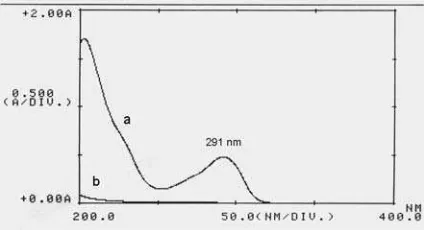
[image:2.595.325.536.590.709.2]The original UV spectrum was demonstrated in Figure 2. It is possible to observe the well-de-fine peak at 291 nm. The specificity test demon-strated the placebo solution exhibited some in-terference in the wavelength of analysis, what
146
GARCIA C.V., MENDEZ A.L., STEPPE M. & SCHAPOVAL E.E.S.
would impede the use the method. New investi-gations were performed and it was found that the UV method could be applied for this deter-mination if the sample aqueous solution was fil-tered with nylon membrane of 0.45 µm (Fig. 3). Otherwise, the titanium dioxide, one of the ex-cipients, which was in dispersion, would cause interference in the absorbance. So, it was neces-sary to adopt the filtration step, which did not represent a complex procedure. On the other hand, the centrifugation was not adopted since it would add another instrument in the analysis and it was not an objective.
The results from linearity are demonstrated in Table 1. The data were validated by means of analysis of variance (ANOVA), which demon-strated significative linear regression and no-sig-nificative linearity deviation (p<0.05).
From this data, it was possible to calculate the detection and quantitation limits 13. The
re-sults found were LOD = 0.32 µg ml–1, LOQ =
0.95 µg ml–1. These low values indicated the
Amount (%) RSD
Method
First day* Second day* Third day* Mean Inter-days
102.40 101.42 102.27
102.40 101.35 102.94
102.33 101.29 102.74
UV 102.14 101.35 103.14 102.26 0.82
102.14 101.42 103.74
102.53 101.10 103.94
Mean 102.32 101.32 103.13
RSD 0.15 0.12 0.61
[image:3.595.284.498.95.160.2]CE mean (RSD)(8) 101.41 (1.89) 100.49 (1.47) 101.27 (1.82) 101.06 1.69
Table 2. Determination of commercial samples of RAB by UV spectrophotometric method (λ 291 nm, water as diluent) and CE. Electrophoretic conditions: sodium tetraborate buffer 10 mM (pH 9.0), voltage of 20 kV, UV detection – 291 nm (8)– precision test; *mean of three determinations.
Figure 3. UV spectra of RAB reference standard (a) and placebo (b), both in water (pH 10.0), concentra-tion of 12 µg ml–1, after filtration with nylon mem-brane.
Feature UV
Regression equation y = 0.042 x + 0.0008 Correlation coefficient (r) 0.9997
[image:3.595.58.270.96.211.2]Linear range (µg ml–1) 6.0-18.0
Table 1. Results of the standard curve of UV spec-trophotometric method (λ291 nm) for RAB.
good sensitivity of the proposed method. The determinations of commercial samples showed excellent precision. The results obtained are list-ed in Table 2. All values for relative standard deviation are below 2.0%. In the sample prepa-ration, it was not possible to use the powder of tablets, as usual, since the coating could not be powdered. So, it was adopted the solution ob-tained from five tablets, which were dissolved together in a volumetric flask. Using this num-ber of units, the sampling was representative and the amount of excipients in suspension was not big enough to impede or delay the filtration step.
The evaluation of accuracy, made through the recovery test, showed a mean recovery of 99.65% (Table 3).
Comparison of methods
The CE method, previously validated 8,
[image:3.595.58.507.551.716.2]147 Latin American Journal of Pharmacy - 29 (1) - 2010
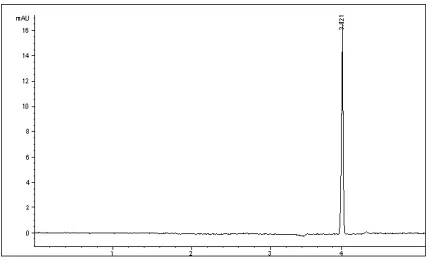
method were not statistically different (tcalc = 2,01< ttab = 2,77, p < 0.05). It means that both methods could be used for the same purpose. A representative electropherogram of RAB is demonstrated in Figure 4.
Considering that chromatographic methods are more expensive, time consumer and need more steps, the proposed UV method is ade-quate for routine analysis and also cheaper, be-ing a safe and sensitive alternative for quality control of RAB in tablets. Another important ap-plication could be the dissolution studies, which need rapid and accurate results. The CE method also has many advantages such as low consume of solvents, good efficacy and rapid analysis, but the instrumental are still not available in all laboratories, mainly for routine use, which may represent a barrier to apply the method.
CONCLUSIONS
The UV method was validated and demon-strated to be simple, linear, accurate, precise, specific and sensitive, which indicates its ade-quacy to pharmaceutical analysis, being equiva-lent to the CE one 8 for RAB determination in
coated tablets.
Acknowledgments. The authors would like to thank LEPCQ and CAPES (Brazil) for financial support.
REFERENCES
1. Carswell, C. & K. Goa (2001) Drugs 61: 2327-56.
2. Barth J. & W. Hahne (2002) Aliment. Pharma-col. Ther. 16: 31-3.
3. Horn, J. (2000) Clin. Ther. 22: 266-80. 4. Janssen-Cilag (1999) Pariet 1-30
5. El-Gindy, A., F. El-Yazby & M. Maher (2003) J. Pharm. Biomed. Anal. 31: 229-42.
6. Garcia, C., C. Paim, & M. Steppe (2004) J. AOAC Int. 87:842-6.
7. Radi, A.; N. Abd El-Ghany & T. Wahdan (2004)
Fármaco 59: 515-8.
8. Garcia, C.V., J. Sippel, L. Sfair, S. Garcia, A. Jablonski, M. Steppe & E.E. Schapoval (2005)
J. AOAC. Int. 88: 1081-5.
9. Garcia, C.V., J. Sippel, M. Steppe & E.E.S. Schapoval (2006) Anal. Lett. 39: 341-8.
10. Garcia, C.V., C.S. Paim, M. Steppe, & E.E.S. Schapoval (2006)J. Pharm. Biomed. Anal. 41: 833-7.
11. Reddy, G.M., B.V. Bhaskar, P.P. Reddy, P. Sud-hakar, J.M. Babu, K. Vyas, P. Reddy & K. Mukkanti (2007) J. Pharm. Biomed. Anal. 43: 1262-9.
12. Garcia, C.V., N. Nudelman, M. Steppe & E.E. Schapoval (2008) J. Pharm. Biol. Anal. 46: 88-93.
13. International Conference on Harmonisation of Technical Requeriments for Registration of Pharmaceuticals for Human Use (ICH) Q2R1 (2005) Guideline on Validation of Analytical Procedure – Methodology.
14. USP 31 (2008) The United States Pharma-copoeia 31st ed. The United States Pharma-copeial Convention.
Concentration (µg ml–1)
% of recovery * Mean (%) Added Found
2.0 1.99 99.50
4.0 4.01 100.25 99.65
[image:4.595.324.539.89.222.2]6.0 5.95 99.17
[image:4.595.98.310.92.178.2]Table 3. Recovery test for RAB by UV spectrophoto-metric method (λ 291 nm), using water pH 10.0 as diluent; * mean of three determinations.