R E S E A R C H P A P E R
On the structure and normal modes of hydrogenated
Ti-fullerene compounds
Alfredo Tlahuice-Flores•Sergio Mejı´a-Rosales•
Donald H. Galva´n
Received: 14 March 2012 / Accepted: 13 July 2012 / Published online: 25 July 2012
ÓSpringer Science+Business Media B.V. 2012
Abstract When titanium covers a C60core, the metal atoms may suppress the fullerene’s capacity of storing hydrogen, depending on the number of Ti atoms covering the C60framework, the Ti–C binding energy, and diffusion barriers. In this article, we study the structural and vibrational properties of the C60TiHn (n=2, 4, 6, and 8) and C60Ti6H48compounds. The IR spectra of C60TiHn compounds have a maximum attributable to the Ti–H stretching mode, which shifts to lower values in the structures withn=4, 8, while their Raman spectra show two peaks corresponding to
the stretching modes of H2 molecules at apical and azimuthal positions. On the other hand, the IR spectrum of C60Ti6H48shows an intense peak due to the Ti–H in-phase stretching mode, while its Raman spectrum has a maximum attributed to the pentagonal pinch of the C60 core. Finally, we have found that the presence of one apical H2 molecule enhances the pentagonal pinch mode, becoming the maximum in the Raman spectrum. Keywords RamanHydrogen storage
Coated fullereneTransition metalsInfrared
Atomic clusters
Introduction
The number of studies of new nanostructures (Zhao et al.
2005; In˜iguez et al. 2007; Yildirim et al. 2005; Bauschlicher et al. 2002; Zope et al. 2009; Zhang et al.2000; Yoon et al.2008; Yang et al.2009; Lee et al.
2008; Durgun et al.2008; Koh et al.2011, Kiran et al.
2006) able to absorb H2in at least 9 wt% have increased in the last years, following the goal proposed by the US Department of Energy of developing a system with this net gravimetric capacity for hydrogen storage. Among the different materials under consideration, systems composed by C60 compounds coated with transition metals are between the most promising ones. Neverthe-less, most of the reports on the properties of these nanomaterials have concentrated their attention to the
This article is part of the topical collection on nanomaterials in energy, health and environment
A. Tlahuice-Flores (&)
Instituto de Fı´sica, Universidad Nacional Auto´noma de Me´xico, Apartado Postal 20-364, 01000 Mexico, DF, Mexico
e-mail: [email protected]
S. Mejı´a-Rosales
CICFIM-Facultad de Ciencias Fı´sico Matema´ticas, and Centro de Innovacio´n, Investigacio´n y Desarrollo en Ingenierı´a y Tecnologı´a, Universidad Auto´noma de Nuevo Leo´n, 66450 San Nicola´s de los Garza, NL, Mexico
e-mail: [email protected]
D. H. Galva´n
Centro de Nanociencias y Nanotecnologia-Universidad Nacional Auto´noma de Me´xico, Apartado Postal 2681, Ensenada, BC, Mexico
calculation of adsorption energies, although a few valuable exceptions exist; the need of a vibrational characterization of the hydrogenated C60TiHn com-pounds, by example, has been remarked by In˜iguez et al., and their study on infrared spectra give value to this kind of calculations (In˜iguez et al.2007).
In comparison with other transition metals, Tita-nium has a small atomic radius (it has a metallic radius of 1.45 A˚ ), which potentiates its use as a material in hydrogen storage devices. However, Ti atoms have a known tendency to form clusters when attached to a C60 core, which is a factor of inhibition of the hydrogen adsorption (Sun et al.2005). Thus, a main issue is to estimate how many Ti atoms can be attached to the fullerenic cage without being close to each other enough to allow the formation of clusters. In the case of Pt and Ir atoms, there exist previous reports of the synthesis of hexa-coordinated compounds, and it has been found that once that six Pt atoms are bound to the fullerenic cage, it is not possible the addition of more atoms (Fajan et al.1991,1992; Bach et al.1991).
Recently, a study of single transition-metal atoms laying on graphene and on a (8,0) single-wall carbon nanotube (SWCNT) has made clear that the clustering of the transition metal atoms depends on factors such as low metal binding energy and low diffusion barriers (Valencia et al.2010). While these factors determine the clustering of Ti atoms specifically on graphene and SWCNT with a large diameter (Krasnov et al.2007), it is likely that the same will occur on C60, but in this case the small diameter and large curvature of C60would difficult the clustering and would make the fullerene a suitable candidate as substrate for transition metals.
In this article we report the all-electron calculation of the IR and Raman spectra of the hexa-coordinated C60TiHn compounds and the more hydrogenated C60Ti6H48compound (point groupTh), and demonstrate the feasibility of their synthesis in accordance with its calculated spectra. In order to be able to perform these calculations despite their computational cost (mostly because of the high use of memory), the symmetry of each compound has been exploited to reduce computing time and make more feasible these calculations.
Theoretical methods and computational details
All the calculations were performed within the density functional theory (DFT) framework (Hohenberg and
Kohn1964). It is known that DFT is a theoretical tool of great reliability in the study of fullerene-like structures, since it reproduces quantitatively some of their main properties measured by experiments, and is able to predict some others when there are no preliminary experimental measurements. Concerning to the prediction of vibration frequencies, DFT has proven to be, in general terms, a reliable tool; even when the predicted values may present deviations from those measured in experiments, usually these deviations are systematic, in such a way that a scaling factor is enough to adjust the predicted values with the experimental results.
The all-electron DFT calculations in this study were carried out by using the Gaussian 03 package (Frisch et al. 2003), with the B3LYP exchange–correlation functional, a 6-31G(d) basis set, and a tight conver-gence criterion of the auto-consistent cycle (SCF). The choice of a base that includes polarization functions is based on reports showing that these functions have influence on the prediction of the Raman intensities (Halls and Bernhard1999).
The binding energy (Eb) was estimated using the following expression:
Eb¼ ½ðEðC60Þ þ EðTinÞÞ EðTin=C60Þ=n; whereE(C60) is the total energy of the pure C60,E(Tin) is the Tincluster’s total energy, andE(Tin/C60) is the total energy of the Tincluster adsorbed on the C60.
transition metals to bind to the (6,6) bond (Mathur et al.1998; Shin et al.2006).
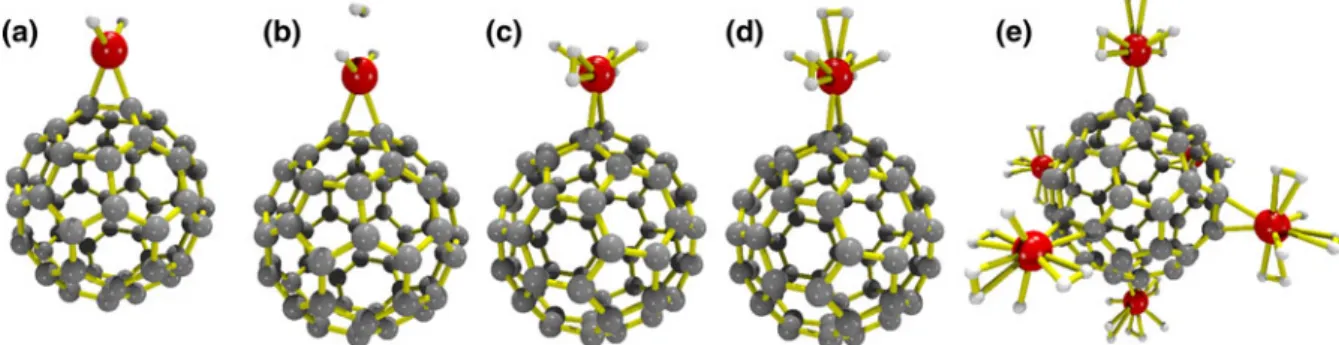
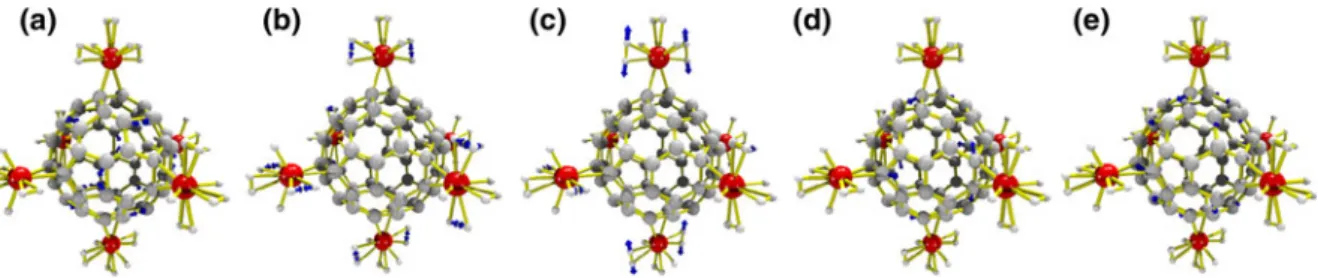
A set of isomers for the C60TiHncompounds (point groupC2v) and the C60Ti6H48compound (point group Th) were calculated, and the isomers with imaginary frequencies were let out of the study. The C60TiH2 molecule was prepared with two H atoms bound to the Ti atom, forming a cyclopropane-like bond with two carbon atoms of the C60core (Fig. 1a). The C60TiH4 molecule has, in addition, one more apical H2 molecule (Fig.1b). The C60TiH6molecule is obtained when two azimuthal H2 are bound to the original C60TiH2molecule (Fig.1c). Finally, the C60TiH8, is a C60TiH6 molecule with an additional apical H2 molecule (Fig.1d). The optimized C60Ti6H48 com-pound has six TiH8 units in an octahedral array (Fig.1e).
Results and discussion
Bond lengths
The different characteristic bond lengths on each system are summarized in Table1. We can note that the H–H bonds may have two different lengths, depending on the relative position of the H2molecule with respect to the whole structure, the apical H2 molecules being larger than the azimuthal ones.
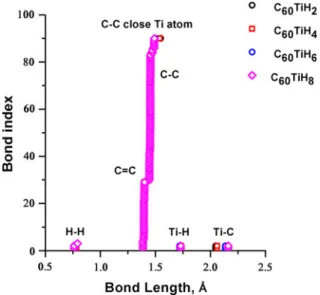
On the other hand, the Ti–H bond, as in the original C60TiH2, is large when apical H2 molecules are present, and short when azimuthal H2molecules are added. The characteristic bond lengths of the C60TiHn compounds are compared in Fig.2, and the specific
case of C60TiH8is compared against the bond lengths for the C60Ti6H48in Fig.3; here, we can note that the existence of six Ti atoms bound to the C60 core produces a deformation of the near C–C bonds. IR and Raman spectra
The obtained frequencies and their irreducible repre-sentations use Mulliken symbols. In this notation, A and B represent 1 dimension or 1 degeneracy, E represents twofold degeneracy and T represents threefold degeneracy.
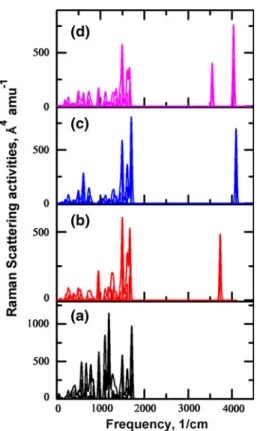
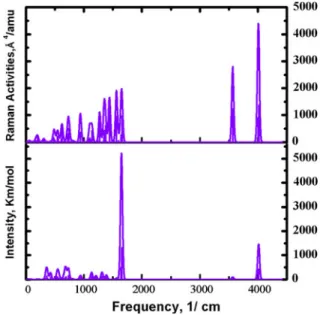
In general, the IR and Raman spectra (Figs.4and5, respectively) for the calculated C60TiHncompounds
Fig. 1 Ball and stick models of the optimized C60TiHn compounds withC2vsymmetry, and the C60Ti6H48compound
withThsymmetry. The atoms of Ti (red), C (gray), and H
(white) are depicted.aC TiH,bC TiH with one apical H
molecule, c C60TiH6 with two azimuthal H2 molecules,
dC60TiH8with one apical and two azimuthal H2molecules,
andeC60Ti6H48structure. (Color figure online)
Table 1 Bond length values, in A˚ , for all the calculated compounds
Compounds Bond Bond length (A˚ )
C60 C–C 1.395
C=C 1.453
C60TiH2 Ti–H 1.723
C60TiH4 H2, apical 0.782
Ti–H 1.733
C60TiH6 H2, azimutal 0.761
Ti–H 1.72
C60TiH8 H2, apical 0.793
H2, azimutal 0.764
Ti–H 1.725
C60Ti6H48 H2, apical 0.792
H2, azimutal 0.765
have peaks at the same frequencies, whose irreducible representations are A1, B1, and B2, while the vibra-tional mode with A2irreducible representation is only active in Raman spectra. We describe individually the results for the different compounds in the next subsections.
Neutral C60TiH2with C2vsymmetry
The optimized structure (see Fig. 1a) has bond lengths in the range from 1.39 to 2.05 A˚ , and it has 183 normal modes, whose irreducible representations are C¼ 49A1þ 43A2þ 45B1þ 46B2:
The estimate of Eb for the atomic H atoms, calculated using a BSSE correction is of 7.82 eV/2H, value that implies that the H atoms are unlikely to desorb.
The maximum in both IR and Raman spectra is at 1715.05 cm-1(within the A1irreducible representa-tion), corresponding to a Ti–H in-phase stretching mode. Near to this peak, at 1693.92 cm-1, the Ti–H out-of-phase stretching mode is also present. From 350 to 700 cm-1there are three more peaks, attrib-utable to the C60 core vibrations and to the two H atoms. A mode is located At 364.85 cm-1, corre-sponding to the wagging mode of the two H atoms. The scissors mode of the H atoms is located at 673.14 cm-1.
The Raman spectrum (Fig.5) has 23 evident peaks, two of them coinciding with the IR active modes mentioned above. In the Raman spectrum we can locate the vibrational modes due to the wagging mode of two C atoms of the cyclopropane-like ring (963.31 cm-1), the pentagonal pinch of the C60core, which in the bare C60 molecule is located at 1503.7 cm-1, and the breathing mode at 491.064 cm-1(496.797 cm-1for C60 mole-cule). Moreover, there exist one peak at 1614.62 cm-1 corresponding to the stretching mode of the (6,6) bonds on the C60 core. In order of intensity, the calculated modes in the Raman spectrum are: Ti–H in-phase stretching mode, cyclopropane-like ring out-of-phase vibration (1195.26 cm-1), pentagonal pinch mode (1495.13 cm-1), and Ti–H out-of-phase stretching mode. It is worthwhile to remark that the calculation of the Raman spectrum allows us the study of those vibrational modes that are no IR active modes or that are comparatively weak. For example, the pentagonal pinch generates an intense peak on the calculated Raman spectrum.
Neutral C60TiH4with C2vsymmetry
The optimized C60TiH4structure has bond lengths in the range from 0.782 to 2.06 A˚ , and it has 189 normal modes whose irreducible representations are:
Fig. 2 Bond lengths of the optimized C60TiHncompounds. In the case of C60TiH8there are two types of H–H distances. The
C–C and C=C distances in the C60framework are between 1.3
and 1.5 A˚ . Other bonds are the C–C bonds near and forming the cyclopropane-like bridge, and Ti–H and Ti–C bonds
Fig. 3 Bond lengths of the optimized C60TiH8and C60Ti6H48
compounds. There are two different distances for the H–H bond, corresponding to both the azimuthal H2and the apical H2bonds,
C¼ 51A1þ 44A2þ 46B1þ 48B2:
The apical H2molecule has an Ebof 0.13 eV, as estimated using a BSSE correction.
The IR spectrum shows a maximum around 1672.30 cm-1, due to the Ti–H in-phase stretching mode, and the Ti–H out-of-phase stretching mode is located at 1656.87 cm-1. The wagging mode of the two H atoms bound to the C atom of the cyclopropane-like ring is located at 409.48 cm-1. The Raman spectrum shows five more representatives peaks, which with the exception the Ti–H vibrational modes, appear as weak signals in the IR spectrum: at 1495.04 cm-1the pentagonal pinch mode of the C60 core is a maximum; at 3730.38 cm-1the apical H–H stretching mode (weak intensity in IR); at 1656.87 and 1672.30 cm-1 the Ti–H vibrational stretching modes—which are active at IR too—, and at 945.792 cm-1, the scissors mode of the H atoms (weak intensity in IR). At first instance, the presence of one apical H molecule into the C TiH enhances the
pentagonal pinch mode of the C60framework, making it the maximum into the calculated Raman spectrum.
Neutral C60TiH6with C2vsymmetry
Their bond lengths are in the range from 0.761 to 2.135 A˚ and its 195 normal modes have the irreducible representations
C¼ 53A1þ 45A2þ 48B1þ 49B2:
The two azimuthal H2molecules are bound with an energy of 0.18/2H2(Ebincluding a BSSE correction). The IR spectrum has a large peak at 1707.28 cm-1 due to the Ti–H in-phase stretching mode, followed in intensity by one peak at 1691.14 cm-1, likely due to the Ti–H out-of-phase stretching mode, and by a peak at 612.08 cm-1 due to the scissors mode of the two H atoms with the two H2molecules moving parallel to the C–C bond. Moreover, the spectrum shows weak signals at 4097.60 cm-1associated to an azimuthal H–H in-phase vibrational mode with its corresponding out-of-phase mode at 4089.81 cm-1, while the H2–Ti–H2 vibrational bending mode is located at 329.72 cm-1.
Fig. 4 IR spectra for the C60TiHn compounds with C2v symmetry.aC60TiH2,bC60TiH4,cC60TiH6, anddC60TiH8
The Raman spectrum has its maximum at 1707.28 cm-1, followed in intensity by the pentagonal pinch at 1493.97 cm-1. The third on intensity is the vibration located at 4089.81 cm-1. At fourth place the 4097.60 cm-1peak is present. In fifth place is the Ti–H out-of-phase stretching mode at 1691.14 cm-1, and finally the H–Ti–H bending mode is at 612.076 cm-1.
Neutral C60TiH8with C2vsymmetry
All the bonds of the optimized structure lay in the range from 0.764 to 2.161 A˚ , with 201 modes with irreducible representations:
C¼ 55A1þ 46A2þ50B1þ50B2:
In the IR spectrum, there are two high-intensity peaks: the first at 1664.92 cm-1 is due to the Ti–H in-phase stretching mode, and the second one at 1655.53 cm-1 that corresponds to the out-of-phase mode. Other weak signals are the azimuthal H–H in-phase mode at 4041.15 cm-1, and the out-of-phase is at 4032.46 cm-1. The apical H–H in-phase stretching mode is at 3548.71 cm-1, and the scissors vibration of the two H2molecules is located at 392.908 cm-1.
The Raman spectrum shows a maximum at 1494.01 cm-1(also observed in the C60TiH4compound), which represents the pentagonal pinch. The next in intensity is the 4032.46 cm-1 peak. The peak at 3548.71 cm-1is on third place, and in fourth place is the mode at 4041.15 cm-1. Other less intense peaks are those due to the C–C vibration modes in the C60core (1,360–1,450 cm-1range). Moreover, the Ti-apical H stretching out-of-phase mode is present at 1356.97 cm-1. The scissors mode of the two H atoms combined with a stretching mode between the Ti atom and the apical H2 molecule is at 950.164 cm-1, and the breathing mode of the C60core is at 492.2 cm-1. In this compound the order in the strength of the Raman spectrum peaks is similar to the one calculated for the C60TiH4compound, where the azimuthal H–H modes are absent.
Neutral C60Ti6H48with Thsymmetry
The C60Ti6H48has 336 normal modes with irreducible representations
C¼45Tuþ45Tgþ15Egþ15Agþ7Euþ7Au:
The normal modes that are IR actives have a Tu irreducible representation, while the Raman-active
modes have Tg, Eg, Eu, Ag, and Au representations (Fig.6).
The IR actives modes are threefold degenerated, with the more intense peak in the IR spectrum, located at 1650.18 cm-1, related to three modes of a pair of H–Ti–H bonds located at both sides of the C60core, vibrating out of phase (Fig.7a). This vibration mode includes the expansion of two Ti–H bonds in one side, and the contraction of two Ti–H bonds located in the opposed side of the C60core. But the Ti–H stretching out-of-phase mode at 1640.45 cm-1, implies the Ti–H contraction and Ti–H expansion in one H–Ti–H unit simultaneously (Fig. 7b), which are related with the opposed H–Ti–H unit by a mirror element of symme-try. A triple degenerated peak at 4015.12 cm-1 is related to four azimuthal H2molecules that are located at both sides of the C60 core. The movement is a contraction of two azimuthal H2molecules on a side of the C60core, with an expansion on the opposite side (Fig.7c).
The peak around 3566.30 cm-1, corresponds to the apical H–H stretching mode. Two apical H2molecules located at both sides of the C60core participate in this vibration mode, one of them contracting while the other expands itself (Fig. 7d).
The scissors mode at 357.77 cm-1, has two H2–Ti– H2units in both sides of the C60framework, moving on opposed directions simultaneously (Fig. 7e).
The spectrum has another two less intense modes: at 4004.74 cm-1 the azimuthal H2 out-of-phase
stretching mode, due to two azimuthal H2molecules on one side of the C60core and another two azimuthal H2molecules on the opposed side, vibrating out-of-phase (the movement between H2molecules on both sides of the C60 core has a mirror element of symmetry); at 940.997 cm-1 there exist a bending mode, which consists of two H–Ti–H units located on opposed sides of the C60-core vibrating at the same time. All these frequencies correspond only to IR active modes.
On the other hand, the Raman spectrum shows a maximum at 1441.58 cm-1, due to the pentagonal pinch (Fig.8a). The next peak on intensity is at 4016.23 cm-1and represents the azimuthal H–H in-phase stretching mode of all the twelve azimuthal H2 molecules (Fig.8b), while the out-of-phase mode is present at 4014.88 cm-1, where only two pairs of apical H2molecules separated by the C60-core partic-ipate (Fig.8c).
There exist a vibration stretching mode of the C–C bond of the cyclopropane-like ring at 1271.87 cm-1, that correspond to six C–C pairs vibrating at the same time. Other vibration mode is present at 1353.23 cm-1, due to two pairs of cyclopropane-like rings located to the both sides of the C60core, where each pair expand or contract at the same time. Moreover, the (6,6) bonds
near to four cyclopropane-like rings of the C60-core vibrate at 1561.37 cm-1.
At 1657.14 cm-1there exists a H–Ti–H in-phase stretching mode of all the 12 H atoms bound to the six Ti atoms. At 4004.71 cm-1 is the out-of-phase azimuthal stretching mode, which includes two pairs of H2 located at both sides of the C60 core. At 3566.3 cm-1the apical H2in-phase stretching mode is present, participating two H2molecules on opposite sides of the C60 framework. The scissor vibration mode of the H–Ti–H bonds is present at 939.67 cm-1, and includes four Ti atoms and eight H atoms.
The Ti–H out-of-phase stretching mode is located at 1640.15 cm-1. This mode includes two Ti atoms and four H atoms, with the Ti atoms related by a mirror symmetry. The Ti–H in-phase stretching mode is present at 1649.81 cm-1; this vibration includes eight H atoms bound to four Ti atoms, where the contraction and expansion occur simultaneously.
The breathing mode of the C60core is located at 483.78 cm-1; in this mode the six pairs of C atoms bound to six Ti atoms stay static, a behavior also observed in the pentagonal pinch.
From all the studied structures, we have found a trend into the enhanced pentagonal pinch mode (Table 2), where the presence of one apical H2
Fig. 7 Five more intense peaks on the infrared spectrum for the C60Ti6H48 compound. a 1650.18 cm-1, b 1640.45 cm-1,
c4015.12 cm-1,d3566.30 cm-1, ande357.77 cm-1
Fig. 8 Five more intense peaks on the Raman spectrum for the C60Ti6H48 compound. a Pentagonal pinch at 1441.58 cm-1,
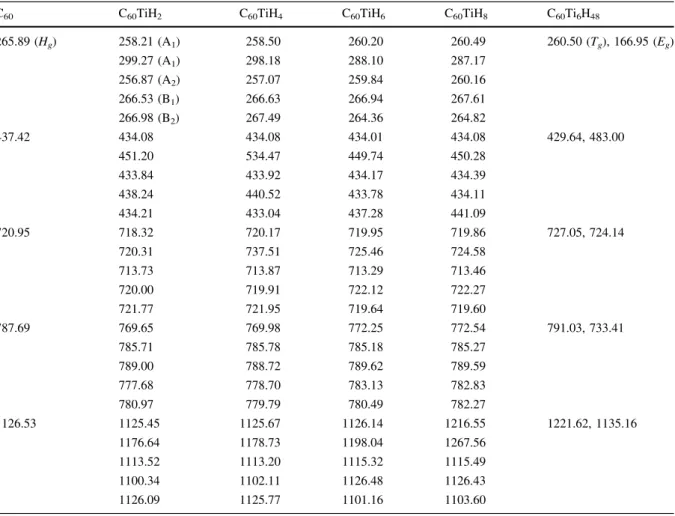
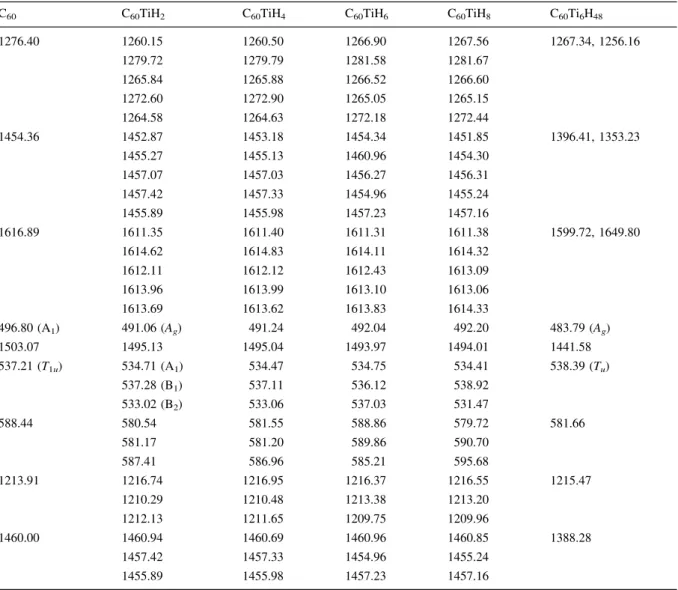
molecule in the C60TiHncompounds have the effect of increasing the length of the Ti–H bond, shifting its frequency to lower values (see for example the compounds C60TiH4, C60TiH8, and C60Ti6H48). Fur-thermore, all the calculated IR and Raman spectra for the C60TiHnand C60Ti6H48compounds allowed us to find a correlation of the Raman and the infrared active modes on the C60molecule and the C60core of all the studied compounds (Table3). Also, the shift on the
frequency allows us to determinate which modes are more perturbed. For example, three normal modes of the C60 parent, located at 1454.36, 1503.07, and 1460 cm-1, shift by more than 60 cm-1 in the C60Ti6H48compound. This shift shows that the more influenced is the pentagonal pinch with a lower value of about 60 cm-1, while the other frequencies are almost unperturbed: for example the azimuthal H2 frequencies in- or out-of-phase are lower for about
Table 2 Bond lengths (A˚ ), and frequencies (cm-1) of selected modes of the calculated C60TiHnand C60Ti6H48compounds
Compound Ti–H bond
Ti–H in/ out-of-phase
Apical H2bond
Apical H2
frequency
Azimuthal H2bond
Azimuthal in/ out-of-phase H2
C60TiH2 1.723 1715.05/1693.92
C60TiH4 1.733 1672.30/1656.87 0.782 3730.38
C60TiH6 1.720 1707.28/1691.14 0.761 4097.60/4089.81
C60TiH8 1.725 1664.92/1655.53 0.793 3548.71 0.764 4041.15/4032.46
C60Ti6H48 1.736 1650.18/1640.47 0.792 3566.30 0.765 4015.12/4004.74
Table 3 Correlation between the calculated IR and Raman-active modes of the bare C60, and their corresponding modes for the
C60TiHnand C60Ti6H48compounds
C60 C60TiH2 C60TiH4 C60TiH6 C60TiH8 C60Ti6H48
265.89 (Hg) 258.21 (A1) 258.50 260.20 260.49 260.50 (Tg), 166.95 (Eg)
299.27 (A1) 298.18 288.10 287.17
256.87 (A2) 257.07 259.84 260.16
266.53 (B1) 266.63 266.94 267.61
266.98 (B2) 267.49 264.36 264.82
437.42 434.08 434.08 434.01 434.08 429.64, 483.00
451.20 534.47 449.74 450.28
433.84 433.92 434.17 434.39
438.24 440.52 433.78 434.11
434.21 433.04 437.28 441.09
720.95 718.32 720.17 719.95 719.86 727.05, 724.14
720.31 737.51 725.46 724.58
713.73 713.87 713.29 713.46
720.00 719.91 722.12 722.27
721.77 721.95 719.64 719.60
787.69 769.65 769.98 772.25 772.54 791.03, 733.41
785.71 785.78 785.18 785.27
789.00 788.72 789.62 789.59
777.68 778.70 783.13 782.83
780.97 779.79 780.49 782.27
1126.53 1125.45 1125.67 1126.14 1216.55 1221.62, 1135.16
1176.64 1178.73 1198.04 1267.56
1113.52 1113.20 1115.32 1115.49
1100.34 1102.11 1126.48 1126.43
26 cm-1in the hexa-coordinated, the Ti–H frequen-cies are small by around 14 cm-1, but the apical H2 frequencies are around 18 cm-1larger. The reason for the lower value of the pentagonal pinch in the C60Ti6H48is a weak mode, produced by the holding of 12 C atoms bound to the six Ti atoms.
Summary and conclusions
In this report we propose the hexa-coordinated C60Ti6H48 compound as a viable hydrogen storage material, based on the value of the calculated binding energy of 2.37 eV for the six Ti atoms bound to the C60
framework. In order to provide some confidence about the studied C60TiHncompounds, we have calculated the binding energies for the Ti atom on the C60, where the Ti atom is bound to (6,6), (5,6), hexagonal and pentagonal sites. The difference between the more stable (6,6) and the (5,6) site for the C60Ti structures is 0.58 eV, in contrast with a previous calculation by Valencia et al. (2010) that mention that a 0.3 eV value is sufficient to hold one single Ti atom and to avoid the diffusion and therefore the clustering. It is important to mention here that the difference in energy between the (6,6) and (5,6) sites has to be considered as an indicative energy barrier of possible diffusion path to the Ti atom, within the quasiharmonic approximation.
Table 3 continued
C60 C60TiH2 C60TiH4 C60TiH6 C60TiH8 C60Ti6H48
1276.40 1260.15 1260.50 1266.90 1267.56 1267.34, 1256.16
1279.72 1279.79 1281.58 1281.67
1265.84 1265.88 1266.52 1266.60
1272.60 1272.90 1265.05 1265.15
1264.58 1264.63 1272.18 1272.44
1454.36 1452.87 1453.18 1454.34 1451.85 1396.41, 1353.23
1455.27 1455.13 1460.96 1454.30
1457.07 1457.03 1456.27 1456.31
1457.42 1457.33 1454.96 1455.24
1455.89 1455.98 1457.23 1457.16
1616.89 1611.35 1611.40 1611.31 1611.38 1599.72, 1649.80
1614.62 1614.83 1614.11 1614.32
1612.11 1612.12 1612.43 1613.09
1613.96 1613.99 1613.10 1613.06
1613.69 1613.62 1613.83 1614.33
496.80 (A1) 491.06 (Ag) 491.24 492.04 492.20 483.79 (Ag)
1503.07 1495.13 1495.04 1493.97 1494.01 1441.58
537.21 (T1u) 534.71 (A1) 534.47 534.75 534.41 538.39 (Tu)
537.28 (B1) 537.11 536.12 538.92
533.02 (B2) 533.06 537.03 531.47
588.44 580.54 581.55 588.86 579.72 581.66
581.17 581.20 589.86 590.70
587.41 586.96 585.21 595.68
1213.91 1216.74 1216.95 1216.37 1216.55 1215.47
1210.29 1210.48 1213.38 1213.20
1212.13 1211.65 1209.75 1209.96
1460.00 1460.94 1460.69 1460.96 1460.85 1388.28
1457.42 1457.33 1454.96 1455.24
However, the determination of the true diffusion path may be a complex, time consuming task, beyond the scope of this study that focuses on the structural and vibrational properties of these compounds.
We calculate the IR and Raman spectra of the hydrogenated Ti metal-fullerene compounds, and report the irreducible representation of their normal modes. We have found that a more wide character-ization of the studied compounds can be done by the calculation of their Raman spectra. Furthermore, we have found that the presence of an apical H2molecule enhance the pentagonal pinch of the C60framework. Since the synthesis of these compounds is feasible, the calculated spectra may play a determining role in the identification of the compounds after the synthesis process, and the approach can be adjusted for the study of other hydrogenated metal-fullerene compounds.
Acknowledgments The authors acknowledge al Departa-mento de Superco´mputo DGSCA-UNAM for the support provided.
References
Bach AL, Catalano VJ, Lee JW, Olmstead MM, Parkin SR (1991) (.eta.2-C70)Ir(CO)Cl(PPh3)2: the synthesis and structure of an iridium organometallic derivate of a higher fullerene. J Am Chem Soc 113:8953–8955. doi:10.1021/ ja00023a057
Bauschlicher CW Jr, So CR (2002) High coverages of hydrogen on (10,0), (9,0) and (5,5) carbon nanotubes. Nanoletters 2:337–341. doi:10.1021/nl020283o
Durgun E, Ciraci S, Yildirim T (2008) Functionalization of carbon-based nanostructures with light transition-metal atoms for hydrogen storage. Phys Rev B 77:085405-1–085405-9. doi:10.1103/PhysRevB.77.085405
Fajan PJ, Calabrese JC, Malone B (1991) A multiply-substituted buckminsterfullerene (C60) with an octahedral array of platinum atoms. J Am Chem Soc 113:9408–9409. doi:
10.1021/ja00024a079
Fajan PJ, Calabrese JC, Malone B (1992) Metal complexes of buckminsterfullerene (C60). Acc Chem Res 25:134–142. doi:10.1021/ar00015a006
Frisch MJ, Trucks GW, Schlegel HB, Scuseria GE, Robb MA, Cheeseman JR et al (2003) Gaussian 03, revision B.03. 2003. Gaussian Inc., Wallingford
Halls MD, Bernhard HS (1999) Comparison study of the pre-diction of Raman intensities using electronic structure methods. J Chem Phys 111:8819–8824.http://dx.doi.org/ 10.1063/1.480228
Hohenberg P, Kohn W (1964) Inhomogeneous electron gas. Phys Rev 136:B864–B871. doi:10.1103/PhysRev. 136.B864
In˜iguez J, Zhou W, Yildirim T (2007) Vibrational properties of TiHn complexes adsorbed on carbon nanostructures. Chem Phys Lett 444:140–144.http://dx.doi.org/10.1016/ j.cplett.2007.06.133
Kiran B, Kandalam AK, Jena P (2006) Hydrogen storage and the 18-electron rule. J Chem Phys. 124:224703–224706.
http://dx.doi.org/10.1063/1.2202320
Koh W, Choi JI, Lee SG, Lee WR, Jang SS (2011) First-prin-ciples study of Li adsorption in a carbon nanotube-fuller-ene hybrid system. Carbon 49:286–293.http://dx.doi.org/ 10.1016/j.carbon.2010.09.022
Krasnov PO, Ding F, Singh AK, Yakobson BI (2007) Clustering of Sc on SWNT and reduction of hydrogen uptake: ab initio all-electron calculations. J Phys Chem C 111:17977– 17980. doi:10.1021/jp077264t
Lee H, Li J, Zhou G, Duan W, Kim G, Ihm J (2008) Room-temperature dissociative hydrogen chemisorption on boron-doped fullerenes. Phys Rev B 77:235101-1–235101-5. doi:10.1103/PhysRevB.77.235101
Mathur P, Mavunkal IJ, Umbarkar SB (1998) Synthetic meth-odologies and structures of metal-[C60] fullerene
com-plexes. J Cluster Sci 9:393–415. doi:10.1023/A:10219 34431858
Shin WH, Yang SH, Goddard WA, Kang JA (2006) Ni-dis-persed fullerenes: hydrogen storage and desorption prop-erties. Appl Phys Lett 88:053111-1–053111-3.http://dx. doi.org/10.1063/1.2168775
Sun Q, Wang Q, Jena P, Kawazoe Y (2005) Clustering of Ti on a C60surface and its effect on hydrogen storage. J Am Chem
Soc 127:14582–14583. doi:10.1021/ja0550125
Valencia H, Gil A, Frapper G (2010) Trends in the adsorption of 3d transition metal atoms onto graphene and nanotube surfaces: a DFT study and molecular orbital analysis. J Phys Chem C 114:14141–14153. doi:10.1021/jp103445v
Yang XB, Zhang RQ, Ni J (2009) Stable calcium adsorbates on carbon nanostructures: applications for high-capacity hydrogen storage. Phys Rev B 79:075431-1–075431-4. doi:10.1103/PhysRevB.79.075431
Yildirim T, In˜iguez J, Ciraci S (2005) Molecular and dissocia-tive adsorption of multiple hydrogen molecules on transi-tion metal decorated C60. Phys Rev B 72:153403–153406.
doi:10.1103/PhysRevB.72.153403
Yoon M, Yang S, Hicke Ch, Wang E, Geohegan D, Zhang Z (2008) Calcium as the superior coating metal in function-alization of carbon fullerenes for high-capacity hydrogen storage. Phys Rev Lett 100:206806-1–206806-4. doi:
10.1103/PhysRevLett.100.206806
Zhang Y, Franklin NW, Chen RJ, Dai HJ (2000) Metal coating on suspended carbon nanotubes and its implication to metal–tube interaction. Chem Phys Lett 331:35–41.
http://dx.doi.org/10.1016/S0009-2614(00)01162-3
Zhao YF, Kim YH, Dillon AC, Heben MJ, Zhang SB (2005) Hydrogen storage in novel organometallic buckyballs. Phys Rev Lett 94:155504-1–155504-4. doi:10.1103/Phys RevLett.94.155504
Zope RR, Baruah T, Lau KC, Liu AY, Pederson MR, Dunlap BI (2009) Boron fullerenes: from B80to hole doped boron