.¿¿SSæ ZJLîSH M B
E L SE V IE R Optics Communications 244 (2005) 315 319
Op t ic s
Co mmu n ic a t io n s
www.elsevier.com/locate/optcom
High-repetition rate acoustic-induced Q-switched all-fiber laser
D. Zalvidea a, N.A. Russo a, R. Duchowicz ab, M. Delgado-Pinar c, A. Diez c,* 1 * 1 *;
J.L. Cruz c, M.V. Andrés c
a C entro de Investigaciones O pticas, C IO p (C O N IC E T , C IC ), L a P lata, A rgentina
b D epartam ento de Física, Fac. Ciencias E xactas, U N L P , L a P lata, A rgentina
c D epartam en to de Física Aplicada, IC M U V , Universidad, de Valencia, Dr. M oliner 50, 46100 B urjassot, Spain
Received 20 May 2004; received in revised form 9 September 2004; accepted 10 September 2004
We report a high repetition rate actively Q switched all fiber laser. The acousto optic interaction controls the cou pling between co propagating core and cladding modes and is used to modulate the optical losses of the cavity, which permits to perform active Q-switching. Using 1.4 m of 300 ppm Er-doped fiber and a maximum pump power of 120 mW, we have obtained up to 1 W peak power pulses, with a pulse repetition rate that can be continuously varied from 1 Hz to 120 kHz and a pulse width that changes from 70 ns to 2.2 ps.
© 2004 Elsevier B.V. All rights reserved.
The development of new fiber optic laser sys tems is of permanent interest in the optical field, especially on the communication spectral window. In particular, erbium-doped fiber lasers have shown a variety of potential applications, such as sources for W D M and soliton communications
* Corresponding author. Tel.: 34 963983431; fax: 34 963983146.
E m ail address:[email protected] (A. Diez).
systems, medicine, sensing and spectroscopy. In order to produce an erbium-doped Q-switched la ser many different approaches can be employed. Passive Q-switching can be obtained by using a saturable absorber constructed by inserting a seg ment of samarium-doped fiber into a ring cavity [1]. Active Q switching was performed using an electro-optic modulator, an acousto-optic modula tor (AOM), or an intensity modulator based in the transmission of a coupler in the cavity [2 4].
On the other hand, U V written fiber Bragg gratings (FBGs) as a reliable fiber technology has
P A C S :42.55.W; 42.60.G
K eyw ords:Fiber lasers; Q switching Abstract
1. Introduction
0030-4018/$ - see front matter © 2004 Elsevier B.V. All rights reserved. doi:10.1016/j.optcom.2004.09.040
-- - - -
-
-
-316 D. Zalvidea et al. / Optics Communications 244 (2005) 315 319
generated very important advances in the develop ment of fiber-based devices and systems. In partic ular, FBGs can be used as all-fiber mirrors to define a Fabry Perot cavity. The laser emission wavelength is, in this case, determined by the Bragg wavelengths of the fiber gratings. Many de signs of fiber lasers for optical communications, making use of fiber gratings to the resonant cavity, have been previously reported [5].
In a previous work, we demonstrated active Q switching of an erbium-doped fiber laser that em ploys a pair of fiber Bragg gratings as reflective mirrors. The laser operation was based on modu lating the Bragg wavelength of one grating fixed to a piezoelectric ceramic tube. By using this very simple scheme, we obtained a Q-switched laser in the erbium spectral gain region with a high laser efficiency of energy conversion. Pumping at 76 mW and operating the laser at 18.5 kHz, an effi ciency of 26% was achieved [6,7].
Recently, Liu and co-workers [8] demonstrated an actively Q-switched fiber laser in which an acousto-optic-based fiber attenuator [9,10] placed inside the cavity was employed to actively control the cavity losses. Microbending induced in the fi ber by a flexural acoustic wave produces resonant coupling between the fundamental core mode and cladding modes, which are rapidly attenuated by the fiber coating [11]. Pulses of several pJ per pulse, 150 ns wide and a repetition rate of up to 5 kHz was reported.
In this paper, we report an optimized design of a Q-switched all-fiber laser based on the idea re ported by Liu and co-workers [8]. We have in cluded two modifications to Liu’s design to improve the performance of the system. First, we used photosensitive erbium-doped fiber, so that the FBG used as reflective elements were written in the active fiber itself, giving rise to a splice-less
laser cavity. Second, to enhance the efficiency of the acousto-optic attenuator, it was made on a section of fiber that was tapered down using a fu- sion-and-pulling technique. This allows making acousto-optic attenuators as efficient as the one used in [8], which was made using HF etching, but with smaller reductions of the fiber diameter. This is relevant to the performance of the Q-switched laser, i.e. the maximum repetition rate achievable, since the time response of the attenua tor shortens as the fiber diameter increases due to the dependence of the acoustic velocity with the diameter [11].
We demonstrate a Q-switched laser with up to 1 W peak power, pulses from 70 ns to 2.2 ps wide, and a pulse repetition rate that can be continu ously varied from 1 Hz to 120 kHz.
Fig. 1. Experimental setup.
2. Ex p e rim e n tal setup and results
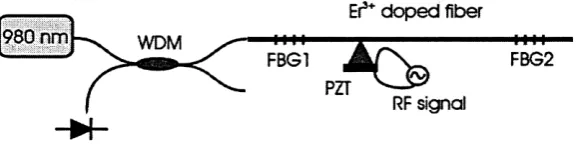
Fig. 1 shows a schematic diagram of the Q switched erbium-doped fiber laser. The fiber used in the experiments was an erbium-doped german osilicate fiber containing 300 ppm Er3+, with a cut-off wavelength of 965 nm, and a numerical aperture (NA) of 0.23. Two Bragg gratings, FBG1 and FBG2, were written on the core of the Er3+-doped fiber by U V exposure using a doubled argon laser and a uniform period phase mask, to define a cavity of 140 cm in length. The fiber was hydrogen loaded to enhance its photosensitivity. The Bragg wavelength of both FBGs was 1546.6 nm. The reflectivity of FBG1 and FBG2 was 60% and 99%, respectively, and the bandwidth was 0.15 and 0.25 nm.
The acousto-optic attenuator was implemented on the Er3+-doped fiber itself. Flexural acoustic waves were imposed on the fiber using a piezoelec
-
-
-
[image:2.595.157.446.611.687.2]-trie transducer (a PZT ceramic disc of 1 cm diam eter) driven by a RF signal, and an aluminum horn (see Fig. 1). The acousto-optic interaction takes place in a section of 8 cm long of the Er3+ fiber. To enhance the acousto-optic interaction, this sec tion of fiber was tapered down from 125 to 80 pm in diameter using a standard fusion-and-pulling tapering technique [12]. We found that resonant coupling between the fundamental core mode LP0i and the LP12 cladding mode occurred at around 1.55 pm when the frequency of the RF sig nal was 1.2 MHz. Fig. 2 shows an example of the transmission spectrum of the fiber when an RF sig nal of 1.201 MHz and an amplitude of 15 V was applied to the piezoelectric. An attenuation peak centered at 1546.6 nm (i.e., the Bragg wavelength of the FBGs) as deep as 16 dB is observed. The in set of Fig. 2 shows the tunability of the dip with the frequency of the RF signal. Coupling from the LP0i to other cladding modes was also ob served for other frequencies. Measurements shown in Fig. 2 were done before the FBGs were written.
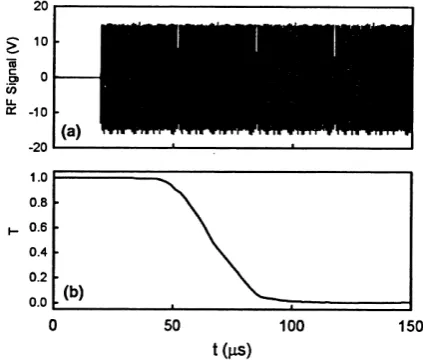
Fig. 3 shows the time response of the acousto optic attenuator. For this experiment, the fiber was illuminated using a laser diode tuned at the acousto-optic resonant wavelength and the FBGs were detuned to avoid reflections from them. Fig. 3(a) shows the electrical signal applied to the pie zoelectric transducer and Fig. 3(b) shows the
cor-Fig. 2. Transmission spectrum when an electrical signal of 15 V and 1.201 MHz is applied to the piezoelectric. The dip is caused by the resonant coupling between the LPoi core mode and the LP12 cladding mode. Inset: acousto optic resonant wavelength
as a function of the RF frequency.
Fig. 3. Time response of the acousto optic process, (a) Electri cal signal applied to the piezoelectric and (b) light transmission.
responding optical transmission. The switching time, i.e., the time that the signal takes to change from 100% to 0%, is about 50 ps. This value is an order of magnitude shorter than the best value reported in [8]. A delay of 30 ps between the elec trical and the optical signals is also observed, which is caused by the overall system that gener ates the acoustic wave.
The active medium was pumped through a W D M coupler using a pigtailed semiconductor la ser diode (980 nm, 125 mW of maximum optical power). The optical output from FBG1 was de tected using a 125 MHz bandwidth InGaAs photo detector. The efficiency of the fiber laser in CW operation (without acoustic excitation) was about 5% and the threshold was 4 mW.
[image:3.595.305.517.133.313.2]To perform Q-switching, the RF signal was amplitude modulated by a rectangular wave of variable frequency and duty cycle. This modula tion produced on off periods of the acoustic wave being imposed to the fiber, which results in a mod ulation of the cavity losses at the laser emission wavelength.
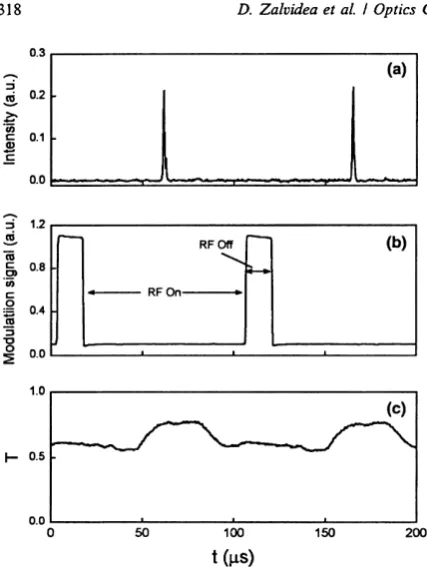
Fig. 4 shows an example of the laser system run ning at 10 kHz. Fig. 4(a) is the laser signal and Fig. 4(b) shows the modulation signal. The duty cycle was adjusted to optimize the amplitude and the sta bility of the pulses. Fig. 4(c) shows the perform ance of the fiber attenuator under the same
-
-
-
-
[image:3.595.65.277.500.652.2]-318 D. Zalvidea et al. / Optics Communications 244 (2005) 315 319
Fig. 4. (a) Laser output when operating at 10 kHz. (b) Corresponding modulation signal, (c) Light transmission under the same piezoelectric excitation.
piezoelectric excitation. This measurement was done in a similar way as in Fig. 3 (with no pump and detuning the FBGs to avoid reflections), and it shows that just a few percent of attenuation change is enough to generate Q-switching. Fig. 5
Fig. 5. Laser output when operating at 120 kHz.
shows an example of the laser operating at 120 kHz. Higher repetition rates could be attainable by reducing the time response of the acousto-optic attenuator. This could be achieved, for example, by shortening the length of the acousto-optic attenuator, provided that enough acoustic power is available to obtain the required attenuation level to perform Q-switching.
Fig. 6(a) gives the output peak power of the Q switched laser pulses against the continuous pump power, for several repetition frequencies. Pulses of up to 1 W were obtained at low frequencies. Pulse to-pulse fluctuation of the peak power was typi cally about 5%. Fig. 6(b) gives the peak power and the pulse width as a function of the repetition rate, when pumping at 85 mW. Around 1-2 kHz the peak power starts to decrease significantly and the pulse width to increase, as expected for a medium with an upper-level effective lifetime of 1 ms. Pulses from 70 ns to 2.2 ps wide were obtained. The long microsecond pulses at high-repetition rates may limit the use of the system in some appli cations. Shorter pulses could be obtained by reducing the length of the laser cavity and also by improving the time response of the acousto optic modulator.
Fig. 6. (a) Optical peak power versus continuous pump power, for several pulse repetition frequencies, (b) Optical peak power and pulse width against pulse repetition frequency when pumping at 85 mW.
-
[image:4.595.69.283.102.386.2] [image:4.595.311.526.465.652.2] [image:4.595.68.285.525.681.2]In summary, we have reported a high-repetition rate acoustic-induced Q-switched all-fiber laser. A single piece of Er3+-doped germanosilicate fiber has been employed to make the laser, writing the FBGs and performing the modulation of the cav ity losses in the fiber itself. Q-switching was per formed by controlling the optical losses in the Er3+ fiber by coupling fight from the core mode to cladding modes using flexural acoustic waves. The active Q switching can be operated continu ously from 1 Hz to 120 kHz and the pulse width changes from 70 ns to 2.2 |is. Using 1.4 m of 300 ppm Er doped fiber and pumping powers lower than 120 mW, up to 1 W peak power pulses were achieved at 2 kHz repetition rate.
[1] L. Luo, P.L. Chu, Opt. Commun. 161 (1999) 257. [2] H.H. Kee, G.P. Lees, T.P. Newson, Electron. Lett. 34
(1998) 1318.
[3] P. Roy, D. Pagnoux, L. Mouneu, T. Midavaine, Electron. Lett. 33 (1997) 1317.
[4] A. Chandonnet, G. Larose, Opt. Eng. 32 (1993) 2031. [5] V. Mizrahi, D.J. DiGiovanni, R.M. Atkins, S.G. Grubb,
Y.K. Park, M.P. Delavaux, J. Lightwave Technol. 11 (1993) 2021.
[6] N.A. Russo, R. Duchowicz, J. Mora, J.L. Cruz, M.V. Andres, Opt. Commun. 210 (2002) 361.
[7] R. Duchowicz, N.A. Russo, E. Sicre, M.V. Andres, J. Opt. A 5 (2003) 5216.
[8] D.W. Huang, W.F. Liu, C.C. Yang, IEEE Photon. Technol. Lett. 12 (2000) 1153.
[9] D.W. Huang, W.F. Liu, C.W. Wu, C.C. Yang, IEEE Photon. Technol. Lett. 12 (2000) 176.
[10] H.S. Kim, S.H. Yun, I.K. Kwang, B.Y. Kim, Opt. Lett. 22 (1997) 1476.
[11] T.A. Birks, P.St.J. Russell, D.O. Culverhouse, J. Light wave Technol. 14 (1996) 2519.
[12] R.P. Kenny, T.A. Birks, K.P. Oakley, Electron. Lett. 77 (1991) 1654.
References
cas y Técnicas (CONICET), the Facultad de Ciencias Exactas, Universidad Nacional de La Plata and the Comisión de Investigaciones Científicas de la Prov. de Buenos Aires (CIC), Argentina.
Acknowledgments
This work was financially supported by the Ministerio de Ciencia y Tecnología of Spain (Grant TIC2002-04527-C02-01), N K T Research & Innovation and the Generalitat Valenciana (grupos03/227). R. Duchowicz, N.A. Russo and D. Zalvidea acknowledge financial support from the Consejo Nacional de Investigaciones Científi
3. Su m m ary
-