Short communication
Serum copper, zinc, calcium and magnesium levels in mothers with
offspring affected by neural tube defects: a case-control study
Noel Taboada Lugo1* http://orcid.org/0000-0002-1254-8087
Ángel Mollineda Trujillo2
Manuela Herrera Martínez1
1Universidad de Ciencias Médicas Villa Clara, Cuba.
2Universidad Central Marta Abreu de Las Villas, Villa Clara, Cuba.
*Autor para la correspondencia: [email protected]
ABSTRACT
Background: Neural tube defects (NTDs) are important causes of infant mortality, which
result from a complex interaction between genetics and environmental factors such as
trace elements, which play and crucial role in the epigenetic regulation in the embryo
fetal developmental program.
Objectives: To measure the maternal serum levels of copper, zinc, calcium and
magnesium in mothers with offspring affected by NTDs, and to examine a possible
relationship between the serum concentrations of these micronutrients and occurrence of
NTDs.
Subjects andMethods: Maternal serum blood samples were obtained from 72 healthy
pregnant women and 36 mothers who had NTDs affected offspring, including those alive,
stillbirths and elective pregnancy' termination at Centro Provincial de Genetica in Villa
Clara. Copper, zinc, calcium and magnesium levels in serum were measured by flame
atomic absorption spectrometry and were compared between the two groups of mothers.
Results: Serum zinc levels were determined to be significantly lower in the study group
compared with the control group, while copper levels were significant elevated in the
study group (all p values < .05). There was a negative correlation between serum zinc
levels and serum copper levels. However, no association between calcium and
magnesium serum levels and increased risk for the development of NTDs was observed.
Conclusions: High maternal serum levels of copper and lower level of zinc during
pregnancy were associated with NTDs in offspring. If folic acid supplementation is
given, additional zinc supplementation should be considered for the further decrease in
the recurrence risk of NTDs.
Keywords: Birth defects, Neural tube defects, Copper, Zinc, Micronutrients, Trace
elements.
INTRODUCTION
Neural tube defects (NTDs) are one of the most common forms of human congenital
defect (CD). NTDs occur in 1-6.5 per 1,000 births, with marked geographic and ethnic
variations.(1, 2)
The etiology of NTDs is multifactorial involving nutritional deficiencies, genetic
predisposition and others environmental factors. Nutritional factors appear to be an
important contributor to the etiology of NTDs. Although it is known that folic acid
deficiency has a definite place in the etiology, supplementation and fortification with
Trace elements, so called micronutrients, because are needed in minute quantities,
encompass minerals essential for normal human development and functioning of the
body. These are known to be limiting in the diets, particularly of the socio-economically
weaker and physiologically vulnerable sections of the population in developing countries.
The World Health Organization (WHO) estimates that more than 2 billion people are
deficient in key vitamins and minerals all over the world.(2-4)
It has been shown that concentrations of various trace elements are altered during
pregnancy by many researches in different countries.(2,5,6) A study of one specific major
CD on a wide range of micronutrients has not been reported previously in Cuba. In this
case-control study, we investigated the level on serum blood concentrations of four
selected trace elements of mother with affected offspring by NTDs and normal pregnant
woman in a central province of Cuba.
METHODS
A case control study supported in a dynamic cohort was conducted at Centro Provincial
de Genetica in Villa Clara province, Cuba; during January 2014 to December 2018. Three
NTDs subtypes, i.e., anencephaly, spina bifida and encephalocele where included,
according the (ICD-10) codes. When a woman with an NTDs-affected pregnancy
(including live birth, still birth, or pregnancy termination) was confirmed as a case, two
healthy pregnant women were selected to serve as control, and were matched to the case
by the same municipality of residence, and same gestational age.
Maternal serum blood samples were obtained from 72 healthy pregnant women and 36
mothers who had NTDs affected offspring diagnosed at Centro Provincial de Genetica in
Villa Clara. Five milliliters of fasting venous blood of antecubital vein were collected,
during 08.00-10.00 hours, from the all participating pregnant women prior they signing
an informed consent form. The collected blood was poured into metal-free plain tubes
and was allowed to clot at room temperature. Plain tubes were centrifuged for 15 min at 3
000 rpm and the serum was separated and kept in trace elementsfree tubes and stored at
biochemical analysis. Cu, Zn, Ca and Mg levels in serum were measured by flame atomic
absorption spectrometry and were compared between the two groups of mothers. All
trace elements values were expressed in μmol per liter.
All other data obtained were subjected to suitable statistical analysis. Mean, standard
deviation (Mean ± SD) were calculated wherever necessary and suitable figures were
prepared. The statistical differences among the groups were analyzed by chi-square test.
Statistical analyses were conducted using SPSS 22. A two-tail p value of < 0.05 was
taken as the statistical significance level.
The Ethics and Research Committee of the "Mariana Grajales" Gynecobstetrics Teaching
Hospital, in Santa Clara city, approved the protocol for this study. After the purpose of
the study was described to all the participating women, written consent was obtained
from each one of them. In order to maintain confidentiality of any information provided
by study subjects, the data collection procedure was anonymous.
RESULTS
Of the total cases of NTDs, 52.8% were cases of anencephaly; 30.5%, spina bifida; and
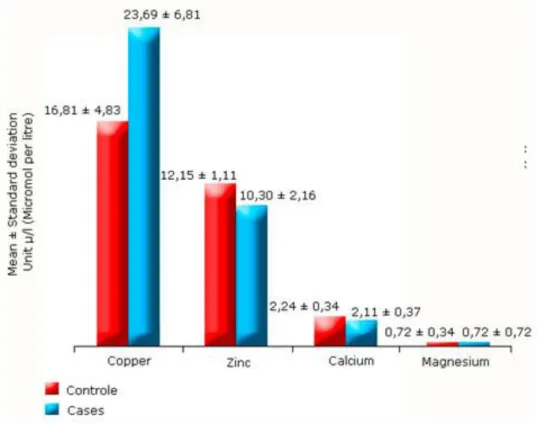
16.7%, encephalocele. The mean (± SD) Zn level of the mothers who had affected
offspring with NTDs was significantly lower when compared to the control group (10.30
±2.16 vs. 12.15± 1.11; p < 0.05.). However, the mean maternal serum Cu levels in the
NTDs group were significantly higher when compared to the control group (23.69±6.81
vs. 16.81 ± 4.83, p < 0.05). On the other hand there was no significant difference among
Ca and Mg levels between cases and controls. Mean concentrations of the four essential
elements determined in maternal serum are presented in Fig. 1.
In comparison with the control group, the ratio of Cu/Zn in the mothers with offspring
affected with NTDs was found to be significantly higher (2.3±2.1 vs. 1.4±1.2, p=0.001).
For the serum Zn level the value of Levene statistical test for equality of variances was
9.690 (p= 0.002) and the t value in the T test for equality of means was -5.873 (p= 0.000),
whereas that Cu serum level the value of Levene statistical test for equality of variances
(p= 0.000) as it's shown in table 1. For the remainder trace elements there was a not
significant difference between cases and controls.
Fig. 1- Mean concentrations of trace elements in cases and control group.
Villa Clara 2014 – 2018.
Table 1- Statistical tests designed for independent samples for Zn and Cu serum
concentrations. Villa Clara 2014 - 2018
DISCUSSION
Anencephaly (from Greek: an: without and enkephalos: encephalon) is the most used
medical terminology all over the world, nevertheless, the term meroencephaly is more
appropriated, because in these cases really exist a vestige of the encephalon. This kind of
congenital defects (CD) was the most prevalent in the present study, this result is agree
with many other researchers for whom this is the most frequent NTDs and it´s the CD
affecting the central nervous system with the highest mortality.(1,2) However, other
researchers had been identified spina bifida as the most frequent NTDs.(5)
The mean Zn concentrations found in controls serum (10.30 μmol/L) fall below accepted
adult levels reported in the literature (10.80-22.90 μmol/L. It is known that pregnant
women are at risk of acquired Zn deficiency because of its requirements by the
developing fetus.(3,5,6)
Zn is an essential nutrient for normal cellular growth and differentiation in all species and
may be especially necessary for closure of the human neural tube. Also, Cu is an
important component of proteins essential for neural function. The role of copper in the
development of NTD is plausible because of its participation in oxidative stress.(4-6)
Zn deficiency has long been considered a common but overlooked problem in developing
countries. It is widely believed that Zn deficiency is as widespread as iron deficiency,
affecting nearly half of the world's population. Studies carried out in developing countries
documented that Zn deficiency in pregnant women is mainly because of the low intake of
dietary Zn, for instance, in a study done to know the micronutrient status and dietary
intake in women of reproductive age and pregnant woman, African researchers reported a
Zn deficiency ranged from 46% to 70% in pregnant woman in Ethiopia, Kenya, Nigeria
and Egypt.(7,8)
In a study conducted in two provinces of China both located in northern with the highest
NTDs prevalence in this country, investigators found that lower maternal concentrations
of Zn and other trace elements during the early period of pregnancy were associated with
Most Cuban population consumed a daily diet composed mainly of rice and beans; the
first of them is a cereal which high concentration of phytates and beans are an important
source of dietetic fibers. The bioavailability of Zn is considerably influenced by the
composition of the diet in the content of inositol phosphates (phytates), the total Zn
content of the meal and the amount and source of protein. Animal protein is a rich source
of Zn and, in addition, exerts a possible enhancing effect on the overall absorption of Zn
from the diet. It is well known that fibers and phytic acid are strong inhibitors of Zn
absorption and a concomitant intake of protein seems to counteract the negative effects
on absorption induced by high intakes of phytic acid.(4)
The results of the present study showed that in comparison with the control group, the
mothers who had offspring affected with NTDs had high levels of serum Cu and low
levels of Zn. This difference between the two groups might be related to the levels of
these trace elements in the environment and their nutrition. It is known that serum levels
of Cu and Zn could be high in mothers from an area where the soil has high levels of
these elements, however all women include in the present study (cases and controls) were
matched by the same municipality of residence. Furthermore, the role played in the
development of NTDs by the level of Cu in the water supply is controversial. Cu and Zn
levels are closely related to nutrition.(8)
In addition, there are important interactions between trace elements at the level of
intestinal absorption. When there is a decrease in Zn, the increase in Cu absorption is the
reason for the increased level of serum Cu. Zn-Cu interaction during intestinal absorption
may be the answer for the relative increase in Cu in patients with NTDs in the present
study. Furthermore, Zn also removes Cu from its binding site, where it may cause free
radical formation. Zn may also play a role by influencing Cu metabolism in the
development of NTDs.(4,6,8)
There might also be a relationship between genetic and metabolic processes involving the
pathology of the serum Cu and Zn levels of the mothers with offspring affected by NTDs.
Vietnamese researchers established a negative correlation between the high level of
serum Cu and the level of serum folic acid in the mothers of infants with NTD. It is
plausible that a high level of Cu plays a role in etiology of NTD by having a negative
Concluding remarks
The etiology of NTDs cannot be explained with one strict etiologic mechanism, on the
contrary, an interaction among environmental, genetic, and nutritional factors such as
trace elements and vitamins would explain these anomalies. The results of the present
study indicate that high maternal serum levels of Cu and lower level of Zn during
pregnancy were associated with NTDs in offspring. If folic acid supplementation is
given, additional Zn supplementation should be considered for the further decrease in the
recurrence and occurrence of NTDs.
REFERENCES
1. Taboada LN, Herrera MM, Algora HA, Noche GG, Noa MM. Conglomerados
espacio-temporales de defectos del tubo neural y niveles maternos de alfafetoproteína en Villa
Clara (2011-2015). Rev Cubana Obstet Ginecol. 2016; 42(4). Available online:
http://revginecobstetricia.sld.cu/index.php/gin/article/view/110/90 [accessed on 3 March
2019].
2. Gedefaw A, Teklu S, Tadesse BT. Magnitude of Neural Tube Defects and Associated
Risk Factors at Three Teaching Hospitals in Addis Ababa, Ethiopia. BioMed Res Int.
2018. Available online: https://www.hindawi.com/journals/bmri/2018/4829023/
[accessed on 3 March 2019].
3. Nutrition: Micronutrients Deficiencies. World Health Organization, [En línea]. 2014.
Available online: http://www.who.int/nutrition/topics/idd/en/ [accessed on 3 March
2019].
4. Taboada Lugo N. Papel del ácido fólico, zinc y cobre en la prevención primaria de los
defectos congénitos. Rev Cubana Med Gen Integ. 2016; 35(4). Available online:
http://www.revmgi.sld.cu/index.php/mgi/article/view/167/110 [accessed on 3 March
5. Lailai Y, Bim W, Zhenjiang L, Yagiong L, Wenhua H, Jingyu W, et al. Association of
essential trace metals in maternal hair with the risk of Neural Tube Defects in offspring
2017. Birth Defects Res. 2017; 109:234-243. Available online:
https://onlinelibrary.wiley.com/doi/pdf/10.1002/bdra.23594 [accessed on 3 March 2019].
6. Rajwinder H, Mieke F, Folake S, Judith K, Afework M, Ans E. Micronutrient status
and dietary intake of Iron, Vitamin A, Iodine, Folate and Zinc in women of reproductive
age and pregnant women in Ethiopia, Kenya, Nigeria and South Africa: A systematic
review of data from 2005 to 2015. Nutrients. 2017; 9: 1096-1119. Available online:
https://www.mdpi.com/2072-6643/9/10/1096/htm [accessed on 3 March 2019].
7. Naem NE, El-Sayed NM, Nossier SA, Abu Zeid AA. Zinc status and dietary intake of
pregnant women, Alexandria, Egypt. J Egyp Pub Health Ass. 2014; 89: 35-41. Available
online:
https://journals.lww.com/ephaj/Fulltext/2014/04000/Zinc_status_and_dietary_intake_of_
pregnant_women,.6.aspx?bid=AMCampaignWKHJ#pdf-link [accessed on 3 March
2019].
8. Cong LN, Dong VH, D , Phung THG, Anh VVH, Tan KC, Ngoc MP, et al. Low
dietary intakes of essential nutrients during pregnancy in Vietnam. Nutrients. [En línea].
2018; 10:1025-1038. Available online: https://www.mdpi.com/2072-6643/10/8/1025/htm