Original article
Self-perceived quality of life in cocaine
dependents with or without dual diagnosis
Sira Díaz-Morán,
1Raúl Felipe Palma-Álvarez,
2Lara Grau-López,
2,3Constanza Daigre,
3Carmen Barral,
2,3Elena Ros-Cucurull,
1,2,3Miguel Casas,
1,2Carlos Roncero
1,2,3ABSTRACT
Introduction
Although impairment in the quality of life is common among cocaine dependent patients, there are but a few researches about the interac-tion between addicinterac-tion and quality of life.
Objective
To study different parameters of quality of life in a sample of cocaine dependent patients and to compare patients with or without dual di-agnosis. Also, to promote the importance of subjectivity in the quality of life and to propose to incorporate patients’ self-perception into their treatment.
Method
Three diagnostic interviews were administered (SCID-I, SCID-II and PRISM) and a quality of life questionnaire (SF-36) was applied be-tween two different patient groups: Group I (cocaine dependent pa-tients) and Group II (cocaine dependent patients with other mental disorder).
Results
Patients diagnosed with dual disorders (Group II) showed broader differences in perceptions of their quality of life in comparison with their clinicians. The perception of quality of life may vary depending on the presence and severity of mental disorders, and these different appreciations may explain the difficulties that clinicians face in under-standing their patients’ expectations and motivations.
Discussion and conclusion
A systematic evaluation of the subjective quality of life should be in-cluded in the management of cocaine dependent patients in order to more accurately understand the patients’ perception of their treatment, motivations and expectations.
Key words: Substance-related disorders, cocaine dependence, quality of life, personal satisfaction, mental health, dual diagnosis.
RESUMEN
Introducción
La calidad de vida de los pacientes dependientes a la cocaína se en-cuentra alterada y hay poca información acerca de cómo interactúa la dependencia a sustancias y la calidad de vida.
Objetivo
Estudiar los diferentes parámetros de calidad de vida en pacientes dependientes a la cocaína con o sin diagnóstico de patología dual. Asimismo, señalar la importancia de la subjetividad en la calidad de vida y proponer la incorporación de la autopercepción de los pacien-tes en su tratamiento.
Método
Se realizaron tres entrevistas diagnósticas (SCID-I, SCID-II y PRISM) y un cuestionario de calidad de vida (SF-36) entre dos grupos diferen-tes de paciendiferen-tes: Grupo I (paciendiferen-tes con dependencia a la cocaína solamente) y Grupo II (pacientes dependiente a la cocaína con otro trastorno mental).
Resultados
Los pacientes diagnosticados con patología dual (Grupo II) mostraban amplias diferencias en la percepción de la calidad de vida compara-da con la percepción de sus terapeutas. La percepción de la calicompara-dad de vida podría variar dependiendo de la presencia y gravedad de los trastornos mentales asociados. Además, estas diferentes apreciacio-nes podrían explicar las dificultades que tiene el clínico para entender las expectativas y motivaciones del paciente de cara a su tratamiento.
Discusión y conclusión
En pacientes dependientes a la cocaína debería realizarse de forma sistemática una evaluación de la calidad de vida subjetiva con el fin de conocer con mayor precisión la percepción que tienen los pacien-tes de su tratamiento, así como sus motivaciones y expectativas.
Palabras clave: Trastornos por uso de sustancias, dependencia a cocaína, calidad de vida, satisfacción personal, salud mental, pato-logía dual.
1 Department of Psychiatry and Forensic Medicine. Neuroscience Institute. Autonomous University of Barcelona. Barcelona (Spain). 2 Psychiatry Service. Vall d’Hebron University Hospital. CIBERSAM. Barcelona (Spain).
3 Addiction and Dual Diagnosis Unit. Vall d’Hebron University Hospital. Barcelona -Public Health Agency (ASPB) Barcelona (Spain).
Correspondence: Carlos Roncero, MD PhD. Department of Psychiatry, Vall d’Hebron University Hospital. Passeig Vall d´Hebron, 119-129, 08035 Barcelona, Spain. Tel: +34 93 489-4295; fax: +34 93 489-4587. E-mail: [email protected]
INTRODUCTION
Evaluation of the psychopathological characteristics in cocaine dependent patients has gained interest in recent
years.1,2 Patients with substance use disorders (SUD) and
other comorbid mental disorders are called dual diagnosis or dual disorder patients (DD). These patients have little
awareness of their disease.3 In psychiatry, it is
recommend-ed to complete subjective evaluations with the clinician
ap-preciation’s.4 One of the reasons for which the health
pro-fessionals consider patients experiences is because often patients’ perceptions and professionals’ evaluations are
dif-ferent, and this may occur more frequently in DD patients.5
There are a lot of definitions of quality of life (QL) re
-lated to health in drug-dependent patients6 and there is
no operative QoL definition.6,7 QoL is conceptualized as a
multidimensional construct;8 currently, the self-perceived
dimension is being intensely studied.8 Other studies have
suggested that personal characteristics, self-concept and clinical characteristics are mediating factors, and these may
influence the subjective perception of QoL.9
The purpose of QoL evaluation should be more than the
presence and severity of the symptoms,10 but it should also
be important to examine how drug users can appreciate and experience this effect in their lives. It has been found that satisfaction is the most appropriate concept to encompass
various aspects of self-perceived QoL.11 Although QoL is an inherently subjective construct, traditionally, a distinction has been made between clinician and patient perceptions. Nevertheless, there are no studies evaluating clinician’s and patient’s concordance of perceptions.
The aims of this study are to compare the QoL percep -tion between cocaine dependent patients and clinicians and to study the differences between DD and non-DD patients.
METHOD
Study site and subjects
We used a cross-sectional design. Two groups of patients were included in the sample: 1. Cocaine dependent patients without another concomitant mental disorder, and 2. Co-caine dependent patients with another mental disorder.
The criteria for sample selection were as follows: 1. only Spanish patients were included in order to avoid cultural
interferences in the results; 2. clinical interviews confirmed that patients should have sufficient cognitive abilities, and
good understanding of the information sheet and informed
consent. Patients did not receive financial compensation
for their participation in the study. A consecutive sampling method was applied. Accordingly, all inpatients who were
attended in ambulatory care or admitted to the Detoxifica -tion Hospital Unit, and met inclusion/exclusion criteria, were included in the study.
Inclusion criteria were cocaine dependence with or without nicotine dependence, and in group two have also been diagnosed with another mental disorder as comorbid-ity. Exclusion criteria were the following: 1. patients who presented another drug dependence (except cocaine and nicotine dependence), 2. patients who presented mental dis-orders due to medical illness or drugs.
Study design and outcome measures
The period of data collection was between January and December of 2009. This study was approved by the Clini-cal Research Ethics Committee of the University Hospital Vall d’Hebron. The Spanish version of the short-form of
the SF-36 was administered.12 Furthermore, three
diagnos-tic interviews were conducted: SCID-I, SCID-II and PRISM.
Different patients’ and clinicians’ QoL scale scores were
considered dependent variables, and psychiatric diagnoses was considered independent variables. Two trained clinical evaluators conducted the diagnostic interviews in order to verify the diagnostic inter-rater reliability (for 10 out of 60 cases).
Statistical analysis
Firstly, a frequency and exploratory descriptive analysis, on
clinicians’ and patients’ QoL perspectives was applied. Stu -dent’s t-tests for independent groups were also applied for comparisons between DD and non-DD group values, and between clinicians’ and patients’ responses. In addition, a correlation matrix was applied to study the associations be-tween clinicians’ and patients’ responses on SF-36 dimen-sions.
Table 1. Sociodemographic sample description Dual disorder patients
n = 28 Non-dual disorder patientsn = 32 OR Confidence interval Entire sample
Age 33.8(21-61) 33(23-59) 33.4(21-61)
Gender (Man %) 24(86%) 26(81%) 1.39 0.35 – 5.51 50(83.3%)
Cohabitation (alone) 4(13.3%) 4(12.5%) 1.16 0.26 – 5.17 9(13.3%)
Children (%) 8(29%) 8(25%) 0.83 0.27 – 2.62 16(26.7%)
Employed (%) 9(34%) 14(44%) 0.61 0.12 – 1.75 23(38.3%)
RESULTS
High correlations were obtained for the inter-rater reliabili-ty (0.98) in the diagnostic patients. Table 1 provides sociode-mographic information on the sample. The DD and non-DD
patient samples (n = 60) did not differ significantly with re
-spect to age, cohabitation type and employment status
(chi-square test, p > 0.05). From the total, 83.3% were men, with
a mean age of 33.4 ± 8.1 years (range 21-61). Overall patients had a primary education level (58.4%) and parental cohabi-tation accounted for 48.3% of the sample.
Cocaine was the primary substance of abuse, but 80% of the patients also showed nicotine dependence, 33.3%, al-cohol abuse, and 10%, cannabis abuse (table 2). Regarding mental disorders comorbidity, table 2 shows also a dual pa-thology proportion (28/60) for the entire sample.
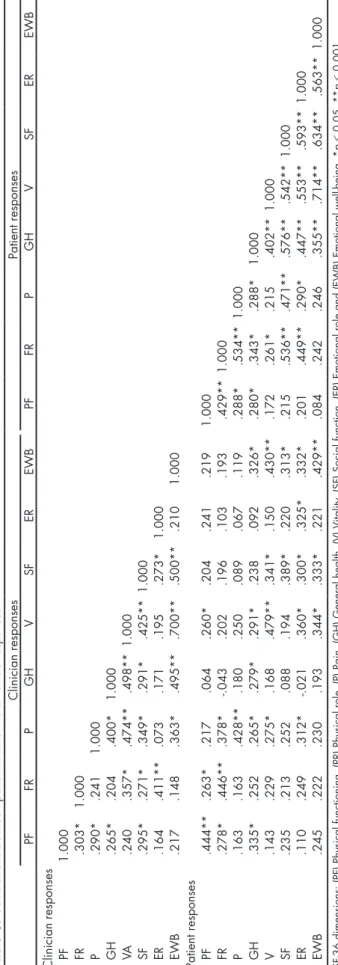
The correlation matrix (table 3) mainly shows: 1. low to
moderate direct correlations (r = 0.26 to 0.48) between
clini-cian and patient responses of the SF-36 dimensions (especial-ly between vitality, emotional well-being and physical role); 2. moderate to high correlations among those from (and
within) the clinician responses (r = 0.49 to 0,70, especially
be-tween emotional well-being, general health, vitality and
so-cial function); and also within the patient responses (r = 0.43
to r = 0.71) between emotional well-being and vitality.
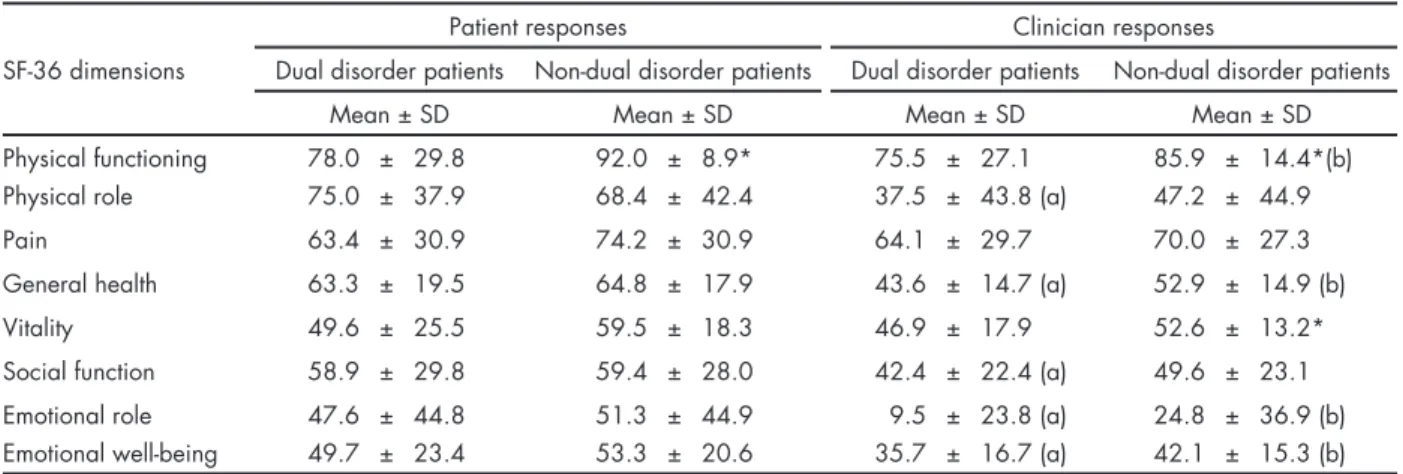
Table 4 shows the comparison between patients’ and clinicians’ responses in the different SF-36 scale sions. As it can be observed, there are basically two
dimen-sions with statistical significant differences between dual
and non-dual pathology patients. This differences account for patients’ perspective and also for clinicians’ perspective
(physical functioning for patient responses, F[58] = 6.4, p =
0.01; physical functioning and vitality for clinician
respons-es, F[58] = 4.5, p < 0.05, indicated by an asterisk in table 3).
To general differences with dual pathology patients (Group
II) and clinician appreciation, it showed significant differ
-ences in most dimensions of the SF-36 scale (all Fs(58) ≥ 5.5,
p < 0.05), in contrast to what occurred in the comparison
be-tween cocaine dependence patients (Group I) and clinician appreciation, in which there are not many differences as in the other groups.
No sociodemographic covariate effects were found to
be statistically significant.
Table 2. Psychiatric comorbidity description in the sample (n = 60)
n % Non-dual diagnosis Cocaine dependence 32 53.3 Dual diagnosis Dysthymic disorder 1 6.0 Induced anxiety disorder 7 41.0
Schizophrenia 1 6.0
Induced psychotic disorder 7 41.0
Agoraphobia 1 6.0
Any personality disorder 11 18.3
Total 28 46.6
Table 3.
Correlations between patient and clinician SF-36 responses
Clinician responses Patient responses PF FR P GH V SF ER EWB PF FR P GH V SF ER EWB
Clinician responses PF
1.000 FR .303* 1.000 P .290* .241 1.000 GH .265* .204 .400* 1.000 VA .240 .357* .474** .498** 1.000 SF .295* .271* .349* .291* .425** 1.000 ER .164 .411** .073 .171 .195 .273* 1.000 EWB .217 .148 .363* .495** .700** .500** .210 1.000
Patient responses PF
.444** .263* .217 .064 .260* .204 .241 .219 1.000 FR .278* .446** .378* -.043 .202 .196 .103 .193 .429** 1.000 P .163 .163 .428** .180 .250 .089 .067 .119 .288* .534** 1.000 GH .335* .252 .265* .279* .291* .238 .092 .326* .280* .343* .288* 1.000 V .143 .229 .275* .168 .479** .341* .150 .430** .172 .261* .215 .402** 1.000 SF .235 .213 .252 .088 .194 .389* .220 .313* .215 .536** .471** .576** .542** 1.000 ER .110 .249 .312* -.021 .360* .300* .325* .332* .201 .449** .290* .447** .553** .593** 1.000 EWB .245 .222 .230 .193 .344* .333* .221 .429** .084 .242 .246 .355** .714** .634** .563** 1.000
SF-36 dimensions: (PF) Physical functioning. (PR) Physical role. (P) Pain. (GH) General
health. (V) Vitality
. (SF) Social function. (ER) Emotional role and (EWB) Emotional well-being. *
p
≤ 0.05. **
p
DISCUSSION AND CONCLUSION
The present research shows the QoL appreciations from a
clinical evaluation from cocaine dependent patients with or without other mental disorder. The singularity of this re-port is the description of clinician and patient discrepancies
about their QoL assessment, according to the subjective as
-sessment of quality of life.6
All cocaine dependent patients expressed a worse QoL
than normal average population.10,13 Although there are few
data in the literature, previous findings stated that the great
-er the sev-erity of cocaine use, the worse QoL.7
In drug addiction, two factors have been described for treatment adherence: psychopathology and the severity of
addiction.14 According to these authors, the low level of
treat-ment adherence is related to the lack of disease awareness and the balance to perform between the positive effect of go-ing to treatment and the immediate reinforcement of drug
consumption.14 Other important factors influencing the QoL
perception are cognitive schemes, motivation to continue the
treatment, social environment and psychiatric comorbidity.10
Based on previous studies, we might consider the
eval-uation of QoL as an indicator of the evolution of patient
satisfaction in different areas of life,8 as well as an
indica-tor in the progression of treatment.15 Otherwise, QoL could
be considered as an indicator of severity in the assessment
of mental disorders and specifically in the field of drug ad -diction, since previous studies indicate that DD patients
have worse QoL in comparison with patients without DD.16
These findings are consistent with results of other studies that show the clinical characterization of DD patients: poor prognostic defined by more number of relapses, short absti
-nence time and greater tendency to chronicity.17
Several longitudinal studies have described that
chang-es in QoL showed inverse correlation with changchang-es in the
mental disorders severity.9,18 It is important to note that
QoL is a subjective construct19 and for this reason it would be consistent to think that this perception is conditioned by the presence of mental disorders, and therefore it has
a paradoxical interpretation. For instance, QoL apprecia -tion of patients with psychosis combined with substance
use disorders has a tendency to be better than QoL levels
perceived by their clinicians, opposite to what happens in
patients with mood disorders.20 This discrepancy could be
explained partially by the Distress/Protection Model for
psychotic patients.21 This model describes QoL as the result
of the interaction between stress and protection factors. If the stress factors are higher than protection factors, then the
perception of QoL decreases. It has been shown some cog
-nitive deficits, and form and content thought alterations in psychotic patients. These deficits questioned the validity of
patients’ scores presented.8
According to patients’ responses, it has been observed a clear trend towards explaining greater satisfaction of their
QoL in all SF-36 dimensions in the DD patient sample com -pared to the non-DD. Nevertheless, due to the diagnoses
heterogeneity, the QoL assessing threshold used between DD and non-DD patients was significantly different in two
dimensions only (physical functioning and vitality). In con-trast to happened in clinical responses, from which DD
pa-tients had lower QoL in comparison with non-DD papa-tients.
However, some studies claim that the insight improve-ments are linked with decreased differences between
pa-tients’ and clinicians’ perceptions.22 The presence of another
mental disorder in drug-dependent patients could influence
the subjective assessment of their context, and in conse-quence, it would be responsible for the discrepancy between clinician and patient.
Some factors that play a significant role in QoL has been described: self-concept, self-efficacy, type of coping style,
Table 4. Different perspectives in quality of life: a comparison between patients and clinicians in the SF-36 dimensions
Patient responses Clinician responses
SF-36 dimensions Dual disorder patients Non-dual disorder patients Dual disorder patients Non-dual disorder patients
Mean ± SD Mean ± SD Mean ± SD Mean ± SD
Physical functioning 78.0 ± 29.8 92.0 ± 8.9* 75.5 ± 27.1 85.9 ± 14.4*(b)
Physical role 75.0 ± 37.9 68.4 ± 42.4 37.5 ± 43.8 (a) 47.2 ± 44.9
Pain 63.4 ± 30.9 74.2 ± 30.9 64.1 ± 29.7 70.0 ± 27.3
General health 63.3 ± 19.5 64.8 ± 17.9 43.6 ± 14.7 (a) 52.9 ± 14.9 (b)
Vitality 49.6 ± 25.5 59.5 ± 18.3 46.9 ± 17.9 52.6 ± 13.2*
Social function 58.9 ± 29.8 59.4 ± 28.0 42.4 ± 22.4 (a) 49.6 ± 23.1
Emotional role 47.6 ± 44.8 51.3 ± 44.9 9.5 ± 23.8 (a) 24.8 ± 36.9 (b)
Emotional well-being 49.7 ± 23.4 53.3 ± 20.6 35.7 ± 16.7 (a) 42.1 ± 15.3 (b)
Dual disorder patients, n = 28 and non-dual pathology patients, n = 32.
personality traits, emotional expression and social support.21 Some differences were found in sociodemographic
charac-teristics, but these differences were not statistically signifi
-cant. Hence, we cannot evaluate the degree of influence of social status on the satisfaction QoL assessment. It is possible
that DD patients’ values could be different for similar social
features, in comparison with non-DD patients.23 Due to these
differences, it will be important to evaluate in future studies
the influence of DD in the QoL assessment, and especially
in social environment, labour and mental health dimensions. In this study we also found differences between cli-nicians’ and patients’ responses, especially in comparison
with DD patients’ responses. It is important to analyze what
implications might have these discrepancies on the
treat-ment evolution,22,24 as well as other studies have shown that
SF-36 administration can discriminate patients in different
stages of treatment and assess their progression.25
Accord-ing to previous studies,24 only the wellness perception is a
predictor of treatment success and the self-efficacy and QoL
perception are related to underlying personality traits, and
thus the evaluation of these traits is a priority to define the
goals of treatment and its effectiveness.
As limitations of the study, it should be pointed out that a heterogeneous group of DD patients were included in the sample and psychiatric disorders were not analysed
sep-arately due to the small sample size. Moreover, subjective evaluations of QoL have been developed to assess patients
with chronic diseases. Consequently, in mental illness and SUD, the same model could not be extrapolated because the disability caused by these disorders could be qualitatively
different.26
In accordance with these results, it may be concluded
that: 1. the perception of QoL may vary depending on the
presence and kind of mental disorders; and 2. it is recom-mended to include a systematic evaluation of subjective
QoL to understand more accurately the patients’ perception
of their treatment, motivations and expectations.
Funding
Supported by grants from the General Deputy Division for Drug Addictions (Health Departament, Generalitat de Catalunya) for co-caine dependence research. Also, a Grant from the Instituto Carlos
III: FIS PI13/1911 “Alucinaciones cenestésicas: factor pronóstico
en dependientes de cocaína” and, a Grant from the Delegación del
Gobierno para el Plan Nacional sobre Drogas 2013I044: “
Complica-ciones clínicas y accidentabilidad asociadas a la presencia de
sín-tomas psicóticos en consumidores de cocaína”. The PND and FIS
had no further role in the study design; in the collection, analysis and interpretation of data; in the writing of the report; and in the decision to submit the paper for publication.
Conflict of interests
No authors of this paper has a conflict of interest, including specific financial interest, relationships, and/or affiliations relevant to the subject matter included in this manuscript.
Acknowledgements
The authors would like to thank Dr. Ángel Egido (Outpatient Clinic Valld’ Hebron, Valld’ Hebron University Hospital), Dr. Sergi Vale-ro (Department of Psychiatry, Valld’ HebVale-ron University Hospital) and Dr. Albert Fernández-Teruel (Medical Psychology Unit, De-partment of Psychiatry and Legal Medicine, UAB) for their collab-oration in this article.
REFERENCES
1. Del Bosque J, Fuentes Mairena A, Diaz DB, Espínola M et al. La cocaí-na: consumo y consecuencias. Salud Ment 2014;37:381-389.
2. Roncero C, Daigre C, Grau-López L, Barral C et al. An international perspective and review of cocaine-induced psychosis: a call to action. Subst Abus 2014;35(3):321-327.
3. Roncero C, Gómez-Baeza S, Vázquez JM, Terán A et al. Perception of Spanish professionals on therapeutic adherence of dual diagnosis patients. Actas Esp Psiquiatr 2013;41(6):319-329.
4. Bobes J, Gutiérrez M, Gibert J, González MP et al. Quality of life and disability in chronic schizophrenics treated with with risperidone and previously treated with depot neuroleptics. Actas Esp Psiquiatr 1999;27(4):229-234.
5. Torrens M, San L, Martinez A, Castillo C et al. Use of the Nottingham
Health Profile for measuring health status of patients in methadone
maintenance treatment. Addiction 1997;92(6):707-716.
6. Roncero C, Díaz-Morán S, Comín M, Miquel L et al. Quality of life concept evolution: the subjective dimension as a relevant factor on drug addiction. Vertex 2011;22(99):343-349.
7. Lozano OM, Domingo-Salvany A, Martinez-Alonso M, Brugal MT et al. Health-related quality of life in young cocaine users and associated factors. Qual Life Res 2008;17(7):977-985.
8. Bengtsson-Tops A, Hansson L, Sandlund M, Bjarnason O et al. Sub-jective versus interviewer assessment of global quality of life among persons with schizophrenia living in the community: a Nordic multi-centre study. Qual Life Res 2005;14(1):221-229.
9. Holloway F, Carson J. Subjective quality of life, psychopathology, sat-isfaction with care and insight: an exploratory study. Int J Soc Psychi-atry 1999;45(4):259-267.
10. Foster JH, Powell JE, Marshall EJ, Peters TJ. Quality of life in alco-hol-dependent subjects-a review. Qual Life Res 1999;8(3):255-261. 11. Pedrero E, Olivar A, Chicharro J. CAD-4 Questionnaire, a
biopsycho-social measure of selfperceived quality of life in drug-dependent pa-tients. Trastornos Adictivos 2008;10(1):17-31.
12. Iraurgi I, Jiménez-Lerna JM, Landabasco M. Analysis of the psy-chometric characteristics of the SF-36 index as an outcome indicator of drugs addiction. Psiquiatría.com 2005;9(2). [serial on-line, cited 1/08/2010]. Avaliable in www.psiquiatria.com
13. Morales-Manrique CC, Palepu A, Castellano-Gomez M, Aleixan-dre-Benavent R et al. Cocaine Group Comunidad Valenciana. Quality of life, needs, and interest among cocaine users: differences by cocaine use intensity and lifetime severity of addiction to cocaine. Subst Use Misuse 2011;46(4):390-397.
14. Secades-Villa R, García-Rodríguez O, Fernández-Hermida JR, Carbal-lo JL. PsychoCarbal-logical bases of the treatment of drug-dependence. Pape-les Picólogo 2007;28(1):29-40.
17. Schmitz JM, Stotts AL, Averill PM, Rothfleisch JM et al. Cocaine de -pendence with and without comorbid depression: a comparison of patient characteristics. Drug Alcohol Depend 2000;60(2):189-198.
18. Priebe S, Roeder-Wanner UU, Kaiser W. Quality of life in first-ad
-mitted schizophrenia patients: a follow-up study. Psychol Med 2000;30(1):225-230.
19. Lehman AF, Ward NC, Linn LS. Chronic mental patients: the quality of life issue. Am J Psychiatry 1982;139(10):1271-1276.
20. Rudolf H, Priebe S. Subjective quality of life in female in-patients with depression: a longitudinal study. Int J Soc Psychiatry 1999;45(4):238-246.
21. Richter D, Eikelmann B, Berger K. Use of the SF-36 in the evaluation
of a drug detoxification program. Qual Life Res 2004;13(5):907-914.
22. Kievit W, Hendrikx J, Stalmeier PF, van de Laar MA et al. The relation-ship between change in subjective outcome and change in disease: a potential paradox. Qual Life Res 2010;19(7):985-994.
23. Astals M, Domingo-Salvany A, Buenaventura CC, Tato J et al. Impact of substance dependence and dual diagnosis on the quality of life of heroin users seeking treatment. Subst Use Misuse 2008;43(5):612-632. 24. Chicharo J. Indicator variables and evolution in addicted patients. Its
relation to personality traits. Psicologia.com 2005; 9(2). [serial on-line, cited 10/07/2009]. Avaliable in www.psiquiatria.com
25. Morales-Manrique CC, Palepu A, Castellano-Gomez M, Aleixan-dre-Benavent R et al. Cocaine Group Comunidad Valenciana. Quality of life, needs, and interest among cocaine users: differences by cocaine use intensity and lifetime severity of addiction to cocaine. Subst Use Misuse 2011;46(4):390-397.