P
www.permanyer.com
Rev Inves Clin. 2016;68:192-200 ORIGINAL ARTICLE
Clinical, Dialytic, and Laboratory
Factors Associated With Poor
Health-Related Quality of Life
in Mexican Patients on Hemodialysis
Edgar Dehesa-López
1,2*, Ricardo Correa-Rotter
3, David Olvera-Castillo
4,
Carlos González-Parra
5and Rafael Baizabal-Olarte
61Hospital Civil de Culiacán, Sinaloa; 2Research and Teaching Center in Health Sciences (CIDOCS), Universidad
Autónoma de Sinaloa, Culiacán, Sinaloa; 3Department of Nephrology and Mineral Metabolism, Instituto Nacional
de Ciencias Médicas y Nutrición Salvador Zubiran, Mexico City; 4Hospital ISSSTE Ciudad Valles, San Luis Potosí;
5Hospital Christus Muguerza-UPAEP, Puebla; 6Hospital ISSSTE Xalapa, Veracruz. Mexico.
Corresponding author:
*Edgar Dehesa-López Eustaquio Buelna No. 91 Col. Gabriel Leyva
C.P. 80030, Culiacán, Sinaloa, México
E-mail: [email protected] Received for publication: 22-03-2016 Accepted for publication: 12-05-2016
ABSTRACT
Background: End-stage renal disease and its treatment have a negative impact on the quality of life of patients. Objective: To
determine the clinical, dialytic, and laboratory factors associated with poor health-related quality of life in Mexican patients on
hemodialysis. Methods: A multicenter, cross-sectional study. The KDQOL-SF36 v1.3 questionnaire was applied to patients with
end-stage renal disease on hemodialysis in different regions of Mexico. Patients were classified according to their overall score on the questionnaire: poor health-related quality of life (overall score below the median) or good health-related quality of life (overall score above the median). Clinical, dialytic, and laboratory variables associated with poor health-related quality of life were analyzed using linear correlation and multivariate logistic regression. Results: We included 194 adult patients with a
median age of 55 (45-64) years. The diagnosis of poor health-related quality of life was present in 47.4% of patients. A poor correlation was found between the clinical, dialytic, and biochemical parameters and the health-related quality of life score (range of correlations r = –0.4 to 0.2). Serum albumin level showed the highest number of weak, statistically significant cor-relations. Factors associated with poor health-related quality of life in the multivariate analysis were: time spent on hemodialy-sis (OR = 1.02; 95% CI; 1.00-1.04; p = 0.02), use of a venous catheter (OR = 3.2; 95% CI: 1.36-7.75; p = 0.01), and serum albumin < 4 g/dl (OR = 3.55; 95% CI: 1.44-8.74; p < 0.01). Conclusions: Poor health-related quality of life was common in
Mexican patients undergoing hemodialysis. No strong correlation was found between the clinical, dialytic, or laboratory factors with health-related quality of life. Factors associated with poor health-related quality of life were: time on hemodialysis, use of a venous catheter, and serum albumin level < 4 g/dl. (REV INVES CLIN. 2016;68:192-200)
Key words: HRQoL. Quality of life. KDQOL-SF36. Hemodialysis.
No part of this publication may be reproduced or photocopying without the prior written permission
of the publisher
.
INTRODUCTION
In Mexico, similar to the rest of the world, end-stage renal disease (ESRD) is a public health prob-lem due to its high prevalence, morbidity, mortality, and economic costs arising from medical care1-9. Additionally, it has been consistently demonstrated that ESRD and its treatment produces a negative impact on the quality of life of patients with this disease10,11. Moreover, the evaluation of the health-related quality of life (HRQoL) is a relatively new concept in the field of nephrology, but it is becoming increasingly important due to its role as an indepen-dent predictor of clinical outcomes12 and as a key indicator in the evaluation of the quality of health care13. However, despite the current trend of includ-ing the evaluation of HRQoL as an important mea-sure of medical care, studies evaluating the HRQoL of patients with ESRD undergoing hemodialysis are scarce. The aim of our study was to evaluate the HRQoL of patients and determine the clinical, dia-lytic, and laboratory factors associated with poor HRQoL (P-HRQoL) in Mexican patients with ESRD who are undergoing hemodialysis.
MATERIALS AND METHODS
We performed a cross-sectional study. The Institu-tional Research and Ethics Committee reviewed and approved the protocol. A version of the Kidney Dis-ease Quality of Life Short Form (KDQOL-SF36 v1.3) questionnaire was administered by an interviewer to 194 adult patients with ESRD who were receiv-ing chronic hemodialysis in different regions of Mex-ico. We included clinically stable patients with more than one month of dialysis treatment. We excluded patients with any physical disability. Patients were grouped according to their overall score as patients with a P-HRQoL (overall score of the questionnaire below the median score of the general group) and patients with a good HRQoL (G-HRQoL, overall score above the median score of the general group). Clin-ical (age, sex, comorbidities, and education), dia-lytic (type of vascular access, time on hemodialysis, and Kt/V), and laboratory (hemoglobin, serum cal-cium, serum phosphorus, and serum albumin levels) variables were collected and compared between groups. Descriptive statistics with means/standard
deviations and medians/25-75th percentiles were used to describe continuous variables according to distri-bution data; frequencies and proportions were used to describe categorical variables. Comparisons be-tween the two groups were performed using Stu-dent’s t test or Mann-Whitney U test according to distributions of data in the case of continuous vari-ables and by a X2 test in the case of categorical
variables. We used one-factor ANOVA for compari-sons between more than two groups. Correlations between dialytic, laboratory variables and the HRQoL scores were done using the Spearman correlation coefficient. Risk factors associated with HRQoL scores were analyzed by multivariate logistic regression. A value of p < 0.05 was considered statistically sig-nificant.
RESULTS
Patient characteristics
A total of 194 adult patients with ESRD who were undergoing chronic hemodialysis were included, of whom 37.6% (n = 73) lived in the northern region, 28.9% (n = 56) lived in the southern region, and 33.5% (n = 65) lived in the central region of Mexico. Me-dian age was 55 (45-64) years, and 54.6% (n = 106) of the patients were male. The most frequently ob-served comorbidities included hypertension in 86.6% (n = 168), diabetes mellitus type 2 in 57.2% (n = 111), and dyslipidemia in 7.2% (n = 14) of patients. Re-garding the educational level of our population, 12.4% (n = 24) were illiterate, 41.8% (n = 81) had a com-plete primary education, and 16.5% (n = 32) had a professional education. The main causes of ESRD were type 2 diabetes mellitus in 48.5% (n = 94) of patients and hypertension in 15.5% (n = 30); in 14.9% (n = 29), the cause was unknown. In addition, 75.3% (n = 146) of patients did not perform any type of paid work. In 55.2% (n = 107) of patients, vascular access was achieved with a catheter, and in 44.8% (n = 87) an arteriovenous fistula was used. The me-dian time on hemodialysis was 19 (8-38) months. The medians (25-75 percentiles) of factors studied were: hemoglobin 10.5 (9.1-11.7) g/dl, calcium 8.7 (8.0-9.2) mg/dl, phosphorus 5.8 (4.8-7.3) mg/dl, serum albumin 4.0 (3.7-4.3) g/dl, Kt/V 1.2 (1.0-1.4), and 250 (20-600) ml/day for residual urine volume.
No part of this publication may be reproduced or photocopying without the prior written permission
of the publisher
.
Comparison of clinical, dialytic,
and laboratory characteristics
between patients with good and poor
health-related quality of life
The median overall score of HRQoL of our population was 55.6 points. A total of 47.4% (n = 92) of patients had a diagnosis of P-HRQoL according to the criterion used (the median score). When comparing general characteristics of patients with P-HRQoL and G-HRQoL, we observed that age was lower in patients with G-HRQoL (53 vs. 59 years; p = 0.03), the mean of time on hemodialysis was higher in patients with G-HRQoL, and the proportion of patients with type 2 diabetes mellitus was higher (65.2 vs. 50.0%; p = 0.03) in the group with P-HRQoL. In addition, the proportion of patients with an arteriovenous fistula was higher for patients in the G-HRQoL group (52.9 vs. 35.9%; p = 0.01). The proportion of patients with serum phosphorus levels greater than 5.5 mg/dl (45.6 vs. 66.3%; p = 0.01) was lower in patients with P-HRQoL. The proportion of patients with normal serum phos-phorus levels was higher (50.6 vs. 28.3%; p = 0.01) in patients with P-HRQoL vs. G-HRQoL. Moreover, se-rum albumin levels (3.9 vs. 4.1 g/dl; p = 0.02) and the proportion of patients with serum albumin levels greater than 4.0 g/dl (40.5 vs. 64.3%; p = 0.001) were lower in patients with P-HRQoL compared with G-HRQoL. For the remaining clinical, dialytic, and labo-ratory characteristics shown in table 1, no statistically significant differences were found between groups.
Comparison of health-related quality
of life between patients with end-stage
renal disease undergoing hemodialysis
and healthy patients
The mean overall score of the KDQOL-SF36 v1.3 questionnaire was 56.5 ± 11.0 points, with a mini-mum score of 25.6 and a maximini-mum of 84.4 points. The most affected dimensions of the specific disease component (KDQOL component) of the question-naire were the quality of social interaction (21.0 ± 20.9 points), cognitive dimension (21.8 ± 21.7 points), and work (33.7 ± 37.1 points). In the generic compo-nent (SF36 compocompo-nent) of the questionnaire, the most affected dimensions were physical role (25.9 ± 37.7), emotional role (37.8 ± 38.2), and general health perception (48.5 ± 23.0). We compared scores of the SF36 generic component of the KDQOL-SF36
with the scores of the QOL SF36 questionnaire ob-tained from healthy Mexican adults in a nationally representative sample reported by Duran, et al., which included 5,961 Mexican healthy individuals over 25 years old selected through multistage sam-pling covering rural and urban areas of Mexico14. We observed that Mexican patients with ESRD on hemo-dialysis had a lower score in all evaluated dimensions of quality of life, except for the dimension of emo-tional well being, in which the scores were similar (Table 2). On the other hand, patients with P-HRQoL had lower scores in all dimensions including the phys-ical and mental component of QOL SF36 compared to patients with G-HRQoL and the healthy population. Finally, patients with G-HRQoL had lower scores on the physical and mental component of QOL SF-36 compared to healthy patients. However, these low scores were mainly attributed to physical functioning, role emotional, and role physical dimensions. In other dimensions of the SF36 component, the scores of G-HRQoL were very similar to the scores observed in the healthy population reported by Duran, et al. (Table 2).
Comparison of dimensions
of health-related quality of life between
patients with poor and good
health-related quality of life
We compared the dimensions of HRQoL between pa-tients with P-HRQoL and G-HRQoL in our population. We observed that in the specific disease component of the questionnaire (KDQOL component), patients with P-HRQoL had a lower score in most dimensions, particularly in the dimensions of burden of chronic kidney disease (CKD) (26.1 vs. 54.3; p < 0.01), work (22.8 vs. 43.6; p < 0.01), and the effect of CKD (53.2 vs. 71.6; p < 0.01). In contrast, patients with P-HRQoL had a higher score in the cognitive (28.2 vs. 16.1; p < 0.01) and quality of social interaction (25.7 vs. 16.7; p < 0.01) dimensions. No statistically significant differences were observed in the dimensions of support from the dialysis team (92.2 vs. 89.8; p = 0.34) and satisfaction with dialysis care (78.6 vs. 80.7; p = 0.49) among patients with G-HRQoL and P- HRQoL (Table 2). In the generic component of the questionnaire (SF-36 component), patients with P-HRQoL had a lower score on most dimensions. This was especially seen in the physical role (4.0 vs. 45.8; p < 0.01), emotional role (18.1 vs. 55.5; p < 0.01), and pain (52.7 vs. 85.3;
No part of this publication may be reproduced or photocopying without the prior written permission
of the publisher
.
p < 0.03) dimensions, as well as the physical (32.2 vs. 43.5; p < 0.01) and mental components (41.3 vs. 51.7; p < 0.01) (Table 2).
Correlation between clinical, dialytic,
and laboratory parameters and
health-related quality of life in patients
with end-stage renal disease undergoing
hemodialysis
A poor correlation was observed between most clini-cal and biochemiclini-cal parameters and the dimensional scores and overall score of HRQoL. Serum albumin level was the parameter with the highest number of statistically significant correlations. However, it showed a weak positive correlation with physical function (r = 0.2; p = 0.01), energy/fatigue (r = 0.3; p = 0.01), and the overall score of HRQoL (r = 0.2; p = 0.01). It also exhibited a weak negative correlation with
cognitive function (r = –0.2; p = 0.01). Age showed a negative correlation with the physical dimensions (physical function: r = –0.4, p = 0.01; physical role: r = –0.2, p = 0.01) and the overall score of HRQoL (r = –0.2; p = 0.01). The Kt/V only exhibited a weak negative correlation with the sleep dimension (r = –0.2; p = 0.01) of the HRQoL, and time on hemodialysis showed a weak negative correlation with general health perception (r = –0.1; p = 0.01) and positive correlation with social function (r = 0.2; p < 0.01). The remaining correlations are shown in table 3.
Clinical, dialytic, and laboratory factors
associated with poor health-related
quality of life in patients with end-stage
renal disease undergoing hemodialysis
In the multivariate logistic regression, the indepen-dent risk factors associated with P-HRQoL in Mexican
Table 1. Comparison of clinical, dialytic, and laboratory characteristics between patients with poor and good health-related quality of life
Variables P-HRQoL G-HRQoL p
n = 92 % n = 102 %
Age (Md; 25-75p) 59 (48-68) 53 (43-60) 0.03
Male/female 52.2/47.8% 56.9/43.1% 0.51
Diabetes mellitus 60 65.2% 51 50% 0.03
Vascular access:
Catheter 59 64.1% 48 47.1% 0.01
Arteriovenous fistula 33 35.9% 54 52.9%
Time on hemodialysis (Md) 14 (5-34) 24 (12-36) 0.02
Kt/V (median) 1.2 (0.9-1.4) 1.2 (1.0-1.3) 0.94
Kt/V < 1.4 61 75.3% 74 79.6% 0.5
Kt/V > 1.4 20 24.7% 19 20.4%
Hemoglobin (Md; 25-75p) 10.4 (8.9-11.6) 10.6 (9.3-11.9) 0.61
Hb < 9 g/dl 26 28.5% 18 17.6% 0.19
Hb 9-11 g/dl 33 36.3% 43 42.2%
Hb >11 g/dl 32 35.2% 41 40.2%
Serum calcium (Md; 25-75p) 8.8 (8.1-9.2) 8.6 (8.0-9.4) 0.58
Ca < 8.5 mg/dl 33 41.2% 38 40.8% 0.15
Ca 8.5-10 mg/dl 38 47.5% 33 35.5%
Ca > 10 mg/dl 9 11.3% 22 23.7%
Serum phosphorus (Md; 25-75p) 5.4 (4.5-6.6) 6.2 (5.3-7.9) 0.13
P < 3.5 mg/dl 3 3.8% 5 5.4% 0.01
P 3.5-5.5 mg/dl 40 50.6% 26 28.3%
P > 5.5 mg/dl 36 45.6% 61 66.3%
Serum albumin (Md; 25-75p) 3.9 (3.5-4.2) 4.1 (3.8-4.3) 0.02
Albumin < 4 g/dl 50 59.5% 35 35.7% 0.001
Albumin > 4 g/dl 34 40.5% 63 64.3%
Md: median; 25-75p: 25-75th percentile; HRQoL: health-related quality of life; P: poor; G: good.
No part of this publication may be reproduced or photocopying without the prior written permission
of the publisher
.
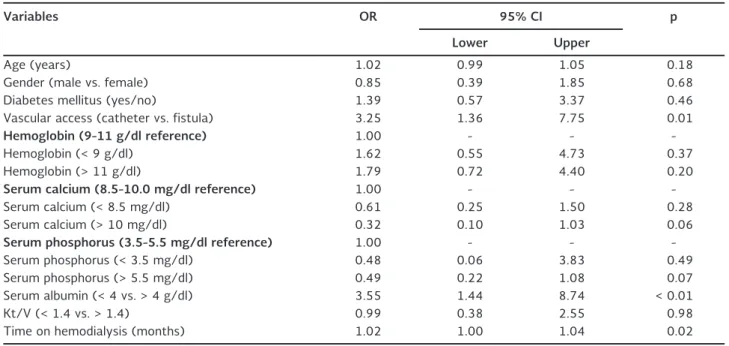
patients on hemodialysis were time spent on hemo-dialysis (OR = 1.02; 95% CI: 1.00-1.04; p = 0.02), the use of a venous catheter vs. arteriovenous fistula (OR = 3.2; 95% CI: 1.36-7.75; p = 0.01), and serum levels of albumin below 4 g/dl (OR = 3.55; 95% CI: 1.44-8.74; p < 0.01). The remaining clinical, dialytic, and laboratory factors included in the multivariate analysis shown in table 4 were not associated with P-HRQoL in our population.
DISCUSSION
Based on the results of our study, we can confirm that Mexican patients on hemodialysis have a marked de-crease in their quality of life. When we compared scores of the SF36 generic component of the KDQOL-SF36 with the scores of the QOL SF36 questionnaire obtained
from healthy Mexican adults in a nationally repre-sentative sample14, hemodialysis patients showed a marked decrease in the scores of physical (38.1 ± 10.0 vs. 79.0 ± 0.2; p < 0.01) and mental (51.7 ± 7.8 vs. 76.7 ± 0.2; p < 0.01) components of QOL SF36. This decrease was more pronounced in the physical role (25.9 vs. 88.7; delta = –62.8 points), emo-tional role (37.8 vs. 88.9; delta = –51.1 points), and physical function (53.1 vs. 89.6; delta = –36.5 points) dimensions. In the medical literature, it has been con-sistently documented that ESRD and its treatment with hemodialysis or peritoneal dialysis produces a negative effect on the quality of life of these patients. Pagels, et al. conducted a study to evaluate the quality of life of patients with CKD in different stages and at the start of dialytic treatment. They included 535 pa-tients with CKD stages 2-5 of the Kidney Disease Outcomes Quality Initiative (KDOQI) classification and
Table 2. Comparisons of health-related quality of life between healthy Mexican subjects and poor and good health-related
quality of life patients with end-stage renal disease on hemodialysis
Healthy* General P-HRQoL G-HRQoL p KDQOL component
Symptom/problem list – 78.9 72.4 84.8 < 0.01
Effects of kidney disease – 62.9 53.2 71.6 < 0.01
Burden of kidney disease – 40.9 26.1 54.3 < 0.01
Work status – 33.7 22.8 43.6 < 0.01
Cognitive function – 21.8 28.2 16.1 < 0.01
Quality of social interaction – 21.0 25.7 16.7 < 0.01
Sexual function – 79.7 70.3 87.1 < 0.01
Sleep – 62.3 58.1 66.1 < 0.01
Social support – 69.0 64.3 74.0 0.03
Dialysis staff encouragement – 90.9 92.2 89.8 0.34
Patient satisfaction – 79.7 78.6 80.7 0.49
SF-36 Component
Physical functioning 89.6 53.1 36.9 67.7 < 0.01†,‡,#
Role physical 88.7 25.9 4.0 45.8 < 0.01†,‡,#
Pain 85.5 69.8 52.7 85.3 < 0.01†,‡
General health 52.2 48.5 36.8 59.0 < 0.01†,‡,#
Emotional well-being 72.1 72.8 60.4 84.0 < 0.01†,‡,#
Role emotional 88.9 37.8 18.1 55.5 < 0.01†,‡,#
Social function 75.1 69.7 54.7 83.2 < 0.01†,‡,#
Energy/fatigue 70.7 61.9 48.4 74.0 < 0.01†,‡,#
Overall score – 56.57 47.1 65.0 < 0.01
SF-12 physical 79.0 38.2 32.2 43.5 < 0.01†,‡,#
SF-12 mental 76.7 46.8 41.3 51.7 < 0.01†,‡,#
T-Student test between P-HRQoL vs G-HRQoL was used in the KDQOL component and overall score of KDQOL SF36. ANOVA test between P-HRQoL, G-HRQoL and Healthy was used in the SF36 component.
*Score obtained from healthy Mexican patients in a nationally representative sample14; †P-HRQoL vs. G-HRQoL; ‡P-HRQoL vs. healthy; #G-HRQoL vs. healthy.
KDQOL: Kidney Disease Quality of Life; SF: short form; P-HRQoL: poor health-related quality of life; G-HRQoL: good health-related quality of life.
No part of this publication may be reproduced or photocopying without the prior written permission
of the publisher
.
55 healthy control patients. Compared to the con-trols, a significant decline was observed in all dimen-sions of quality of life evaluated in patients with CKD, especially in the physical and general health dimen-sions, which were more pronounced in patients with more advanced stages of CKD (Stage KDOQI-5)11. These findings show that quality of life is affected even in patients with early stages of CKD, and is sub-stantially impaired in patients with ESRD at the start of dialytic treatment. Furthermore, Brennan, et al. con-ducted a systematic review, including 47 studies, that evaluated the quality of life of patients with ESRD and compared the results to the quality of life of healthy control subjects. Patients with ESRD who received he-modialysis and peritoneal dialysis showed a significant decline in their quality of life compared to healthy subjects, especially in the physical, vitality, and, to a lesser degree, mental status dimensions, which dem-onstrates the negative effect of CKD and its treat-ment on the quality of life of these patients10. We performed a comparison of HRQoL scores between the different hemodialysis centers of our study. No
statistically significant differences were found in the overall scores between hemodialysis patients of dif-ferent regions of Mexico. However, in specific dimen-sions of KDQOL SF36 we observed differences be-tween hemodialysis patients of different regions of our country (Table 5). Furthermore, when comparing the overall HRQoL score of our population (56.5) with that of patients with ESRD receiving hemodialysis re-ported in other countries, we observed that the score in Mexican patients was lower than that of patients in the USA (63.7), Europe (62.7), Japan (63.3), and Bra-zil (62.3) (Table 5)15,16. Similar to the results observed in other countries, the dimensions work and physical role in the quality of life component were the most affected in Mexican patients. However, the dimensions with lower scores in our population included quality of social interaction and cognition, which showed much lower scores than those observed for these dimen-sions in other countries. Such low scores observed in our population could be due in part to comprehension problems regarding the questions that evaluate these dimensions in the questionnaire. In contrast, the dimen-sion of HRQoL with the highest score in our population
Table 3. Correlations between clinical, dialytic and laboratory factors with health-related quality of life
Age TH Hb Ca P Alb Kt/V
KDQOL component
Symptom/problem list –0.099 0.119 0.059 –0.008 0.101 0.296* –0.127
Effects of kidney disease –0.136 0.036 0.160* –0.005 0.167* 0.197* 0.041
Burden of kidney disease –0.082 0.140 0.086 0.014 0.098 0.239* –0.031
Work status –0.114 0.140 –0.010 0.125 0.081 0.173* –0.109
Cognitive function 0.064 –0.082 –0.071 –0.105 –0.152* –0.284* 0.137
Quality of social interaction –0.050 –0.071 –0.027 –0.098 –0.132 –0.218* –0.047
Sexual function –0.083 0.026 0.005 0.101 –0.076 0.032 0.034
Sleep –0.198* 0.202* 0.110 0.024 0.072 0.278* –0.208*
Social support 0.012 –0.101 0.101 –0.107 0.021 –0.040 0.055
Dialysis staff encouragement 0.045 –0.018 –0.116 0.078 –0.066 –0.095 0.092
Patient satisfaction –0.071 –0.085 –0.005 –0.204* 0.006 –0.035 0.048
SF-36 component
Physical functioning –0.410* 0.088 0.217* –0.015 0.196* 0.229* 0.106
Role physical –0.236* 0.091 0.045 –0.005 0.174* 0.103 0.179*
Pain –0.079 0.053 –0.023 0.012 0.147 0.234* 0.017
General health 0.045 –0.155* 0.168* –0.002 0.070 0.024 0.070
Emotional well being –0.122 0.155* 0.002 –0.007 0.184* 0.268* –0.045
Role emotional –0.096 0.079 0.115 –0.048 0.126 0.083 0.010
Social function –0.097 0.217* 0.033 0.075 0.190* 0.221* 0.166*
Energy/fatigue –0.134 0.198* 0.022 0.023 0.188* 0.310* –0.024
Overall score –0.263* 0.171* 0.131 0.017 0.190* 0.271* 0.021
*p < 0.05 for Spearman correlation coefficient.
KDQOL: Kidney Disease Quality of Life; SF: short form; P-HRQoL: poor health-related quality of life; G-HRQoL: good health-related quality of life; TH: time on hemodialysis (months); Hb: hemoglobin; Ca: serum calcium; P: serum phosphorus; Alb: serum albumin.
No part of this publication may be reproduced or photocopying without the prior written permission
of the publisher
.
Table 4. Multivariate logistic regression analysis of clinical, dialytic and laboratory factors associated with poor health-related quality of life
Variables OR 95% CI p
Lower Upper
Age (years) 1.02 0.99 1.05 0.18
Gender (male vs. female) 0.85 0.39 1.85 0.68
Diabetes mellitus (yes/no) 1.39 0.57 3.37 0.46
Vascular access (catheter vs. fistula) 3.25 1.36 7.75 0.01
Hemoglobin (9-11 g/dl reference) 1.00 - -
-Hemoglobin (< 9 g/dl) 1.62 0.55 4.73 0.37
Hemoglobin (> 11 g/dl) 1.79 0.72 4.40 0.20
Serum calcium (8.5-10.0 mg/dl reference) 1.00 - -
-Serum calcium (< 8.5 mg/dl) 0.61 0.25 1.50 0.28
Serum calcium (> 10 mg/dl) 0.32 0.10 1.03 0.06
Serum phosphorus (3.5-5.5 mg/dl reference) 1.00 - -
-Serum phosphorus (< 3.5 mg/dl) 0.48 0.06 3.83 0.49
Serum phosphorus (> 5.5 mg/dl) 0.49 0.22 1.08 0.07
Serum albumin (< 4 vs. > 4 g/dl) 3.55 1.44 8.74 < 0.01
Kt/V (< 1.4 vs. > 1.4) 0.99 0.38 2.55 0.98
Time on hemodialysis (months) 1.02 1.00 1.04 0.02
OR: odds ratio.
Table 5. National (between hemodialysis centers in our study) and international comparison of health-related quality of life of Mexican patients on hemodialysis
National comparison International comparison
Sinaloa Veracruz Puebla SLP p Mexico Europe Japan USA Brazil
KDQOL component
Symptom/problem list 73.0* 80.0* 80.9 87.1† < 0.01 78.9 70.4 73.8 72.2 81.2
Effects of kidney disease 62.5 64.0 64.5 61.5 0.9 62.9 57.9 66.7 63.3 73.3
Burden of kidney disease 33.8* 49.3* 38.0 43.9 0.01 40.9 36.8 27.6 42.4 46.8
Work status 22.6† 38.4 37.5 45.1† < 0.01 33.7 28.5 33.0 27.0 22.3
Cognitive function 22.1 21.3‡ 35.0‡,# 14.5# < 0.01 21.8 74.3 80.0 78.0 78.4
Quality of social interaction 18.4 24.9 29.4# 15.4# 0.02 21.0 77.2 60.6 76.0 80.9
Sexual function 73.9* 90.8*,‡ 66.3‡ 79.8 < 0.01 79.7 66.7 63.3 60.5 35.6
Sleep 59.5† 64.8 58.9 66.0† 0.02 62.3 58.1 61.2 59.9 75.5
Social support 63.5 73.8 77.1 69.5 0.17 69.0 73.0 72.0 74.1 86.7
Dialysis staff encouragement 95.7* 83.0*,§ 93.2 92.1§ < 0.01 90.9 80.5 79.3 78.0 90.8
Patient satisfaction 86.3*,¶ 73.5* 70.1¶ 82.1 < 0.01 79.7 68.9 76.2 69.2 72.6
SF-36 component
Physical functioning 54.1 63.5§ 52.3 37.8§ < 0.01 53.1 45.0 60.3 42.7 61.0
Role physical 29.1† 35.3§ 25.0 7.9†,§ < 0.01 25.9 37.2 46.5 37.6 59.0
Pain 72.9 72.8 59.4 66.8 0.18 69.8 56.4 61.4 57.1 67.4
General health 53.7† 51.0§ 48.1 36.1†,§ < 0.01 48.5 36.1 40.7 41.0 59.0
Emotional well being 72.0 73.4 67.3 76.9 0.34 72.8 60.8 61.8 68.2 66.1
Role emotional 34.7* 56.0*,‡,§ 31.9‡ 22.0§ < 0.01 37.8 49.1 48.7 58.0 71.2
Social function 77.9†,¶ 67.0 62.0¶ 63.4† < 0.01 69.7 62.2 69.2 63.5 76.6
Energy/fatigue 59.9 61.9 58.1 67.8 0.24 61.9 42.4 50.8 43.4 60.4
Overall score 55.8 59.8 55.2 54.2 0.06 56.5 62.7 63.3 63.7 62.3
KDQOL: Kidney Disease Quality of Life; SF: short form; P-HRQoL: poor health-related quality of life; SLP: Ciudad Valles, San Luis Potosi;
Veracruz: Xalapa, Veracruz; Sinaloa: Culiacán, Sinaloa; Puebla: Puebla, Puebla.
ANOVA post hoc comparison: *Sinaloa vs. Veracruz; †Sinaloa vs. SLP; ‡Veracruz vs. Puebla; #Puebla vs. SLP; §SLP vs. Veracruz; ¶Sinaloa vs. Puebla.
No part of this publication may be reproduced or photocopying without the prior written permission
of the publisher
.
was support from the dialysis team, similar to pa-tients in Europe, the USA, and Brazil and in contrast to the results observed in Japan, where the cognitive dimension had the highest HRQoL score.
Furthermore, Brennan, et al., in their excellent system-atic review of 47 studies, also investigated the asso-ciation between biochemical parameters and HRQoL in patients with ESRD10. The authors identified 14 studies that evaluated the association between Kt/V, as a variable of dialysis adequacy, and the dimensions of the HRQoL of the SF36 questionnaire. The authors did not document a strong association between Kt/V and HRQoL (r = 0.01; 95% CI: –0.02-0.22; p = NS). With regard to anemia parameters, the authors iden-tified 16 studies that evaluated the association be-tween hematocrit value and the dimensions of HRQoL of the SF36 questionnaire. However, the authors did not find a strong association between hematocrit value and the dimensions of HRQoL (r = 0.1; 95% CI: 0.13-0.17). In two studies, the associations between hematocrit value and dimensions of HRQoL of the KDQOL component were evaluated, and only a weak statistically significant association (r < 0.2) was found between the hematocrit value and the satisfaction dimensions, effect of CKD, and quality of social interac-tion17,18. In contrast, the authors identified 16 stud-ies that evaluated the associations between nutri-tional markers, such as serum albumin level, with dimensions of HRQoL of the SF36 questionnaire. A weak correlation (r < 0.2) was documented be-tween albumin level and the different dimensions of the SF36 questionnaire, and a moderate correlation was found with physical function (r = 0.34), vitality (r = 0.22), and mental health (r = 0.29). Only one study documented a moderate association between serum albumin level and all dimensions of HRQoL of the KDQOL component (r = 0.3; p = 0.007)19. The authors found only one study that evaluated the association between parameters of bone metabolism (Ca x P product) and HRQoL, in which no association was documented between these variables20. How-ever, a very important point to consider when analyz-ing the association between biochemical variables and the HRQoL score using a correlation coefficient is that the type of association between biochemical variables and clinical outcomes in patients with ESRD may have a “U”-shaped form instead of being linear, which could also occur with the HRQoL21. Based on this reasoning, using multivariate logistic regression, we
performed an analysis of the association with ordinal or dichotomous statistical management of the main biochemical dialytic variables and the HRQoL. The independent risk factors associated with P-HRQoL in the analysis included the time spent on hemodialysis (OR = 1.02; 95% CI: 1.00-1.04; p = 0.02), use of a venous catheter vs. arteriovenous fistula for vascular access (OR = 3.2; 95% CI: 1.36-7.75; p = 0.01), and serum levels of albumin below 4 g/dl (OR = 3.55; 95% CI: 1.44-8.7; p < 0.01). In this type of multi-variate analysis, Kt/V (Kt/V > or < 1.4) was ana-lyzed dichotomously, and hemoglobin (Hb < 9 g/dl vs. Hb 9-11 g/dl vs. Hb > 11 g/dl), serum calcium (Ca < 8.5 mg/dl vs. Ca = 8.5-10 mg/dl vs. Ca > 10 mg/ dl), and serum phosphorus levels (P < 3.5 mg/dl vs. P = 3.5-5.5 mg/dl vs. P > 5.5 mg/dl) were analyzed ordinally and were not associated with P-HRQoL in our population. In conclusion, these findings indicate that, while clinical and biochemical measurements provide important information to the physician regarding clinical outcomes, these parameters weakly corre-late with HRQoL of patients with ESRD who receive hemodialysis. In this regard, the subjective evalua-tion that the individuals produce regarding their own quality of life plays an important role, and similar health states may correspond to different percep-tions of the HRQoL.
Regarding the weaknesses of our study, one issue is the difficulty of precisely defining and measuring the quality of life as well as the lack of a universally ac-cepted criterion for defining P-HRQoL based on the overall score of the KDQOL questionnaire. In contrast, our work is the first multicenter study to measure the HRQoL in Mexican patients with ESRD undergoing he-modialysis, in addition to studying the association between biochemical and dialytic factors and the HRQoL in a linear form and through multivariate lo-gistic regression.
In conclusion, Mexican patients with ESRD undergo-ing hemodialysis have a marked decrease in their quality of life compared to the general population. Poor HRQoL was a common diagnosis, observed in up to 47.4% of our population. The most affected dimensions of the KDQOL component were work, cog-nition, and quality of social interaction, as well as the physical role, emotional role, and general health per-ception in the SF36 generic component. Factors as-sociated with P-HRQoL included the use of a venous
No part of this publication may be reproduced or photocopying without the prior written permission
of the publisher
.
catheter for vascular access, a serum albumin level < 4 g/dl, and time on hemodialysis. Based on these results, we can conclude that comprehensive treat-ment of patients with ESRD undergoing hemodialysis should include assessment of the HRQoL as a mea-sure of dialysis adequacy and not be limited exclu-sively to measurement of clinical, dialytic, and bio-chemical parameters.
REFERENCES
1. Incidence, prevalence, patient characteristics and treatments modalities. U.S. Renal Data System, USRDS 2013 Annual Data Report: Atlas of Chronic Kidney Disease and End-Stage Renal Disease in the United States, National Institutes of Health, Na-tional Institute of Diabetes and Digestive and Kidney Diseases, Bethesda, MD, 2013.
2. International comparisons. U.S. Renal Data System, USRDS 2013 Annual Data Report: Atlas of Chronic Kidney Disease and End-Stage Renal Disease in the United States, National Insti-tutes of Health, National Institute of Diabetes and Digestive and Kidney Diseases, Bethesda, MD, 2013.
3. Amato D, Alvarez-Aguilar C, Castañeda-Limones R, et al. Preva-lence of chronic kidney disease in an urban Mexican population. Kidney Int. 2005;97: S11-17.
4. Paniagua R, Ramos A, Fabian R, Lagunas J, Amato D. Chronic kidney disease and dialysis in Mexico. Perit Dial Int. 2007;27: 405-9.
5. Gutierrez-Padilla JA, Mendoza-Garcia M, Plascencia-Perez S, et al. Screening for CKD and cardiovascular disease risk factors using mobile clinics in Jalisco, Mexico. Am J Kidney Dis. 2010; 55:474-84.
6. Obrador GT, Garcia-Garcia G, Villa AR, et al. Prevalence of chronic kidney disease in the Kidney Early Evaluation Program (KEEP) Mexico and comparison with KEEP US. Kidney Int. 2010; 77:S2-8.
7. López-Cervantes M. La importancia epidemiológica actual y fu-tura de la enfermedad renal crónica en México. En: Enfermedad renal crónica y su atención mediante tratamiento sustitutivo en México. Facultad de Medicina, Universidad Nacional Autónoma de México: Primera edición, México, D.F. 2009:47-57.
8. Méndez Durán A, Méndez Bueno JF, Tapia Yáñez T, Muñoz Montes A, Aguilar Sánchez L. Epidemiología de la insuficiencia renal crónica en México. Dial Traspl. 2010;3:7-11.
9. Mortality. International comparisons. U.S. Renal Data System, USRDS 2013 Annual Data Report: Atlas of Chronic Kidney Dis-ease and End-Stage Renal DisDis-ease in the United States, Na-tional Institutes of Health, NaNa-tional Institute of Diabetes and Digestive and Kidney Diseases, Bethesda, MD, 2013.
10. Spiegel BM, Melmed G, Robbins S, Esrailian E. Biomarkers and health-related quality of life in end-stage renal disease: A sys-tematic revision. Clin J Am Soc Nephrol. 2008;3:1759-68. 11. Pagels AA, Söderkvist BK, Medin C, Hylander B, Heiwe S.
Health-related quality of life in different stages of chronic kidney dis-ease and at initiation of dialysis treatment. Health Qual Life Outcomes. 2012;10:71.
12. Østhus TB, Preljevic VT, Sandvik L, et al. Mortality and health-related quality of life in prevalent dialysis patients: Comparison between 12-items and 36-items short-form health survey. Health Qual Life Outcomes. 2012;10:46.
13. Velarde-Jurado E, Avila-Figueroa C. [Evaluation of the quality of life]. Salud Publica Mex. 2002;44:349-61.
14. Durán Arenas L, Gallegos Carrillo K, Salinas Escudero G, Mar-tínez-Salgado H. [Towards a Mexican normative standard for measurement of the short format 36 health-related quality of life instrument]. Salud Publica Mex. 2004;46:306-15.
15. Fukuhara S, Lopes AA, Bragg-Gresham JL, et al. Health-related quality of life among dialysis patients on three continents: the Dialysis Outcomes and Practice Patterns Study. Kidney Int. 2003;64:1903-10.
16. Duarte PS, Ciconelli RM, Sesso R. Cultural adaptation and valida-tion of the “Kidney Disease and Quality of Life--Short Form (KDQOL-SF 1.3)” in Brazil. Braz J Med Biol Res. 2005;38:261-70. 17. Vázquez I, Valderrábano F, Fort J, et al. Spanish Cooperative
Renal Patients Quality of Life Study Group. Psychosocial factors and health-related quality of life in hemodialysis patients. Qual Life Res. 2005;14:179-90.
18. Carmichael P, Popoola J, John I, Stevens PE, Carmichael AR. Assess-ment of quality of life in a single center dialysis population using the KDQOL-SF questionnaire. Qual Life Res. 2000;9:195-205. 19. Kurella M, Luan J, Yaffe K, Chertow GM. Validation of the Kidney
Disease Quality of Life (KDQOL) cognitive function subscale. Kidney Int. 2004;66:2361-7.
20. Tanaka M, Yamazaki S, Hayashino Y, et al. Hypercalcaemia is as-sociated with poor mental health in haemodialysis patients: results from Japan DOPPS. Nephrol Dial Transplant. 2007;22:1658-64. 21. Floege J, Kim J, Ireland E, Chazot C, Drueke T, de Francisco A, et
al. Serum iPTH, calcium and phosphate, and the risk of mortal-ity in a European haemodialysis population. Nephrol Dial Trans-plant. 2011;26:194.
No part of this publication may be reproduced or photocopying without the prior written permission
of the publisher
.