Laparoscopic
vs.
open total
mesorectal excision for treatment of rectal cancer
Quintín H. González,* Homero A. Rodríguez-Zentner,* J. Manuel Moreno-Berber,* Omar Vergara-Fernández,*
Héctor Tapia-Cid de León,* Federico López-R.,* Luis A. Jonguitud,* Roberto Ramos,* Roberto Castañeda-Argáiz*
* Departamento de Cirugía, Servicio de Colon y Recto Instituto Nacional de Ciencias Médicas y Nutrición Salvador Zubirán.
ARTÍCULO ORIGINAL
ABSTRACT
Introduction. Because definitive long-term results are not yet available, the oncologic safety of laparoscopic sur-gery in rectal cancer remains controversial. Laparoscopic total mesorectal excision (LTME) for rectal cancer has been proposed to have several short-term advantages in comparison with open total mesorectal excision (OTME). However, few prospective randomized studies have been performed. Objectives. The main purpose was to evaluate whether there are relevant differences in safety and efficacy after elective LTME for the treatment of rectal cancer compared with OTME in a tertiary academic medical center. Material and methods. This comparative non-randomi-zed prospective study analyzes data of 20 patients with middle and low rectal cancer treated with low anterior re-section (LAR) or abdomino perineal rere-section (APR) from November 2005 to April 2006. Follow-up was determined through office charts or direct patient contact. Statistical analysis was performed using χ2 test and Student’s t-test. Results. Ten patients underwent LTME and 10 patients underwent OTME. No conversion was required in the LTME group. Mean operating time was shorter in the lapa-roscopic group (LTME) (186.7 vs. 204.4 min, p < 0.007). Less intraoperative blood loss and fewer postoperative com-plications were seen in the LTME group. An earlier return of bowel motility was achieved after laparoscopic surgery. There was no 30-day mortality and the overall morbidity was 20% in the LTME group vs. 40% in the OTME group. The mean number of harvested lymph nodes was greater in the laparoscopic group than in OTME group (10.2 ± 2.5 vs. 8.3 ± 3). Mean follow-up time was 12 months (range 9-15 months). No local recurrence was found. Conclusion. LTME is a feasible procedure with acceptable postoperative morbidity and low mortality, however it is technically deman-ding. This series confirms its safety, while oncologic resul-ts are at present comparable to the OTME published series, with limitation of a short follow-up period though. Further
Escisión Total de Mesorrecto Laparoscópica vs. Abierta en el tratamiento del cáncer de recto
RESUMEN
Introducción. Se ha propuesto que la escisión total de
mesorrecto laparoscópica (ETML) para el tratamiento del cán-cer rectal, conlleva una mejoría en los resultados quirúrgicos a corto plazo, en comparación con la escisión total de meso-rrecto abierta (ETMA). Sin embargo, pocos estudios prospecti-vos aleatorios se han realizado. Objetiprospecti-vos. El motivo principal por el que se realizó el estudio, fue para evaluar las diferencias relevantes en cuanto a seguridad y eficacia después del trata-miento electivo del cáncer rectal con ETML, comparada con ETMA en un centro médico académico de tercer nivel.
Mate-rial y métodos. En este estudio prospectivo, comparativo y
no aleatorio, se analizaron variables de 20 pacientes con cán-cer de recto medio y bajo, tratados quirúrgicamente con resección anterior baja (RAB) o resección abdominoperineal (RAP) en un periodo de noviembre de 2005 a abril de 2006. El seguimiento se llevó a cabo mediante encuestas y contacto di-recto con los pacientes en la consulta externa de cirugía de co-lon y recto. El análisis estadístico fue realizado usando la prueba de χ2 y T de Student. Resultados. Diez pacientes
INTRODUCTION
Colorectal cancer is a common malignant disease with more than 800,000 new cases diagnosed each year and is a leading cause of morbidity and mortality. It ranks second only to cancers of lung and breast as cause of cancer-related death in men and women, respectively.1
Surgical therapy for rectal cancer has evolved sin-ce Ernest Miles first described the abdominoperineal resection (APR) in 1908.2 By the 1920s, he had redu-ced the recurrence rate from almost 100% to approximately 30%, thus making his technique the gold standard at that time. Several modifications were proposed to improve locoregional control and survival.3
Low anterior resection (LAR) has been the mains-tay of surgical therapy for rectal cancer since the 1970s. Worldwide local recurrence rates have avera-ged 30% and 5-year survival rates have ranavera-ged from 27% to 42%.4-6
The introduction of total mesorectal excision (TME) in 1982 by Heald gained general acceptance and good oncological outcomes: better functional re-sults, lower local recurrence, and longer survival rates.3,7,8
TME became the gold standard procedure for can-cer of the middle and lower third of the rectum and includes the routine excision of the intact mesorec-tum by precise sharp dissection of the areolar tissue between the visceral and parietal layers of the pelvic fascia.3
Over the past 10 years laparoscopy has become the gold standard for the surgical management of many diseases of the digestive tract.9,10
Since the first series of successful laparoscopic co-lon resections reported in 1991, the laparoscopic te-chniques for colorectal diseases have been widely accepted.9-11
Although many studies have shown the benefits of laparoscopy for colon cancer, including decreased
surgical trauma, reduction in perioperative compli-cations, prompt recovery, and survival comparable to conventional surgery, only a few studies have re-ported the benefits of laparoscopy for rectal can-cer.12,13
Procedural complexity has limited the widespread penetration of laparoscopic TME. While there are ac-cumulating reports confirming the technical feasibi-lity of the procedure, its oncologic safety remains controversial.9,14,15
The objectives of this study were to compare open versus laparoscopic mesorectal total excision, assess the feasibility and efficacy of the laparoscopic appro-ach, prospectively examine our experience with lapa-roscopic TME, analyze the short-term results, and discuss the role of this procedure in treatment of rectal cancer.
MATERIAL AND METHODS
Twenty patients (nine women and 11 men) with low rectal cancer underwent TME with LAR or APR for low rectal carcinoma from November 2005 to April 2006 by surgeons from the department of colo-rectal surgery in a tertiary academic medical center in Mexico City.
Patients with histologically proven adenocarcino-ma of the middle and lower third of the rectum, defi-ned preoperatively as the lower margin of the tumor within 10 cm of the anal verge measured by rigid sigmoidoscopy, were recruited.
In case of tumors less than 3 cm from the anal verge, abdominoperineal resection was performed. For tumors 3 cm from anal verge or above, sphinc-ter-preserving TME was routinely attempted unless there was clinical or radiological involvement of the external anal sphincter.
Ten procedures were performed laparoscopically and 10 by open technique.
Both groups have similar preoperative staging of rectal cancer and epidemiologic data. Tumor stage
un procedimiento fiable de realizar, con una morbilidad posto-peratoria aceptable y mortalidad baja; no obstante es técnica-mente demandante. Esta serie confirma su seguridad, mientras que los resultados oncológicos son actualmente comparables con las series publicadas de ETMA; sin embargo con la limitante de un seguimiento a corto plazo. Se requieren de más estudios aleatorios controlados para evaluar los resul-tados obtenidos en el seguimiento a largo plazo.
Palabras clave. Laparoscopia. Cáncer de Recto. Escisión
Total Mesorrectal.
randomized studies are necessary to evaluate long-term clinical outcome.
was defined according to the TNM classification16,39 (Table 1).
Inclusion criteria
Patients diagnosed with rectal adenocarcinoma below the peritoneal reflection were included in the study.
Exclusion criteria
Patients diagnosed with tumor pathology other than adenocarcinoma (e.g. lymphoma), those in emergency situations (e.g. acute obstruction, hemo-rrhage, perforation), and those unwilling to take part in the study were excluded.
Data entry
Patient data were recorded prospectively and su-pplemented on short-term follow-up visits including standard demographics, operative procedure, loca-tion of the tumor, and final pathologic diagnosis. Morbidity and mortality were also included.
The clinical data examined and recorded include tumor localization, duration of surgery, blood loss, histopathologic study, time to onset of borborygmus and to flatus passage, time to resumption of oral in-take (liquids), postoperative hospital stay, and mor-bidity.
Perioperative management
Informed consent was obtained from each patient. Chest x-ray, abdominal CT scan, colonoscopy, and endorectal ultrasound were routinely performed for staging.
Patients with radiologic T3, T4 or node-positive disease were given neoadjuvant chemoradiation.
Operation was scheduled six weeks after completion of radiotherapy.
All patients received mechanical bowel prepara-tion (polyethylene glycol) plus three doses of erythromycin and neomycin the day before surgery. Prophylactic antibiotic was administered (cefuroxi-me 1.5 g) on induction of anesthesia and two more doses postoperatively.
Preoperative care was standardized for both lapa-roscopic and open resection groups. Preoperative as-sessment included physical examination, liver function test, and carcinoembryonic antigen assay.
Operative technique
A single colorectal surgeon performed all opera-tions with a standard technique. Heald, et al. des-cribed open resection with TME and details of the technique were reported previously.17,18
We describe the laparoscopic procedure. Conver-sion was defined as when any part of the procedure, other than specimen delivery, had to be completed with an open technique.
General anesthesia was administered to all pa-tients. Patients are placed in lithotomy position with Trendelenburg and a urinary catheter is inser-ted after induction of anesthesia. Pneumoperito-neum is established and routine abdominal exploration under the guide of the laparoscope with “no touch” technique is performed. The visceral pel-vic fascia along with the mesorectum is kept intact during the course of rectal dissection.
Subsequent to TME approach, high ligation of the inferior mesenteric artery close to its origin and of the inferior mesenteric vein is performed. The rec-tum and its mesentery are sharply dissected to the anal hiatus ensuring en bloc resection of the meso-rectum with harmonic scalpel.
The lateral ligaments are gradually divided from the inner limit of the inferior hypogastric nerve fi-bers. Ideally, the pelvic splanchnic nerves should be left intact. Denonvillier’s fascia is dissected ante-riorly; while posteriorly the rectosacral fascia, ano-coccygeal fascia, and pubococcygeus muscle are divided. S2-S4 sacral splanchnic nerves should be identified and protected.
Rectal cross clamping is performed 1.5 to 3 cm be-low the tumor with an endo-cutter.
An impermeable wound protector is used at the specimen extraction site.
The double stapling technique was performed in LAR. The anastomosis was created intracorporeal and a 10 mm drainage tube was routinely placed in Table 1. Clinical and demographic data.
Open group Laparoscopic group Age mean (years) 60.21 (45-85) 57.24 (47-68) Sex (n)
Male 6 5
Female 4 5
TNM Stage
I 5 4
II 5 6
III 0 0
the pelvic cavity. A loop ileostomy for fecal diversion was created in all patients in the laparoscopic LAR group and in three patients in the open LAR group. Loop ileostomy is usually indicated to avoid anasto-motic leakage or dehiscence in colorectal surgery. They are especially indicated in the presence of risk factors such as an anastomosis site closer than 5 cm from the anal margin, radiotherapy, bowel obstruc-tion, wound infection or poor surgical expertise.
Patients were discharged once they were ambula-tory, capable of independent stoma care, and had no major complications.
Follow-up
Closure of the ileostomy, following radiologic ve-rification of the colorectal anastomosis integrity, was performed two to three months after resection in patients with no adjuvant therapy and four weeks after they finished their adjuvant chemotherapy and radiotherapy. Patients with T3, T4 and/or node-posi-tive disease received postoperanode-posi-tive adjuvant chemo-therapy.
Patient’s first follow-up was six weeks postopera-tively to assess stoma care and to arrange ileostomy closure in the LAR group, then every three months after ileostomy closure for one year. Carcinoembryo-nic antigen was evaluated at each visit and colonos-copy was performed one year after surgery.
Abdominal CT scan and chest x-ray were performed every six months.
Statistical analysis
Statistical analysis was performed using chi-squa-re test and Student’s t-test to determine statistical difference between the laparoscopic and open resec-tion groups.
A p value less than 0.05 was considered statistica-lly significant. Statistical analysis was performed with SPSS for Windows®.
RESULTS
From November 2005 to April 2006, 20 patients presented with non-metastatic adenocarcinoma of the middle and lower third of the rectum. Ten proce-dures were performed laparoscopically and ten were performed open. TME was accomplished in all pa-tients.
In the laparoscopic LAR group the anastomosis was below the peritoneal reflection. The anastomotic height was within 2 cm of the dentate line in two patients and at or below the dentate line in two pa-tients; in the open group the numbers were two and two, respectively. Two colonic J pouches and two end-to-end anastomosis were performed in the lapa-roscopic LAR group, as were also in the open group.
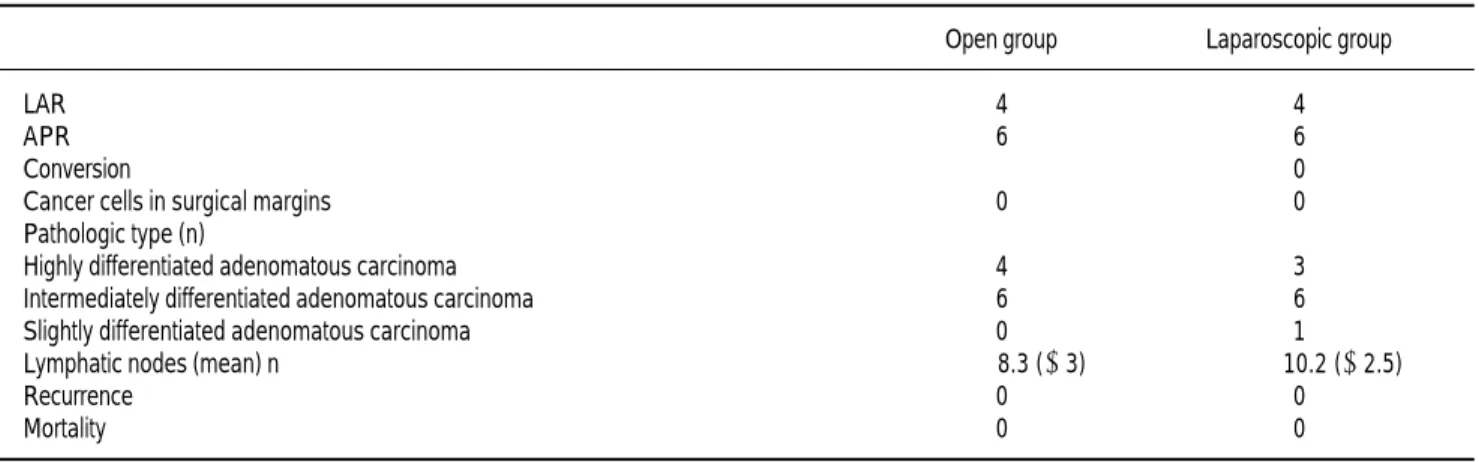
Table 2. Surgical outcome.
Open group Laparoscopic group
LAR 4 4
APR 6 6
Conversion 0
Cancer cells in surgical margins 0 0 Pathologic type (n)
Highly differentiated adenomatous carcinoma 4 3 Intermediately differentiated adenomatous carcinoma 6 6 Slightly differentiated adenomatous carcinoma 0 1 Lymphatic nodes (mean) n 8.3 (± 3) 10.2 (± 2.5)
Recurrence 0 0
Mortality 0 0
Table 3. Results of postoperative recovery.
A loop ileostomy for fecal diversion was created in all patients from the laparoscopic LAR group and in three patients from the open LAR group.
The mean operative times for laparoscopic and open procedures were 186.7 min (range, 125-210) and 204.4 min (120-240) p < 0.007, respectively; whereas the mean operative blood loss was 136.7 mL (range, 100-350) and 229.1 (150-400) p < 0.007, respectively (Tables 2 and 3).
There was a significant difference in time to reinstitute oral intake in the laparoscopic group (2) versus OTME (3, range 2-6) p < 0.05.
Postoperative hospital stay was shorter in the la-paroscopic group (6.5, range 4-12) versus the open group (8.5, range 4-13) p < 0.05.
A significant difference in terms of recovered lym-ph nodes was found in the LTME (10.2 ± 2) versus OTME (8.3 ± 3) p < 0.05.
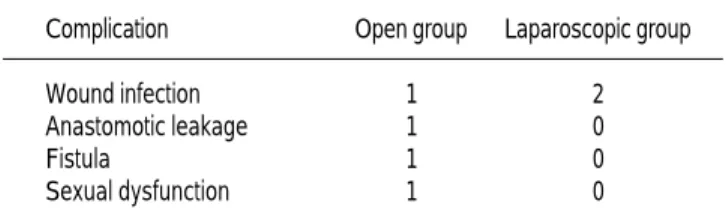
There was no 30-day mortality. Six patients deve-loped early complications (Table 4).
Morbidity was lower in the laparoscopic group compared to the control group (20% vs 40%).
In the laparoscopic group two patients developed wound infection. In the open TME group one patient had persistent erectile dysfunction at the conclusion of follow-up, one patient had a colonic fistula, one patient presented anastomotic leakage, and one pa-tient presented wound infection.
All surgical margins were negative for cancer ce-lls and no recurrence was found during follow up, which ranged from nine to 15 months.
DISCUSSION
Rectal cancer persists as a significant worldwide problem.9,19,20 Despite the improvements during the last two decades in preoperative staging, surgical te-chnique, and adjuvant therapy, local recurrence re-mains a significant problem.20-22
The technique of TME for the treatment of can-cer of the middle and distal third of the rectum is increasingly recognized as a new benchmark of quality.
Developed and popularized by Heald, it represents at present the gold standard, with a 5- and 10-year local recurrence rate of 4% in curative cases; and a 5-year tumor-free survival rate of 78%.9,22-24
Conventional rectal mobilization by blunt dissection has been associated with a high local recurrence rate.22
Heald, et al. and Enker, et al. have reported low local recurrence rates in patients with rectal cancer by sharp meticulous perimesorectal dissection and total mesorectal excision. With the introduction of TME, local recurrence rates have been reliably de-creased below 10% after curative resection, approxi-mately 6.6% in published series.24-26
In the original series by Heald, et al. TME was performed in patients with upper rectal cancer.
Lopez-Kostner, et al. demonstrated that outcomes of upper rectal cancer treatment in terms of local re-currence and survival were similar to those of sig-moid cancer and that TME was not necessary in upper rectal lesions.19 Routine TME in upper rectal cancer is now considered unnecessary.
The importance of the complete removal of lym-phatic vascular tissue surrounding the rectum and a free circumferential margin has been recognized in the management of rectal cancer.27,28
Recently, the concept of TME has gradually chan-ged. It is defined as complete removal of circumferen-tial fatty tissue around rectum with autonomic nerve preservation.1,3,29
However, the anastomotic leakage rates are high in series of patients with TME and is associated with increased morbidity.20,23,28
The laparoscopic approach to resection for rectal cancer remains controversial due to fears that onco-logic principles will be compromised.9,21,23,24
However, the early results of LTME have provi-ded optimism for the oncologic safety and have showed advantages of minimally invasive surgery including earlier return of bowel function, re-sumption of preoperative activity, shorter hospitali-zation, and improved cosmesis.
As a technically demanding procedure, laparosco-pic TME is currently limited to a number of speciali-zed centers.22-25
Several patient- and tumor-related risk factors for the development of local recurrence have been iden-tified and are being addressed by regimens of pre- or postoperative adjuvant therapy.15-18,39
Surgical dissection along the connective tissue space between rectal and parietal pelvic fascia with complete mesorectal excision results in reliable exci-sion of all relevant lymphatic pathways with preser-vation of continence and sexual function.
Table 4. Postoperative complications.
Complication Open group Laparoscopic group Wound infection 1 2 Anastomotic leakage 1 0
Fistula 1 0
The local recurrence rate after rectal cancer sur-gery is believed to be related to conventional and to-tal mesorecto-tal excision (TME) techniques. Studies now show that the wide variation in results between centers and among surgeons depends, at least in part, on differences in surgical technique.21-26
The available evidence for TME is largely compo-sed of retrospective series, although the benefits of TME compare favorably to established conventional controls. Recent studies have clarified the benefit of adjunctive radiotherapy with TME.39
Total mesorectal excision (TME) is the surgical gold standard treatment for middle and lower third rectal carcinoma. Laparoscopy has gradually beco-me accepted for the treatbeco-ment of colorectal malig-nancy after a long period of questions regarding its safety.
LTME is a feasible but technically demanding procedure (12% conversion rate) and appears to have clinically measurable short-term advantages in patients with primary resectable rectal cancer.
Minimally invasive TME can be performed safely and efficiently by colorectal surgeons with adequate experience in open and laparoscopic techniques.
Several large prospective studies have reported encouraging results with laparoscopic colorectal surgery for cancer.13,18-26,29
Laparoscopy amplifies images and helps to identi-fy the interspace of loose connective tissue between the visceral and parietal pelvic fascia. Besides, it is easier to identify and protect the pelvic autonomic nerve fiber and plexus of its magnifying effect.
Due to high specialty, the TME requires long and arduous training, more experience when performed laparoscopically.22-26,30-32
In the present study, there was no 30-day morta-lity and 20% in the LTME experienced early compli-cations. These results compare favorably with open TME series.33-36
The present study demonstrated the short-term benefits that are recognized in general laparoscopic colorectal surgery (less blood loss, quicker return to normal diet, less pain, less narcotic use and less im-mune response).
It seems likely that LTME is associated with lon-ger operative time. However, in this study we found less operative time in the laparoscopic group and no conversion rate.
No significant differences in terms of local recu-rrence rate, mortality, morbidity or resection mar-gins were found.
Recovered lymph nodes were significantly greater in the LTME group. Postoperative hospital stay in
the present study was comparable to other series of laparoscopic TME.32-37
Quah, et al. suggested that laparoscopic TME might be associated with increased male sexual dys-function. In their study, however, the open techni-que was used to complete the distal rectal dissection during which nerve damage is most likely. In con-trast, we found in this series a case of erectile dys-function in the OTME group.16,38
There was no port-site metastasis in the present series, a finding that concurs with recent literatu-re.31-36
This study shows a small number of patients and short mean follow-up time to conclude on the long-term oncologic outcomes of laparoscopic TME. However, the local recurrence rate in the present study is comparable to other laparoscopic TME se-ries as well as open TME sese-ries.
The long-term impact on oncological endpoints awaits the findings of large randomized trials.
REFERENCES
1. Leung KL, Kwok SPY, Lam SC, Lee JF, Yiu RY, Ng SS, et al. Laparoscopic resection of rectosigmoid cancer: prospective randomized trial. Lancet 2004; 363: 1187-92.
2. Miles WE. A method of performing abdominoperineal exci-sion for carcinoma of the rectum and of the terminal portion of the pelvic colon. Lancet 1908; 2: 1812-3.
3 . Ridgway PF, Darzi AW. The Role of Total Mesorectal Excision in the management of Rectal Cancer. Cancer Control 2003; 102: 205-11.
4 . Fisher B, Wolmark N, Rockette H, Redmond C, Deutsch M, Wickerham DL, et al. Postoperative adjuvant chemotherapy or radiation therapy for rectal cancer: results from NSABP proto-col R-01. J Natl Cancer Inst 1988; 80: 21-9.
5. Gastrointestinal Tumor Study Group. Adjuvant therapy of co-lon cancer – results of a prospective randomized trial. N Engl J Med 1984; 310: 737-43.
6. Gastrointestinal Study Group. Prolongation of the disease-free interval in surgically treated rectal carcinoma. N Engl J Med 1985; 312: 1465-72.
7 . Heald RJ, Husband EM, Ryall RD. The mesorectum in rectal cancer surgery: the clue to pelvic recurrence? Br J Surg 1982; 69: 613-6.
8 . Heald RJ, Moran BJ, Ryall RD, Sexton R, MacFarlene JK. Rec-tal cancer: the Basingstoke experience of toRec-tal mesorecRec-tal exci-sion, 1978-1997. Arch Surg 1998; 133: 894-9.
9 . Clinical Outcomes of Surgical Therapy Study Group. A compa-rison of laparoscopically assisted and open colectomy for co-lon cancer. N Engl J Med 2004; 350: 2050-9.
10. Lacy AM, Garcia-Valdecasas JC, Delgado S, Castells A, Taura P, Pique JM, Visa J. Laparoscopy-assisted colectomy versus open colectomy for treatment of non-metastatic colon cancer: a randomized trial. Lancet 2002; 359: 2224-9.
11. Jacobs M, Verdeja JC, Goldstein HS. Minimally invasive colon resection (laparoscopic colectomy). Surg Laparosc Endosc 1991; 1: 144-50.
13. Fleshman JW, Wexner SD, Anvari M, LaTulippe JF, Birnbaum EH, Kodner IJ, et al. Laparoscopic vs. Open abdominoperineal resection for cancer. Dis Colon Rectum 1999; 42: 930-9. 14. Lavery IC, Lopez-Kostner F, Pelley RJ, Fine RM. Treatment of
colon and rectal cancer. Surg Clin North Am 2000; 80: 535-69. 15. Kapiteijn E, Marijnen CAM, Nagtegaal ID, Putter H, Steup WH, Wiggers T, Dutch Colorectal Cancer Group, et al. Preope-rative radiotherapy combined with local mesorectal excision for resectable rectal cancer. N Engl J Med 2001; 345: 638-46. 16. Quah HM, Jayne DG, Eu KW, Seow-Choen F. Bladder and
sexual dysfunction following laparoscopically assisted and conventional open mesorectal resection for cancer. Br J Surg 2002; 89: 1551-6.
17. Enker WE, Thaler HT, Cranor ML, Polyak T. Total mesorectal excision in the operative treatment of carcinoma of the rectum. J Am Coll Surg 1995; 181: 335-46.
18. Enker WE. Total mesorectal excision-the new golden standard of surgery for rectal cancer. Ann Med 1997; 29: 127-33. 19. Lopez-Kostner F, Lavery IC, Hool GR, Rybicki LA, Fazio
VW. Total mesorectal excision is not necessary for cancers of the upper rectum. Surgery 1998; 124: 612-7.
20. Karanjia ND, Corder AP, Bearn P, Heald RJ. Leakage from sta-pled low anastomosis after total mesorectal excision for carci-noma of the rectum. Br J Surg 1994; 81: 1224-6.
21. Nymann T, Jess P, Christiansen J. Rate and treatment of pelvic re-currence after abdominoperineal resection and low anterior resec-tion for rectal cancer. Dis Colon Rectum 1995; 38: 799-802. 22. Morino M, Parini U, Giraudo G, Salval M, Brachet Contul R,
Garrone C. Laparoscopic total mesorectal excision: a consecuti-ve series of 100 patients. Ann Surg 2003; 237: 335-42. 23. Hartley JE, Mehigan BJ, Qureshi AE, Duthie GS, Lee PW,
Monson JR. Total mesorectal excision: assessment of the lapa-roscopic approach. Dis Colon Rectum 2001; 44: 315-21. 24. Larach SW, Salomon MC, Williamson PR, Goldstein E.
Lapa-roscopic assisted abdominoperineal resection. Surg Laparosc Endosc 1993; 3: 115-8.
25. Darzi A, Lewis C, Menzies-Gow N, Guillou PJ, Monson JR. La-paroscopic abdominoperineal excision of the rectum. Surg En-dosc 1995; 9: 414-7.
26. Carlsen E, Schlichting E, Guldvog I, Johnson E, Heald RJ. Effect of the introduction of total mesorectal excision for the treatment of rectal cancer. Br J Surg 1998; 85: 526-9. 27. Wai Lun Law, Kin Wah Chu. Anterior Resection for Rectal
Cancer with mesorectal excision. A prospective evaluation of 622 patients. Ann Surg 2004; 240: 260-8.
28. Griffen FD, Knight CD Sr, Whitaker JM, Knight CD Jr. The double stapling technique for low anterior resection: results, modifications and observations. Ann Surg 1990; 211: 745-51. 29. Leroy J, Jamili F, Forbes L, Smith M, Rubino F, Mutter D,
Ma-rescaux J. Laparoscopic total mesorectal excision (TME) for rectal cancer surgery: long term outcomes. Surg Endosc 2004; 18: 281-9.
30. McAnena OJ, Heald RJ, Lockhart-Mummery HE. Operative and functional results of total mesorectal excision with ultra-low anterior resection in the management of carcinoma of the lower one-third of the rectum. Surg Gynecol Obstet 1990; 170: 517-21.
31. McArdle CS, Hole D. Impact of variability among surgeons on postoperative morbidity and ultimate survival. BMJ 1991; 302: 1501-5.
32. Fazio VW, Lopez-Kostner F. Role of laparoscopic surgery for treatment of early colorectal carcinoma. World J Surg 2000; 24: 1056-60.
33. Braga M, Vignali A, Gianotti L, Zuliani W, Radaelli G, Grua-rin P, et al. Laparoscopic versus open colorectal surgery: a randomized trial on short-term outcome. Ann Surg 2002; 236: 759-67.
34. Champault GG, Barrat C, Raselli R, Elizalde A, Catheline JM. Laparoscopic versus open surgery for colorectal carcinoma: a prospective clinical trial involving 157 cases with a mean fo-llow-up of 5 years. Surg Laparosc Endosc Percut Tech 2002; 12: 88-95.
35. Hong D, Tabet J, Anvari M. Laparoscopic vs open resection for colorectal adenocarcinoma. Dis Colon Rectum 2001; 44: 10-9.
3 6 . Milsom JW, Bohm B, Hammerhofer KA, Fazio V, Steiger E, Elson P. A prospective, randomized trial comparing laparos-copic versus conventional techniques in colorectal cancer surgery: a preliminary report. J Am Coll Surg 1998; 187: 4 6 - 5 5 .
37. Weeks JC, Nelson H, Gelber S, Sargent D, Schroeder G, Clini-cal Outcomes of SurgiClini-cal Therapy (COST) Study Group. Short-term quality-of-life outcomes following laparoscopic-as-sisted colectomy vs open colectomy for colon cancer: a rando-mized trial. J Am Med Assoc 2002; 287: 321-8.
38. Rubino F, Leroy J, Marescaux J. Bladder and sexual dysfunc-tion following laparoscopically assisted and convendysfunc-tional open mesorectal resection for cancer. Br J Surg 2003; 90: 48. 39. AJCC Cancer Staging Manual. 5th Ed. Philadelphia, PA:
Lip-pincott-Raven; 1998.
Correspondence and reprint request:
Quintín H. González, MD
Departmento de Cirugía
Instituto Nacional de Ciencias Médicas y Nutrición Salvador Zubirán
Vasco de Quiroga No.15, Tlalpan 14000, México, D.F.
Tel.: 5487-0900, Ext. 2140 E-mail: [email protected]