Ant Colonies using Arc Consistency Techniques
for the Set Partitioning Problem
Broderick Crawford1,2 and Carlos Castro2
1 Escuela de Ingenier´ıa Inform´atica, Pontificia Universidad Cat´olica de Valpara´ıso, Chile 2 Departamento de Inform´atica, Universidad T´ecnica Federico Santa Mar´ıa, Chile
[email protected] [email protected]
Abstract. In this paper, we solve some benchmarks of Set Covering
Problem and Equality Constrained Set Covering or Set Partitioning Problem. The resolution techniques used to solve them were Ant Colony Optimization algorithms and Hybridizations of Ant Colony Optimiza-tion with Constraint Programming techniques based on Arc Consistency. The concept of Arc Consistency plays an essential role in constraint sat-isfaction as a problem simplification operation and as a tree pruning technique during search through the detection of local inconsistencies with the uninstantiated variables. In the proposed hybrid algorithms, we explore the addition of this mechanism in the construction phase of the ants so they can generate only feasible partial solutions. Computational results are presented showing the advantages to use this kind of addi-tional mechanisms to Ant Colony Optimization in strongly constrained problems where pure Ant Algorithms are not successful.
1
Introduction
Set Covering Problem (SCP) and Set Partitioning Problem (SPP), or Equality Constrained Set Covering, are two types of problems that can model different real life situations [2, 3, 11, 21]. In this work, we solve some benchmarks of them with Ant Colony Optimization (ACO) algorithms and some hybridizations of ACO with Constraint Programming based on Arc Consistency.
There exist problems for which ACO is of limited effectiveness, among them the very strongly constrained problems. They are problems for which neighbor-hoods contain few solutions, or none at all, and local search is of very limited use. Probably, the most significant of such problems is the SPP [18]. A direct implementation of the basic ACO framework is incapable of obtaining feasible solutions for many standard tested instances of SPP. The best performing meta-heuristic for SPP is a genetic algorithm due to Chu and Beasley [5, 6]. There exist already some first approaches applying ACO to the SCP. In [1, 16] ACO has been used as a construction algorithm and the approach has only been tested on some small SCP instances. Others works [15, 17] apply Ant Systems to the SCP and use techniques to remove redundant columns and local search to improve solu-tions. In [14] there is a very interesting work of ACO solving the related problem Set Packing.
way of the used form in [20] where was proposed a lookahead function evaluat-ing pheromone in a supersequence problem, and in [13] where was introduced a lookahead mechanism to estimate the quality of the partial solution.
The remainder of the paper is organised as follows: Section 2 is devoted to the presentation of the problems and their mathematical models. In Section 3, we describe the applicability of the ACO algorithm for solving SPP and SCP. In Section 4, we present the basic concepts to adding Constraint Programming tech-niques to the two basic ACO algorithms: Ant System and Ant Colony System. In Section 5, we present results when adding Constraint Programming techniques to the two basic ACO algorithms to solve some benchmarks from ORLIB. Fi-nally, in Section 6 we conclude the paper and give some perspectives for future research.
2
Equality Constrained Set Covering Problem
Equality Constrained Set Covering Problem, or Set Partitioning Problem, is the NP-complete problem of partitioning a given set into mutually independent sub-sets while minimizing a cost function defined as the sum of the costs associated to each of the eligible subsets. SPP importance derives from the fact that many combinatorial optimization problems (such as, crew scheduling, vehicle routing, project scheduling, and warehouse location problems, to name a few) can be modeled as SPP with maybe some additional constraints. In SPP we are given a m×nmatrixA= (aij) in which all the matrix elements are either zero or one. Additionally, each column is given a non-negative costcj. We say that a column j can cover a rowiifaij = 1. LetJ denotes a subset of the columns andxj a binary variable which is one if columnj is chosen and zero otherwise. The SPP can be defined formally as follows:
M inimize f(x) = n
X
j=1
cj×xj
Subject to
n
X
j=1
aij×xj = 1;∀i= 1, . . . , m
These constraints enforce that each row is covered by exactly one column. The SCP is a SPP relaxation. The goal in the SCP is to choose a subset of the columns of minimal weight which covers every row. The SCP can be defined formally using constraints to enforce that each row is covered by at least one column as follows:
n
X
j=1
3
Ant Colony Optimization for Set Covering Problems
ACO can be applied in a very straightforward way to the SCP and SPP. The columns are chosen as the solution components and have associated a cost and a pheromone trail [10]. Each column can be visited by an ant once and only once and that a final solution has to cover all rows. A walk of an ant over the graph representation corresponds to the iterative addition of columns to the partial solution obtained so far. Each ant starts with an empty solution and adds columns until a cover is completed. A pheromone trail and a heuristic information are associated to each eligible column j. A column to be added is chosen with a probability that depends of pheromone trail and the heuristic information. In the application of ACO to other problems, such as the TSP, there are some differences. For example, the SPP/SCP solution construction of the individual ants does not necessarily end after the same number of steps of each ant, but only when a cover is completed. One of the most crucial design decisions to be made in ACO algorithms is the modeling of the set of pheromones. In the original ACO implementation for TSP the choice was to put a pheromone value on every link between a pair of cities, but for other combinatorial problems often can be assigned pheromone values to the decision variables (first order pheromone values) [10]. In this work the pheromone trail is put on the problems componentes (each elegible columnJ) instead of the problems connections. And setting good pheromone quantity is a non trivial task too. The quantity of pheromone trail laid on columns is based on the idea: the more pheromone trail on a particular item, the more profitable that item is [16]. Then, the pheromone deposited in each component will be in relation to its frequency in the ants solutions. In this work we divided this frequency by the number of ants obtaining better results. We use a dynamic heuristic information that depends on the partial solution of an ant. It can be defined as ηj = ej
cj, whereej is the so called cover value, that is, the number of additional rows covered when adding columnj to the current partial solution, andcj is the cost of columnj[10]. In other words, the heuristic information measures the unit cost of covering one additional row. An ant ends the solution construction when all rows are covered. Figure 1 describe the pure ACO algorithm to solve SCP and SPP.
In this work, we use two instances of ACO: Ant System (AS) and Ant Colony System (ACS) algorithms, the original and the most famous algorithms in the ACO family [9, 8, 10]. ACS improves the search of AS using: a different transition rule in the constructive phase, exploting the heuristic information in a more rude form, using a list of candidates to future labeling and using a different treatment of pheromone. ACS has demostrated better performance than AS in a wide range of problems.
1 Procedure ACO_for_SCP_and_SPP 2 Begin
3 InitParameters();
4 While (remain iterations) do 5 For k := 1 to nants do
6 While (solution is not completed) do 7 AddColumnToSolution(election) 8 AddToTabuList(k);
9 EndWhile 10 EndFor
11 UpdateOptimum(); 12 UpdatePheromone(); 13 EndWhile
14 Return best_solution_founded 15 End.
Fig. 1.Pure ACO algorithm for SCP and SPP
4
ACO with Constraint Programming
Recently, some efforts have been done in order to integrate Constraint Program-ming techniques to ACO algorithms [19, 12].An hibridization of ACO and CP can be approached from two directions: we can either take ACO or CP as the base algorithm and try to embed the respective other method into it. A form to integrate CP into ACO is to let it reduce the possible candidates of the not yet instantiated variables participating in the same constraints that the actual variable. A different approach would be to embed ACO within CP. The obvious point at which ACO can interact with CP is during the labeling phase, using ACO to learn a value ordering that is more likely to produce good solutions.
In this work, ACO uses CP in the variable selection (when adding columns to partial solution). The CP algorithm used in this paper is Arc Consistency Technique and Chronological Backtracking [7]. In the construction phase ACO performs Arc Consistency between pairs of a not yet instantiated variable and an instantiated variable, i.e., when a value is assigned to the current variable, any value in the domain of a future variable which conflicts with this assignment is removed from the domain.
Adding Arc Consistency Technique and Backtracking to ACO for SPP means that columns are chosen if they do not produce any conflict with respect to the next column to be chosen, trying to assure the possibilities of ants in order to complete the solutions. Figure 2 describe the hybrid ACO with CP.
5
Experiments and Results
1 Procedure ACO+CP_for_SPP 2 Begin
3 InitParameters();
4 While (remain iterations) do 5 For k := 1 to nants do
6 While (solution is not completed) and TabuList <> J do 7 Choose next Column j with Transition Rule Probability
8 For each Row i covered by j do /* j constraints */ 9 feasible(i):= Posting(j); /* Constraint Propagation */ 10 EndFor
11 If feasible(i) for all i then AddColumnToSolution(j)
12 else Backtracking(j); /* set j uninstantiated */ 13 AddColumnToTabuList(j);
14 EndWhile 15 EndFor 16 UpdateOptimum(); 17 UpdatePheromone(); 18 EndWhile
[image:5.595.135.467.118.275.2]19 Return best_solution_founded 20 End.
Fig. 2.Hybrid ACO+CP algorithm for SPP
and published experimental results [16, 17, 10] we use the following parameters values for the algorithms: evaporation rate = 0.4, number of iterations = 160, number of ants = 120, influence of pheromone (alpha) = 1.0, influence of heuris-tic information (beta) = 0.5, for ACS the list size = 500 (in scp41, scp42, scp48, scp61, scp62, and scp63), for ACS Qo = 0.5.
Algorithms were implemented using ANSI C, GCC 3.3.6, under Microsoft Windows XP Professional version 2002.
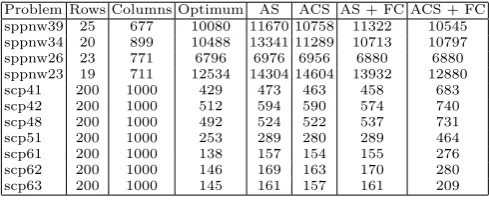
Problem Rows Columns Optimum AS ACS AS + FC ACS + FC sppnw39 25 677 10080 11670 10758 11322 10545 sppnw34 20 899 10488 13341 11289 10713 10797
sppnw26 23 771 6796 6976 6956 6880 6880
sppnw23 19 711 12534 14304 14604 13932 12880
scp41 200 1000 429 473 463 458 683
scp42 200 1000 512 594 590 574 740
scp48 200 1000 492 524 522 537 731
scp51 200 1000 253 289 280 289 464
scp61 200 1000 138 157 154 155 276
scp62 200 1000 146 169 163 170 280
scp63 200 1000 145 161 157 161 209
Table 1.ACO with Forward Checking
[image:5.595.185.430.432.532.2]6
Conclusions and Future Directions
The concept of Arc Consistency plays an essential role in Constraint Program-ming as a problem simplification operation and as a tree pruning technique during search through the detection of local inconsistencies among the unin-stantiated variables. We have shown that it is possible to add Arc Consistency to any ACO algorithms. The computational results confirm that the performance of ACO is possible to improve with some types of hibridization.
Our goal was to demonstrate that ACO is possible to improve with CP in some kind of problems. Future versions of the algorithm will study the pheromone treatment representation and the incorporation of available local search tech-niques in order to reduce the input problem (Pre Processing) and improve the solutions given by the ants (Post Processing). The ants solutions may contain re-dundant components which can be eliminated by a fine tuning after the solution, then we will explore Post Processing procedures, which consist in the identifica-tion and replacement of the columns of the ACO soluidentifica-tion in each iteraidentifica-tion by more effective columns.
References
1. D. Alexandrov and Y. Kochetov. Behavior of the Ant Colony Algorithm for the Set Covering Problem. InProc. of Symp. Operations Research, pp 255–260. Springer Verlag, 2000.
2. E. Andersson, E. Housos, N. Kohl and D. Wedelin. Crew Pairing Optimization.
In Yu G.(ed.)Operations Research in the Airline Industry,Kluwer Academic
Pub-lishing, 1998.
3. E. Balas and M. Padberg. Set Partitioning: A Survey.SIAM Review, 18:710–760, 1976.
4. J. E. Beasley. OR-Library:Distributing test problem by electronic mail. Journal of Operational Research Society, 41(11):1069–1072, 1990.
5. J. E. Beasley and P. C. Chu. A genetic algorithm for the set covering problem.
European Journal of Operational Research, 94(2):392–404, 1996.
6. P. C. Chu and J. E. Beasley. Constraint handling in genetic algorithms: the set partitoning problem. Journal of Heuristics, 4:323–357, 1998.
7. R. Dechter and D. Frost. Backjump-based Backtracking for Constraint Satisfac-tion Problems. Artificial Intelligence, 136:147–188, 2002.
8. M. Dorigo, G. Di Caro, and L. M. Gambardella. Ant Algorithms for Discrete Optimization. Artificial Life, 5:137–172, 1999.
9. M. Dorigo and L. M. Gambardella. Ant colony system: A cooperative learning approach to the traveling salesman problem. IEEE Transactions on Evolutionary Computation, 1(1):53–66, 1997.
10. M. Dorigo and T. Stutzle. Ant Colony Optimization. MIT Press, USA, 2004. 11. A. Feo, G. Mauricio, and A. Resende. A Probabilistic Heuristic for a
Computa-tionally Difficult Set Covering Problem. OR Letters, 8:67–71, 1989.
12. F. Focacci, F. Laburthe and A. Lodi. Local Search and Constraint Programming.
13. C. Gagne, M. Gravel and W.L. Price. A Look-Ahead Addition to the Ant Colony Optimization Metaheuristic and its Application to an Industrial Scheduling Prob-lem. In J.P. Sousa et al., eds.,Proceedings of the fourth Metaheuristics Interna-tional Conference MIC’01, July 16-20, 2001. Pages 79-84.
14. X. Gandibleux, X. Delorme and V. T’Kindt. An Ant Colony Algorithm for the Set Packing Problem. In M. Dorigo et al., editor,ANTS 2004, vol 3172 ofLNCS, pp 49–60. SV, 2004.
15. R. Hadji, M. Rahoual, E. Talbi, and V. Bachelet. Ant colonies for the set covering problem. In M. Dorigo et al., editor,ANTS 2000, pp 63–66, 2000.
16. G. Leguizam´on and Z. Michalewicz. A new version of Ant System for subset problems. In Congress on Evolutionary Computation, CEC’99, pp 1459–1464, Piscataway, NJ, USA, 1999. IEEE Press.
17. L. Lessing, I. Dumitrescu, and T. Stutzle. A Comparison Between ACO Algo-rithms for the Set Covering Problem. In M. Dorigo et al., editor,ANTS 2004, vol 3172 ofLNCS, pp 1–12. SV, 2004.
18. V. Maniezzo and M. Milandri. An Ant-Based Framework for Very Strongly Con-strained Problems. In M. Dorigo et al., editor,ANTS 2002, vol 2463 ofLNCS, pp 222–227. SV, 2002.
19. B. Meyer and A. Ernst. Integrating ACO and Constraint Propagation. In M. Dorigo et al., editor,ANTS 2004, vol 3172 ofLNCS, pp 166–177. SV, 2004. 20. R. Michel and M. Middendorf. An Island model based Ant system with
looka-head for the shortest supersequence problem. Lecture notes in Computer Science, Springer Verlag, 1498:692–701, 1998.