
A matter of taste: local explanations for the consumption of wild food plants in the Catalan Pyrenees and the Balearic Islands
33
0
0
Texto completo
(2) This is an accepted manuscript of an article published in Economic Botany on 10 May 2016, available online: http://dx.doi.org/10.1007/s12231-016-9343-1. 27 28. Abstract Previous research has documented different trends in the consumption of wild food. 29. plants but has rarely analyzed the motivations behind their continued (or lack of). 30. consumption. In this article, we use empirical data to explore the factors driving the. 31. consumption of a selected set of wild food plants. We start by analyzing the different trends. 32. (i.e., abandonment, maintenance, and valorization) across 21 selected species with different. 33. food uses. We then explore the reported motivations that drive such trends using data. 34. collected among 354 respondents in three Catalan-speaking rural areas. The consumption of. 35. wild food plants is decreasing in the three study areas and across the categories of food use. 36. analyzed. Respondents listed sociocultural factors, rather than environmental or economic. 37. factors, as more prominent determinants of consumption trends: taste preferences seem to. 38. be the most relevant motivation for those who continue to consume wild food plants,. 39. whereas a myriad of motivations related to changes in lifestyle were provided by those who. 40. explain the abandonment of their consumption.. 41 42 43. Key words: Edible wild plants; ethnobotany; motivations; quantitative analysis; Spain.
(3) This is an accepted manuscript of an article published in Economic Botany on 10 May 2016, available online: http://dx.doi.org/10.1007/s12231-016-9343-1. 44. Cuestión de gusto: ¿Qué explica el consumo de plantas silvestres? Estudio en los. 45. Pirineos catalanes y las Islas Baleares. 46 47 48. Resumen Se han documentado diferentes tendencias en el consumo de plantas silvestres. 49. comestibles, pero raramente se han analizado las razones que explican por qué algunas. 50. plantas se siguen consumiendo y otras no. En base a una selección de plantas silvestres. 51. comestibles, en este artículo exploramos los factores que explican las tendencias en el. 52. consumo de plantas silvestres. En la primera parte analizamos las tendencias de consumo. 53. (abandono, mantenimiento y valorización) de un grupo de 21 especies con diferentes usos. 54. alimentarios y en la segunda exploramos las motivaciones esgrimidas por 354 habitantes de. 55. tres áreas rurales catalanoparlantes en relación a estas tendencias. El consumo de plantas. 56. silvestres parece haber sufrido una reducción generalizada en las áreas prospectadas. Para. 57. todas las especies, los encuestados mencionaron factores socioculturales, más que. 58. ambientales o económicos, como importantes a la hora de explicar sus patrones de. 59. consumo. Específicamente, el sabor parece ser el principal argumento para aquellos que. 60. continúan consumiendo plantas silvestres mientras que una combinación de motivos. 61. relacionados con cambios en estilos de vida predominan entre las explicaciones de aquellos. 62. que han abandonado su consumo..
(4) This is an accepted manuscript of an article published in Economic Botany on 10 May 2016, available online: http://dx.doi.org/10.1007/s12231-016-9343-1. 63 64. Introduction Over the last decades, wild food plants (including semi-wild and naturalized taxa). 65. (hereafter WFP) have been widely studied, both in developing (Joshi et al., 2015;. 66. Teklehaymanot and Giday, 2010; Termote et al., 2010) and developed countries (Ghirardini. 67. et al., 2007; Poe et al., 2013; Rigat et al., 2009). In addition to providing inventories and. 68. descriptive accounts, such studies have also shown: a) the contribution of WFP to. 69. household food security (Bharucha and Pretty, 2010; Bonet and Vallès, 2002) and local. 70. economy (Łuczaj et al., 2013; Shackleton, 2003); b) their nutritional value (Heinrich et al.,. 71. 2005; Pardo-de-Santayana et al., 2007; Vardavas et al., 2006); and c) their relevance for. 72. biodiversity conservation (Demissew, 2011; Paton and Lughadha, 2011).. 73. Researchers have documented changes in the consumption of WFP both in. 74. developing countries (Bhattarai et al., 2009; Cruz-García, 2014; Joshi et al., 2015) and -. 75. more intensively- in the developed world, where the mechanization of agricultural. 76. production and the increasing availability of foods through market transactions have greatly. 77. affected the consumption and gathering of WFP (Reyes-García et al., 2015; Rigat et al.,. 78. 2009; Tardío et al., 2006). Nowadays, most WFP seem to be only sparsely collected in rural. 79. areas of developed countries (Bharucha and Pretty, 2010; Reyes-García et al., 2015; Schulp. 80. et al., 2014). This general trend does not affect all WFP equally, and thus the gathering of. 81. some specific plant species has gained in popularity. For example, some authors have. 82. argued that some WFP are becoming local delicatessens and markers of cultural identity. 83. (Aceituno-Mata, 2010; Kalle and Soukand, 2013), some are entering commercial circuits. 84. (Acosta-Naranjo, 2008; Łuczaj et al., 2012; Molina et al., 2012), and some are so. 85. appreciated to be collected in unconventional spaces such as urban parks (Poe et al., 2013)..
(5) This is an accepted manuscript of an article published in Economic Botany on 10 May 2016, available online: http://dx.doi.org/10.1007/s12231-016-9343-1. 86. These examples have led researchers to hypothesize that WFP consumption could. 87. follow, at least, three different paths: abandonment, maintenance, and valorization. 88. (Aceituno-Mata, 2010; Acosta-Naranjo, 2008; Pardo-de-Santayana et al., 2007).. 89. Abandonment refers to the decrease in WFP consumption. For example, in the southern. 90. Italian village of Castelmazzano, Pieroni et al. (2005) found that the ancient practice of. 91. eating the roasted kernels of Quercus virgiliana (Ten.) Ten. (a synonym of Quercus. 92. pubescens Willd.), has been discontinued. Maintenance refers to the lack of observable. 93. changes when comparing the current consumption of a specific WFP with its consumption. 94. in the recent past. And valorization refers to the increase when comparing the current. 95. consumption of a specific WFP with its consumption in the recent past, as for example the. 96. case of Allium ursinum L. and Epilobium angustifolium L. in Poland, where these wild. 97. species are nowadays largely sold in health food stores (Łuczaj et al., 2012).. 98 99. Although researchers have documented changes in WFP consumption, few offer explanations for the changes (see Schunko et al., 2015 for a recent exception), and less so at. 100. the level of the species. A priori, one could categorize the factors that drive the. 101. consumption of WFP (or their abandonment) as environmental, economic and. 102. sociocultural. Environmental factors refer to WFP ecological abundance or scarcity;. 103. economic factors refer to material costs and benefits associated with the collection and. 104. consumption of WFP; and sociocultural factors refer to cultural considerations, such as. 105. associating WFP consumption with famine, better health, preferred taste, or enjoyable pass. 106. time.. 107. The goal of this article is to identify factors driving abandonment, maintenance, or. 108. valorization of some WFP. We start by analyzing the different trends (i.e., abandonment,. 109. maintenance, and valorization) across selected species and different food-use categories.
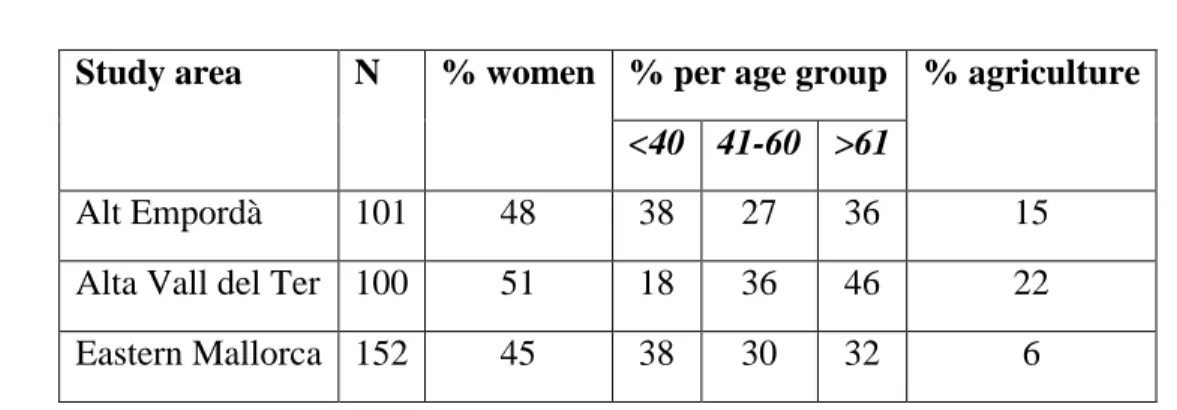
(6) This is an accepted manuscript of an article published in Economic Botany on 10 May 2016, available online: http://dx.doi.org/10.1007/s12231-016-9343-1. 110. and then we explore the reported motivations that might drive such trends. Understanding. 111. people’s motivation to consume WFP or not is essential not only for understanding why. 112. WFP continue to be gathered, but also for predicting gathering trends in relation to certain. 113. species.. 114 115 116. Case studies Our study examines three Catalan-speaking regions: Alta Vall del Ter (AVT) and. 117. Alt Empordà (AE) in northeastern Iberian Peninsula, and eastern Mallorca (EM) in the. 118. Balearic Islands (Fig. 1).. 119. INSERT FIGURE 1. 120. The Alta Vall del Ter valley, an area of about 294 km2, is located on the southern. 121. flanks of the Pyrenees in the Ripollès district. Its population is 4,497 (IDESCAT, 2014).. 122. Hydrographically, the valley corresponds to the watersheds of the Ter and Ritort rivers. 123. (Rigat et al., 2009). The vegetation of the area is shaped by the climatic conditions of. 124. mountainous area. Although the nival stage is rare, i.e., snow is rarely found all year round,. 125. abundant representative species of the alpine (e.g., Festuca sp. and other grasses) and. 126. subalpine stages (e.g., Pinus mugo Turra subsp. Uncinata (Ramond ex DC. in Lam. et DC.). 127. Domin and Abies alba Mill.) are common. Raising livestock is the most important. 128. economic activity in the area. Nowadays, most arable surface (including home gardens) has. 129. been reclaimed to build secondary residences and tourist facilities (Rigat et al., 2009).. 130. Previous research on WFP in the area has documented 84 taxa used for human. 131. consumption, mostly eaten raw, although some species were also used as condiments or in. 132. the elaboration of jams or alcoholic beverages (such as ratafia, a traditional liquor of. 133. Catalonia) (Rigat et al., 2009). According to the aforementioned work, commonly used.
(7) This is an accepted manuscript of an article published in Economic Botany on 10 May 2016, available online: http://dx.doi.org/10.1007/s12231-016-9343-1. 134. wild or naturalised species include Cynara cardunculus L., Laurus nobilis L., Mentha. 135. spicata L., Molopospermum peloponnesiacum (L.) W.D.J.Koch, Origanum vulgare L.,. 136. Taraxacum dissectum (Ledeb.) Ledeb., Thymus vulgaris L., and Urtica dioica L.. 137. Alt Empordà is the easternmost district of northern Catalonia, opening eastwards to. 138. the Mediterranean Sea, limited northwards by the French Pyrenees and westwards by the. 139. Garrotxa district, with low-level mountain ranges that connect with the Pyrenees (Parada et. 140. al., 2011). It is one of the largest districts in Catalonia with around 141,351 inhabitants who. 141. live in 68 municipalities in an area of 1,358 km2 (IDESCAT, 2014). With a coastal. 142. Mediterranean climate, the area is affected by the strong northerly wind called tramuntana.. 143. Biogeographically, the flora and vegetation correspond to the Mediterranean region (e.g.,. 144. Quercus ilex L. and Q. suber L.), but it also contains species typical of Eurosiberian regions. 145. (e.g., deciduous Quercus sp. and Fagus sylvatica L.). Historically, the most important. 146. economic activity of the area was agriculture, although since the 18th century, industry. 147. (especially related with cork) grew in importance. Over the last decades, and despite the. 148. recent economic crisis, tourism -especially on the seaside- has become the main economic. 149. activity. Researchers have recorded 211 species used for human consumption (Parada,. 150. 2007; Parada et al., 2011), among which the most common are Juglans regia L., Chondrilla. 151. juncea L., Asparagus acutifolius L., Rosmarinus officinalis L. and Silene vulgaris. 152. (Moench) Garcke.. 153. The last study area was located in Mallorca, the largest island of the Balearic. 154. archipelago, east of the Iberian Peninsula. Mallorca has a total population of 858.313. 155. habitants (IBESTAT, 2014) in 3,622 km2. The landscape of the island belongs to the. 156. Mediterranean biogeographical region, with presence of Quercus ilex and associated. 157. communities. The area is also characterized by the important influence of the marine.
(8) This is an accepted manuscript of an article published in Economic Botany on 10 May 2016, available online: http://dx.doi.org/10.1007/s12231-016-9343-1. 158. habitat (with seaweeds and land plants, such as Crithmum maritimum L.). Before the tourist. 159. boom, agriculture and services were the fundamental economic activities of the island, but. 160. since the 1960’s, it experienced an intense economic growth based nearly exclusively on. 161. tourism (Mayol and Machado, 1992). Mallorca is now one of the most famous tourist. 162. hotspots in Europe. The study conducted by Carrió (2013) compiled 65 wild food plants. 163. used in Mallorca, the most common being Foeniculum vulgare Mill., Arbutus unedo L.,. 164. Laurus nobilis, Rubus ulmifolius Schott and Cichorium intybus L.. 165 166 167. Methods Fieldwork expanded from July 2012 to March 2013, included two phases, and. 168. followed the guidelines of the code of ethics of the International Society of Ethnobiology.. 169. In each of the two phases of study, we followed different sampling strategies. In the first. 170. phase we used semi-structured interviews (Newing, 2011) to collect data on past and. 171. present uses of WFP, as well as information on the connotations associated to the. 172. gathering, consumption and commercialization of such plants. Data on past and present. 173. uses of WFP have been published by Rigat et al. (2009) from AVT, by Parada et al. (2009). 174. from AE, and by Carrió (2013) from EM. In the second phase, we used information from. 175. these interviews to construct a survey addressing past and present consumption of selected. 176. WFP and motivations for WFP consumption (or abandonment).. 177. For the purpose of this study, we use the term “wild” to refer to wild native species. 178. growing in their natural habitat, but also to managed as well as introduced species that have. 179. been naturalized. As our study centers on local perceptions, we also included trees and.
(9) This is an accepted manuscript of an article published in Economic Botany on 10 May 2016, available online: http://dx.doi.org/10.1007/s12231-016-9343-1. 180. shrubs that were planted long ago and are now harvested as if they were wild, like Juglans. 181. regia.. 182. Sample of participants. 183. Our total sample for all three sites included 354 respondents, recruited in 30. 184. different villages or small towns of the three study areas. People were approached at public. 185. areas (i.e., parks or bars). After approaching a person, we first explained the goal of the. 186. study and requested consent to ask some questions. Given that randomization was not. 187. feasible, the sample was stratified according to criteria that might affect use and. 188. consumption of WFP. Specifically, in each site we included women and men, adults of. 189. different age ranges (≥16≤40, ≥41≤60, and ≥61), and people with different occupations. 190. (including students, farmers, unemployed people, and people working in construction,. 191. domestic service, industry, tourism, or liberal professions) (Table 1).. 192 193 194. INSERT TABLE 1 Species selection Survey questions referred to seven wild food species specific to each study area.. 195. Therefore, in total we asked about the use of 21 plants (with some overlap between areas).. 196. To increase the comparability of the results, the seven species were chosen using the. 197. following criteria: i) all selected species have a prominent food use (rather than medicinal. 198. or other uses); ii) the selected plant species had to be collected or bought in the area, but not. 199. largely commercialized; and iii) each questionnaire included at least one species from each. 200. of the following categories of use defined by Tardío et al. (2006), i.e., vegetables (or. 201. species in which any of the vegetative parts is consumed raw or cooked), fruits (or species. 202. in which the fresh or dry fruit is eaten, raw or cooked), beverages (or species in which any.
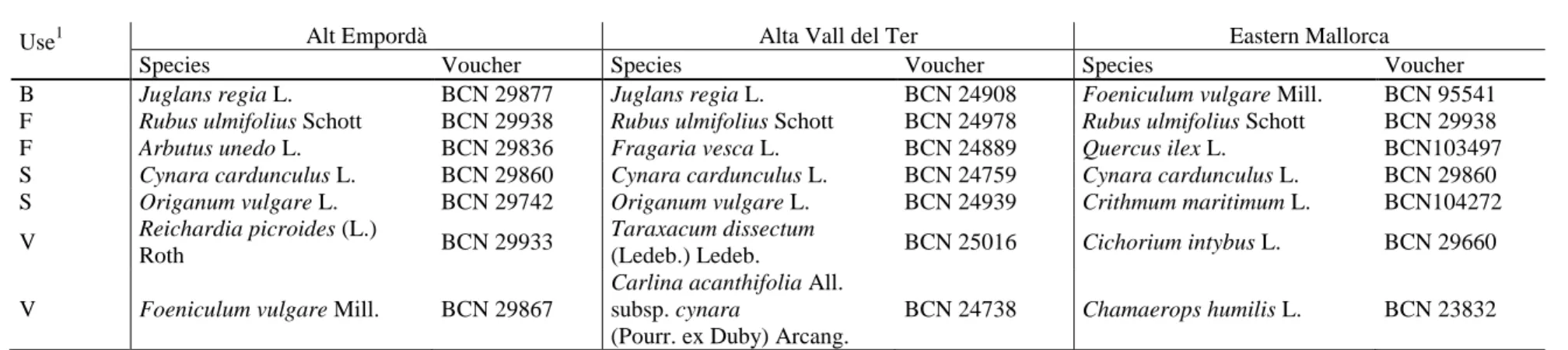
(10) This is an accepted manuscript of an article published in Economic Botany on 10 May 2016, available online: http://dx.doi.org/10.1007/s12231-016-9343-1. 203. part is used to prepare liquor or infusions), and seasonings (or species in which any part is. 204. used for food seasoning). Some WFP have several edible uses, but we only considered the. 205. most common one. For example, we asked about the stems of Foeniculum vulgare, but not. 206. about its seeds, which in some areas are also used as seasoning. Vouchers of all taxa used. 207. in this study are deposited in the herbarium BCN, of the Centre de Documentació de. 208. Biodiversitat Vegetal, Universitat de Barcelona.. 209. The final survey is based in a total of 21 wild food-uses (where the same use in a. 210. different area is counted twice) (Table 2). We compare WFP that represent the same. 211. category of use (Table 2). For example, each survey included a species that has been. 212. traditionally used to elaborate alcoholic beverages: in AE and AVT the complete and. 213. immature raw fruits of Juglans regia (walnuts) are used to elaborate ratafia and in EM the. 214. shoots of Foeniculum vulgare are used to prepare herbes, both traditional alcoholic drinks. 215. elaborated with aromatic plants. Each survey also included two WFP whose fruits could be. 216. consumed raw: Rubus ulmifolius was included in the three surveys and Arbutus unedo in. 217. AE, Fragaria vesca L. in AVT and Quercus ilex in EM. Similarly, two WFP used for. 218. seasoning were included in each survey: Cynara cardunculus, common across the three. 219. sites, and Origanum vulgare in AE and AVT and Crithmum maritimum in EM. Finally, two. 220. more WFP were included as vegetables: the young leaves of Reichardia picroides (L.). 221. Roth, Taraxacum dissectum and Cichorium intybus are eaten raw as salad and Foeniculum. 222. vulgare, Carlina acanthifolia All. and Chamaerops humilis L. are eaten as snacks. Two. 223. species (Rubus ulmifolius and Cynara cardunculus) were included in the surveys conducted. 224. in the three areas and two more (Juglans regia and Origanum vulgare) were common to. 225. both continental areas. Foeniculum vulgare was included in the surveys of AE and EM, but. 226. representing different categories of use. The remaining species are specific to each area..
(11) This is an accepted manuscript of an article published in Economic Botany on 10 May 2016, available online: http://dx.doi.org/10.1007/s12231-016-9343-1. 227 228 229. INSERT TABLE 2 Survey The survey addressed three main topics: 1) participant’s socioeconomic information. 230. (e.g., sex, age, occupation); 2) past and present consumption of selected WFP; and 3). 231. motivations for consumption (or abandonment) of WFP. To enquire about past and present. 232. consumption of selected WFP, we showed a visual stimulus where the food part could be. 233. easily recognized. When possible, we used the fresh plant, but when not available, we used. 234. a herbarium specimen or pictures. Respondents were asked to identify the species by their. 235. Catalan name, the language most frequently used during interviews. To reduce biases. 236. associated to problems recognizing the visual stimulus, if the informant could not identify. 237. the species, we provided the local name of the WFP and asked again if the person knew it.. 238. If the person could recognize the plant, either from the stimulus or when the name was. 239. provided, then we asked about its uses. If the person could not recognize the plant or did. 240. not mention its food-use, we moved to the next item in the survey. If the plant was. 241. recognized and the food-use listed, we asked: “Have you eaten the plant in the last 12. 242. months?” and “Had you eaten it in the past?”. 243. Questions on motivations for consumption depended on previous answers. If the. 244. respondent reported having consumed the WFP during the last 12 months, then we asked:. 245. “Why do you consume this plant?” However, if the respondent reported having consumed. 246. the plant in the past, but not in the 12 months previous to the survey, then we asked: “Why. 247. did you not consume this plant anymore?” In case the survey respondent did never consume. 248. the plant, we asked: “Why have you never consumed this plant?” We noted verbatim. 249. answers to those different questions..
(12) This is an accepted manuscript of an article published in Economic Botany on 10 May 2016, available online: http://dx.doi.org/10.1007/s12231-016-9343-1. 250 251. Data analysis Data were aggregated at the WFP level, where each food-use per area corresponds. 252. to one observation (n=21=7 plants *3 areas). To analyze the different WFP consumption. 253. trends we used responses to questions about present and past WFP consumption.. 254. Specifically, we created two variables: the variable ever consumed refers to the percentage. 255. of people who had ever consumed the species, either currently or in the past; the variable. 256. consumption change refers to the difference between the percentage of informants who. 257. consume a species now minus those who consumed it in the past. We used the value of the. 258. variable consumption change to assess consumption trends defined as ‘abandonment’ when. 259. the value of consumption change was lower than -10%; ‘maintenance’ when the value was. 260. between -10% and 10%; and ‘valorization’ when the value of the variable was higher than. 261. 10%. To qualify how noticeable is the trend, we talk about a slight change when the value. 262. of consumption change is between 10% and 40% and about a deep change when is higher. 263. than 40%.. 264. In the second part of the analysis, we explored the factors that might drive such. 265. trends using information from the third part of the survey. We first clustered similar. 266. responses and assigned them a code. For example, answers such as “we used to eat them. 267. because they were free” and “there is no need to buy vegetables, you can get them free. 268. from nature” were both coded as “it is free.” The coded motivations were then classified. 269. according to two criteria: direction and type. Direction refers to whether the motivation. 270. listed explains why the consumption of the species was continued or discontinued and type. 271. refers to whether the motivation listed was environmental, economic, or sociocultural.. 272. Since the consumption of WFP can be driven by several motivations, and since some. 273. motivations can potentially be classified in more than one type, before doing the.
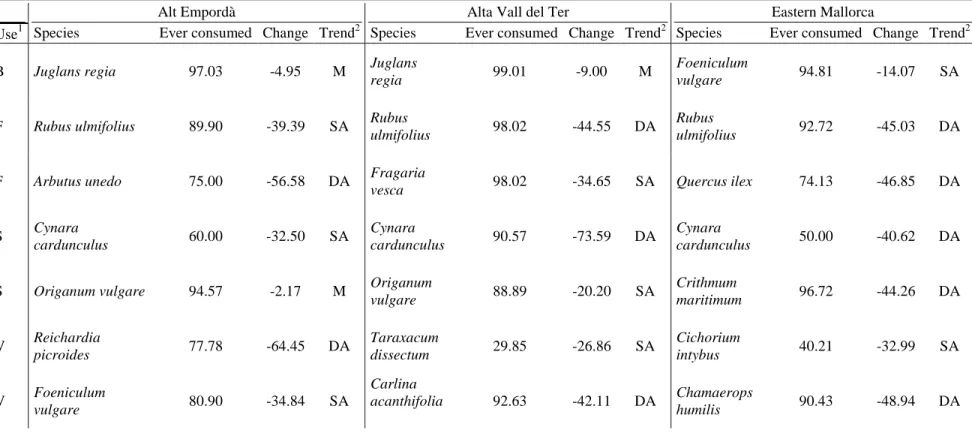
(13) This is an accepted manuscript of an article published in Economic Botany on 10 May 2016, available online: http://dx.doi.org/10.1007/s12231-016-9343-1. 274. classification, we agreed on the meaning of each category using the Delphi method. 275. (Linstone and Turoff, 2002). The agreement reached was to include under environmental. 276. motivations mentions to environmental conditions such as climate, species abundance or. 277. scarcity, and seasonality; under economic motivations reasons such as commercial value or. 278. monetary and time-related costs associated to the harvesting and preparation of WFP; and. 279. under sociocultural motivations explanations that respond to cultural perceptions, such as. 280. use associated to particular activities or of given cultural significance.. 281. Results. 282. Trends in the consumption of WFP. 283. More than 50% of people answering the survey in each site had ever consumed most. 284. of the WFP in our lists. Exceptions are Taraxacum dissectum, which had only been. 285. consumed by 30% of informants in AVT, and Cichorium intybus only consumed by 40% of. 286. informants in EM. Overall, 16 out of the 21 WFP in the survey had been consumed by. 287. more than 75% of people interviewed.. 288. The analysis of the variable consumption change suggests a significant general. 289. decrease in the consumption of WFP (Table 3). According to our classification, 10 of the. 290. plant-uses included in the survey seem to have experienced a deep abandonment (difference. 291. <-40%), eight seem to have experienced a slight abandonment (difference≥-40% & ≤-. 292. 10%), and three seem to be maintained (difference ≥-10% & ≤10%).. 293 294. INSERT TABLE 3 Two of the three WFP that seem to be maintained are used to elaborate beverages.. 295. Thus, the use of Juglans regia to elaborate ratafia continues alive in AE and AVT. 296. (consumption change≥-10% in both cases), whereas the use of Foeniculum vulgare to.
(14) This is an accepted manuscript of an article published in Economic Botany on 10 May 2016, available online: http://dx.doi.org/10.1007/s12231-016-9343-1. 297. elaborate herbes in EM seems to have experienced a slight abandonment (consumption. 298. change=-14%).. 299. Overall, WFP included as fruits seem to have been very popular in the past, as they. 300. have reportedly been consumed by most people interviewed (>75%). However, the. 301. relatively high values of the variable consumption change (<-35%) signal the steep. 302. abandonment of the consumption of WFP in this category. This is the case even for the. 303. very popular Rubus ulmifolius, with values of consumption change ranging between -39%. 304. and -45%.. 305. Among the WFP included in the category of seasoning, Origanum vulgare. 306. continues to be largely consumed in AE (consumption change=-2.2%), but the use is. 307. slightly abandoned in AVT (-20.2%). The equivalent species in EM, Crithmum maritimum,. 308. seems to have been very popular in the past (with 97% of people reporting its use), but its. 309. use have been deeply abandoned nowadays (consumption change= -44%). Differently, the. 310. use of Cynara cardunculus for seasoning seems to have been popular only in AVT (where. 311. 90% of informants report its use), but it seems now largely abandoned in the three study. 312. areas.. 313. Overall, the consumption of the six WFP included as vegetables seems to be. 314. decreasing too, although it is worth noticing that some of the uses in this category were. 315. never very popular (i.e., two species in this food use category displaying the lowest values. 316. in the variable ever consumed). Nevertheless, the values of the variable consumption. 317. change suggest that all the WFP in this category have experienced some level of. 318. abandonment, a trend that is similar for vegetables eaten as snack, such as Foeniculum. 319. vulgare in AE (consumption change =-38.8%) and Carlina acanthifolia (-42.1%), and for.
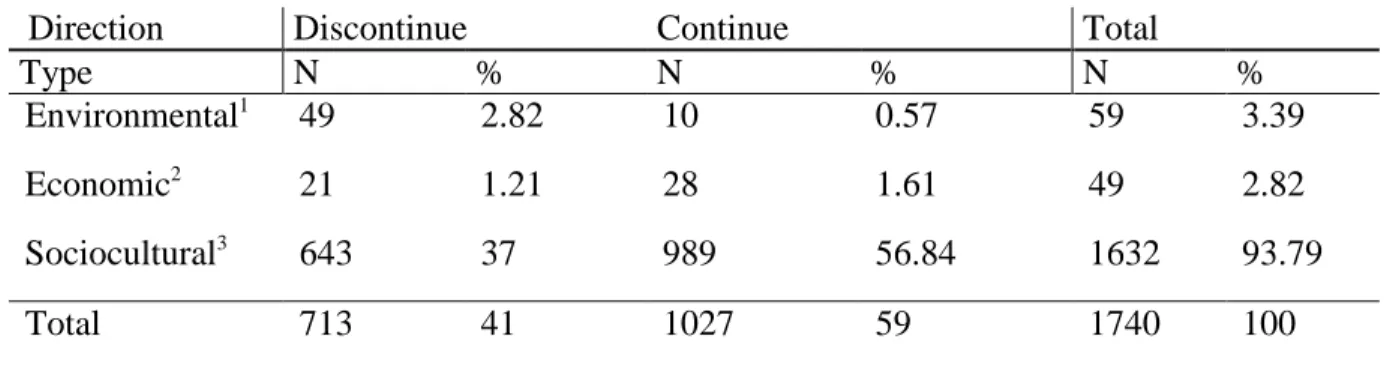
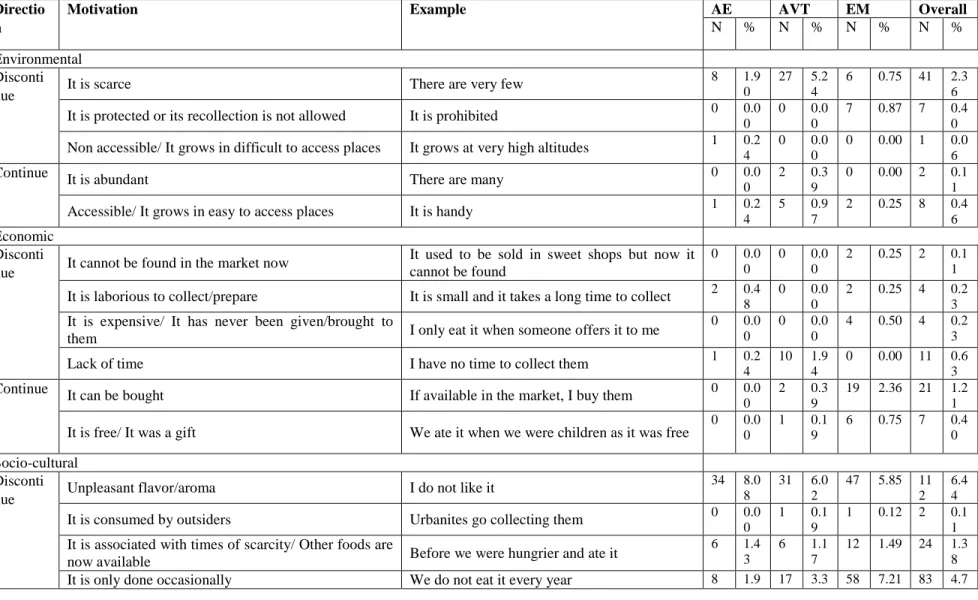
(15) This is an accepted manuscript of an article published in Economic Botany on 10 May 2016, available online: http://dx.doi.org/10.1007/s12231-016-9343-1. 320. vegetables eaten as main dishes, such as Reichardia picroides (-64.4%) or Cichorium. 321. intybus (-33%).. 322. Motivations for the consumption of WFP. 323. The 354 respondents listed as much as 1740 explanations of why they consume or. 324. have abandoned the consumption of the WFP included in our survey, or 4.92 explanations. 325. per informant. We grouped the registered explanations in 40 different motivations.. 326. Considering the two criteria used to classify motivations, respondents provided: 1) a larger. 327. diversity of sociocultural (=29) than environmental (n=5) or economic (n=6) motivations. 328. and 2) a higher diversity of reasons to discontinue (n=24) than to continue (n=16) the. 329. consumption of WFP. When considering individual responses to motivations associated to. 330. the consumption or abandonment of WFP, we found that sociocultural factors accumulate. 331. 93.8% of the explanations given, with only 3.4% of the explanations being classified as. 332. environmental and 2.8% as economic (Table 4). More responses explained the continuation. 333. (59%) rather than the abandonment (41%) of WFP’s consumption.. 334 335. INSERT TABLE 4 Thus, few informants claimed that environmental reasons affected their. 336. consumption of WFP, neither in negative (2.8%) or positive (0.6%) ways. Some informants. 337. in AVT and AE argued that they had not consumed the WFP during the year when the. 338. surveys were conducted, as the climatic conditions were not favorable and fruits were not. 339. available. Similarly, very few informants claimed that there were economic reasons. 340. affecting their consumption of WFP (2.8% in total). Among the few economic motivations. 341. mentioned, the most common was that some species, i.e. Origanum vulgare, are. 342. commercially available, so there is no need to gather them (1.2% of the answers).. 343. INSERT TABLE 5.
(16) This is an accepted manuscript of an article published in Economic Botany on 10 May 2016, available online: http://dx.doi.org/10.1007/s12231-016-9343-1. 344. Thus, the most common arguments given to explain WFP consumption (56.8%) or. 345. abandonment (37%) were sociocultural. Furthermore, among the sociocultural. 346. explanations, informant’s appreciation of the flavor and aroma of WFP was the most. 347. frequently cited motivation (44.3% of all the answers).. 348. Interestingly, the second most popular category refers to exactly the opposite: 6.4%. 349. of all responses correspond to informants who have abandoned the consumption of WFP. 350. because they did not like their taste. Other explanations given for the abandonment of the. 351. consumption of WFP include not going to the field or the mountains where WFP grow. 352. (5.2%), lack of sufficient knowledge to recognize the plant in the field (5.2%), or the. 353. consideration that it as a children’s food (2.5%) (Table 5).. 354. Apart from their taste, explanations of why people continue to consume WFP. 355. included the association of the gathering of WFP with other activities (e.g., walking on the. 356. mountains) or celebrations (2.9%) and the medicinal (2.8%) or health-related (2.2%). 357. properties of the WFP selected.. 358. The type and direction of the motivations did not vary substantially between the. 359. three case studies, with some concrete exceptions. For example, some explanations were. 360. only relevant in one of the study sites. Thus, in AE 1.2% of the explanations referred to the. 361. cited the rough texture of WFP, in AVT 1.9% related to the lack of time, and in EM 1.7%. 362. of the explanations referred to the fact that the WFP mentioned were considered fodder.. 363 364 365. Discussion Various authors have claimed that in modern industrial Europe there is a. 366. valorization of the consumption of wild edible foods (Schunko et al., 2015) resulting of the. 367. growing interest in incorporating wild food plants into the diet and on local cuisines.
(17) This is an accepted manuscript of an article published in Economic Botany on 10 May 2016, available online: http://dx.doi.org/10.1007/s12231-016-9343-1. 368. (Acosta-Naranjo, 2008; Łuczaj, 2012). Such valorization trend has been also documented in. 369. the consumption of certain wild species in some areas of the Iberian Peninsula (Aceituno-. 370. Mata, 2010; Parada et al., 2011; Rigat et al., 2009). Results from the work presented here,. 371. however, do not confirm this finding. Rather, findings from this work suggest that, in the. 372. selected study areas, there is an overall decreasing trend in the consumption of WFP. The. 373. trend seems irrespectively of the food use given to the species.. 374. It is possible that methodological and sampling differences explain the mismatch. 375. between our results and results from previous research. Thus, the above-cited works consist. 376. on compilations of ethnobotanical information, which report valorization of certain species. 377. based on qualitative data. While qualitative information might provide nuanced and expert. 378. information, it does not allow to quantifying changes for a given species, as it has been. 379. done in the present work. Furthermore, it is also possible that the contradictory findings. 380. point to sampling selection differences. Thus, qualitative work conducted with targeted. 381. groups of respondents such as knowledgeable elders or WFP consumers can only provide. 382. information from the selected groups. The results presented here have a more general. 383. character, as the sample –without being statistically representative- included sectors of the. 384. population not necessarily targeted in conventional ethnobotanical studies. So, while it is. 385. possible that a specific WFP is revalorized, or that the overall value of WFP grows among. 386. specific groups, our results suggest that this trend is not generalizable neither to the. 387. diversity of WFP nor to the general population. We argue that future work aiming at. 388. quantifying overall trends in the consumption of WFP should use a larger number of WFP. 389. and a statistically significant sample of the population.. 390 391. With those caveats in mind, we discuss the second important finding of this work: that the decreasing trend in WFP consumption is mostly driven by sociocultural, rather than.
(18) This is an accepted manuscript of an article published in Economic Botany on 10 May 2016, available online: http://dx.doi.org/10.1007/s12231-016-9343-1. 392. by environmental or economic factors. Previous authors have provided evidence of the. 393. importance of sociocultural motivations in explaining the consumption of WFP (i.e.,. 394. Łuczaj, 2010; Pieroni, 2001). For example, Pardo-de-Santayana et al. (2007) documented. 395. that in Piloña (northwestern Spain) people had stopped eating Nasturtium officinale R. Br.,. 396. which they associated with times of starvation; and Pieroni (2001) reported that older. 397. generations of Italians regarded eating wild greens as particularly healthy. In the same vein,. 398. recent work has found that WFP providing cultural services, such as recreation and sense of. 399. place, being markers of cultural identity, or present in culinary traditions are less likely to. 400. experience a consumption decrease than WFP that do not provide such cultural services. 401. (Schulp et al., 2014, Reyes-García et al., 2015, Schunko et al., 2015).. 402. While our finding is not new, the novelty of our work lies in the ability to provide a. 403. quantification of arguments across the different species selected. Based on qualitative data,. 404. researchers have highlighted elements such as the importance that some food wild plants. 405. play as childhood food (Kalle and Soukand, 2013), or the negative connotations associated. 406. with WFP consumption, which in some areas are considered famine foods (i.e., Kalle and. 407. Soukand, 2013; Cruz-García, 2014). Interestingly, although such motivations were. 408. sporadically mentioned by our informants, they were not the most frequently cited. Rather,. 409. our results indicate that changes in lifestyles and habits concentrate a large number of. 410. explanations of why people are abandoning the consumption of the selected WFP. Thus,. 411. some respondents argued that, in the past, they used to eat or gather WFP when going to the. 412. fields for another activity (e.g., agriculture or keeping livestock). The fading of these. 413. activities reduces people’s chances to go to places where WFP are found. This is the case,. 414. for example, of Carlina acanthifolia, which was specially consumed by shepherds, farmers. 415. and children (who usually were in charge of the livestock). Or the case of Cynara.
(19) This is an accepted manuscript of an article published in Economic Botany on 10 May 2016, available online: http://dx.doi.org/10.1007/s12231-016-9343-1. 416. cardunculus, which was traditionally used to process milk in order to obtain cheese; as. 417. nowadays most people buy cheese, the species is not used anymore, except in AE, where a. 418. local cheese producer has reintroduced its use.. 419. One last important finding deserves discussion. While respondents provided a. 420. myriad of answers to explain why they have abandoned WFP consumption, they were. 421. rather consistent in their responses to explain the maintenance of WFP consumptions:. 422. people who continue to consume WFP do so because they like their taste. Such results. 423. resonate with findings from research in Italy suggesting that taste is a main factor involved. 424. in the prevalence of consumption of wild food plants (Ghirardini et al., 2007) and with. 425. findings regarding the consumption of landraces grown in home gardens in the Pyrenees. 426. (Calvet-Mir et al., 2011). If, as several authors have pointed, taste is culturally developed. 427. (Ghirardini et al., 2007; Lewis, 1988), our finding contributes to reinforce the importance. 428. of examining the links between local cultures and the different elements of their. 429. environments.. 430 431. Conclusion. 432. The work presented here aimed at finding general trends and exploring the relative. 433. importance of the different motivations behind the consumption or abandonment of WFP.. 434. Overall, our work supplements the limited pool of current ethnobotanical literature on WFP. 435. transitions through documenting and understanding how different plants and uses change. 436. over space and time especially in the light of a generalized abandonment of their usage. It. 437. also provides a deeper understanding of transformations through detailing the changing. 438. ethnobotanical systems surrounding the studied areas, a research subject which is virtually.
(20) This is an accepted manuscript of an article published in Economic Botany on 10 May 2016, available online: http://dx.doi.org/10.1007/s12231-016-9343-1. 439. non-existent in postindustrial societies. Importantly, this kind of analysis is ideally suited to. 440. raising public understanding of the significance of sociocultural parameters to the study of. 441. the diversity and complexity in ethnobiological contexts.. 442. While the aim of this work was to map general trends and motivations behind the. 443. consumption of WFP, it is possible that such motivations play a different role across. 444. different sectors of the population (as Schunko et al., 2015 suggest). While the sample used. 445. for this work is too fragmented to systematically explore the issue, we argue that this line of. 446. research is worth pursuing in future works.. 447 448. Acknowledgements. 449. The present work has been conducted under the framework of the project “Sociocultural. 450. factors that explain the gathering and consumption of food wild plants and minor crops.. 451. Case studies in the Iberian peninsula and the Balearic Islands”, funded by the Economy and. 452. Competitiveness Ministry (CSO2011-27565) of the Spanish government. The contribution. 453. of Generalitat de Catalunya is also acknowledged (project 2014SGR514). E.C. benefited. 454. from a predoctoral contract from the Spanish Ministry for Education. We thank M. Mayans,. 455. A. Noguera and C. Prat for their help in data collection, Marta Borrós for cartographical. 456. design, and three anonymous reviewers for comments to a previous version of this. 457. manuscript..
(21) This is an accepted manuscript of an article published in Economic Botany on 10 May 2016, available online: http://dx.doi.org/10.1007/s12231-016-9343-1. 458. References. 459. Aceituno-Mata, L., 2010. Estudio etnobotánico y agroecológico de la Sierra Norte de. 460 461 462 463 464 465 466 467. Madrid. PhD Thesis. Universidad Autónoma de Madrid, Madrid. Acosta-Naranjo, R., 2008. Dehesas de la sobremodernidad. La cadencia y el vértigo. Diputación de Badajoz, Badajoz. Bharucha, Z., Pretty, J., 2010. The roles and values of wild foods in agricultural systems. Philosophical Transactions of the Royal Society B 365, 2913-2926. Bhattarai, S., Chaudhary, R.P., Taylor, RSL., 2009. Wild edible plants used by people of Manang District, Central Nepal. Ecology of Food & Nutrition 48, 1-20. Bonet, M.À., Vallès, J., 2002. Use of non-crop food vascular plants in Montseny biosphere. 468. reserve (Catalonia, Iberian Peninsula). International Journal of Food Sciences and. 469. Nutrition 53, 225-248.. 470. Calvet-Mir, L., Calvet-Mir, M., Vaqué-Nuñez, L., Reyes-García, V., 2011. Landraces in. 471. situ Conservation: A Case Study in High-Mountain Home Gardens in Vall Fosca,. 472. Catalan Pyrenees, Iberian Peninsula. Economic Botany 65, 146-157.. 473. Carrió, E., 2013. Contribució a l’etnobotànica de Mallorca. La biodiversitat vegetal i la. 474. seva gestió en una illa mediterrània. PhD Thesis. Universitat de Barcelona.. 475. Cruz-García, G. S., 2014. Symbol of poverty? Children's evaluation of wild food plants in. 476. Wayanad, India Plants and People: Choices and Diversity through Time. Early. 477. Agricultural Remnants and Technical Heritage (EARTH): 8,000 Years of Resilience. 478. and Innovation (Vol. 1, pp. 421–427): Oxbow Books, Oxford.. 479. Demissew, S., 2011. How has Government policy post-Global Strategy for Plant. 480. Conservation impacted on science? The Ethiopian perspective. Botanical Journal of. 481. the Linnean Society 166, 310-325..
(22) This is an accepted manuscript of an article published in Economic Botany on 10 May 2016, available online: http://dx.doi.org/10.1007/s12231-016-9343-1. 482. Ghirardini, M.P., et al., 2007. The importance of a taste. A comparative study on wild food. 483. plant consumption in twenty-one local communities in Italy. Journal of. 484. Ethnobiology and Ethnomedicine 3:22.. 485. Heinrich, M., Leonti, M., Nebel, S., Peschel, W., 2005. "Local Food- Nutraceuticals": An. 486. example of a multidisciplinary research project on local knowledge. Journal of. 487. Physiology and Pharmacology 56, 5-22.. 488. IBESTAT, 2014. Institut d’Estadística de les Illes Balears. http://www.ibestat.caib.es/. 489. IDESCAT, 2014. Institut Català d’Estadística. www.idescat.cat.. 490. Joshi, N., Siwakoti, M. and Kehlenbeck, K., 2015. Wild Vegetable Species in Makawanpur. 491. District, Central Nepal: Developing a Priority Setting Approach for Domestication. 492. to Improve Food Security. Economic Botany, 69(2), 161-170.. 493. Kalle, R., Soukand, R., 2013. Wild plants eaten in childhood: a retrospective of Estonia in. 494. the 1970s-1990s. Botanical Journal of the Linnean Society 172, 239-253.. 495. Lewis, D.E.,1988. Gustatory subversion and the evolution of nutritional dependency in. 496 497 498 499. Kiribati. Food and Foodways 3(1), 79-98. Linstone, H.A., Turoff, M., 2002. The Delphi method. Techniques and Applications. Portland State University, Portland. Łuczaj, L., 2010. Changes in the utilization of wild green vegetables in Poland since the. 500. 19th century: A comparison of four ethnobotanical surveys. Journal of. 501. Ethnopharmacology 128, 395-404.. 502 503 504 505. Łuczaj, L., 2012. Ethnobotanical review of wild edible plants of Slovakia. Acta Societatis Botanicorum Poloniae 81, 245-255. Łuczaj, L., Pieroni, A., Tardío, J., Pardo-de-Santayana, M., Soukand, R., Svanberg, I., Kalle, R., 2012. Wild food plant use in 21st century Europe: the disappearance of.
(23) This is an accepted manuscript of an article published in Economic Botany on 10 May 2016, available online: http://dx.doi.org/10.1007/s12231-016-9343-1. 506. old traditions and the search for new cuisines involving wild edibles. Acta Societatis. 507. Botanicorum Poloniae 81, 359-370.. 508. Łuczaj, Ł., Zovko Končić, M., Miličević, T., Dolina, K., Pandža, M., 2013. Wild vegetable. 509. mixes sold in the markets of Dalmatia (southern Croatia). Journal of Ethnobiology. 510. and Ethnomedicine 9:2.. 511 512 513. Mayol, J., Machado, A., 1992. Medi ambient, ecologia i turisme a les Illes Balears. Editorial Moll, Palma de Mallorca. Molina, M., Pardo-de-Santayana, M., García, E., Aceituno-Mata, L., Morales, R., Tardío,. 514. J., 2012. Exploring the potential of wild food resources in the Mediterranean region:. 515. natural yield and gathering pressure of Asparagus acutifolius L. Spanish Journal of. 516. Agricultural Research 10, 1090-1100.. 517 518 519 520 521. Newing, H., 2011. Conducting research in conservation. Social science methods and practice. Routledge, London. Parada, M., 2007. Estudi Etnobotànic de l’Alt Empordà, PhD Thesis. Universitat de Barcelona, Barcelona. Parada, M., Carrió, E., Bonet, M.À., Vallès, J., 2009. Ethnobotany of the Alt Emporda. 522. region (Catalonia, Iberian Peninsula) Plants used in human traditional medicine.. 523. Journal of Ethnopharmacology 124, 609-618.. 524. Parada, M., Carrió, E., Vallès, J., 2011. Ethnobotany of food plants in the Alt Emporda. 525. region (Catalonia, Iberian Peninsula). Journal of Applied Botany and Food Quality-. 526. Angewandte Botanik 84, 11-25.. 527 528. Pardo-de-Santayana, M., Tardío, J., Blanco, E., Carvalho, A.M., Lastra, J.J., San Miguel, E., Morales, R., 2007. Traditional knowledge of wild edible plants used in the.
(24) This is an accepted manuscript of an article published in Economic Botany on 10 May 2016, available online: http://dx.doi.org/10.1007/s12231-016-9343-1. 529. northwest of the Iberian Peninsula (Spain and Portugal): a comparative study.. 530. Journal of Ethnobiology and Ethnomedicine 3.. 531. Paton, A., Lughadha, E.N., 2011. The irresistible target meets the unachievable objective:. 532. what have 8 years of GSPC implementation taught us about target setting and. 533. achievable objectives? Botanical Journal of the Linnean Society 166, 250-260.. 534. Pieroni, A., 2001. Evaluation of the cultural significance of wild food botanicals. 535. traditionally consumed in Northwestern Tuscany, Italy. Journal of Ethnobiology 21,. 536. 89-104.. 537. Pieroni, A., Nebel, S., Santoro, R.F., Heinrich, M., 2005. Food for two seasons: Culinary. 538. uses of non-cultivated local vegetables and mushrooms in a south Italian village.. 539. International Journal of Food Sciences and Nutrition 56, 245-272.. 540 541. Poe, M.R., McLain, R.J., Emery, M., Hurley, P.T., 2013. Urban forest and the rights to wild foods, medicines, and materials in the city. Human Ecology 41, 409-422.. 542. Reyes-García, V., et al., 2015. From famine foods to delicatessen: Interpreting trends in the. 543. consumption and gathering of wild edible plants through their connection to cultural. 544. ecosystem services. Ecological Economics 12, 303-311.. 545. Rigat, M., Bonet, M.À., García, S., Garnatje, T., Vallès, J., 2009. Ethnobotanical studies in. 546. the high river Ter valley (Pyrenees, Catalonia, Iberian Peninsula). Non-crop food. 547. vascular plants and crop food plants with medicinal properties. Ecology of Food and. 548. Nutrition 48, 303-326.. 549. Schulp, C.J.E., Thuiller, W., Verburg, P.H., 2014. Wild food in Europe: A synthesis of. 550. knowledge and data of terrestrial wild food as an ecosystem service. Ecological. 551. Economics 105, 292-305..
(25) This is an accepted manuscript of an article published in Economic Botany on 10 May 2016, available online: http://dx.doi.org/10.1007/s12231-016-9343-1. 552. Schunko, C., Grasser, S., & Vogl, C. R., 2015. Explaining the resurgent popularity of the. 553. wild: motivations for wild plant gathering in the Biosphere Reserve Grosses. 554. Walsertal, Austria. Journal of Ethnobiology and Ethnomedicine, 11(1), 1.. 555 556 557 558 559. Shackleton, C.M., 2003. The prevalence of use and value of wild edible herbs in South Africa. South African Journal of Science 99, 23-25. Tardío, J., Pardo-de-Santayana, M., Morales, R., 2006. Ethnobotanical review of wild edible plants in Spain. Botanical Journal of the Linnean Society 152, 27-71. Teklehaymanot, T., Giday, M., 2010. Ethnobotanical study of wild edible plants of Kara. 560. and Kwego semi-pastoralist people in Lower Omo River Valley, Debub Omo Zone,. 561. SNNPR, Ethiopia. Journal of Ethnobiology and Ethnomedicine 6.. 562. Termote, C., Van Damme, P., Djailo, B.D., 2010. Eating from the Wild: Turumbu. 563. Indigenous Knowledge on Noncultivated Edible Plants, Tshopo District, DRCongo.. 564. Ecology of Food and Nutrition 49, 173-207.. 565. Vardavas, C.I., Majchrzak, D., Wagner, K.H., Elmadfa, I., Kafatos, A., 2006. The. 566. antioxidant and phylloquinone content of wildly grown greens in Crete. Food. 567. Chemistry 99, 813-821.. 568 569.
(26) This is an accepted manuscript of an article published in Economic Botany on 10 May 2016, available online: http://dx.doi.org/10.1007/s12231-016-9343-1. 570. Table 1 Study area. Sample description by study area (n=353) N. % women % per age group % agriculture <40 41-60 >61. Alt Empordà. 571. 101. 48. 38. 27. 36. 15. Alta Vall del Ter 100. 51. 18. 36. 46. 22. Eastern Mallorca 152. 45. 38. 30. 32. 6.
(27) This is an accepted manuscript of an article published in Economic Botany on 10 May 2016, available online: http://dx.doi.org/10.1007/s12231-016-9343-1. Table 2. Use B F F S S V V 1. 1. Species included in the survey, per study site. Alt Empordà Species Juglans regia L. Rubus ulmifolius Schott Arbutus unedo L. Cynara cardunculus L. Origanum vulgare L. Reichardia picroides (L.) Roth Foeniculum vulgare Mill.. Voucher BCN 29877 BCN 29938 BCN 29836 BCN 29860 BCN 29742 BCN 29933 BCN 29867. B= Beverage, F=Fruit, S=Seasoning, V=Vegetable. Alta Vall del Ter Species Voucher Juglans regia L. BCN 24908 Rubus ulmifolius Schott BCN 24978 Fragaria vesca L. BCN 24889 Cynara cardunculus L. BCN 24759 Origanum vulgare L. BCN 24939 Taraxacum dissectum BCN 25016 (Ledeb.) Ledeb. Carlina acanthifolia All. subsp. cynara BCN 24738 (Pourr. ex Duby) Arcang.. Eastern Mallorca Species Voucher Foeniculum vulgare Mill. BCN 95541 Rubus ulmifolius Schott BCN 29938 Quercus ilex L. BCN103497 Cynara cardunculus L. BCN 29860 Crithmum maritimum L. BCN104272 Cichorium intybus L.. BCN 29660. Chamaerops humilis L.. BCN 23832.
(28) This is an accepted manuscript of an article published in Economic Botany on 10 May 2016, available online: http://dx.doi.org/10.1007/s12231-016-9343-1. Table 3. Use. 1. Trends in consumption of selected WFP, per study site. Species. Alt Empordà Ever consumed Change Trend2 Species. Alta Vall del Ter Ever consumed Change Trend2 Species. Eastern Mallorca Ever consumed Change Trend2. B. Juglans regia. 97.03. -4.95. M. Juglans regia. 99.01. -9.00. M. Foeniculum vulgare. 94.81. -14.07. SA. F. Rubus ulmifolius. 89.90. -39.39. SA. Rubus ulmifolius. 98.02. -44.55. DA. Rubus ulmifolius. 92.72. -45.03. DA. F. Arbutus unedo. 75.00. -56.58. DA. Fragaria vesca. 98.02. -34.65. SA. Quercus ilex. 74.13. -46.85. DA. S. Cynara cardunculus. 60.00. -32.50. SA. Cynara cardunculus. 90.57. -73.59. DA. Cynara cardunculus. 50.00. -40.62. DA. S. Origanum vulgare. 94.57. -2.17. M. Origanum vulgare. 88.89. -20.20. SA. Crithmum maritimum. 96.72. -44.26. DA. V. Reichardia picroides. 77.78. -64.45. DA. Taraxacum dissectum. 29.85. -26.86. SA. Cichorium intybus. 40.21. -32.99. SA. V. Foeniculum vulgare. 80.90. -34.84. SA. 92.63. -42.11. DA. Chamaerops humilis. 90.43. -48.94. DA. 1 2. Carlina acanthifolia. B= Beverage, F=Fruit, S=Seasoning, V=Vegetable M=Maintenance, SA= Slight abandonement, DA= Deep abandonement.
(29) This is an accepted manuscript of an article published in Economic Botany on 10 May 2016, available online: http://dx.doi.org/10.1007/s12231-016-9343-1. Table 4 Percentage of responses according to type and direction of the motivations for the consumption of WFP. Direction Type Environmental1. Discontinue N % 49 2.82. Continue N 10. % 0.57. Total N 59. % 3.39. Economic2. 21. 1.21. 28. 1.61. 49. 2.82. Sociocultural3. 643. 37. 989. 56.84. 1632. 93.79. Total. 713. 41. 1027. 59. 1740. 100. 1. Clime, abundance, scarcity. 2. Commerce availability, investment of time, prize. Flavor/aroma/texture, association with animal/children’s/ scarcity/ local food, fashionable/ healthy/ traditional consideration, changes in resources management, habit/dietary changes, etc. 3. 29.
(30) This is an accepted manuscript of an article published in Economic Botany on 10 May 2016, available online: http://dx.doi.org/10.1007/s12231-016-9343-1. Table 5 Directio n. Classification of motivations for the consumption of WFP Motivation. Environmental Disconti It is scarce nue It is protected or its recollection is not allowed. Continue. There are very few It is prohibited. Non accessible/ It grows in difficult to access places. It grows at very high altitudes. It is abundant. There are many. Accessible/ It grows in easy to access places. It is handy. Economic Disconti It cannot be found in the market now nue. Continue. Example. It used to be sold in sweet shops but now it cannot be found. It is laborious to collect/prepare. It is small and it takes a long time to collect. It is expensive/ It has never been given/brought to them. I only eat it when someone offers it to me. Lack of time. I have no time to collect them. It can be bought. If available in the market, I buy them. It is free/ It was a gift. We ate it when we were children as it was free. AE N %. AVT N %. EM N %. Overall N %. 8. 1.9 0 0.0 0 0.2 4 0.0 0 0.2 4. 27. 5.2 4 0.0 0 0.0 0 0.3 9 0.9 7. 6. 0.75. 41. 7. 0.87. 7. 0. 0.00. 1. 0. 0.00. 2. 2. 0.25. 8. 0.0 0 0.4 8 0.0 0 0.2 4 0.0 0 0.0 0. 0. 0.0 0 0.0 0 0.0 0 1.9 4 0.3 9 0.1 9. 2. 0.25. 2. 2. 0.25. 4. 4. 0.50. 4. 0. 0.00. 11. 19. 2.36. 21. 6. 0.75. 7. 8.0 8 0.0 0 1.4 3 1.9. 31. 6.0 2 0.1 9 1.1 7 3.3. 47. 5.85. 1. 0.12. 11 2 2. 12. 1.49. 24. 58. 7.21. 83. 0 1 0 1. 0 2 0 1 0 0. Socio-cultural Disconti Unpleasant flavor/aroma nue It is consumed by outsiders It is associated with times of scarcity/ Other foods are now available It is only done occasionally. I do not like it Urbanites go collecting them Before we were hungrier and ate it We do not eat it every year. 34 0 6 8. 0 0 2 5. 0 0 10 2 1. 1 6 17. 2.3 6 0.4 0 0.0 6 0.1 1 0.4 6 0.1 1 0.2 3 0.2 3 0.6 3 1.2 1 0.4 0 6.4 4 0.1 1 1.3 8 4.7. 30.
(31) This is an accepted manuscript of an article published in Economic Botany on 10 May 2016, available online: http://dx.doi.org/10.1007/s12231-016-9343-1. It is considered food for animals. Rabbits eat it. Food from the past/ Consumed during activities now in disuse. These are things of the past. It is children’s food. Eating it was a child’s thing. It has a rough texture. I do not like it; it has too many seeds. Consumption associated to a specific place. We ate it when we lived in the country house. Changes in resources management. We do not have cows anymore. Unhealthy/ It has contraindications or restrictions for eating it Consumption associated to a specific past activity. Continue. If you eat many you get drunk We do not make cheese anymore. 2 1 3 5 0 11 2 9 23. Collection is time consuming or inconvenient. I do not go to the fields anymore. Consumption associated to a specific person not around anymore It is not within the person’s habits. I ate it when my mother used to prepare it.. 0. I do not use it. 5. Lack of specific knowledge of the use. I do not know well the plant. Dietary changes. We have changed our diet. Pleasant flavor/aroma/texture. I like it. Eaten as a social compromise. It was offered to me and I ate it. Local food. This is very much from here. Collection is a hobby. I never eat it but go to collect it for the family. It is a tradition. It is our tradition here. Specific cooking properties. Cheese prepared with it is tender. 4 1 22 5 2 0 0 1 1. 0 0.4 8 0.2 4 0.7 1 1.1 9 0.0 0 2.6 1 0.4 8 2.1 4 5.4 6 0.0 0 1.1 9 0.9 5 0.2 4 53. 4 0.4 8 0.0 0 0.0 0 0.2 4 0.2 4. 0 1 2 2 0 16 4 5 49 0 4 4 4 25 1 0 7 1 4 1. 0 0.0 0 0.1 9 0.3 9 0.3 9 0.0 0 3.1 1 0.7 8 0.9 7 9.5 1 0.0 0 0.7 8 0.7 8 0.7 8 48. 7 0.0 0 1.3 6 0.1 9 0.7 8 0.1 9. 14. 1.74. 16. 15. 1.87. 17. 39. 4.85. 44. 2. 0.25. 9. 17. 2.11. 17. 3. 0.37. 30. 2. 0.25. 8. 14. 1.74. 28. 19. 2.36. 91. 10. 1.24. 10. 39. 4.85. 48. 82. 10.2 0 1.12. 90. 29 5 1. 36.6 0.12. 77 1 3. 1. 0.12. 8. 2. 0.25. 3. 11. 1.37. 16. 2. 0.25. 4. 9. 14. 7 0.9 2 0.9 8 2.5 3 0.5 2 0.9 8 1.7 2 0.4 6 1.6 1 5.2 3 0.5 7 2.7 6 5.1 7 0.8 0 44. 3 0.1 7 0.4 6 0.1 7 0.9 2 0.2 3. 31.
(32) This is an accepted manuscript of an article published in Economic Botany on 10 May 2016, available online: http://dx.doi.org/10.1007/s12231-016-9343-1. It has become fashionable. All youngsters use it. It is healthy/natural. It is good for health. It has medicinal properties. It is good for cholesterol. It is eaten to remember the past. I bought it because I get emotional with things of the past. It is associated with festivities/specific activities. I eat it when I go collecting mushrooms. Just because. I eat it just because. 0 18 23 0 11 13. 0.0 0 4.2 8 5.4 6 0.0 0 2.6 1 3.0 9 421. 1 11 24 1 2 19. 0.1 9 2.1 4 4.6 6 0.1 9 0.3 9 3.6 9 515. 0. 0.00. 1. 10. 1.24. 39. 1. 0.12. 48. 0. 0.00. 1. 37. 4.60. 50. 13. 1.62. 45. 804. 0.0 6 2.2 4 2.7 6 0.0 6 2.8 7 2.5 9 1740. 32.
(33) This is an accepted manuscript of an article published in Economic Botany on 10 May 2016, available online: http://dx.doi.org/10.1007/s12231-016-9343-1. Figure 1. Location of studied areas. 33.
(34)
Figure
+2
Documento similar