Genetic factors affecting susceptibility
to alcoholic liver disease in an Indian population
Atanu Kumar DuttaDepartment of Biochemistry,Institute of Postgraduate Medical Education and Research, 244 AJC Bose Road, Kolkata-700020, West Bengal, India.
ABSTRACT
Introduction. Indians are more likely to develop alcoholic cirrhosis compared to Caucasians, though the cause remains obscure. North Indians tend to consume more alcohol than other parts of the country. Ge-netic factors are likely to play a major role in these observations. This study investigated whether 10 diffe-rent polymorphisms were associated with alcohol dependence and/or cirrhosis in North Indians. These were in ADH2*2 (rs1229984), ADH3*2 (rs698), CYP2E1*1D, CYP2E1*5 (rs3813867 and rs2031920), TNF-α
(rs1800629), TNF-α (rs361525), IL-1β (rs3087258), CD-14 (rs2569190), IL-10 (rs1800872) and PNPLA3 (rs738409). Material and methods. Hundred healthy controls and 120 chronic alcoholics (60 alcoholic noncirrhotics and 60 alcoholic cirrhotics) attending various departments of PGIMER, Chandigarh were genotyped using PCR-RFLP methods. Results. Alcoholic cirrhotics compared to healthy individuals demonstrated a statistically significant increase in PNPLA3 (10109G) allele (p = 0.037, OR = 2.12, 95% CI 1.29-3.4). Rest of the associations were not significant after correction for multiple testing. Conclusion. PNPLA3 10109G predisposed North Indian subjects to alcoholic cirrhosis.
Key words. Alcoholic liver disease. Alcohol dependence. Genetic polymorphism. Cytokine. Alcohol metabolizing enzyme. PNPLA3.
Correspondence and reprint request: Atanu Kumar Dutta
Departament of Biochemistry, Institute of Postgraduate Medical Education and Research, 244 AJC Bose Road, Kolkata-700020, West Bengal, India. Tel.: +91-9434582887. Fax: +91-3322234659
E-mail: [email protected]
Manuscript received: April 25, 2013. Manuscript accepted: May 31, 2013. INTRODUCTION
Alcoholism remains a major socio-economic and medical problem throughout the world. According to WHO estimates 26% men and 4% women in India drink alcohol which are considerably lower than Eu-ropeans (90% men and 81% women). Although alco-hol consumption per drinker in India is around 12.9 L/y which is comparable to the rest of the world and alcohol consumption patterns vary considerably within India with North Indians are much more predisposed to alcohol dependence. Alcohol contribu-tes to apparently 4% of total deaths, 20% of hospital admissions, 18% of psychiatric emergencies, 20% of all brain injuries and 60% of all injuries reported in
emergency rooms in India. With per capita
con-sumption of alcohol rising in India over past two de-cades alcoholism is likely to cause more problems in future. Though alcohol affects many organs in the body, liver bears the highest brunt as it metabolizes more than 90% of ingested alcohol. There is a spec-trum of alcoholic liver disease (ALD) namely steato-sis, hepatitis, cirrhosis and hepatocellular carcinoma. However only 6 to 41% of heavy drinkers (> 60 to 80 g/d of alcohol in men and > 20 g/d
in women develop cirrhosis.1 Hence, in addition to
alcohol other co-existing factors might influence ALD. Various agents and environmental factors have been implicated in pathogenesis and progres-sion of ALD including type, amount and pattern of drinking, obesity, hyperglycemia, HBV, HCV, HIV infection, diet, toxin and drugs etc. In addition, twin studies have demonstrated that genetic factors
are responsible for alcohol dependence and ALD.2 A
number of case-control studies involving single nucleotide polymorphism (SNP) analysis have impli-cated various genes namely, alcohol dehydrogenase (ADH), aldehyde dehydrogenase (ALDH) and cyto-chrome P4502E1, manganese superoxide dismutase
(IL-10), tumor necrosis factor α (TNF-α), matrix metalloproteinase (MMP), tissue inhibitor of ma-trix metalloproteinase (TIMP) and adiponutrin (PN-PLA3) to have causal relationship with alcoholism and/or ALD. But due to heterogeneity in control subjects which constituted of healthy volunteers in some studies whereas alcoholics without liver cir-rhosis in others, it is difficult to rule out the con-founding effect of alcohol dependence while studying the genetic susceptibility towards ALD. Moreover
several cytokines (TNF-α, IL-1β and IL-10)
previ-ously thought to be responsible for ALD were found to be responsible for alcohol dependence by
modula-ting serotonin neurotransmission in the brain.3
In-dians may be more susceptible to ALD compared to
Caucasians,4 there have been only few studies in
India to comprehend the susceptibility genes
towards ALD.5 But in none of the studies the whole
spectrum of susceptibility genes (cytokines and metabolizing enzymes) were studied simultaneously in alcohol dependence and ALD. Hence, a retrospec-tive, observational, case-control study involving the
polymorphism in ADH2*2, ADH2*3, ADH3*2,
ALDH2*2, CYP2E1*1D, CYP2E1*5, TNF-α, IL-1β,
IL-10, CD-14 and PNPLA3 in healthy controls (HCs) and alcoholics (ALCs) [alcoholic noncirrho-tics (ANCs) and alcoholic cirrhononcirrho-tics (ACs)] was undertaken.
MATERIAL AND METHODS
The study constituted of 100 HCs and 120 ALCs (60 ACs and 60 ANCs). Selection criteria for ALCs were consumption of at least 80 g alcohol per day for ten or more year. Alcoholic cirrhosis was diagnosed by clinical, radiological and biochemical parameters. All the subjects were residents of North India (Chandigarh, Punjab, Haryana, Delhi, Utta-ranchal, Himachal Pradesh and Jammu and Kash-mir) for the last three generations, within the age group 25-60 y, were negative for HBsAg and IGM anti HCV and free from any other liver disease. ACs were recruited from the Department of Hepatology and ANCs were recruited from the Department of Psychiatry. HCs were recruited among blood donors. Written consent was taken from all the sub-jects and the study was approved by the Institute Ethics Committee of PGIMER, Chandigarh. All the subjects were studied for alcohol abuse and depen-dence by the DSM IV criteria and scored on the ba-sis of CAGE questionnaire. DNA was isolated by the
method of Daly et al.6 All mutations were diagnosed
by using PCR-RFLP methods available in the
litera-ture (Table 1). Three millimetres blood was collected in plain vial and assayed in Random Access Autoa-nalyzer Modular-P (Hitachi) for bilirubin (total and conjugated), aspartate aminotransferase (AST), ala-nine aminotransferase (ALT), alkaline phosphatase (ALP), total protein and albumin. The variance of biochemical parameters between different groups was calculated by Mann-Whitney and Kruskal-Wallis test (nonparametric ANOVA) and Dunn’s multiple comparisons test, using GraphPad StatMate software version 3. Allele frequency was calculated by direct counting. Fisher exact test was used to as-sess the significance of the differences between allele frequencies (using 2 x 2 contingency table) and ge-notype distributions (using 3 x 2 contingency table) in different groups. Bonferroni correction was made to the p value to account for multiple testing (10 SNPs). Odds ratio and 95% confidence interval was also calculated to measure the association of the po-lymorphisms with alcohol dependence or alcoholic cirrhosis. Statistical power of individual analysis was calculated with GraphPad StatMate software
version 3. Haplotyping was done for TNF-α (-308,
-238) and ADH2*2, ADH2*3 and ADH3*2 alleles.
LOD score, D’, r2 and p values for the association
tests and HWE were calculated with the Haploview version 4.2.
RESULTS
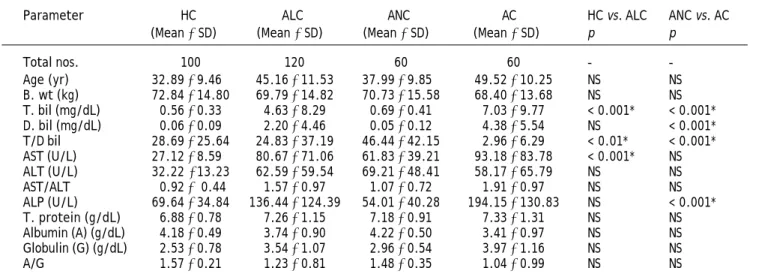
The anthropological and biochemical parameters of the studied subjects are summarized in table 2. The mean age in HCs, ANCs and ACs was 32.89, 37.99 and 49.52 y respectively. The age difference was not statistically significant. None of the sub-jects in any group demonstrated the presence of
ADH2*3 (rs2066702) or ALDH2*2 allele (rs671). The data of all the alleles and statistical analysis are presented in table 3. Genotype frequencies of all alleles were in Hardy-Weinberg equilibrium in HCs and ANCs. This study also demonstrated there is no
linkage in the TNF-α and ADH gene cluster in North
Indians which supports previous findings.19 The
frequency of the mutant alleles ADH2*2 (0.025),
CYP2E1*5 (0.005), TNF α -308A (0.04) AND TNF α
-238A (0.03) were also rare in healthy North Indians. After Bonferroni correction no other snps excepting PNPLA3 rs738409 were significantly associated with alcoholic cirrhosis or alcoholism. PNPLA3 10109G allele was significantly associated with alcoholic cirrhosis compared to healthy
con-trols (corrected p 0.037, OR 2.12, 95% CI 1.29-3.47).
was borderline significant alcoholic cirrhosis
compa-red to healthy controls (corrected p 0.06). When
PNPLA3 10109 C/G and G/G genotypes were clubbed together using a dominant model still this association was not significant between cirrhotics
and healthy controls (corrected p 0.08, OR 2.45,
95% CI 1.27-4.72).
DISCUSSION
With fast socioeconomic change India is witnes-sing a rapid increase in per capita alcohol con-sumption, especially in younger age group. There is a lacuna in the available literature regarding the na-tional prevalence of alcohol dependence and ALD.
However, North Indians tend to consume more
alco-hol compared to other parts of the country.7
Mo-reover there are few reports from United Kingdom suggesting South Asian men are more predisposed to alcohol induced liver cirrhosis. Indian men living in UK tend to develop cirrhosis earlier and after
consuming less alcohol compared to Caucasians.1,4,8
The biochemical and hematological parameters (MCV, AST, ALT, and GGT) also tend to be higher
in Indian cirrhotics.8 It is well known that
metabo-lic syndrome is an important risk factor towards de-velopment of liver disease in alcoholics. Thus Indian alcoholics must be more predisposed than Cauca-sians to develop liver disease because they tend have more abdominal fat content for a given BMI. C to G
Table 1. PCR-RFLP methods followed.
Allele Primers Restriction Reference
enzyme
ADH2*2 FP 5’-AATCTTTTCTGAATCTGAACAG-3’ Tsp45I 16Wu, et al., 2005
RP 5’-GAAGGGGGGTCACCAGGTTGC-3’
ADH2*3 FP 5’-GGACTCTCACAACAAGCATGTG-3’ AlwNI 17Frenzer, et al., 2002
RP 5’-TTTCTTTGGAAAGCCCCC-3’
ADH3*2 FP 5’-TTGTTTATCTGTGATTTTTTTGT-3’ SspI 18Yin, et al., 2007
RP 5’-CGTTACTGTAGAATACAAAGC-3’
ALDH2*2 FP 5’-CAAATTACAGGGTCAACTGCT-3’ MboII 16Wu, et al., 2005
RP 5’-CCACACTCACAGTTTTCTCTT-3’
CYP2E1*1D FP 5’-TGGTACATTGTGAGACAGTG-3’ - 17Hu, et al., 1999
RP 5’-ATACGGGAACACCTCGTTTG-3’
CYP2E1*5 (G-1293C) FP 5’-CCAGTCGAGTCTACATTGTCA-3’ PstI 14Kato, et al., 1992
RP 5’-TTCATTCTGTCTTCTAACTGG-3’
CYP2E1*5 (C-1053T) FP 5’-CCAGTCGAGTCTACATTGTCA-3’ RsaI 14Kato, et al., 1992
RP 5’-TTCATTCTGTCTTCTAACTGG-3’
TNF-α(G-308A) FP 5’-AATAGGTTTTGAGGGCCATG-3’ NcoI 17Grove, et al., 1997
RP 5’-ATCTGGAGGAAGCGGTAGTG-3’
TNF-α (G-238A) FP 5’-AGAAGACCCCCCTCGGAACC-3’ MspI 17Grove, et al., 1997
RP 5’-ATCTGGAGGAAGCGGTAGTG-3’
IL-1β (C-511T) FP 5’-TGGCATTGATCTGGTTCATC-3’ AvaI 18Takamatsu, et al., 2000
RP 5’-TTCACCCTTCTAAGGATTTG-3’
IL-10 (C-627A) FP 5’-GGTGAGCACTACCTGACTAGC-3’ RsaI 19Grove, et al., 2000
RP 5’-CCTAGGTCACAGTGACGTGG-3’
CD-14 (C-159T) FP 5’-ATCATCCTTTTCCCACAC-3’ HaeIII 20Shih, et al., 2005
RP 5’-AACTCTTCGGCTGCCTCT-3’
PNPLA3 (C10109G) FP 5’-TGGGCCTGAAGTCCGAGGGT-3’ BtsCI 21Dutta, 2011
Table 2. Comparison of anthropometric and biochemical parameters.
Parameter HC ALC ANC AC HC vs. ALC ANC vs. AC (Mean ± SD) (Mean ± SD) (Mean ± SD) (Mean ± SD) p p
Total nos. 100 120 60 60 -
-Age (yr) 32.89±9.46 45.16±11.53 37.99±9.85 49.52±10.25 NS NS B. wt (kg) 72.84±14.80 69.79±14.82 70.73±15.58 68.40±13.68 NS NS T. bil (mg/dL) 0.56±0.33 4.63±8.29 0.69±0.41 7.03±9.77 < 0.001* < 0.001* D. bil (mg/dL) 0.06±0.09 2.20±4.46 0.05±0.12 4.38±5.54 NS < 0.001* T/D bil 28.69±25.64 24.83±37.19 46.44±42.15 2.96±6.29 < 0.01* < 0.001* AST (U/L) 27.12±8.59 80.67±71.06 61.83±39.21 93.18±83.78 < 0.001* NS ALT (U/L) 32.22 ±13.23 62.59±59.54 69.21±48.41 58.17±65.79 NS NS AST/ALT 0.92± 0.44 1.57±0.97 1.07±0.72 1.91±0.97 NS NS ALP (U/L) 69.64±34.84 136.44±124.39 54.01±40.28 194.15±130.83 NS < 0.001* T. protein (g/dL) 6.88±0.78 7.26±1.15 7.18±0.91 7.33±1.31 NS NS Albumin (A) (g/dL) 4.18±0.49 3.74±0.90 4.22±0.50 3.41±0.97 NS NS Globulin (G) (g/dL) 2.53±0.78 3.54±1.07 2.96±0.54 3.97±1.16 NS NS A/G 1.57±0.21 1.23±0.81 1.48±0.35 1.04±0.99 NS NS
p values given in the table was calculated by Dunn’s multiple comparisons test using GraphPad InStat version 3. *p < 0.05 was con-sidered statistically significant.
substitution (rs738409) at genomic position 10109 (cDNA 444) in adiponutrin (patatin-like phospholi-pase domain containing 3) gene, results in substitu-tion of isoleucine with methionine at 148th posisubstitu-tion. Meta analysis of the 16 studies reported between 2008 and 2011 has established a strong association of this polymorphism with non-alcoholic fatty liver disease in Hispanics, Asians, African Americans and
Caucasians.9 Mutant homozygotes (PNPLA3,
G10109G) also demonstrated increased serum alanine transferase activity in different ethnic groups in this meta analysis. This polymorphism is also
as-sociated with alcoholic cirrhosis in Mestizos10 and
Germans,11steatosis in chronic hepatitis C Italian
patients12 and fibrosis in Germans.13 Adiponutrin
is known to regulate hepatic fat content. ADH2*3
and ALDH2*2 alleles were not present in North In-dians. This finding is consistent with the view that
ADH2*3 is confined to the Africans. While absence of ALDH2*2 increases the predisposition of In-dians towards alcohol dependence, it decreases the predisposition towards oesophageal carcinoma by decreasing the local concentration of acetaldehyde
after alcohol consumption.15 Interestingly
accord-ing to World Health Organization estimates, In-dians have much lower age standardized death rate from esophageal cancer (< 15 per 1,00,000 popula-tion) compared to Orientals (> 30 per 1, 00,000 po-pulation), who have much higher frequency of
ALDH2*2 allele (0.06-0.27). CYP2E1*5 allele was rare in North Indians with a frequency of 0.01 among HCs. This observation support previous
re-sults that CYP2E1*5 allele is infrequent among
North Indians.5 This allele was not found to be
as-sociated with either alcohol dependence or alcoholic
cirrhosis. However, CYP2E1*5 allele was found to
be predisposing to the ALD in North Indians in a
prior study5 carried out in Uttar Pradesh, India.
These apparently conflicting findings may be ex-plained by the higher prevalence of tobacco abuse in Uttar Pradesh. Nicotine also acts as an inducer of CYP2E1, hence potentiates the harmful effect of
alcohol to liver. Frequency of PNPLA3 10109G in
North Indians (0.235) was slightly higher than
Caucasians (0.19)11 but lower than Hispanics
(0.53).10 PNPLA3 10109G is associated with
in-creased hepatic fat content (dein-creased triglyceride
lipase activity) and liver fibrosis.10,11 This
polymor-phism (rs738409) was found to be predisposing towards the development of alcoholic cirrhosis (OR = 1.949) in North Indians. Allele frequency of most polymorphisms studied was similar to Caucasians and different from Orientals. In conclusion
PNPLA3 10109G predisposed North Indians to alcoholic cirrhosis however a much larger sample size is required to rule out the association of other snps with alcoholic liver disease.
FUNDING AGENCY
Indian Council of Medical Research, New Delhi, India.
ACKNOWLEDGEMENTS
Table 3.
Genotypes and allele frequencies of studied polymorphisms in HCs, ALCs, ANCs and ACs.
Frequency H Cs ALCs ANCs AC s ACs vs. Frequency H Cs ALCs ANCs Ac s ACs vs. ANCs N ( % ) N ( % ) N ( % ) ANCs N ( % ) N ( % ) N ( % ) N ( % ) ADH2*2 genotype ADH2*2 allele *1/*1 95 (95) 120 (100) 60 (100) 60 (100) *1 195 (0.975) 240 (1) 120 (1) 120 (1) *1/*2 5 (5) 0 0 0 *2 5 (0.025) 0 0 0 *2/*2 0 0 0 0 P -0.19* 1.61 1.60 P -0.18* 1.60* 1.60* OR/95% CI -0.07* 0.15* 0.15* (0.004-1.35) (0.008-2.69) (0.008-2.69) ADH3*2 genotype ADH3*2 allele *1/*1 44 (44) 49 (40.83) 25 (41.67) 24 (40.00) *1 136 (0.68) 156 (0.65) 77 (0.64) 79 (0.66) *1/*2 48 (48) 58 (48.33) 27 (45.00) 31 (51.67) *2 64 (0.32) 84 (0.35) 43 (0.36) 41 (0.34) *2/*2 8 (8) 13 (10.83) 8 (13.33) 5 (8.33) P -5.44* 5.41* 7.13* 8.92 ** P -7.40* 5.50* 8.80* 6.10 ** OR/95% CI -1.14* 1.19* 1.103* 0.93 ** (0.77-1.70) (0.74-1.91) (0.68-1.78) (0.55-1.58) CYP2E1*1D genotype CYP2E1*1D allele *1/*1 74 (74) 82 (68.33) 44 (73.33) 38 (63.33) *1 169 (0.845) 195 (0.8125) 103 (0.858) 92 (0.77) *1/*1D 21 (21) 31 (25.83) 15 (25) 16 (26.67) *1 D 31 (0.155) 45 (0.1875) 17 (0.142) 28 (0.23) *1/*1D 5 (5) 7 (5.83) 1 (1.67) 6 (10) P 3.79* 8.72* 1.01* 0.97 ** P -6.50* 5.00* 2.90* 1.30 ** OR/95% CI -1.26* 0.90* 1.66* 1.84 ** (0.76-2.08) (0.47-1.71) (0.94-2.94) (0.95-3.59) CYP2E1*5 genotype CYP2E1*5 allele *1/*1 99 (99) 117 (97.50) 57 (95) 60 (100) *1 199 (0.995) 237 (0.9875) 117 (0.975) 120 (1.00) *1/*5 1 (1) 3 (2.50) 3 (5) 0 *5 1 (0.005) 3 (0.0125) 3 (0.025) 0 *5/*5 0 0 0 0 P -6.30* 1.50* 10 * 2.50 ** P -6.30* 11.50* 10 * 1.40 ** OR/95% CI -2.52* 5.10* 0.55* 0.14 ** (0.26-24.42) (0.52-49.65) (0.02-13.67) (0.007-2.73) TNF-α (G-308A) genotype TNF-α (G-308A) allele G /G 93 (93) 94 (78.33) 47 (78.33) 47 (78.33) G 192 (0.96) 212 (0.88) 105 (0.875) 107 (0.89) G /A 6 (6) 24 (20) 11 (18.33) 13 (21.67) A 8 (0.04) 28 (0.12) 15 (0.125) 13 (0.11) A/ A 1 (1) 2 (1.67) 2 (3.33) 0 P -0.05* 0 .07* 0.20* 8.40 ** P -0.09* 0.20* 0.10* 3.40 ** OR/95% CI -3.17* 3.43* 2.91* 0.85 ** TNF-α (G238A) genotype TNF-α (G238A) allele G /G 94 (94) 109 (90.83) 57 (95) 52 (86.67) G 194 (0.97) 229 (0.95) 117 (0.975) 112 (0.93) G /A 6 (6) 11 (9.17) 3 (5) 8 (13.33) A 6 (0.03) 11 (0.05) 3 (0.025) 8 (0.07) A/A 0 0 0 0 P -4.60* 10 * 1.60* 2.20 ** P -4.50* 10 * 1.50* 2.00 **
OR/ 95% CI
-1.55* 0.83* 2.31* 2.79 ** (0.56-4.28) (0.20-3.38) (0.78-6.83) (0.72-10.77) IL-1 β (C-511T) genotype IL-1 β (C-511T) allele C/ C 12 (12) 17 (14.17) 11 (18.33) 6 (10) C 84 (0.42) 88 (0.37) 49 (0.41) 39 (0.325) C/ T 60 (60) 54 (45) 27 (45) 27 (45) T 116 (0.58) 152 (0.63) 71 (0.59) 81 (0.675) T/ T 28 (28) 49 (40.83) 22 (36.67) 27 (45) P -2.81* 9.10* 1.00* 2.30 ** P -0.80* 1.70* 0.90* 3.70 ** OR/95% CI -1.25* 1.05* 1.50* 1.43 ** (0.85-1.84) (0.66-1.66) (0.94-2.42) (0.85-2.43)
IL-10 (C-627A) g
REFERENCES
1. Mandayam S, Jamal MM, Morgan TR. Epidemiology of alco-holic liver disease. Semin Liver Dis 2004; 24: 217-32. 2. Hrubec Z, Omenn GS. Evidence of genetic predisposition
to alcoholic cirrhosis and psychosis: twin concordances for alcoholism and its biological end points by zygosity among male veterans. Alcohol Clin Exp Res 1981; 5: 207-15.
3. Zhu C-B, Blakely RD, Hewlett WA. The proinflammatory cytokines interleukin-1beta and tumor necrosis factor-al-pha activate serotonin transporters. Neuropsychopharma-col 2006; 31: 2121-31.
4. Douds AC, Cox MA, Iqbal TH, Cooper BT. Ethnic differences in cirrhosis of the liver in a British city: alcoholic cirrhosis in south Asian men. Alcohol Alcoholism 2003; 38: 148-50. 5. Khan AJ, Ruwali M, Choudhuri G, Mathur N, Husain Q,
Par-mar D. Polymorphism in cytochrome P450 2E1 and interac-tion with other genetic risk factors and susceptibility to alcoholic liver cirrhosis. Mut Res 2009; 664: 55-63. 6. Daly AK, Steen VM, Fairbrother KS, Idle JR. CYP2D6
multial-lelism. Methods Enzymol 1996; 272: 199-210.
7. Das SK, Balakrishnan V, Vasudevan DM. Alcohol: its health and social impact in India. Nat Med J India 2006; 19: 94-9. 8. Wickramasinghe SN, Corridan B, Izaguirre J, Hasan R,
Marjot DH. Ethnic differences in the biological consequen-ces of alcohol abuse: a comparison between South Asian and European males. Alcohol Alcoholism 1995; 30: 675-80. 9. Sookoian S, Pirola C. Meta-analysis of the influence of I148M variant of patatin like phospholipase domain contain-ing 3 gene (PNPLA3) on the susceptibility and histological severity of nonalcoholic fatty liver disease. Hepatology
2011; 53: 1883-94.
10. Tian C, Stokowski RP, Kershenobich D, Ballinger DG, Hinds DA. Variant in PNPLA3 is associated with alcoholic liver di-sease. Nat Genet 2010; 42: 21-3.
11. Stickel F, Buch S, Lau K, Zu Schwabedissen HM, Berg T, Ri-dinger M, Rietschel M, et al. Genetic variation in the PN-PLA3 gene is associated with alcoholic liver injury in Caucasians. Hepatology 2011; 53: 86-95.
12. Valenti L, Rumi M, Galmozzi E, Aghemo A, Del Menico B, De Nicola S, Dongiovanni P, et al. Patatin-like phospholipase domain-containing 3 I148M polymorphism, steatosis and li-ver damage in chronic hepatitis C. Hepatology 2010; 53: 791-9.
13. Krawczyk M, Grunhage F, Zimmer V, Lamert F. Variant adiponutrin (PNPLA3) represents a common fibrosis risk gene: non-invasive elastography-based study in chronic li-ver disease. J Hepatol 2011; 55: 299-306.
14. Kato S, Shields PG, Caporaso NE, Hoover RN, Trump BF, Surgimura H, Weston A, et al. Cytochrome. P45011E1 ge-netic polymorphisms radical variation and lung cancer risk. Cancer Res 1992; 52: 6712-32.
15. Brooks PJ, Enoch M-A, Goldman D, Li T-K, Yokoyama A. The alcohol flushing response: an unrecognized risk factor for esophageal cancer from alcohol consumption. PLoS Med
2009; 6: e1000050.
16. Wu CF, Wu DC, Hsu HK, Kao EL, Lee JM, Lin CC, Wu MT. Relationship between genetic polymorphisms of alcohol an-daldehyde dehydrogenases and esophageal squamous cell carcinoma risk in males. World J Gastoenterol 2005; 11: 5103-8.
17. Grove J, Daly AK, Bassendine MF, Day CP. Association of a tumor necrosis factor promoter polymorphism with sus-ceptibility to alcoholic steatohepatitis. Hepatol 1997; 26: 143-6.
CD-14(C-159T)
genotype
CD-14 (C-159T)
allele
C/
C
6
(6)
12
(10)
11 (18.33)
1 (1.67)
C
72 (0.36)
80 (0.33)
48 (0.40)
32 (0.27)
C/
T
60
(60)
56 (46.67)
26 (43.33)
30
(50)
T
128 (0.64)
160 (0.67)
72 (0.60)
88 (0.73)
T/
T
34
(34)
52 (43.33)
23 (38.33)
29 (48.33)
P
-6.10*
4.80*
1.10*
0.40
**
P
-1.30*
0.20*
1.20*
0.09
**
OR/95% CI
-1.12*
0.84*
1.55*
1.83
**
(0.76-1.67)
(0.53-1.34)
(0.94-2.54)
(1.06-3.16)
PNPLA3 (C10109G)
genotype
PNPLA3 (C10109G)
allele
C/
C
62 (62)
58 (48)
34 (57)
24 (40)
C
135
(0.765)
156
(0.65)
87
(0.725)
69
(0.575)
C/
G
29 (29)
40 (33)
19 (32)
21 (35)
G
47
(0.235)
84
(0.35)
33
(0.275)
51
(0.425)
G
/G
9
(9)
22 (18)
7
(11)
15 (25)
P
-0.45*
7.94*
0.037*
0.21
**
P
-0.60*
7.60*
0.06*
0.90
**
OR/95% CI
-1.55*
1.09*
2.12*
1.949
**
(1.01-2.37)
(0.65-1.83)
(1.29-3.47)
(1.13-3.34)
Fisher’s exact test was performed.
p: p
value after Bonferroni correction for multiple testing (10),
p
< 0.05 was considered statistically significant. *
p
or OR – ALCs, ANCs and ACs
vs.
HCs.
**p
or OR - ACs
vs.
18. Takamatsu M, Yamauchi M, Maezawa Y, Saito S, Maeyama S, Uchikoshi T. Genetic polymorphisms of interleukin-1beta in association with the development of alcoholic liver di-sease in Japanese patients. Am J Gastroenterol 2000; 95: 1305-11.
19. Grove J, Daly AK, Bassendine MF, Gilvarry E, Day CP. Inter-leukin 10 promoter region polymorphisms and susceptibility to advanced alcoholic liver disease. Gut 2000; 46: 540-5.
20. Shih H-H, Lin T-M, Chuang J-H, Eng H-L, Juo S-HH, Huang F-C, Chen CL, et al. Promoter polymorphism of the CD14 endotoxin receptor gene is associated with biliary atresia and idiopathic neonatal cholestasis. Pediatrics 2005; 116: 437-41.