INSTITUTO TECNOLÓGICO Y DE ESTUDIOS SUPERIORES DE MONTERREY
PRESENTE.-Por medio de la presente hago constar que soy autor y titular de la obra denominada
en los sucesivo LA OBRA, en virtud de lo cual autorizo a el Instituto Tecnológico y de Estudios Superiores de Monterrey (EL INSTITUTO) para que efectúe la divulgación, publicación, comunicación pública, distribución, distribución pública y reproducción, así como la digitalización de la misma, con fines académicos o propios al objeto de EL INSTITUTO, dentro del círculo de la comunidad del Tecnológico de Monterrey.
El Instituto se compromete a respetar en todo momento mi autoría y a otorgarme el crédito correspondiente en todas las actividades mencionadas anteriormente de la obra.
De la misma manera, manifiesto que el contenido académico, literario, la edición y en general cualquier parte de LA OBRA son de mi entera responsabilidad, por lo que deslindo a EL INSTITUTO por cualquier violación a los derechos de autor y/o propiedad intelectual y/o cualquier responsabilidad relacionada con la OBRA que cometa el suscrito frente a terceros.
Methodology for the Construction of Technology-Based Product
Ideas for Emerging Markets-Edición Única
Title
Methodology for the Construction of Technology-Based
Product Ideas for Emerging Markets-Edición Única
Authors
Claudia Adrileth Cambero Calva
Affiliation
Tecnológico de Monterrey, Campus Monterrey
Issue Date
2008-12-01
Item type
Tesis
Rights
Open Access
Downloaded
19-Jan-2017 03:00:21
CAMPUS MONTERREY
GRADUATED PROGRAM IN ENGINERING AND ARCHITECTURE
METHODOLOGY FOR THE CONSTRUCTION OF
TECHNOLOGY-BASED PRODUCT IDEAS FOR EMERGING MARKETS
THESIS
PRESENTED AS PARTIAL REQUIREMENT TO OBTAIN
THE ACADEMIC DEGREE OF
MASTER IN SCIENCES WITH SPECIALITY ON
QUALITY AND PRODUCTIVITY
BY:
CLAUDIA ADRILETH CAMBERO CALVA
ASESSOR:
DR. ARTURO MOLINA GUTIÉRREZ
SUPERIORES DE MONTERREY
CAMPUS MONTERREY
DIVISIÓN DE INGENIERIA Y ARQUITECTURA
PROGRAMA DE GRADUADOS EN INGENIERÍA
Los miembros del comité de tesis recomendamos que el presente proyecto de tesis de la
Ing. Claudia Adrileth Cambero Calva sea aceptado como requisito parcial para obtener el
grado académico de Maestro en Ciencias con especialidad en:
SISTEMAS DE CALIDAD Y PRODUCTIVIDAD
Comité de Tesis
_____________________________
Dr. Arturo Molina Gutiérrez
Asesor
_____________________________
Dr. David Güemes Castorena
Sinodal
____________________________
Dra. Imelda de Jesús Loera Hernández
Sinodal
Aprobado:
_____________________________
Dr. Joaquín Acevedo Mascarúa
Director del Programa de Graduados en Ingeniería
DEDICATORIA
A Dios y San Judas Tadeo por guiar mis pasos y concederme una vida llena de
bendiciones.
A mi madre Rosalina por ser el motor de mi vida, por su amor incondicional y su ejemplo de disciplina, constancia y trabajo.
A mi padre Luis por su confianza en mí y por apoyarme en todas las facetas de mi vida.
Al amor de mi vida Ángel por su lealtad y respeto incondicional, por ser mi inspiración, y mi compañero de vida y por regalarme tantas ilusiones del futuro: TE AMO.
A mis hermanas y hermano Mayra, Rosy y Memo por todas las experiencias juntos y por apoyarme siempre, escucharme y aceptar con respeto nuestras diferencias.
A mi abuelita Chatita por sus conversaciones y cuidados, y a mi tía Meche por sus sabios consejos y su ejemplo de fortaleza.
A mi abuelito Rufinito que está en el cielo y que siempre me apoyó y creyó en mí.
A toda mi familia, incluyendo a la nueva integrante y a mi nueva familia por el tiempo
ACKNOWLEDGEMENTS
To my supervisor Arturo Molina, for introducing me to the world of research, for sharing your knowledge and experience with me and for supporting my academic and professional development
To my professor David Güemes, for your time expended on the reviewing of this work and your advices and contributions for this thesis research
To my postgraduate coordinator Imelda Loera for your enthusiasm on my thesis and for your suggestions to this work
To my work fellow Angel Valerio for helping me in the development of this Thesis and for transmitting to me your spirit of dedication
To all the members of the research group and all my work fellows in each project for sharing your expertise with me
SUMMARY
As developing and emerging regions of the world are experiencing accelerated growth in populations and income, they are becoming more important to define the future of many industries, this is why developing and emerging countries and the markets they represent, constitutes enormous opportunities for companies and entrepreneurs willing to take advantage of their technology hunger, by developing technology-based products for the satisfaction of their particular needs and expectations.
This document presents a Methodology for the creation of technology- based product ideas for emerging and developing markets. The methodology leans on the analysis of technology trends for the exploitation of entrepreneurs´ technical capabilities, and the identification and analysis of the characteristics and needs of a specific market, with the main objective of aligning the technological development to particular less-developed markets.
The methodology is supported by creativity tools, information analysis practices, technology commercialization processes, and methods for evaluation and selection of products before their introduction to the market.
Each step of the methodology presents a succession of activities to be made, inputs required and key results. Some suggestions gathered from the literature are also included in each step in order to facilitate the understanding of developing and emerging markets particularities.
TABLE OF CONTENTS
DEDICATORIA ... ¡Error! Marcador no definido.
ACKNOWLEDGEMENTS ... ¡Error! Marcador no definido.
SUMMARY ... ¡Error! Marcador no definido.
TABLE OF CONTENTS ... 4
LIST OF TABLES ... 7
LIST OF FIGURES... 8
CHAPTER 1. INTRODUCTION ... 9
1.1. Introduction to the document _______________ ¡Error! Marcador no definido. 1.2. Problem Presentation ____________________ ¡Error! Marcador no definido. 1.3. Objectives _____________________________ ¡Error! Marcador no definido. 1.4. Expected Results _______________________ ¡Error! Marcador no definido. 1.5. Research Questions _____________________ ¡Error! Marcador no definido. 1.6. Justification of the Research _______________ ¡Error! Marcador no definido. 1.7. Scope of the Research ___________________ ¡Error! Marcador no definido. CHAPTER 2. RESEARCH METHODOLOGY ... 18
2.1. Introduction __________________________________________________ 18 2.2. Hypothesis __________________________________________________ 18 2.3. Research pathways ____________________________________________ 19 2.4. Overall Research Steps ________________________________________ 20 2.4.1. Work flow perspective ________________________________________ 22 CHAPTER 3. LITERATURE REVIEW... 26
3.2. Emerging and Developing Markets ________________________________ 27 3.2.1. Characteristics of Developing and Emerging Markets ________________ 29 3.2.2. Business Opportunities in Developing and Emerging Markets __________ 30 3.2.3. Mexico as an emerging market _________________________________ 31 3.3. Technology __________________________________________________ 35 3.3.1. Technology Maturity _________________________________________ 36 3.3.2. Emerging Technologies _______________________________________ 37 3.3.3. Challenges related with Emerging Technologies ____________________ 38 3.4. Technology Monitoring _________________________________________ 40 3.4.1. Technology Intelligence _______________________________________ 40 3.4.2. Technology Mapping _________________________________________ 41 3.5. Product Realization ____________________________________________ 43 3.5.1. Product Design _____________________________________________ 44 3.5.2. Product Design Process ______________________________________ 44 3.6. Product Idea _________________________________________________ 46 3.7. Innovation Processes __________________________________________ 47 3.8. Technology Appraisal according to Kozmetsky and Kilcrease ____________ 48 3.9. Technology Commercialization according to Jolly _____________________ 50 3.9.1. Imagining __________________________________________________ 53 3.9.2. Incubating _________________________________________________ 55
CHAPTER 4. METHODOLOGY ... 58
4.3.2.4. Prioritization of product ideas according to its attractiveness and feasibility (technological feasibility and commercialization potential) ____________________ 86
CHAPTER 5. CASE STUDY ... 96
5.1. Introduction __________________________________________________ 96 5.1.1. STAGE 1: Generation a Portfolio of Product Ideas __________________ 96 5.1.1.1. Selection and Analysis of the Technological area for Development ____ 96 5.1.1.2. Selection and Analysis of an Emerging Market __________________ 102 5.1.1.3. Link between technologies and the market _____________________ 105 5.1.2. STAGE 2: Selection and Prioritization of Ideas ____________________ 107 5.1.2.1. Market Attractiveness Assessment ___________________________ 107 5.1.2.2. Technical Feasibility Assessment _____________________________ 110 5.1.2.3. Commercializability Factors Identification _______________________ 111 5.1.2.4. Prioritization of factors for the evaluation of the product idea ________ 113
CONCLUSIONS AND FUTURE WORK ... 123
Conclusions _________________________________ ¡Error! Marcador no definido.
Future Work _____________________________________________________ 125
REFERENCES ... 127
ANNEX 1 Summary of the Methodology ... 134
LIST OF TABLES
Table 1. Contrasting Emerging and Established Technologies __________________ 39
Table 2. Technology Scanning __________________________________________ 41
Table 3. Kozmetsky and Kilcrease technology appraisal procedure ______________ 50
Table 4. Principal sources of information about Science and Technology _________ 65
Table 5. Technology-Market Matrix _______________________________________ 73
Table 6. Selection and Prioritization of Ideas ________________________________ 76
Table 7. Classification of potential barriers _________________________________ 85
Table 8. Criteria for the product idea prioritization and selection _________________ 89
Table 9. Matrix for pairwise comparison between "general criteria" _______________ 90
Table 10. Matrix for pairwise comparison for Technical Feasibility elements ________ 91
Table 11.Matrix for pairwise comparison for Product Ideas _____________________ 91
Table 12.Scale of preference between two elements _________________________ 92
Table 13.Average random index RI _______________________________________ 95
Table 14 Technical background and expertise of group members ________________ 98
Table 15 New Energetic Technologies Megatrend ___________________________ 99
Table 16 Agricultural Biotechnology Megatrend _____________________________ 99
Table 17 Artificial Intelligence Megatrend _________________________________ 100
Table 18 Technology Functions and Applications ___________________________ 102
Table 19 Information gathered about Emerging Market selection _______________ 102
Table 20 Information gathered for the selection of the Agricultural Mexican Market _ 103
Table 21 Mexican Agricultural Market Challenges and Needs __________________ 104
Table 22 Link between technologies and the market-Case Study _______________ 105
Table 23 Market Attractiveness-Case Study _______________________________ 109
Table 24 Technical Feasibility-Case Study ________________________________ 111
Table 25 Commercializability Factors-Case Study___________________________ 113
Table 26 Matrix for pairwise comparison between general criteria _______________ 114
Table 27 Matrix for pairwise comparison between Market Attractiveness factors ___ 114
Table 28 Matrix for pairwise comparison between Technical Feasibility factors _____ 114
LIST OF FIGURES
Figure 1. Research Pathway Overview ____________________________________ 20
Figure 2. Consistency between the research chair´s work plan and this research ____ 21
Figure 3.Overall Research Process _______________________________________ 23
Figure 4.Literature Review Framework ____________________________________ 26
Figure 5.Developed Emerging and Developing Markets in the World _____________ 28
Figure 6.The Largest Economies for 2050 __________________________________ 33
Figure 7.Income Per Capita for 2050 ______________________________________ 33
Figure 8 Technology S-curve ___________________________________________ 37
Figure 9.Traditional stages of the Product Design Process _____________________ 45
Figure 10. Commercializing technologies, getting from mind to market ____________ 51
Figure 11. Relation between Product Design process and _____________________ 52
Figure 12. Technology and Market Exploration in Technology Commercialization ___ 53
Figure 13.Screening for Attractive Applications ______________________________ 57
Figure 14. Frame of the methodology _____________________________________ 60
Figure 15.Generation of a Portfolio of Product Ideas __________________________ 61
Figure 16.Selection and Analysis of Technological area for Development __________ 62
Figure 17.Selection and Analysis of an Emerging Market ______________________ 68
Figure 18.Link between Technologies and the Market _________________________ 71
Figure 19.Market Attractiveness Assessment _______________________________ 77
Figure 20.Technical Feasibility Assessment ________________________________ 81
Figure 21.Commercializability Factors Identification __________________________ 84
Figure 22.Prioritization of Product Ideas ___________________________________ 87
Figure 23.Proposed AHP Model for Prioritization and Selection of Product Ideas ____ 89
Figure 24.Calculus of the priorities for each matrix ___________________________ 93
Figure 25.Calculus of the lambda max of each matrix ________________________ 94
Figure 26 AHP Model for the evaluation of the Case Study ____________________ 113
Figure 27 Priorities of General Criteria ___________________________________ 115
Figure 28 Priorities of Market Attractiveness Factors ________________________ 116
Figure 29 Priorities of Technical Feasibility Factors __________________________ 117
[image:12.612.88.524.78.707.2]Figure 30 Priorities of Commercializability Factors __________________________ 117
CHAPTER 1. INTRODUCTION
1.1. Research context
Growing competition in developed countries has forced many entrepreneurs to seek new options. As some developing countries have been growing and gaining competitive positions in the global environment to the extent of being considered emerging economies, the chances for entrepreneurs to do business in these nations of opportunities increases as well.
Moreover, as those emerging economies (and emerging markets as will be explained later) are also entering the vast competition in the global economy, technological change and innovation are becoming their motors in order to make their expansion not only possible but also sustainable. Technology has been introduced not only in the industry, but also in the day to day life of people who have easily adopted enormous quantities of technological devices.
Nevertheless, the evolution and growth of emerging countries has not been achieved in a balanced way, whereas only some population groups have been able to follow the steps of these products and services designed for people and companies in developed countries. It is because of this that some sectors of the population have not taken proper advantage of technological developments or which is the same, entrepreneurs have not taken proper advantage of those particular markets that would represent important prospects for becoming clients of technology-based products that could suit their needs: “Technology doesn't change anything until people with vision and determination do something with it” (McCormick, 2006).
opportunities for product development based on what for them would be “emerging technologies,” which could translate into radical novelty and evolution.
A second challenge consists on the need of rapid and effective methodology for the ideation, design, manufacture and commercialization of new products with high quality, low cost and in a timely manner for those markets.
In the Tecnológico de Monterrey, it has been developed a complete reference framework and a methodology for Integrated Product, Process and Manufacturing System development (Molina, et al, 2007). This methodology incorporates models, methodologies, techniques and best practices and technologies for the rapid product realization. By using this framework, it can be reduced the time from a product ideation to its production.
But this could not be enough, because this challenge goes further. The product development process has been studied and enhanced within the time, it has been recognized the importance of the product design phase due to the amount of money that the entrepreneur and designers can save if they make a robust design and the facility to make substantial changes in this stage, without representing a big change in the budget. The assumption of a successful idea of product is the initial point for this phase where stakeholders will expend money and resources on understanding the potential market or customer and the environment in order to achieve the design of a good or service that attains the expectations of the client.
But, the way an entrepreneur comes to an idea of a product that could be successful in a specific market has not been considered in traditional product design or product development methodologies or reference frameworks. This is why this thesis is focused on providing entrepreneurs (be it a experimented group of professionals or a just graduated engineer) with a series of steps that can be developed in order to achieve the creation of a technology-based product idea for a specific emerging market, that will increase the chances for its successful commercialization.
technology and markets in the conceptualization of products, was presented by Valerio et. al (2008a) and Valerio et. al (2008b). In that proposal, the general process of market´s needs coverage identification using emerging technologies was applied for the conceptualization of a Low-Income Green House.
The main result of this thesis research consist on a methodology that attains the creation of a product idea since the screening of the technological progress and the monitoring of market environment to the generation of some product idea and their evaluation according to their commercializability potential. Information handling is one of the cornerstones of this methodology: primary and secondary information sources are proposed where needed, and techniques for analysis of the information collected are also presented. For the evaluation and prioritization of the commercialization potential of the product ideas, a variant of the Analytical Hierarchy Process (Saaty, 1990) is proposed.
NOTE: The term “developing/emerging market” and “developing/emerging
economy/country” in this research will be used to interchangeably. Since the focus of
this research is on those less developed regions, which suggest “developing ore
emerging markets” for some technological products and services.
“Emerging Technologies” are understood in this document as all those technological
advances that have not been introduced or accepted by those “emerging” and
“developing markets” studied in this thesis.
1.2. Research work challenges
The challenge presented in this research emerges from the previous explained situation. The key question to be answered by this research is:
Which methodology of creation of product ideas provides an efficient path to align
In order to appreciate the functional relationship of the subjects of the research problem, the identification of the variables is meaningful:
Independent Variable: Product Ideation methodology.
Dependent Variable: Efficient merge between emerging markets’ necessities with
available technology.
Thus, the aim of the methodology will be directed to the construction of product ideas, and their prioritization in order to assure the usability, adjustment and acceptation of a technology-based product ideation in a selected emerging market. This aim will be reached by structuring a helpful methodology to identify emerging economies’ needs and expectations, identifying which technologies can satisfy those needs and selecting some products/services ideas.
1.3. Objectives
The general purpose of this investigation is the development of a methodology for the ideation of technology-based products or services, in order to provide to entrepreneurs of a business opportunity to conceive ideas that could be successful in emerging markets.
The specific objectives of this research are:
• Recognize existing techniques, tools and methodologies to construct ideas for new products, as well as identify the way technology developers get advance of their progresses to offer a benefit for the market.
• Design a methodology that allows in a structured way the ideation of technology-based products or services that could be successfully commercialized in an emerging or developing economy.
• Integrate in the methodology the consideration of the needs and characteristics of
• Offer the entrepreneur with a tool that allows him to increase their possibilities of success in the commercialization of a technology-based product or service in a developing or emergent market.
• Support like input to product designers´ works directed to emergent and developing markets.
• Underpin designers to obtain a robust design of the product in a specific context.
• Demonstrate the proposed methodology by carrying out a case study.
1.4. Expected Results
At the end of the research, the expected results are:
• Delivery of clear steps for technology-based idea generation, evaluation and selection.
• Generation of a methodology that compiles a set of techniques and best practices for the collection and analysis of market and technology information for the generation and prioritization of product ideas.
• Demonstration of the methodology in a case study.
1.5. Research Questions
With the meaning of orienting the development of the literature review, the investigation questions are established:
1. What are Developing and Emerging Markets? 2. Which characteristics do emerging markets’ share?
3. For entrepreneurs, which are the advantages and constrains that kind of markets presents?
4. What is an Emerging Technology?
5. Which challenges are related with technology commercialization?
7. How the product ideation is made? What methodologies or techniques are applied for that purpose?
8. How technology-based products are ideated?
9. How do entrepreneurs assure the success of technology-based products in the market?
10. Which methodologies exist for assuring success of technology-based products commercialization?
These questions are going to be answered along the literature review presented in the next chapter.
1.6. Justification of the Research
Nowadays environment in developing and emerging economies forces enterprises and entrepreneurs to constantly innovate the products and services they offer. The literature presents numerous methodologies for product development; nevertheless, they regularly do not analyze the process by means of which the conception of the product idea is done. It is usually said that is big part of “heart” and “feeling” finding of good ideas for product development.
The generation of ideas for products in specific markets is usually resulted of the environment observation in which the developer or entrepreneur is immersed. In cases where the enterprise or entrepreneur has identified a technological expertise in determined field, they employ some techniques to stimulate the innovation between groups. Those brainstormings usually go around the initial statement of encountering an application for the technology developed by the firm (or entrepreneur), and under the assumption that the development level or novelty of the technology being developed will assure it acceptance and thus, its commercialization success.
technological developments, without having a clear idea of any feasible application of that technology in the outside world.
It is a fact that as technology gets more advanced, the products that are being used for its demonstration are usually targeted for commercialization in developed markets. For instance, new manufacturing technologies could hardly be acquired by small or medium size enterprises on emerging or developing markets, they usually can not afford state of the art technologies, instead of that, they could be able to pay for established technologies with a new approach thought for their special requirements and in such an innovative way that could represent a giant step forward for them in terms of competitiveness.
Traditionally, two kinds of approaches have been used to innovate and to introduce technology into markets: technology-push and market-pull. The former has been used mainly by technology developers or scientists that seek for an application to demonstrate the novelty and usability of their technology. The latter comes as a result of an articulated demand of the market, but not always this is solved by means of high level technology.
Many enterprises based on a first product idea, spend months on a design and prototyping of their new product. And just then spend their marketing resources for digging out market research reports in order to have an idea of the market potential of their invention.
The main motivation of this thesis research is to provide entrepreneurs and enterprises of a step by step methodology for creation of technology-based product ideas that could represent for them business opportunities in less developed markets.
1.7. Scope of the Research
This thesis presents the results of a research work carried out by the author since august, 2007 in the frame of the research chair “Rapid Product Realization for Developing Markets using Emerging Technologies”. The main product of this research was the creation of a methodology for aligning technological products development to emerging and developing markets´ needs.
The methodology presented in this document provides entrepreneurs and technology developers of a first template to conceptualize products based on new-to- developing/emerging-markets’ technologies that could have an important potential of market penetration and customer interest. The methodology comprises the first phase of the product realization process which is related with the product ideation until its evaluation and selection for further product design.
The methodology presented in this research work is supported by the experimental knowledge developed in the research chair quoted, but also with a strong focus on the state of the art literature review on Product Conceptualization and Technology Commercialization.
1.8. Structure of the Thesis
The thesis is structured in the following manner:
• Chapter 1: Introduction to the research context and challenge, including the objectives, expected results and justification of the research.
• Chapter 2: Research methodology, presenting the process for achieving the
• Chapter 3: Literature review explaining the main concepts that are required to understand the methodology proposed.
• Chapter 4: Methodology, describing in a detailed way the new methodology and each one of its stages and activities.
• Chapter 5: Case Study presenting the application of the methodology to the low-income Mexican agricultural market. This case study was carried out by the research chair “Rapid Product Realization for Developing Markets using Emerging Technologies”.
• Results, Conclusions and Future Work: Each one of the objectives achievement is discussed, and in function to those results some conclusions and recommendation of future work and future research lines are made.
• Annex 1: The methodology is recapitulated in tables that include the main inputs,
activities, outputs, tools, resources and comments for each process.
CHAPTER 2. RESEARCH METHODOLOGY
2.1. Introduction
In this chapter the author describes the research methodology to be followed during this thesis elaboration. The hypotheses are going to be structured and the author will propose the way in which the validation of the proposed model will be carried out.
2.2. Hypothesis
The adjustment of technology commercialization models to the characteristics of new-to-emerging-markets technologies and emerging markets can result in a methodology to conceptualize successful and feasible technology-based products for less developed regions.
The utilization of a methodology to create ideas of technology-based products based upon a specific market increases the possibility of commercialization success of the product. The utilization of such methodology diminishes the resources spent on designing and developing products that will not satisfy potential customers’ necessities.
Variables:
• Methodology to ideate technological-based products based on a specific
emerging market necessities and characteristics: It refers to the methodology to be proposed which will integrate both, the monitoring of emerging technologies and a specific emerging market.
• Adjustment of technology commercialization models to the characteristics of
• Resources spent on designing and developing products: It refers to all the
resources such as money and human time invested on the design and developing a product.
2.3. Research pathways
The research to be presented on this document will be developed in the context of the research chair “Rapid Product Realization for Emerging Markets using Emerging Technologies”. The methodology and reference model provided in this document emerges from the necessity of a series of steps that assures the adequacy of a technological-product idea to a particular market for it successful commercialization and market adoption. Subsequent chapters will present a conceptual solution that will consist on the methodology itself (Chapter 4), and finally a study case will be presented in order to validate the methodology in a real environment (Chapter 5).
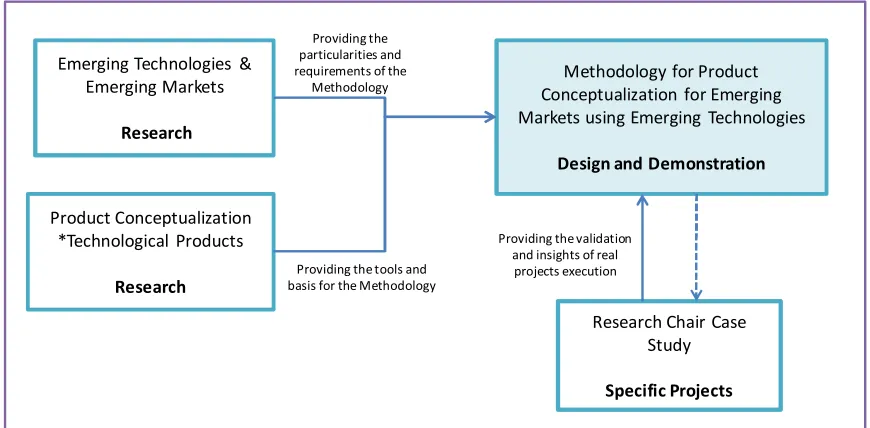
The research methodology includes three different pathways referring to the 3 different sources of information and analysis that will help develop the project and that will converge in a point in which both of them contribute in the work proposed (See Figure 1).
1. Literature Review of the two focuses of the methodology: Review of the literature that provides insightful information about the features, categorization, and concepts of Emerging Technologies and Emerging Markets.
Figure 1. Research Pathway Overview
3. Experiences from study cases: Some projects are being developed by the research chair team at Tecnológico de Monterrey that will be used as demonstrators of all the concepts presented in this research. The conceptual development of the methodology will be carried at the same time while two projects are being developed. In Chapter 3 one of those study cases will be presented.
These information sources complement each other, and the information obtained from them, will converge on a novel solution for the problem presented in Chapter 1.
2.4. Overall Research Steps
In this section the author presents the research steps to be followed in the consecution of the objectives of this thesis. An overall perspective will be presented including the integration of all the steps and those that deserve more attention will be explained in a more detailed way.
In order to develop the research proposed before, and in order to achieve the objectives stated in the first chapter, the author will follow a research methodology that is consistent
Emerging Technologies & Emerging Markets
Research
Product Conceptualization *Technological Products
Research
Research Chair Case Study
Specific Projects Methodology for Product Conceptualization for Emerging Markets using Emerging Technologies
Design and Demonstration
Providing the tools and basis for the Methodology
Providing the validation and insights of real
projects execution Providing the
particularities and requirements of the
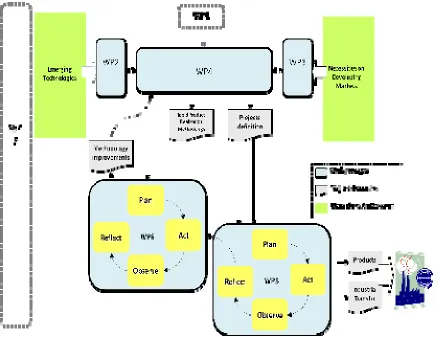
with the work plan stated for the research chair mentioned above. In Figure 2 is presented the working plan of the research chair, work packages and deliverables of each one of them are depicted. Discontinuous lines are used to identify those working packages that were not used for the development of this thesis.
Figure 2. Consistency between the research chair´s work plan and this research
• WP1: Preparation of detailed working plans.
• WP2: State of the art review on Emerging Technologies.
• WP3: State of the art review on Emerging Markets.
• WP4: Methodology generation.
• WP6: Methodology improvements (using Action Research)
• WP7: Project Management
For the purpose of this research, WP2 and WP3 leveraged the knowledge to support the identification of the objectives and distinctive of the methodology that the author is looking for.
As part of the research developed in WP4, the review of product design processes (including the stage of product conceptualization) was reviewed.
WP5 and WP6 allowed the enhancing of the methodology by means of its execution, observation of its effectiveness and hence, the enhancement of the methodology.
The study case and the enhancement of the methodology followed an Action Research approach, AR is defined as a spiral process that allows action (change, improvement) and research (understanding and knowledge) to be achieved at the same time (Barskervillea and Pries-Hejeb, 1999). The methodology Action Research includes four stages: Plan, Act, Observe and Reflect that, in our case, will support the execution of the case study for a product conceptualization in WP5 and the robustness of the methodology in WP6.
2.4.1. Work flow perspective
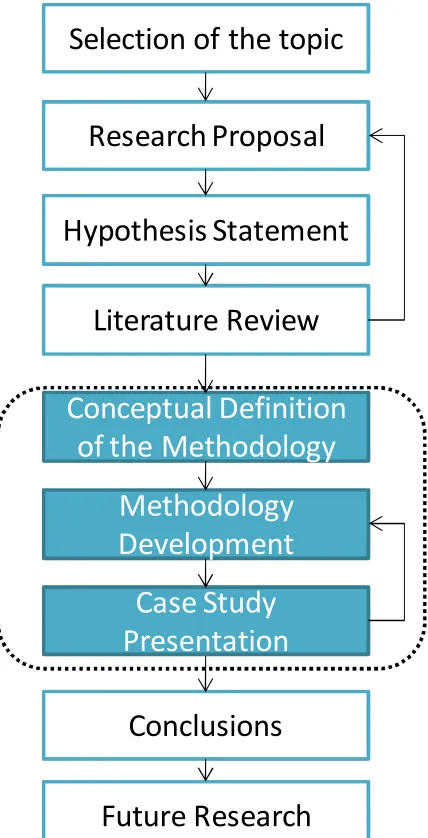
Figure 3. Overall Research Process
1. Research Proposal: Once defined in previous step the topic of interest, the author looked up for the best way to design such methodology. It could happen only after a complete understanding of the characteristics and particularities of the Emerging Markets and the Emerging Technologies, as well as the newer trends for the commercialization of technology-based products. A tentative topic was narrowed in order to create a particular methodology for the conceptualization of technology-based products to cover necessities of emerging markets, particularly in México.
Research
Proposal
Literature
Review
Selection
of
the
topic
Hypothesis
Statement
Conceptual
Definition
of
the
Methodology
Methodology
Development
Case
Study
Presentation
2. Hypothesis Statement: After a first approach to the problem, the author attained the conclusion that the selected topic was worthy to be investigated, and it was also identified the Jolly’s model as a strong starting point to develop a methodology to accomplish the objectives of this thesis.
3. Literature Review: The main concepts surrounding the research topic selected are studied and understood in Chapter 3. The main objective of the literature review is to answer the research questions formulated in Chapter 1. The definition of Emerging Markets, their characteristics and challenges are presented and the depiction of México as one of those Emerging Markets is also done. Emerging Technologies definition, their characteristics, and the existing challenges for its commercialization is also introduced. The Product Development phases are investigated to identify the importance of a good Product Conceptualization, and some best practices employed for product conceptualization are listed. Finally, the literature review allowed the author to familiarize with the Jolly´s model for Technology Commercialization.
The knowledge and understanding generated in the literature review, allowed the enhancement of the research proposal.
4. Conceptual Definition of the Methodology (Generalities of the Methodology): A definition of the methodology is presented in the first sections of chapter 4, where the main bases of the methodology are referred to. In order to include all the significant aspects to the design of the methodology and trying to take into account all the restrictions and challenges presented by the two main elements that constitutes the focus of this research (Emerging Markets and Emerging Technologies), the models and techniques presented in the literature review are analyzed in Chapter 4, and the characteristics of them are also contrasted with the necessities of the two elements mentioned.
markets. It is presented a depiction of the methodology steps in a global way and each of its elements is explained. For the completion of this methodology some supporting techniques are proposed and explained.
6. Case Study Presentation: This research was developed in a parallel way with the development of one case study. This case study nourished the methodology by providing it with empirical experience, and it also allowed the author to validate it in a real scenario.
7. Conclusions: This methodology integrates a very important and validated model (from Jolly) to the particularities of Emerging Technologies for Emerging Markets, thus naturally it gives plenty of conclusions and insightful comments to be taken into account.
CHAPTER 3. LITERATURE REVIEW
3.1. Introduction
The theoretical foundations shown in this chapter will serve as a conceptual basis for the development of a methodology that allows the ideation of technology-based products focused on the satisfaction of necessities of specific emerging markets, in a systematic and structured way. The market focus of those technology-based products will be attained by identifying and analyzing the particular opportunities, trends and constraints of product commercializing at emerging and developing markets. Further, the methodology presented will be based on emerging technologies.
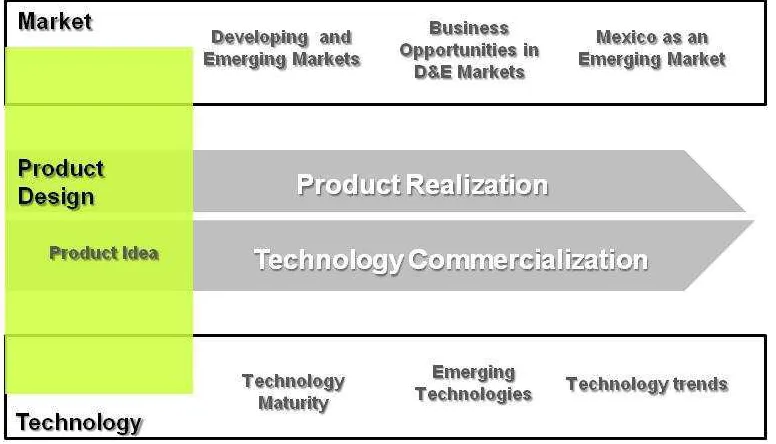
[image:30.612.116.504.455.677.2]This literature review provides an introduction to the generalities of Emerging and Developing Markets and Emerging Technologies, as the center of attention of the methodology presented. The second part of this chapter will consist on the revision of product development literature, in order to identify processes employed to conceptualize or ideate products. This chapter will be structured as is shown in the Figure 4.
3.2. Developing and Emerging Markets
The financial industry makes a distinction between three main categories of international markets according to their maturity and level of risk. Investors differentiate between developed markets, developing markets and emerging markets, and normally this classification is tagged to entire countries or economies.
A developing market economy is defined as an economy with low-to-middle per capita income (a GDP of less than USD $10 000), and typically are in course of industrializing. According to Prahalad, (2004), such countries constitute approximately the 86% of the global population, representing about 14% of the world’s economies. Some times the term is confused with emerging markets, but this is not correct, since emerging markets are those countries that are in the translation between developing and developed markets.
Developed markets are those mature markets that have reached a state of equilibrium that is manifested by the absence of significant growth or innovation. Developed markets include big economies such as U. S., Japan, Western Europe, Canada, New Zealand and Australia. Those markets are large in market value and in volume of trading. The urbanized infrastructure, as well as the deep-rooted financial services companies in these countries facilitates the selling-buying processes, that makes developed markets more liquid because the system is more efficient and there is acquisitive power enough to allow it.
Other advantageous characteristics of those markets are the transparency of the trading as well as the security of investing due to the political and social regulations. Nevertheless, mature markets present challenges for product/services providers, due to the huge quantity of competitors within.
an increasing role in the world economy and on political platforms, as a result of the involvement of the private sector on their development.
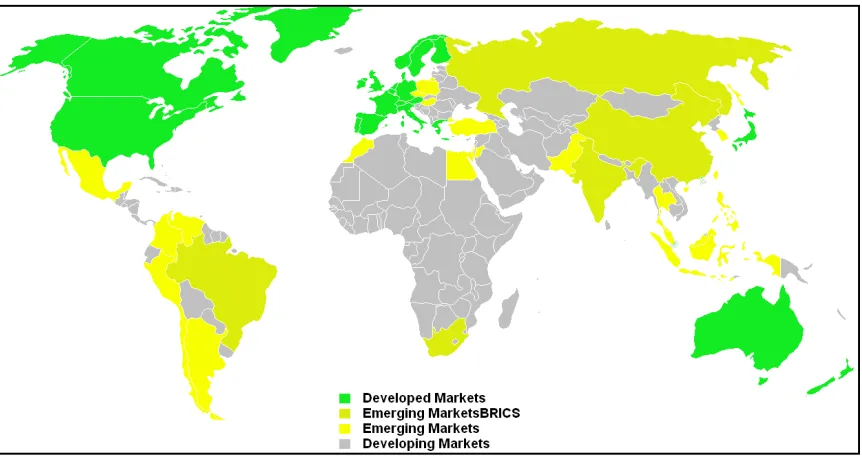
[image:32.612.92.523.203.431.2]According to the World Bank (2002), the five biggest emerging markets are Brazil, Russia, India, China and South Africa, this group is known as BRICS. In Figure 5 the depiction of the emerging markets, developed markets and developing markets is offered.
Figure 5. Developed Emerging and Developing Markets in the World
(From O’Neill, et al. 2005)
According to their demographic profiles, there are other countries that might have BRICs like potential: the Next Eleven (N-11), though whether they will emerge is still an open question for many. This group includes Bangladesh, Egypt, Indonesia, Iran, Korea, Mexico, Nigeria, Pakistan, Philippines, Turkey and Vietnam (O’Neill, et al. 2005). Other authors include in this description countries like Argentina, Poland and South Korea.
economy. For this reason, the importance of “regionalizing” the markets in this research is high.
3.2.1. Characteristics of Developing and Emerging Markets
Besides the economical characteristics previously explained of developing and emerging markets, Rusell (1998) makes the following classification of those markets characteristics:
Physical characteristics
Emerging and developing markets lack of an infrastructure capable of supporting increased commercial activity. Insufficient capital is the most often problem, although in countries where funding for capital is more available, the problem consist on the lack of technical know-how necessary for the efficient implementation of the infrastructure. Inadequate infrastructure makes market entry more difficult. Physical facilities important for marketing purposes are:
• Communication: practically all emerging markets lack a communication system to support adequately commercial activities.
• Transportation: typically, air transportation is controlled by the government, roads are unsurfaced, and sometimes there is an inadequate network of road and rail transportation.
• Power Generation: many emerging and developing markets lack enough
power-generation facilities to sustain a minimum level of commercial development.
Socio-political characteristics
3.2.2. Business Opportunities in Developing and Emerging Markets
Opportunities presented by emerging and developing markets can present advantages for large firms, not only by expanding their market but also due to the benefits gained from operating these markets that can also have significant influence on the management practices of the global firms. In the literature, there are many study cases of successful business developed on emerging markets, especially in India (Prahalad, 2004). Some of the practices developed by these pioneers have been copied or have been taken advantage by people in developed markets.
In the new global economy, the tendency suggests that the competitive advantage will be for those companies capable to develop products rapidly with a focus on the client. The economical success of organizations depends on their ability to identify the necessities of the market and the development of products which satisfy those necessities with a low cost and in the lowest time.
Emerging economies contain varieties of segments, all of which are moving rapidly upward. There is no a global-massive market opportunity, there are diverse segments such as the rich and super-rich, the middle class, the poor and the rural. All these segments share a common environment and characteristics, which represent challenges for companies entering to them, but also represent opportunities for companies with the right solutions for their necessities and cultural, social and political characteristics (Mahajan et Banga, 2006).
Because the developing economies force an extraordinary emphasis on price performance, firms must focus on all elements of cost. The efficiency in the capital use is a must that firms must focus on. Sustainability in packaging is another source of knowledge that developed markets can get form experiences in emerging markets, as well as the innovation that must become “value oriented” from the customer’s perspective.
Emerging markets are experiencing an accelerated growth not only in population but also in income, this combination historically translates into tremendous consumer demand for all kinds of products and services, and this is making them fertile soil for companies selling products and services. Together with the consuming power, emerging markets offer a better opportunity for rapid market expansion and less intense competitive environment. Two relevant examples are the countries with the highest populations in the world: China and India.
Furthermore, many companies from mature economies, such as U.S. companies are expanding their business operations into emerging markets (e.g. Unilever in India, Wal-Mart in Mexico, Sony in Brazil, etc.). This type of international investment can further accelerate the development and growth of the domestic economies, as experienced companies bring money and modernized business practices to emerging markets.
3.2.3. Mexico as an emerging market
Mexico has a free market economy, and according to the World Bank (2002) in its list of economies, Mexico is one of the less indebted countries with an upper middle income (this is between $2,976 and $9,205 USD). Mexican economy has gone through a significant transformation in the last twenty years, after the 1994 economic debacle, due to deregulation, a more open economy, reduced inflation, and strengthened public finances; as a result, vulnerability to crisis has been greatly reduced (Randal, 2006).
income, and nowadays it is being a national debate about opening the energetic sector in the country, with purpose of improving the services and infrastructure of the oil industry in Mexico by increasing the competition.
The poverty in Mexico has decreased considerably, according to the director from Mexico at the World Bank, from 24.2% in the general population in 2000 to 17.6% in 2004 (El Universal, 2005), nevertheless as in other emerging or developing markets, inequality is still a problem. It is contradictory the fact that the richest person of the world, Carlos Slim, is Mexican, while a 17.6% of Mexican people live in poverty. Huge gaps remain not only between rich and poor but also between the north and the south, and between urban and rural areas. These gaps refer not only to income, but also to human development and quality of life.
However, the poverty reduction and the increase in purchasing power of the middle class are attributed to the last two administrations. The GDP (Gross Domestic Product) annual average growth for the period of 2007 was 4.6% (CIA, 2007).
Since the middle of the 80´s, the country adopted a neoliberal economic model with an emphasis on commercial openness to other countries. Mexico´s principal commercial association is the TLCAN (Tratado de Libre Comercio de América del Norte) or NAFTA (North American Free Trade Agreement), and almost the 85% of Mexican trade goes to North America (United States and Canada). Other major trade agreements have been signed with the European Union, Japan, Israel and many countries in Latin America.
The closed trade-relation with United States represents a benefit, but also an economical concern because of the Mexican dependence on that country. For instance, in the last year the economic recession in the United States also caused a similar pattern in Mexico.
In Mexico the first source of income is the petroleum exportation, followed by the shipment of remittances from the United States, and the tourism is the third one.
estimated that for 2025, Mexico will be the eleventh biggest economy of the world, and for 2050 the sixth one, only preceded by China, US, India, Japan and Brazil (Figure 6).
Figure 6. The Largest Economies for 2050 (O´Neil, et al. 2005)
In terms of income per capita, the forecast is somewhat different. By 2050, Mexico converge to develop country income levels at roughly US$ 55,000, occupying the tenth place following US, Korea, Japan, France, UK, Germany, Canada, Italy and Russia (Figure 7).
Figure 7. Income Per Capita for 2050 (O´Neil, et al. 2005) 0
10000 20000 30000 40000 50000 60000
US
$b
n
The
Largest
Economies
for
2050
0 25000 50000 75000 100000
US
$
[image:37.612.92.523.473.688.2]Physical characteristics of Mexico
Concerning energy, in Mexico it is managed by state-owned companies, CFE (Comisión Federal de Electricidad) which is in charge of the operation of electricity-generating plants and its distribution within the country (except for the central states of the country that are supplied by Luz y Fuerza del Centro); and Pemex (Petróleos Mexicanos) which is in charge of the exploitation, extraction, transportation and marketing of crude petroleum and natural gas, as well as the refining and distribution of oil products and petrochemicals.
Regarding Transportation, according to the National Economies Encyclopedia (2007), the highway network in Mexico is the most extensive in Latin America: 235,670 km paved: 116,751 km (includes 6,144 km of expressways) unpaved: 118,919 km in 2004 (CIA, 2007). The railway is still inefficient to meet economic demands of transportation: 17,665 km standard gauge: 17,665 km 1.435-m gauge at 2006 (CIA, 2007). Most of the rail network is mainly used for merchandise or industrial shipments and was mostly operated by FNM (Ferrocarriles Nacionales de Mexico) that was privatized in 1997. At 2007, Mexico had 1,603 airports over 3,047 m: 1 1,524 to 2,437 m: 63 914 to 1,523 m: 408 under 914 m: 1,131 (CIA, 2007). The Mexico City International Airport remains the largest in Latin America and the 44th largest in the world. There are more than 70 domestic airline companies of which only two are known internationally: Aeromexico and Mexicana.
Socio-Political characteristics of Mexico
Mexico is one of the most populated countries in the world, with a total population of 103.3 million people, occupying the eleventh place (INEGI, 2005). As many of the emerging countries are predominantly young, the middle age in Mexico at 2005 was 24 years old. The 31.5% of the population is from 0 to 14 years old, this is almost 34 million of people, 62.19 millions are between 15 and 60 years old and only 8.57 millions are older than 60 years old (INEGI, 2005).
In terms of education, Mexico has made great strides in improving access to education and literacy over the past decades, the illiteracy rate has diminished from 9.5 in 2000 to 8.4 in 2005 (INEGI, 2005).
About the political life, since 2000, Mexico has been experiencing a transformation on their political structure with the election of Vicente Fox the candidate of PAN (Partido Acción Nacional), followed in 2006 by President Felipe Calderon from the same party. The last administration has faced resistance from the left-of-center “Partido de la Revolución Democrática” (PRD) not only at the election process but also in each purpose of reform launched by the President.
Mexico is facing a frontal fight with the insecurity; President Calderon has made public security a focus of his presidency and has launched aggressive operations against organized crime and drug traffickers, and has also been willing to deploy the Mexican Army in the states where the cartels are dominant. The current administration is working on creating a favorable business environment for investing in the country, according to President Calderon´s self words.
3.3. Technology
So technology is the knowledge of a functional technique (Betz, 1998), it is the know how, a multifaceted capability.
The definition given by the Britannic Encyclopedia (2008) can be summarized as: “The application of scientific knowledge to the practical aims of human life”; which is consistent with the definition given by Betz (1998): “Technology is the knowledge of the manipulation of nature for human purposes”.
In contrast, science is concerned with the physical world and its phenomena, it involves a pursuit of knowledge (Britannic Encyclopedia, 2008), the know why; and products are a singular application of technology.
For the purpose of this research, a technology will be understood as the set of knowledge, techniques and processes that can be applied for the design and
construction of products or services to satisfy human needs.
3.3.1. Technology Maturity
Technology emerges from the knowledge generated by science and engineering, it grows from initial development of research and development and continues to develop until it reaches the physical limit. The pattern of technology performance over time is usually similar for most technologies: it has an initial exponential growth in progress, followed by a linear growth in progress and finally, asymptotically leveling off to little or no progress. The form of this plot looks like an S, hence its name “technology S-curve” (Betz, 1998).
Figure 8 Technology S-curve (Adapted from Betz, 1998)
It is important to understand the pattern of technology development, since for the proposal presented in this thesis, technologies suitable to be commercialized in the form of products and/or services in Developing or Emerging markets are those that are in their maturity or saturation stage. In the next section it will be defined the term Emerging Technology as used in this document in order to best understand the terminology employed.
3.3.2. Emerging Technologies
There is no standard definition of an emerging technology. Emerging technologies are often taken to mean science-base innovations that are at the forefront of technological innovations and research. For the scientific community, emerging technologies are those technologies rising from research and development, such as Nanotechnology, Biotechnology, Information Technology, Cognitive Science, Robotics, Artificial Intelligence, etc. (Roco and Bainbridg 2002).
Embryonic
Growth
Maturity
Obsolescence
Time
Te
chno
lo
g
y
Pe
rf
o
rm
a
nc
Day et al (2000) include in the classification of emerging technologies those derived from radical innovations (for example, biotherapeutics, portable computers, etc) but also more evolutionary technologies formed by the convergence of previously separate research branches (for example, faxing, Internet, etc).
According to Vine (2000), emerging technologies are those that have not been commercialized but are liable to be commercialized within a medium period of time, or those technologies that are commercialized but they are not common yet or have not reached high levels of penetration to the market. In this connotation, developments in energy field, computer hardware and software, biological imaging, between others can be considered as emerging technologies also.
Compared to established technologies, emerging technologies (as well as their scientific basis and applications) are uncertain as they are evolving, and their functions or benefits have not been fully experienced. Their potential is mostly unfulfilled as evidence by a lack of significant products or services, and possibly by the lack of market demand or need.
It is important to highlight that for the purpose of this research the definition most suitable is the given by Vine (2000): “those technologies that are commercialized but they are not common yet or have not reached high levels of penetration to the market”. In this connotation, the emergency or newness of a technology will depend upon the market were it is intended to enter.
For the case of this research, we are going to consider “emerging technologies” the all spectrum of technological advances that are new to each emerging market analyzed by the methodology.
3.3.3. Challenges related with Emerging Technologies
Established Emerging
Technology
•
Science basis and applications•
Architecture or standards•
Functions or benefitsEstablished Evolutionary Evolutionary Uncertain Emergent Unknown Infrastructure
•
Value network of suppliers, channels•
Regulation/standards Established Established Formative Emergent Market/Customers•
Usage patterns/behavior•
Market knowledgeWell-defined Thorough Formative Speculative Industry
•
Structure•
Rivals•
Rules of the gameEstablished Well-known Known Embryonic New players Emergent
Table 1. Contrasting Emerging and Established Technologies (Day et al, 2000)
While established technologies benefit from technology, infrastructure, customers, and industry reasonably well defined, emerging technologies has to deal with imperative necessities such as lack of specialized skills, uncertain knowledge about potential functions or benefits, shortage of infrastructure, deficiencies on knowledge of potential customers as well as market´s unawareness in relation to the subject.
The biggest challenges to be faced by emerging technologies industry has to do with: the accelerating technology innovation, a great uncertainty and complexity, and also the need of developing new competencies (Day et al, 2000). The challenge is not only about identifying these technologies and their applications, but also is highly correlated with the prejudices and limitations of enterprises; thought pattern is a kind of “cognitive risk” and a kind of “cultural risk”.
They have a big potential to create new industries or transform existing ones. According to Day et al (2000), each of these technologies offers a rich source of market opportunities that provides the incentive for risk investments.
The use of emerging technologies for the design of products demands new skills, new ways of thinking and innovative managerial approach to cope an eventually prevail. Creative ideas breed new ideas, and through time and technological growth, the innovative cycle and changes are accelerated (Myers, 2006).
3.4. Technology Monitoring
As proposed in the literature review structure, it is important for this research the definition and identification of techniques and methods for the monitoring of technology trends. Since the departure point of the methodology to be proposed in this thesis is not the development but the identification and utilization of emerging technologies (for specific markets) in the form of products, it is important to include some techniques to screen the technological environment in order to decide which technologies could have a better impact on specific emerging markets. In the next paragraphs some tools in the literature for this purpose will be presented.
3.4.1. Technology Intelligence
The technology intelligence consists on the technology-related information that is useful and utilized by product developers. An important issue to address is how to get and use the information outside to decide which technology is ready and convenient for product-development, and which industry to enter first with a new technology.
3.4.2. Technology Mapping
Mapping technology environment refers to the process of gathering external data and analyzing it to derive intelligence for major strategic decisions. Conceptually, the process consist of three interlinked steps: scanning the environment to detect ongoing and emerging change and monitoring specific environmental trends and patterns to determine their evolution; forecasting the future direction of environmental changes; and assessing the current and future environmental changes for their strategy and organizational implications (Phillips, 2001).
a) Technology scanning and monitoring.
Developers must frequently scan the environment in order to identify indicators or precursors of current and/or potential change and issues in the technological environment. Technology scanning is focused on the inspection for applicable technologies, screening them for cost- effectiveness, competitive advantage and technological maturity. Phillips (2001) proposes some sources of technologies according to the stage of development (Table 2):
Stage of development Sources
Scientific Research Internet, Universities, and Scientific
conferences and journals.
Technology Development University-Industry workshops, Patent
searches, engineering conferences and Technology Transfer organizations.
Product Development Competitive Intelligence methods and
societies, and Incubator associations.
Table 2. Technology Scanning (Phillips, 2001)
b) Technology Forecasting
According to Phillips (2001), technology forecasting describes and identifies the rate, direction and implications of change, with the objectives of anticipating change by means of a definition and communication of technical realities and environment that will allow the anticipation and distinguish between possible, probable and preferable futures. Technology forecasting looks at the timing, function and cost of new technology.
Technology forecasting exercises should have a clearly stated objective, schedule, scope and methodological approach. There are some useful tools to forecast technology (Vaston; cited on Phillips, 2001):
•
Surveillance,
that
includes scanning the environment, monitoring and trackingdevelopments, in order to examine existing technologies and their modifications, as well as look for new technologies entering the market.
•
Projective,
that includes tools as trend extrapolation, substitution analysis, andexamination of historical precursors of a current trend. Projective tools are based on the theory that the future will be very much like the past.
•
Normative,
are tools that ask users to set goals for the future and to design aplan to meet them. These tools include focus groups, morphological analysis and interviews.
•
Expert opinion,
single individuals, surveys or group formats that draw on theintuition and beliefs of leaders in the field.
•
Integrative,
this tool is a combination of the other four tools, attempting tocollapse all the information into a coherent planning process, for example the scenario planning.
advances and focuses. The information provided in this literature research will give entrepreneurs gears for deciding which information is more reliable according to their expectations.
3.5. Product Realization
Product realization is the transformation of a market opportunity and a set of assumptions about product technology into product availability for sale (Lopez, 2007), it comprises since the design, development, manufacture and delivering of finished goods of services to a costumer.
The product realization is an ancient activity. Since the prehistoric age men and women had to imagine, design and build artifacts to help them in the daily satisfaction of their necessities. Those artifacts were evolving into more specialized and hence, complex instruments. As population was growing up, societies were developing and more products were bringing out, not only to satisfy the necessities of a person, but of a group of persons.
Having well done products ready for everyone was gaining importance in societies, first obtained from artisanal works, and later from methods of serial production. Machines were designed also to produce them, and a single person could not manage a complete project because he could not have the knowledge, training and time enough to make it.
As the complexity of design and development of products was increasing, groups of specialized people were appearing on areas as Marketing, Design, Manufacturing, Management, Research and Development. This evolution brought whit it the loss of communication and interaction between people involved in the design, manufacturing and marketing processes, as well as between researchers and practitioners.
elements of the life cycle of products since its concept to it decommission; these disciplines are strongly related or were conceived for the global process or set of activities required for the realization of new products.
Product design is one of the most crucial parts of the product realization, since in this stage the minimum part of total costs of product realization is incurred, and in is the most impacting stage of the product life cycle because improvements in this stage impact strongly on latter stages of manufacturing and selling.
3.5.1. Product Design
The success of a new product launch into the marketplace is determined not only by the technical characteristics of the product but also by a set of strategic factors that will help ensure its market success. Involving customers in the innovation process or the product design and development process can perhaps be the easiest way of increasing quality, decreasing cost, and speeding the product development time.
Although it can not be considered in detail all the activities required to be performed during the process of product development, some methodologies have demonstrated an improving of time, quality and cost in all different disciplines. The common stages of product design processes are going to be explained in the next section.
3.5.2. Product Design Process