A CONTEXTUAL ONTOLOGY TO PROVIDE
LOCATION-AWARE SERVICES AND INTERFACES IN SMART
ENVIRONMENTS
Miriam Machuca, Miguel A. López, Iván Marsá Maestre and Juan R. Velasco
Departamento de Automática, Universidad de AlcaláEdificio Politécnico – Crtra. N-II Km. 31,600 – 28871 Alcalá de Henares {miriam|ivmarsa|miguellop|juanra}@aut.uah.es
ABSTRACT
Context-aware computing is about gathering user information and their environment such as user location and preferences, service status, and nearby devices. Such context information is used to adjust enviroment settings to suit user needs and preferences. As environments can change rapidly, applications must be aware of it and adapt their behaviour in real time. We describe an application that introduces intelligent agents in smart homes to provide location-aware services and interfaces. This application must keep an eye on some context information to carry out user preferences. Our approach is based on a contextual ontology that is a key component to enable context sharing and representation.
KEYWORDS
Ontology, pervasive computing, context-aware application, smart home, intelligent agent.
1.
INTRODUCTION
Context-aware applications are applied in spaces where humans spend the majority of their time like homes, workplaces, leisure time places and vehicles. Usually these types of applications release the user from doing different tasks, and try to make those places more comfortable according to the user desires or habits.
It is important to know what Context is; the definition which best matches our view is presented in [Chen & Kotz 2001]: Context is the set of environmental states and settings that either determines an application’s behaviour or in which an application event occurs and is interesting to the user. Different types of context information have been used [Chen & Kotz 2001] such as location, time, nearby objects, network bandwith, orientation and context changes. An application is usually able to manage its context that could be different from other application contexts. Then it could be interesting to rely on the same context representation in order to enable interaction between different applications in the same domain like a smart home.
Existing systems cover different domains such as tourist guides [Cheverst et al 2000], indoor information systems [Conner et al 2001], and smart environments, e.g. The Essex intelligent dormitory, iDorm [Hagras et al 2004]. These systems gather contextual information through sensors placed in the environment, the information is reasoned, and actions to automate features of the environment are taken. Thereby it is necessary an efficient context management and there are two ways to allow it: context models and contextual ontologies. Context models provide access to contextual information similar to a dabatase, whereas contextual ontologies represent knowledge about context.
In previous work we find contextual ontologies like CONON [Wang et al 2004] and CoBrA ontology [Chen et al 2003]. Both are very useful and complete contributions, however to develop our system we need the specific representation of knowledge related to the services we offer, and the required aspects to share knowledge among software agents.
The work we propose here outlines a contextual ontology for smart environments, and demonstrates the effectiveness of such approach by using it in the implementation of some sample domotic services. In particular, we have turned our handheld device into a universal remote control, capable of adapting itself to the location where the user is, providing the corresponding interfaces for the services available at that location. We have implemented a multimedia service which allows contents requested by users to follow their movements throughout the house in real time, so that there is no loss of information for them. Software agents provide the necessary technology to achieve the required degree of distribution, autonomy and intelligence and gather contextual information like user location, status services and user identity. In addition the contextual ontology represents such context, and gives meaning to the contents of messages sent among agents, thus enabling knowledge sharing. This ontology reuses some existing ontologies and provides new objects required in service and location management.
The paper is structured as follows. In section 2 we review the most important aspects about our previous work. In section 3 we introduce ontology definitions and describe our contextual ontology (iHAP Ontology). Section 4 summarizes our main contributions and sheds light on some future research.
2.
PREVIOUS WORK
Our domotic system is based on agent technology as it requires analyzing data from several different sources distributed throughout the entire house to make a decision. These considerations lead to requirements of distributed data mining, autonomy and intelligence that suggest the use of software agents.
There are different definitions for software agents. From the viewpoint of design and technology, we can define a software agent as a self-contained program capable of controlling its own decision making and acting, based on its perception of its environment, in pursuit of one or more objectives [Jennings & Wooldridge 1996]. This definition suggests clearly how this technology can serve the problem of intelligent automation of the environment.
2.1 An Intelligent Home Agent Platform
The iHAP (intelligent Home Agent Platform) system is a multiagent platform specially designed for domotic environments developed over the open-source agent platform JADE (Java Agent DEvelopment framework). Using an already established agent platform releases us from the low-level tasks about agent life-cycle and message interchange. Furthermore, JADE complies with the specifications of FIPA (Foundation for Intelligent Physical Agents), which guarantees a certain degree of interoperability with other agent-based systems.
For the first implementation of the iHAP system [Velasco et al 2005] we have considered two smart home services: multiroom audio/video distribution and location-aware user interfaces. With multiroom audio/video systems users can retrieve multimedia contents from any location in the smart home by accessing a centralised content repository. These systems increase access to entertainment contents, but not necessarily its ease of use for the end users. Furthermore nowadays the number of devices in the home is increasing and usually implies an equal increase in the number of interfaces the user must learn to use. The services we have implemented over the iHAP make these tasks easier for the users in two senses. On one hand, providing generic interface devices which adapt to the services available in a particular location, on the other, allowing multimedia content to follow the user if he decides to go to another room.
Our system detects and locates the user through a system based on Bluetooth technology [Marsá et al 2005]. We have chosen Bluetooth due to its ubiquity: we can find a great variety of Bluetooth-capable mobile devices, such as mobile phones and PDAs. We track the Bluetooth personal devices carried by users and obtain the unique MAC addresses of the mobile devices to identify each user.
3.
THE IHAP ONTOLOGY
The iHAP Ontology has been made from reusing some FIPA ontologies and defines new terms to build a vocabulary that represents knowledge in smart environments. It also defines relationships between terms, and attributes of them. Our ontology is intended to work not only in smart homes but also in other smart environments such as vehicles, public buildings, workplaces and cities. As the iHAP system is based on JADE agents in compliance with the FIPA, we have adapted our ontology to that environment. In [Caire 2002] the terms of ontologies for JADE agents are classified and in the current version of the iHAP Ontology we have used the following types: Predicates, Concepts and Agent Actions. We have chosen UML class diagrams [Fowler 1997] to represent our ontology. Due to lack of space we are representing those elements more relevant:
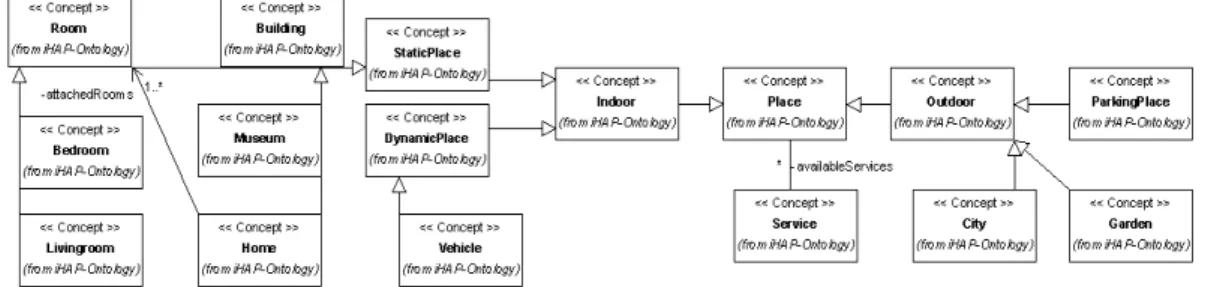
− Spatial description. We define the general concept place (see Figure 1) as a physical location that could be turned into a smart place. We have defined dynamic or staticindoor places to refer to new smart environments where we will extend our system in future implementations, like universities or workplaces. It is also defined the concept of room as our system needs to find out where inhabitants are in order to adapt the environment. A place contains instances of services available to users so as to modify their settings when it was required.
Figure 1. iHAP Ontology: Spatial description
− Actor description. An actor (see Figure 2) uses the system in some way; the concepts software agent and person extend an actor. In a smart environment there could be different profiles of users and of agents. For example, interface agents interact with users and location agents are in charge of locating users. A particular agent in the system may belong to more than one of these types. An
agent contains an agent identifier and an agent platform description, both provided by FIPA Agent Management Ontology [FIPA 2004]. There are context rules associated to people, for example underage can not watch some kind of films and requests from a person can have a higher priority than others. In addition a list of security parameters are required to access the system and to provide contents to users. When a user asks for a service, the status of this service is linked to this user besides its location to manage user preferences. Finally the user profile is stored in a class provided by the FIPA Audio/Visual Entertainment and Broadcasting Ontology [FIPA 2001].
− Context features description. We have defined in our ontology some parameters we can estimate from the environment like temperature, sonority, humidity and brightness. Those parameters are features of the environment which surrounds the users, and they are used by agents to make decisions, adapt their behaviour and consequently modify that environment to suit user preferences. − Service description. In smart environments there could be different types of services to be
automated; in Figure 3 we can see some of them. In the current version of the iHAP system we are focusing in multimedia services so they have been implemented. The concept service is described by a concept of the FIPA Agent Management Ontology. Concrete services like audio, video and
television extend multimedia services. All of them have an attribute taken from the FIPA Audio/Visual Entertainment and Broadcasting Ontology, which define additional features of the services. These elements may contain the quality of service related to FIPA Quality of Service Ontology [FIPA 2002].
Figure 3. iHAP Ontology: Service description
− Device and interface description. In the iHAP Ontology we have defined a general type of device
that is a generalization of the concept Device from the FIPA Device Ontology [FIPA 2002], and more specific devices like actuators, sensors and personal devices. However some devices may work as a combination of these types. There could be associations between software agents and the devices that contain these agents. As far as interfaces are concerned, users can access to the system through them, and we can find mainly two types of them; those which are device dependent and those which are not, like web interfaces.
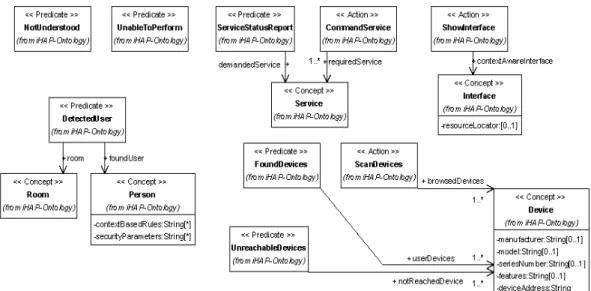
− Agent actions and predicates. In Figure 4 there are represented agent actions and predicates currently used in the iHAP system. Some of them have attributes and others are empty, it depends on the additional information shared by agents.
4.
CONCLUSION
The contextual ontology for smart environments proposed in this paper supports the iHAP multiagent system to represent context and share knowledge among agents. That is, agents use the iHAP Ontology to interoperate and work together to provide the mentioned location-aware services to the inhabitants of the smart home. There are no existing ontologies that provide the wide set of terms we need and that emphasize the required aspects for JADE software agents, so we had to create our own.
Currently we are working in new services for smart homes, and we will also extend our system to other environments like a city where available services are different, but the architecture essentially would be the same we have developed. Those changes will affect our ontology so it will be modified and extended.
By now the multiagent system behaviour is mainly reactive, and we plan on adding more intelligence to it incorporating reasoning capabilities using context information. This information will be not only location and status services but other context features like lighting, movement or temperature. Finally we intend the system to learn from user behaviour and habits, so that the system really adapts the environment to users.
ACKNOWLEDGEMENT
This work has been supported by the Ministerio de Ciencia y Tecnología grant MCYT-TIC2003-09192-C11-05, by the Universidad de Alcalá grant UAH-PI-2003/001 and by the Ministerio de Industria, Turismo y Comercio PROFIT FIT-330201-2004-0018.
REFERENCES
Caire, G. 2002, Jade tutorial. Application-defined content languages and ontologies, Technical report, TILAB.
Chandrasekaran, B., Josephson, J.R. & Benjamins, V.R. 1999, "What are ontologies, and why do we need them?", IEEE Intelligent Systems, pp. 20-26.
Chen, H., Finin, T. & Anupam, J. 2003, "An ontology for context-aware pervasive computing environments", Proc. IJCAI Workshop on Ontologies and Distributed Systems.
Chen, G. & Kotz, D. 2001, "A survey of context-aware mobile computing research", tech. report TR2000-381, Dept. of computer Science, Dartmouth College.
Cheverst, K., Davies, N., Mitchell, K., Friday, A. & Efstratiou, C. 2000, "Developing a context-aware electronic tourist guide: some issues and experiences", Proc. of CHI. Netherlands.
Conner, W.S., Krishnamurthy, L. & Want, R. 2001, "Making everyday life easier using dense sensor networks", Proc. of UBICOMP. Atlanta, USA.
FIPA. 2004, FIPA Agent Management Specification, Document SC00023K.
FIPA. 2001, FIPA Audio/Visual Entertainment and Broadcasting Specification, Document XC00081B. FIPA. 2002, FIPA Device Ontology Specification, Document SC00091E.
FIPA. 2002, FIPA Quality of Service Ontology Specification, Document SC00094A.
Fowler, M. 1997, UML Distilled: Applying the Standard Object Modeling Language Addison-Wesley.
Hagras, H., Callaghan, V., Colley, M. & Clarke, G. 2004, "Creating an ambient-intelligence environment using embedded agents", In IEEE Inteligent Systems, pp. pp 12-20.
Jennings, N. & Wooldridge, M. January 1996, “Software agents,” IEEE Review, pp. 17–20.
Marsá Maestre, I., Machuca, M., Navarro, A. & Velasco, J. R. 2005, “Un enfoque práctico para la localización de usuarios mediante Bluetooth en entornos domóticos”, 1st Iberoamerican Congress on Ubiquitous Computing (CICU'2005) CEUR Workshop Proceedings, online: CEUR-WS.org/Vol-132/paper13.pdf.
Velasco, J.R., Marsá Maestre, I., Navarro, A., López, M.A., Vicente, A.J., de la Hoz, Enrique, Paricio, A. & Machuca, M. 2005, "Location-aware Services and Interfaces in Smart Homes using Multiagent Systems", 2005 International Conference on Pervasive Systems and Computing.