
Dominican related dissertations in the U S : an analytical approach (1939 2009)
31
0
0
Texto completo
(2) CAMINO REAL. RESUMEN En este artículo se busca presentar una visión general de las tesis doctorales relacionadas con la temática dominicana que han sido producidas en los Estados Unidos desde el año 1939 hasta el año 2009. Se han incluido todas las tesis que se conocen que de alguna manera examinan asuntos dominicanos. Entre algunos de los factores explorados están los siguientes: 1) la evolución de la producción anual de tesis doctorales, 2) las características de los receptores de doctorado, entre los que se encuentran la raza / el origen étnico y género, 3) temas importantes, conceptos e instituciones que han dado forma a esta lista diversa, y 4) los campos de estudio más populares y las instituciones de educación superior con mayor número de estas tesis doctorales. Incluye además sumarios de las obras pioneras, tesis doctorales importantes y ensayos menos conocidos. Este artículo es un perfil cuantitativo que ofrece a los investigadores un contexto histórico al estudio de tesis doctorales de temática dominicana producidas en los Estados Unidos. Palabras clave: tesis doctorales, bibliografía dominicana, estudios dominicanos, República Dominicana, historiografía dominicana, literatura dominicana, política dominicana, cultura dominicana, movimientos sociales dominicanos. ***** 1. INTRODUCTION Although in recent decades the Dominican community represented the fastest growing Latino population in the United States, students, educators, scholars, and others in and outside the university have long complained about the difficulty of covering Dominican topics or conducting research on Dominican issues due to the lack of data even in reference sources on Latinos. Dominicans were generally not included in many major bibliographies because there was not enough available material on them. A search on the WorldCat, a union catalog, showed that while there are a number of dissertation bibliographies prepared for various Latin American and Caribbean populations, there is not a single bibliography that deals specifically with dissertations and theses on the Dominican experience. The annotated bibliography on Dominican migration to the United States that I prepared in 1999 (Aponte) was the first attempt to fill that bibliographical gap.. 22.
(3) SARAH APONTE. In January 2004, thanks to a PSC CUNY (Professional Staff Congress, The City University of New York) professional development grant, I was able to visit the Library of Congress to review a compilation made by the H. W. Wilson Co. for the Association of Research Libraries entitled Doctoral Dissertations Accepted by American Universities, a 22 volume series. An examination of the volumes covering the years from 1933 to 1954 revealed a number of interesting facts regarding Dominican related doctoral dissertations, facts which came to form the bulk of this essay. For subsequent years through 1999, I used the Index to American Doctoral Dissertations, the series’ successor published by University Microfilms. Dissertations submitted after 1999 were identified by examining the online database Dissertation Abstracts International, a ProQuest Information and Learning database that covers dissertations and theses from virtually all accredited institutions in North America and Europe that award doctoral degrees since 1861. The following analysis of doctoral dissertations is done in the hope that it may stimulate an interest in and encourage further exploration of Dominican Studies in our schools, colleges, and universities.1 By focusing attention on the earliest Dominicanrelated doctoral dissertations, their authors and the schools that granted the degrees, one can trace the beginning of Dominican Studies as an academic discipline and profession. Working scholars can refer to this analysis to survey what has already been written and avoid unnecessary duplication as well as make use of previous work in their special fields of interest. Little current analysis has been produced of Dominican-related doctoral dissertations and no comprehensive study of this subject has been undertaken before, although there have been studies covering particular topics or periods. For example, Frank Moya Pons published a series of articles called “La historia tiene otra historia” that appeared in the Dominican magazine Rumbo from 1994 to 2000. These articles were later compiled and published in a book format entitled La otra historia dominicana (2009). In these articles, Moya Pons provides valuable historical information regarding Dominican related dissertations. On several occasions, Moya Pons and I have discussed the importance of analyzing and providing abstracts for all these dissertations in a book format. 23.
(4) CAMINO REAL. While this project comes to fruition, it is worth mentioning the useful online source compiled by Emmanuel W. Vedrine and Andrés Paniagua from the University of Massachusetts, Boston, “A Bibliography of Theses and Dissertations Related to the Dominican Republic.” This online bibliography lists dissertation and theses abstracts and is arranged alphabetically by author with the capability to search by author’s last name and by year. The authors used Dissertation Abstracts International to do a statistical analysis on the subject areas of the theses and dissertations. While it is a great source, this bibliography omits several seminal works that have been published as books: the dissertation by Cuban scholar José Antonio Moreno who obtained a Ph.D. from Cornell University in 1967 and submitted his thesis, Sociological Aspects of the Dominican Revolution; Deborah Pacini Hernández who obtained her Ph.D. also from Cornell University in 1989 with Music of Marginality: Social Identity and Class in Dominican Bachata; and Dominican scholar Ramona Hernández who obtained her Ph.D. from The City University of New York in 1997 with The Mobility of Labor under Advanced Capitalism: Dominican Migration to the United States, among others. Another oversight is that the online compilation includes two dissertations that deal with the Catholic order (who is also referred to as Dominicans) and has no relation with people of Dominican descent or the Dominican Republic. These dissertations are: Catherine Mary Jones. Charles-Francois Cheve and French Christian Socialism in Mid-Nineteenth Century. Ph.D. Dissertation. Michigan State University, 1991, and Mark Jurdjevic. Citizens, Subjects, and Scholars: The Valori Family in the Florentine Renaissance, 1480-1608. Ph.D. Dissertation. Northwestern University, 2002. 2. METHODOLOGY This paper analyzes all doctoral dissertations completed at U.S. institutions from 1934 to 2009 that are known to deal in some way with Dominican themes. Therefore, this paper includes titles that are not entirely devoted to Dominicans, as in the case of comparative studies with other nationalities. Some studies have only one relevant chapter while others have numerous pertinent references scattered throughout their chapters.2 The dissertations I analyze include those completed for the following 24.
(5) SARAH APONTE. degrees: Ph.D. (Doctor of Philosophy), Ed.D. (Doctor of Education), Au.D. (Doctor of Audiology), D.M.A. (Doctor of Musical Arts), D.S.W. (Doctor of Social Welfare), D.A. (Doctor of Arts), D.Min. (Doctor of Ministry), Psy.D (Doctor of Psychology), and D.P.H. or Dr.PH (Doctor of Public Health). The article aims to provide a comprehensive review of the research that is being conducted at the graduate level on Dominican and Dominican-related issues. The intention is to contribute to the development of the production of Dominican bibliographies. In recent years, Dominican Studies has experienced a surge of interest throughout the United States. As one of only a few people of Dominican descent in the United States trained in library sciences, and who also specializes in Dominican Studies, I feel compelled to undertake this project. At the CUNY Dominican Studies Institute Library, we hold 85% of the Dominican related dissertations analyzed in this article and we are in the process of acquiring the remaining volumes. This is a central location where researchers can secure complete and accurate information on doctoral studies that relate to Dominican Studies. Students from around the world use this collection as well as a our small but growing collection of Dominican-related dissertations completed outside of the United States. After visiting and using our resources and upon completion of their doctoral studies, some international scholars have donated a copy of their dissertations to our library.3 3. PRELIMINARY FINDINGS The preliminary research I have conducted indicates that from 1939 to 2009, 673 Dominican-related Ph.D. dissertations were produced. Of those, only 331 are solely dedicated to the field of Dominican Studies. When we divide these dissertations into two geographical areas — those dealing with the Dominican Republic and those dealing with Dominicans residing in the United States — we find that only 57 of the dissertations deal with Dominicans in the United States, while the overwhelming majority are centered on the Dominican Republic. Of those 57 dissertations, 65 percent were written after 1999. The overall majority (620) are written in English — 52 in Spanish, and one in Portuguese. 25.
(6) CAMINO REAL. While the 673 dissertations were accepted at 154 different American institutions of higher education, three-fifths of the studies were written at only six schools – five located in the Northeast region and one in the south; four private and two public. These institutions have been responsible for granting doctorates to more than 26 percent of the recipients. As Table 1 indicates, of these six schools, Columbia University (including Teachers College) dominated production with 45 dissertations. New York University comes next with 30, followed by University of Florida with 29, The City University of New York (CUNY ) with 28, State University of New York (SUNY) with 25 (including the campuses at Albany, Binghamton, Buffalo, Stony Brook, and the College of Environmental Science and Forestry), and Harvard University with 23. This marks a shift from the period from 1956 to the late 1970s when Columbia University and University of Florida were the two institutions primarily responsible for dissertation production in this field. New York University, Harvard University, and the State University of New York produced only five dissertations in the 1970s, increasing their numbers only after the 1980s. It was not until 1982 that The City University of New York began granting doctoral degrees for Dominican related dissertations. In addition to determining the general focus of research, I was also interested in seeing whether there was a pattern of emphasis on specific subjects among the institutions. Table 2 shows the number of dissertations by subject for each of the six institutions mentioned above. In general, there appears to be a fairly even distribution of subjects for each institution although there are a few noteworthy combinations. The bulk of research at Columbia University and New York University is in the area of Education (12 and 7 respectively) while at the University of Florida, the concentration has been on Geography (5). New York University has a higher number of Psychology dissertations (6) in comparison with the other institutions. The City University of New York stands out with a high number of studies in Literature (12). Further discussion will be presented below on the relationship between dissertation subject and the characteristics of doctoral recipients in The City University of New York. A worthwhile area that is ripe for study is the growing number of masters’ theses that concentrate on Dominican Studies. While not as substantial, extensive, and scholarly 26.
(7) SARAH APONTE. as doctoral dissertations, many masters’ theses contain material of distinct value. However, information regarding masters’ theses is much less widely known and more difficult to secure than doctoral dissertations. Several of the granting institutions either do not share information on these studies with other institutions or are not required to submit them to ProQuest / UMI to be included in Dissertation Abstracts International. Moreover, very few have been published in full or in part. Thus, they are almost lost to scholarship outside of the institution in which they were written. My review of the indexes mentioned above shows that the first Dominican related doctoral dissertation written in the United States was accepted at the Massachusetts Institute of Technology (MIT) in 1939. Since then, the rate of production of these dissertations has continued unabated, attesting to the growing interest of U.S. scholars in Dominican issues. In addition, many American-born children of Dominican immigrants are currently contributing to the growing volume of these dissertations. This upsurge of doctoral work on Dominicans in the United States, which I will analyze below, is an indicator of the growing ethnic awareness among the American population that the Dominican community constitutes a visible and established population in the United States. 4. EARLY DISSERTATIONS The first known Dominican related dissertation was completed by Louise Jordan for a doctoral degree in Paleontology at MIT in 1939: The Study of Miocene Foraminifera from Jamaica, the Dominican Republic, the Republics of Panama, Costa Rica and Haiti. It should be noted that Dissertation Abstracts International wrongly attributes the granting institution of this dissertation to The Medical College of Pennsylvania. However, the 1938-1939 print volume of the Doctoral Dissertations Accepted by American Universities that I reviewed at the Library of Congress lists Massachusetts Tech as the granting institution on page 35. Further research on Dr. Louise Jordan corroborated that the granting institution was MIT instead of The Medical College of Pennsylvania since she appears on pages 404-405 in a book dedicated to Geology scholars who graduated from MIT (Shrock 1982). 27.
(8) CAMINO REAL. It is not until 1943 that the first dissertation completely devoted to the Dominican Republic was submitted by Charles Christian Hauch. Hauch obtained a History degree from the University of Chicago with the title: The Dominican Republic and Its Foreign Relations, 1844-1882. This dissertation has been translated to Spanish and published in 1996 by the prestigious Sociedad Dominicana de Bibliófilos in the Dominican Republic (La República Dominicana y sus relaciones exteriores, 1844-1882). Nine years later, in 1952, two dissertations appeared, one completely devoted to the Dominican Republic written by William R. Tansill, Diplomatic Relations between the United States and the Dominican Republic 1874-1899, which was submitted to Georgetown University for a degree in Political Sciences; and the other one partially related to the Dominican Republic by Terrence L. Hansen, The Types of the Folktale in Cuba, Puerto Rico, the Dominican Republic and in Spanish South America, submitted to Stanford University and published by the University of California Press in 1957. In an essay on Dominican related dissertations, “Las universidades norteamericanas estudian a la República Dominicana” (524-526), Moya Pons outlines several hypotheses to explain this apparent lack of interest within U.S. academia to study the Dominican Republic in the early half of the 20th Century. He argues that during the oppressive dictatorship of Rafael L. Trujillo, who ruled the country from 1930 to 1961, scholars were not driven to analyze the political or social situation of the region since one of those who dared to venture to write a dissertation on the dictatorship eventually paid with his own life. This was the case of Spanish writer and Columbia University lecturer Jesús De Galíndez who submitted his dissertation, Trujillo’s Dominican Republic: a Case Study of Latin American Dictatorship, to Columbia University in 1955 and obtained his degree in Political Sciences posthumously in 1956, after he was assassinated on Trujillo’s orders. In the 1960s, scholarly interest concentrated on the natural resources of the Dominican Republic; five of the thirteen Dominican related dissertations produced in that decade dealt with Geology (2), Agriculture (2) and Physical Geography (1). The next most popular area was Political Sciences, in particular dissertations dealing with U.S.Dominican relations and Trujillo. Worth mentioning are Howard J. Wiarda’s dissertation, 28.
(9) SARAH APONTE. The Aftermath of the Trujillo Dictatorship: the Emergence of a Pluralist Political System in the Dominican Republic, submitted to the University of Florida in 1965; and George P. Atkins’ The United States and the Dominican Republic during the Era of Trujillo submitted to The American University in 1966. It is worth mentioning that many of these seminal doctoral dissertations went on to become standard texts in their respective fields. 5. SHIFTS IN INTEREST IN LATER DECADES 5.1. The 1970s Important historical transformations and political movements in the Dominican Republic inspired many of the dissertations written in the 1970s. There were 47 Dominican related dissertations submitted to U.S. institutions during this decade. One of the most studied is the 1965 Dominican revolution and U.S. intervention. Worth mentioning are the useful studies that analyzed media coverage of this revolution submitted by William E. Hanks to the University of Pittsburgh in 1970: A Study of Selected Newspaper Coverage of the 1965 Dominican Revolt; and Abraham F. Lowenthal’s The Dominican Intervention of 1964: A Study of United States Policy, which was submitted to Harvard University in 1971.4 Also in 1970, the first known dissertation dealing with Dominican literature was submitted by Elmore J. DeGrange to Tulane University. This work entitled The Poetry of Manuel del Cabral, analyzed the writings of Dominican literary figure Manual del Cabral, who was also included in Social Aspects of Black Poetry in Luis Palés Matos, Nicolás Guillén and Manuel del Cabral a dissertation submitted to New York University in 1976 by Jeanette B. Coin. The first known Dominican scholar to write a Dominican related dissertation is Eduardo Latorre who obtained his Ph.D. in Political Sciences from Columbia University in 1972. His dissertation, The Dominican Republic: a Case Study of a Caudillistic Political System and the Challenge of a Populist Movement, was translated to Spanish and published in the Dominican Republic in 1975.5 In 1973, the first known dissertation to deal with Haitian-Dominican relations, Haiti and the Dominican Republic: a Case for Economic Integration, was written by Haitian 29.
(10) CAMINO REAL. scholar Léo Mérorés and submitted to New York University. In his study, Mérorés proposed a customs union or economic integration project between Haiti and the Dominican Republic. Another early dissertation dealing with Haitians and Dominicans is James R. Newton’s The People of Batey Mosquitisol: Workers on a Sugar Cane Plantation in the Dominican Republic, submitted to the New School for Social Research in 1979. This dissertation is an ethnographic study of Haitians living in one of the sugar cane field villages (batey) in the Dominican Republic. Two of the first known dissertations that deal with Dominican migrants were written in the 1970s as well. The first is Glenn L. Hendricks’ The Dominican Diaspora: the Case of Immigrants from the Dominican Republic in New York City, submitted to Teachers College, Columbia University in 1972 to obtain a doctorate in Education (Ed.D.). Based on ethnographic research, the dissertation studies the residents of a small rural Dominican village, the dynamics of their emigration to New York, and their adjustment to a foreign culture. This study was published as a book and then translated into Spanish, becoming a seminal work on Dominicans in the United States. The other dissertation, Politicalization of Immigrant Women from Puerto Rico and the Dominican Republic, was written by Isa Maria Infante and submitted to The University of California in 1977. This dissertation examines Puerto Rican and Dominican women living in New York and California and their participation in the political process and their feminist ideals. In 1976, the first known dissertation to study the African influence on Dominican religion and music, Afro-Dominican Religious Brotherhoods: Structure, Ritual, and Music, was submitted to the University of Illinois at Urbana-Champaign by anthropologist Martha Ellen Davis. 5.2. The 1980s Dissertations produced in the 1980s show a growing interest in Dominican immigrants and their living conditions in the United States. As the Dominican population of New York City continued to grow, the Dominican community became more visible in the Upper Manhattan neighborhood known as Washington Heights. In the same decade, there was a concurrent growth of academic interest in this community. 30.
(11) SARAH APONTE. In the 1980s, there were 123 Dominican related dissertations submitted to U.S. institutions of higher education. Twelve out of the 123 dissertations produced in the 1980s deal with Dominicans in the United States. Worth mentioning are the pioneer works of Carol I. Weiss who studied a group of 15 Dominican migrant women with a long-term history of mental health issues in Washington Heights. The title of the dissertation is “Helping to Live”: Deinstitutionalization, Dominican New Yorkers, and Networks for Health Seeking and was submitted to Columbia University in 1982. In 1982, another dissertation that centered on Dominicans in Washington Heights was written by Rafael J. Sepúlveda Castillo. The title of the dissertation is Community Environment: Its Assessment and Relationship to Psychological Well-Being among Dominicans and Puerto Ricans in New York City and was submitted to New York University. Sepúlveda Castillo is the first known Dominican to write a Dominican related dissertation for a Ph.D. degree in Psychology (in this case from NYU). His dissertation examined the sense of community and social life satisfaction among Puerto Ricans in East Harlem and Dominicans in Washington Heights. Another groundbreaking study is Max J. Castro’s Dominican Journey: Patterns, Context and Consequences of Migration from the Dominican Republic to the United States presented to The University of North Carolina in 1985. The findings in this study challenge the position taken by some scholars who have argued that Dominican migrants have mainly come from rural settlements or those who have said that they come from mainly urban settlements. According to this dissertation, Dominican migrants are drawn significantly from both the urban and rural masses and from all social classes. In 1985, Eugenia Georges submitted her dissertation, The Causes and Consequences of International Labor Migration from a Rural Dominican Sending Community, to Columbia University to obtain a degree in Anthropology. This is a detailed historical and ethnographic socioeconomic study of a rural Dominican community and the effect of migrants’ remittances and investments in the village’s economy. The dissertation was published as a book in 1990 by Columbia University Press (The Making of a Transnational Community: Migration, Development, and Cultural Change in the Dominican Republic). 31.
(12) CAMINO REAL. The first dissertation dealing with Dominican students in U.S. academic settings was produced in this decade. Dominican scholar James O. Ortiz obtained his Doctorate in Education (Ed.D.) from Boston University in 1986 with a study entitled The Acculturation of Immigrant Students in an American College: a Study of Dominican Students in a Community College, which focused on Dominican migrant ESL students in Northern Essex Community College in Massachusetts. Another pioneering dissertation of this decade was written by Marsh Leona which deals with Dominicans and their use of language and code switching in the home. The study was entitled Que de adentro sale/It Comes from Inside: a Sociolinguistic Study of the Code Switching Behavior in a Dominican Household in New York City and was submitted to New York University in 1987. 5.3. Overview of Number of Dissertations by Decade The steady increase in Dominican related dissertations by decades is visible in Graph 1. Relatively few dissertations were completed until 1965; an average of only one or two dissertations per annum (totaling 10). The rate of increase was slow at first but took off in the 1970s. An examination of the completion date of those 673 doctoral studies revealed four distinct and increasingly active periods of production. It is important to note that no dissertations were written during the years: 1940-1942; 19441951; 1953-1954; 1957-1959; and 1961-1962. It was not until 1966 that the number of Dominican related dissertations began to increase slightly. It can be argued that one of the factors that contributed to this increase was the 1965 U.S. military intervention in the Dominican Republic; since the dissertations produced from that period were related to the intervention and were mainly political in nature. Between 1966 and 1972, we perceive a relative growth (an average of 8.3 dissertations). During the next 17 years (roughly from 1980 to 1997), total production not only equaled the output of the preceding years, but average annual completion multiplied fourfold (39% of the dissertations were submitted during these years). This period coincides with the first decade of massive Dominican migration to the United States due to new U.S. 32.
(13) SARAH APONTE. immigration laws as well as political and economic instability in the Dominican Republic. During the next period (1998-2009), Dominican related dissertations achieved a rather sustained rate of production: 349 or an average of 51.5% of the total number. During this period, we can perceive numerous growth spurts and declines (a drop came in 2004 until 2007 and the high point came in 2008). The subjects of the dissertations produced during these years widely varied with a higher percentage of Literature and Education topics. 6. SIGNIFICANT SUBJECTS As may be expected, the subject matter of the dissertations varied widely. A total of 40 subjects are represented in my data. Dominican literature was the most popular. The subjects with the largest number of dissertations reported are the following: Literature (102), Education (77), Sociology (62), Economics (59), History (55), and Anthropology (50). As we will observe below, there is a correlation between the decades/years and the subjects which researchers were interested in investigating. Interest in Dominican related dissertations increased and the relative role of the disciplines in contributing to this field of scholarship began to change. The upsurge of doctoral work on immigration topics was an index of growing ethnic awareness in U.S. society. In this section, I would like to highlight important topics within the Dominican related dissertations that contribute to the field. 6.1. Dominican Community Associations in the United States It is not until the 1990s that the first dissertations dealing with the Dominican voluntary associations, CBOs, church organizations and social welfare groups that emerged during the 1960s began to appear. In the early 1960s, Dominicans began forming voluntary associations by recreating institutions in the U.S. which were familiar to those in the Dominican Republic. These organizations then evolved into established institutions marking Dominican presence in the receiving society. In 1990, Rudy Antonio Sainz researched these associations and submitted his dissertation to obtain a D.S.W. from Columbia University. His study, Dominican Ethnic Associations: 33.
(14) CAMINO REAL. Classif ication and Service Delivery Roles in Washington Heights (New York City), is a seminal work and the first stop for those interested in learning the history of these organizations. Sainz examined the development of 18 Dominican community-based associations in Washington Heights founded between 1962 and 1985. This was followed by Anneris Goris-Rosario’s The Role of the Ethnic Community and the Workplace in the Integration of Immigrants: A Case Study of Dominicans in New York City, a dissertation submitted to Fordham University in 1994 which provides a list of 109 Dominican associations. 6.2. Dominican Politics in the United States In the 1990s, Dominicans began to establish themselves in the New York City political arena. This began in 1991 when, for the first time, Dominican votes in Washington Heighs were determinant in putting a Dominican politician, Guillermo Linares, on the City Council, making him the first elected official of Dominican descent in the U.S. This was followed by the establishment of a New York State Assembly seat for the same district, a seat which was occupied by Linares’ fellow Dominican, Adriano Espaillat. The emergent presence of Dominicans in New York City politics is highlighted in two dissertations; the first one is Pamela M. Graham’s Re-imagining the Nation and Defining the District: The Simultaneous Political Incorporation of Dominican Transnational Migrants, a study exploring Dominican political organizing in New York City. This study presents details on the establishment of dual citizenship for Dominican migrants as well as the creation of the local political district in the Washington Heights area where most Dominicans lived at the time that the study was conducted. Graham presented her dissertation to the University of North Carolina at Chapel Hill and obtained a degree in Political Sciences in 1996. The other dissertation to discuss the political situation of Dominicans in New York City is Ana Aparicio’s Developing Politics in Quisqueya Heights: Local and National Trajectories of Dominican-American Organizing (New York), submitted to The City University of New York in 2004. Aparicio examined the ways in which Dominicans living in Washington Heights participate in local politics and the involvement of second 34.
(15) SARAH APONTE. generation Dominicans as well as other ethnic and racial groups. This dissertation appeared in book format in 2006, published by the University Press of Florida under the title Dominican-Americans and the Politics of Empowerment. 6.3. Dominicans in the United States and the Business Sector As of now, the only dissertation that deals solely with Dominican entrepreneurs in New York City is Luis E. Guarnizo’s study, One Country in Two: Dominican-owned Firms in New York and in the Dominican Republic. Submitted to The Johns Hopkins University in 1992, the study explores the Dominican population’s patterns of economic adaptation in the United States and the effects these patterns have on the economic development of the immigrants’ home country. Guarnizo’s research includes the findings of a survey conducted among 92 entrepreneurs in New York City and 113 firms linked to migration in two key Dominican cities (Santo Domingo and Santiago). The fact that there is only one available source on this topic indicates the need for further study of the dynamics of a diverse and active Dominican entrepreneurial milieu, from street vendors to Dominican-owned businesses, as cultural expressions of economic survival. 6.4. Gays and Lesbians Gays and lesbians have imparted invaluable lessons regarding ways to challenge long-standing walls of exclusion in Dominican society, in the process contributing to the expansion of the very notion of Dominicanness. It is a surprising and unfortunate reality that the field of gay and lesbian studies has not seen the kind of explosion of activity among Dominican academics that it has seen in the rest of the world since the mid-1990s. Only one dissertation has been written exploring sexual behaviors and preferences in Dominican society in the United States and in the Dominican Republic, Carlos Ulises Decena’s Queering the Heights: Dominican Transnational Identities and Male Homosexuality in New York City. Decena’s dissertation, which examines class relations, ethnicity and sexuality among Dominican men in the United States, was submitted to New York University in 2004.. 35.
(16) CAMINO REAL. 6.5. Tourism Tourism in the Dominican Republic has been an extremely popular topic of study. Eight dissertations have been produced on the topic so far. Among them, we find three dissertations dedicated to the impact the development of tourism has had on Dominican coastal communities: Tilman G. Freitag’s In the Path of the Golden Horde: tourism and Rural Development in a Coastal Dominican Community (Ph.D. Dissertation. University of Florida, 1993); William J. Meltzer’s Tourism and the Development of Capitalism in a Dominican Village (Ph.D. Dissertation. The University of Michigan, 1994); and Dominican scholar Yolanda M. León’s Community Impacts of Coastal Tourism in the Dominican Republic (Ph.D. Dissertation. University of Rhode Island, 2004). Three other dissertations are focused on sex tourism: Denise E. Brennan’s Everything is for Sale Here: Sex Tourism in Sosúa, the Dominican Republic (Ph.D. Dissertation. Yale University, 1998); Amalia L. Cabezas’ Pleasure and Its Pain: Sex Tourism in Sosúa, the Dominican Republic (Ph.D. Dissertation. University of California, Berkeley, 1998); and Mark B. Padilla’s Looking for Life: Male Sex Work, HIV/AIDS, and the Political Economy of Gay Sex Tourism in the Dominican Republic (Ph.D. Dissertation. Emory University, 2003). These three studies have already been published in book format. 6.6. Music Education in the Dominican Republic Two dissertations have centered on music instruction in the Dominican Republic and both have been written by Dominican scholars. The first one by JuanTony Guzmán, Music education in the Dominican Republic Schools: a Survey-appraisal was submitted to The Florida State University in 1999. This dissertation evaluates the status and conditions of music education in Dominican public and private urban schools, as well as in rural schools. The other dissertation is Susana Acra-Brache’s Toward a Contemporary Vision of Music Education in the Dominican Republic, submitted to Temple University in 2004 for a degree in Music Education. Her dissertation challenges music education curriculum throughout schools in the Dominican Republic.. 36.
(17) SARAH APONTE. 6.7. The City University of New York and Dominican Literature The first person of Dominican ancestry to complete a doctoral dissertation in CUNY was Daisy Cocco De Filippis, current President of Naugatuck Valley Community College in Connecticut. Cocco De Filippis focused her studies on Dominican poetry and completed her dissertation, La trayectoria de la poesía dominicana del postumismo a la poesía sorprendida, in 1983. Since then, the rate of scholars completing dissertations on Dominican-related issues in CUNY has continued unabated. Of the twenty eight (28) doctoral dissertations on Dominican-related topics submitted to CUNY in the past twenty seven years (1982-2009), twelve (12) have centered on Dominican Literature. The literary dissertations produced at CUNY examine themes and topics that cross borders into other disciplines such as sociology, politics, history, the arts, psychology, and more, providing the opportunity for wider discussion beyond the literary field. 6.8. Singular Titles In this section, I would like to highlight those dissertations that stand alone in their fields. These are rare cases of areas of interest that have not been further studied. The first and only dissertation related to Library Sciences was presented by Maria Soledad Floren-Romero (Marisol Floren-Romero) to the University of Illinois at Urbana-Champaign in 1994 for a Ph.D. degree in Library Sciences. Her study, The Impact of Information Loss on Research: a Case Study in the Dominican Republic, examined the difficulties that pharmaceutical researchers in the Dominican Republic encounter when trying to obtain information, and their reliance on their personal libraries and colleagues’ resources inside or outside the country. Another unique dissertation is Aristides Collazo-Matos’ Ethno-aesthetic Description and Political Interpretation of Selected Spanish Caribbean Prints (Ph.D. Dissertation, New York University, 1997). This is the only dissertation on Art History identified thus far that analyzes selected Spanish Caribbean printmaking art works for their aesthetic, cultural, and political content. The prints examined are from Cuba (37), Puerto Rico (34) and the Dominican Republic (13). Also worth mentioning is Rafael Scarfullery’s dissertation on Dominican musical composers of the twentieth century, Twentieth Century Composers from the Dominican 37.
(18) CAMINO REAL. Republic: an Overview and Analysis of the Guitar Music of Luis Cernuda, Pedro HolguinVeras, Manuel Simo, and Miguel Pichardo. Scarfullery obtained his D.M.A. degree from the Shenandoah Conservatory in 2004. Another unique dissertation is the one produced by Nazly K. Nadri about the characteristics Dominicans exhibit when involved in negotiation. Her study, Negotiating with Dominicans: an analysis of the Negotiation Style Used by Dominicans, earned her a D.I.B.A. from Nova Southeastern University in 2009 in Business Administration and Management. The only dissertation produced thus far on the health care for the elderly in the Dominican Republic was written by Susan E. Adler Pappas in 1994: Adaptive Strategies for Dominican Elderly (Ph. D. Dissertation. University of South Florida). 6.9. A Summary of the Decades by Subjects In the early decades of the production of Dominican related dissertations, we find that the most popular topics were Political Sciences and History. There has been a steady decline of Ph.D.s in Political Sciences, from three in 1971 to one in 2008, representing a 33 percent decline within the seventy year period. On the other hand, Literature has shown a steady increase from a low of one dissertation in 1983 to a high of twelve in 2003. It is difficult to present a consistent theory, to explain these trends. Certainly the changing political climate in the Dominican Republic and the world over the last four decades has affected the interests of scholars. It would be useful and interesting to look at class data regarding Dominican immigration from the period as well, and to consider the reciprocal exchange of information and ideas between the diaspora and the native land, to say nothing of the economic exchange. Finally, one cannot overlook the decisive impact that one or another well-placed individual in the academy can have on the subjects that are taken up for study by graduate students at their institutions or in their departments. 7. CHARACTERISTICS OF DOCTORATE RECIPIENTS Below are some key findings on major characteristics of the authors of Dominican related dissertations. 38.
(19) SARAH APONTE. Race / Ethnicity. Investigating the presence of Dominicans or Latinos in general can be difficult, especially if one attempts to infer ethnicity/nationality from surnames in the absence of more precise biographical data. It is difficult to tell from the data available the proportion of dissertations written by Dominicans or people of Dominican ancestry, and which are by non-Dominicans.6 What can be argued is that after the 1980s, the number of Dominicans writing Dominican related dissertations included a significantly higher percentage of doctorate recipients than earlier years. As mentioned above, the first known Dominican scholar to write a Dominican related dissertation is the Columbia University alumnus Eduardo Latorre who obtained his Ph.D. in 1972. Prior to that, the majority of the candidates were not of Dominican extraction; rather, they were mainly U.S. citizens not of Dominican ancestry. This fact is significant because it demonstrates that there is a correlation between the length of time the Dominican population has been present in the United States and that population’s increased presence in academia. Gender. Roughly 49 percent of Dominican related doctorate recipients were female. Table 3.1 illustrates the percentage of females and males in three broad professional fields. It shows that Literature and Psychology have the greatest percentage of female doctorates (75% of all degrees awarded in these categories), with the second greatest number awarded in the field of Education (61%). Important to note is that of 8 Social Work degrees awarded, 7 were earned by women. These numbers are consistent with the gender ratios in these fields. Additional analysis shows that a relationship exists between gender and type of degree received. As table 3.2 shows, statistically, more females earned Ed.D. degrees (23, or 67%) than males (11, or 32.3%). In regard to Ph.Ds., similar proportions of males and females earned the degree (female=271 and male=287). Degrees Earned. Table 4 provides data regarding the type of doctorate earned. The type of degree earned did not vary over time. The overwhelming majority of doctorates were awarded Ph.D. degrees (92 percent). The Ed.D. was the next most commonly earned degree (5%), followed by the D.S.W. and Psy.D. degrees (0.7). The Au.D. and D.I.B.A. are the least frequently held doctorate (0.15% each). The Ph.D. 39.
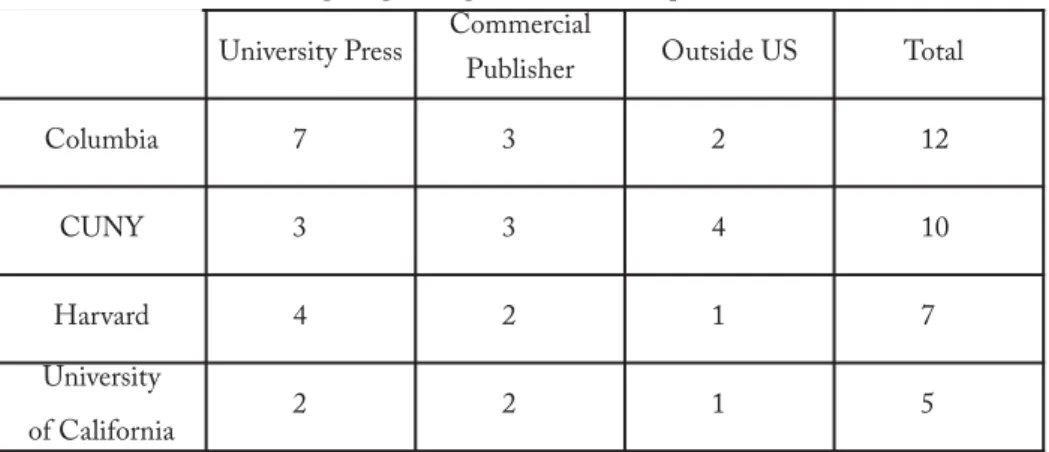
(20) CAMINO REAL. consistently dominated the degrees earned by doctorates; in every decade since 1939, the majority of students received Ph.D. degrees. 8. PUBLICATION DATA A great number of the doctoral dissertations in the humanities and social sciences have been published in full or in part. Ninety-nine dissertations (15%) were published in book format. As figure 2 shows, History titles represent 20% of the published studies followed by Literature which represents 19%. Anthropology and Sociology with 12% each have the next largest shares, followed by Political Sciences (10%), Economics (8%), and Education (6%). In addition, many of these dissertations have provided the foundation for book chapters and articles in scholarly journals. Table 6 shows the pattern of the five leading institutions that have produced Dominican related dissertations for publication. Of 45 dissertations from Columbia University, 12 were published in book format. Their publishing distribution is as follows: seven by university presses, three as commercially published books, and two outside of the United States. 10 of the 28 dissertations were published at The City University of New York: three by university presses, three by commercial presses, and four outside of the United States. At Harvard, a total of seven dissertations have been published; four by university presses, two by commercial publishers, and one outside of the United States. Out of the six dissertations produced at the University of California, five of those have been published in book format (four by university presses and one by a commercial publisher). Worth mentioning is that the first and only Dominican related dissertation produced at New York University which has been published by a university press is the study by Dominican scholar Silvio Torres-Saillant. His dissertation Caribbean Poetics: Aesthetics of Marginality in West Indian Literature was submitted in 1991 and published by Cambridge University Press in 1997 under the title Caribbean Poetics: Toward an Aesthetic of West Indian Literature. Another interesting fact is that the first Dominican related dissertation produced at The City University of New York and published by a university press was the one submitted by Dominican scholar Ramona Hernández in 1997, The Mobility of Labor under Advanced Capitalism: Dominican 40.
(21) SARAH APONTE. Migration to the United States. In 2002, Columbia University Press published this dissertation under the title The Mobility of Workers under Advanced Capitalism: Dominican Migration to the United States. 9. CONCLUSION In writing this article, I have provided ample evidence that interest in Dominican Studies has steadily increased in U.S. higher education institutions during the last seven decades. I have provided an analysis by decade, including a list of subjects, degree-granting institutions, and authors to indicate which have been the major topics, who were writing the dissertations, and what institutions were supporting and approving this research. Using the data collected in the study, the Dominican related dissertations dealing with Dominicans in the United States experienced an increase in the late 1990s. Although, the majority of these dissertations were produced at three of the six leading institutions I already mentioned (Columbia University, New York University and The City University of New York), it is important to note that two other institutions experienced an increase: the University of Texas at Austin and the University of Massachusetts (Amherst and Lowell). Can it be argued that this phenomenon is partly due to the increase of the Dominican population in these two states? In addition, the scholars who wrote these dissertations were overwhelmingly Dominicans or of Dominican descent. Is there a relationship between the theme (Dominicans in the United States) and the writers who themselves or their families have been part of the immigration process? Further research will be able to answer these questions and other questions that may arise in the future. This article is a tool that provides knowledge seekers with a welcome historical context in which to place the study of Dominican related dissertations produced in the United States. In this paper, I have highlighted the evolution of these dissertations, pointing to significant topics, concepts, and institutions that have shaped them. I have included highlights on seminal works, lesser-known important dissertations, and feature essays that contextualize their contribution and significance. The richness, diversity, and 41.
(22) CAMINO REAL. sheer bulk of the dissertations covered speak to the dynamism and complexity of Dominican Studies as an academic subject. REFERENCES Acra-Brache, S. Toward a Contemporary Vision of Music Education in the Dominican Republic. Ph.D. Dissertation. Temple University, 2004. Print. Adler Pappas, S. E. Adaptive Strategies for Dominican Elderly. Ph. D. Dissertation. University of South Florida, 1994. Print. Aparicio, A. Developing Politics in Quisqueya Heights: Local and National Trajectories of Dominican-American Organizing (New York). Ph.D. Dissertation. The City University of New York, 2004. Print. ___. Dominican-Americans and the Politics of Empowerment. Gainesville: University Press of Florida, 2006. Print. Aponte, S. Dominican Migration to the United States, 1970-1997: An Annotated Bibliography. New York: CUNY Dominican Studies Institute, 1999. Print. Atkins, G. P. The United States and the Dominican Republic during the Era of Trujillo. Ph.D. Dissertation. The American University, 1966. Print. Boersen, L. Bloed Weegt Meer Dan Water. Etniciteit en partnerkeuze bij Dominicaanse meisjes in New York. Ph.D. Dissertation. University of Amsterdam, 2000. Print. Brennan, D. E. Everything is for Sale Here: Sex Tourism in Sosúa, the Dominican Republic. Ph.D. Dissertation. Yale University, 1998. Print. Cabezas, A. L. Pleasure and Its Pain: Sex Tourism in Sosúa, the Dominican Republic. Ph.D. Dissertation. University of California, Berkeley, 1998. Print. Castro, M. J. Dominican Journey: Patterns,Context and Consequences of Migration from the Dominican Republic to the United States. Ph.D. Dissertation. The University of North Carolina, 1985. Print. Cocco De Filippis, D. La trayectoria de la poesía dominicana del postumismo a la poesía sorprendida. Ph.D. Dissertation. The City University of New York, 1983. Print. Coin, J. B. Social Aspects of Black Poetry in Luis Palés Matos, Nicolás Guillén and Manuel del Cabral. Ph.D. Dissertation. New York University, 1976. Print. 42.
(23) SARAH APONTE. Collazo-Matos, A. Ethno-aesthetic Description and Political Interpretation of Selected Spanish Caribbean Prints. Ph.D. Dissertation. New York University, 1997. Print. Davis, M.E. Afro-Dominican Religious Brotherhoods: Structure, Ritual, and Music. Ph.D. Dissertation. University of Illinois at Urbana-Champaign, 1976. Print. Decena, C. U. Queering the Heights: Dominican Transnational Identities and Male Homosexuality in New York City. Ph.D. Dissertation. New York University, 2004. Print. De Galíndez, J. Trujillo’s Dominican Republic: a Case Study of Latin American Dictatorship. Ph. D. Dissertation. Columbia University, 1955. Print. DeGrange, E. J. The Poetry of Manuel del Cabral. Ph.D. Dissertation. Tulane University, 1970. Print. Dissertation Abstract International. 1861-2009. Web. 27 January 2011. Doctoral Dissertations Accepted by American Universities. New York: H.W. Wilson Co., 1934-1955. Print. Frech, A. Negocios & Accents Identitätsfragen in der US-“dominikanischen” Literatur 1990 bis 2005. Ph.D. Dissertation. Vienna University, 2008. Print. Freitag, T. G. In the Path of the Golden Horde: tourism and Rural Development in a Coastal Dominican Community. Ph.D. Dissertation. University of Florida, 1993. Print. Floren-Romero, M.S. The Impact of Information Loss on Research: a Case Study in the Dominican Republic. Ph.D. Dissertation. University of Illinois at UrbanaChampaign, 1994. Print. Georges, E. The Causes and Consequences of International Labor Migration from a Rural Dominican Sending Community. Ph.D. Dissertation. Columbia University, 1985. Print. ___. The Making of a Transnational Community: Migration, Development, and Cultural Change in the Dominican Republic. New York: Columbia University Press, 1990. Print. Goris-Rosario, A. The Role of the Ethnic Community and the Workplace in the Integration of Immigrants: A Case Study of Dominicans in New York City. Ph.D. Dissertation. Fordham University, 1994. Print. 43.
(24) CAMINO REAL. Graham, P. M. Re-imagining the Nation and Def ining the District: The Simultaneous Political Incorporation of Dominican Transnational Migrants. Ph.D. Dissertation. University of North Carolina at Chapel Hill, 1996. Print. Guarnizo, L. E. One Country in Two: Dominican-owned Firms in New York and in the Dominican Republic. Ph.D. Dissertation. The Johns Hopkins University, 1992. Print. Guzmán, J. T. Music Education in the Dominican Republic Schools: a Survey-appraisal. Ph.D. Dissertation. The Florida State University, 1999. Print. Hanks, W. E. A Study of Selected Newspaper Coverage of the 1965 Dominican Revolt. Ph.D. Dissertation. University of Pittsburgh, 1970. Print. Hansen, T. L. The Types of the Folktale in Cuba, Puerto Rico, the Dominican Republic and in Spanish South America. Ph.D. Dissertation, Stanford University, 1952. Print. ___. The Types of the Folktale in Cuba, Puerto Rico, the Dominican Republic and Spanish South America. Berkeley: University of California Press, 1957. Print. Hauch, C. C. The Dominican Republic and Its Foreign Relations, 1844-1882. Ph.D. Dissertation. University of Chicago, 1943. Print. ___. La República Dominicana y sus relaciones exteriores, 1844-1882. Santo Domingo, República Dominicana: Sociedad Dominicana de Bibliófilos, 1996. Print. Hendricks, G. L. The Dominican Diaspora: the Case of Immigrants from the Dominican Republic in New York City. Ph.D. Dissertation. Teachers College, Columbia University, 1972. Print. Hernández, R. The Mobility of Labor under Advanced Capitalism: Dominican Migration to the United States. Ph.D. Dissertation. The City University of New York, 1997. Print. ___. The Mobility of Workers under Advanced Capitalism: Dominican Migration to the United States. New York: Columbia University Press, 2002. Print. Index to American Doctoral Dissertations. Ann Arbor, Mich.: University Microfilms, 19561963. Print. Infante, I. M. Politicalization of Immigrant Women from Puerto Rico and the Dominican Republic. Ph.D. Dissertation. The University of California, 1977. Print. Jones, C. M. Charles-Francois Cheve and French Christian Socialism in Mid-Nineteenth Century. Ph.D. Dissertation. Michigan State University, 1991. Print. 44.
(25) SARAH APONTE. Jordan, L. The Study of Miocene Foraminifera from Jamaica, the Dominican Republic, the Republics of Panama, Costa Rica and Haiti. Ph.D. Dissertation. Massachusetts Tech, 1939. Print. Jurdjevic, M. Citizens,Subjects, and Scholars: The Valori Family in the Florentine Renaissance, 1480-1608. Ph.D. Dissertation. Northwestern University, 2002. Print. Latorre, E. The Dominican Republic: a Case Study of a Caudillistic Political System and the Challenge of a Populist Movement. Ph.D. Dissertation. Columbia University, 1972. Print. ___. De política dominicana e internacional y desarrollo humano. Santo Domingo: Dominican Republic, INTEC, 1975. Print. León, Y. M. Community Impacts of Coastal Tourism in the Dominican Republic. Ph.D. Dissertation. University of Rhode Island, 2004. Print. Leona, M. Que de adentro sale/It Comes from Inside: a Sociolinguistic Study of the Code Switching Behavior in a Dominican Household in New York City. Ph.D. Dissertation. New York University, 1987. Print. Lowenthal, A. F. The Dominican Intervention of 1964: A Study of United States Policy. Ph.D. Dissertation. Harvard University, 1971. Print. ___.The Dominican Intervention. Harvard University press, 1972. Print. Meltzer, W. J. Tourism and the Development of Capitalism in a Dominican Village. Ph.D. Dissertation. The University of Michigan, 1994. Print. Mérorés, L. Haiti and the Dominican Republic: a Case for Economic Integration. Ph.D. Dissertation, New York University, 1973. Print. Moreno, J. A. Sociological Aspects of the Dominican Revolution. Ph.D. Dissertation. Cornell University, 1967. Print. Moya Pons, F. La otra historia dominicana. Santo Domingo: Librería La Trinitaria, 2009.Print. Nadri, N. K. Negotiating with Dominicans: an analysis of the Negotiation Style Used by Dominicans. Ph.D. Dissertation. Nova Southeastern University, 2009. Print. Newton, J. R. The People of Batey Mosquitisol: Workers on a Sugar Cane Plantation in the Dominican Republic. Ph.D. Dissertation. New School for Social Research, 1979. Print. 45.
(26) CAMINO REAL. Offer-Ohlsen, K. Dominican Identity Reconsidered: Ethnicity and Belonging in an InnerCity High School, New York. Ph.D. Dissertation. The University of Oslo, 2007. Print. Ortiz, J. O. The Acculturation of Immigrant Students in an American College: a Study of Dominican Students in a Community College. Ph.D. Dissertation. Boston University, 1986. Print. Pacini Hernández, D. Music of Marginality: Social Identity and Class in Dominican Bachata. Ph.D. Dissertation. Cornell University, 1989. Print. Padilla, M. B. Looking for Life: Male Sex Work, HIV/AIDS, and the Political Economy of Gay Sex Tourism in the Dominican Republic. Ph.D. Dissertation. Emory University, 2003. Print. Sainz, R. A. Dominican Ethnic Associations: Classification and Service Delivery Roles in Washington Heights (New York City). Ph.D. Dissertation. Columbia University, 1990. Print. Scarfullery, R. Twentieth Century Composers from the Dominican Republic: an Overview and Analysis of the Guitar Music of Luis Cernuda, Pedro Holguin-Veras, Manuel Simo, and Miguel Pichardo. Ph.D. Dissertation. Shenandoah Conservatory, 2004. Print. Sepúlveda Castillo, R. J. Community Environment: Its Assessment and Relationship to Psychological Well-Being among Dominicans and Puerto Ricans in New York City. Ph.D. Dissertation. New York University, 1982. Print. Shrock, R. R. Geology at MIT, 1865-1965: A History of the First 100 Years of Geology at Massachusetts Inst. of Technology 2. Cambridge, Mass.: MIT Press, 1982. Print. Tansill, W. R. Diplomatic Relations between the United States and the Dominican Republic 1874-1899. Ph.D. Dissertation. Georgetown University, 1952. Print. Torres-Saillant, S. Caribbean Poetics: Aesthetics of Marginality in West Indian Literature. Cambridge, U.K; New York: Cambridge University Press, 1997. Print. Torres-Saillant, S. and R. Hernández. “Editors’ Preface: Dominican Quiddities in the U.S. Academy.” Punto 7 Review: A Journal of Marginal Discourse. 3:1. (Fall 1996): 1-10. Print. Vedrine, E. W. and A. Paniagua. A Bibliography of Theses and Dissertations Related to the Dominican Republic. Web. 5 January 2011. 46.
(27) SARAH APONTE. Wiarda, H. J. The Aftermath of the Trujillo Dictatorship: the Emergence of a Pluralist Political System in the Dominican Republic. Ph.D. Dissertation. University of Florida, 1965. Print. Weiss, C. I. “Helping to Live”: Deinstitutionalization, Dominican New Yorkers, and Networks for Health Seeking. Ph.D. Dissertation. Columbia University, 1982. Print. NOTES 1. For a definition of the field of Dominican Studies, see Torres-Saillant, Silvio and Ramona Hernández.. 2. I exclude dissertations granted in universities located in Puerto Rico due to the difficulty of obtaining accurate information since not all major universities in Puerto Rico submit information for inclusion in Dissertation Abstracts International. Although this article appears in 2011, I decided not to include the dissertations produced in 2010 since this information is not yet completely available to researchers.. 3. Among these are Alexandra Frech’s dissertation on Dominican American Literature, Negocios & Accents Identitätsfragen in der US-“dominikanischen” Literatur 1990 bis 2005, from Vienna University, 2008; and two dissertations on second generation Dominican ethnicity and identity issues: Kristin Offer-Ohlsen. Dominican Identity Reconsidered: Ethnicity and Belonging in an Inner-City High School, New York. The University of Oslo, 2007; and Lisa Boersen. Bloed Weegt Meer Dan Water. Etniciteit en partnerkeuze bij Dominicaanse meisjes in New York. University of Amsterdam, 2000.. 4. This material was published as a book by Harvard University Press in 1972, under the title The Dominican Intervention. 5. I determined that Eduardo Latorre was Dominican by reading his curriculum vitae which was attached to his Ph.D. dissertation. I used similar sources of biographical information to determine Dominican nationality and ancestry for other scholars identified as Dominicans in this paper.. 6. While this question might be of limited significance to a non-Dominican reader, for the Dominican public it is intimately linked with questions of power and representation of the Dominican population in the United States.. 47.
(28) CAMINO REAL. APPENDIX GRAPHS Graph 1. Dominican related dissertations in the U.S., 1939-2009 by decades.. Source: Dissertation Abstract International, Doctoral Dissertations Accepted by American Universities, Index to American Doctoral Dissertations.. Graph 2 Publication data. Source: Dissertation Abstract International, Doctoral Dissertations Accepted by American Universities, Index to American Doctoral Dissertations.. 48.
(29) SARAH APONTE. TABLES Table 1. Top six institutions granting doctorates for Dominican related dissertations, 1939-2009 Institution. Number. Beginning Year. Columbia University. 45. 1956. New York University. 30. 1973. University of Florida. 29. 1965. 28. 1982. 25. 1975. 23. 1971. The City University of New York State University of New York Harvard. Source: Dissertation Abstract International, Doctoral Dissertations Accepted by American Universities, Index to American Doctoral Dissertations.. 49.
(30) CAMINO REAL. Table 2. Dominican related Dissertations by major subject for each of the top six institutions, 1939-2009. Literature. Education. Sociology. Economics Psychology Geography. 3. 12. 3. 3. 3. 0. 3. 7. 2. 1. 6. 0. 2. 0. 2. 4. 1. 5. 12. 1. 4. 0. 3. 0. 6. 5. 2. 1. 1. 0. 4. 8. 2. 2. 2. 0. Columbia University New York University University of Florida The City University of New York State University of New York. Harvard. Source: Dissertation Abstract International, Doctoral Dissertations Accepted by American Universities, Index to American Doctoral Dissertations.. Table 3.1. Gender in relation to subjects LITERATURE. EDUCATION. PSYCHOLOGY. FEMALE. 75%. 61%. 75%. MALE. 25%. 39%. 25%. Source: Dissertation Abstract International, Doctoral Dissertations Accepted by American Universities, Index to American Doctoral Dissertations. 50.
(31) SARAH APONTE. Table 3.2. Gender and Degree Earned. Ed.D.. Ph.D.. FEMALE. 67%. 49%. MALE. 33%. 51%. Source: Dissertation Abstract International, Doctoral Dissertations Accepted by American Universities, Index to American Doctoral Dissertations. Table 4. Degrees Earned. DEGREE. PERCENT. Ph.D.. 92%. E.d.D.. 5%. D.S.W.. 0.70%. Psy.D.. 0.70%. Au.D.. 0.15%. D.I.B.A.. 0.15%. Source: Dissertation Abstract International, Doctoral Dissertations Accepted by American Universities, Index to American Doctoral Dissertations.. Table 5 Relation between degree-granting institutions and publication data. Commercial University Press Outside US Publisher. Total. Columbia. 7. 3. 2. 12. CUNY. 3. 3. 4. 10. Harvard. 4. 2. 1. 7. University. 2 2 1 5 of California Source: Dissertation Abstract International, Doctoral Dissertations Accepted by American Universities, Index to American Doctoral Dissertations. 51.
(32)
Figure


Documento similar
One example of the importance of the resources offered by an environment is reflected in the study of abundance and species richness carried out in New York City
Another possible mechanism involved in the stimulatory effects exerted by BIM-23A760 in certain pituitary adenomas might be related to the use of one, relatively
The analysis of the stories precise us with lot of clearness that the existence of middlemen is given in three main ambits, the first one is related to the support in the
What is perhaps most striking from a historical point of view is the university’s lengthy history as an exclusively male community.. The question of gender obviously has a major role
Our interpretation is that the broad infrared features at 6–9, 9–13, 15–20, and 25–35 μm are intimately related with the formation of fullerenes in PNe, being likely produced by
To contribute to the development of local community & enhancement of life quality in Gaza & Palestine5. To promote universal values & mutual cultural understanding
In Figure 18 we present the ratio of the dust luminosity (L dust ) derived from the UV/optical SED fitting to the observed IR luminosity against the current specific SFR.. Objects
Source: Authors’ own creation based on data contained in the EGM 2009. The analysis was applied to 100% of the alcohol-related journalistic texts published by the selected
