
G
Guuiimmaarrããeess--PPoorrttuuggaall
PC: 01 / p.1
Past, Present and Future of Dummy Heads
M. Vorländer
Institute of Technical Acoustics, RWTH Aachen University, 52056 Aachen, Germany
ABSTRACT: Dummy heads are prerequisite for binaural recordings. Only with binaural recording or synthesis technology the full spatial information of sound events can be kept. Appropriate reproduction systems of binaural sounds are another important and interesting field of research and development. The application of binaural technology reaches from professional audio to home entertainment and games. However, more “serious” applications like measurements of hearing aids and development of virtual reality systems are to be considered, too. In this presentation the historical development of dummy heads (artificial heads) is briefly described, the commercial products and their applications presented. Finally, research projects are discussed for improving the quality of binaural technology and for further extension of dummy head applications.
1. INTRODUCTION
Recordings using dummy heads should include the complete spatial information as best as possible and they should give a very high naturalness of sound. Ideal dummy head recordings can be replayed with an appropriate reproduction system to such a high extent that the listening impression is identical to the natural sound field. To achieve this high quality, however, various details must be considered. In this contribution the major aspects, their historical development, the state of the art and the future of dummy heads is discussed.
[image:1.595.71.336.547.709.2]Spatial sound reproduction is the better the nearer the characteristics of the dummy head matches the indivi-dualities of the listener. For spatial hearing the binaural cues in the horizontal plane, interaural time differences, ITD, and level differences, ILD, are essential quantities. In the median plane these interaural differences do not contribute, but from experience we know that we can distinguish well between front and back sound incidence. Hence, also monaural level differences (coloration of diotic signals) can be evaluated by the brain Figure 1 – Dummy heads (left to right):
G
Guuiimmaarrããeess--PPoorrttuuggaall
PC: 01 / p.2
in order to localise in the median plane. It is generally agreed that the binaural cues are present in the eardrum sound pressure [1] with only negligible contribution of bone conduction or other effects. Research of human sound localisation is highly developed [2 - 6] and this information is available for binaural technology.
1.2 Head-related transfer functions
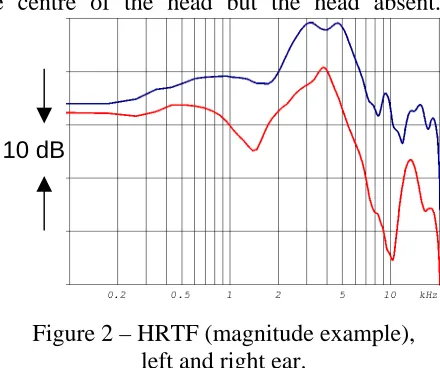
The binaural cues are introduced into the eardrum sound pressure by diffraction of sound incident on the head and torso. Usually a plane wave is considered as reference. The amount of diffraction is described by the head-related transfer function, HRTF. It is defined by the sound pressure measured at the eardrum or at the ear canal entrance and divided by the sound pressure measured with a microphone at the centre of the head but the head absent. Accordingly, HRTF are dependent on the
direction of sound incidence.
The principal components of HRTF are above 200 Hz, where the (linear) sound field distortion due to diffraction becomes significant. Head and shoulder affect the sound transmission into the ear canal at mid frequencies whereas pinna effects contributes to distortions in the higher frequency range (above 3 kHz). It should be mentioned that HRTF are dependent on the individual anatomic dimensions [7].
2. HISTORIC DUMMY HEAD DEVELOPMENT
2.1 “The KEMAR years”
The first significant studies aiming at a standard dummy head were presented in the 1960s by the pioneering work by Burkhard and Sachs, by Zwislocki and by Shaw [8 - 12]. In 1972 KEMAR was introduced. Its first main application was measurement of hearing aids under in-situ conditions [13]. KEMAR, however, was used as reference dummy head in a more wide sense. It serves, for instance as reference for database of HRTF still today. Together with the properties of head and torso, the conditions of the ear canal must be described, i.e. the open-ear condition with impedance simulator (open-ear canal plus open-eardrum) or blocked open-ear canal. Shall the dummy head be used for external sources only, or also for sources close to the ear? To cover all these aspects ear simulators (artificial ears) were developed and standardised [14].
[image:2.595.304.524.300.484.2]The main problem of research and development to be solved at that time was the definition and creation of an average head representing an “average listener”. The aim, of course, is finding the most appropriate head with respect to standardisation. The result, however, might not be the optimum in the performance of localisation tests with an arbitrary individual listener (see below). This problem was thought to be solved with various kinds of geometric
Figure 2 – HRTF (magnitude example), left and right ear.
G
Guuiimmaarrããeess--PPoorrttuuggaall
PC: 01 / p.3
or structural averaging. With respect to this goal, the following design criteria were defined [15] 1.) average anthropometric dimensions of an adult human, based on [16 - 18], 2.) ear canal and eardrum to match real ears in open, partially closed, and closed ear use, 3.) acoustically and dimensional-average pinna, 4.) easily exchangeable pinna to permit study of ear size effects, and 5.) reproducibility of acoustic testing. The result is shown in Fig. 1 (left).
2.2 Mathematically describable geometries
Further research aimed at a more transparent and simple description of head and torso geometry with the same acoustic behaviour as more natural replicas. Genuit developed a mathematical diffraction model based on elliptical and cylindrical elements [19]. The pinna is also simplified to the cavum conchae and the asymmetric ear canal entrance. The exact location of the ear canal entrance point, mostly used as reference point for measuring sources close to the ear, is very important for correct localisation cues. This head (see the commercial version in Fig. 1, centre) is widely used in the area of sound quality and sound design in automobile industry. Another dummy head with geometrical
elements is the Brüel&Kjær 4128 (or 4100, see Fig. 1, right), expect for the pinna which is identical with the original KEMAR pinna.
These more modern dummy heads were investigated in comparison tests, as well as regards objective quantities like HRTF, headphone frequency responses and attenuation of hearing protectors. Furthermore, large interest for application of dummy heads can be found in telecommunication, where the performance of headsets and any kind of telephones is to be measured [20]. The mathematically described standard dummy heads have clear advantages in calibration and equalisation, and thus in comparability.
2.3 Individual human geometries
[image:3.595.285.521.256.470.2]When using the standard dummy heads for recordings and for research in perception of direction and distance, a rather large portion of the test subject population reports on disturbances of the listening experience. The test results typically suffer from front-back confusion and large uncertainties in localisation in the median plane. The reason can be found by multidimensional analysis (magnitude, phase, frequency, ILD, ITD, …) of HRTF in comparison of individuals with the dummy heads. There might be some individuals matching
Figure 3 – Mathematically described dummy head and pinna (after [19]).
G
Guuiimmaarrããeess--PPoorrttuuggaall
PC: 01 / p.4
the dummy head performance quite well, while others’ “ears” are “far away” from the “dummy head ears”.
Approaches for developing best-match heads were published by Schmitz [21] and by Møller et al. [22]. The procedure was not to measure the head and torso dimensions (see section 2.1 above), but HRTF of a large population of test subjects and to use this database of HRTF in listening tests of localisation. The individual HRTF with the best success in localisation tests among the largest group of test subjects is obviously the “best choice HRTF” and, accordingly, belongs to the individual person with best matching head and torso geometry. Please note that this approach is not based on a geometric or structural average but on a selected HRTF including significant HRTF details like peaks and notches.
Recent results showed that a well-selected human head (fitted with probe microphones) is superior to dummy heads. Dummy heads which were created from an individual selection process and a copy of an individual human (rather than from an average) are almost as good as human heads [22].
3. STATE OF THE ART OF USING DUMMY HEADS
Applications of dummy heads can be found in the following fields:
• Recording and documentation
Historical documents Soundscapes
• Measurement and simulation
Hearing and Audiology Electroacoustics
Communication technology Room acoustics
Sound quality
• Binaural technology
3D-Audio, Surround sound Home entertainment Virtual Reality
G
Guuiimmaarrããeess--PPoorrttuuggaall
PC: 01 / p.5
4. NEW DEVELOPMENTS
The test subject population represented by any dummy head is a crucial process of selection. All studies presented so far suffer from a somewhat arbitrary choice of subjects and the limited number of subjects. The most comprehensive study in this respect is still Burkhard et al. [8, 9]. Today, it might be argued that the human population changed during the last three decades (typically the standard group of normal hearing subjects, adults of age 18 - 25 are taller than they have been years ago). And it might be asked whether one standard dummy head might be sufficient to cover all humans. This statement does not only refer to populations in various parts of the world, but, at first, to children.
Due to the lack of knowledge about the outer ear of children, there is little information about the interrelation between growth and the HRTF, about the neural formation of binaural hearing and about the termination conditions for close-to-the-ear sources like hearing aids or headphones. A database containing anthropometric data of children aged from four to six years was created and the data were analysed [23]. Due to difficulties involved during direct measurements of HRTF of children, detailed and simplified CAD models were created and HRTF were obtained by numerical simulations using the boundary element method. Using some basic geometrical data, an abstract
parametric CAD model of heads can be built.
It was shown that the modelled HRTF of a child looks quite different from an adult HRTF. The naïve assumption that a scaled adult head yields HRTFs similar to child HRTFs cannot be maintained. There are still big differences in the principle shape of HRTF. Accordingly interaural cues differ, too. This very first investigation about HRTFs from children shows that it is necessary to investigate further HRTFs of various ages until the best gradual transition into an adult HRTF is found.
5. SUMMARY AND CONCLUSIONS
[image:5.595.305.519.419.544.2]Dummy heads and binaural technology have been developed towards a high quality. International standards for telecommunication technology and for measuring hearing aids are available. They represent the state of the art published over the last decades and the applications of dummy heads in research and development. Besides dummy head recordings and reproduction for home entertainment, which was not too successful in commercial aspects, several fields like 3D audio, virtual environments, headphone development and sound quality could be created and extended to high relevance in applied acoustics and audio
G
Guuiimmaarrããeess--PPoorrttuuggaall
PC: 01 / p.6
engineering. Some questions related to the applicability of average head dimensions for both sexes, humans in all parts of the world, and particularly for children remain.
REFERENCES
[1] J. Blauert, Spatial Hearing. – Rev. edition. MIT Press, Cambridge (Mass.)/London, 1997. [2] S.K. Roffler, R.A. Butler, Factors that influence the localization of sound in the vertical plane. J.
Acoust. Soc. Am. 43 (1968) 1255–1259.
[3] G.F. Kuhn, Model for the interaural time difference in the azimuthal plane. J. Acoust. Soc. Am. 62(1) (1977), 157.
[4] J.C. Middlebrooks; Narrow-band sound localization related to external ear acoustics. J. Acoust. Soc. Am. 92 (1992) 2607–2624.
[5] F. Asano, Y. Suzuki, T. Sone, Role of spectral cues in the median plane. J. Acoust. Soc. Am. 88 (1990) 159–168.
[6] A. Kulkarni, H.S. Colburn, Role of spectral detail in sound-source localization. Nature 396 (1998), 747-749.
[7] H. Møller, M.F. Sørensen, D. Hammershøi, C.B. Jensen, Head-Related Transfer Functions of Human Subjects. J. Audio Eng. Soc. 43 (1995), 300.
[8] M.D. Burkhard, R.M. Sachs, “KEMAR the Knowles Electronics Manikin for Acoustic Research”. Report No. 20032-1. Industrial Research Products, Inc., Elk Village, Illinois, (November 1972).
[9] M.D. Burkhard, R.M. Sachs, Anthropometric manikin for acoustic research, J. Acoust. Soc. Am. 58 (1975), 214-222.
[10] J.J Zwislocki, An acoustic coupler for earphone calibration. Rep. LSC-S-7, Lab. Sensory Commun., Syracuse U., 1970
[11] J.J. Zwislocki, An ear-like coupler for earphone calibration. Rep. LSC-S-9, Lab. Sensory Commun., Syracuse U., 1971.
[12] E.A.G. Shaw, R. Teranishi, Sound pressure generated in an external-ear replica and real human ears, by a nearby point source. J. Acoust. Soc. Am. 44 (1968), 240-256.
[13] IEC 60959, Provisional head and torso simulator for acoustic measurements on air conducting hearing aids. First edition 1990.
[14] IEC 60711, Occluded-ear simulator for the measurement of earphones coupled to the ear by ear inserts.
[15] M.D. Burkhard, A Manikin Useful for Hearing Aid Tests – Revisited. Proc. ICA 2004, Kyoto, Volume V, 3443.
[16] H. Dreyfus, The Measure of Man (Whitney Library of Design, New York), 1963.
[17] E. Churchill, B. Truett, Metrical Relations Among Dimensions of the Head and Face. WADC Tech. Rep. 56-621, ASTIA Docum. No. AD 110629 (June 1957).
[18] M. Alexander, L.L. Laubach, Anthropometry of the human ear. AMRL-TR-67-203, Air Force Systems Command, Wright-Patterson Air Force Base, Ohio 1968.
[19] K. Genuit, Ein Modell zur Beschreibung von Außenohrübertragungseigenschaften. PhD Dissertation, RWTH Aachen University, 1984
[20] ITU-T Recommendation P.58: Head and torso simulator for telephonometry. [21] A. Schmitz, Ein neues digitales Kunstkopfmeßsystem. Acustica 81 (1995), 416-420.
[22] P. Minnaar, S. K. Olesen, F. Christensen, H. Møller, Localization with binaural recordings from human and artificial heads. J. Audio Eng. Soc., Vol. 49 (2001), 323-336.

![Figure 3 – Mathematically described dummy head and pinna (after [19]).](https://thumb-us.123doks.com/thumbv2/123dok_es/5462928.111844/3.595.285.521.256.470/figure-mathematically-described-dummy-head-pinna.webp)
![Figure 4 – Average parametric dummy heads for children, left: 6 months (early age for fitting hearing aids), right: kindergarten age, after [23]](https://thumb-us.123doks.com/thumbv2/123dok_es/5462928.111844/5.595.305.519.419.544/figure-average-parametric-children-months-fitting-hearing-kindergarten.webp)
