Combinatorial Desings, Ideals and Quasi-Steiner
Triple Systems
by
M. Sc. Javier Mu˜
noz Bernabe
A Thesis Submitted
in Partial Fulfillment of the
Requirements for the Degree
Doctor of Philosophy in Mathematics
Advisor
Dr. Feli´
u D. Sagols Troncoso
Mexico, D.F
Combinatorial Desings, Ideals and Quasi-Steiner Triple Systems
by
M. Sc. Javier Mu˜noz Bernabe
In this work we study the generation of Steiner Triple Systems witch are an
im-portant family of combinatorial designs. The work consists of two parts.
In the first part we propose a method to generate combinatorial designs based on
algebraic geometry techniques and consider particular combinatorial designs as points
in the geometric variety associated to a polynomial ideal. With this technique we were
able to construct ideals whose geometric varieties are Steiner Triple Systems and also
we were successful producing Steiner Triple Systems satisfying additional restrictions
as being anti-Pasch or Kirkman Triple Systems. Unfortunately, the computation of
the geometric variety was only possible for systems with very small orders. First, we
tried to construct a Gr¨obner basis and then to generate the points in the varieties by
using genetic algorithms, but in all the cases our methods only worked fine for small
orders.
The chromosomes of the genetic algorithms that we developed were precisely the
points in the domain of the geometric varieties used and the fitness function was
the number of polynomials in the ideal that a chromosome satisfied. The method
worked fine when the fitness function was far from zero, but as it approached to
zero it was increasingly difficult to find better chromosomes. After some adjustments
climbing algorithm by Stinson [30] that worked very similar to Hartley-Konstam’s
and ours method but with a more efficient behavior. This fact discards the use of
genetic algorithms to generate STSs. It is interesting however that Hartley-Konstam’s
method was published in 1993 and Stinson’s method in 1985. Eight years before!
We found that a formal analysis of Stinson’s method is extremely difficult. It
is based on the extension of Partial Steiner Triple Systems and we found that by
making a refinement of these designs that we called Quasi-Steiner Triple Systems it
was possible to produce a method with more operations than Stinson’s method. In
contrast the analysis on the correctness of this method is easier compared to Stinson’s
method.
In consequence, the second part of the work is devoted to study Quasi-Steiner
Triple Systems. We discovered a very rich structure in Quasi-Steiner Triple Systems
and some properties about them that we considered relevant. The study of
Quasi-Steiner Triple Systems is relevant from either the theoretical and the practical points
of view. In particular we consider that one of the main contributions of this thesis is
Abstract ii
List of Illustrations vi
List of Tables vii
1 Introduction
1
2 Gr¨
obner basis and combinatorial designs
9
3 Stable sets, ideals, stability ideal and Gr¨
obner basis
12
4 Colorings Steiner Triple Systems and Kirkman Triple
Systems
24
5 Parametric generation of STSs
30
6 Quasi-Steiner Triple Systems and basic operations
37
7 Graph decompositions of QSTSs and operations to
re-duce the level of QSTS
46
8 Quasi-Steiner Triple Systems of level two
59
9 Direct transformations among QSTSs
69
7.1 A component of the decomposition Q7,8 for the QSTS in Example 26. 46
7.2 Illustration of the proof of Theorem 33. . . 51
7.3 Blocking structure for the reducing method. . . 56
7.4 Operation to allow further reductions when a blocking structure appears. . . 58
8.1 Two climbing paths are contained into Q2E,D. . . 64
8.2 Illustration of the proof of Theorem 42. . . 65
8.3 Fusion of two non-climbing paths to yield two climbing paths. . . 65
6.1 Basic transformations. . . 42
Chapter 1
Introduction
ASteiner Triple System (STS) of orderv, briefly STS(v), is a set of 3-element subsets called triples or blocks of a v-set of points such that every pair of points occurs in exactly one block. Given an STS(v), standard counting arguments prove that each
point must occur in exactly r = v−21 blocks, and that the triple system consists of exactlyb= v(v6−1) blocks. Since both randbare integers, we get necessary conditions for the existence of an STS(v), which in fact turn out to be sufficient.
Theorem 1 For v ≥ 3, an STS(v) exists if and only if either v ≡ 1 mod 6 or
v ≡3 mod 6.
For a survey of basic results on Steiner Triple Systems see [9].
A Partial Steiner Triple System (PSTS) is a set system (V,B) in which every block has size three, and every pair of points from V is contained into at most one
block. Such set system is denoted PSTS(v), and v = |V|. The size of a PSTS(v) is
the number of blocks it contains. It is easy to see that any PSTS(v) has size at most
v(v−1)
6 ; and a PSTS(v) of size v(v−1)
6 is in fact an STS(v).
Several techniques have been used to generate Steiner Triple Systems. Among
them, constructions based on groups and quasi-grous [20] are common, also exhaustive
searches by computer and other heuristic searches [12]. Here we introduce a different
method to generate combinatorial designs in general and to construct Steiner triple
hill-climbing techniques.
Our first objective is to establish links between design theory and algebraic
geom-etry through the use of ideals and Gr¨obner bases. We concentrate on Steiner triple
systems because they are simple designs with well known properties. However, the
algebraic geometry techniques we use can be easily translated to other designs.
Our method to generate combinatorial designs by algebraic geometry techniques
starts by encoding the restrictions of a particular combinatorial design class into a
polynomial ideal I over an appropriate polynomial ring. By combinatorial design
class we mean a whole family of combinatorial designs as Steiner Triple Systems or
Kirkman triple systems, see Chapter 4, with a particular order. The second step
is to compute the Gr¨obner basis of I. At this point every particular combinatorial
design in the class will be a point in the geometric variety ofI and can be found from
the Gr¨obner basis. When this basis is different from{1} at least one instance of the
combinatorial design class does exist; otherwise, no instance exists and a formal proof
of such fact could be derived from the Gr¨obner basis. With this method we produced
instances of several combinatorial designs classes by placing the polynomials modeling
the restrictions of each class. Among them were STSs, STSs anti-Pasch and Kirkman
triple systems.
Computing the Gr¨obner basis of ideals generating a particular combinatorial
de-sign class is very important since it represents a synthetic form to encode every
combinatorial design belonging to the class. So, to recover each one of this designs
we only need to solve the polynomials in the Gr¨obner basis.
The ideals produced by our methods contain a huge number of polynomials and
variables, and it represents a difficult problem because the software available to
only allowed us to general Gr¨ober basis for combinatorial designs of very small orders.
For instance, to generate STSs of order 21 the polynomial ideal has 1330 variables,
and no software available can manage this amount. To generate STSs of order 19 the
polynomial ideal has 969 variables and contains 24226 polynomials; all the software
available exhausted the computer memory after few execution hours. So, we looked
for alternatives where our ideals were useful.
We found that genetic algorithms (GAs) could be applied to look for points in
the geometric variety. A set of triples (to be completed as an STS) could be codified
as a chromosome represented by one characteristic vector and the fitness function
could be the number of polynomials not satisfied by the chromosome. In this way the
objective was to find the best chromosome. That is, to find the organism minimizing
the fitness function. For the basic nomenclature and definitions related to GAs we
follow [17].
GAs are powerful tools. However, they proved to be unappropriate to generate
STSs. There is a strong deficiency with the crossover operation because after applying
it the attitude of the resulting organism is significantly increased with respect to the
parents’ attitude; mainly when they are close to zero. Our genetic algorithm worked
fast and fine when the fitness function of the population members was far from zero,
but it became slow as the fitness approached to zero. Then we eliminated the crossover
operation and thus a pure-mutative genetic algorithm [14] was used.
Our mutation operation looks randomly for two positions, one containing a zero
and other containing a one and switch their values with a probability inversely
pro-portional to the degree of unbalance of the resulting set. By unbalance of a set of triples we mean the standard deviation of the number of repetitions of the pairs in
With this mutation operation we were able to construct combinatorial designs
for several classes, but our polynomial ideals were non essential. For instance, to
generate STSs it is possible to define a fitness function counting the missing pairs in
each chromosome. The organisms themselves could be constructed without reference
to any polynomial ideal. So, we finally developed our algorithms without using any
polynomial ideal.
Looking into the literature for the construction of STSs by genetic algorithms we
found a work by Hartley-Konstam [18]. The method in this paper is not
purely-mutative, in fact it has two mutation operations. The two mutation operations used
are the following.
Each chromosome is a bit string of length equal to the total number of triples over
the set S of v elements. Each bit encodes whether or not the corresponding triple
is in the potential Steiner triple system represented by the chromosome. Since the
number of bits set to 1 in each chromosome corresponds to the number of triples in a
solution the program keeps constant the number of bits set to 1 in each chromosome.
The first mutation operator consists of choosing at random a bit to be flipped then
some other bit set oppositely would be chosen at random to be flipped. Thus the
number of bits set to 1 in the chromosome is kept constant.
The second mutation operation by Hartley-Konstam is quite similar to ours. The
idea is to remove from the chromosome a redundant triple. We mean, a triple
con-taining a pair which is contained in another triple. And to add to the chromosome a
triple that would contain pairs not contained in any other triple in the chromosome.
From a performance point of view Hartley-Konstam’s method was equivalent to ours.
Then, trying to find similar methods not necessarily based on GAs we found
which in each step used an operation that was very close to the second mutation
op-eration used by Hartley-Konstam’s. Stinson’s called this opop-eration SWITCH and it
is described in Chapter 6.
Hill-climbing heuristics do not use big populations as it occurs in GAs. In fact,
in hill-climbing heuristics only one organism is considered in each step and in
conse-quence Stinson’s method is much more efficient than both Hartley-Konstam’s method
and ours. From this, immediately follows that hill-climbing heuristics are a better
option to construct STSs than genetic algorithms, and it seems unfeasible that a
genetic algorithm could improve Stinson’s method.
We wondered why Stinson’s method had such good performance. Stinson’s only
gave the brief algorithmic description of his method that we reproduced in Chapter 6,
a justification in terms of intuitive ideas, the experimental results he obtained, and
no more. We programed the method and in every running it always found correctly
an STS. We tried to construct a formal proof on the correctness of Stinson’s method
but we found that it was difficult by using the elements in which Stinson based his
development. He worked on Partial Steiner Triple Systems (PSTSs), see Chapter 6,
and we consider that it was the source of the difficulties.
We then introduced a refinement of PSTSs that we called Quasi-Steiner Triple Systems (QSTSs) and by using it we were able to understand better the behavior of Stinson’s method. We also wondered whether a similar process was possible on
Triple Systems with missing and repeated pairs, but with the same number of triples
as an STS. We observed that with the introduction of this change several operations
to increase or reduce the number of missing pairs were possible, and finally there
So, our second objective in this thesis is to study QSTSs. QSTSs of a specific order
v contain the same number of triples than an STS of the same orderv, but repeated
and missing pairs are allowed. In fact, the number of missing pairs in a QSTS Q is
named the level of Q. We focus our study on basic operations to transform QSTSs from one level to another being the most interesting the transformation from level two
to level zero. It certainly corresponds to the conversion of a QSTS into an Steiner
Triple System. In addition to the rich combinatorial structure of QSTSs, several
properties of STSs can be derived from it. We remark that non-isomorphic QSTSs
could be obtained from a single QSTS and this property is immediately valid in STSs.
We substitute PSTSs by Quasi-Steiner Triple Systems. In a PSTS only
infor-mation about missing pairs is provided, but in QSTSs instead inforinfor-mation about
repeated pairs is also given. This information allows to identify patterns of triples
to be changed in order to increase or reduce the level of the QSTS. In PSTSs these
patters are not visible just because they are at a coarser level than QSTSs. Probably
that is the reason why Stinson did not presented a formal proof on the correctness of
his method in [30]. Our original purpose was to establish some operations similar to
SWITCH to construct STSs from QSTSs, but we finally found combinatorial
struc-tures that we considered relevant and decided to study them in detail. The results of
this study are reported in Chapter 6.
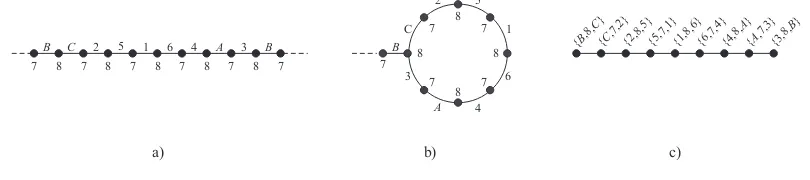
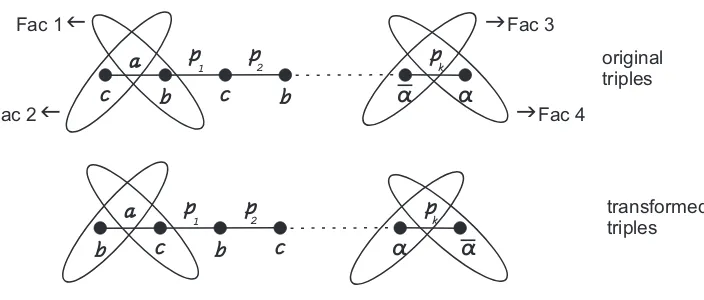
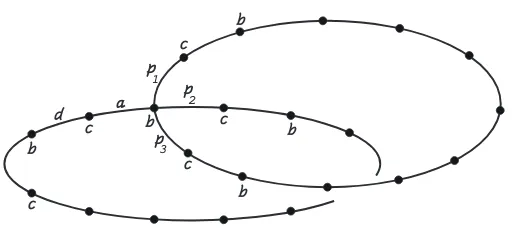
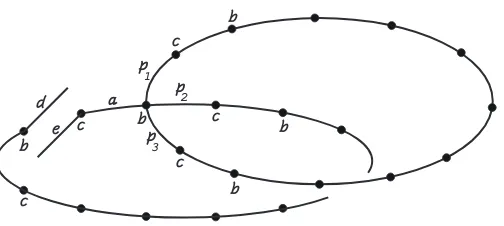
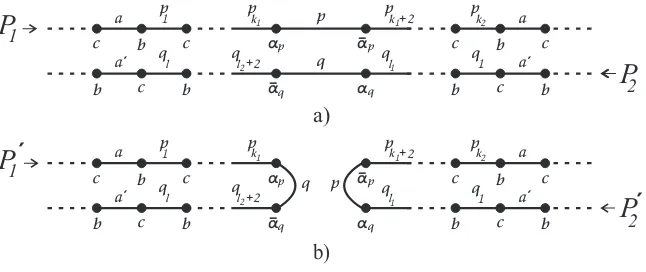
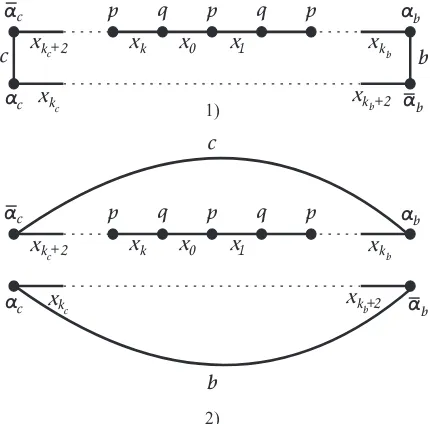
Among these combinatorial structures are thedecomposition graphs, see Chapter 7. In Theorem 33 the patters referred in the previous paragraph are analyzed in detail.
Decomposition graphs are also into STSs, but in this case their structure is just a
family of cycles. For instance, a Pasch [24] into an STS is a cycle of length four into
Rather than studying the effect on Pasches, we focused our attention in the use of
the swapping operation to convert an STS into non-isomorphic STSs.
Other interest on QSTSs is related to practical computational issues. Suppose for
instance that some STS with certain restrictions hard to satisfy is required, but there
is no problem if a QSTS Q at a small level l >0 satisfying the same restrictions is
produced. Then, findingQcould be less expensive because in general there are much
more QSTSs of a given order v at levell than STSs of the same order.
The thesis is divided into two parts. The first part consists of chapters 2, 3, 4 and
5. The second part consists of chapters 6, 7, 8 and 9. The thesis is organized as follows.
In Chapter 2 an ideal to generate stable sets based on the Motzkin-Strauss formula
[25] is first introduced. Then a general ideal introduced by Lov´asz [23], which has
been extensively used for the generation of stable sets in graphs, is described. Both
ideals are examples of 0-1 ideals, a recently introduced class having combinatorial applications beyond stability (see [28]). These ideals are shown to be radical, and
consequently the equality of the two ideals is established. Also in this chapter we
introduces basic properties of stability ideals. In Chapter 3 the stability ideal of
the Johnson’s graphs J(n,3,2) is determined and used to build MPTs; difficulties
to solve the equations involved are explored, and potential means to generate MPTs
with restrictions are examined. In particular a modification of the stability ideal
of J(n,3,2) is shown to generate anti-Pasch MPTs. Chapter 4 introduces two new
ideals to generate MPTs that use colorings instead of stable sets. Also introduces an
ideal to generate Kirkman triple systems that employs a mixture of techniques based
on stable sets and on colorings. Chapter 5 explores parametric generation of MPTs.
The second part of this work starts in Chapter 6. Here we introduce the concept
of Quasi-Steiner Triple System as well as fundamental notation and results. Also
we introduce basic operations to either increment or decrement the level of QSTSs,
a method to compute the change in the level is introduce and a concrete example
for one of the operations is developed. Chapter 7 is devoted to decompositions of
QSTSs which are graphs representing dependence relations among the triples in the
system; some elementary properties of decompositions are introduced as well as the
concept of exchangeable path. At the middle of this chapter the main theorem is
stated. Then applications of the main theorem are presented to reduce the level
of QSTSs and general conditions to guaranty level reductions are proved. Chapter 8
deals with combinatorial properties of QSTSs of level two and it introduces conditions
to transform these systems into STSs. This section contains a theorem to transform
QSTSs and STSs into non-isomorphic systems at the same level. In Chapter 9 the
algorithm to construct QSTSs pair-wise non-isomorphic is developed. Finally, in
Chapter 2
Gr¨
obner basis and combinatorial designs
Let us start defining the fundamental objects and concepts from design theory, graph
theory and algebraic geometry with which we work. A maximum packing by triples
(MPT or MPT(n)) of ordern >0 is maximum cardinality set of triples in{0, . . . , n−
1} such that every pairi, j ∈ {0, . . . , n−1} is in at most one triple. MPTs exist for
every n ≥3. When n≡1,3 (mod 6), an MPT(n) is a Steiner triple system (STS or STS(n)); in this case, every 2-subset of elements appears in exactly one triple.
All graphs considered here are simple. Let v, ℓ, and i be fixed positive integers,
with v ≥ ℓ ≥ i. Let Ω be a cardinality v set. Define a graph J(v, ℓ, i) as follows.
The vertices of J(v, ℓ, i) are the ℓ-subsets of Ω, two ℓ-subsets being adjacent if their
intersection has cardinality i. Therefore, J(v, ℓ, i) has vℓ
vertices and it is a regular
graph with valency ℓi v−ℓ ℓ−i
.Forv ≥2ℓ, graphsJ(v, ℓ, ℓ−1) are Johnsongraphs [16]. One of the main methods that we use to characterize MPT(n)s consists of finding
stable sets (or independent sets) in J(n,3,2). A stable setS of a graph Gis a subset of vertices in V(G) containing no pair of adjacent vertices in G. The maximum size
of a stable set inG is the stability number of G, denoted byα(G).
The stability polytopeof an-vertex graphGis the convex hull of{(x0, . . . , xn−1)|
xi = 1 or xi = 0 and{i∈V(G)|xi = 1} is a stable set ofG}.
We also use vertex colorings. A λ vertex coloring (or coloring for short) of a graphG (whereλ is a positive integer) is a function c:V(G)→ {1, . . . , λ} such that
coloring ofG exists is thechromatic number of G, denoted byχ(G).
We introduce some algebraic structures. For k a field, k[x] = k[x1, . . . , xn] is the
polynomial ring in n variables. A subset I ⊂ k[x1, . . . , xn] is an ideal of k[x1, . . . , xn]
if it satisfies 0∈I; iff, g ∈I, thenf+g ∈I; and if f ∈I and h∈k[x1, . . . , xn] then
hf ∈I. When f1, . . . , fs are polynomials ink[x1, . . . , xn] we set
hf1, . . . , fsi= ( s
X
i=1
hifi
h1, . . . , hs∈k[x1, . . . , xn] )
.
Then hf1, . . . , fsi is an ideal (see [10]) of k[x1, . . . , xn], the ideal generated by
f1, . . . , fs. One remarkable result, the Hilbert Basis Theorem (see [10]), establishes
that every ideal I ⊂k[x1, . . . , xn] has a finite generating set.
The monomials ink[x] are denoted byxa
=xa11 xa22 · · ·xan
n ; they are identified with
lattice points a = (a1, . . . , an) in Nn, where N is the set of nonnegative integers. A
total order≺onNn is a term order if the zero vector is the unique minimal element,
and a≺b implies a+c≺b+cfor all a,b,c∈Nn.
Given a term order ≺, every nonzero polynomial f ∈ k[x] has a unique initial
monomial, denoted by in≺(f). If I is an ideal in k[x], then its initial ideal is the
monomial ideal in≺(I) :=hin≺(f) : f ∈Ii.
The monomials that do not lie in in≺(I) arestandard monomials. A finite subset
G ⊂I is a Gr¨obner basis for I with respect to ≺ if in≺(I) is generated by {in≺(g) :
g ∈ G}. If no monomial in this set is redundant, the Gr¨obner basis is unique for I
and ≺, provided that the coefficient of in≺(g) in g is 1 for each g ∈ G.
A finite subset U ⊂ I is a universal Gr¨obner basis if U is a Gr¨obner basis of I with respect to all term orders ≺simultaneously.
is algebraically closed and such that every element of ¯k is the root of a nonzero
poly-nomial in one variable with coefficients in k. This field is unique up to isomorphism,
and is the algebraic closureof k.
Given a subset S⊆k[x1, . . . , xn], the variety V¯k(S) in ¯kn is
Vk¯(I) = {(a1, . . . , an)∈k¯n |f(a1, . . . , an) = 0 for all f ∈S}.
If I =hf1, . . . , fsi ⊆k[x1, . . . , xn] then
Vk¯(I) = {(a1, . . . , an)∈k¯n |fi(a1, . . . , an) = 0, 1≤i≤s}=V¯k(f1, . . . , fs).
One of the most remarkable results in algebraic geometry is the following.
Theorem 2 (Weak Hilbert Nullstellensatz (see [19])) Let I be an ideal
contained in k[x1, . . . , xn]. Then V¯k(I) = ∅ if and only if I =k[x1, . . . , xn]
We may use this theorem to demonstrate that some designs do not exist, by
proving that they correspond to varieties of ideals whose reduced Gr¨obner basis is
{1}, or equivalently that I =k[x1, . . . , xn] and, by the weak Hilbert Nullstellensatz,
the variety is empty.
These are the fundamental objects employed, and more specific definitions are
introduced as needed. With the exception of the ideals introduced in Chapter 5,
we use the field of rational numbers. When an algebraic closed field is needed, the
complex numbers are used instead. Computations for Gr¨obner basis ideals are done
Chapter 3
Stable sets, ideals, stability ideal and Gr¨
obner
basis
Combinatorial and algebraic aspects of the stable set problem have been extensively
studied. One of the most interesting connections is given by the Motzkin-Strauss
explicit formula for α(G) (see [25]):
Theorem 3 Let G= (V, E) be a graph. Then
1− 1
α(G) = max
2 X
i,j /∈E
xixj
X
i∈V(G)
xi = 1, xi ≥0
. (3.1)
The Motzkin-Strauss formula enables one to determine part of the structure of
the stability polytope, and consequently to prove several results in extremal graph
theory, including Tur´an’s Theorem. In (3.1), α(G) is determined by an optimization
problem which at first sight might be solved by Lagrange multipliers. Unfortunately
the objective function reaches its maximum at the feasible region boundary and out
of this region it is unbounded. We can circumvent this problem by squaring each
variable to get a different version of the Motzkin-Strauss formula that still yields
α(G):
1− 1
α(G) = max
2 X
i,j /∈E
yi2yj2
X
i∈V(G)
y2i = 1
. (3.2)
Lagrange multipliers can be used for (3.2). Make the objective function’s gradient
of equations:
4yi
X
j∈V(G)|i,j /∈E
y2j = 2λyi for each i∈V(G), (3.3)
X
i∈V(G)
y2i = 1.
This system has several solutions that do not maximize (3.2). Lov´asz [23]
char-acterizes the set of maximum solutions for (3.1): Any vector x maximizes the right
hand side if and only if xhas a stable set as support and if xi 6= 0 for somei∈V(G)
then xi = 1/α(G). Let y be an optimal solution to (3.2) such that yj ≥ 0 for every
j ∈V(G). From (3.3), if yi 6= 0 then
4 α(G)−1
α(G)pα(G) = 4
1
p
α(G)
α(G)−1
α(G) = 4yi
X
j∈V(G)|i,j /∈E
yj2
= 2λyi = 2λ
1
p
α(G)
So, a solution of (3.3) is a maximum of the objective function in (3.2) if and only
if λ = 2α(G)α(G)−1. If we substitute this value in (3.3), substitute zi = y2iα(G), and
introduce the equations zi(zi−1) = 0 to restrict the values of zi to 0 or 1, then we
transform (3.3) into
zi(zi−1) = 0 for each i∈V(G),
zi(
X
j∈V(G)|i,j /∈E
zj −α(G) + 1) = 0 for eachi∈V(G), (3.4)
X
i∈V(G)
zi−α(G) = 0.
Proposition 4 The graphGhas stability number at leasteif and only if the following zero-dimensional system of equations
x2i −xi = 0 f or every node i∈V(G),
xi(
X
j∈V(G)|i,j /∈E
xj−e+ 1) = 0 f or each i∈V(G), (3.5)
n X
i=1
xi−e = 0,
has a solution. The vector xis a solution of (3.5) if and only if the support of xis a stable set.
The ideal generated by the polynomials in (3.5) is the Motzkin-Strauss idealofG, denoted by M S(G).
A second approach was introduced by Lov´asz [23].
Proposition 5 (Lov´asz) The graph Ghas stability number at least e if and only if the zero-dimensional system of equations
x2i −xi = 0 f or every node i∈V(G),
xixj = 0 f or every edge{i, j} ∈E(G), (3.6)
n X
i=1
xi−e = 0,
has a solution. Vector x is a solution of (3.6) if and only if the support of x is a stable set.
Proof: If there exists some solution x to these equations, the identities x2
i −xi = 0
ensure that all variables take values only in {0,1}. The set S ={i|xi = 1} is stable
because equationsxixj = 0 guarantee that the end points of any edge in E(G) cannot
The ideal generated by the polynomials in (3.6) is thestability idealof G, denoted by S(G). As Lov´asz [23] explains, solving (3.6) appears to be hopeless but he uses
S(G) to write alternative proofs of several known restrictions on the stability polytope.
A quick comparison of S(G) and M S(G) demonstrates that the ideals are close;
actually their generators only differ in the polynomials defined in terms of E(G).
However the generators of both ideals contain the polynomials x2
i −xi fori∈V(G).
This condition confers on them a strong structure that we can generalize by
intro-ducing a bigger class of ideals containing them.
LetIbe an ideal ink[x1, . . . , xn]. ThenI is a0-1 idealif{x21−x1, x22−x2, . . . , x2n−
xn} ⊂I. Ideals S(G) and M S(G) are 0-1 ideals. Our objective now is to prove that
0-1 ideals are radical, with the consequence that the Motzkin-Strauss and stability
ideals are the same for any graph G.
For a polynomial f ∈k[x1, . . . , xn] write f =pv11 p v2
2 · · ·pvmm where the polynomials
pv11 pv22 · · ·pvmm are irreducible. Polynomial f∗ =p1p2· · ·pm is thesquare free part off.
Polynomial f is square freeif and only if f =f∗.
If M is an additive group, for a natural number n and an element a of M, na
denotes then-ple suma+· · ·+aofa(the addition ofa,n times). Under the notation,
we define the characteristic of a ring k, denoted chart(k) as follows. Consider the set
D = {n ∈ N|na= 0 for every a ∈ k}. If D is empty, then the characteristic of k is
defined to be zero, otherwise, the least number inDis defined to be the characteristic
of k. The next result is due to A. Seidenberg.
Lemma 6 [3, pages 341-342, 8.2] Let k a field and let I be a zero-dimensional ideal of k[x1, . . . , xn], and assume that for 1 ≤ i ≤ n, I contains a polynomial fi ∈ k[xi]
with gcd(fi, fi′) = 1. Then I is an intersection of finitely many maximal ideals. In
Proposition 7 [1] Let I be a zero-dimensional ideal and G be the reduced Gr¨obner basis for I with respect to the lex term order with x1 < x2 < · · · < xn. Then we
can order g1, . . . , gt such that g1 contains only the variable x1, g2 contains only the
variables x1 and x2 and lp(g2) is a power of x2, g3 contains only the variables x1, x2
and x3 and lp(g3) is a power of x3, and so forth until gn.
Here lp(g) stands for the leader powerof the polynomial g.
Theorem 8 Let k a field and I a 0-1 ideal in k[x1, . . . , xn] then I is a radical ideal.
Proof: Let G be the reduced Gr¨obner basis for I. If 1 ∈ G, by Theorem 2 I =
k[x1, . . . , xn] and henceI = √
I. Now we consider the case whenIis zero-dimensional,
since for eachi= 1, . . . , n, I contains the univariate polynomial x2
i −xi which satisfy
that gcd(x2
i −xi,2xi−1)=1, the result follows from Lemma 6. ✷
Theorem 9 (Strong Hilbert Nullstellensatz) I(V¯k(I)) = √I for all ideals I of
k[x1, . . . , xn].
As a consequence, two idealsI andJ correspond to the same variety (V¯k(I) =Vk¯(J))
if and only if √I =√J.
Proposition 10 For G a graph, S(G) =M S(G).
Proof: By Theorem 8 S(G) and M S(G) are both radical. By Propositions 4 and 5
these two ideals correspond to the same variety. Finally by Theorem 9, both ideals
coincide. ✷
Note that Proposition 10 is valid for all field k.
This gives two names and two ways to designate the same ideal, so henceforth the
established now fromS(G). This is one reason whyS(G) is important. The relevance
of 0-1 ideals goes beyond stability. They help to solve problems like finding
hamil-tonian cycles in graphs and other combinatorial problems. A detailed presentation
appears in [28].
In this chapter we study basic properties of the stability ideal of a graph Gfrom
the point of view of its Gr¨obner basis. In an implicit way we use S-polynomials and
Buchberger’s algorithm for the calculation of reduced Gr¨obner basis; see [1] for details.
The S-polynomial of two polynomialsf andg ink[x1, . . . , xn], denotedS(f, g), is the
polynomial S(f, g) = lcm(in≺(f),in≺(g)) in≺(g) ·f −
lcm(in≺(f),in≺(g))
in≺(g) ·g. The lcm is the least
common multiple in relation to the monomial order≺.
We separate the generators of S(G) into sets of polynomials P1(G) and P2(G):
P1(G) = {x2i −xi|i∈V(G)} [
{xixj|i, j ∈E(G)} (3.7)
P2(G) = {
X
i∈V(G)
xi−e} (3.8)
Proposition 11 Let G be a graph. Then P1(G) is the reduced Gr¨obner basis of hP1(G)i with respect to any monomial order.
Proof: Buchberger’s algorithm starts with P1(G) as initial basis.
For every i, j, k, ℓ ∈V(G) with i6= j and k 6=ℓ, S(xixj, xℓxk) = 0. If i 6=j then
S(x2
i−xi, xixj) =−xixj. Ifi, jandkare pairwise differentS(x2i−xi, xjxk) = −xixjxk.
Finally, if i6=j then S(x2
i −xi, x2j −xj) =−xi(x2j −xj). No new polynomial should
be added into the basis because any possible S-polynomial is zero or reduced to zero
with respect to P1(G). We conclude that P1(G) is a reduced Gr¨obner basis. The
monomial order is irrelevant. ✷
This fact is a direct consequence of the following result [21].
Lemma 13 Let F ={f1, f2, . . . , fk}be a set of polynomials in k[x1, . . . , xn]such that
polynomialfi is a product of linear factors and for any permutationπof {1, . . . , n}we
have π(fi(x1, . . . , xn)) =fi(xπ(1), . . . , xπ(n))∈F. If F is a Gr¨obner basis for the ideal hFi with respect to the lexicographic monomial order induced by x1 > x2 > · · ·> xn
then F is a universal Gr¨obner basis for the ideal hFi.
The set of polynomials P1(G) is the reduced Gr¨obner basis of hP1(G)iand P2(G)
is the reduced Gr¨obner basis of hP2(G)i; actually both of them are universal, but
when we try to calculate the Gr¨obner basis of theS(G) =hP1(G)SP2(G)i, the
num-ber of S-polynomials calculated by Buchberger’s algorithm increases exponentially.
Proposition 14 explains this behavior.
Proposition 14 The Gr¨obner basis ofS(G) with respect to the term order e < x0 <
x1 <· · ·< x|V|−1 contains the polynomial e(e−1)(e−2). . .(e−α(G)).
Proof: By Proposition 7 there exists a polynomial g1 in the reduced Gr¨obner basis
ofS(G) such thatg1 is the generator of S(G)∩k[e]. Since erepresents the size of the
stable set this variable can be assigned to one of the values 0,1, . . . , α(G). Note that
g1(i) = 0 when i ∈ {0,1, . . . , α(G)} and g1(i) 6= 0 when i /∈ {0,1, . . . , α(G)}. The
polynomiale(e−1)(e−2). . .(e−α(G)) has minimum degree and roots 0,1, ... . . . α(G).
Thusg1 =e(e−1)(e−2). . .(e−α(G)). ✷
If we calculate a Gr¨obner basis for S(G), in an implicit way we are calculating
α(G): Look for the polynomial in the basis that only contains the variable e. This
polynomial has degree α(G) + 1. Because the calculation of the stability number of
to generate the Gr¨obner basis of S(G). However we can use this ideal to do direct
deductions related to stability.
Maximum size stable sets in J(n,3,2) correspond to MPT(n)s. In this chapter
we construct the generators of S(J(n,3,2)) and discuss some properties of this ideal
and its Gr¨obner basis.
Letn >3 be an integer, and letAbe a 4-set contained in Ω ={0, . . . , n−1}. Any
pair of triples inA is an edge in J(n,3,2). In other words, the subgraph ofJ(n,3,2)
induced by the triples contained in A is isomorphic to K4. We denote this subgraph
byKA.
Proposition 15 Let n be a positive integer. The family
{E(KA)}A is a 4-set in Ω
is a partition of E(J(n,3,2)).
Proof: Let e be an arbitrary edge in E(J(n,3,2)), e = ({w0, w1, w2},{w0, w1, w3})
for somew0,w1,w2 andw3 which are pairwise different elements in Ω. Thenebelongs
toE(K{w0,w1,w2,w3}) and E(J(n,3,2))⊆ ∪A∈{4-sets in Ω}E(KA).
Let A be a 4-set contained in Ω and let e be an edge of KA. There are two
different triples A1 and A2 contained in A such that e = (A1, A2). We have that
4 = |A1 ∪ A2| = |A1|+ |A2| − |A1 ∩ A2| and thus |A1 ∩ A2| = 2 or equivalently
e∈E(J(n,3,2)). Thus E(KA)⊆E(J(n,3,2)).
Finally, letB1 andB2 be different 4-sets contained in Ω, thenE(KB1)∩E(KB2) = ∅. Suppose to the contrary that there is an edge e in the intersection of both sets.
Let A1 and A2 be triples in Ω such that e = (A1, A2), then A1∪A2 =B1 given that
e ∈ E(KB1), but A1 ∪A2 = B2 because e ∈ E(KB2), but that is a contradiction.
We can use this proposition to construct the generators of S(J(n,3,2)).
Corollary 16 Let n≥4 be a positive integer. Then
P1(J(n,3,2)) = {x2A−xA|A⊆ {0, . . . , n−1} and |A|= 3} [
(3.9)
{xAxB|A, B ⊆ {0, . . . , n−1},|A|=|B|= 3 and |A∪B|= 4}
P2(J(n,3,2)) = {
X
A⊆T riples({0,...,n−1})
xA−e}.
The ideal generated by the polynomials in (3.9) is the stability Steiner ideal of order n. We have an algorithmic approach for its construction.
Algorithm 3.0.1 Construction of the generators of S(J(n,3,2)) Input: An integer n ≥4.
Output: The setP of polynomials generatingS(J(n,3,2)).
Method:
1. P← ∅
2. f ←0
3. for i←1 to n3
4. a ← combination(n,3, i)
5. P ←P ∪ {x2
{a[0],a[1],a[2]}−x{a[0],a[1],a[2]}}
6. f ←f+x{a[0],a[1],a[2]}
7. for i←1 to n4
8. a ← combination(n,4, i)
9. P ←P ∪ {x{a[1],a[2],a[3]}x{a[0],a[2],a[3]}}
11. P ←P ∪ {x{a[1],a[2],a[3]}x{a[0],a[1],a[2]}}
12. P ←P ∪ {x{a[0],a[2],a[3]}x{a[0],a[1],a[3]}}
13. P ←P ∪ {x{a[0],a[2],a[3]}x{a[0],a[1],a[2]}}
14. P ←P ∪ {x{a[0],a[1],a[3]}x{a[0],a[1],a[2]}}
15. P ← {f−e}
16. return P
Here “combination(n, k, i)” generates (in some order) the i-th k-set contained in
Ω.
The complexity of Gr¨obner basis computation depends strongly on the term
order-ing. The best one is reported to be degree-reverse-lexicographical [1]; for this ordering,
the computation of the Gr¨obner basis of the system of polynomial equations of degree
d in n variables is polynomial in dn2
if the number of solutions is finite (see [5, 6]).
The time needed to compute an MPT(n) is therefore polynomial in 2n2
. Indeed this
suffices to find all possible MPT(n)s. However whenn is small enough we can hope to
do successful calculations to prove in “an automatic way” (through the Nullstelensatz
Hilbert Theorem) conjectures about MPTs satisfying specific conditions.
We implemented this method in Macaulay 2. We adopted some heuristics,
de-scribed next, that make the program faster, and use less memory, to allow the
com-putation for larger values of n.
1. Substitute the variable e in the generating set of S(J(n,3,2) by the constant
value ofα(J(n,3,2)) in order to simplify computation. See [5, 6].
2. Always make the polynomials homogeneous. Use reverse
3. Restrict the MPTs to be generated. There is no lost of generality if we assume
that the MPTs contain the triples{0,1,2},{0,3,4},{0,5,6}, . . . ,{0, n−2, n−1}
and {1,3,5} (assuming that n is odd). Of course, we are not working with
S(J(n,3,2)) anymore, but we omit only systems isomorphic to those found. To
enforce the presence of these triples, include in the generators the polynomials
x{0,1,2} −1, x{0,3,4} −1, . . . , x{1,3,5} − 1. Some further pruning can be done if
we consider the combined presence of other triples, for example, the pair {2,3}
could belong without loss of generality only to the triple {2,3,6} or to the
triple{2,3,7}. To do this, adjoin to the generator set the polynomial x{2,3,6}+
x{2,3,7} −1. We can continue with this process as desired to make the process
faster and reduce the number of resulting MPTs. Taking this process to the
extreme yields a full enumeration of the nonisomorphic MPTs.
4. Impose further restrictions when possible. For example, to build an anti-Pasch
MPT (one not containing a copy of the MPT(6)), leta be an array containing
a 6-subset of {0, . . . , n−1}. Including
x{a[3],a[4],a[5]}x{a[1],a[2],a[5]}x{a[0],a[2],a[4]}x{a[0],a[1],a[3]}
with the generators of S(J(n,3,2)) prevents the Pasch
{a[3], a[4], a[5]},{a[1], a[2], a[5]},{a[0], a[2], a[4]},{a[0], a[1], a[3]}
from appearing in the MPTs. The other 23 monomials of this form must be
included for the 6-set in a. A total of n6
24 monomials must be included in
order to ensure that the MPTs generated are anti-Pasch.
Despite these heuristics, computation is far too time-consuming. Being optimistic,
with a supercomputer and these heuristics, we may reach values of n as big as 21.
This time consumed by this method is not very different from brute force
al-gorithms. Why we would prefer to use the stability ideal and a program such as
Macaulay 2? The answer is simple: Some conjecture is false when the number one
enters the Gr¨obner basis. Macaulay 2 can in principle produce the sequence of
cal-culations involved. The reductions and computations of S-polynomials involved is
a formal deduction, while with brute force algorithms additional work is required
to get a mathematical proof. On the other hand, when a conjecture is true, the
Gr¨obner basis calculation provides a full description of the associated geometric
va-riety. Moreover, the strong structure of the ideals, if understood well, may permit
direct inferences without using the Buchberger algorithm. Sturmfels [31] used a
sim-ilar development on polytopes in combinatorial optimization applications. At the
Chapter 4
Colorings Steiner Triple Systems and Kirkman
Triple Systems
Generation of MPTs from stability ideals is natural and could be extended to other
designs. Now we turn to a different approach. Stability and colorings are closely
related concepts because vertices in a colour class form a stable set. In this chapter
we use colorings to construct STSs. First we introduce a well known ideal to find
a λ coloring of a graph G provided that λ is known in advance. Then we use two
variations of this ideal to construct STSs. Also we introduce an ideal based on a
combination of stability and colorings for the generation of Kirkman triple systems
(see [8]).
Let s be a positive integer and let n = 6s + 3. A Kirkman triple system of order n is a Steiner triple system with parallelism, that is, one in which the set of
b = (2s+ 1)(3s + 1) triples is partitioned into 3s+ 1 components such that each
component is a subset of triples and each of the elements appears exactly once in
each component.
Lemma 17 (Loera [22]) Let G be a graph on n vertices, and let λ be a nonnega-tive integer.The graph G is λ-colorable if and only if the zero-dimensional system of equations in C[x1, . . . , xn]
xλi −1 = 0, for every vertex i∈V(G), (4.1)
has a solution. Moreover, the number of solutions equals the number of distinct λ
-colorings multiplied by λ!. ✷
The coloring idealof λ and G is the ideal Iλ(G) of C[x1. . . , xn] generated by the
polynomials in (4.1) and (4.2).
Note that the coloring ideal of λ and Gis radical.
By (4.1) every vertex can take one ofλ possible colors. Let us examine (4.2) more
thoroughly. Denote by Pλ(x, y) the polynomialxλ−1+xλ−2y+· · ·+yλ−1.
Lemma 18 Let λ be a positive integer. If r0 andr1 are roots of unity of xλ−1then
r0 6=r1 if and only if Pλ(r0, r1) = 0.
Proof: We have that
xλ−yλ = (x−y)Pλ(x, y). (4.3)
Since r0 and r1 are roots of unity r0λ −r1λ = 1−1 = 0. If r0 6= r1 then 0 =
(r0−r1)Pλ(r0, r1), since r0−r1 6= 0 we have thatPλ(r0, r1) = 0. On the other hand,
if r0 = r1 then there exists an integer j ∈ {0, . . . , λ−1} such that r0 = r1 = e 2πj
λ i,
and so Pλ(r0, r1) =λ(e 2πj
λ i)λ−1 6= 0. The lemma follows. ✷
By (4.2) ifi, j ∈E(G) thenxishould be different toxjbecause otherwisePλ(xi, xj)
would be nonzero. In other words, the color assigned to xi should be different to the
color assigned to xj.
Proposition 19 Let n ≡ 1,3 (mod 6) be a nonnegative integer. Let λ = (
n
2) 3 . The
xλ{i,j}−1 = 0, for every pair (i, j)∈E(Kn)
Pλ(x{i1,j1}, x{i2,j2})·Pλ(x{i2,j2}, x{i3,j3})·
Pλ(x{i3,j3}, x{i1,j1}) = 0, for each set {(i1, j1),(i2, j2),(i3, j3)}
not inducing a copy of K3 in Kn
has a solution if and only if {{i, j, k} |x{i,j} =x{j,k} =x{k,i}} is an STS.
Proof: Suppose that the system of equations has a solution. The value of x{i,j} is
the color for the edge (i, j) inKn. We are using as many colors as there are triples in
a STS(n). If the coloring is not balanced, then some color is assigned to fewer than
three edges and some color is assigned to more than 3 edges. In this way there exist
edges (i1, j1),(i2, j2),(i3, j3) and (i4, j4) for which x{i1,j1} =x{i2,j2} =x{i3,j3} =x{i4,j4}.
Among these four edges, there are three which do not induce a copy of K3 in Kn;
we can assume that these edges are (i1, j1),(i2, j2) and (i3, j3). By the properties of
Pλ, Pλ(x{i1,j1}, x{i2,j2})Pλ(x{i2,j2}, x{i3,j3})Pλ(x{i3,j3}, x{i1,j1}) 6= 0 but this contradicts
the existence of a solution to the system of equations. Thus three edges receiving the
same color induce a copy of K3 inKn.
In the other direction, ordering the triples of an STS(n) as{i0, j0, k0}, {i1, j1, k1},
. . .,{iλ−1, jλ−1, kλ−1}, and forl = 0, . . . , λ−1 we assign tox{il,jl}, x{jl,kl} and x{kl,il}
the l-th λ-root of unity then the system of equations is satisfied. ✷
The ideal generated by the polynomials in the system of equations in
Proposi-tion 19 is theedge coloring Steiner ideal of order n.
The stability Steiner ideal of order n associates the 3-sets in {0, . . . , n−1} to its
variables; the edge coloring Steiner ideal associates the 2-sets. Does some ideal to
in an STS(n) each vertex is assigned to (n−1)/2 triples, we need (n−1)/2 copies
of each vertex. We denote by (i, j) the j-th copy of vertex i, i = 0, . . . , n−1 and
j = 1, . . .(n−1)/2.
Proposition 20 Let n ≡ 1,3 (mod 6) be a nonnegative integer. Let λ be equal to
(n
2)
3 . The zero-dimensional system of equations
xλ(i,j)−1 = 0, for every pair (i, j) with
i, j = 1, . . . ,(n−1)/2
Pλ(x(i1,j1), x(i2,j2))·Pλ(x(i2,j2), x(i3,j3))·
Pλ(x(i3,j3), x(i4,j4))·Pλ(x(i1,j1), x(i3,j3))·
Pλ(x(i1,j1), x(i4,j4))·Pλ(x(i2,j2), x(i4,j4)) = 0, for i1, i2, i3, i4 ∈ {0, . . . , n−1}
distinct and
j1, j2, j3, j4 ∈ {1, . . . ,(n−1)/2}
Pλ(x(i,j1), x(i,j2)) = 0, for i∈ {0, . . . , n−1} and
j1, j2 ∈ {1, . . . ,(n−1)/2}, j1 6=j2
has a solution if and only if {{i, j, k} | x(i,l1) = x(j,l2) = x(k,l3) for some l1, l2, l3 ∈ {0, . . . ,(n−1)/2}} is an STS.
Proof: Analogous to the proof of Proposition 19. ✷
The ideal generated by the polynomials in the system of equations in
Proposi-tion 19 is thevertex coloring Steiner ideal of order n.
The earlier comments for the stability Steiner ideal of order n are essentially the
the complexity of the polynomials involved increases. The final effect is that, as we
expect, the practical limitations of these ideals are similar.
Proposition 21 Lets be a positive integer and letn = 6s+ 3. The zero-dimensional system of equations
x2{i,j,k}−x{i,j,k} = 0, when {i, j, k} ⊂ {0, . . . , n−1},
x{i,j,k}x{j,k,l} = 0, when {i, j, k},{j, k, l} ⊂ {0, . . . ,
n−1} and i6=l,
X
{i,j,k}⊆{0,...,n−1}
x{i,j,k} −(2s+ 1)(3s+ 1) = 0,
y{3s+1i,j,k}−1 = 0, when {i, j, k} ⊂ {0, . . . , n−1}, x{i,j,k}x{k,l,m}P3s+1(y{i,j,k}, y{k,l,m}) = 0, for every unordered couple of
different 3-sets {i, j, k}, and {k, l, m}
contained in {0, . . . , n−1}.
has a solution if and only if S ={{i, j, k} |x{i,j,k} = 1} is a Kirkman triple system.
Proof: The first three equations in the system generate the stability Steiner ideal of
order n, thus the set of triples S is an STS. A new variable y{i,j,k} is introduced for
each vertex{i, j, k}inJ(n,3,2). These variables are used for coloring the elements of
S; by the fourth equation each triple receives one of 3s+ 1 colors. When x{i,j,k} = 0
the value of y{i,j,k} is immaterial. By the fifth equation, when x{i,j,k} = 1 the color
assigned to y{i,j,k} must be different from the one assigned to every other triple in S
Using the technique in the proof of Proposition 19, every color is associated to
exactly 2s+ 1 variables yi,j,k. So S is a Kirkman triple system. ✷
The ideal generated by the polynomials in the system of equations in
Proposi-tion 19 is theKirkman ideal of order n.
In Proposition 21 the fifth equation is equivalent to the conditional statement:
if {i, j, k} and {k, ℓ, m} are in S then
Put{i, j, k} and {k, ℓ, m} in different color classes.
Few elements in the ideal suffice for the construction of ideals related to design
the-ory: stability, colorings,Pλ polynomials and the proper use of conditional polynomial
Chapter 5
Parametric generation of STSs
Let V = V(f1, . . . , fs) ⊂ kℓ be a variety. Let k(t1, . . . , tm) represent the field of
rational functions, that is, quotients between two polynomials in k[t1, . . . , tm]. The
rational parametric representation of V consists of rational functions r1, . . . , rℓ ∈
k(t1, . . . , tm) such that the points (x1, x2, . . . , xℓ) given by
xi =ri(t1, . . . , tm) i= 1, . . . , ℓ (5.1)
lie inV. When functionsr1, . . . , rℓare polynomials rather than rational functions this
is a parametric polynomial representation. The original defining equations f1, . . . , fs
form the implicit parametric representation of V.
It is well known that not every affine variety has a rational parametric
represen-tation; however the set of points described by a rational parametric representation
is always an affine variety. In this chapter we consider the triples in a STS(n) as
points in R3 (fixing elements in some particular order for each triple), and then we
try to build a parametric polynomial representation for them. When successful, it is
implicitly proved that the points produced from the triples in the STS form an affine
variety.
For instance, for n = 7 the following parametric polynomial equations generate
x = t mod 7 (5.2)
y = 1 +tmod 7
z = 3 +tmod 7
Taking t= 0, . . . ,6 produces the STS
{{0,1,3},{1,2,4},{2,3,5},{3,4,6},{4,5,0},{5,6,1},{6,0,2}}.
This is a parametric polynomial representation that works exactly as we want.
The polynomials in (5.2) belong to Z/7Z[x, y, z, t]. However, we cannot generalize
this directly because the quotient ring Z/nZ is a field only when n is prime. This is
a technical difficulty, addressed later. First let us generalize the parametric
represen-tation in (5.2).
Letn≡1,3 (mod 6) be an integer and letℓ, l1, l2, l3, n1, . . . , nℓ be nonnegative
in-tegers such thatni ≤nfori= 1, . . . , ℓandQℓj=1ni =n(n−1)/6 (the number of triples
in an STS(n)). A polynomial parametric Steiner representation (PPSR) of order n, and parametersℓ, l1, l2, l3, n1, . . . , nℓis a triple ({αi}l1i=0,{βi}l2i=0,{δi}l3i=0), such that the
elements in each succession are pairwise different and belong to (Z+S
{0})ℓ. We
de-note a parametric representation like this asP(n, ℓ, l1, l2, l3,{ni}ℓi=1,({αi}l1i=0,{βi}l2i=0, {δi}l3i=0)). A PPSR is feasibleif the system of equations
x(t) =
l1 X
i=0
aαit
αi y(t) =
l1 X
i=0
bβit
βi z(t) =
l1 X
i=0
cδit
δi
in the variables aα0, . . . , aαl1, bβ0, . . . bβl2, cδ0, . . . , cδl3, (where t = (t1, . . . , tl)) has a
solution such that the setS ={{x(t), y(t), z(t)}|t∈ {0, . . . , n1−1}×. . .×{0, . . . , nℓ−
That ni ≤n fori= 1, . . . , ℓis necessary because the operations are onZ/nZ; but
it imposes restrictions on the PPSRs dealt with. For example, only forn = 7 can we
have a PPSR withℓ = 1. For any other value ofnit is not possible to find an integer
n1 satisfying n1 < n and Q1i=1ni = n(n−1)/6. In other words, it is impossible to
generalize (5.2) for n >7 using only one parameter t.
The important fact concerning PPSRs is that their feasibility is decided by weak
Hilbert Nullstelensatz Theorem.
Proposition 22 Let n ≡ 1,3 (mod 6) be a prime. Let P(n, ℓ, l1, l2, l3,{ni}ℓi=1,({
αi}l1i=0,{βi}l2i=0,{δi}l3i=0)) be a PPSR of order n. Let P and Q be the polynomials in
Z/nZ[aα0, . . . , aαl1, bβ0, . . . , bβl2, cδ0, . . . , cδl3], P(u) = (u−1)(u−2)· · ·(u−n + 1),
Q(u) = uP(u), u ∈ {0, . . . , n − 1}. Then P is feasible if and only if the zero-dimensional system of equations
Q(aαi)
Q(bβj)
Q(cδk)
= 0, for i= 0, . . . , l1,
j = 0, . . . , l2 and k= 0, . . . , l3
(5.3)
P(x(t)−y(t))
P(x(t)−z(t))
P(y(t)−z(t))
= 0, for t∈ {0, . . . , n1−1}× . . .× {0, . . . , nℓ−1}
P(x(t1)−x(t2))P(y(t1)−y(t2))
P(x(t1)−y(t2))P(y(t1)−x(t2))
P(x(t1)−x(t2))P(z(t1)−z(t2))
P(x(t1)−z(t2))P(z(t1)−x(t2))
P(z(t1)−z(t2))P(y(t1)−y(t2))
P(z(t1)−y(t2))P(y(t1)−z(t2))
= 0, for t1,t2 ∈ {0, . . . , n1−1}× . . .× {0, . . . , nℓ−1},t1 6=t2
(5.5)
has a solution.
Proof: Assume that the system of equations is satisfied. Then by (5.3) the values
of these coefficients should be in the set {0,1, . . . , n−1} which corresponds to the
roots of the polynomial Q(t). Also (5.4) guarantees that the elements in each of
the triples in S are distinct. (The polynomial P plays a similar role to that of the
polynomials Pλ introduced in Chapter 4.) Finally, by (5.5) every pair of different
vertices in {0, . . . , n−1} appears in exactly one of the triples and thus it is an STS.
The converse is immediate. ✷
The ideal generated by the polynomials in Proposition 22 is theparametric Steiner ideal of P.
Solutions to the polynomials in the parametric Steiner ideal of a PPSR can be
found using Gr¨obner bases. For example, the Gr¨obner basis for the unique possible
PPSR of order n = 7 andℓ=l1 =l2 =l3 = 1 is
{ c6
1−1, b1−c1, a1−c1, c70−c0,
b6
0+b50c0+b40c20+b30c03+b20c40+b0c50+c60−1,
a5
0+a40b0+a40c0+a30b20+a30b0c0+a30c20+a20b30+a20b20c0+a20b0c20+a20c30+a0b40+
A solution that makes all these polynomials zero is a0 = 0, b0 = 1, c0 = 3, a1 =
1, b1 = 1,and c1 = 1; it corresponds to the PPSR in (5.2).
Corollary 23 A PPSRP is feasible if and only if the Gr¨obner basis of the parametric Steiner ideal of P does not contain 1.
While these provide a relatively simple way to determine the feasibility of a PPSR,
it is limited to prime orders. We can circumvent this limitation by working in the
complex number field. We carry the operations from Z/nZ to C through the
trans-formation φ : Z/nZ → C, φ(k) = e2πkn i. Two well known properties of φ are: For
every a and b inZ/nZ
φ(a+b) = φ(a)φ(b) (5.6)
φ(a·b) = φ(a)b =φ(b)a
Let n ≡ 1,3 (mod 6) be a prime. Let P(n, ℓ, l1, l2, l3,{ni}ℓi=1,({αi}i=0l1 ,{βi}l2i=0, {δi}l3i=0)) be a PPSR of order n. We extend the domain of φ to the polynomial
x(t) =Pl
j=1aαjt
αj as φ(Pl
j=1aαjt
αj) =Ql
j=1φ(aαj) tαj
=Ql j=1ˆa
tαj
αj . This extension
is compatible with (5.6); it takes a polynomial on the variables aα0, . . . , aαl1 and
transforms it into a polynomial on the variables ˆaα0, . . . ,aˆαl1 (here ˆaαj stands for
φ(aαj)). For each t∈ {0, . . . , n1−1} ×. . .× {0, . . . , nℓ−1}, φ(x(t)(aα0, . . . , aαl1)) =
φ(x(t))(ˆaα0, . . . ,ˆaαl1). Similar extensions are made toφ in order to be applied to the
polynomials y(t) andz(t).
Proposition 24 Let n ≡ 1,3 (mod 6) be a prime. Let P(n, ℓ, l1, l2, l3,{ni}ℓi=1,({
αi}l1i=0,{βi}l2i=0,{δi}l3i=0)) be a PPSR of order n. Let Pn and Qn be polynomials in
un−1, u, v ∈ {0, . . . , n−1}. Then P is feasible if the zero-dimensional system of
equations
Qn(ˆaαi) =Qn(ˆbβj) =Qn(ˆcδk) = 0,
for i= 0, . . . , l1,
j = 0, . . . , l2 and
k= 0, . . . , l3
(5.7)
Pn(φ(x(t)), φ(y(t)))
Pn(φ(x(t)), φ(z(t)))
Pn(φ(y(t)), φ(z(t)))
= 0, for
t∈ {0, . . . , n1−1}×
. . .× {0, . . . , nℓ−1}
(5.8)
Pn(φ(x(t1)), φ(x(t2)))Pn(φ(y(t1)), φ(y(t2)))
Pn(φ(x(t1)), φ(y(t2)))Pn(φ(y(t1)), φ(x(t2)))
Pn(φ(x(t1)), φ(x(t2)))Pn(φ(z(t1)), φ(z(t2)))
Pn(φ(x(t1)), φ(z(t2)))Pn(φ(z(t1)), φ(x(t2)))
Pn(φ(z(t1)), φ(z(t2)))Pn(φ(y(t1)), φ(y(t2)))
Pn(φ(z(t1)), φ(y(t2)))Pn(φ(y(t1)), φ(z(t2)))
= 0, for
t1,t2 ∈ {0, . . . , n1−1}×
. . .× {0, . . . , nℓ−1},t1 6=t2 (5.9)
has a solution inaˆ0, . . . ,aˆl1,ˆb0, . . . ,ˆbl2,ˆc0, . . . ,cˆl3 if and only if P is feasible.
Proof: Assume that the system of equations has a solution. From (5.7) ˆa0. . . ,ˆaℓ,
ˆb0, . . . ,ˆbℓ, ˆc0, . . . ,ˆcℓcould only be assigned tonth roots of unity. Sinceφ(x(t)), φ(y(t)),
and φ(z(t)) are expressed as products and integer powers of nth roots of unity, they
evaluate to nth roots of unity too. The polynomial Pn is the polynomial Pλ, with
λ = n, defined in Chapter 4, and so, by Lemma 18 the arguments in the proof
of Proposition 22 with respect to (5.4) and (5.5) are applicable to (5.8) and (5.9),
respectively. So ˆS ={{φ(x(t)), φ(y(t)), φ(z(t))}|t∈ {0, . . . , n1−1}×· · ·×{0, . . . , nℓ−
1}} contains only triples of nth roots of unity and each pair of nth roots of unity is
contained in exactly one triple. When we apply φ−1 to the elements in every triple
From a computational point of view, the Gr¨obner basis of the ideal in
Propo-sition 22 can be found faster in Macaulay 2 than the corresponding Gr¨obner basis
for Proposition 24. For n = 7 and ℓ = 1 we required with the former approach 12
seconds, with the last one the system exhausted the memory.
Now we do the same type of transformation done from Proposition 22 to
Propo-sition 24 in the opposite direction to get an ideal on Z/nZ to obtain a λ-coloring of
a graphG. We transform Lemma 17 in the following way.
Lemma 25 Let G be a graph on n vertices for some prime n, and let λ be a non-negative integer. Graph G is λ-colorable if and only if the following zero-dimensional system of equations in Z/nZ[x1, . . . , xn]
xi(xi−1)· · ·(xi−λ) = 0, for every vertex i∈V(G), (5.10)
(xi−xj −1)· · ·(xi−xj −λ) = 0, for every edge {i, j} ∈E(G), (5.11)
has a solution. ✷
This new ideal is useful only for prime values ofnbut the calculation of its Gr¨obner
Chapter 6
Quasi-Steiner Triple Systems and basic operations
The idea of defining Quasi-Steiner Triple Systems came from a hill-climbing heuristic
search proposed in 1985 by Stinson [30]. He transformed a PSTS by adding
succes-sively new triples until an STS was built. We wondered whether a similar process
was possible on Triple Systems with missing and repeated pairs, but with the same
number of triples as an STS. We observed that with the introduction of this change
several operations to increase or reduce the number of missing pairs were possible,
and finally there appeared transformation methods and results applicable in a general
context which we consider relevant.
The key element in Stinson’s method is a randomized heuristic operation named
SWITCH that will be explained now.
Let (V,B) be a PSTS(v). A point x ∈ V is a live point if rx < v−21, where rx is
the number of blocks in B containing x. A pair of distinct points, {x, y}, is called a
live pair if there is no blockB ∈ B such that{x, y} ⊂B.
Now, if (V,B) has size less than v(v6−1), then there must exist a live point, say x, and at least two points y, z ∈ V (y 6= z), such that both {x, y} and {x, z} are live
pairs. This is because rx ≤ v−23, and x has occurred in a block with at most v −3
other points.
Algorithm 6.0.2 SWITCH()
Output: The PSTS(v) B with a new triple added.
global NumBlocks
letx be any live point
lety, z be points such that both {x, y} and {x, z} are live pairs
if {y, z}is a live pair then
B ← B ∪ {{x, y, z}}
N umBlocks←N umBlocks+ 1
else
let{w, y, z} ∈ B be the block containing the pair {y, z}
B ← B ∪ {{x, y, z}}r{{w, y, z}}
Algorithm 6.0.3 STINSON’S ALGORITHM(V)
Input: A positive integer v.
Output: An STS(v).
global NumBlocks
N umBlocks←0
V ← {1, . . . , v}
B ← ∅
while NumBlocks < v(v−1)/6
doSW IT CH
output (V,B)
The author of this method did not prove it works in general [30], and he accepted
From our point of view the algorithm is correct due to its randomness. We have
implemented it and in every execution an STS was found in a reasonable short time.
In this chapter we introduce five operations which are similar to SWITCH. These
and other operations introduced in subsequent chapters are used by a method that
will be referenced to as the reduction method whose purpose is to take as input a QSTS(v) Q of level greater than zero and produces a new QSTS(v) Q′ with level
lower than l(Q). Due to the complexity of the reduction method we do not present
here all the details, instead we explain the basic reduction transformations. The
computer program implementing the complete algorithm may be requested from the
authors.
In Example 26 a QSTS(13) is presented. The triples appear column-wise. There
10, 11 and 12 were replaced by A, B and C, respectively, to left aligned the triples
as columns.
Example 26
00000011111222233334445678
1245792456A357957895689A8B
36CA8BB978C48CA6ABCB7ACB9C
Two triples in a QSTS(v) Q may have the same elements. So, we will consider
that Q={T0, T1, . . . , Tv(v−1)
6 −1}. The indexes will be used to avoid any confusion.
If several triples in Qcontain {i, j} then it is a repeated pair inQ. If no triple in Q contains {i, j} then it is amissing pair inQ.
M s(Q) = {{i, j} | {i, j}*T for allT ∈Q}
Re(Q) = {{i, j} | {i, j}is a repeated pair inQ}
Rte(Q) = {(k,{a, b})|Tk ∈Q,{a, b} ⊂Tk and {a, b} ∈Re(Q)}
Let a, bbe two different elements in{0, . . . , v−1} we denote rQ,a,b the number of
triples in Q containing{a, b}. The level of Qdenoted l(Q) is l(Q) = |M s(Q)|.
For the QSTS(13) Q in Example 26 we have
M s(Q) = {{6,9},{6, C},{7, B}},
Re(Q) = {{7,8},{8, B},{9, C}},
Rte(Q) = {(4,{7,8}),(24,{7,8}),(17,{8, B}),(25,{8, B}),(18,{9, C}),
(22,{9, C})},
l(Q) = 3.
Lemma 27 For all QSTS(v) Q
l(Q) = |M s(Q)|=|Rte(Q)| − |Re(Q)|.
Proof: The quantity |Rt
e(Q)| − |Re(Q)| is the excess of pairs in Q. The meaning of
“excess of pairs” is explained now. We know that a repeated pair {a, b} in Q is in
rQ,a,b triples inQ. Then, by definition, rQ,a,b−1 is the excess of the pair {a, b} inQ.
Since Q has the same number of triples that any STS(v) every pair in excess in Q
should replace a pair which becomes a missing pair in Q. The result follows. ✷
The maximum level of a QSTS(v)Q occurs when all the triples in Q are exactly
the same, say{0,1,2}. It means thatM s(Q) ={{0,1},{1,2},{0,2}}and|M s(Q)|=
v(v−1)
2 −3. Thus the level of a QSTS(v) is between zero and v(v−1)
2 −3. If a QSTS(v)
has level zero then it is an STS(v).
Lemma 28 No QSTS(v) has level one.
Proof: Let us proceed by contradiction. Suppose that a QSTS(v) Q has level one.
Then, there exists a pair{a, b}and exactly two triplesB1 ={a, b, c}andB2 ={a, b, d}
in Q. Since no other pair of triples contains a repeated pair we have that for each
element p in A ={0,1, . . . , v−1} − {a, b, c, d} there exists a unique element p′ 6=p
such that {a, p, p′} ∈Q. So, it is possible to establish a perfect matching in K A, the
complete graph on the vertices of A, but that is impossible because both v and |A|
are odd. ✷
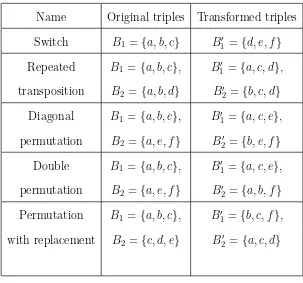
Each operation is specified as follows. We implicitly assume the existence of a
QSTS(v) Q. Let B1, B2, . . . , Bk be a set of triples in Q for a positive integer k and
let B′
1, B2′, . . . , Bk′ be a set of new triples which will replace B1, B2, . . . , Bk in Q to
produce a new QSTS(v) Q′. Any possible transformation can be represented in this
way, but we are only interested in those such that l(Q′) ≤ l(Q). In general, we
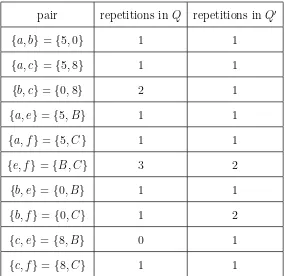
analyze the possibility that a proposed transformations and a specific QSTS satisfies
this condition by using the following.
Lemma 29 The above described transformation yields a QSTS(v) Q′ such that