ALTERNATIVE PUBLISHING MODELS
John W. Houghton
Centre for Strategic Economic Studies, Victoria University PO Box 14428, Melbourne, Victoria 8001, Australia
e-mail: [email protected]
Abstract
This paper reports findings from a project undertaken for the Joint Information Services Committee (JISC) in the UK which explored the Economic Implications of Alternative Scholarly Publishing Models [1]. The aim of the project was to examine the costs and potential benefits of the major emerging models for scholarly pub-lishing, including subscription pubpub-lishing, open access publishing and self-archiving. To ensure that cost-benefit comparisons can be made, analysis focuses on self-archiving models that include the certification and quality control functions necessary for formal scholarly publishing, namely (i) ‘Green OA’ self-archiving in parallel with subscription publishing and (ii) the deconstructed or overlay journals model in which self-archiving provides the foundation for overlay journal ser-vices. Adopting a formal approach to modelling the process and identifying activ-ity costs, this paper examines scholarly communication life-cycle costs per article. It concludes that different scholarly publishing models can make a material differ-ence to returns to R&D expenditure as well as the costs faced by various stake-holders. It seems likely that more open access would have substantial net benefits in the longer term and, while net benefits may be lower during a transitional period, they are likely to be positive for both open access publishing and self-archiving alternatives.
Keywords:
scholarly publishing; open access; economics; cost-benefit analy-sis; alternative business models.1. Introduction
wealth. It is not simply about pushing back the frontiers of knowledge; it is also about the more effective use and exploitation of all types of knowledge in all man-ner of economic activities [2]. In a knowledge economy, innovation and the capac-ity of the system to create and disseminate the latest scientific and technical infor-mation are important determinants of prosperity [3]. Scholarly publishing plays a key role as it is central to the efficiency of research and to the dissemination of re-search findings and diffusion of scientific and technical knowledge. However, ad-vances in information and communication technologies are disrupting traditional publishing models, radically changing our capacity to reproduce, distribute, con-trol and publish information. In such an environment, one key question is whether there are new opportunities and new models for scholarly publishing that might better serve researchers and more cost-effectively communicate and disseminate research findings [4].
To date, debate on the economics of scholarly publishing and alternative pub-lishing models has focused almost entirely on costs. From an economic perspec-tive, however, the aim should be to have the most cost-effective system, not (nec-essarily) the cheapest, and however much one studies costs one cannot know which is the most cost-effective system until one examines both the costs and the benefits. The aim of the JISC EI-ASPM Project was to examine both costs and bene-fits, and in so doing to inform policy discussion and help stakeholders better understand the economic implications of alternative models for scholarly publish-ing [5].
The JISC EI-ASPM Project relied primarily on existing sources, collating activ-ity cost information from a wide-ranging literature on scholarly publishing [6]. Where necessary, these sources were supplemented by informal consultation with experts in the field (e.g. in relation to scholarly book publishing, book distribution and discounts, library purchasing practices, repository operations and statistics, etc.). The project report presented a summary of the estimated costs and benefits, together with a full disclosure of sources and modelling assumptions. An simpli-fied version of the JISC EI-ASPM Model has been made available online so that in-terested parties can explore the impacts of alternative assumptions, variables and costings [7].
2. Publishing
models
on two publishing models in which self-archiving is complemented by the peer review and production activities necessary for formal publishing, namely: (i) Green OA self-archiving operating in parallel with subscription publishing; and (ii) the deconstructed or overlay journals model in which self-archiving provides the foundation for overlay journals and services (e.g. peer review, branding and quality control services) which depend on repositories to provide registration, awareness, access and archiving. Thus all of the publishing models explored in-clude the key functions of scholarly publishing (i.e. registration, certification, dis-semination/awareness and preservation).
These publishing models are not necessarily alternatives. For example, self-archiving may depend on subscription publishing for peer review (e.g. ‘Green OA’), and open access publishing does not prevent self-archiving (e.g. the self-archiving of pre-prints). There are also a number of variations, hybrids and alter-natives (e.g. delayed open access, open choice/author choice, etc.). Moreover, in practice, models co-exist in various mixes in different fields of research. Neverthe-less, these models do have some key defining characteristics, and these characteris-tics have cost implications for producers, intermediaries and the users and consumers of content, as well as for the flow of funds between them and the bene-fits each receives. They also have implications for the efficiency of research, the ac-cessibility of research findings and their impacts, and thereby, for returns on investment in R&D.
2.1. Subscription or toll access publishing
Subscription or toll access publishing refers to journal (and database) publishing and includes individual subscriptions and the so called Big Deal – where institu-tional subscribers pay for access to online aggregations (e.g. of journal titles) through consortial or site licensing arrangements. In a wider sense, subscription or toll access publishing includes any publishing business model that imposes reader access tolls and restrictions on content use designed to maintain publisher control over that access in order to enable the collection of those tolls.
The key characteristics of subscription or toll access scholarly publishing include: - A primary focus on scholarly journals and journal articles, although publishing
research monographs is also characteristically toll access;
- Quality control, with much of the content being peer reviewed prior to publica-tion;
- Reader access requires a toll payment by the reader or an intermediary (e.g. re-search libraries);
- Publisher intellectual property requirements and/or licensing conditions set li-mitations on access to and use of the content;
- Online access to a particular publisher’s titles is typically provided through proprietary access systems and/or access restricted websites.
2.2. Open access
Definitions of Open Access vary with major statements, such as The Budapest Open Access Initiative, The Bethesda Statement and The Berlin Declaration, devel-oping the core concepts over time. Referring to these collectively as the ‘BBB’ defi-nition, Peter Suber (2007) suggested that open access removes price barriers (e.g.
subscription fees) and permission barriers (e.g. copyright and licensing restric-tions) to royalty-free literature (i.e. scholarly works created for free by authors), making them available with minimal use restrictions (e.g. author attribution) [8]. The key characteristics being free online access with minimal use restrictions.
Bailey (2006) noted several key points. First, open access works are freely avail-able. Second, they are online, which would typically mean that they are digital documents available on the Internet. Third, they are scholarly works – romance novels, popular magazines, self-help books, and the like are excluded. Fourth, the authors of these works are not paid for their efforts [perhaps, more accurately, not paid for the content]. Fifth, since most (but not all) authors of peer-reviewed jour-nal articles are not paid and such works are scholarly, these articles are identified as the primary type of open access material. Sixth, there are an extraordinary number of permitted uses for open access materials. Aside from the requirements of proper attribution of the author and the assurance of the integrity of the work, users can copy and distribute open access works without constraint. Seventh, there are two key open access strategies: open access journals and self-archiving [9].
2.2.1. Open Access publishing
Open Access publishing (OA publishing) refers to journal publishing and includes situations where authors, their employing or funding organizations or other sup-porters contribute to the costs of publication in open access journals in the form of submission and/or publication payments (i.e. ‘author-pays’), and/or sponsor and support the operation of journals that are free to both readers and authors (i.e. do not charge ‘author fees’).
The key characteristics of OA publishing include:
- A primary focus on scholarly journals and journal articles, although OA scho-larly book publishing is now emerging;
- Toll-free reader access to the online version of journal articles or books for any-one with Internet access;
- Authors, their funders or supporting institutions may be required to pay publi-cation fees (e.g. in the ‘author-pays’ model), although often they are not; - Less restrictive conditions are placed on use, although practices vary
depend-ing on publisher choice – with some publishers demanddepend-ing copyright while others adopt more flexible licensing alternatives (e.g. creative commons or simi-lar licensing).
A key distinction is that between OA journals that impose publication charges (i.e.
‘author-pays’) and those that do not.
There are also a number of hybrids, such as: delayed open access (i.e. where journals allow open access after a period during which articles are accessible to subscribers only); open choice / author choice (i.e. where authors can choose to pay author fees and make their works open access, or not to pay and make their works subscription only); and online open access (i.e. where journals allow free access to the online edition, while charging subscription fees for the print edition). Willinsky (2007) also mentioned ‘development open access’ (i.e. where journals provide free access for organisations and/or individuals in developing countries), and referred to subscription journal publishers that allow self-archiving as ‘archi-val open access’ [10].
The key characteristics of such models relate to the speed of access and delay imposed, uncertainty as to access for readers due to the mix of open and closed material, the variety of practices regarding imposition of copyright and use limita-tions versus the adoption of creative commons or similar licensing, and placement of the material in proprietary publishers’ access systems used for subscription publishing. As a result, many of these hybrid and transitional models cannot be considered to meet widely accepted definitions of open access (i.e. available free, immediately and with minimal restrictions on use).
2.2.2. Self-archiving
institu-tion (e.g. holding collections for research management and reporting, open courseware and course-packs, etc.). Subject repositories tend to focus more on pre- and post-prints and work that has been subjected to editorial and/or peer review, while institutional repositories tend to be somewhat more varied in their content and levels of review [11].
The key characteristics of OA self-archiving include:
- Accommodation of a wider range of outputs than journals and journal articles alone;
- Limited quality control, with a mix of peer reviewed and non-peer reviewed content (e.g. pre- and prints), although some editorial oversight of post-ings is common;
- Toll-free access for authors and readers;
- Authors may grant greater freedom of use (e.g. creative commons or similar li-censing), although practices vary considerably;
- Enhanced discoverability, with subject and institutional repositories providing metadata and adopting standards that ensure the material is discoverable through general purpose web searchers as well as specialised searchers (e.g.
OAI-PMH).
Material deposited in such repositories may include journal articles prepared for and/or submitted for publication (i.e. pre-prints), articles that have been accepted for publication and/or published (i.e. post-prints), and/or a range of other research outputs, such as working papers, pre- or post-print book chapters or entire books, project reports, field or laboratory reports, and a range of research-related non-text digital objects, such as sound or image files, data collections, models, software, etc. as well as theses and dissertations, course material and learning objects. However, of itself, self-archiving does not constitute formal publication, except when it is formal publications that are self-archived (e.g. post-print journal articles, book chapters and books, etc.). Self-archiving other materials is a mechanism for the communication and the dissemination of informally-published and unpublished works.
qual-ity control services), which depend on OA repositories to provide registration, awareness, access and archiving, while adding value to their content through qual-ity control – but not paralleling the other functions [12].
To ensure that cost-benefit comparisons can be made, this paper focuses on those self-archiving models that include the certification and quality control func-tions necessary for formal scholarly publishing, namely: (i) Green OA self-archiving operating in parallel with subscription publishing; and (ii) the decon-structed or overlay journals model in which self-archiving provides the foundation for overlay journal services.
3.
Identifying costs and benefits
The first phase of the JISC EI-ASPM Project sought to describe the three models of scholarly publishing, identify all the dimensions of cost and benefit associated with each of the models, and examine which of the main players in the scholarly communication system would be affected and how they would be affected by the use of alternative publishing models. In order to provide a solid foundation for analysis we developed and extended the scholarly communication life-cycle model outlined by Björk (2007) [13].
3.1. Identifying costs: The scholarly communication process model
Björk (2007) developed a formal model of the scholarly communication life-cycle to act as a roadmap for policy discussion and research concerning the process. Based on the IDEF0 process modelling method, often used in business process re-engineering, it provided the first detailed ‘map’ of the scholarly publishing proc-ess. Björk’s central focus was the single publication (primarily the journal article), how it is written, edited, printed, distributed, archived, retrieved and read, and how eventually its reading may affect practice. Björk’s model included the activi-ties of the: researchers who perform the research and write the publications; pub-lishers who manage and carry out the actual publication process; academics who participate in the process as editors and reviewers; libraries who help in archiving and providing access to the publications; bibliographic services who facilitate the identification and retrieval of publications; readers who search for, retrieve and read publications; and practitioners who implement the research results directly or indirectly [14].
communication process activities, namely: (i) fund research and research commu-nication; (ii) perform research and communicate the results; (iii) publish scientific and scholarly works; (iv) facilitate dissemination, retrieval and preservation; and (v) study publications and apply the knowledge (Figure 1). This formal process modelling was used to identify activities and activity costs, and in its current form the model includes 53 diagrams and 190 activities. Details of the entire model in ‘browseable’ form can be found on the Web at http://www.cfses.com/EI-ASPM/ SCLCM-V7/.
Figure 1: The scholarly communication process: Fund research, perform research, publish scientific and scholarly works, disseminate and preserve, study and apply.
3.2. Identifying benefits: Dimensions of impact and benefit
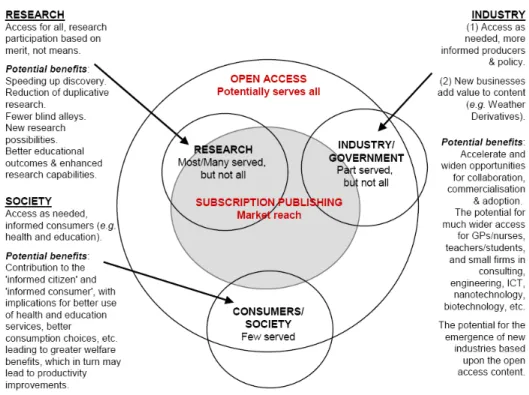
There are various ways to explore the impacts and possible benefits of different scholarly publishing models. Focusing on access and use, Houghton et al. (2006) noted that potential benefits include impacts relating to research use, industry and government use, and use by the wider community [15]. They suggested that the most immediate impacts would be felt within research,wherein potential benefits include:
- Speed of access, speeding up the research and discovery process, reducing the time and cost involved in achieving a given outcome and, thereby, improving the efficiency of R&D;
- More complete access, leading to better informed research, reducing the pur-suit of blind alleys and duplicative research, saving wasteful R&D expenditure and, thereby, improving the efficiency of R&D;
O1 I1 I2 O2 C2 C1 M1 Study publication and apply knowledge A5 Facilitate dissemination, retrieval and preservation A4 Publish scientific / scholarly works A3 Perform research and communicate results A2 Fund R&D and
communication A1
Improved quality of life
New knowledge & greater awareness Disseminated scientific knowledge
Scientific / scholarly publications Existing knowledge
Scientific/Scholarly problems
New knowledge Public/Tax funding (Block & Competitive Grants)
Commercial, government or NGO funding (Contract) Donations and Philanthropic Grants
Funding for research and communication
Access to publications
Copyright restrictions on reusing material
Infomediaries Libraries IP restrictions / licensing
Commercial, society or institutional publisher Commercial publishing considerations Scientific/Scholarly curiosity Researchers Economic incentives Philanthropic funders Society needs Commercial needs Research Councils Norms of science/scholarship
Evaluation of the contribution
- Wider access, providing enhanced opportunities for multi-disciplinary research, inter-institutional and inter-sectoral collaborations, and enabling researchers to study their context more broadly, potentially leading to increased opportuni-ties for application and commercialisation;
- Greater public access, potentially leading to improved research education out-comes and enabling a given education spend to produce a higher level of edu-cational attainment, leading to an improvement in the quality of the ‘stock’ of researchers and research users.
Given relative levels of access under the subscription or toll access publishing sys-tem, Houghton et al. (2006) suggested that the impacts of enhanced access for in-dustry and government users may also be significant, with potential benefits including:
- The potential for wider access to both accelerate and widen opportunities for adoption and commercialisation of research findings, thereby increasing re-turns on (public) investment in R&D and reducing the cost of (private) invest-ment in its commercialisation;
- The potential for wider access for doctors and nurses, teachers and students, smaller firms in knowledge-intensive industries, such as consulting, engineer-ing, architecture and design, electronics, software, biotechnology, nanotechnol-ogy, etc., with a positive impact on quality of service, innovation and produc-tivity in those sectors of the economy; and
- The potential for the emergence of new industries based on readily accessible content (as happened with the Weather Derivatives industry based on meteo-rological data) [16], with potential for the emergence of value adding services overlaying the content (e.g. peer review services, bibliometrics and webome-trics for research evaluation, etc.).
Impacts might be felt more in particular industries (e.g. knowledge intensive ser-vices, biotechnology, etc.). Impacts in such areas as management and economic consulting and engineering might be significant, raising the quality of advice to the benefit of clients across the economy. There may also be significant impacts on policy development, through more informed policy debate and enhanced access to the ‘science’ underpinning policy decisions. One particularly important dimension might be the potential for greater access for small firms, enabling them to do more research internally, thereby increasing their ‘absorbtive capacity’ and enabling them to be more innovative [17].
Figure 2: An impacts framework: subscription publishing versus open access.
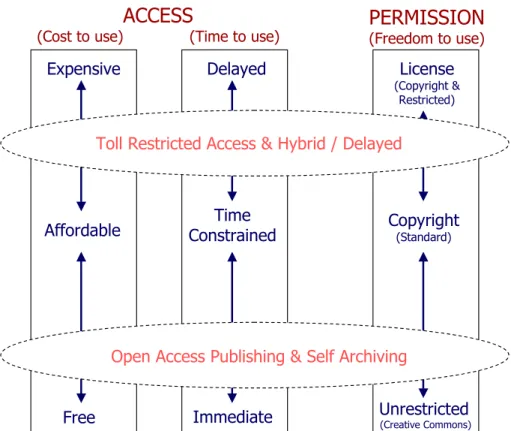
While providing a useful starting point, their analysis focused on use impacts and did not explore the production-side impacts fully or explicitly. The key issues in open access are access and permission – where access includes accessibility in the sense of ease and affordability (time and cost), and permission refers to permission to use the material in terms of what is permitted and the time and cost involved in checking and obtaining permission. This suggests analysis along the overlapping dimensions of access and permission, mediated by cost in terms of both money and time. In essence, setting the publishing models against the ‘ideal’ of open ac-cess (i.e. for free, immediate and unrestricted access) by exploring the time and cost involved in accessing and using scientific and scholarly works and whenever required for whatever purpose (Figure 3).
Drawing on a number of previous reviews and following an established lead, Martin and Tang (2007) explored seven mechanism or channels through which the benefits of publicly funded research may flow through to the economy or to soci-ety more generally, namely:
1. An increase in the stock of useful knowledge; 2. The supply of skilled graduates and researchers;
5. The enhancement of problem solving capacity; 6. The creation of new firms;
7. The provision of social knowledge [18].
Figure 3: Dimensions of impact and benefit: access and permission.
Enhanced access and reduced permissions barriers are important in all of these (arguably, with the exception of number 3). More open and less restricted access would effectively increase the stock of useful knowledge that is accessible to would-be users; contribute through impacts on education to enhancing the supply and skills of researchers; enable the development of networks on the basis of a shared, common and complete set of information; enhance problem solving capac-ity by providing the necessary supporting information; enable the provision of a range of social knowledge (e.g. in health care); and provide opportunities for the emergence of new firms and new industries (as noted above).
Of course, the principal input to the process of performing research and com-municating the results is existing knowledge, as the production of knowledge depends, in large part, on its consumption. Hence, costs and benefits on the
pro-ACCESS
(Cost to use) (Time to use)
PERMISSION
(Freedom to use)Free
Expensive
Affordable
Constrained
Time
Copyright
(Standard)Immediate
License
(Copyright &Restricted)
Delayed
Unrestricted
(Creative Commons)
Toll Restricted Access & Hybrid / Delayed
duction-side also relate, in large part, to access and permission – the costs associ-ated with limiting and managing access, copyright, licensing and permissions; and the cost savings (benefits) of not doing so. Indirect benefits also relate, in large part, to access and permission – the greater use, higher profile and higher im-pact/return for funders, researchers and research institutions, publishers and those facilitating dissemination, retrieval and preservation. Access and permission, therefore, are crucial to the overall efficiency of the scholarly communication sys-tem.
Hence, our approach to exploring and quantifying costs, impacts and benefits is twofold. First, a detailed ‘bottom up’ costing which provides a foundation for the estimation of cost savings and the development of scenarios exploring impacts and benefits. Second, a ‘top down’ modelling of impacts on returns to R&D through further development and application of the modified Solow-Swan model outlined in Houghton et al. (2006) and Houghton and Sheehan (2006; 2009), which introduced accessibility and efficiency into the standard model as negative variables, in order to explore the impact of increasing accessibility and efficiency on returns to R&D expenditure [19].
4.
Quantifying costs and benefits
There are three elements to our approach to quantifying costs and benefits. First, we explore the costs of the process activities and system costs, and from that we can see cost differences and direct savings. Second, we present cases and scenarios to explore the potential cost savings resulting from alternative publishing models (looking, for example, at impacts on search and discovery, library handling costs, etc.), and from that we can explore the indirect cost differences. Third, we ap-proach the issue from the top down and model the impact of changes in accessibil-ity and efficiency on returns to R&D. This paper presents an example from each of these steps.
4.1. Estimating process activity and system costs
electronic production) and electronic-only formats for toll and open access busi-ness models, and then to compare toll and open access models as if they were all electronic or ‘e-only’. All of the costings included commercial publisher manage-ment, investment and operating margins. A summary of the journal publisher ac-tivities costed can be found in Annex I.
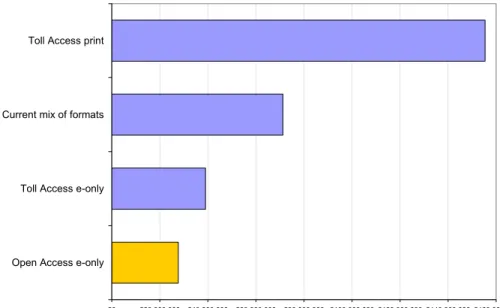
For subscription or toll access publishing, we estimate an average publisher cost of around £3,247 per article for dual-mode production, £2,728 per article for print only production and £2,337 per article for e-only production. All of these exclude the costs associated with external peer review and value-added tax (Fig-ure 4). For open access publishing, we estimate average per article costs at £1,524 for e-only production. We explored the implied publisher costs of overlay services to open access self-archiving (i.e. the deconstructed or overlay journals model) us-ing the same commercial management, investment and profit margins, and found that operating peer review management, editing, production and proofing as an overlay service would cost around £1,125 per article excluding hosting, or £1,260 including hosting.
Figure 4: Estimated average publisher costs per article by format and model (GBP, circa 2007) [20].
Not surprisingly, the cost difference between print and electronic formats is often greater than the difference between toll and open access publishing models. One example is that of estimated UK higher education library handling costs (Figure 5), for which the difference between toll access print and e-only is much greater than
£0 £500 £1,000 £1,500 £2,000 £2,500 £3,000 £3,500 Subscription PRINT
the difference between toll and open access models in e-only form. Based on activ-ity times reported in library activactiv-ity surveys [21], we estimate SCONUL library journal handling costs at £112 per title per year for subscription journals in print format, £28 per title for subscription journals in e-only format and £20 per title for open access e-only journals. Of course, this assumes that research libraries con-tinue to play a role in facilitating access to open access journals, in cataloguing and linking, user instruction and so on.
Figure 5: Estimated SCONUL library handling costs by mode and model (UK Higher Educa-tion, 2006-07).
At 2006-07 subscription levels, we estimate that journal handling activities alone would have cost SCONUL libraries £155 million if they had all been print sub-scriptions, £39 million if they had all been e-only subsub-scriptions, and £28 million if they had been open access e-only. The mix of formats acquired by SCONUL librar-ies in 2006-07 is estimated to have involved journal handling costs of around £70 million. Hence, in an open access world, a shift to open access journal publishing could save SCONUL libraries around £44 million a year in handling costs, in addi-tion to subscripaddi-tions expenditures of around £113 million.
4.2. Estimating system costs, cost differences and savings
In the second of the three steps, we sum the costs of the three publishing models through the main phases of the scholarly communication life-cycle, including
re-£0 £20,000,000 £40,000,000 £60,000,000 £80,000,000 £100,000,000 £120,000,000 £140,000,000 £160,000,000
search production, publisher, and library and dissemination activities, to highlight system cost differences. From this we can estimate potential cost savings from the alternative publishing models.
Figure 6: Estimated scholarly communication system costs per article (GBP, circa 2007) [22].
Summing the costs of production, publishing and dissemination per article in elec-tronic-only format suggests that average subscription or toll access publishing sys-tem costs would amount to around £8,296 per article (excluding VAT), average open access publishing costs would amount to £7,483 per article and average open access self-archiving costs would amount to £7,115 per article (including overlay review and production services with commercial margins). At these costs, open access publishing would be around £813 per article cheaper than subscription or toll access publishing, and open access self-archiving with overlay services around £1,180 per article cheaper (Figure 6). For the journal article output of UK higher education in 2007, these journal article cost differences would have amounted to savings of around £80 million per annum from a shift from subscription access to open access publishing, and £116 million per annum from a shift from subscription access to open access self-archiving with overlay services.
In addition to direct cost differences, there are potential system cost savings in the discovery, access, dissemination and use of the content. Based on the cases and scenarios explored in the JISC EI-ASPM study we estimate that open access pub-lishing for journal articles might have brought system savings of around £215 mil-lion per annum nationally in the UK (at 2007 prices and levels of publishing
£6,500 £7,000 £7,500 £8,000 £8,500
activity), of which around £165 million would have accrued in higher education. The open access self-archiving with overlay services model explored in the study is necessarily speculative, but a repositories and overlay services model may well produce greater cost savings than open access publishing – with our estimates suggesting system savings of perhaps £250 million nationally, of which around £200 might have accrued in higher education.
These savings can be set against the cost of open access publishing, which if all journal articles produced in the UK had encountered author fees of £1,500 per arti-cle published would have been around £170 million nationally in 2007, of which around £150 million would have been faced by higher education institutions. While repository costs vary widely, we estimate that a system of publications-oriented repositories in which all articles were self-archived once would have cost around £22 million nationally, of which £18 million would have been for higher education.
4.3. Comparing estimated costs and savings
In simplified form, the following figures summarise the estimated impacts for the UK nationally and for UK higher education of unilateral national and worldwide adoption of alternative open access publishing models, including (i) ‘Green OA’ self-archiving, (ii) ‘Gold OA’ or author-pays journal publishing, and (iii) self-archiving with overlay services (i.e. the deconstructed or overlay journals model). Increased returns are from public sector and higher education R&D spending expressed as annual increases in current values [23]. As many of the potential cost savings could not be fully realised unless there was worldwide open access and all schol-arly articles were open access, research and library handling cost savings are scaled to UK article outputs in the unilateral national open access scenarios.
Separating modelled increases in returns to R&D resulting from enhanced ac-cess from the cost impacts, these figures also present the net cost impacts of the al-ternative publishing models. Where net cost is negative it represents a saving, and where positive it represents a cost (i.e. effectively the investment required to obtain the increased returns). For example, at 2007 prices and levels of publishing activ-ity, it is estimated that unilateral ‘Green OA’ in the UK would have brought net benefits of £114 million per annum from higher education but would have re-quired an additional cash spend of £10 million, whereas with worldwide ‘Green OA’ the net benefits would have been £182 million as a part of which there would have been a cost saving in higher education of £57 million (Figure 7).
returns to R&D that might arise from enhanced access. Thus, it seems possible that in an open access world open access publishing alternatives could be supported from within existing budgetary allocations [24].
Figure 7: Estimated cost impact of “Green” OA self-archiving (GBP millions per annum).
Figure 8: Estimated cost impact of “Gold” OA publishing (GBP millions per annum).
£106 £73 £172 £172 £124 £124
-£22 -£22 -£18 -£18
£1 £2 £1 £2 £6 £9 -£50 £0 £50 £100 £150 £200 £250 £300
National UK (Worldwide OA) National UK (Unilateral OA) Higher Education (Worldwide OA) Higher Education (Unilateral OA)
Benefit 258m (Net Cost -86m) Benefit 160m (Net Cost 12m) Benefit 182m (Net Cost -57m) Benefit 114m (Net Cost 10m) Funder Savings Research Savings Publisher Savings Library Savings Subscription Costs Increased Returns Repository Costs
National + Higher Education
£2 £2 £106 £73 £93 £93 £80 £11 £11 £1 £113 £124 £124
-£172 -£172 -£148 -£148 £1 £1 £6 £9 £80 £1 £113 £172 £172 -£200 -£100 £0 £100 £200 £300 £400 £500
National UK (Worldwide OA) National UK (Unilateral OA) Higher Education (Worldwide OA) Higher Education (Unilateral OA)
Benefit 326m (Net Cost -154m) Benefit 104m (Net Cost 68m) Benefit 256m (Net Cost -132m) Benefit 65m (Net Cost 59m) Funder Savings Research Savings Publisher Savings Library Savings Subscription Costs Increased Returns Author Fees
Figure 9: Estimated cost impact of OA self-archiving with overlay services (GBP millions per annum)
4.4. Estimating the impact of more open access on returns to R&D
In the third of the three major steps we modify a basic Solow-Swan model to esti-mate the impacts of changes in accessibility and efficiency on returns to R&D [25]. The standard Solow-Swan approach makes some key simplifying assumptions, including that:
- All R&D generates knowledge that is useful in economic or social terms ( effi-ciency of R&D);
- All knowledge is equally accessible to all entities that could make productive use of it (accessibility of knowledge); and
- All types of knowledge are equally substitutable across firms and uses ( substi-tutability).
A good deal of work has been done to address the fact that the substitutability as-sumption is not realistic, as particular types of knowledge are often specialised to particular industries and applications. Much less has been done about the other two, equally unrealistic, assumptions. Addressing these, we introduce accessibility
and efficiency as negative or friction variables, to reflect the fact that in the real
world there are limits and barriers to access and to the efficiency of production and usefulness of knowledge. Then we explore the impact on returns to R&D of reducing the friction by increasing accessibility and efficiency [26].
We produced range estimates, looking at rates of return from 20% to 60% and increases in access and efficiency of 1% to 10%, and produce a table for each major
£106 £73 £138 £138 £119 £119 £11 £1 £11 £1 £113 £113 £172 £172 £124 £124 £1 £1 £2 £2 £6 £9
-£22 -£22 -£18 -£18 -£100 £0 £100 £200 £300 £400 £500 £600
National UK (Worldwide OA) National UK (Unilateral OA) Higher Education (Worldwide OA) Higher Education (Unilateral OA)
Benefit 520m (Net Cost -349m) Benefits 299m (Net Cost -127m) Benefits 425m (Net Cost -301m) Benefits 234m (Net Cost -110m) Funder Savings Research Savings Publisher Savings Library Savings Subscription Costs Increased Returns Repository Costs
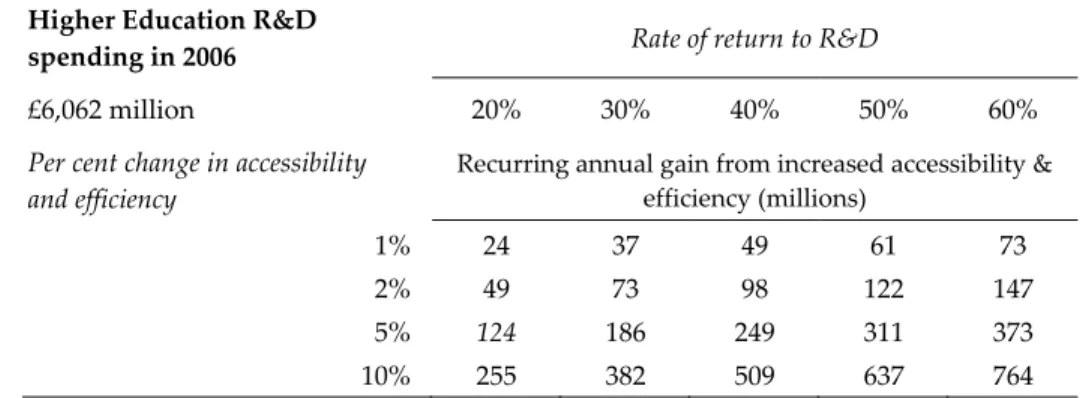
category of R&D expenditure (Table 1). The ranges are quite large, but for the pur-poses of discussion based on an extensive review of the literature, we take the lower bound average 20% social return on public sector R&D and suggest that a 5% increase in accessibility and efficiency might be plausible. Despite limitations in models of this type these model parameters are well grounded, and if anything, err on the conservative side [27]. For example, the percentage change in accessibility
and efficiency is based on metrics relating to: the share of publications in general
and journals in particular in the research stock of knowledge; the share of the re-search stock of knowledge potentially available to open access; a number of proxy measures of accessibility, including UK research library subscriptions and conser-vative estimates of the open access citation advantage; and a number of estimates of the potential efficiency implications of access limitations, such as poorly in-formed and duplicative research, and of relaxing those limitations, such as speed-ing up the research and discovery process and facilitatspeed-ing greater collaboration.
Higher Education R&D
spending in 2006 Rate of return to R&D
£6,062 million 20% 30% 40% 50% 60%
Per cent change in accessibility and efficiency
Recurring annual gain from increased accessibility & efficiency (millions)
1% 24 37 49 61 73
2% 49 73 98 122 147
5% 124 186 249 311 373
10% 255 382 509 637 764
Table 1: Impact estimation ranges: UK Higher Education Expenditure on R&D (GBP mil-lions, 2006).
Rates of return to R&D spending vary considerably, so the further one moves from the aggregate the larger the range of uncertainty. Nevertheless, given a 20% rate of return to public sector R&D, for the major categories of research expenditure in the UK in 2006 a 5% increase in accessibility and efficiency would have been worth:
- £172 million a year in increased returns to public sector R&D;
- £124 million a year in increased returns to Higher Education R&D (Table 1); and
- Around £33 million a year in increased returns to UK Research Councils com-petitive grants funded research.
5.
Comparing costs and benefits
It’s not possible to compare subscription with open access publishing directly at the national level, because they perform very different roles: subscription publish-ing seeks to provide UK subscribers with access to worldwide research (to the lim-its of affordability); whereas open access seeks to provide worldwide access to UK research. These are very different things. Therefore, we explore the lower and up-per bounds. First, we explore the cost-benefit implications of simply adding open access publishing and self-archiving to current activities, all other things remain-ing the same (i.e. ceteris paribus scenarios); and then we explore the implications of open access publishing and self-archiving as alternatives to current activities, by adding the estimated savings to estimated increases in returns to R&D (i.e. net cost scenarios) (Figure 10).
Figure 10: Conceptual map of benefit/cost scenarios.
One major issue in comparing costs and benefits over a period is whether to model the transitional period or a ‘steady-state’ alternative system. Because of the lag be-tween research expenditure and the realisation of economic and social returns to that research, the impact on returns to R&D is lagged and the value of those re-turns discounted accordingly. This reflects the fact that a shift to open access
pub-Toll Access System Costs
Open Access System Costs
Increased Returns
To R&D
Savings
Costs
Costs Benefits
Benefits
OA Publisher
Costs
Increased Returns
To R&D Ceteris Paribus Scenarios: Adding OA costs to existing system
lishing or self-archiving would be prospective and not retrospective, and that the economic value of impacts of enhanced accessibility and efficiency would not be reflected in returns to R&D until those returns were realised. Put simply, this has the effect that over a transitional period of 20 years one is comparing 20 years of costs with 10 years of benefits. An alternative approach would be to model a hypo-thetical ‘steady-state’ system for alternative publishing models in which the bene-fits of historical increases in accessibility and efficiency enter the model in year one. This would reflect the situation in an alternative system, after the transition had worked through and was no longer affecting returns to R&D. Put simply, in such a model one would be comparing 20 years of costs with 20 years of benefits.
We took the view that it was more realistic and of more immediate concern to model the transition. Nevertheless, it must be emphasised that a transitional model returns significantly lower benefit/cost ratios than would a hypothetical al-ternative ‘steady-state’ model. To explore the extent of the difference we ‘force fed’ our transitional model by simply putting the increase in returns to R&D into year one – effectively ignoring the lag between R&D expenditure and the realisation of impacts and thus simulating the situation in which the benefits of historical in-creases in accessibility and efficiency enter the model in year one. To an approxi-mation, the increased returns in a steady-state model might be 3 to 10 times greater than in the transitional model.
The cost-benefit comparisons performed suggest that the additional returns to R&D resulting from enhanced accessibility and efficiency alone would be suffi-cient to cover the costs of parallel open access self-archiving without subscription cancellations (i.e. Green OA). When estimated savings are added to generate net costs there is a substantial increase in the benefit/cost ratios, and for both open ac-cess publishing and self-archiving (i.e. Gold OA as well as Green OA) the benefits exceed the costs, even in transition. Indicative modelling of post-transition ‘steady-state’ alternative systems suggests that, once established, alternative open access publishing and/or self-archiving models would produce substantially greater net benefits.
Net Cost Scenarios Benefits Benefit/ Cost Ratio Costs Savings Increased returns
Ceteris Paribus Scenarios
Transitional Model:
OA Publishing in HE (unrealistic) 1,787 .. 615 0.3 OA Publishing Nationally (unrealistic) 2,079 .. 2,353 1.1
OA Repositories in HE 189 .. 615 3.2
OA Repositories Nationally 237 .. 2,353 9.9
Simulated Steady State Model:
OA Publishing in HE (unrealistic) 1,787 .. 6,876 3.8 OA Publishing Nationally (unrealistic) 2,079 .. 26,318 12.7
OA Repositories in HE 189 .. 6,876 36.3
OA Repositories Nationally 237 .. 26,318 110.8
Net Cost Scenarios
Scenario (Unilateral UK Open Access)
Transitional Model:
OA Publishing in HE 1,787 1,068 615 0.9
OA Repositories in HE (Green OA) 189 76 615 3.7 OA Repositories in HE (Overlay
Ser-vices) 189 1,330 615 10.3
OA Publishing Nationally 2,079 1,261 2,353 1.7 OA Repositories Nationally (Green OA) 237 106 2,353 10.4 OA Repositories Nationally (Overlay
Services) 237 1,563 2,353 16.5
Simulated Steady State Model:
OA Publishing in HE 1,787 1,068 6,876 4.4
OA Repositories in HE (Green OA) 189 76 6,876 36.7 OA Repositories in HE (Overlay
Ser-vices) 189 1,330 6,876 43.3
OA Publishing Nationally 2,079 1,261 26,318 13.3 OA Repositories Nationally (Green OA) 237 106 26,318 111.3 OA Repositories Nationally (Overlay
Services) 237 1,563 26,318 117.4
Scenario (Worldwide Open Access)
Transitional Model:
OA Publishing in HE 1,787 3,382 615 2.2
OA Repositories in HE (Green OA) 189 786 615 7.4 OA Repositories in HE (Overlay
Ser-vices) 189 3,326 615 20.8
OA Publishing Nationally 2,079 3,941 2,353 3.0
cont’d
Net Cost Scenarios Benefits Benefit/
Cost Ratio Costs Savings Increased returns
OA Repositories Nationally (Green OA) 237 1,132 2,353 14.7 OA Repositories Nationally (Overlay
Services) 237 3,875 2,353 26.2
Simulated Steady State Model:
OA Publishing in HE 1,787 3,382 6,876 5.7
OA Repositories in HE (Green OA) 189 786 6,876 40.5 OA Repositories in HE (Overlay
Ser-vices) 189 3,326 6,876 53.9
OA Publishing Nationally 2,079 3,941 26,318 14.6 OA Repositories Nationally (Green OA) 237 1,132 26,318 115.6 OA Repositories Nationally (Overlay
Services) 237 3,875 26,318 127.2
Table 2: Summary of benefit/cost comparisons (GBP millions and benefit/cost ratio) [29].
6. Conclusions
The costs, benefits and impacts of alternative scholarly publishing models revealed in the JISC EI-ASPM study demonstrate that research and research communication are major activities and the costs involved are substantial. Preliminary analysis of the potential benefits of more open access to research findings suggests that re-turns to research can also be substantial, and that different scholarly publishing models can make a material difference to the returns realised as well as the costs faced. It seems likely that more open access would have substantial net benefits in the longer term and while net benefits may be lower during a transitional period, they are likely to be positive for both open access publishing and self-archiving al-ternatives. This suggests that there are likely to be gains realised from moving to-wards more open access scholarly publishing models.
Acknowledgements
also benefited from the very generous contributions of Bo-Christer Björk of the Hanken School of Economics in Helsinki, and Donald King of the University of North Carolina. The JISC EI-ASPM Project research team included Australian and UK-based groups. The Australian team was led by John Houghton and included Bruce Rasmussen and Peter Sheehan of The Centre for Strategic Economic Studies at Victoria University in Melbourne, together with Colin Steele, Emeritus Fellow at The Australian National University in Canberra; and the UK team was led by Charles Oppenheim and included Anne Morris of the Department of Information Science, Claire Creaser, Helen Greenwood and Mark Summers of LISU, and Adrian Gourlay of the Department of Economics, at Loughborough University.
Notes and references
[1] HOUGHTON, J.W., RASMUSSEN, B., SHEEHAN, P.J., OPPENHEIM, C., MORRIS, A., CREASER, C., GREENWOOD, H., SUMMERS, M. and GOURLAY, A. Economic Implications of Alternative Scholarly Publishing Models: Exploring the Costs and Benefits, London & Bristol: The Joint Information Sys-tems Committee (JISC), 2009. Available http://www.cfses.com/EI-ASPM/ (March 2009).
[2] Department of Trade and Industry (DTI), Building the Knowledge Driven Econ-omy: Competitiveness White Paper, London: Department of Trade and Industry, 1998.
[3] DAVID, P. and FORAY, D. Assessing and Expanding the Science and Tech-nology Knowledge Base, STI Review, No.16, Paris: Organisation for Economic Cooperation and Development (OECD), 1995 and OECD National Innovation Systems, Paris: Organisation for Economic Cooperation and Development (OECD), 1997.
[4] OECD Digital Broadband Content: Scientific Publishing, Paris: Organisation for Economic Cooperation and Development (OECD), 2005, p. 14.
[5] HOUGHTON, J.W., RASMUSSEN, B., SHEEHAN, P.J., OPPENHEIM, C., MORRIS, A., CREASER, C., GREENWOOD, H., SUMMERS, M. and GOURLAY, A. Economic Implications of Alternative Scholarly Publishing Models: Exploring the Costs and Benefits, London & Bristol: The Joint Information Sys-tems Committee (JISC), 2009. Available http://www.cfses.com/EI-ASPM/ (March 2009).
Unit-ed Kingdom Office of Library and Information Networking, 1999; FriUnit-edlan- Friedlan-der, A. and Bessette, R.S. The Implications of Information Technology for Scientific Journal Publishing: A Literature Review, Washington DC: National Science Foundation, 2003; OECD Digital Broadband Content: Scientific Publishing, Paris: OECD, 2005; European Commission Study on the economic and technical evolu-tion of the scientific publicaevolu-tion markets in Europe, Brussels: European Commis-sion, 2006; Houghton, J.W. Steele, C. and Sheehan, P.J. Research Communication Costs in Australia, Emerging Opportunities and Benefits, Canberra: Department of Education, Science and Training, 2006; EPS, et al. UK scholarly journals: 2006 baseline report – An evidence-based analysis of data concerning scholarly journal publishing, London: Research Information Network, Research Councils UK and Department of Trade and Industry, 2006; KING, D.W. The cost of journal publishing: a literature review and commentary, Learned Pub-lishing 20(2), April 2007, pp. 85-106; BJÖRK, B-C. A model of scientific com-munication as a global distributed information system, Information Research 12(2) paper 307, 2007; CLARKE, R. The cost profiles of alternative approaches to journal publishing, First Monday 12(12), December 2007; and CEPA Activi-ties, costs and funding flows in the scholarly communications system in the UK, London: Research Information Network (RIN), May 2008.
[7] See http://www.cfses.com/EI-ASPM/.
[8] SUBER, P. Open Access Overview: Focusing on open access to peer-reviewed re-search articles and their reprints, 2007. Available http://www.earlham.edu/~ peters/ fos/overview.htm (March 2009).
[9] BAILEY (2006) BAILEY, C.W. What is Open Access? in ed. Jacobs, N. Open Access: Key strategic, technical and economic aspects, Oxford: Chandos Publish-ing, 2006.
[10] WILLINSKY, J. Ensuring a Journal’s Economic Sustainability While Increasing Access to Knowledge, Vancouver: Public Knowledge Project, Simon Fraser University, 2007. Available http://pkp.sfu.ca/node/687/ (January 2008).
[11] TERRY, R. Text mining of subject archives will enable new facts to be discov-ered, Research Information, June/July 2006. Availablehttp://www.researchinfor mation.info/ (November 2007).
GORMAN, G.E. & Rowland, F. International Year Book of Library and Informa-tion Management 2004-2005: Scholarly Publishing in an Electronic Era, London: Facet Publishing, 2005.
[13] BJÖRK (2007) BJÖRK, B-C. A model of scientific communication as a global distributed information system, Information Research 12(2) paper 307, 2007. Available http://informationr.net/ir/12-2/paper307.html (October 2007). [14] BJÖRK (2007) BJÖRK, B-C. A model of scientific communication as a global
distributed information system, Information Research 12(2) paper 307, 2007. Available http://informationr.net/ir/12-2/paper307.html (October 2007). [15] HOUGHTON, J.W., Steele, C. and Sheehan, P.J. Research Communication Costs
in Australia, Emerging Opportunities and Benefits, Canberra: Department of Edu-cation, Science and Training, 2006. Available http://dspace.anu.edu.au/handle/ X1885/44485 (February 2008).
[16] PLUIJMERS, Y. and WEISS, P. Borders in Cyberspace: Conflicting Government Information Policies and their Economic Impacts, April 2005, p. 33. Available http://uo.space.frot.org/archive/borders_weiss.doc (November 2005). STELL, J. Results of the 2005 PwC Survey, Weather Risk Management Association, No-vember 2005. Available http://www.wrma.org/wrma/library/PwCSurveyPre sentationNov92005.ppt (December 2005). See www.wrma.org.
[17] Absorptive capacity is the measure of a firm’s ability to value, assimilate and apply new knowledge. See COHEN, W.M. and LEVINTHAL, D.A. Absorp-tive capacity: A new perspecAbsorp-tive on learning and innovation, Administrative Science Quarterly, 35(1), 1990, pp. 128-152; and ZAHRA, S.A. and GEORGE, G. Absorptive Capacity: A Review, Reconceptualization, and Extention, Academy of Management Review 27(2), 2002, pp. 185-203.
[18] MARTIN, B.R. and TANG, P. The benefits of publicly funded research, SWEPS Paper No. 161, Science Policy Research Unit, Brighton: University of Sussex, 2007. Available http://www.sussex.ac.uk/spru (October 2007).
[19] HOUGHTON, J.W., STEELE, C. and SHEEHAN, P.J. Research Communication Costs in Australia, Emerging Opportunities and Benefits, Canberra: Department of Education, Science and Training, 2006. Available http://dspace.anu.edu.au/ handle/1885/44485 (February 2008). HOUGHTON, J.W. and SHEEHAN, P.J. The Economic Impact of Enhanced Access to Research Findings, CSES Working Paper No.23, Melbourne: Victoria University, 2006. Available http://www. cfses.com/documents/wp23.pdf (November 2007). HOUGHTON, J.W. and SHEEHAN, P.J. Estimating the Potential Impacts of Open Access to Research Findings, Economic Analysis and Policy 39(1), March 2009. Available http:// www.eap-journal.com/ (forthcoming).
with commercial margins. Estimates for print and dual-mode open access pub-lishing exclude copy print and delivery related costs, assuming that the con-tent is produced print ready and print is an add-on.
[21] HalliEday, L. and OpEpenheim, C. Economic Models of the Digital Library, Re-port to UKOLN, Loughborough: Loughborough University, 1999. KING, D.W., AERNI, S., BRODY, F., HERBISON, M. and KOHBERGER, P. Compara-tive cost of the University of Pittsburgh electronic and print library collections, Pittsburgh: University of Pittsburgh, May 2004. SCHONFELD, R.C., KING, D.W., OKERSON, A. and Fenton, G.E. The non-subscription side of periodicals: changes in library operations and costs between print and electronic journals, Washington DC: Council on Library and Information Resources, 2004. SCHONFELD, R.C., KING, D.W., OKERSON, A. and FENTON, G.E. Com-parison of non-subscription costs of print and electronic formats on a life-cycle basis, D-Lib Magazine 10(1), January 2004.
[22] Includes the direct costs of writing, peer review, publishing and disseminat-ing in e-only format, and excludes VAT. Self-archivdisseminat-ing includes publisher production and review costs, including commercial margins (i.e. overlay ser-vices).
[23] Increased returns are recurring gains from one year’s R&D expenditure. Such returns can be expressed in Net Present Value (NPV), lagged and recurring over the useful life of the knowledge. For the sake of simplicity and transpa-rency in these charts we have simply taken the original value of annual re-turns as indicative. In the cost-benefit comparisons present below rere-turns are presented in Net Present Value and lagged.
[24] While it would be necessary to move the funds around within the system (e.g. away from subscriptions towards author fees), overall the funds should be sufficient to cover costs.
[25] HOUGHTON, J.W. and SHEEHAN, P.J. The Economic Impact of Enhanced Access to Research Findings, CSES Working Paper No.23, Melbourne: Victoria University, 2006. Available http://www.cfses.com/documents/wp23.pdf (No-vember 2007). HOUGHTON, J.W. and SHEEHAN, P.J. Estimating the Poten-tial Impacts of Open Access to Research Findings, Economic Analysis and Policy 39(1), March 2009. Available http://www.eap-journal.com/ (forthcoming). [26] HOUGHTON, J.W. and SHEEHAN, P.J. The Economic Impact of Enhanced
MORRIS, A., CREASER, C., GREENWOOD, H., SUMMERS, M. and GOURLAY, A. Economic Implications of Alternative Scholarly Publishing Models: Exploring the Costs and Benefits, London & Bristol: The Joint Information Sys-tems Committee (JISC), 2009. Available http://www.cfses.com/EI-ASPM/ (March 2009). Refer to section 5 for the model parameters.
[28] Details of the modelling assumptions can be found in the JISC EI-ASPM Project report (see http://www.cfses.com/EI-ASPM/).
[29] Compares Open Access alternatives against subscription or toll access, with costs, savings and increased returns expressed in Net Present Value over 20 years (GBP millions).
[30] ARUNDEL, A. and GEUNA, A. Proximity and the use of public science by innovative European firms, Economics of Innovation and New Technology 3(6), 2004, pp. 559-580.
JOURNAL PUBLISHER ACTIVITY COST ITEMS INCLUDED
Activity/Item Description
Establishment: Costs relating to establishing a new journal title
Title development and launch Costs of investigating demand from authors and readers
Establish ‘editorial office’, recruit editor and editorial board
Costs of establishing the title’s management and oversight
Operate and manage editorial board meetings
Overall management of journal business strategy
Include new title in existing sys-tem for author recruitment and marketing
Embedding title into publisher’s operations
Operation: On-going operational costs
Article processing (first-copy costs)
Costs associated with production of an article
Handling submissions (internal) Management of submissions (incl. author ‘copy-right’ agreement, payment agreement for author-pays, etc.)
Peer review management (inter-nal)
Management of the peer review process
Article/manuscript production (in-ternal)
Editing, formatting, proofing, ‘typesetting’, etc. in-cluding illustrations, data conversion, hyperlinks, etc.
Peer review conduct (external) Work of external peer reviewers Revision and re-submission
(ex-ternal)
Work of author(s) in revision and re-submission
Non-article processing Costs associated with non-article journal content
Covers Preparation and proofing
Index Preparation and proofing
Editorial Handling, preparation and proofing Letters Handling, preparation and proofing Book reviews Handling, preparation and proofing News and commentary Handling, preparation and proofing Advertising content Handling, preparation and proofing
cont’d
Activity/Item Description
Production and distribution Costs of (re)production and distribution
Quality assurance Costs of quality assurance (incl. e-content, multime-dia, metadata, etc.)
Print: Printing and binding, etc. Costs of paper, printing and binding
Print: Packaging and postage Costs of packaging and postage
Online: Operation of systems and servers
Operation of servers and systems (incl. hosting, up-load, upgrades, etc.)
Online: Attaching DOIs Costs of generating and attaching DOIs
Online: Authentication and access control
Costs of access control (toll access only)
Online: Technical and customer support
Customer support costs (technical, claims, etc.)
Online: Usage statistics Costs of generation of usage statistics
Distribution: Indexing and ab-stracting
Costs of indexing and abstracting
Distribution: Subscription mainte-nance
Subscription maintenance (subscription model only)
Overheads: Business and operational overheads
Development of systems Costs of IT/manual systems/platforms development
Marketing: to authors Costs of author recruitment
Marketing: to buyers / readers Costs of marketing title
Sales: Price negotiations Cost of sales negotiation (price in subscription model)
Sales: Licensing negotiations Cost of sales negotiation (price in subscription model)
Rights: Copyright permissions Costs of handling copyright permissions
Payments Costs of handling payments (incl. subscriptions, au-thor-pays, sponsors, advertising, payment to editors and reviewers, etc.)
General administration Administration overheads Building, facilities and equipment Costs of facilities
Finance and business reporting Costs of accounting and reporting
MODELLING PARAMETERS AND ASSUMPTIONS
Parameter Basis Value
Percentage change in accessi-bility (access)
(i) 50% of the 20% of the stock of knowledge that is journals (ii) 50% of the 40% of the stock of
knowledge that is publications
10% to 20%
CHANGE IN ACCESSIBILITY
Percentage change in accessi-bility (OA citation)
(i) 25% of the 20% of the stock of knowledge that is journals (ii) 25% of the 40% of the stock of
knowledge that is publications
5% to 10%
Combined estimate of the per-centage change in accessibility to be modelled
Conservative consensus of the above 5% to 10%, estimate 5%
CHANGE IN EFFICIENCY Percentage change in effi-ciency (wasteful expenditure: duplicative research and blind alleys)
Authors’ estimate, for illustrative
purposes 1% to 5%, estimate 2%
Percentage change in effi-ciency (new opportunities: collaborative opportunities)
Authors’ estimate, for illustrative
purposes 1% to 5%, estimate 2%
Percentage change in effi-ciency (speeding up the proc-ess)
Authors’ estimate, for illustrative
purposes 1% to 5%, estimate 2%
Combined estimate of the per-centage change in efficiency to be modelled
5%
R&D ASSUMPTIONS
Social returns to R&D Conservative consensus from litera-ture (Arundel & Geuna 2004) [30]
20% to 60%, estimate 20%
Rate of growth in R&D
spending UK National Statistical Office
5% per annum (current prices)
Lag between R&D spending
and impacts Mansfield (1991, 1998) [31]
3 years to publication plus 7 years to impact, 10 years
Discount rate (risk premium) Conservative consensus from
litera-ture 10% per annum

![Figure 4: Estimated average publisher costs per article by format and model (GBP, circa 2007) [20]](https://thumb-us.123doks.com/thumbv2/123dok_es/5695358.135177/13.723.97.608.454.768/figure-estimated-average-publisher-costs-article-format-model.webp)
![Figure 6: Estimated scholarly communication system costs per article (GBP, circa 2007) [22]](https://thumb-us.123doks.com/thumbv2/123dok_es/5695358.135177/15.723.98.598.192.507/figure-estimated-scholarly-communication-costs-article-gbp-circa.webp)