Cognitive world: Neuropsychology of individual differences
Alfredo Ardilaa and Monica Rossellib
aCommunication Sciences and Disorders, Florida International University, Miami, Florida, USA; bPsychology, Florida Atlantic University,
Boca Raton, Florida, USA
It is proposed that depending upon the specific pattern of cognitive abilities, each individual lives in an idiosyncratic “cognitive world.” Brain pathology can be associated with some disturbed abilities, and frequently experiential changes (i.e., how the world is understood) are observed. Because these patients often are aware of their intellectual changes, they may represent excellent models to illustrate the diversity of cognitive interpretations an individual can have about the surrounding environmental conditions. Four neuropsychology cases are presented to illustrate this point: (a) prosopagnosia associated with spatial agnosia; (b) Gerstmann’s syndrome; (c) dysexecutive syndrome due to a head injury; and, (d) patient with Capgras’ syndrome associated with a left temporal cyst. It is further emphasized that non-brain damaged people present an enormous—but usually overlooked—dispersion in different cognitive domains, resulting in specific and idiosyncratic patterns of cognitive abilities. It is concluded that the concept of “cognitive world” in neuropsychology can parallel the concept of “perceptual world” introduced by von Uexküll in biology, which assumes that different animal species live in idiosyncratic perceptual worlds, available and knowable by the differences in their sensory system abilities. That is, different individuals live in idiosyncratic cognitive worlds, owing to their differences in cognitive abilities.
Keywords Capgras’ syndrome; cognitive world; dysexecutive syndrome; Gerstmann’s syndrome; individual differences; prosopagnosia
Introduction
The analysis of individual differences has attracted no more than a modest interest in neuropsychology (Hartlage & Telzrow, 1985; Vernon, 1994), by reason of the underlying assumption that cognitive abilities are similar across normal individuals. Disregarding the existence of significant individual differences in the patterns of cognitive abilities (Fillmore, Kempler, & Wang, 2014; Halpern, 2013; Maltby, Day, & Macaskill, 2007; Sternberg & Sternberg, 2016), norms in cognitive testing implicitly presume some cognitive homogeneity in normal populations.
In psychology, it has been established that people have quite different patterns of intellectual strategies and cog-nitive abilities (e.g., Chamorro-Premuzic, 2007; Zhang & Sternberg, 2005). Consequently, it can be speculated that each individual understands and interprets the world in a separate way; they live in different “cognitive worlds,” and have distinct worldviews (“Weltanschauung”).
The concept of “cognitive styles” has frequently been used to identify individual differences in cognitive strategies. Cognitive style refers to the specific way an individual perceives, thinks, remembers, and processes incoming information (Allinson & Hayes, 1996). Cognitive styles represent heuristics individuals use to
process information about their environment. These heuristics can be identified at multiple levels of information processing, from perceptual to metacogni-tive (Kozhevnikov, 2007). Cognitive styles have often been used to refer to the psychological dimension “field dependent vs. field independent” (Witkin, Moore, Goodenough, & Cox, 1977). The core meaning however, regarding the concept of “cognitive styles,” refers to the preferred cognitive strategies used by the individual to cope with different living conditions.
The concept of “cognitive world” is by any means par-tially coincidental with the idea of “cognitive style.” We are proposing, however, that “cognitive world,” refers to the experiential dimension of cognition, to the worldview (Weltanschauung) resulting from the specific pattern of an individual’s intellectual abilities; whereas the idea of “cog-nitive style” emphasizes that there are different problem- solving strategies. For instance, Richardson (1977) pro-poses the dimension “verbalizer-visualizer” as a basic cog-nitive style dimension, emphasizing that people use different problem solving strategies. Many years later Oli-veri et al. (2012) analyzed the relationships between the preference in use of visual-verbal cognitive representation strategies and lesion site in patients with acquired brain injury. The Visualiser-Verbaliser Questionnaire and the
CONTACT Alfredo Ardila [email protected] Florida International University, Communication Sciences and Disorders, 11200 SW 8th Street, AHC3-431B, Miami, FL 33199, USA.
Questionnaire on Visual and Verbal Strategies were administered to 48 patients with brain damage. Results showed that the preference for verbalization decreased in patients with a parietal focal lesion, who tended to use a mixed cognitive style. Patients with subcortical bilateral lesions verbalized more than patients with no lesion or right focal lesions. The authors concluded that damage in a specific area associated to a type of cognitive strategy may compromise its use, but does not lead to its complete extinction. But the important point that should be emphasized is that the concept of cognitive style refers to the preferred cognitive strategies in problem-solving, not to the experiential dimension of cognition.
Few studies have approached the analysis of individ-ual differences in specific cognitive abilities in neuropsy-chology. For instance, King and Just (1991) analyzed the individual differences in working memory responsible for differences in syntactic processing. Wilson et al. (2002) suggested that changes in cognitive function in old age primarily reflect person-specific factors rather than a developmental process. Bishop, Aamodt-Leeper, Creswell, McGurk, and Skuse (2001) suggested that indi-vidual differences in neuropsychological maturity could account for differences on the performance of the Tower of Hanoi in children aged from 7 to 15 years. Kane and Engle (2002) analyzed the role of prefrontal cortex in working-memory capacity, executive attention, and gen-eral fluid intelligence from an individual-differences per-spective. Friedman et al. (2008) proposed that individual differences in executive functions are almost entirely genetic in origin. More recently, attempts have been made to connect neuropsychological test performance with neuroimaging to understand the brain basis for nor-mative variance in cognition (Gess, Fausett, Kearney- Ramos, Kilts, & James, 2014). McDaniel and Einstein (2011) suggest the aging decline in frontal systems is particularly important to explain individual differences in prospective memory tasks that require planning and strategic monitoring. Frontal lobe damage, on the other hand, is clearly associated with disturbances not just in cognition, but also in controlling cognition, that means, metacognition (Ardila, 2016a; Mazzoni & Nelson, 2014). Thus, individual differences in specific cognitive abilities have been clearly recognized (Temple, 2014), even though an integrative perspective of these differ-ences is not readily available yet.
Brain pathology can represent a provocative model for studying individual differences in neuropsychology. Brain damage can result in specific patterns of preserved and impaired cognitive abilities. It may be conjectured that patients with brain pathology live in quite idiosyn-cratic “cognitive worlds.” For instance, a person deprived of language due to aphasia or an individual
who is unable to recognize places as a result of a right parietal-occipital lesion, has a rather different under-standing and interpretation of the surrounding world. Patients with focal brain pathology are frequently aware of the changes in cognition, and can compare their cur-rent cognitive conditions with their previous ones. However, the link between brain pathology and cogni-tive and behavioral changes sometimes is not clear; for instance, Dronkers (2000) has observed that around 40%–50% of patients with lesions in Broca’s are do not present signs of Broca’s aphasia, while 15% of the patients with the diagnosis of Broca’s aphasia, have no injuries in that area.
In this article four neuropsychology cases are pre-sented to illustrate this point: (a) a case of prosopagno-sia associated with spatial agnoprosopagno-sia and lack of affect for visual stimuli; (b) a case of Gerstmann’s syndrome with severe acalculia; (c) a dysexecutive syndrome due to a head injury; and finally, (d) a patient with Capgras’ syn-drome associated with a left temporal cyst. Personal reports will be included. To extend the idea of “cogni-tive worlds” to normal populations, an analysis of indi-vidual differences in neuropsychological test scores will be further presented.
We are aware that potentially other more illustrative cases of brain pathology associated with changes in the “cognitive world” could be found. We selected these four cases because of the following reasons: (a) they rep-resent quite diverse types of brain pathologies and quite different types of changes in the cognitive world; (b) all the four patients were aware of their current condition; and (c) they explained their internal experiences (cogni-tive world) in a quite clear, understandable, and overt way. This last condition is not easy to fulfill.
Prosopagnosia and ‘visual hypoemotionality’ The patient is a 58-year-old man with a college level education. Prior to the accident, he owned a cloth factory. He sustained a severe head injury in a car accident and presented bilateral basal temporo-occipital hemato-mas, which were surgically drained. Upon recovering consciousness, he was found to have a severe prosopagno-sia and topographic agnoprosopagno-sia (for a full report of neuro-psychological findings see Lopera & Ardila, 1992; Bobes et al., 2003, 2004). From the onset, it became clear that in addition to his visual agnosia the patient also described an inability to endow visual perception with emotional feelings. The patient reports this experience in the following way:
person to guide me through the streets, otherwise I was completely lost. I was hoping this was transitory since I was expecting my condition to improve over time, but soon I discovered that as the days and months passed by my problem remained. The inability I have to recog-nize people by their faces and to orientate in space are horrible limitations and very serious problems for me. After the accident, everyone seems unknown, unfam-iliar; including my wife and my children. To recognize someone, I have to listen to the person’s voice. Every-one is unfamiliar to me until I hear them talking. If I see pictures of people, they don’t mean anything to me. I only see one nose, two eyes, and one mouth. I know it is a face, but I cannot state whose face it is, or the person’s age. I cannot recognize the age of people unless the person is a child or an older person and I hear their voices, because I see the differences there are between them. Otherwise it is impossible for me to establish someone’s age just by looking at the face. I can distinguish races, but age is only by the voice. I am capable of the identification of the face gender look-ing at specific factors such as the length of hair (assuming that almost always males have short hair) or the presence or absence of moustache. For example, if the face has a moustache, I automatically know that it belongs to a male. But someone without a moustache, I won’t be able to know if he/she is a male or a female unless I hear the voice.
In relation to animals … I am not sure. If you show me a tiger and a lion, I won’t be able to distinguish them. However, birds are different because they have the particularity of flying. But if it is a fowl, I won’t be sure what animal that would be. The truth is, that the problem I have with faces extends to animals too. I also have difficulties in identifying models of cars and shirt designs—that is my profession.
Flowers to me have lost their essence; I fail to see them as part of nature. They have become almost synthetic, artificial. It seems to lack a kind of knowledge, no, it’s not really a knowledge, rather a certain clarity to see nature itself. I fail to see the flower in all its authenticity. With landscapes, is as with flowers, there is also empti-ness in landscapes. I cannot appreciate them; I cannot grasp the beauty of nature. I lack a kind of lucidity in my vision that would normally allow me to appreciate it; its colors, the temperature of its colors so to speak. I cannot think of a right word to explain it. I just cannot enjoy that sense of beauty that nature brings. I cannot distinguish beautiful from ugly things. There is a lack of feeling to what I see.
Both my sense of smell and my hearing have become more sensitive, and this has been of some help to ident-ify people, but at the same time it is also problematic. I have become very sensitive to unpleasant odors. With regard to hearing, no matter how low people speak, I can hear what they are saying. But it’s not only that it has become more acute. I seemingly have become more sensitive to detecting other people’s emotions by the tone of their voices. I can tell when they are feeling
uneasy. I think this is all due to an increased sensitivity in my hearing. Regarding taste, I have to keep asking what I will be eating; since, with the exception of common food such as potatoes, yucca, I am capable of recognizing them, but with infrequent food I have difficulties and I need to be told what I am tasting.
This patient is clearly aware and shows critical think-ing of the diverse cognitive changes occurrthink-ing after the brain pathology. He describes his current way of per-ceiving, understanding and reacting to the external environmental conditions. Most changes are related with the significance of different sensory information, particularly but not only, visual information.
Gerstmann’s syndrome
The patient is a 55 year-old, right-handed male, mono-lingual native Spanish speaker with high-school level education. Prior to his cerebrovascular accident, he worked as a successful businessman and prestigious politician. Twenty-eight months before the neuropsy-chological examination he suddenly lost language pro-duction and understanding. Brain MRI showed an ischemic lesion involving the left angular gyrus.
For several days following the event he was unable to speak and his level of language understanding was sig-nificantly reduced. Except for a mild right facial droop no other significant motor impairment was noted. Speech therapy was initiated and overall his language improved, although remaining with significant word- finding difficulties and paraphasias. Substantial diffi-culties were evident in discriminating antonyms, such as up-down, open-close, to go in-to go out, before-after, and over-below (for a complete description of this case, see Ardila, Concha, & Rosselli, 2000). In addition, he reported important impairments in understanding numbers and using numerical concepts in the following way:
The comprehension of quantities of any type was impossible for this patient; he did not understand the meaning of large or small quantities, nor understand money, dates, or age. Any type of information with a numerical representation was impossible for him. In other words, there was a particular conceptual dimen-sion of the world that was lost; consequently, his under-standing and interpretation of the surrounding conditions (cognitive world) became rather different.
Dysexecutive syndrome
Patient is a 39-year right-handed man who had gradu-ated from medical school. After working as a physician for a few years, he decided to become a Catholic priest. As a priest, he devoted the majority of his time to teach-ing, religious guidance, and writing activities. His papers primarily dealt with religious and philosophic topics, reflections about the meaning of life, ethics, and human behavior. While riding a bicycle, he fell down, briefly lost consciousness, and presented a post- traumatic anterograde amnesia for about an hour. When he was taken to a local hospital, a CT scan dis-closed a left fronto-temporal fracture with associated edema.
Approximately six months later, he was referred for a neuropsychological exam because he complained about attentional difficulties, mild memory deficits, inability to understand his readings on philosophy, and lack of interest toward his work. He described his current con-dition in the following way:
I remember that only some two hours after the accident I realized about the situation. That is, that I had suffered a trauma. Apparently, I lost consciousness for about 30 minutes. For the next one-hour and half, I only have some fragmentary memories. For instance, the journey to the hospital in the ambulance. Four hours later I was vomiting in two opportunities. I remember that I had a very severe headache at the hospital.
Initially, I did not care about the body damage I had suffered. I only listened that the physician said I had some brain edema. I was quiet, and although my left face was deformed, I did not care about it. I supposed it was due to the edema in my left eyebrow. I remained hospitalized for about one week.
About one month after the accident, I returned to my usual activities and I began to celebrate the Mass. How-ever, I got very confused. For instance, I didn’t know if I had already read or not the gospel; if I had or not per-formed a particular step. Somebody else had to be with me all the time, in order to help me and to indicate me what should I do. By the same token, in the everyday life I began to do something, and then I moved to another activity, and another, and another without
finishing any one—when I realized I had begun three or four different things simultaneously. Moreover, sometimes I began something, and then I wondered what for I was doing it. Or just I forget what I was going to do.
Since the first weeks, I permanently felt a great somnol-ence. I suppose it has now decreased, but anyhow, it remains. In my community during the morning, we spend half an hour in meditation and half an hour in reading. Meditation was impossible for me. I didn’t know what to do during this time, and I felt it was non-sense and terribly boring. I couldn’t read either, because it was totally non-interesting to me. If I tried to read, I did not retain anything at all. In addition, I did not feel any interest toward current news and events, and I preferred simple activities such as to watch TV, particularly soap-operas and easy programs. I never before behaved in such a way.
About 40 days after the accident, I realized I did not feel any interest toward my work activities. I felt a complete indifference. Not because I did consider these activities were not valid or important, just they did not have any affective interest for me. When I have tried to lecture and teach, I cannot organize a sequence of ideas in my head. When I have tried to write, my writing has not any clearness and it is totally confusing. I skip logi-cal steps in the redaction, and additionally, I make many orthographic mistakes. I feel a permanent slow-ness in all my intellectual activities. When reading or writing, I cannot identify what is the central issue or idea, and how to develop and analyze it.
I used to read and to write a lot about ethical issues. After the accident, when I have tried to read books about ethics, I feel that it is non-sense and silly. Why to be so harsh and strict? I cannot understand the reasoning. Of course, I know they are right.
During the second month, I realized I did not have any initiative. Usually, I had been used to be a sort of leader. I used to be all the time looking for new activities and programming new work. When I visited another city, I immediately phoned my friends. I was always advising my friends and pupils about new interesting books to read. Now, if my friends phone me, it is O.K., but I do not look actively for them. Furthermore, I always felt very excited when somebody I love phoned or visited me, for instance, my mother. Now it is quite different; when my mother phones me, I do not feel the same affection I had before. In a certain sense, I do not care. Now, when I am with some very good and close friends, I do not feel the same emotional relationship I had before. I feel they are far away.
had been there a very, very long time ago. I feel things and memories as strange to me.
About three months after the accident, I realized that my temperament had changed. I used to be a very tol-erant and easy-going person. I began not tolerating jokes and I strongly reject any reference to me. I become really mad, even with my community superiors. I liked to paint, especially landscapes. I never have been a real painter, but anyhow, I enjoyed it and it was for me a great hobby. Now, I take the palette and I do not know what to do next. I think I don’t enjoy land-scapes as before. I feel things as far away and alien. It is a sort of indifference.
Four months after the previous self-report, the patient returns for a follow-up exam. He emphasizes that his attentional span has improved. However, his affective changes (indifference to people and to pro-fessional activities) have remained as previously reported. He feels that religious conferences he has attended have been too boring and detailed, and he does not understand the purpose of devoting so much atten-tion to little and irrelevant things; this has been parti-cularly true with regard to ethical issues. Additionally, he has had some difficulties following the community timetable; he states that he cannot understand why it has to be so important to begin the activities at a parti-cular time. The patient mentions he understands it is right to follow a timetable, but it is disgusting for him. He feels better, but he has observed that his sexual drive and fantasies have increased and this has been particularly embarrassing for him, although he assures he never has presented any inappropriate behavior with women. The patient mentions that he has begun to smoke again (he had been a smoker only during his uni-versity years) but, he supposes, this is for increasing his level of attention (and during the exam he begins to smoke). He has observed that money (and in general, according to his words “material things”) has become very important for him (before the accident, he was a “spiritual-oriented person,” not especially concerned with money). He emphasizes he has become interested in concrete and not abstract things. He mentions that he has even considered the possibility of leaving the religious community. Additionally, before the accident, he strongly liked classic music; now, he evidently prefers popular and dancing music.
This report is particularly illustrative of the diversity of changes in the patient’s understanding and interpret-ing the world; the value system (what is and what is not important and significant) has dramatically changed after the accident. Certain changes should be empha-sized: difficulties in controlling attention, impairments in the ability to conceptualize, emotional changes, temporality of behavior, and social relationships.
Capgras’ syndrome
A 31-year-old male, final year law student consulted a physician because of depression, headaches and ady-namia. On occasions he reported nausea. The EEG showed high theta activity level in the temporal areas at the end of hyperventilation, but without a true parox-ystic character. A diagnosis of depression and headaches caused by stress was made. During the following months, the patient consulted different psychiatrists and psychologists because of these symptoms. He fol-lowed short therapy sessions and took antidepressants (for a full report of this case see Ardila & Rosselli, 1988). Some months later, he presented partial elementary motor seizures of the right upper limb and face. At times, there was sudden anacusia without loss of con-sciousness. Rivotril was prescribed. EEG showed mini-mal, nonspecific anomalies in the left hemisphere and occasional bursts at the same frequency but without a true epileptic character during hyperventilation. Tegre-tol (600 mg/day) was prescribed. About one month later, a generalized tonic-clonic seizure set in. One month after that, a new EEG was taken, this time under sleep deprivation. It appeared quite abnormal, showing theta activity bursts intermixed with acute elements in the left temporal regions. At times, there was continual theta activity which became marked under hyperventila-tion. A CT scan was taken. A low density cyst was observed; it was approximately 6 ⇥8 mm in size,
loca-lized at the left external capsule which remained unmo-dified through contrast injection and did not produce a mass effect. The ELISA test was positive for cysticerco-sis; neurocysticercosis was diagnosed.
slowness. His reading was slow; he demonstrated dif-ficulty in understanding complex texts. His conver-sational understanding was adequate; he followed verbal orders without any difficulty. He pointed at the named objects, parts of the body and colors. There was slight right hemi-spatial neglect when copying drawings. He retained seven bi-syllabic common words after four repetitions and was able to recall them at the end of the examination.
During testing, the patient reported that the nurses were wearing masks to confuse him; he insisted that they were not the same people but were only pretending to be. Moreover, he claimed that at times a tall blonde nurse came in, and later a short, dark one. To him, they were one and the same person; he realized this because they had the same voice. Everyone was trying to dis-cover who was responsible for the other patient’s death. When another patient underwent a blood transfusion, he understood it to be a message telling him that he was going to die. Everyone had been trying to confuse him and that was why they changed faces. A hospital doorman was passing as a doctor and the doctors as visitors.
It should be emphasized that at no time were any signs of prosopagnosia present. The patient recognized photos of well-known personalities, matched faces, remembered and recognized people he had recently met, and was able to describe familiar faces. He left the hospital having completed his treatment. Upon returning home, he reported feeling it to be different; “the rugs seem thicker and brighter in color.” When he went to the dentist, he found that the dentist was not the same person as the one who used to see him, but looked like him. He realized this because the original dentist had been more talkative.
He returned for follow-ups and mentioned how much things had changed; little was the same as before. He stated that he was seeing the world as a different place and himself as a different person since being at the hospital. He continued blaming himself for the other patient’s death and reported the existence of a plot against him for the same reason. He also said that people had changed places or that the same person had taken on a different appearance. He mentioned that everything was absurd but true at the same time because he knew how frequent people got killed at hospitals.
Noteworthy, this patient spontaneously stated that the world had changed and his interpretation of the surrounding conditions was not the same. He stated that he was seeing the world as a different place and himself as a different person since being at the hospital. In other words, he was now living in an idiosyncratic world, dif-ferent from the world existing before his brain condition.
It should be emphasize that these four patients present a constellation of symptoms that have been well described in the neuropsychology literature: proso-pagnosia was initially described by Bodamer (1947); Gertsmann syndrome was described by Gerstmann (1940); dysexecutive syndrome is a well-known syndrome reported by many authors in contemporary neuropsychology (Baddeley & Wilson, 1988); and Capgras syndrome was reported by Capgras and Reboul-Lachaux (1923) (Ardila, 2016b); in such a regard, they are not unique cases, but rather typical cases. Differ-ences in their interpretation of the surrounding con-ditions are quite evident and are obviously associated with the particular type of pathology they present. Indeed, the brain conditions in the four cases can be considered as typical. We can speculated that the cogni-tive world in different neuropsychological syndromes – aphasia, amnesia, and so forth—quite likely present significant similarities; for instance, two patients with a Broca’s aphasia have a significant communality of defi-cits, and hence their perception and interpretation of the world has to be similar in a significant extent. But the cognitive world has to be rather different among dif-ferent neuropsychological syndromes; so, the cognitive world of the patient with aphasia has to be different of the cognitive world of the patient with agnosia.
Dispersion of cognitive abilities in normal people
Individual different in cognition and behavior are signifi-cant (Gale & Edwards, 2016). Few studies, however, have specifically approached the question of normal individual differences in neuropsychological test performance using a comprehensive test battery. Ardila, Galeano, and Rosselli (1998) analyzed the dispersions in scores for relatively usual neuropsychological tests in a group of normal subjects. A population sample of 300 normal homogeneous (according to the selection variables) sub-jects from a middle socioeconomic class was studied. Participants were right-handed male university students between 17 and 25 years of age (M à21.04; SD à2.41).
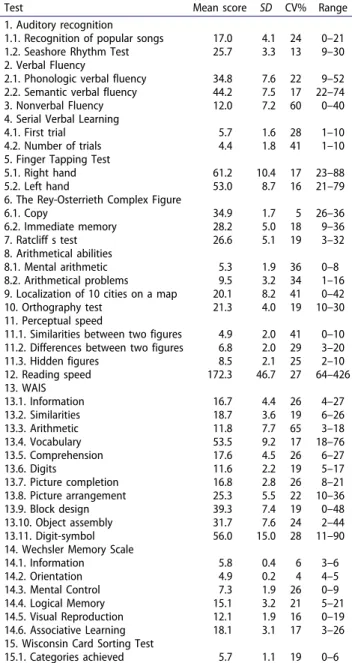
It is observed that mean scores were, in general, those expected according to the subjects’ age and educational level (Ardila, Rosselli, & Puente, 1994; Lezak, Howieson, & Loring, 2004; Strauss, Sherman, & Spreen, 2006). For some of the tests, there are no available norms for com-parisons. However, for the purpose of understanding individual differences, the most important information refers to the standard deviations in combination to the score ranges. For all the tests, the score ranges in this normal group of university students are particularly large; for instance, for sake of illustration three scores can be mentioned—one verbal, one nonverbal, and one executive function score—WAIS Vocabulary raw score range was 18–76 (mean score à53.5; SD à9.2);
WAIS Block design score range was 0–48 (mean score à
39.3; SD à7.4); and Categories in the Wisconsin Card
Sorting Test was 0–6 (mean score à5.7; SD à1.1).
For all the rest of the tests, similar results were observed. The SDs are also large across measures and in most cases corresponding to more than 30% of the mean value as indicated by the coefficient of variation (CV à
the standard deviation divided by the mean ⇥100)
pre-sented in percentages in Table 1. The SD is an indi-cation of the spread of observations and this coefficient is indicating the heterogeneity of the parti-cipants’ cognitive abilities. Simply speaking, dispersion of scores in diverse neuropsychological tests in a rela-tively homogenous population (at least age, gender, SES, education level, and cultural background variables are controlled) is enormous.
Comment
Departing from the aforementioned observations, it can be concluded that the dispersion of cognitive profiles is enormous in normal population individuals. That means, patterns of cognitive abilities are significantly heterogeneous even when major demographic variables are controlled. This dispersion in cognition can become more evident in cases of brain pathology.
It could be assumed that individuals live in idiosyn-cratic cognitive worlds, due to the differences in their patterns of cognitive abilities. The concept of cognitive world in neuropsychology can parallel the concept of “perceptual world” introduced by Uexküll (1957) in biology, which assumes that different animal species live in idiosyncratic perceptual worlds, given the differences in their sensory systems. Uexküll (1957) referred to the
Umwelt as the perceptual world in which an organism exists. He was studying the sensory system of different animals, including the amoebae, jellyfish and sea worms’ work; he speculated that those organisms have different experiences of the world and live in different perceptual worlds. As a result, the Umwelt is limited by the sensory capacities of each organism. By the same token, individuals live in different cognitive worlds resulting from the distinction between their patterns of cognitive abilities. No question, the cognitive world differs between a musician, a taxi driver, a lawyer, and a mathematician. The underlying assumed differences in cognition and daily activities, their experience of the world, and their worldview (Weltanschauung) has to be different.
Some attempts have been made to analyze how dif-ferences in neuropsychological abilities affect the world of the patient after brain damage. For example, Van Patten, Keith, Bertolin, and Wright (2015) argue for Table 1. Means and standard deviations found in different
neuropsychological tests in a 300 normal male participants.
Test Mean score SD CV% Range
1. Auditory recognition
1.1. Recognition of popular songs 17.0 4.1 24 0–21 1.2. Seashore Rhythm Test 25.7 3.3 13 9–30 2. Verbal Fluency
2.1. Phonologic verbal fluency 34.8 7.6 22 9–52 2.2. Semantic verbal fluency 44.2 7.5 17 22–74 3. Nonverbal Fluency 12.0 7.2 60 0–40 4. Serial Verbal Learning
4.1. First trial 5.7 1.6 28 1–10 4.2. Number of trials 4.4 1.8 41 1–10 5. Finger Tapping Test
5.1. Right hand 61.2 10.4 17 23–88 5.2. Left hand 53.0 8.7 16 21–79 6. The Rey-Osterrieth Complex Figure
6.1. Copy 34.9 1.7 5 26–36 6.2. Immediate memory 28.2 5.0 18 9–36 7. Ratcliff s test 26.6 5.1 19 3–32 8. Arithmetical abilities
8.1. Mental arithmetic 5.3 1.9 36 0–8 8.2. Arithmetical problems 9.5 3.2 34 1–16 9. Localization of 10 cities on a map 20.1 8.2 41 0–42 10. Orthography test 21.3 4.0 19 10–30 11. Perceptual speed
11.1. Similarities between two figures 4.9 2.0 41 0–10 11.2. Differences between two figures 6.8 2.0 29 3–20 11.3. Hidden figures 8.5 2.1 25 2–10 12. Reading speed 172.3 46.7 27 64–426 13. WAIS
13.1. Information 16.7 4.4 26 4–27 13.2. Similarities 18.7 3.6 19 6–26 13.3. Arithmetic 11.8 7.7 65 3–18 13.4. Vocabulary 53.5 9.2 17 18–76 13.5. Comprehension 17.6 4.5 26 6–27 13.6. Digits 11.6 2.2 19 5–17 13.7. Picture completion 16.8 2.8 26 8–21 13.8. Picture arrangement 25.3 5.5 22 10–36 13.9. Block design 39.3 7.4 19 0–48 13.10. Object assembly 31.7 7.6 24 2–44 13.11. Digit-symbol 56.0 15.0 28 11–90 14. Wechsler Memory Scale
14.1. Information 5.8 0.4 6 3–6 14.2. Orientation 4.9 0.2 4 4–5 14.3. Mental Control 7.3 1.9 26 0–9 14.4. Logical Memory 15.1 3.2 21 5–21 14.5. Visual Reproduction 12.1 1.9 16 0–19 14.6. Associative Learning 18.1 3.1 17 3–26 15. Wisconsin Card Sorting Test
15.1. Categories achieved 5.7 1.1 19 0–6
the utility of a brief assessment of premorbid ADHD in the acute care of individuals with mild traumatic brain injury; Jefferies, Rogers, and Ralph (2011) demonstrated that individual differences in pre-morbid ability can give rise to category-specific semantic impairment in the context of global semantic degeneration.
This concept of cognitive world can potentially advance our understanding of humankind psychology, and individual differences in neuropsychological activity.
References
Allinson, C., & Hayes, J. (1996). The cognitive style index.
Journal of Management Studies, 33(1), 119–135.
Ardila, A. (2016a). Is “self-consciousness” equivalent to “executive functions”? Psychology & Neuroscience, 9(2), 215–220. doi:10.1037/pne0000052
Ardila, A. (2016b). Some unusual neuropsychological syndromes: Somatoparaphrenia, akinetopsia, reduplicative paramnesia, autotopagnosia. Archives of Clinical
Neuro-psychology, 31(5), 456–464. doi:10.1093/arclin/acw021
Ardila, A., Concha, M., & Rosselli, M. (2000). Angular gyrus syndrome revisited: Acalculia, finger agnosia, right-left disorientation, and semantic aphasia. Aphasiology, 14(7), 743–754. doi:10.1080/026870300410964
Ardila, A., Galeano, L. M., & Rosselli, M. (1998). Toward a model of neuropsychological activity. Neuropsychology Review, 8, 171–190.
Ardila, A., & Rosselli, M. (1988). Temporal lobe involvement in capgras syndrome. International Journal of Neuroscience,
43(3–4), 219–224. doi:10.3109/00207458808986173 Ardila, A., Rosselli, M., & Puente, A. (1994).
Neuropsychologi-cal evaluation of the Spanish speaker. New York, NY:
Plenum Press.
Baddeley, A., & Wilson, B. (1988). Frontal amnesia and the dysexecutive syndrome. Brain and Cognition, 7(2), 212– 230. doi:10.1016/0278-2626(88)90031-0
Bishop, D. V. M., Aamodt-Leeper, G., Creswell, C., McGurk, R., & Skuse, H. (2001). Individual differences in cognitive planning on the tower of Hanoi task: Neuropsychological maturity or measurement error? Journal of Child
Psychology and Psychiatry, 42(4), 551–556. doi:10.1017/
s0021963001007247
Bobes, M. A., Lopera, F., Díaz Comas, L., Galan, L., Carbonell, F., Bringas, M. L., & Valdés-Sosa, M. (2004). Brain potentials reflect residual face processing in a case of prosopagnosia. Cognitive Neuropsychology, 21(7), 691–718. doi:10.1080/02643290342000258
Bobes, M. A., Lopera, F., Garcia, M., Déaz-Comas, L., Galan, L., & Valdes-Sosa, M. (2003). Covert matching of unfam-iliar faces in a case of prosopagnosia: An ERP study. Cortex,
39(1), 41–56. doi:10.1016/s0010-9452(08)70073-x
Bodamer, J. (1947). Die prosop-agnosie. Archiv für Psychiatrie
und Nervenkrankheiten, 179(1–2), 6–53. doi:10.1007/
bf00352849
Capgras, J., & Reboul-Lachaux, J. (1923). L’illusion dessosies’ dans un dlire systmatise chronique [The illusion of the doubles in a chronic delirium]. Bulletin de la Socite
Clini-que de Medecine Mentale, 2, 616.
Chamorro-Premuzic, T. (2007). Personality and individual
differences. Oxford, UK: Blackwell.
Dronkers, N. F. (2000). The gratuitous relationship between Broca’s aphasia and Broca’s area. Behavioral and Brain
Sciences, 23(1), 30–31. doi:10.1017/s0140525x00322397
Fillmore, C. J., Kempler, D., & Wang, W. S. (Eds.). (2014).
Individual differences in language ability and language
behavior. New York, NY: Academic Press.
Friedman, N. P., Miyake, A., Young, S. E., DeFries, J. C., Corley, R. P., & Hewitt, J. K. (2008). Individual differences in executive functions are almost entirely genetic in origin.
Journal of Experimental Psychology: General, 137(2),
201–225. doi:10.1037/0096-3445.137.2.201
Gale, A., & Edwards, J. A. (Eds.). (2016). Individual differences and psychopathology: Physiological correlates of human
behaviour (Vol. 3). New York, NY: Academic Press.
Gerstmann, J. (1940). Syndrome of finger agnosia, disorien-tation for right and left, agraphia and acalculia: Local diag-nostic value. Archives of Neurology & Psychiatry, 44(2), 398–408. doi:10.1001/archneurpsyc.1940.02280080158009 Gess, J. L., Fausett, J. S., Kearney-Ramos, T. E., Kilts, C. D., &
James, G. A. (2014). Task-dependent recruitment of intrin-sic brain networks reflects normative variance in cognition.
Brain and Behavior, 4(5), 650–664.
Halpern, D. F. (2013). Sex differences in cognitive abilities. London, UK: Psychology Press.
Hartlage, L. C., & Telzrow, C. F. (1985). The Neuropsychology
of individual differences: A developmental perspective.
New York, NY: Springer.
Jefferies, E., Rogers, T. T., & Ralph, M. A. L. (2011). Premor-bid expertise produces category-specific impairment in a domain-general semantic disorder. Neuropsychologia,
49(12), 3213–3223. doi:10.1016/j.neuropsychologia.2011. 07.024
Kane, M. J., & Engle, R. W. (2002). The role of prefrontal cortex in working-memory capacity, executive attention, and general fluid intelligence: An individual-differences perspective. Psychonomic Bulletin & Review, 9(4), 637–671. doi:10.3758/bf03196323
King, J., & Just, M. A. (1991). Individual differences in syntac-tic processing: The role of working memory. Journal of
Memory and Language, 30(5), 580–602. doi:10.1016/0749-
596x(91)90027-h
Kozhevnikov, M. (2007). Cognitive styles in the context of modern psychology: Toward an integrated framework of cognitive style. Psychological Bulletin, 133(3), 464–481. doi:10.1037/0033-2909.133.3.464
Lezak, M. D., Howieson, D. B., & Loring, D. W. (2004).
Neuropsychological assessment (4th ed.). New York, NY:
Oxford University Press.
Lopera, F., & Ardila, A. (1992). Prosopamnesia and visuolim-bic disconnection syndrome. Neuropsychology, 6(1), 3–12. Maltby, J., Day, L., & Macaskill, A. (2007). Personality, indi-vidual differences and intelligence. London, UK: Pearson Education.
Mazzoni, G., & Nelson, T. O. (2014). Metacognition and cog-nitive neuropsychology: Monitoring and control processes. London, UK: Psychology Press.
Oliveri, S., Incorpora, C., Genevini, M., Santagostino, L., Tettamanti, L., Antonietti, A., & Risoli, A. (2012). Clinical investigation of cognitive styles in patients with acquired brain damage. Neuropsychological Rehabilitation, 22(3), 362–373. doi:10.1080/09602011.2011.647416
Richardson, A. (1977). Verbalizer-visualizer: A cognitive style dimension. Journal of Mental Imagery, 1(1), 109–125. Sternberg, R., & Sternberg, K. (2016). Cognitive psychology.
Toronto, Canada: Nelson Education.
Strauss, E., Sherman, E. M., & Spreen, O. (2006). A compen-dium of neuropsychological tests: Administration, norms,
and commentary (3rd ed.). New York, NY: Oxford
Univer-sity Press.
Temple, C. (2014). Developmental cognitive neuropsychology. London, UK: Psychology Press.
Uexküll, J. V. (1957). A stroll through the world of animals and men: A picture of invisible worlds. In C. H. Schiller (Ed.), Instinctive behavior: The development of a
modern concept (pp. 5–80). New York, NY: International
Universities Press.
Van Patten, R., Keith, C., Bertolin, M., & Wright, J. D. (2015). The effect of premorbid attention-deficit/hyperactivity dis-order on neuropsychological functioning in individuals with acute mild traumatic brain injuries. Journal of Clinical
and Experimental Neuropsychology, 38(1), 12–22.
Vernon, P. A. (1994). The neuropsychology of individual
differences. New York, NY: Academic Press
Wilson, R. S., Beckett, L. A., Barnes, L. L., Schneider, J. A., Bach, J., Evans, D. A., & Bennett, D. A. (2002). Individual differences in rates of change in cognitive abilities of older persons. Psychology and Aging, 17(2), 179–193. doi:10.1037/0882-7974.17.2.179
Witkin, H. A., Moore, C. A., Goodenough, D. R., & Cox, P. W. (1977). Field dependent and field independent cognitive styles and their educational implications. Review of
Educational Research, 47(1), 1–64. doi:10.3102/0034654
3047001001