NEUROPSI ATTENTION AND MEMORY: A Neuropsychological
Test Battery in Spanish with Norms by Age and Educational Level
Feggy Ostrosky-Solı´s and Ma. Esther G
o
omez-Pe´rez
Laboratory of Neuropsychology and Psychophysiology, National Autonomous University of Mexico, Mexico D. F., Mexico
Esmeralda Matute
Neuroscience Institute, University of Guadalajara, Guadalajara, Mexico
M
o
onica Rosselli
Department of Psychology, Florida Atlantic University, Davis, Florida, USA
Alfredo Ardila
Department of Communication Sciences and Disorders, Florida International University, Miami, Florida, USA
David Pineda
Neuropsychology and Behaviour Group, University of San Buenaventura and University of Antioquia, Medellin, Colombia
Health care professionals are now faced with a growing number of patients from different ethnic groups, and from different socioeconomical backgrounds. In the field of neuropsy-chology there is an increasing need of reliable and culturally fair assessment measures. Spanish is the official language in more than 20 countries and the second most spoken lan-guage in the world. The purpose of this research was to develop and standardize the neu-ropsychological battery NEUROPSI ATTENTION AND MEMORY, designed to assess orientation, attention and concentration, executive functions, working memory and immediate and delayed verbal and visual memory. The developmental sequences of atten-tion and memory as well as the educaatten-tional effects were analyzed in a sample of 521 mono-lingual Spanish Speaking subjects, aged 6 to 85 years. Educational level ranged from 0 to 22 years of education. The consideration of the developmental sequence, and the effects of education, can improve the sensitivity and specificity of neuropsychological measures. Key words: age, attention, culture, educational level, memory, neuropsychological test,
Spanish-speaking norms
INTRODUCTION
Appropriate performance and personal adjust-ment in daily life requires both attention and mem-ory; which, in turn, are indispensable preconditions for suitable functioning of other cognitive domains (Lezak, 1995).
The evaluation of these processes is essential in neuropsychological assessment because impairments of these functions are some of the most common symptoms observed following brain damage in chil-dren, adolescents and adults (Larrabee & Crook, 1996; Lezak, 1995; Ruff, Light, & Quayhagen, 1989; Squire & Shimamura, 1996).
Cognitive assessment of both healthy and pathological populations requires the use of objec-tive and reliable neuropsychological instruments designed and adapted to appropriately evaluate the populations we are interested in. Even more,
appropriate normative data must be developed in order to establish an accurate clinical picture about the nature of the impairments (Bauer, Tobias, & Valenstein, 1993; Mayes, 1986; Squire & Shimamura, 1996).
However, neuropsychological tests are fre-quently literally translated into Spanish with little consideration of cultural relevance. For example, using backward spelling for the evaluation of attention (such as in the Mini-Mental State Examination; Folstein, Folstein, & McHugh, 1975), naming the fingers to evaluate language or word finding difficulty (as found in the Alzheimer’s Disease Assessment Scale; Rosen, Mohs, & Davis, 1984), or asking for the seasons of the year to assess orientation, as included in several geriatric scales, may be inappropriate in certain countries and some cultural contexts. In many countries, instead of four seasons there are only rainy and dry seasons. In tropical areas, there may be two rainy and two dry seasons. The seasonal changes around the year may be so mild and unnoticed that the concept of ‘‘season’’ is irrelevant. In many world areas the names of the fingers are rarely used, even by highly educated neurologically intact people. The use of visual stimuli that are of high frequency for one culture but infrequent or nonexistent for another (i.e., drawing of a pretzel) is also inappropriate. Because the simple translation, use of inappropri-ate visual stimuli, and use of norms of a foreign instrument do not take into account these kinds of cultural differences, errors in diagnosis can be predicted unless items are correctly adapted or developed to assess the new population and new normative data are obtained.
Spanish is the official language in more than 20 countries and the second most-spoken language in the world (330 million speakers). Therefore, it is important to have neuropsychological tests that are developed and standardized for Spanish-speaking populations. When tests developed in other populations are used within Spanish speakers, they are frequently just translated and the norms of other populations used. This procedure undoubtedly invalidates the results. It is not only important to have data collected in Spanish-speaking popula-tions, but also, given the influence that educational factors have on cognitive performance (Ardila, Ostrosky-Solis, Rosselli, & Gomez, 2000; Ardila, Rosselli, & Ostrosky, 1992; Castro-Caldas, Reis. & Guerreiro, 1997; Heaton, Grant, & Matthews, 1986; Ostrosky-Solı´s, Ardila, & Rosselli, 1999;
Ostrosky-Solı´s, Ardila, Rosselli, Loopez, & Mendoza, 1998; Ostrosky-Solı´s, Arellano, & Pe´rez, 2004; Ostrosky-Solı´s, Canseco, Quintanar, Navarro, & Ardila, 1985; Ostrosky et al., 1986; Ostrosky-Solı´s et al., 2003b), norms for neuropsychological tests should represent persons with different educational levels including illiterates. It has even been proposed that in neuropsychological testing, schooling is a more significant variable than age (Ostrosky-Solı´s et al., 1998). This effect of education has been reported not only for Spanish-speaking populations but for English speakers as well; for example, the Mini-Mental State Examination Score is affected more by level of education than by age across whites, Hispanics, and Afro-American English-speaking subjects (Launer, Dinkgreve, Jonker, Hooijer, Lindeboom. (1993), Murden, McRae, Kaner, & Bucknam, 1991). Moreover, the effects of education extend to both verbal and nonverbal neuropsychological measures (Rosselli & Ardila, 2003).
From a theoretical point of view, to date, very few studies have encompassed a life-span analysis of attention and memory within a single project. The scarcity of life-span studies restricts the comprehension of life-long development as a system of diverse change patterns that differ, for example, in terms of timing (onset, duration, ter-mination), direction, and order. Due to differences in age groups and tasks employed, comparisons among the existing developmental studies become difficult.
Evidence of multiple attentional and memory systems is provided by experimental, neuropsycho-logical, psychopharmaconeuropsycho-logical, and developmen-tal dissociations between performances in a variety of situations. Classification of attention and memory has proved to be heuristically useful for describing specific problems (Tulving, 1987; Van Zomeren & Brouwer, 1994). Components of attention and memory are often related to each other and to other cognitive abilities as well, such as executive functions; yet the specifications and relationships among these components are not con-sistent, nor are they fully understood.
Development of attention and memory subfunc-tions involves a complex pattern of change, with some aspects exhibiting significant change and others exhibiting remarkable stability across the life span (Klenberg, Korkman, & Lahti-Nuuttila, 2001; Plude, Enns, & Brodeur, 1994). The scarcity of developmental studies which include a wide age
range, as well as a wide spectrum of attentional and mnemonic subfunctions, restricts the comprehen-sion of development as a continuous and complex process.
Given the current limitations in the neuro-psychological assessment of Spanish speakers, and the scarce information about attention and memory development along the life-span, the pur-poses of the research here described were to develop, standardize, and analyze the factor struc-ture of a neuropsychological test battery, named NEUROPSI ATTENTION AND MEMORY (Ostrosky-Solı´s et al., 2003), as well as analyze age and education effects in a sample of Spanish speaking subjects from 6 to 85 years of age.
METHODS
Participants
The sample consisted of 521 unpaid volunteers who participated in the standardization of the NEUROPSI ATTENTION AND MEMORY (Ostrosky-Solı´s et al., 2003). Sample age ranged from 6 to 85 years, and in the adult sample (16– 85 years), educational level ranged from 0 to 22 years of education. Table 1 presents the mean values of age and education for nine age groups (6–7 years, 8–9 years, 10–11 years, 12–13 years, 14–15 years, 16–30 years, 31–55 years, 56–64 years and 65–85 years); and three educational levels (zero to 3 years of education, 4–9 years of education and 10–22 years of formal education), according to NEUROPSI ATTENTION AND MEMORY norms.
Volunteers were recruited from urban areas of four different states of the Mexican Republic (Mexico City, Colima, Guadalajara and Zacatecas) over a 4-year period (1998–2002). Sources of part-icipants included in the present analysis were as follows: regional medical facilities (medical and paramedical people and spouses, friends or rela-tives of patients who attended for medical check-ups) (5.8%); retirement community (33.2%); social community centers (19.5%); primary schools, secondary schools, high-schools and university stu-dents (22.1%); and volunteers and self-referred participants (19.4%).
The following inclusion criteria were used: (1) no neurological or psychiatric disorders (such as brain injury, cerebrovascular disease, epilepsy,
Parkinson’s disease, depression, psychiatric hospi-talizations, and the like), according to a health his-tory questionnaire; (2) absence of current and=or history of chronic alcohol and=or drug abuse; and (3) normal or corrected-to-normal vision and hearing. In addition, children were screened for childhood behavioral and neurological problems including Attention Deficit Disorder and reading and learning disabilities through use of a health his-tory questionnaire, as well as parent and teacher reports of the child’s behavior and scholar per-formance. All participants were unpaid volunteers. All participants were native Spanish speakers and were active and functionally independent. Parti-cipants with questionable health histories (e.g., those reporting history of craneoencephalic trauma, cerebrovascular disease, and=or subjects under medication for psychiatric and=or central nervous system disorders) were excluded.
Materials
NEUROPSI ATTENTION AND MEMORY (Ostrosky-Solı´s et al., 2003) has standardized pro-cedures for both administration and scoring. It includes several measures that are based on princi-ples and procedures developed in cognitive neu-roscience. The covered domains encompass orientation, attention and concentration, executive functions, working memory, immediate verbal memory, delayed verbal memory, immediate visual memory, and delayed visual memory, each having its own subtests. Each area includes assessment of different aspects of that particular cognitive domain. Thus, assessment of attention includes level of alertness, span or efficiency of vigilance– concentration, and selective attention. Executive function assessment comprises concept formation, flexibility, inhibition, and several motor program-ming tasks. Memory assessment includes immedi-ate and delayed recall of auditory–verbal and visual–nonverbal functioning. Word list learning includes three learning trials of 12 words. Each of the 12 items belonged to one of three high-frequency semantic categories in Spanish language (animals, fruits or body parts). Delayed recall includes free and semantic cued recall, as well as a recognition trial, which includes a 24-word list that does not contain high-frequency words within each category.
frequency and relevance for Spanish-speaking indi-viduals; for example, the battery included language and picture tests that were previously standardized in our laboratory according to high, medium, and low frequency of occurrence in the Spanish lan-guage (Aveleyra, Goomez, Ostrosky-Solı´s, Rigalt,
& Cruz, 1996). Phonological verbal fluency was evaluated using letter P. This letter was selected based on the ratio of words in the Spanish language starting with this letter, relative to the total number of words in a Spanish dictionary. According to this analysis, there is a good proportion of high frequency words beginning with this letter in Spanish.
Interpretation of NEUROPSI ATTENTION AND MEMORY results is twofold: (1) quantitat-ive, in that each item is scored, and can be further compared with normal performance in the general population; and (2) qualitative, in that different types of errors can be distinguished and specifically analyzed. For example, in addition to an overall memory performance score, the battery provides several memory parameters including rate of decay, primacy and recency effects, rate of acquisition across learning trials, intrusion and perseveration rates, semantic versus serial-order clustering, and signal detection parameters (discriminability and response bias) of recognition performance.
The subtests included in the NEUROPSI ATTEN-TION AND MEMORY neuropsychological battery are described in the Appendix.
In total, 30 different scores were obtained. The Stroop subtest (Stroop, 1935) was not used with adults having fewer than 4 years of education. In children aged 6–7 years and in adults having fewer than 4 years of education, the Rey-Osterreith figure (Osterreith, 1944) was replaced by the semicomplex figure (Ostrosky-Solı´s et al., 1999). Because data for these populations were missing for Stroop and Rey-Osterreith Complex Figure, both tests were excluded of the factor analysis, but descriptive information is presented for the remaining age and education groups.
Procedure
The NEUROPSI ATTENTION AND MEM-ORY neuropsychological battery was administered independently by trained psychologists. Testing was performed in single sessions. Administration time was 60–70 min.
Statistical Analysis
Statistical analysis was carried out using the Statistical Package for Social Science (SPSS 11.0 for Windows). Descriptive values of mean and standard deviation were obtained for each of the 29 subtests in the nine age groups and in the three adult educational levels. Analysis of Vari-ance (ANOVA) was used to statistically examine the effects of age in the whole sample (6–85 years of age) and the effects of education; interactions were analyzed for both demographic variables in the adult sample (16–85 years of age), in each of the six generated factors, reported in a previous study (Goomez-Pe´rez & Ostrosky-Solı´s, 2006). For the present analysis, age was divided into nine age groups (6–7, 8–9, 10–11, 12–13, 14–15, 16–30, 31–55, 56–64, 65–85 years); and education was divided into the three following groups: 0–3, 4–9 and 10–22 years of education. Age and education groups were determined analyzing homogeneous performance of subjects in the battery employed. No gender differences were consistently found, therefore, data for both men and women were merged in a single group. One-way ANOVA was employed to examine the effects of age in the whole sample for each factor. The effect of education, as well as interactions between age and education, were only analyzed in the adult sample performing a 4 (age: 16–30, 31–55, 56–64 and 65–85 years)3 (education: 0–3, 4–9, 10–22 years) Multivariate Analysis of Variance (MANOVA). To avoid Type I error due to multiple comparisons, post hoc com-parisons were performed using the Bonferroni test (p.01). Effect sizes were calculated using the x2
value of Hays.
RESULTS
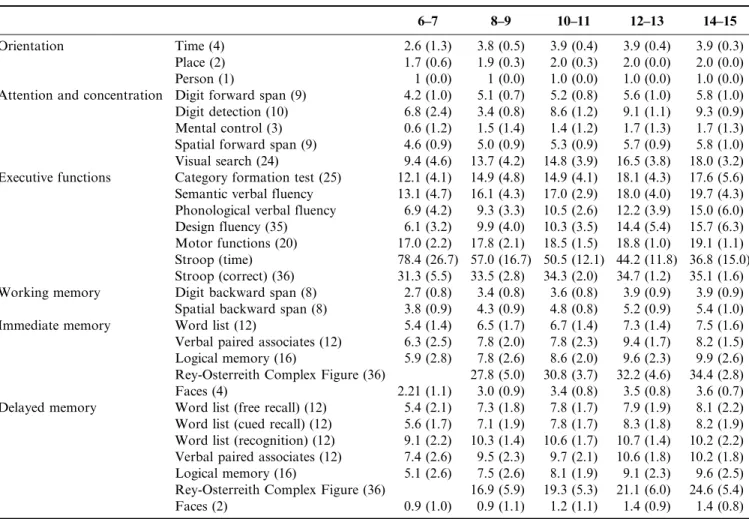
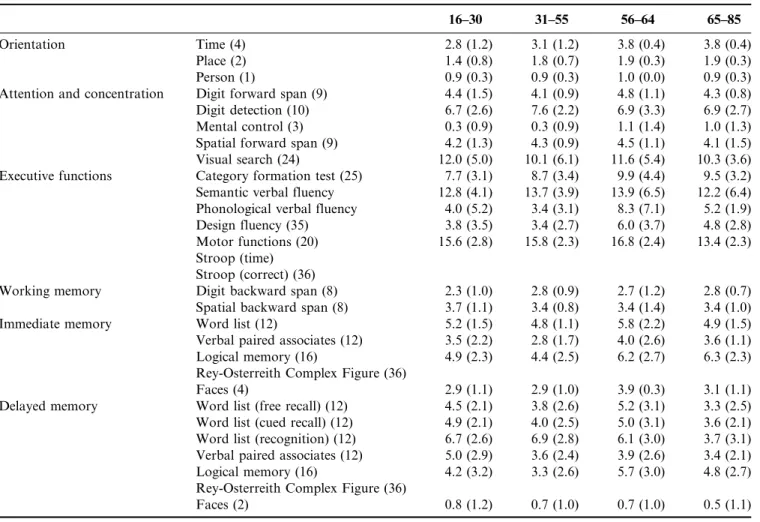
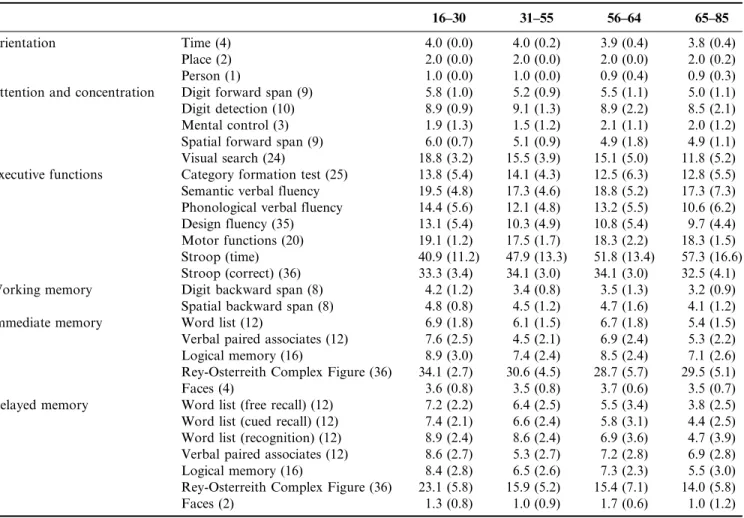
Means and Standard Deviations for the NEU-ROPSI ATTENTION AND MEMORY subtests, organized according to age and educational level, are presented in Tables 2–5.
Factor Analysis
ATTENTION AND MEMORY battery. Six dif-ferent factors with an eigenvalue higher than 1.000 were disclosed. These six factors accounted for 63.6% of the total variance. Factor I enclosed the Category Formation Test, Visual Search, Semantic and Phonological Verbal Fluency, and Design Flu-ency. Correlations between each of these subtests and Factor I were as follows: Category Formation Test 0.66, Visual Search 0.62, Semantic Verbal Fluency 0.74, Phonological Verbal Fluency 0.70 and Design Fluency 0.69. This factor accounted for 36.6% of the variance and was considered an Attention-Executive Function factor. Factor II contained items assessing Logical Memory Immedi-ate and Delayed Recall, Verbal Paired AssociImmedi-ates Immediate and Delayed Recall, and Motor Func-tions. Correlations between each of these subtests and factor II were as follows: Logical Memory Immediate Recall 0.67, Logical Memory Delayed Recall 0.70, Verbal Paired Associates Immediate Recall 0.78, Verbal Paired Associates Delayed Recall 0.79 and Motor Functions 0.45. This factor
accounted for 7.3% of the variance. This factor was considered to evaluate a contextual-executive memory. Factor III was mainly represented by Word List Encoding, Word List Free Recall, Word List Cued Recall and Word List Recognition Trial. The correlations between each of these subtests and fac-tor III were as follows: Word List Encoding 0.70, Word List Free Recall 0.78, Word list Cued Recall 0.81 and Word List Recognition Trial 0.75. This fac-tor accounted for 6.7% of the variance and it was considered a verbal memory factor. Factor IV con-tained items assessing Time Orientation, Digit Detection, Mental Control and Faces Immediate and Delayed Recall. The correlations between each of these subtests and factor IV were as follows: Time Orientation 0.58, Digit Detection 0.61, Mental Con-trol 0.70, Faces Immediate Recall 0.44 and Faces Delayed Recall 0.40. This factor accounted for 4.6% of the variance. This factor may had repre-sented a selective and sustained component of atten-tion and orientaatten-tion. Factor V primarily involved Digit Forward Span, Digit Backward Span, Spatial
Table 2. Means and Standard Deviations for the NEUROPSI ATTENTION AND MEMORY Subtests, in the Children Sample
6–7 8–9 10–11 12–13 14–15
Orientation Time (4) 2.6 (1.3) 3.8 (0.5) 3.9 (0.4) 3.9 (0.4) 3.9 (0.3)
Place (2) 1.7 (0.6) 1.9 (0.3) 2.0 (0.3) 2.0 (0.0) 2.0 (0.0)
Person (1) 1 (0.0) 1 (0.0) 1.0 (0.0) 1.0 (0.0) 1.0 (0.0)
Attention and concentration Digit forward span (9) 4.2 (1.0) 5.1 (0.7) 5.2 (0.8) 5.6 (1.0) 5.8 (1.0) Digit detection (10) 6.8 (2.4) 3.4 (0.8) 8.6 (1.2) 9.1 (1.1) 9.3 (0.9) Mental control (3) 0.6 (1.2) 1.5 (1.4) 1.4 (1.2) 1.7 (1.3) 1.7 (1.3) Spatial forward span (9) 4.6 (0.9) 5.0 (0.9) 5.3 (0.9) 5.7 (0.9) 5.8 (1.0) Visual search (24) 9.4 (4.6) 13.7 (4.2) 14.8 (3.9) 16.5 (3.8) 18.0 (3.2) Executive functions Category formation test (25) 12.1 (4.1) 14.9 (4.8) 14.9 (4.1) 18.1 (4.3) 17.6 (5.6) Semantic verbal fluency 13.1 (4.7) 16.1 (4.3) 17.0 (2.9) 18.0 (4.0) 19.7 (4.3) Phonological verbal fluency 6.9 (4.2) 9.3 (3.3) 10.5 (2.6) 12.2 (3.9) 15.0 (6.0) Design fluency (35) 6.1 (3.2) 9.9 (4.0) 10.3 (3.5) 14.4 (5.4) 15.7 (6.3) Motor functions (20) 17.0 (2.2) 17.8 (2.1) 18.5 (1.5) 18.8 (1.0) 19.1 (1.1) Stroop (time) 78.4 (26.7) 57.0 (16.7) 50.5 (12.1) 44.2 (11.8) 36.8 (15.0) Stroop (correct) (36) 31.3 (5.5) 33.5 (2.8) 34.3 (2.0) 34.7 (1.2) 35.1 (1.6) Working memory Digit backward span (8) 2.7 (0.8) 3.4 (0.8) 3.6 (0.8) 3.9 (0.9) 3.9 (0.9) Spatial backward span (8) 3.8 (0.9) 4.3 (0.9) 4.8 (0.8) 5.2 (0.9) 5.4 (1.0) Immediate memory Word list (12) 5.4 (1.4) 6.5 (1.7) 6.7 (1.4) 7.3 (1.4) 7.5 (1.6) Verbal paired associates (12) 6.3 (2.5) 7.8 (2.0) 7.8 (2.3) 9.4 (1.7) 8.2 (1.5) Logical memory (16) 5.9 (2.8) 7.8 (2.6) 8.6 (2.0) 9.6 (2.3) 9.9 (2.6) Rey-Osterreith Complex Figure (36) 27.8 (5.0) 30.8 (3.7) 32.2 (4.6) 34.4 (2.8) Faces (4) 2.21 (1.1) 3.0 (0.9) 3.4 (0.8) 3.5 (0.8) 3.6 (0.7) Delayed memory Word list (free recall) (12) 5.4 (2.1) 7.3 (1.8) 7.8 (1.7) 7.9 (1.9) 8.1 (2.2) Word list (cued recall) (12) 5.6 (1.7) 7.1 (1.9) 7.8 (1.7) 8.3 (1.8) 8.2 (1.9) Word list (recognition) (12) 9.1 (2.2) 10.3 (1.4) 10.6 (1.7) 10.7 (1.4) 10.2 (2.2) Verbal paired associates (12) 7.4 (2.6) 9.5 (2.3) 9.7 (2.1) 10.6 (1.8) 10.2 (1.8) Logical memory (16) 5.1 (2.6) 7.5 (2.6) 8.1 (1.9) 9.1 (2.3) 9.6 (2.5) Rey-Osterreith Complex Figure (36) 16.9 (5.9) 19.3 (5.3) 21.1 (6.0) 24.6 (5.4) Faces (2) 0.9 (1.0) 0.9 (1.1) 1.2 (1.1) 1.4 (0.9) 1.4 (0.8)
Forward Span and Spatial Backward Span. The correlations between each of these subtests and factor V were: Digit Span Forward 0.47, Digit Span Backward 0.48, Spatial Span Forward 0.69 and Spatial Span Backward 0.65. This factor accounted for 4.4% of the variance and was considered as an attention-working memory factor. Factor VI included Place and Person Orientation. These subt-ests had a correlation value of 0.88 and 0.89, respect-ively, with factor VI. This factor accounted for 4.1% of the variance and was interpreted as an orientation factor.
Effects of Age
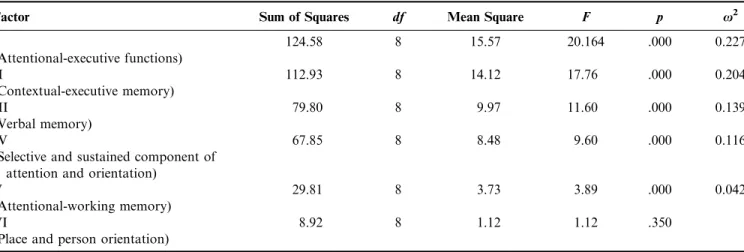
To investigate the effects of age in the whole sample, in the present study a one-way ANOVA was performed on each of the above-mentioned factors. A summary of the ANOVA results is pre-sented in Table 6. It was observed that age had
an effect in most of the factors, except for factor VI (place and person orientation). Effect sizes (x2) were variable, age explained 23% of the vari-ance in factor I, 20% in factor II, 14% in factor III, 12% in factor IV and 4% in factor V. Post hoc comparisons (Bonferroni test, p0.01) were used to determine at which age level the children test performance no longer demonstrated a signifi-cant improvement and at which age level the adult test performance began to significantly decrease. For children, when the performance of a specific age group, in a specific factor, did not differ from that of the group achieving the highest score, the development in this particular skill was considered to have reached a mature level. For adults, when the performance of a specific age group, in a spe-cific factor, differed from that of the group achiev-ing the highest score, the performance in this particular skill was considered to undergo a deterioration process.
Table 3. Means and Standard Deviations for the NEUROPSI ATTENTION AND MEMORY Subtests, in the Adult Sample With 0–3 Years of Education
16–30 31–55 56–64 65–85
Orientation Time (4) 2.8 (1.2) 3.1 (1.2) 3.8 (0.4) 3.8 (0.4)
Place (2) 1.4 (0.8) 1.8 (0.7) 1.9 (0.3) 1.9 (0.3)
Person (1) 0.9 (0.3) 0.9 (0.3) 1.0 (0.0) 0.9 (0.3)
Attention and concentration Digit forward span (9) 4.4 (1.5) 4.1 (0.9) 4.8 (1.1) 4.3 (0.8) Digit detection (10) 6.7 (2.6) 7.6 (2.2) 6.9 (3.3) 6.9 (2.7) Mental control (3) 0.3 (0.9) 0.3 (0.9) 1.1 (1.4) 1.0 (1.3) Spatial forward span (9) 4.2 (1.3) 4.3 (0.9) 4.5 (1.1) 4.1 (1.5) Visual search (24) 12.0 (5.0) 10.1 (6.1) 11.6 (5.4) 10.3 (3.6) Executive functions Category formation test (25) 7.7 (3.1) 8.7 (3.4) 9.9 (4.4) 9.5 (3.2) Semantic verbal fluency 12.8 (4.1) 13.7 (3.9) 13.9 (6.5) 12.2 (6.4) Phonological verbal fluency 4.0 (5.2) 3.4 (3.1) 8.3 (7.1) 5.2 (1.9) Design fluency (35) 3.8 (3.5) 3.4 (2.7) 6.0 (3.7) 4.8 (2.8) Motor functions (20) 15.6 (2.8) 15.8 (2.3) 16.8 (2.4) 13.4 (2.3) Stroop (time)
Stroop (correct) (36)
Working memory Digit backward span (8) 2.3 (1.0) 2.8 (0.9) 2.7 (1.2) 2.8 (0.7) Spatial backward span (8) 3.7 (1.1) 3.4 (0.8) 3.4 (1.4) 3.4 (1.0)
Immediate memory Word list (12) 5.2 (1.5) 4.8 (1.1) 5.8 (2.2) 4.9 (1.5)
Verbal paired associates (12) 3.5 (2.2) 2.8 (1.7) 4.0 (2.6) 3.6 (1.1) Logical memory (16) 4.9 (2.3) 4.4 (2.5) 6.2 (2.7) 6.3 (2.3) Rey-Osterreith Complex Figure (36)
Faces (4) 2.9 (1.1) 2.9 (1.0) 3.9 (0.3) 3.1 (1.1)
Delayed memory Word list (free recall) (12) 4.5 (2.1) 3.8 (2.6) 5.2 (3.1) 3.3 (2.5) Word list (cued recall) (12) 4.9 (2.1) 4.0 (2.5) 5.0 (3.1) 3.6 (2.1) Word list (recognition) (12) 6.7 (2.6) 6.9 (2.8) 6.1 (3.0) 3.7 (3.1) Verbal paired associates (12) 5.0 (2.9) 3.6 (2.4) 3.9 (2.6) 3.4 (2.1) Logical memory (16) 4.2 (3.2) 3.3 (2.6) 5.7 (3.0) 4.8 (2.7) Rey-Osterreith Complex Figure (36)
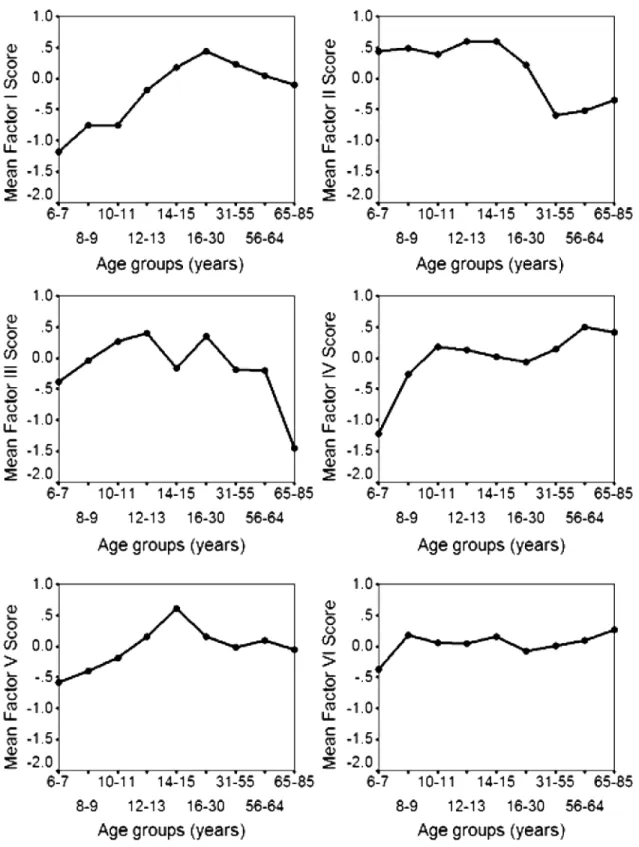
Post hoc comparisons showed that differences between age groups are variable depending upon the particular factor. As can be appreciated in Figure 1, the age ranges at which children reached the highest level of performance varied depending on the particular skills. The first areas to mature were related to memory functions. Contextual-executive memory (factor II) reached the highest performance level at the 6–7 age range, and verbal memory (factor III) reached it at the 8–9 age range. In functions related to orientation, selec-tive and sustained attention, and attention-working memory (factors IV and V), the highest perform-ance level was attained at the 10–11 age range. The last area to reach the highest performance level was attention-executive functions (factor I) at the age range of 14–15 years. Regarding adult per-formance, areas related to orientation, selective and sustained attention, attention-working mem-ory, and attentional-executive functions (factors I, IV and V) did not show a significant detriment
from the age range, achieving the highest score up to 85 years. On the other hand, it was noticed that the first areas to mature (contextual-executive memory and verbal memory), were also the areas showing a significant deterioration starting at the 31–55 age range.
Effects of Education and Its Interactions with Age in the Adult Sample
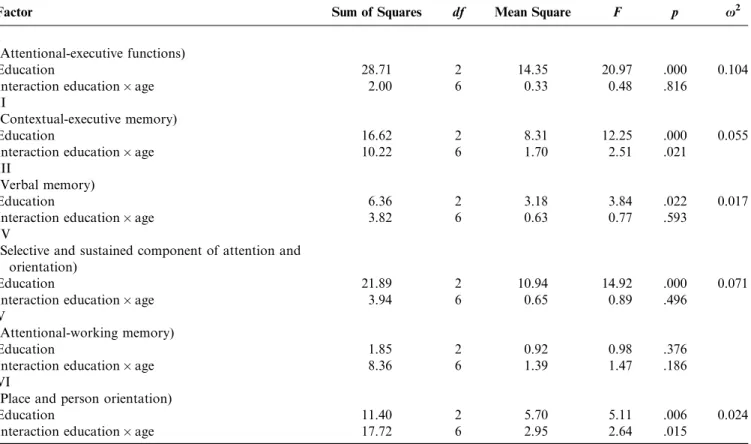
Using MANOVAs, differences among the three education adult groups, as well as its interactions with age, were calculated (Table 7). A main effect of education was seen in all the factors, except for factor V (attentional-working memory). Effect sizes in the adult population were variable, education explained 10%of the variance in factor I, 6%in fac-tor II, 2%in factor III, 7%in factor IV and 2%in factor VI. Interactions between education and age were only seen in factors II (contextual-executive memory) and VI (place and person orientation).
Table 4. Means and Standard Deviations for the NEUROPSI ATTENTION AND MEMORY Subtests, in the Adult Sample With 4–9 Years of Education
16–30 31–55 56–64 65–85
Orientation Time (4) 4.0 (0.0) 4.0 (0.2) 3.9 (0.4) 3.8 (0.4)
Place (2) 2.0 (0.0) 2.0 (0.0) 2.0 (0.0) 2.0 (0.2)
Person (1) 1.0 (0.0) 1.0 (0.0) 0.9 (0.4) 0.9 (0.3)
Attention and concentration Digit forward span (9) 5.8 (1.0) 5.2 (0.9) 5.5 (1.1) 5.0 (1.1) Digit detection (10) 8.9 (0.9) 9.1 (1.3) 8.9 (2.2) 8.5 (2.1) Mental control (3) 1.9 (1.3) 1.5 (1.2) 2.1 (1.1) 2.0 (1.2) Spatial forward span (9) 6.0 (0.7) 5.1 (0.9) 4.9 (1.8) 4.9 (1.1) Visual search (24) 18.8 (3.2) 15.5 (3.9) 15.1 (5.0) 11.8 (5.2) Executive functions Category formation test (25) 13.8 (5.4) 14.1 (4.3) 12.5 (6.3) 12.8 (5.5) Semantic verbal fluency 19.5 (4.8) 17.3 (4.6) 18.8 (5.2) 17.3 (7.3) Phonological verbal fluency 14.4 (5.6) 12.1 (4.8) 13.2 (5.5) 10.6 (6.2) Design fluency (35) 13.1 (5.4) 10.3 (4.9) 10.8 (5.4) 9.7 (4.4) Motor functions (20) 19.1 (1.2) 17.5 (1.7) 18.3 (2.2) 18.3 (1.5) Stroop (time) 40.9 (11.2) 47.9 (13.3) 51.8 (13.4) 57.3 (16.6) Stroop (correct) (36) 33.3 (3.4) 34.1 (3.0) 34.1 (3.0) 32.5 (4.1) Working memory Digit backward span (8) 4.2 (1.2) 3.4 (0.8) 3.5 (1.3) 3.2 (0.9) Spatial backward span (8) 4.8 (0.8) 4.5 (1.2) 4.7 (1.6) 4.1 (1.2)
Immediate memory Word list (12) 6.9 (1.8) 6.1 (1.5) 6.7 (1.8) 5.4 (1.5)
Verbal paired associates (12) 7.6 (2.5) 4.5 (2.1) 6.9 (2.4) 5.3 (2.2) Logical memory (16) 8.9 (3.0) 7.4 (2.4) 8.5 (2.4) 7.1 (2.6) Rey-Osterreith Complex Figure (36) 34.1 (2.7) 30.6 (4.5) 28.7 (5.7) 29.5 (5.1)
Faces (4) 3.6 (0.8) 3.5 (0.8) 3.7 (0.6) 3.5 (0.7)
Delayed memory Word list (free recall) (12) 7.2 (2.2) 6.4 (2.5) 5.5 (3.4) 3.8 (2.5) Word list (cued recall) (12) 7.4 (2.1) 6.6 (2.4) 5.8 (3.1) 4.4 (2.5) Word list (recognition) (12) 8.9 (2.4) 8.6 (2.4) 6.9 (3.6) 4.7 (3.9) Verbal paired associates (12) 8.6 (2.7) 5.3 (2.7) 7.2 (2.8) 6.9 (2.8) Logical memory (16) 8.4 (2.8) 6.5 (2.6) 7.3 (2.3) 5.5 (3.0) Rey-Osterreith Complex Figure (36) 23.1 (5.8) 15.9 (5.2) 15.4 (7.1) 14.0 (5.8)
Faces (2) 1.3 (0.8) 1.0 (0.9) 1.7 (0.6) 1.0 (1.2)
Post hoc comparisons (Bonferroni test,p0.01) showed that the educational effect is variable depending on the particular factor. In factor IV (selective and sustained component of attention and orientation), once subjects had completed 4 or more years of formal education, no further
improvement in performance was noticed. In factor I (attentional-executive functions), a gradual increment of scores was seen, with significant improvements among the three analyzed education ranges. In factor III (verbal memory), it was noticed that having completed 10 or more years
Table 5. Means and Standard Deviations for the NEUROPSI ATTENTION AND MEMORY Subtests, in the Adult Sample With 10–22 Years of Education
16–30 31–55 56–64 65–85
Orientation Time (4) 4.0 (0.2) 4.0 (0.1) 4.0 (0.0) 4.0 (0.0)
Place (2) 2.0 (0.0) 2.0 (0.0) 2.0 (0.0) 2.0 (0.0)
Person (1) 1.0 (0.0) 1.0 (0.0) 1.0 (0.0) 1.0 (0.0)
Attention and concentration Digit forward span (9) 6.0 (1.0) 5.6 (0.9) 5.8 (1.2) 5.3 (0.7) Digit detection (10) 9.5 (0.9) 9.6 (0.7) 9.6 (1.0) 9.6 (1.1) Mental control (3) 1.8 (1.3) 2.0 (1.2) 2.3 (1.2) 2.1 (1.4) Spatial forward span (9) 5.8 (1.2) 5.6 (1.1) 6.0 (1.2) 5.2 (1.0) Visual search (24) 20.1 (2.9) 17.9 (3.8) 17.4 (4.2) 14.3 (5.2) Executive functions Category formation test (25) 18.8 (4.6) 18.9 (4.3) 18.5 (5.3) 15.8 (4.3) Semantic verbal fluency 23.5 (4.8) 22.0 (5.6) 21.7 (4.7) 19.5 (5.5) Phonological verbal fluency 16.4 (4.7) 16.3 (4.9) 13.2 (5.5) 13.5 (2.5) Design fluency (35) 16.2 (5.6) 15.7 (5.8) 15.7 (6.6) 11.5 (2.4) Motor functions (20) 19.1 (1.1) 18.7 (1.4) 18.8 (1.2) 17.3 (3.6) Stroop (time) 35.1 (12.9) 41.8 (16.7) 42.9 (8.4) 45.3 (6.7) Stroop (correct) (36) 33.3 (3.4) 35.1 (1.2) 35.4 (0.8) 32.8 (3.6) Working memory Digit backward span (8) 4.2 (1.0) 3.9 (1.0) 4.7 (1.4) 3.6 (1.0) Spatial backward span (8) 5.3 (1.0) 5.0 (1.1) 5.1 (1.2) 4.6 (0.9)
Immediate memory Word list (12) 7.9 (1.2) 7.2 (1.4) 6.9 (1.5) 5.2 (2.0)
Verbal paired associates (12) 8.8 (2.0) 6.8 (2.2) 6.4 (2.7) 6.0 (2.9) Logical memory (16) 10.7 (2.0) 10.2 (2.8) 10.0 (2.1) 7.6 (2.4) Rey-Osterreith Complex Figure (36) 34.5 (2.4) 33.3 (3.2) 33.5 (2.5) 33.1 (2.7)
Faces (4) 3.9 (0.4) 3.9 (0.4) 3.9 (0.3) 3.2 (1.1)
Delayed memory Word list (free recall) (12) 9.0 (1.9) 7.6 (1.9) 7.2 (2.6) 4.2 (3.8) Word list (cued recall) (12) 9.1 (1.8) 8.0 (1.7) 7.7 (2.0) 5.2 (3.2) Word list (recognition) (12) 11.1 (1.2) 10.1 (2.0) 9.5 (1.8) 5.8 (4.2) Verbal paired associates (12) 10.6 (1.8) 8.3 (2.8) 7.5 (3.3) 6.3 (2.8) Logical memory (16) 10.4 (2.2) 9.0 (2.7) 8.7 (3.0) 6.7 (2.2) Rey-Osterreith Complex Figure (36) 25.2 (5.5) 20.3 (6.0) 19.5 (4.5) 16.8 (8.0)
Faces (2) 1.5 (0.8) 1.3 (0.9) 1.2 (1.0) 1.6 (1.0)
Table 6. Effects of Age. Summary of Analysis of Variance for the Six Factors in the Whole Sample and Effect Sizes (x2)
Factor Sum of Squares df Mean Square F p x2
I 124.58 8 15.57 20.164 .000 0.227
(Attentional-executive functions)
II 112.93 8 14.12 17.76 .000 0.204
(Contextual-executive memory)
III 79.80 8 9.97 11.60 .000 0.139
(Verbal memory)
IV 67.85 8 8.48 9.60 .000 0.116
(Selective and sustained component of attention and orientation)
V 29.81 8 3.73 3.89 .000 0.042
(Attentional-working memory)
VI 8.92 8 1.12 1.12 .350
of formal education made a significant contri-bution to performance. Interactions between edu-cation and age showed that, in factor VI (place and person orientation), having completed 4 or more years of formal education made a significant
contribution only at the age range of 16–55 years. In factor II (contextual-executive memory) it was necessary to have completed 10 or more years of education to gain a significant improvement at the same age range.
Figure 1. Effects of age on the six factors from 6 to 85 years of age.
DISCUSSION
From a clinical point of view, attention and memory impairments represent the most common symptoms observed following brain damage in chil-dren, adolescents, and adults (Anderson, Northam, Hendy, & Wrennall, 2001; Larrabee & Crook, 1996; Lezak, 1995; Ruff, Light & Quayhagen, 1989; Squire & Shimamura, 1996). To provide an adequate assessment, differential diagnosis and treatment of these populations, normative develop-mental data is required. Even more, educative training depends on the knowledge we have about the differential capabilities along the life-span. Assessment of cognitive functions in healthy popu-lations is essential to understand the disabilities reported after brain damage, as well as to plan effective rehabilitation programs.
Although a general tendency toward an increment in test scores during childhood and a decrease during aging has been described (De Luca; Wood, Anderson, Buchanan, Proffitt, Mahony, & Pantelis, 2003; Gathercole, 1998; Gomes, Molholm, Christodoulou, Ritter, & Cowan, 2000; Grady & Craik, 2000; Haaland, Price, & Larue, 2003; Lewis,
Kelland, & Kupke, 1990; Plude et al., 1994; Siegel, 1994; Trenerry, Crosson, DeBoe, & Leber, 1990), comparisons of a wide age range, evaluated in a var-iety of cognitive functions, allowed us to determine that developmental trajectories may not be homo-geneous. Abilities such as contextual-executive mem-ory (factor II) or verbal memmem-ory (factor III) reached the adult performance level at an early stage (before 9 years of age); this might be due to restriction in range from a 12-word list, however, in a pilot study we found that a 16-word list was very difficult for normal functioning adults. Orientation and selective and sustained attention (factor IV) and attentional-working memory (factor V) did it at a later age (10–11 years); and attentional-executive functions (factor I) were the last abilities to attain an adult performance level. On the other hand, while some functions (orientation, selective and sustained atten-tion, working memory, and attentional-executive functions) remained relatively preserved from the age range achieving the highest score up to 85 years; functions related to verbal memory (factors II and III) were affected during this age range. The factors with no particular sensitivity to normal aging effects, may be useful when diagnosing
Table 7. Effects of Education and its Interactions With Age in the Adult Sample. Summary of Analysis of Variance for the Six Factors and Effect Sizes (x2)
Factor Sum of Squares df Mean Square F p x2
I
(Attentional-executive functions)
Education 28.71 2 14.35 20.97 .000 0.104
Interaction educationage 2.00 6 0.33 0.48 .816
II
(Contextual-executive memory)
Education 16.62 2 8.31 12.25 .000 0.055
Interaction educationage 10.22 6 1.70 2.51 .021
III
(Verbal memory)
Education 6.36 2 3.18 3.84 .022 0.017
Interaction educationage 3.82 6 0.63 0.77 .593
IV
(Selective and sustained component of attention and orientation)
Education 21.89 2 10.94 14.92 .000 0.071
Interaction educationage 3.94 6 0.65 0.89 .496
V
(Attentional-working memory)
Education 1.85 2 0.92 0.98 .376
Interaction educationage 8.36 6 1.39 1.47 .186
VI
(Place and person orientation)
Education 11.40 2 5.70 5.11 .006 0.024
pathological aging (i.e., dementia) or mild cognitive impairment.
Our results agreed with several other studies that have shown effects of educational level on neurop-sychological test performance (Ardila, Ostrosky-Solı´s, Rosselli, & Goomez, 2000; Ardila, Rosselli,
& Ostrosky, 1992; Heaton, Grant, & Matthews, 1986; Ostrosky et al., 1986; Ostrosky-Solı´s et al., 1998, 1999).
However, the effect of education on neuropsy-chological test performance is uneven. In reviewing current results, it was evident that some functions were sensitive to education (time, place and person orientation, sustained and selective attention, ver-bal and non verver-bal fluency, immediate and delayed recall of verbal and visual information, and motor functions); whereas others were not (attentional-working memory). Furthermore, although it has been pointed out that the educational effect is not represented by a linear effect, but by a negatively accelerated curve (differences between 0–3 and 10–22 years of education are huge, and differences between 4–9 and 10–22 years of education are lower; Ostrosky-Solis et al., 1998, Ardila et al., 2000); the differences among educational ranges may be distinct depending upon the evaluated abil-ity. In the selective and sustained component of attention and orientation (factor IV) it was found that once subjects had completed 4 or more years of education, no further improvement was seen. In attentional-executive functions a gradual increment of scores was seen with significant improvements among the three analyzed education levels. In verbal memory (factor III), it was noticed that having completed 10 or more years of formal education made a significant contribution to per-formance. These heterogeneous effects of education on cognition have not been carefully studied. For example, previous cross-cultural reports evaluating the effect of education on semantic verbal fluency have clustered subjects having 0–8 years vs. 9 or more years of education (Kempler, Teng, Dick, Taussig, & Davis, 1998). However, the results reported in our study suggested that education has a more gradual effect on verbal fluency, and an adequate analysis should include a finer division of education ranges. On the other hand, the results obtained in factor III (verbal memory) suggested that it would be possible to cluster together subjects from 0 to 9 years of education, when analyzing these abilities. In sum, the years of education that can be clustered together may vary depending on
the ability to be studied, and further reports should take this into account.
Only a few age and education interactions were statistically significant: factor II (contextual-executive memory) and factor VI (place and person orientation). It follows that both schooling and age represented rather independent factors on NEUROPSI ATTENTION AND MEMORY performance. Interactions between age and edu-cation during adulthood were observed only in the 16–30 and 31–55 age ranges, thus years of edu-cation only favored the performance in orientation in person and place, and in contextual-executive memory function in this age range. According to our data from 56 to 85 years of age, the protective effect of schooling was overcome by the age effect. These data could help to refine the cognitive reserve hypothesis (Scarmeas & Stern, 2003), because protective effects of education depend on cognitive function and specific age range. Our current results pointed to a complex relationship between education and cognitive ability asso-ciated with age. The interaction between age and education may be different depending upon the specific cognitive domain and, undoubtedly, this is an area that deserves more research and analysis. Further studies should also analyze the effects of other modulating variables such as occupational effects and quality of education (i.e., reading comprehension).
ACKNOWLEDGMENTS
This research was partially supported by a grant given to the Laboratory of Psychophysiology and Neuropsychology (Dr. Feggy Ostrosky-Solis), National University of Mexico, by the Consejo Nacional de Ciencia y Tecnologı´a (CONACYT-38570-H) and Programa de Apoyo a Proyectos de Investigacioon e Innovacioon Teconloogica (PAPIIT IN-308500).
REFERENCES
Anderson, V., Northam, E., Hendy, J., & Wrennall, J. (2001).
Developmental neuropsychology. New York: The Psy-chology Press.
Ardila, A., Ostrosky-Solı´s, F., Rosselli, M., & Goomez, C. (2000). Age-related cognitive decline during normal aging: The complex effects of education. Archives of Clinical Neuropsychology,15, 495–513.
Ardila, A., Rosselli, M., & Ostrosky, F. (1992). Sociocultural factors in neuropsychological assessment. In A. E. Puente & R. J. McCaffrey (Eds.), Handbook of neuropsychologi-cal assessment: A biopsychosocial perspective (pp. 181– 192). New York: Plenum Press.
Aveleyra, E., Goomez, C., Ostrosky-Solı´s, F., Rigalt, C., & Cruz, F. (1996). Adaptacioon de los estı´mulos no verbales de Snodgrass y Vanderwart en poblacioon hispanoha-blante: Criterios para la denominacioon, concordancia de la imagen, familiaridad y complejidad visual [Snodgrass and Vanderwart nonverbal stimuli adaptation to a Span-ish-speaking population: Criteria for naming, concord-ance, familiarity, and visual complexity]. Revista Mexicana de Psicologı´a,13, 5–19.
Bauer, R. M., Tobias, B., & Valenstein, E. (1993). Amnesic disorders. In K. M. Heilman & E. Valenstein (Eds.), Clini-cal Neuropsychology (3rd ed.). New York: Oxford University Press.
Castro-Caldas, A., Reis., A., & Guerreiro, M. (1997). Neurop-sychological aspects of illiteracy. Neuropsychological rehabilitation,7, 327–338.
De Luca, C. R., Wood, S. J., Anderson, V., Buchanan, J.-A., Proffitt, T. M., Mahony, K., & Pantelis, C. (2003). Nor-mative data from the Cantab. I: Development of executive function over the lifespan.Journal of Clinical and Experi-mental Neuropsychology,25, 242–254.
Folstein, M. F., Folstein, S. E., & McHugh, P. R. (1975). ‘‘Mini-Mental State.’’ A practical method for grading the cognitive state of patients for the clinician. Journal of Psychiatric Research,12, 189–198.
Gathercole, S. E. (1998). The development of memory.Journal of Child Psychology and Psychiatry,39, 3–27.
Gomes, H., Molholm, S., Christodoulou, C., Ritter, W., & Cowan, N. (2000). The development of auditory attention in children.Frontiers in Bioscience,5, 108–120.
Goomez-Pe´rez, E., & Ostrosky-Solı´s, F. (2006). Attention and memory evaluation across the life span: heterogeneous effects of age and education. Journal of Clinical and Experimental Neuropsychology,28, 477–494.
Grady, C. L., & Craik, F. I. M. (2000). Changes in memory processing with age. Current Opinion in Neurobiology,
10, 224–231.
Haaland, K. Y., Price, L., & Larue, A. (2003). What does the WMS-III tell us about memory changes with normal aging. Journal of the International Neuropsychological Society,9, 89–96.
Heaton, R. K., Grant, I., & Matthews, C. (1986). Differences in neuropsychological test performance associated with age, education and sex. In I. Grant & K. M. Adams (Eds.), Neuropsychological assessment in neuropsychiatric disorders (pp. 108–120). New York: Oxford University Press.
Kempler, D., Teng, E. L., Dick, M., Taussig, I. M., & Davis, D. S. (1998). The effects of age, education, and ethnicity on verbal fluency. Journal of the International Neuropsy-chological Society,4(6), 531–538.
Klenberg, L., Korkman, M., & Lahti-Nuuttila, P. (2001). Differential development of attention and executive func-tions in 3- to 12-year old Finnish children.Developmental Neuropsychology,20, 407–428.
Larrabee, G. J., & Crook, T. H. III (1996). Computers and memory. In I. Grant & K. M. Adams (Eds.), Neuropsy-chological assessment of neuropsychiatric disorders (pp. 102–117). New York: Oxford University Press.
Launer, L., Dinkgreve, M., Jonker, C, Hooijer, C., & Lindeboom, J. (1993) Are age and education independent correlates of the Mini-Mental State Exam performance of community-dwelling elderly?Journal of Gerontology,48, 138–145.
Lewis, R., Kelland, D. Z., & Kupke, T. (1990). A normative study of the Repeatable Cognitive-Perceptual-Motor Battery.Archives of Clinical Neuropsychology,5, 201. Lezak, M. D. (1995).Neuropsychological assessment(3rd ed.).
New York: Oxford University Press.
Mayes, A. R. (1986). Learning and memory disorders and their assessment.Neuropsychologia,24, 25–39.
Murden, R., Mcrae, T., Kaner, S., & Bucknam, M. (1991). Mini-Mental Status Exam scores with education in blacks and whites. Journal of American Geriatrics Society, 39, 149–155.
Osterreith, P. A. (1944). Le test de Copie d’une figure complexe.Archives de Psychologie,30, 206–356.
Ostrosky-Solı´s, F., Ardila, A., & Rosselli, M. (1999). NEUROPSI: A brief neuropsychological test battery in spanish with norms by age and educational level.Journal of the Inter-national Neuropsychological Society,5, 413–433.
Ostrosky-Solı´s, F., Ardila, A., Rosselli, M., Loopez, G., & Mendoza, V. (1998). Neuropsychological test perform-ance in illiterates. Archives of Clinical Neuropsychology,
13, 645–660.
Ostrosky-Solı´s, F., Arellano, M., & Perez, M. (2004). Can learning to read and write change your brain anatomy: An eletrophysiological study. International Journal of Psychology,39, 27–35.
Ostrosky-Solı´s, F., Canseco, E., Quintanar, L., Navarro, E., & Ardila, A. (1985). Sociocultural effects in neuropsycholo-gical assessment. International Journal of Neuroscience,
27, 53–66.
Ostrosky-Solı´s, F., Goomez, M. E., Matute, E., Rosselli, M., Ardila, A., & Pineda, D. (2003).NEUROPSI ATENCIO´ N Y MEMORIA 6 a 85 a~nnos [NEUROPSI ATTENTION AND MEMORY 6 to 85 years]. Mexico: American Book Store.
Ostrosky-Solı´s, F., Lozano, A., Ramı´rez, M., Picasso, H., Goomez, E., Ve´lez, A., Castillo-Parra, G., Ardila, A., Gonzalez-Cantu´, R., & Lira-Hereford, B. (2003b). Estudio neuropsicoloogico de poblacioon mexicana adulta en proceso de alfabetizacioon [Illiteracy in mexican popu-lation: A neuropsychological study of adults learning to read].Revista Mexicana de Psicologı´a,20, 5–17.
Ostrosky, F., Quintanar, L., Canseco, E., Meneses, S., Navarro, E., & Ardila, A. (1986). Habilidades cognosciti-vas y nivel sociocultural [Cognitive abilities and socio-cultural level].Revista de Investigacioon Clı´nica,38, 37–42. Plude, D. J., Enns, J. T., & Brodeur, D. (1994). The develop-ment of selective attention: A life-span overview. Acta Psychologica,86, 227–272.
Rosselli, M., & Ardila, A. (2003). The impact of culture and education on non-verbal neuropsychological measurements: A critical review. Brain & Cognition, 52, 326–333.
Ruff, R. M., Light, R. H., & Quayhagen, M. (1989). Selective reminding tests: A normative study of verbal learning in adults.Journal of Clinical and Experimental Neuropsychol-ogy,11, 539–550.
Scarmeas, N., & Stern, Y. (2003). Cognitive reserve and life-style.Journal of Clinical & Experimental Neuropsychology,
25, 625–633.
Siegel, L. (1994). Working memory and reading: A lifespan perspective.International Journal of Behavioural Develop-ment,17, 109–124.
Squire, L. R., & Shimamura, A. (1996). The neuropsychology of memory dysfunction and its assessment. In I. Grant & K. M. Adams (Eds.), Neuropsychological assessment of neuropsychiatric disorders (pp. 232–262). New York: Oxford University Press.
Stroop, J. R. (1935). Studies of interference in serial verbal reactions. Journal of Experimental Psychology, 18, 643–662.
Trenerry, M. R., Crosson, B., DeBoe, J., & Leber, W. R. (1990). Visual search and attention test. Florida: Psycho-logical Assessment Resources.
Tulving, E. (1987). Multiple memory systems and conscious-ness.Human Neurobiology,6, 67–80.
Van Zomeren, A. H., & Brouwer, W. H. (1994).Clinical Neu-ropsychology of Attention. New York: Oxford University Press.
APPENDIX
Description of the neuropsychological subtests battery
I. ORIENTATION. General information
regarding subject’s orientation in time, place and person. (Maximum score¼7 points).
II. ATTENTION AND CONCENTRATION:
Auditory=verbal:Digit forward span. It consists of pairs of random number sequences that the examiner reads aloud, at the rate of one per second, the sub-ject’s task was to repeat each sequence exactly as it was given. (Maximum score¼9 points).
Digit Detection. This vigilance test examines the ability to sustain and focus attention. It involves the sequential presentation of digits over a period of time with instructions for the patient to tap only when the target item 5 was preceded by the item 2. (Maximum score ¼ 10 points).
Mental Control. Requires the subject to count from 1 to 40 by 3’s within a time limit. (Maximum score¼3 points).
Visual=nonverbal:Spatial forward span. A board with blocks attached in an irregular arrangement.
In the spatial forward span test, each time the examiner taps the blocks in a prearranged sequence, the patient must attempt to copy this tapping pattern exactly as it was given. (Maximum score¼9 points).
Visual Search. This test requires visual selectivity at fast speed on a repetitive motor response task. It consists of rows of figures randomly interspersed with a designated target figure. The subjects were requested to cross out those figures equal to the one presented as a model. Two scores were obtained: total number of correct responses (maximum score¼24), and number of intrusions.
III. MEMORY Working Memory.
Auditory=verbal: Digit backward span. Pairs of random number sequences that the examiner reads aloud, at the rate of one per second, and the sub-ject’s task was to repeat each sequence in an exactly reversed order. (Maximum score¼8).
Visual=nonverbal:Spatial backward span. Board with blocks. Each time the examiner taps the blocks in a prearranged sequence, the patient must attempt to copy the tapping pattern in an exactly reversed order. (Maximum score¼9).
Immediate and 20 minutes delayed recall.
Auditory=verbal: Word List. (Three learning trials of 12 words.) Immediate trials consisted of three presentations with recall of a 12-word list. Each of the 12 items belonged to one of three sem-antic categories (animals, fruits or body parts). After each presentation, the subject repeated those words that he=she remembered. The total score was the average number of words repeated in the three trials (maximum score¼12). The delayed presen-tation provided one first free recall on the long term (20 min) (maximum score¼12). The second long term recall trial utilized the item categories as cues, asking the subject for items in each of the three categories (maximum score¼12). A recog-nition trial, in which the examiner asked the subject to identify as many words as possible from the list, when shown a list of 24 words containing all the items from the list, as well as words that were semantically associated or phonemically similar, was also provided (maximum score¼12 points). In addition, intrusions, perseverations and false positive errors scores were noted.
Verbal Paired Associates. Twelve word pairs, four that were not readily associated (i.e., coche-payaso), four forming phonetic associations (i.e., camioon-mel oon) and four forming semantic
associations (i.e., fruta-uva). The list was read three times, with a memory trial following each reading. The words were randomized in each of the three learning trials to prevent positional learning. The total score was the average number of words repeated in the three trials (maximum score¼12). It was provided a 20 min. delayed recall (maximum score¼12). In addition, intrusions, perseverations and errors were noted.
Logical Memory I and II. Prose learning that allows to score thematic recall and factual knowl-edge. The examiner reads two stories, stopping after each reading for an immediate free recall. Each story contains 16 story units and five the-matic units. A delayed recall trial after 20 minutes was also given.
Visual=Nonverbal: Rey-Osterreith Complex
Figure=Semicomplex Figure. In the copy adminis-tration subjects were shown a nonsense figure which they must copy. A delayed recall was also provided in which subjects were asked to recall what they had drawn on the administration trial. (Maximum scores¼32 in Rey-Osterreith Complex Figure, 12 in Semicomplex figure).
Faces. On the immediate trial subjects were shown two photographs with their respective names. After seeing each of them for five seconds, subjects were asked to repeat the names (maximum score¼4 points). On the delayed recall subjects were asked to remember the names of the persons (maximum score¼8 points) and to identify the previously shown persons among a set of four photographs (maximum score¼2 points). In addition, false positive errors were noted.
IV. EXECUTIVE FUNCTIONS
Category Formation Test. Five visually pre-sented sets, each one containing four figures of common objects. Each set was organized on the basis of different principles. On each set trial the subjects were asked to form as many categories as they could. (Maximum score¼25).
Verbal Fluency. Measures the quantity of words produced within a time limit of one minute and con-sists of a semantic as well as a phonological trial. On the semantic trial subjects were required to generate items in a category (animals), whereas on the
phono-logical trial subjects were required to generate words according to an initial letter (‘‘P’’). Total number of correct words, intrusions, perseverations, clusters and switchings were noted in both tests.
Design Fluency. The subject was instructed to draw different patterns by connecting the dots in each five-dot matrix using four lines. Subjects were given three minutes to perform this test. Total number of correct designs, intrusions and perse-verations were noted.
Motor Functions.
Conjugate eye movement. A pencil was shown to the subject and he=she has to follow it with his eyes to the left and then to the right. (Maximum score¼4 points).
Conflicting commands. The instruction was: ‘‘Tap once, when I tap twice; tap twice when I tap once’’. (Maximum score¼2 points).
Go=No-Go. The instruction was: ‘‘Tap twice, when I tap once, but when I tap twice, don’t tap at all’’. (Maximum score¼2 points).
Luria’s Hand sequences. The examiner with his right hand made a fist, then extended his fingers, holding his hand horizontally and finally turned his hand by 90 with the extended fingers still pointing forward. After seeing this sequence of movements, subjects with their right hand must repeat it exactly as it was given. In a second trial the examiner repeated the sequence in an exactly reversed order with his left hand and subjects must repeat it with their left hand, exactly as it was given. (Maximum score¼4).
Alternating pattern. Copy of a drawing without lifting the hand from the paper. The test required alternating between peaks and blocks. (Maximum score¼8).