UNIVERSIDAD TÉCNICA PARTICULAR DE
LOJA
La Universidad Católica de Loja
ÁREA SOCIO HUMANÍSTICA
TITULO DE LICENCIADO EN CIENCIAS DE LA EDUCACIÓN
MENCIÓN INGLÉS
"Academic Factors that Hinder the Use of Grammar for
Communicative Purposes in Second Year Students of Public
High schools in Loja"
AUTOR:
Sosoranga Gualan Doris Elizabeth
DIRECTOR:
Espinosa Jaramillo Franklin Oswaldo, Mgtr.
LOJA
–
ECUADOR
2016
Esta versión digital, ha sido acreditada bajo la licencia Creative Commons 4.0, CC BY-NY-SA: Reconocimiento-No comercial-Compartir igual; la cual permite copiar, distribuir y comunicar públicamente la obra, mientras se reconozca la autoría original, no se utilice con fines comerciales y se permiten obras derivadas, siempre que mantenga la misma licencia al ser divulgada. http://creativecommons.org/licenses/by-nc-sa/4.0/deed.es
ii
APROBACION DEL DIRECTOR DEL TRABAJO DE TITULACION
Magister.
Espinosa Jaramillo Franklin Oswaldo
DOCENTE DE LA TITULACION
De mis consideraciones:
Que el presente trabajo de titulación: "Academic Factors that Hinder the Use of Grammar for
Communicative Purposes in Second Year Students of Public High schools in Loja” realizado
por Sosoranga Gualan Doris Elizabeth ha sido orientado y revisado durante su ejecución por
cuanto se aprueba la presentación de la misma
Loja, junio 2016
f)………
iii
DECLARACIÓN DE AUTORÍA Y CESIÓN DE DERECHOS
“Yo, Sosoranga Gualan Doris Elizabeth declaro ser autora del presente trabajo de titulación "Academic Factors that Hinder the Use of Grammar for Communicative Purposes in Second
Year Students of Public High schools in Loja” de la titulación Ciencias de la Educación mención Inglés, siendo Franklin Oswaldo Espinosa Jaramillo director del presente trabajo; y eximo expresamente a la Universidad Técnica Particular de Loja y a sus representantes legales de posibles reclamos o acciones legales.
Adicionalmente declaro conocer y aceptar la disposición del Art. 88 del Estatuto Orgánico de la Universidad Técnica Particular de Loja que en su parte pertinente textualmente dice:
“Forman parte del patrimonio de la Universidad la propiedad intelectual de investigaciones, trabajos científicos o técnicos y tesis de grado que se realicen a través, o con el apoyo
financiero, académico o institucional (operativo) de la Universidad”.
iv
DEDICATION
First of all, I have to thank God for his blessings and because allowed me reach one more goal in my life. Second, this thesis is dedicated; especially to my mother who is not with me, but from heaven guided me.
v
ACKNOWLEDGEMENT
I would like to thank my thesis advisor, Mgtr. Franklin Espinosa, who has guided me with dedication and patience during the research process.
Also I would like to thank Universidad Técnica Particular de Loja and all the teachers who have guided me through this process learning and who have been willing to help me during my studies.
vi
CONTENTS
COVER………..i
APROBACIÓN DEL DIRECTOR DEL TRABAJO DE FIN DE TITULACIÓN…. ...ii
DECLARACION DE AUTORIA Y CESIÓN DE DERECHOS………...ii
DEDICATION……….iv
ACKNOWLEDGEMENT………...v
CONTENTS……….vi
ABSTRACT………...vii
RESUMEN……….viii
INTRODUCTION ………...1
LITERATURE REVIEW………...4
METHOD………….………...23
-Description, Analysis and Interpretation of Results………..25
-Conclusions………..57
-Recommendations………...58
REFERENCE………...59
vii
ABSTRACT
The topic of this study focuses on the Academic Factors that hinder the Use of Grammar for Communicative Purposes in Second Year Students of Public High Schools in Loja by considering the importance of developing communicative competences. The current study attempts to identify the methodological aspects which influence the use of grammar for communicative purposes. For the purposes of this study, the current research was carried out in three public high schools in Loja; the samples selected included six English teachers and thirty male and female students. In order to undertake this research, it was necessary to carry out a literature review, and field research. It was therefore necessary to apply questionnaires to both teachers and students; as well as observing some classes.
In order to analyze the results obtained from the data gathered, both quantitative and qualitative methods of research were used. Though this analysis, it was possible to determine that the factors affecting the use of grammar for communicative purpose are the inadequate application of methods, strategies and activities in the teaching-learning process.
viii
RESUMEN
Este estudio se enfoca en los factores académicos que dificulta el uso de la gramática para propósitos comunicativos en los estudiantes del segundo año de bachillerato de colegios públicos en Loja. Teniendo en cuenta la importancia del desarrollo de las competencias comunicativas, el presente estudio pretende identificar los aspectos metodológicos que influyen en el uso de la gramática para propósitos comunicativos. En este contexto, la presente investigación se llevó a cabo en tres colegios públicos de Loja. La muestra seleccionada fue seis profesores de inglés y treinta estudiantes entre hombres y mujeres. Por otra parte, para cumplir con la presente investigación, el presente trabajo realizo una investigación bibliográfica y una investigación de campo. Para la cual fue necesario la aplicación de cuestionarios a profesores y estudiantes a más de la observación de algunas las clases.
Finalmente, es importante mencionar que para el análisis de los resultados se utilizaron los métodos cuantitativo y cualitativo, los cuales hicieron posible determinar que los factores que afectan el uso de la gramática para el propósito comunicativo son: la inadecuada aplicación de métodos, estrategias y actividades en el proceso de enseñanza-aprendizaje.
Palabras clave: clases de inglés, gramática, competencias comunicativas, métodos, estrategias,
1
INTRODUCTION
Nowadays, the English language is the international language used to communicate in many fields of: education, technology, business, and politics, among others. The acquisition of the English language allows people to gain better opportunities to improve their personal and academic knowledge; therefore, learning English in many countries around the world has become a major necessity.
However, the learning of English in Ecuador has not achieved the results expected by the current government. In fact, the majority of students who have finished secondary education have still not attained the basic academic purpose of developing communicative competence through the use of the four language skills. Despite the fact that learners attend English classes during the six years they attend school, they are not able to effectively communicate in real life situations. Consequently, it is important to consider the teaching methodologies currently in use, in order to attest if grammar is being taught in a structural form instead of being taught in a communicative form. Therefore, the government of Ecuador is attempting to make the teaching and learning of English in its schools more effective.
Considering that students do not use grammar for communicative purposes even though it is becoming more and more a necessity, the present research attempts to determine the
“Academic factors that hinder the use of grammar for communicative purposes in second year
2
One previous investigation related to this research was carried out by Cordero and Pizarro (2012), their research was focused on the teaching of grammar and the implementation of communicative Language teaching as a tool to develop communicative skills. The purpose of this study was to help English teachers to improve their grammar lessons through an interactive and creative, classroom environment, as well as the use of the Communicative approach, which includes activities such as sitting students in circle to discuss, read a paragraph and ask questions, also write open and close questions, and description of pictures were used. The study was undertaken at Escuela de Literatura y Ciencias del Lenguaje at Universidad Nacional, in Costa Rica. The authors of this study discovered that some of the methods and activities used by teachers to develop communicative competences were not appropriate methods by which to increase communicative skills; as the development of communicative competences does depends not just on the type of
method and activities used, but also on the teacher’s ability to combine different methods and
strategies in the process of teaching English.
Another study carried out by Boukhzar (2015), focused on the combination of both perspectives, namely focus-on-form instruction, in order to cater for the weaknesses of each approach of teaching communicative grammar. The objective of this research was to combine two
teaching approaches “focus- on- form” and ‘meaning focused instruction” in order to develop communicative abilities on students. It was discovered that the successful implementation of “form
3
4
LITERATURE REVIEW
Grammar is the study of possible structures in the language. Traditional grammar deals with the rules that control how a phrase or sentence is formed. It attempts to explain why the sentences are acceptable in a specific context. In simple terms grammar is the part of speech which include nouns, verbs, adjectives, articles and so on (Harmer 2004).
Concerning grammar definition Zhang (2009), said that Grammar is the base of learning the English language as it provides learners with the structure that they need in order to organize ideas and give clear messages in written and oral communication. Grammar is the part of speech which focuses on structure and meaning of words and phrases in context. Burns (2009), claims that grammar is the essential part of the system of teaching and learning because it is considered as the basic knowledge that students have to acquire to develop different skills in order to combine word, phrases, and sentences to produce variety of logical meaning.
Importance of learning grammar
According to Kumar (2013), Grammar is considered the essential part of written and oral communication, therefore the correct use of grammar rules and spelling in a text gives logical meaning to the context. Consequently, when the students use grammar accurately, they are able to communicate effectively in a written and oral manner because the wider knowledge of grammar rules facilitates students’ use of language.
5
the language in a set of skills (listening, speaking, reading and writing) in order acquire the ability of producing correct grammar utterances, and comprehend sentences, paragraphs and passages in the target language. Conversely, in a social context the learning of grammar gives students the chance to use the vocabulary in a social way, allowing them to combine phrases, omit words and make contractions in common conversation.
Strategies, activities and materials to teach grammar
According to Wenden and Rubin (2013) cited in The Internet TESL (2000), strategies are any set of operations, steps routines used by the teachers in the classroom to facilitate students acquisition of knowledge and skills in the use of the English language. The use of strategies has to stimulate connections between the learning and the use of language in order to achieve a common goal.
One of the strategies that connect the use of grammar and communication is syntax surgery; this is a useful strategy that allows students to develop communicative competences; since it connects the grammatical rules and its structure which is often confusing to understand, but which is necessary to produce meaning in both written and oral contexts. Also, syntax surgery strategy helps students develop communicative skills whilst learning grammar because it enables learners to recognize the grammar patterns when writing and expressing ideas through two different ways: written, and oral.
6
Regarding activities used to teach grammar interactively, Pölzleitner (3013), claims that Language classes should be communicative, therefore we should make sure to include enough communicative activities in our lessons in order to use grammar in a communicative context. But how to do it? The key to communicative grammar is presenting language in a manner which allows students to make relationships in real situations allowing their brains to process and encode the language. Additionally, academic activities should provide students with the opportunities for verbal interaction in order for learners to explore all their academic knowledge and skills not only in written but in oral ways as well.
Some of the activities which contribute to communicative grammar are memorization of dialogs and drills, the use of pair work activities, role plays, group work activities and project work. These activities help students to improve their communicative skills because they provide them with opportunities to explore and practice the language in an exhaustive way (Richards 2006).
7
between form, meaning, and use of the grammar, since a communicative drilling activity combines all the previous learning in order to develop communicative abilities through repetition and communication.
Similarly, Howard and Major (2015), mention that there are a lot of materials available, but not all of these are appropriate for the teaching objective. For that reason, they mention that the material used to teach English should be chosen according to the objective of teaching,
students’ needs, levels and ages in order to facilitate students learning. Effective materials to
teach English have to be applicable and relevant to the curriculum being taught. Therefore, the materials selected to the teaching of communicative English grammar needs to be suitable and be related to real experiences of both the first and second language; additionally, the materials should stimulate student interaction and participation; as well as encouraging learners to develop communicative skills in both form and function.
Marshall (2004), argues that the materials should be as authentic as possible in order to link the previous learning with the new learning. Also it needs to be attractive, applicable and easy to use. Hence, when teachers select materials such as videos, DVDs, and internet resources
they have to consider two important aspects of the curriculum, “student’s needs and the objective” in order to engage learners in active learning.
8 Communicative language teaching
According to Kamiya (n.d.), Communicative language teaching has been used for over three decades as the first method used in the field of second language acquisition (SLA). In various institutes and colleges, the communicative language teaching method was adopted as an effective way of improving communication skills in order to replace the traditional teaching of grammar. The communicative language teaching method (CLT) was approved by educators in the classroom as a model of communicative competence because it is linked with phonology and lexical learning in an L2 scenario as it enables students to learn grammar expressions, manners of communication, and other linguistic aspects of the target language. The communicative language teaching approach is based on the theory that the primary function of language is communication. Therefore, the primary goal of this approach is developing communicative competences in learners or simply communicative abilities to use in real life situations which requires communication. The idea of communicative competence is originally derived from
Chomskyʼs distinction between competence and performance.
9
in the application of vocabulary, register, politeness and style in which a situation is given. The third is discourse competence; this is the ability to combine different types of grammatical structures into different kinds of text (academic and social). The final, is strategic competence, which refers to the knowledge of verbal and non-verbal communications, enhancing the efficiency of communication and overcoming its difficulties.
Harmer (2012), argues that communicative language teaching is focused on two important aspects: first of all, language is not just based on grammatical structures and vocabulary but it also connects language functions to agree and disagree, petition and suggestion. The second aspect of Communicative Language Teaching states that if students are confronted with a language, they will have the opportunity to apply communicative language through real conversations. Savignon (2015), states that Communicative language teaching derives from a multidisciplinary perspective which includes linguistics, psychology, philosophy, sociology, and educational research. Communicative language teaching emphasizes the development and implementation of programs and methods which promote the functional language ability through
learners’ participation in communicative events because students are able to combine diverse contexts to meet the main objective, promote communicative competence, and consider student's needs and learning styles.
10
increasing their communicative skills. It is well known that the development of communicative competences does not depend on the type of activities used, but on the teacher’s ability of combining different methods and strategies while teaching English.
Methods, Approaches and procedures for teaching grammar
According to Mart (2013) The Audio-Lingual Method is an approach which provides students with the necessary approaches they need in order to develop communicative competences, as the main objective of this method is to develop communicative skills through listening and speaking, dialogues and drilling activities. Learning through this method is presented through the spoken language rather than in a structural way. Trong, and Minh (2010), adds that The Audio-lingual method is the method which most helps students develop communicative abilities because it is an approach based on the teaching of oral skills. It utilises certain practical techniques such as mimicry, memorization, practice patterns, and use of drilling activities in which students have the chance to practice the use of grammar in order to produce the similar expressions using different words.
Inductive Method
11
isolated sentences because their learning is experimental. Harmer (2012), says that the teaching of grammar through this method is more effective because students feel more confident as they enjoy working out, exploring grammar structures, and discovering activities by themselves.
In this sense, one activity that contributes to the Inductive Method is “Read for details”, this is an excellent activity because students are able discover and identify the various types of grammar structures in the text. The purpose of this activity is to give the students the opportunity to discover the grammatical rules in the text without previous teacher explanation (Kontozi and Kouratou, 2013).
Another type of activity which contributes to the Inductive approach is “Underline the word with the different sound”. This activityprovides students with the appropriate development of listening and communicative skills because they have to pay attention to the pronunciation of specific words in different contexts (Perez and Sanchez, 2009).
An additional activity that contributes to the Inductive method in order to foster students’
communicative competence is the role-play. This activity gives students opportunities to interact while they learn grammar because students compare opinions, and share information in a communicative way (Herrell and Jordan, 2012).
Deductive method
According to Bilash (2011), the Deductive methodencourages students to “notice grammar
12
English. The deductive method does not promote the development of communicative skills because the majority of its activities are related to the teaching grammar structures.
Two of the most common activities used in the deductive approach are: “Filling in the
blanks” and “memorization of the grammatical rules”. Activities in which students have to complete tasks based on the grammatical structures learned with a focus on writing ability, also this activity involves the learning of grammar rules and its structures to produce new sentences or contexts following a system of passive learning (Silvia, 2004).
Integrative Grammar Teaching
According to Sysoyev (1999), in order to provide students with opportunities to learn grammar in a communicative way, Integrative Grammar Teaching provides students with an adequate balance in the teaching of communicative grammar. Integrative Grammar Teaching is a method that helps students with their communicative abilities because this method combines the teaching of two different approaches: form and structure. Therefore, the use of the “Integrative grammar teaching method” in the teaching of grammar, allows students to learn grammar in a
communicative way because the method is based on real examples in context. Integrative
13
grammar method, such as: Task-based learning, “Task Cycle”, “Task, Planning, and Report” these activities involve students in the use of authentic grammar learning through real activities such as dialogues, oral presentations, role-plays, pair or groups work, and discussions.
A study addressed by Boukhzar (2015), which had as an objective to improve the communicative skills through the combination of both perspectives, namely focus-on-form instruction, to cater for the weaknesses of each approach of teaching of communicative grammar. Focus on Form instruction tends to combine both positions through drawing students’ attention to grammatical forms in communicative contexts, because the implementation of form-focused instruction to meaning-focused instruction helps English students improve their communicative skills. Also the implementation of this approach yields many beneficial outcomes in communicative contexts in the students such as an increase in the student's knowledge as well as the ability to encourage communicative skills.
Interface Position
14
Krashen cited in Perez and Sanchez (2009), react against this stating that explicit knowledge does not combine or interact with implicit knowledge because learners can know a lot about the language, but they may not be able to use grammar structure in oral communication or in writing. Therefore, the non-interface position which is associated with Krashen’s view on second language acquisition argues that explicit and implicit knowledge do not have an inter-relationship; since this method utilizes two different approaches in the teaching of grammar. Krashen extended his work and makes a distinction between acquiring and learning a language. He states that the acquisition of a language is a subconscious process dealing with implicit knowledge which is built up from natural exposition. Consequently, the learning of a language is a conscious process which results from the explicit knowledge of the language and its grammatical rules. In a study carried out by Perez and Sanchez in (2009) at the University of Murcia they explain that there is a possible relationship between implicit and explicit knowledge in teaching grammar, as when teachers combine implicit and explicit knowledge, English students tend to become more well developed in oral production tasks. Furthermore, Explicitness and Implicitness may appear as complementary to each other, and, if one thinks of activities related to implicit learning, one also has to design an activity related to explicit learning in order to link implicit and explicit knowledge and allow one be aligned to the other. In this model, each activity should be designed with absolute values in order to allow students to develop communicative competencies through possible interaction of explicit and implicit features.
Communicative Approach
15
language of speaker-listener. Basta (2011), describes the communicative approach as an attractive method for students to learn grammar because this style bases its teaching on the interaction and the dialogue between students. Therefore, the role of teachers in this case is to provide students with the necessary teaching resources and instructions in order for students to achieve the goal of the teaching. Furthermore, the communicative approach considers language as a tool to communicate. It does not just consider the development of the four skills, but also the correlation between them; enabling students to use interactive academic activities to master communicative competences.
Bilash (2011), states that communicative activities are activities which provide interaction between students and that they need to practice the language because the purposes of this is to engage students with opportunities to use the language through different type of tasks. For example, a script, is a written text that contains a series of instructions or details of a specific topic that students need to revise before giving an oral presentation.
Another activity that contributes to the communicative approach is “reading aloud” or describing an “image”. These kinds of activities contribute to develop communicative skills
because they promote the interaction and the active participation of reader or listener.
16
Difficulties in teaching and learning grammar in an EFL context
Learners often have various difficulties and problems in learning English however, Huang (2010), argues that the main limitations for developing communicative competences are: limited time for oral practice in the classroom and lack of English use both outside and inside the classroom. Also, he mentions that the lack of techniques, strategies and activities in teaching ensures students lose opportunities to practice the language.
Thi, Warren, and Fehring (2014), in a paper made by Hutech University indicate that the factors which hinder the quality of teaching are: slack teaching styles; insufficient time for communicative activities; unreasonable time-management; unclear instructions; large class sizes;
teachers’ limited ability, classroom organization; lack of English teachers at appropriate levels; lack of lesson plans; and limited use of teaching strategies and methods, amongst others.
Furthermore, a previous study carried out by Mohammed (2011), on students’ and
teachers’ attitudes suggests that while students prefer learning grammar in a formal and explicit way, teachers prefer to use communicative activities focused on teaching grammar in communicative way, more than in a structured form. The difficulties that students and teachers face in the teaching-learning process are not only based on how students and teachers wish to teach and learn grammar, it also includes the difficulty in the use of grammatical tenses.
17
language since the percentage of teacher’s talking time in class influences on the student’s achievement and proficiency in communication
Mother Tongue
Regarding the above mentioned issue, Radhika and Kala (2013), state that the interference of the mother tongue is another factor that affects the learning of grammar and communication because as many authors have stated: when children learn their mother tongue their minds are clean of any knowledge therefore, they can easily learn the first language, whereas when students try to learn a new language they have some difficulties because their minds keep previous knowledge of the first language, hence learners try to translate the first language into a foreign language and as a result they feel confused, and tend to make grammar mistakes in writing and oral communication.
Classroom management
According to Marzano, Marzano, and Pickering, (2003), Classroom management is another concern that students present in class. Although, teachers play several functions, one of the most important is the management of the classroom. The effectiveness of the teaching learning process does not depend only on the excellent level that teachers may have; but also on the good skills to control student’s discipline. Harmer (2007), said that to manage the class teachers need to be aware of what classroom management involves. Therefore, the English teachers have to know what they need to do in order to control student discipline, provide clear instructions in order to manage disrespect, chaos and a noise in a classroom.
18
feel confident with the activities that they are going to do and say. That is why instructions have to be clear and objective.
It is also important to manage the classroom effectively, therefore teachers need to combine and organize their time and their activities. According to Jane, Hill, Kathleen and Flynn (2006), when teachers consider time, activities, and adequate feedback, the management of the class will be successful because the organization of these elements provides students with the adequate instructions that are required to carry out the teaching-learning process. Rollefson (1997), mentions that managing time is very important in English language learning because it helps teachers organize each class activity. Time management is an effective strategy used by teachers to improve classes because it implies the taking of an active role in setting the amount of time that is necessary for developing skills; especially the communicative skill. Time management is closely related to the activity that students need to undertake, the objective of the lesson plan and the goal of teaching. For that, the importance of assigning time for each activity in class is related with the approach that one, as a teacher wants to achieve in order to give students opportunities to practice the language.
19 Providing Feedback
It is important to consider feedback as one of the main aspects related to the teaching learning process. Spiller (2009), describes the importance of providing feedback as a strategy of improving the class because feedback gives students additional benefits such as metacognitive and cognitive learning experiences as well active participation. Hence, when teachers comment on
students’ work, there is a gradual and positive improvement because students know in which areas
they have to work the most. Speller (2009), identifies various different types of activities that a teacher can use in order to provide feedback. One of them is asking common questions to identify strengths and weaknesses. Another type of activity is to create dialogues in which the teacher can control the spoken English. Also, teachers can design a task related to the topic, taking into account the learning goal and the skills that students need to expand. These types of activities help teachers and students to make effective use of the acquired knowledge.
20 Lesson Plans Design
According to Brown (2001, p. 128-130) designing Lesson Plansis a vital component in the teaching- learning process. Therefore, it is important that when teachers are planning a class they have to consider two important aspects, principled teaching and context learning; in order to facilitate students learning. Since planning a class involves the appropriate selection of methods strategies and activities as well as the correct organization of classes, learning styles, objectives, and level of students. Additionally, planning a classes provide teachers with opportunities to improve their own performance because it helps them assess which activities worked well in class. Harmer (2012), argues that a lesson plan should never be taken as instruction to be followed. A lesson plan can be considered as an idea about a learning outcome; it needs to be consistent and varied. Consistency means the teachers follow a logical sequence in the development of each activity in class; for example, first, the warm up; second, presentation of the topic; next, grammar practice; finally, feedback, and homework. The term varied refers to the variety of activities in order to help students engage learning skills.
According to Kadimba (2012), a lesson plan is a worthwhile instrument which helps teachers deliver concrete information that is important for both teachers and students, that is why, it is important to monitor a lesson plan. First, because it helps teachers assess student’s actual knowledge, by looking at the strengths and weaknesses. Second, because it helps obtain a variety of information concerning all aspects of the learning which will be taught. Finally, monitoring lesson plans helps teachers judge which activities made in class achieves the main objective of teaching.
21
that teachers want to improve while taking into account the learners cognitive level and developmental stage in which it will be learned. Other elements are the differentiation and extension between the activities applied and the effectiveness of them; as well as the skills
students’ need to practice, and the learning outcomes.
Regarding materials and resources; the most important things that teachers should consider are: the efficiency of materials, resources and equipment and provide students with the necessary information to produce effective learning. On the other hand, monitoring methods, and strategies, involves paying attention to the methodology of teaching grammar and the strategies that will be applied in order to generate opportunities to interact in the foreign language.
Teachers and Students English Proficiency level
According to Stronge, Tucker, and Hindman (20016), highly effective teachers can have an enriching effect on the daily lives of children and their lifelong educational and career aspirations. Besides, teachers also have a direct influence in enhancing student learning. Years of research on teacher quality supports the fact that effective teachers not only make students feel good about school and learning, but also that their work actually results in increased student achievement since as the verbal ability, content knowledge, pedagogical knowledge, certification status, ability to use a range of teaching strategies characterize the excellent level of teachers.
Furthermore, Abedi (2008), said the language proficiency level of teachers is an extremely important aspect for learners because it shows how much progress they have made and enables students to apply it in the appropriate context. Therefore, to provide reliable and valid assessments
about student’s proficiency level helps teachers determine outcomes of academic progress of
22
23
METHOD
Setting and participants
The current study was carried out in three public high schools in Loja, which is located in the southern region of Ecuador. The educational institutions are located in the urban area of Loja. It is important to note that the chosen schools do not have adequate conditions, or necessary resources for teaching English. The selected population was learners of different academic levels because some of them take regular English classes in particular institutes. It is also important to emphasize that the participants included 6 English teachers and 30 foreign language learners (female and male) from 14 to 16 years old, who were second year students. The participants were selected at random, in order to improve the reliability of the research.
Procedures
In order to conduct the current study, it was necessary to collect information from different sources such as the Internet, books, journals and web articles. The collected information helped to give theoretical support to the current project. The information was related to the following topics: Grammar concept, strategies, activities, materials to teach grammar, approaches and procedures for teaching grammar, difficulties in teaching and learning grammar, teachers and students proficiency level, classroom management, lesson plans; and factors that affect the use of grammar for communicative purposes, this information was collected in order to determine the academic factors which hinder the use of grammar for communicative purposes.
24
information was collected using various instruments: questionnaires and observation-sheets. These instruments were used for both teachers and students, in order to validate the information. The questionnaires were used to collect information from participants while the observation-sheet was used to verify the information from teachers and students’ replies. The collected information in the classroom helped to obtain the statistical information for the quantitative interpretation, and the information gathered from the observation-sheet was used for the qualitative interpretation.
Finally, the conclusions of the current study were based upon the results provided and the analysis advanced which gave the necessary guidelines to make suggestions and recommendations in order to improve the teaching-learning process of the English language.
25
DISCUSSION
Description, Analysis and Interpretation of Results
This section includes quantitative and qualitative descriptions of the results obtained from the application of questionnaires to both teachers and students from public high schools. The quantitative analysis is based on the percentage of teachers and student’s answers. Whilst the qualitative analysis is based on the information gathered from the literature review, and observation-sheet, which will be compared to the statistical results and theoretical support; as well as, academic contributions.
This analysis will contribute to an understanding of the academic factors which hinder the use of grammar for communicative purposes. In addition, the research will provide some recommendations for the improvement of the teaching learning process of grammar for communicative purposes.
Which level of education do you have?
Graph 1 shows that 3 out of 9 teachers, which constitutes 50% of the population, have obtained an English Bachelor´s Degree; while the 3 remaining English teachers that represent the other 50% have a High school diploma.
0% 0%
50% 50%
PHD Digree
English Master´s Degree
English Bachelor´s Degree
High school diploma
Source: Teacher’s questionnaire. Author: Doris Sosoranga
26
According to Stronge, Tucker and Hindman (2016), effective teachers have a direct influence in enhancing student learning. Years of research on teacher quality support the fact that effective teachers not only make students feel good about school and learning, but also that their work actually results in increased student achievement since as the verbal ability, content knowledge, pedagogical knowledge, certification status, ability to use a range of teaching strategies characterize the excellent level of teachers.
Considering the statistical results, it is evident that half of the teachers who are currently teaching, have the English Bachelor´s Degree. However, according observation data English teachers do not develop verbal ability, or ability to use a range of teaching strategies. Based upon the above analysis, it is important for teachers to specialize in the subject in order teachers able to enhance students in active learning.
You study English because:
Looking closely at graph 2, it can be seen that 59% of students study English because they consider this language is important for them 22% study English because it is part of the curriculum. Finally, 19% of students study English because they like the subject.
Graph 2
Source: Student’s questionnaire
Author: Doris Sosoranga 19%
59% 22%
you like it
it is important
27 Graph 3
According to Burns (2009), Grammar is an essential part of the system of teaching and learning because it is considered as the basic component students need to acquire and develop different skills. Therefore, Widodo (2006), adds the teaching and learning of grammar needs to have an academic and social purpose
Considering the importance of learning grammar, comparing both the aforementioned results with the data from the observation sheet it was discovered that more of half of students consider that studying English is important whereas the rest of the population were not interested in learning the language, which is why in some cases students were doing other activities while the teacher was conducting the class. Also some students lost concentration or were not engaged with the lesson because teachers tend to teach using methods and strategies which no longer give productive results. Even though students claimed that they considered it important to learn English and some of them show interest in the subject they feel that teachers do not motivate students to learn English by using interactive activities in class.
Do you consider that teaching grammar is important?
Do you consider that learning grammar is important?
100% 0%
Yes
Not
100% 0%
YES
NOT
Source: Students questionnaire Author: Doris Sosoranga Source: Teacher’s questionnaire.
28
Graph 3 displays information about the teaching and learning of grammar in high schools. The first pie chart indicates that 6 teachers which is 100%, consider that teaching grammar is really important because it helps students develop confidence in the use of language.
By the same token, students were asked about the importance of learning grammar and 100% answered that grammar is relevant in the process because it allows them to communicate fluently as well as improve written and oral communication.
According to Zhang (2009), Grammar is the base of learning the English language as it provides learners with the structure that they need in order to organize ideas and give clear messages in written and oral communication. Grammar is the part of speech which focuses on structure and meaning of words and phrases in context.
Consequently, based on the statistical results and the author’s opinion it can be stated that the teaching and learning of grammar is the basis of learning the language and enhancing learning skills: listening, speaking, reading, and writing. Thus, students are able to develop communicative abilities efficiently.
Source: Students questionnaire Author: Doris Sosoranga
Source: Teacher’s questionnaire. Author: Doris Sosoranga What is the amount of spoken
English you use in class?
What is the amount of spoken English your teacher uses in class?
29
The figures from graph 4 indicate that 67% of teachers speak in English approximately 45% to 75% of the class. Conversely, two teachers claim that the percentage of English spoken in a regular class is about 80% to 100%.
Based upon students' results, 50% of learners indicated that the amount of English used in class by the teacher ranges from 45% to75%, whereas 30% of students said that the percentage of English spoken in class varies from 10% to 40%. Finally, 20% of participants pointed out that the use of English in class goes from 80% to 100%.
According to Harmer (2012), some classes are criticized because there is too much teacher talking time and not enough students talking time. However, there is not a specific time that teachers and students have to spend talk-time, but it is appropriate that teachers provide students with an adequate balance of spoken English.
Taking into consideration the results revealed in the chart, and according to the author’s
30 What percentage of the class talk-time do
you use?
What percentage of the class talk-time does your teacher use?
The pie chart illustrates the percentage of talking time by teachers in a regular class. As can be seen from the graph, 100% of teachers stated that the figure for talking-time in class ranges from 45% to75%.
The same question was applied to students and the 60% indicated that teachers usually talk a considerable amount of time which in terms of percentage is represented as 80% to 100%. Conversely, 40% of students pointed out that the talking time by their teachers goes from 45% to 75%.
According to Harmer (2012), there is not a specific time that teachers and students have to spend talk-time, but thus it is appropriate that teachers reduce the talking time in order to give students more chance to practice the English language since the percentage of teacher’s talking
time in class influences on the student’s achievement and proficiency in communication.
Therefore, if teachers allow an appropriate percentage of talking time in class, it will provide students with opportunities to become more involved in active oral communication within
Graph 5
Source:Teacher’s questionnaire
Author: Doris Sosoranga
Source: Students questionnaire
Author: Doris Sosoranga 0%
100%
0% 10%-40%
45%-75%
80%-100%
0%
40%
60%
10%_40%
45%-75%
31
the class. However, considering the statistical results and comparing these with the observation-sheet, it was noticed that the majority of talk-time as used by teachers which would seem to indicate that there is not enough interaction between both constituents. Additionally, considering
the author’s opinion concerning the percentage of the talk-time which teachers should use in class, it is evident that they do not meet the basic requirement which the author suggests would make a good balance so that students are able to undertake opportunities to interact with the language.
The above pie charts depict information concerning the talking time that students have in a regular class. The graph shows that 67% of English teachers utilise 10% to 45% of students speaking and interacting in class, whilst 33% of professors stated that the percentage of talking time goes from 45% to 75%.
Looking closely at chart 6, it can be noted that 17 participants representing 57% of the
total, claimed that the percentage of students’ talk-time varies from 45% to 75%; while 40% of Source:Teacher’s questionnaire
Author: Doris Sosoranga
Graph 6
Source: Students questionnaire
Author: Doris Sosoranga
What percentage of the class
tak-time do your students use? What percentage of the class talk-time do you use?
67% 33%
0% 10%-40%
45%-75%
80%-100%
40%
57% 3%
10%_40%
45%-75%
32
them stated that the percentage of talk-time ranges from 10% to 45%, and only 3% indicated that
the percentage of students’ speaking time varies from 80% to100%.
According to Harmer (2012), there is not a specific time that teachers and students have to spend talk-time, but thus it is appropriate that teachers reduce the talking time in order to give students more chance to practice the English language since the percentage of teacher’s talking time in class influences on the student’s achievement and proficiency in communication.
During observations the majority of teachers mentioned that the talk-time spent by students in class is not enough. They argued that their English level is low and that is why they do not speak in class as much as they should. Others claimed that students do not make any effort to make progress in the subject. The findings also showed that most of the time the teacher kept on talking and did not provide students with opportunities to develop their communicative abilities. Therefore, teachers need to reduce their talking time and encourage students to take advantage of each lesson and get the most out of it by participating more actively in class.
Graph 7
Source:Teacher’s questionnaire
Author: Doris Sosoranga
Source: Students questionnaire
Author: Doris Sosoranga Grammar should be taught with a
focus on:
Your teacher teaches grammar with a focus on:
34%
33% 33%
structure
communication
both
7% 10%
83%
Structure
Communicatio n
33
The above pie charts give information on teaching grammar. The first graph shows that 34% of the population teaches grammar in a structural form, whereas 33% of teachers prefer to teach grammar centering on communication. Finally, a group of participants representative of 33% stated that they teach grammar focusing on both communication and structure.
Conversely, the student’s chart shows that 83% of learners indicated that grammar is usually taught by teachers using both communication and structure, while 10% of participants said that grammar is taught in a communicative way. Finally, a figure of 3% stated that grammar is carried out communicatively.
According to Krashen cited in Chalipa (2013), grammar should be taught in a structural and communicative way in order to help students develop communicative competences in the English language.
34
Graph 4 shows figures for aspects that must be considered during the teaching of English: 67% of teachers consider different learning styles whereas, 33% of them stated that they work entirely based on their unit / yearly lesson plan.
Brown, (2001, p. 128-130), states that when teachers design a lesson plan they must consider various aspects such as: learning styles, objectives, level of students, skills and time for each activity, use of materials and strategies to provide feedback.
In respect of the teachers results from graph 8, there are a significant number of English teachers who take into account both learning styles and unit/yearly lesson plans. Having analyzed the above information, it is important to note that according to the observations, teachers face some problems during the class, as many classrooms are inadequately equipped to cope with the requirement of modern teaching methods.
Which of the following aspects do you consider at the moment of teaching English? Graph 8
Source:Teacher’s questionnaire
Author: Doris Sosoranga 0% 0% 0%
67% 33%
Gender
Age
Students´proficiency level
Different learning styles
35
The chart shows the percentage of students’ English proficiency. As can be seen from the graph, 67% of English teachers claim that the students’ proficiency level is intermediate. While
the remaining 33% for beginners.
According to Zhang (2008), the English proficiency level of students depends a
great deal on the scale of the teacher’s training. They need to be up to date with the latest advances
in education and hold an appropriate linguistic level, nowadays the requirement for teachers is the B2 level. Thus, students are provided with an effective and appropriate use of the target language.
Taking into account the previous statistical results and comparing them to the findings gathered from observations, more than fifty per cent of students were shown to have an intermediate level, and the remaining percentage are considered beginners as they still struggle with sentence construction. Even though their level is low-intermediate, it is enough to communicate with their peers. However, they hardly ever interact with their peers. The fact that
their teachers are explaining grammar in a structural way often affects students’ interaction, they
need to use grammar to communicate effectively.
Graph 9
Source:Teacher’s questionnaire
Author: Doris Sosoranga 33%
67%
0% Beginners
Intermedia
Advance
36
Mark the strategies that favor the communicative approach of language
Mark the strategies that your teacher uses, to teach English grammar.
Teacher’s questionnaire Source: Students questionnaire
Author: Doris Sosoranga 12% 13% 12% 12% 11% 11% 16% 13%
Game that encorage speaking
visual scaffolding
syntax surgery
Grouping students
Use realia to describe
Individual assignment
Pairing students
Read for details Source:Teacher’s questionnaire
Author: Doris Sosoranga 20% 10% 0% 10% 20% 20% 10% 10%
Game that encorage speaking
visual scaffolding
syntax surgery
Grouping students
Use realia to describe
Individual assignment
Pairing students
Read for details Graph 10
37
The above pie chart displays information about strategies that teachers use to teach grammar, 20% of participants stated that they use games to encourage speaking, the same figure used realia to describe and introduce vocabulary. A similar percentage relied on individual assignments to develop autonomy and get the most of students talking. There was a low percentage for activities such as pair work, readings exercises, visual scaffolding and syntax surgery.
The second graph shows students’ answers concerning strategies used by teacher. Pair
work accounts for 15%, details and visual scaffolding had 13% respectively. Students also stated that one of the strategies used by teachers is games to encourage speaking; the figure for this option is 12%. Syntax surgery and grouping students account for the same percentage. Finally, 11% of learners pointed out two strategies which teacher use; they are individual assignments and realia to teach contents, especially vocabulary.
According to Wenden and Rubin (2013), strategies are any set of operations, steps, and routines used by teachers to encourage and facilitate student’s language acquisition in written and oral communication. Therefore, including activities such as communicative games that foster speaking and grouping students can provide them with opportunities to develop communicative abilities.
38
majority of strategies used by teachers do not enhance communicative competence. Therefore, it does not promote the active participation and interaction of students in using the target language; as a consequence, students do not feel encouraged to learn.
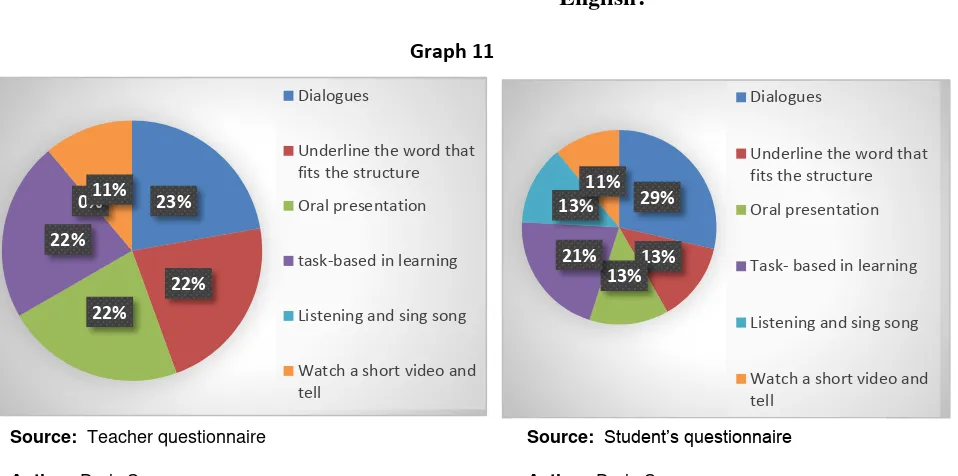
Figure 11 presents data about activities used in a class and to develop communicative skills, as illustrated in the first chart, 23% of participants used dialogues, 22% of teachers prefer to work with strategies such as underline the words which fits the structure, oral presentation and task-based in learning. On the other hand, the 11% of participants rely on other activities such as watching a short videos and commenting on them.
The students’ results plotted in chart 2 clearly show that dialogues represent the highest percentage, i.e. 29%. Task based learning is the second most popular activity with 21%. Nearly
23% 22% 22% 22% 0%11% Dialogues
Underline the word that fits the structure Oral presentation
task-based in learning
Listening and sing song
Watch a short video and tell 29% 13% 13% 21% 13% 11% Dialogues
Underline the word that fits the structure Oral presentation
Task- based in learning
Listening and sing song
Watch a short video and tell
Source: Teacher questionnaire
Author: Doris Sosoranga
Source: Student’s questionnaire
Author: Doris Sosoranga Which of the following activities do
you use to encourage students communicate?
Which of the following activities does you teacher use, to teach
English?
[image:47.612.70.549.213.451.2]39
13% of participants claimed that some of the activities their teachers apply in class are listening and singing a song, underlining the word that fits the structure, and oral presentations. Watching short videos represents the lowest percentage.
Pölzleitner (3013), notes that Language classes should be communicative, therefore we should make sure that we include enough communicative activities in our lessons in order to grammar s be taught communicatively. Richards (2006), mention some of activities that contribute to communication such as memorization of dialogs and drills, the use of pair work activities, role plays, group work activities and project work. These activities help students improve communicative skills because these activities provide students with opportunities explore and practice the language in an exhaustive way.
Contrasting the author’s opinion with the results from graph 11; it is noticeable that
40
Which of the following methods or approaches do you use when teaching grammar?
Regarding methods and approaches applied by teachers to teach English, chart 12 showed
the following results: 33% use “The communicative language teaching” and “The grammar translation method”. Interestingly enough, the Audio-lingual method, Natural-method, and Total Physical response method account for the same percentage, i.e. 17%.
According to Mart (2013), The Audio-Lingual Method is an approach that provides students with the necessary approaches they need in order develop communicative competences. Sysoyev (1999) says that in order to provide students with opportunities to learn grammar in a communicative way, Integrative Grammar Teaching provides students with an adequate balance in teaching communicative grammar because this method combines the teaching of two different approaches: form and structure Kamiya (n.d.), Communicative language teaching is an effective way of improving communication skills in order to replace the traditional teaching of grammar because it based on the theory that the primary function of language is communication.
Source:Teacher’s questionnaire
Author: Doris Sosoranga 33%
33% 17%
17%0%0%
Communicative language teaching
Grammar translation
Audio-lingual method
Natural method
Total physical response
Funtional Notional
41
Taking into account the results from graph 12 and comparing them with author opinions, it is important to highlight that the approaches used by teachers are focused in the main, on the teaching objective, which is to develop communicative competences in Spanish, but not in English because the most popular approaches among English teachers are the Grammar translation, and Audio- Lingual method. These methods have some advantages but they are considered obsolete and should be replaced by new methods which offer complete skill development. On the other hand, considering the data from the observation-sheet, Grammar Translation, which is the most popular method, does not provide a wide range of communication as students tend to translate every sentence into their first language. In addition, overemphasis on translation does not foster learner autonomy on the foreign language. Grammar translation focuses more on reading and writing, leaving behind listening and speaking. Knowing many grammar rules does not guarantee their appropriate use in real contexts.
Source:Teacher’s questionnaire Author: Doris Sosoranga
Source: Students questionnaire Author: Doris Sosoranga
Do you consider discipline is important to improve the teaching-learning environment?
Does the teacher control discipline to
improve the teaching-learning
environment? Graph 13
93% 7%
Yes Not
67% 33%
Yes
42
The pie charts above depict information concerning discipline issues, as a factor that influences the teaching learning process. Graph 13 indicates that 67% of teachers agree with the fact that discipline is crucial to improve the academic process. Interestingly enough, 33% of educators are not in agreement with this statement.
Student’s answers are illustrated in figure 2. While 93% of students considered that discipline is important to improve the teaching learning process, only 7% argued that discipline does not have much effect on the above mentioned process.
According to Marzano, Marzano, and Pickering (2003), teachers play several functions in
the classroom, but the most significant is classroom management and students’ discipline because
they can both seriously interfere and affect the development of the class. Harmer (2007), claims
that controlling student’s discipline and providing clear instructions can benefit both teachers and students because it helps to set an organized classroom environment.
The statistical results from both charts and the author’s opinion agree on controlling
43
As the above pie charts indicate; 100% of teachers stated that their students understand the instructions given.
In contrast, the second chart which depicts students’ answers shows that 70% fully understood the instructions; 17% state that they always understood the directions. Conversely, 13% of students had a hard time understanding the teachers’ instructions.
According to Case (2010), the way teachers give instructions determines the success or failure of an activity. Giving and understanding instructions clearly will help students to develop the contents easily. On the other hand, unclear instructions may confuse students and cause frustration in some cases.
Both charts show that nearly sixty percent of the participants frequently and always understood instructions. However, taking into account the data from the observation-sheet and comparing them with the previous statistical results, it was noticeable that the moment teachers
Source:Teacher’s questionnaire
Author: Doris Sosoranga Source: Students questionnaire
Author: Doris Sosoranga
When you provide instructions, in English, do your students
understand them?
When your teacher provides instructions, in English, do you
44
give instructions and asked students to undertake an activity, they found it difficult to follow the directions and in some cases they did not carry out the tasks. Furthermore, it was found out that
teachers’ instructions were abstruse and too long which caused several problems such as wasting time, noise, disorganization and discipline issues. They also made the teacher lose the sequence of the lesson.
The pie charts above give information about teachers’ instructions. As shown 67% of teachers stated that their students frequently ask for clarification; whereas 33% of participants needed clarification all the time.
Graph 15 exhibits data about students’ results, 47% expressed that they frequently asked for clarification. The second highest percentage, i.e. 30% is for those students who rarely asked for clarifications; and 23% claimed that they always asked teachers to clarify the directions.
Graph 15
Source: Students questionnaire
Author: Doris Sosoranga Source:Teacher’s questionnaire
Author: Doris Sosoranga
Regarding instructions, do your students ask for clarifications?
Regarding teacher´s
instructions in English, do you ask for clarifications?
33%
67% 0%
Always
Frequently
Rarely
23%
47% 30%
Always
Frequently
45
According to, (n.d.), in an article publish by Teaching English to Speakers of Other Languages (2015), asking for clarification enables students to undertake any task and develop it as accurately as possible. Clarifying instructions involves genuineness on the listener's part, also learners feel confident with the activities that they are going to do and say. That is why instructions have to be clear and objective.
Considering the statistical results from the charts, teachers, as well as students agree that clarification was always and frequently asked. These findings are consistent with the observations which also revealed that students asked teachers to repeat and explain the instructions more than once. The observations also provided evidence that teachers’ instructions were not clear enough, and as a consequence students struggled with the assignments and took more time to complete each activity.
Graph 16
Source: Students questionnaire
Author: Doris Sosoranga Source: Teacher questionnaire
Author: Doris Sosoranga
How often do you assign specific time for the activities that students have to perform in class?
How often does your teacher assign specific time for the activities that you have to perform in class?
0%
100%
0% Always
Frequently
Rarely
59% 27%
14% Always
Frequently