PONTIFICIA UNIVERSIDAD CATÓLICA DEL ECUADOR
FACULTAD DE COMUNICACIÓN, LINGÜÍSTICA Y LITERATURA
ESCUELA DE LINGÜÍSTICA APLICADA CON MENCIÓN EN TRADUCCIÓN
DISERTACIÓN PREVIA A LA OBTENCIÓN DEL TITULO DE LICENCIADA EN
LINGÜÍSTICA APLICADA MENCIÓN EN TRADUCCIÓN
Analysis on how adolescent girls ages 12-18 use the anglicisms found in the
teen magazines: Tú, Generación 21, and Seventeen
MARÍA LUISA MONTENEGRO MONTENEGRO
ACKNOWLEDGEMENTS
First and foremost I would like to thank God whose many, many
blessings have made me who I am today.
To my family, words cannot express how thankful I am for their
unconditional love, patience and support throughout my career
and for all the sacrifices they have made on my behalf.
To Mary Ortega, for her endless amount of support and
encouragement
because,
honestly,
if
not
for
her
this
dissertation would never have been finished. And contrary to
what others think, SHE IS THE BEST DISSERTATION WRITER IN THE
WORLD.
I also thank Veronica Montero, my dissertation advisor, who has
guided me through the process, and whose input has been
extremely invaluable to this dissertation.
To Elizabeth Feinstein who helped me count surveys, cheered me
on, and for being a wonderful proofreader.
To Gabriel Del Castillo, because he is really awesome (also
because of his love and support to me while writing this
dissertation and his acceptance to my crazy ideas about
unicorns, zombies, food, among other random things).
To Anita Perez
who also helped me with surveys. (You’re the
best!).
"Even when the music was still playing, the applause began. Because the wild modern creature on stage was showing them all, showing Betsy Groom and everyone else in the house, that there was more than one way to be a girl.
There was Anna's way, a way that, today, was going to twist and stomp and dance its way to first place."
Special dedication to Campanita, the editor cat, who had sat on my lap and bit me when I tried to procrastinate writing this dissertation, therefore
proving that she, deep down in the recesses of her evil soul, loves her human mama cat.
Because of this, and many other generous actions by this editor cat, warrants dedication in this paperweight you have in your hand -I mean-
TABLE OF CONTENTS
BACKGROUND AND JUSTIFICATION ... i
INTRODUCTION ... iv
OBJECTIVES ... vi
METHODOLOGY ... vii
CHAPTER 1 ... 1
1.1. Linguistics and its Branches ... 1
1.2. Morphology ... 4
1.2.1. Morpheme vs. Word ... 6
1.3. Morphological Processes: Derivation and Inflection ... 8
1.3.1. Compounding ... 10
1.4. Other Word Formation Processes ... 12
1.4.1. Coinage ... 13
1.4.2. Blending ... 14
1.4.3. Clipping ... 14
1.4.4. Backformation ... 15
1.4.5. Conversion ... 16
1.4.6. Acronyms ... 17
1.4.7. Onomatopoeia ... 18
1.4.8. Multiple Processes ... 18
1.5. Semantics ... 19
1.5.1. Semantic Field ... 20
1.5.2. Semantic Change ... 21
CHAPTER 2 ... 24
SOCIOLINGUISTIC ASPECTS ... 24
2.1. Sociolinguistics ... 24
2.2. Diglossia ... 24
2.3. Language Contact ... 25
2.4. Borrowing ... 26
2.5.1. Semantic Calques ... 32
2.6. English Around the World/English As a Global Language ... 33
2.6.1. Three Concentric Circles of English ... 37
2.6.2. English in Ecuador ... 38
2.7. Anglicisms ... 40
2.7.1. Common Lexical Fields ... 43
CHAPTER 3 ... 44
RESEARCH ... 44
3.1. First Survey Application ... 44
3.2. Magazines Used ... 45
3.3 Sample Determination ... 47
3.4. Surveys - Pilot Survey Test Results ... 48
3.5. Pilot Survey Results ... 48
3.6 Surveys - Final Survey Application ... 50
3.6.1. Final Survey Results ... 51
3.7. Survey Results and Analysis ... 54
PART ONE ... 55
PART TWO ... 57
PART THREE ... 80
i
BACKGROUND AND JUSTIFICATION
The world is going through globalization. It’s not a theory, idea
, or notion, it is a fact.
One of the effects of globalization is the spread of English to other countries and
Ecuador is not immune to this spread. Anglicisms such as
trendy
,
in
,
looks
,
sexy
, and
girly
are being incorporated into Ecuadorian Spanish through mass media such as
magazines, particularly teen magazines. Teenagers, especially teenage girls, read
these publications and adopt English words and phrases into their speech. Teen
magazines are important to girls because they have always been a source of
information for girls to find out about the latest fashion or gadget. They have the power
to sway its readers on what is popular and what is not, what kind of product or
cosmetic to use, who is the hottest celebrity, which is
the latest “must have”
technology and so on and so forth. Adolescents also use these magazines to discover
new ways to improve their self-image.
In o
rder to attract consumers’ attention, m
agazine editors and product advertisers also
use English in their pages so they can promote a certain prestige (Paramo 2008:
28-29). This strategy is not exactly new. There have been examples that have appeared
in German advertisements dating from the early 20
thcentury.
1
ii
Previous studies prove that English usage is increasing in Ecuador (in store signs,
food branding, newspapers, general magazines, etc.), as well as their attitudinal
perceptions towards that language. However, what they have not established, at least
theoretically, is to what extent these words and phrases have been incorporated into
daily usage, nor is there an analysis on anglicisms themselves or on their usage.
Also, as a linguist and a native English speaker, I think it is important to investigate the
current situation of the English language here in Ecuador, especially in Quito, where
English has a large presence, despite the fact that it does not have an official status in
the country. I have chosen to investigate teenage girls since they are the ones that are
most likely to read and benefit from the source material of this study, which are teen
magazines.
Social reasons for this study is that it will help linguists and researchers at least in a
small way, since the research analysis, results and conclusions will be a measure of
how English is a presence in magazines sold in Quito, as well as in Quitenian female
teenagers.
Additionally, this study will help other people who are interested in language contact
between two language communities and its influence on teenagers within one of these
communities. It will also help English language teachers here in Ecuador to know of
iii
language acquisition. This study will also be helpful as a reference for possible future
iv
INTRODUCTION
This dissertation is titled: Analysis on How Adolescent Girls Ages 12-18 Use the
Anglicisms Found in the Teen Magazines:
Tú, Generación21,
and
Seventeen
. It
describes the way anglicisms are used by teenagers ages 12-18. This dissertation will
only cover words that have been found in the three magazines above dating from
January 2011 to December 2011.
It is important to note that this dissertation will not discuss the positive or negative
effects these magazines
have on adolescents nor determine if these words influence
them. This study will also not deal with the positive or negative effects the English
language has on Spanish.
This dissertation is divided into three chapters:
Chapter 1 covers the linguistic theoretical background topics that are necessary to
carry out the description and analysis of the surveys. This chapter includes topics such
as linguistics and its branches: morphology, and semantics.
Chapter 2 contains the sociolinguistic aspects that will provide the basis for this topic.
Some of these topics are language contact, borrowing, English in Ecuador and the
three concentric circles of English.
v
This dissertation also contains a conclusions section as well as an annex which
contains the results for the first survey done before the dissertation plan, as well as a
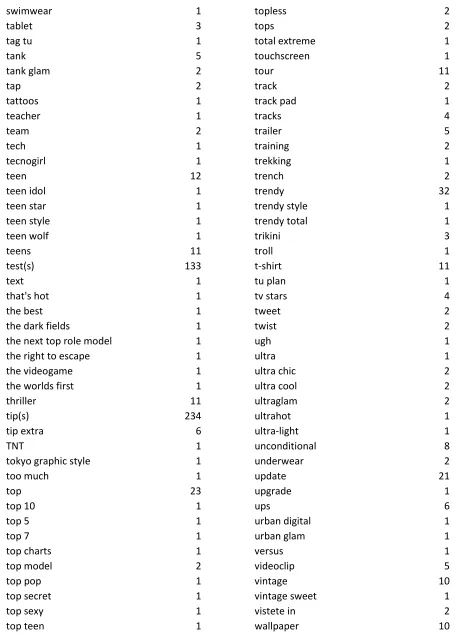
copy of the second survey. It also contains all the words found in the magazines as
vi
OBJECTIVES
Main Objective
To determine the most frequently used anglicisms in
Tú, Generación21,
and
Seventeen
,
and how these forms are used within a target group of teenagers.
Specific Objectives
To establish whether the adolescent readers of
Generación21
,
Seventeen
, and
Tú
use and understand the meaning of the anglicisms
that appear in these publicat
ions.
To analyze these anglicisms regarding semantic, and morphological
aspects.
To determine if these adolescents learn these terms through magazines
vii
METHODOLOGY
Dissertation Methodology
This dissertation uses a descriptive-analytic method and is divided into two phases.
The first phase is descriptive in which the linguistic elements needed for the analysis
are explained. The second phase, the analytical one, consists of analyzing the data
obtained from the surveys.
Investigation Methodology
The investigator determined that to obtain the data on which this dissertation is based,
it was necessary to create surveys. There were two surveys made in this study. The
first survey was created and applied to a group of teenage girls, in order to determine
whether teenagers read magazines and which are the most popular among them. The
result showed that the top three read magazines are
Generación21, Tú
, and
Seventeen,
after which the investigator examined them to determine and write down
on a list, all English words that appear within their pages. On the basis of the
frequency of occurrence, eighteen words were chosen from the previous list, in order
to be used in the second survey. With this survey, the author of this dissertation
wanted to determine whether the girls used these words, how they used them, and
where they had learned them.
The next step was to find out whether these words have actually been borrowed into
Spanish. Since eight of them occur in Spanish dictionaries, only the remaining ten
viii
bibliographical research was conducted in terms of linguistic and sociolinguistic
aspects. The literature review of this dissertation was written to serve as a theoretical
background for the analysis.
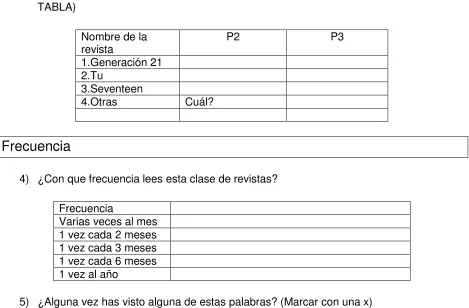
The second part was the survey analysis. This analysis was divided into three parts.
Part One consists of questions one to four and analyzes magazine usage and reading
frequency. Part Two consists of questions five, six, seven, ten and eleven, which were
related to word usage and where the students learned these words. This section
1
CHAPTER 1
LINGUISTIC ASPECTS
This chapter deals with the theoretical concepts, as well as information, that can be
considered relevant to the dissertation topic. This chapter consists of the following topics:
linguistics, morphology, semantics, and their respective branches.
1.1. Linguistics and its Branches
What is linguistics? John Lyons in his book, Language and Linguistics defines linguistics as
the “scientific study of language” (Lyons 2002: 34). David Crystal, in his book Linguistics, says
that the reason why linguistics was created was to find out more information on language
because earlier approaches have been unsatisfactory, unhelpful, and often wrong.
According to Lyons, in English, the word language has caused some confusion since it can
refer to language in general, but it is also applied to systems of communication, whether
natural or artificial, human or non-human, spoken or written. Several European languages
have two words to translate the English word language, such as lenguaje and lengua in
Spanish (Lyons 2002: 2-3). Ferdinand de Saussure had therefore introduced three terms to
help differentiate it: langage, langue, and parole. Langage is, according to The Concise Oxford
Dictionary of Linguistics, “a system in the mind of the individual“or the phenomenon of human
2
social reality constraining the speaker, whereas parole is the instances of language use, the
executive aspect of language compromising the combination of signs in the mind of the
speaker, and the “psycho-physical mechanisms” by which they are externalized, or better
explained as linguistic production. (Lyons 2002: 9-10, Matthews 1997: 200, 266 and
Malmkjaer 2004: xxvi) Langue and parole are more focused on the social aspects of language.
Other authors, mainly Noam Chomsky, focus on psychological aspects of language:
competence and performance. Competence refers to a person’s intuitive knowledge of the
rules and structure of his or her language as a native speaker, and presumes individual
differences between humans. Performance is the actual use of these rules and structures
(Lyons 2002: 9 and Malmkjaer 2004: xxxviii). These two views have generated debate on
which should be the main focus of linguistics. (Malmkjaer 2004: xxxi-xxxiii and Matthews 1997:
198)
Peter Matthews’ definition takes both views (Saussure and Chomsky) into account, and states
that:Language is the phenomenon of vocal and written communication among human beings generally
again as in ordinary usage. Thus the subject matter in linguistics includes both language as a general property of our species and particular languages.”
Matthews also gives more information on linguistics, giving a glimpse on how it relates to other
subjects.
3 computer science, deal with language one way or another, and the boundaries between them and linguistics are not fixed. (Matthews 1997: vii)
This is significant because this author establishes links between linguistics and other fields of
study. However, linguistics studies all aspects related to language. According to Crystal,
several branches and approaches of linguistics can be distinguished, depending on the
linguist’s focus and range of interest. For this dissertation, linguistics branches are divided
according to what Randy Allen Harris2 in his book The Linguistic Wars has determined, which
includes the following:
Phonology and phonetics3 deal with speech sounds within the systems of individual
languages (phonology), as well as the nature and typology of speech sounds
themselves (phonetics). The basic unit is the phoneme.
Morphology is concerned with the forms of words in different uses and constructions.
The basic unit is the morpheme.
Syntax traditionally covers both construction of phrases and sentences. The basic unit
is the sentence.
Semantics is the study of word meanings and what these mean in the real world. The
area of study is the meaning of signs and the study of relations between different
linguistic units and compounds.
2 This author is not the first author (nor last) to divide it this way, but the investigator considered it the most
straightforward version of it.
3 Crystal states that there is some controversy in considering phonetics as a branch of linguistics or a separate
4
Of course, these fields are not separate, and they interact and overlap with each other. Each
level has its own importance which cannot be completely ignored when analyzing language in
any context.
Crystal says that since linguistics has links to other sciences and fields, it has given way to the
setting up of new branches of the subject in both pure and applied contexts, such as
anthropological linguistics, developmental linguistics, psycholinguistics, sociolinguistics,
statistical linguistics, among many others.
This dissertation will not focus on phonology and syntax, but it will focus on morphology and
semantics. The reason for this is that in order to focus on all four branches, the author of this
work would also have to make and evaluate recordings (for phonology) as well as analyze how
the anglicisms are used within the sentence as it appears in the magazines (for syntax). This
is not possible to achieve for this dissertation, due to time constraints, however, it would make
an excellent follow-up study to analyze the phonological and syntactic aspects.
1.2. Morphology
According to Geert E. Booij, the term morphology has been adopted from biology where it was
used to denote the study of the forms of plants and animals. The first linguist to use this term
was by the German linguist August Schleicher in 1859 who had used it to refer to the study of
the forms of words.
Nowadays, many linguists (O’Grady (1997), Radford (1999), Fromkin (2000), among others)
5
as“the branch of grammar which studies the structure or forms of words, primarily through the
use of the morpheme construct.” (Crystal 2003: 300-1). As seen from these definitions, it can
be pointed out that they all use structure of words to define morphology; however, other
authors take into account meaning. Matthews, in his book entitled Morphology, defines this
branch of linguistics as follows: “…morphology is a term for that branch of linguistics which is
concerned with the form of words in different uses and constructions”(Matthews 1991: 8). He
also states that even though word is a unit which is familiar in our culture, the notion that this
has a form is not.
Booij sees morphology as the study of the internal structure of words, and of the systematic
form-meaning correspondences between words (Booij 2012: 7). The word systematic is
important because, as Booij states: “for instance, we might observe a form difference and a
corresponding meaning difference between the English noun “ear” and the verb “hear”.
However, this pattern is not systematic: there are no similar word pairs, and we cannot form
new English verbs by adding h- to a noun”(Booij 2012: 7).
It is important at this time to define the term word. According to Andrew Radford, the term
word hides an important ambiguity. For this reason, he introduces the following: lexeme, word
form, and morphosyntactic word.
A lexeme is an abstract notion of a word; different lexemes refer to different concepts (Radford
1999: 165-6 and Katamba 1993: 18). Crystal states that it is the abstract unit underlying such
sets of grammatical variants. He gives the following example: walk, walks, walking, walked
6 kick the bucket = die). These are the units which are listed in dictionaries as separate entries.
(Crystal 2003: 265)
Word forms are different forms of the same lexeme, and do not refer to different concepts.
Radford uses this as an example: cat and dog are lexemes, whereas cat and cats are word
forms of the lexeme cat. Cat and cats are the singular and plural forms of cat. (Radford
1999:166)
A morphosyntactic word (also known as grammatical word) is as defined by Matthews: “a
representation of a word in terms of its grammatical properties, as opposed to a phonetic or
written *word form” (Matthews 1997: 234). Radford gives this as an example: crossed is the
past tense and the past participle of the word cross, however crossed (past) does not have the
same function as crossed (past participle) (Radford 1999: 169). Francis Katamba mentions
that the nature of the grammatical word is important in the discussion of the relationship
between words and sentences as well as the boundary between morphology and syntax
(Katamba 1993: 19).
1.2.1. Morpheme vs. Word
As we saw previously in Crystal’s definition of morphology, he mentioned the word morpheme.
Many linguists define morpheme as the “minimal unit of grammar”. Crystal (1971: 187-199)
mentions that there are some controversies on whether to use word or morpheme.
There were some difficulties presented if using the term word. First of all, there were problems
7
it became difficult. People normally do not pause after every word; also, when a person listens
to the speech of a foreign language, they are temporarily unable to decipher neither individual
words nor where the boundaries between them go. He mentions a few solutions to this
problem; however, each of them has their drawbacks. The word can be considered as a unit of
sense is one; however, this does not include idioms which consist of more than one word (like
spick and span, and a rolling stone gathers no moss). The potential pause criterion is another
one, but how does one convey compound words such as washing-machine? A third way
would be to see words as the smallest units that can be understood on their own in a
sentence, but even then, there are difficulties. Function words, such as pronouns, cannot be
used on their own but they are necessary for grammatical reasons (For example: This is my
mother does not covey the same meaning as: This is his mother). He also mentions other
ways. Another problem with using the term word is word classification. Some languages have
more “word-like”- units and others, mostly agglutinative languages, do not have words. He
uses this as an example: the (in English) is hard to be considered as a word, but {–en} in
children, it is less of a word. This is contrasted with Rumanian, in which the definite article is
always added to the noun as a suffix (as in pumul, the tree) but is not a free morpheme and
therefore, cannot be separated from the noun as in English (the nice policeman). We also see
this phenomenon in Hebrew. Articles and prepositions become a part of the noun when used.
For example, the word chair is written אסיכ, and is pronounced as quise, while the chair is
written אסיכה and pronounced haquise. The ה which represents [h], attaches as a suffix
(Hebrew is always written from right to left) and cannot be separated from the word it modifies
as in Rumanian.
As seen above, it is difficult to create a notion of a word that encompasses these and other
8
problematic. Morphemes were artificially created as a reaction to the existing word-based
grammars. It was not a novel way of doing this; people have dealt with word structure before
(prefixes, suffixes, etc.); this was just on a wider scale, but it was easier to use morphemes to
compare languages (such as English and Turkish). Crystal stated that a morpheme should
have phonetic shape, meaning and a syntactic role to play in the construction of larger units;
however, this process of identifying morphemes should enable us to identify them, but to be
able to identify it again when it appears in another context. However, there was a problem;
what would happen if one of the three (phonetic shape, meaning and syntactic function)
changed? Also, the morpheme concept is in itself of only limited value and the concept is not
as all-encompassing as initially thought.
There is no linguistic theory that is primarily based on the morpheme concept; however,
linguists would recognize the existence of morphemic units, since linguists view the inventory
of morphemes in a language as the basis of that language’s lexicon. The role of morphemes
has thus changed considerably since they were first introduced, but they are still vastly used
instead of the word. This dissertation will deal with the morpheme, because this analysis will
be more based on certain modifications based on words.
1.3. Morphological Processes: Derivation and Inflection
Morphology is generally divided, according to Crystal, into two branches: inflection and
word-formation, word formation is further divided into derivational morphology and compounding.
9
According to Crystal (2005: 197), inflection is an affix that signals a grammatical relationship
e.g.: case (girl’s – possessive form of girl) and tense (played – past form of play). Inflection
studies the way words vary in their forms to express a grammatical contrast (as in the case of
horses, where the s-ending marks plurality). The base of an inflectional affix is sometimes
called the stem. In the case of most English nouns, inflection marks the plural subclass by
adding the plural morpheme {-s}. In the case of English verbs, inflections usually marks a
distinction between past and non-past subclasses by adding the suffix {–ed} to indicate the
past tense.
Derivation is a major process of word formation; it studies the way in which new items of
vocabulary can be built out of a combination of elements (as in the case of in-describ-able).
George Yule elaborates further and states that, these words are combined with affixes such as
un-, mis-, -ism, and ness to create new words such as unhappy, miscommunicate, terrorism
and sadness (Yule 1985: 55).
Matthews states that affixes are part of derivational processes and that they are any element
in the morphological structure of a word other than its root. (Matthews 1991: 131) Thus,
affixation is the process of adding an affix to a word. Affixes are traditionally divided into
prefixes and suffixes. Prefixes precede the word that to which they are attached while suffixes
follow it. Other forms are circumfixes and superfixes. There are also affixes known as infixes,
which are not common in English, but they come within the word. Another familiar form of
10
expression. Less rude is abso-bloody-lutely, and milder still, but retaining the structure is
abso-freaking-lutely.4
So, derivational affixes are added to morphemes to form new words that may or may not
change their part of speech, and inflectional affixes are added to the end of a word for purely
grammatical reasons. Derivation is different from inflection as it uses another kind of affix to
create variants of the same word. An example in English is determine/determine-s/determin
-ed/determin-ing. To be more precise, inflection applies to all members of a part of speech
(e.g. all English verbs have a past tense form) while derivation applies only to some members
of a part of speech (the suffix {–er} is used with the adjectives big and small, but not with
important or beautiful). Except for these few instances previously mentioned, English is
generally not an inflectional language. This is important to keep that in mind because Spanish
generally is.
To conclude, morphology is important for this dissertation because some of the anglicisms
analyzed in this dissertation have been modified. These changes are important to consider
because these words can change their form when adopted into a new language such as
Spanish.
1.3.1. Compounding
Another way to build words in English is compounding. According to Matthews, a compound is
a word that is formed by two components that are themselves words (Matthews 1997:66) For
example: sunflower comes from the nouns sun and flower, or Spanish cortauñas (nail clippers)
4Carey, Stan. "Absoposilutely infixed." . N.p., 07 Oct 2011. Web. 10 Jun 2013.
11 from the verb cortar (cut) and the noun uña (nail). Another term for this process is composition.
Fromkin et al. considers compounding the most common way a word enters a language and
states that the meaning of the compounds cannot be predicted from the meaning of the
individual morphemes and words (Fromkin 1988: 137). These words have to be learned and
memorized separately in our internalized dictionaries. Yule also notes that compounding is
more common in Germanic languages such as English and German, rather than Romance
languages such as Spanish and French (Yule 1985: 53)
William O’Grady states that the final component in a word determines the category of the
word. For example the word sunflower is a noun because the last component, flower, is a
noun. Breakdance is a noun since dance is a noun. Nationwide is an adjective since wide is an
adjective. Verbs rarely appear in compounds in English (O’Grady 1997: 133).
Additionally, the word formation processes responsible for derivation and compounding can
interact with each other. O’Grady uses the following as an example(O’Grady 1997:134).
A compound is formed by combining a single word debate with the derived word abortion
12 1.3.1.1. Properties of Compounds
O’Grady states that English orthography is not consistent in representing compounds since
they are sometimes written as single words; sometimes these words are separated by
hyphens, and sometimes they occur as separate words (O’Grady 1997: 135). However, in
pronunciation, we can state a very general rule: adjective/noun compounds are characterized
by their stress on the first component. In non-compound words consisting of an adjective and
a noun, the second is generally stressed.
GREEN house (an indoor garden) green HOUSE (a house painted green)
Another distinguishing feature of compounds in English is that tense and plural markers can
typically not be attached to the first element. However, they can be added to the compound as
a whole.
1.4. Other Word Formation Processes
O’Grady states that derivation and compounding are the most common word formation
processes, but they are not the only ones (O’Grady 1997: 138). He notes that many speakers
13 1.4.1. Coinage
Yule states that coinage is the word formation process which consists of the creation of
completely new words (Yule 1985: 52). He also states that the most typical sources are
invented trade names for a company without capital letters for any version of that product. He
states words such as aspirin, nylon, and zipper as examples (Yule 1985: 52). Fromkin
expands this and states that coined words usually fulfill a purpose of some kind (Fromkin
1988: 135). She states that Madison Avenue has added many new words to English such as:
Kleenex, Xerox, Frigidaire, Vaseline, and Kodak. Some of these word names were created
from existing words like Kleenex from clean or Frigidaire from frigid and air. Sometimes, a
brand name becomes so popular it becomes the generic term for a product. An example in
Spanish is gillette, which is a company name that became the name and what a large
population calls razors. Yule also notes that this process is the least common word formation
process (Yule 1985: 52), and is mostly used when a company or industry requires a new and
attractive name for a product. Some literature authors (like J.K. Rowling) have also created
words to describe objects or people in their fictitious worlds they have created like muggle or
quidditch.
A related practice can be seen by words such as watt, fahrenheit, and boycott, which are
words derived from the names of individuals (usually inventors or discoverers) associated with
14 1.4.2. Blending
Matthews states that blending refers to words that are formed by the joining of the beginning of
one lexical unit to the end of another (Matthews 1997: 40). O’Grady has a similar definition;
he says that a blend is usually formed from the initial part of one word and the final part of a
second one (O’Grady 1997: 139). Their meaning is often a combination of these words. For
example: smog is formed by blending smoke and fog. Motel is from motor and hotel. Spanglish
is formed by combining the words Spanish and English. Bash is formed by combining the
words bang and smash.
O’Grady also states that sometimes a word is formed by a process that seems to be on the
border between compounding and blending in that it combines all one word with part of
another such as perma-press (from permanent press) and medicare (from medical care)
(O’Grady 1997: 139)
Some blends have been so assimilated into a language that some people are unaware that
the words they use are a blended form of two words: (chortle from chuckle and snort, bit from
binary and digit, and modem from modulator and demodulator).
1.4.3. Clipping
Matthews and O’Grady (Matthews 1997: 56 & O’Grady 1997: 139) explain that clipping is a
word-formation process in which an existing form of a polysyllabic word is abbreviated by
deleting one or more syllables, for example: fan (devotee, enthusiast) was created by
15 created words such as home-ec (from home economics), gym (from gymnasium), math (from
mathematics) (O’Grady 1997: 139). In Spanish, we can see profe from professor, tele from
television, doc from doctor, etc. Fromkin expands this and states that some of these forms
have become used as whole words and accepted into general usage. She uses these words
as examples: ad, bike, gas, phone, bus, fax and van. (Fromkin 2011: 504)
1.4.4. Backformation
Matthews states that backformation is the formation of a simple or simpler word from what it
appears to be its derivative, usually by removing actual or supposed affixes (Matthews 1997:
33). Examples in English include resurrect from resurrection, edit from editor, donate from
donation, beg from beggar, difficult from difficulty etc. O’Grady adds to this, stating that
backformation sometimes involves an incorrect assumption of a word’s form: for example pea
was derived from the singular noun pease, whose final /z/ was incorrectly interpreted as the
plural (O’Grady 1997: 139-140). He also states that a major source of backformations in
English have been words that end in –or or –er and have meanings involving the notion of an
agent, such as editor, and peddler. Since hundreds of these words are the result of affixation it
was assumed that these words too have been formed by adding {–or} or {–er} to a verb. By the
process of backformation, the verbs, edit and peddle were formed.
In Spanish, this process is used to create nouns from verbs, examples: corte from cortar,
debate from debatir, marchar from marcha. Backformation is different from clipping in that
clipping shortens words but does not change the part of speech or meaning of the word.
16 language corruption. Despite this, many words have entered the language this way (Fromkin
et al .2011: 508).
1.4.5. Conversion
O’Grady and Matthews go on to explain that conversion – also known as zero derivation- is a
process that transforms a form of speech such as a noun, to another form of speech, without
changing in its form. O’Grady says that this is often considered a type of derivation because of
the change of category and meaning that it brings about (O’Grady 1997: 138). For example,
access as in “access the file”, which was previously a noun, as in “gain access to the file”.
Other examples include: host (noun) transforms into a verb as in “host a party” or chair (noun)
to a verb “chair the meeting.” Radford states that this commonly happens to transform nouns
into verbs and it is sometimes difficult to determine which the original category was. He uses
this as an example: rain is basically a verb and a noun; however, it is not known which one
was coined first (Radford 1999:165).
In English, as explained by O’Grady, conversion usually changes from a noun to a verb as
demonstrated in the previous examples; however, he adds, there are two more common types
of conversion in English: verbs to nouns and adjectives to nouns. (O’Grady 1997:138)
Examples from verbs to nouns include: permit (to give permission versus a document
indicating that one has permission to do something), call (to cry out to someone or to
telephone someone versus a telephone call), and report (to give a spoken or written account
that someone has done something versus a document that describes an account). Examples
from adjectives to verbs are: dirty (covered or marked with an unclean substance versus to
17 types of conversion are: adjectives to nouns (the) poor (lacking money or resources versus a
group of people), green (color versus a spot of grassy plain or plot) and even preposition to
verb: down (from a higher to a lower point of something versus knock or bring to the ground),
up (from a lower to a higher point on something versus to increase).
This process is usually restricted to morphologically simple words; however, there are a few
exceptions such as noun to verb: proposition (an idea versus to offer an idea) or noun to verb:
referee (someone who supervises a sporting game versus supervising a game).
1.4.6. Acronyms
Matthews, as well as O’Grady, state that an acronym is a word that is formed from the initial
letters of two or more successive words, or in a phrase, and pronouncing them as a word
(Matthews 1997: 6 & O’Grady 1997: 140). For example: laser from Light Amplification by
Stimulated Emission of Radiation, or NASA from National Aeronautics and Space
Administration. We also see this in Spanish with these examples: SIDA from síndrome de
inmuno deficiencia adquirida, Mercosur from Mercado Común del Sur. These acronyms can
consist of capital letters (like UN, FAQ, or FBI) or can lose their capitals to become everyday
words such as scuba (self-contained underwater breathing apparatus). Crystal states that
there are two types: initialisms (or alphabetisms) pronounce each letter separately, (like FBI,
CIA, SRI) and abbreviations which pronounces the entire construction as one word (scuba,
laser, NATO). (Crystal 2003: 1). O’Grady notes that this type of word formation is especially
common in names of organizations and in military and scientific terminology (O’Grady
18 1.4.7. Onomatopoeia
According to O’Grady, all languages have words that have been created to sound like that
thing that they name (O’Grady 1997: 140). Examples of these onomatopoeia words in English
are moo, buzz, hiss, neigh, etc. These words are not exact phonetic copies of noises;
therefore, their form can differ from language to language. Examples: cat sound meow in
English is nya in Japanese, dog sound woof in English is guau-guau in Spanish. The sound of
a rooster is cock-a-doodle-doo (English) kokekokko (Japanese) and kikiri-ki (Spanish). English
also does not always have an equivalent for onomatopoeic words found in other languages.
For example: herahera is a Japanese onomatopoeia which means acting foolishly or frivolous.
1.4.8. Multiple Processes
According to Fromkin, word formation is not limited to just one of these methods; sometimes
words are created with more than one process. For example, in the expression “waspish
attitudes”, the form WASP, which is an acronym (White Anglo-Saxon Protestant) has lost its
capital letters and gained a suffix (ish) in the derivational process (Fromkin et al. 2011: 531).
Yule gives other examples such as yuppie, which was an acronym for young urban
professional plus the suffix ie (Yule 1997:56). He adds that the formation of this word was also
helped by a different process known as analogy in which words are formed to be similar in
some ways to existing words. Yuppie was made possible from the earlier existence of hippie.
He also says that it is possible that sometimes these words could have a brief life span and
generally one way to know if a word was accepted or not would be to see if it had been
19
example where Noah Webster was criticized for adding words such as advisory, presidential
and test (as a verb).
1.5. Semantics
What is semantics? Lyons has defined semantics as the study of meaning (Lyons 1978: 1).
Other authors such as Fromkin defined semantics as the study of linguistic meanings of
words, expressions, phrases, and sentences (Fromkin et al. 1974:124).
F.R. Palmer defines semantics as the technical term used to refer to the study of meaning,
(Palmer 1977: 1) and, since meaning is part of language, semantics is part of linguistics.
However, Palmer also notes that “meaning” covers a variety of aspects of language and that
there is no consensus either, on the definition of “meaning” or how it should be described, nor
which language aspects it includes. Stephen Ullmann agrees with this and theorizes that this
may be so because of its earlier history, as well as its role in other branches of linguistics such
as syntax and morphology (Ullmann 1962:10, 33).
Semantics is a relatively new term, compared with other linguistic terms. Palmer gives a brief
summary of its history, stating that the first example of its use is found in an article from 1894
entitled Reflected Meanings: A Point in Semantics. The previous year, M. Bréal coined the
word sémantique which was borrowed from Greek into French. In both of these cases,
semantics was not used to refer to meaning but to its development, or what is now currently
known as historical semantics. Later, Bréal would publish a book titled Semantics: Studies in
the Science in Meaning; this is the first book that considered semantics as the “science of
20
Crystal defines semantics “as a major branch of linguistics devoted to the study of meaning in
language” (Crystal 2003: 410). He also mentions that this term is also used in philosophy and
logic; however, it does not have the same range of meaning as in linguistics (Crystal 2003:
410). In linguistics, semantics emphasizes the study of semantic properties of natural
languages. Many different linguists’ approaches to meaning nonetheless illustrate the
influence of general philosophical or psychological positions.
Crystal also stresses the importance of structural semantics, which displays the application of
the principles of structural linguistics to the study of meaning through semantic relations
(sense or meaning relations such as synonymy and antonomy). He also says semantic
meaning may be used in contrast to grammatical meaning. He also talks about semantic fields
(Crystal 2003: 137-138).
1.5.1. Semantic Field
Semantic field is an approach which was developed in the 1930s. It took the view that the
vocabulary of a language is not simply a listing of independent items (as in dictionaries) but is
organized in areas or fields, within which words interrelate and define each other in various
ways. Crystal uses color as an example of a semantic field. The precise meaning of a color
word can only be understood by placing it in relation to the other terms which occur with it,
demarcating the color spectrum (Crystal 2003: 138). Laurel J. Brinton (2000: 112) gives more
examples on this subject:
21 some apparent gaps (e.g., there are no simple terms for the different stages of adulthood). Note that a term such as minor or juvenile belongs to a technical register, a term such as kid or tot to a colloquial register, and a term such as sexagenarian or octogenarian to a more formal register. The semantic field of 'water' could be divided into a number of subfields; in addition, there would appear to be a great deal of overlap between terms such as sound/fjord or cove/harbor/bay.
1.5.2. Semantic Change
Other areas of semantics include the diachronic study of word meanings (etymology), the
synchronic analysis of a word usage (lexicology), and the compilation of dictionaries
(lexicography). Crystal also talks about semantic change and that linguists have distinguished
several kinds of semantic change (Crystal 2003: 138). He gives four types:
(1) Extension or generalization
(2) Narrowing or specialization
(3) Amelioration
(4) Pejoration or deterioration.
1.5.2.1. Extension
Extension is also known as generalization. Extension occurs when a lexeme widens its
meaning. Numerous examples of this process have occurred in the religious field where office,
doctrine, novice and other terms have taken a general meaning. Crystal uses flower as an
example; the extension of flower would be the set of all kinds of flowers (Crystal 2003: 173)
Terry Crowley (2000: 200) states:
22 particularly powerful breed of dog that originated in England. The word bird derives from the earlier word bridde, which originally referred only to young birds while still in the nest, but it has now been semantically broadened to refer to any birds at all.”
1.5.2.2. Narrowing
Narrowing is also referred as specialization in some linguistics sources. Narrowing occurs
when a lexeme becomes more specialized in meaning. Crowley gives a good example of this:
“The history of the word hound in English neatly illustrates this process. The word was originally pronounced hund in English, and it was the generic word for any kind of dog at all. This original meaning is retained, for example, in German, where the word Hund simply means 'dog.' Over the centuries, however, the meaning of hund or hound in English has become restricted to just those dogs used to chase game in the hunt, such as beagles. . . .“ (Crowley 2010: 200)
1.5.2.3. Amelioration
Amelioration is a lexeme that develops a positive sense of approval. Crystal gives some
examples: the word pretty, in Old English, meant tricky or sly. Two more examples are nice
and mischievous. Nice meant foolish or stupid in Middle English, while mischievous meant
disastrous and now it means playfully annoying. (Crystal 2003: 136-8)
1.5.2.4. Pejoration
Pejoration is also known as deterioration. It is when a lexeme develops a negative sense of
disproval. This is opposite of amelioration. Example: Silly used to mean, in Old English, happy
or blessed, whereas nowadays, it refers to someone foolish or empty headed. Another
example is the word notorious, it once meant widely known, whereas now it means widely and
23
It is important to consider semantics in this dissertation because when words are borrowed
from another language, their meaning can undergo certain changes.
With this, we conclude the first chapter which covered all the linguistic topics needed to
24
CHAPTER 2
SOCIOLINGUISTIC ASPECTS
2.1. Sociolinguistics
R.A. Hudson defines sociolinguistics as the study of language in relation to society. (Hudson
2001: 4) According to Crystal, sociolinguistics is a branch of linguistics and is a term including
the aspects of linguistics applied toward the connections between language and society, and
the way we use it in different social situations. (Crystal 2003: 422) It ranges from the study of
the wide variety of dialects across a given region down to the analysis between the way men
and women speak to one another. Sociolinguistics often shows us the reality of human
speech and how a dialect of a given language can often describe the age, sex, and social
class of the speaker; it codes the social function of a language. (Crystal 1992: 45)
Sociolinguistics is important to the study because it will not only analyze anglicisms from a
linguistic point of view, but also how teenage girls use them.
2.2. Diglossia
Crystal defines diglossia as a term used in sociolinguistics to refer to a situation where two
different varieties of a language co-occur in a speech community each with a distinct range of
social function (Crystal 2003, 138). Both varieties are standardized to a certain degree and are
felt to be alternatives by native speakers while usually having special names. Sociolinguists
25
The high variety tends to be learned in school, church, or in other high social prestige areas.
Low variety, on the other hand, is used at family gatherings, with friends, and other informal
settings. One example in the USA, Black English is considered as a low variety, while
Standard English is a high variety. In early American settlements, the black slaves had a
different way of communicating than the white slave owners. Black English developed in this
context and it was considered lower than the standard, giving Black English the title of low
variety, and Standard English the title of high variety (Crystal, 2003: 96).
Susan Romaine expands this and says that the standard language is used for high functions
such as giving a lecture reading or broadcasting, while the home variety is reserved for low
functions such as interacting with friends or speaking at home (Romaine 1994: 45).
She also says that this has also extended to other communities in which the varieties of
diglossic distribution have the status of separate languages, such as Spanish and Guarani (an
indigenous language native to Paraguay that is unrelated to Spanish) (Romaine 1994:47). In
Paraguay, Spanish is the high variety and is used for high functions, as well as the language
of the government and education, although 90% of the population speaks Guarani, which has
the status of national language. Recent attempts of extending this language into education
have met with resistance.
2.3. Language Contact
Factors like migration, business, colonial expansion, globalization, and mass media have
contributed to create a world where speakers of one language live with speakers of another
26
easier ways to communicate and travel, distances between communities and people are
getting shorter and shorter and, therefore, contact between our current 6000 languages is
increasing, as mentioned by McWhorter as well as Crystal (Crystal 2003: 3), especially with
languages such as English and Spanish, which have been in contact at least since the 1800s.
(Lipski 1985: 12)
Language contact can occur along language borders, as a result of migration, or between two
languages, that have the same prestige. According to Rene Appel and Pieter Muysken, two
languages in contact inevitably lead to bilingualism (Appel and Muysken:1987 9). This belief is
supported by Silva – Corvalán (qtd. In Martinez 2005: 5), who says: two or more languages
are in contact when they are used by the same individuals; in other words, within a bilingual or
multilingual situation, where the bilingual speakers constitute the contact locus.
As seen below, language contact is important in this work because it will show that there is
contact between English and Spanish in teen magazines, despite the geographical distance
between Spanish speaking countries and English speaking countries.
As a result of language contact between English and Ecuadorian Spanish, many concepts
have entered people’s vocabularies. The processes that have been used to adopt these words
into Spanish are the following:
2.4. Borrowing
According to Fromkin et al, borrowing occurs when one language adds a word or morpheme
27
common source of new words in the English language. Throughout its history, English has
acquired a vast amount of loan-words from other languages such as cookie (Dutch),
delicatessen (German), mafia (Italian), and tsunami (Japanese). Spanish has given English
many words such as mosquito, adobe, corral, llama, nacho, patio, and tornado. Other
languages have borrowed words from English such as party - パーティー (Japanese), football
- futbal (Hungarian), and the weekend - le weekend (French). English has also been a great
source of words to the Spanish language, with words such as pop, piercing, club, sandwich,
bestseller, among many others.
According to Molina and Albir (2002:520), borrowing can be classified in into various sub
classes, and classified into two types: pure borrowing and naturalized borrowing. Pure
borrowing is also known as loan word.
Pure borrowing is an expression or a word is adopted as is into the target language without
any changes, like for example the English word bus, which has been borrowed into Spanish
with no changes. While in naturalized borrowing, it can be adapted or naturalized to fit the
spelling rules in the target language, for example the English word football had been adapted
into Spanish and became futbol.
28 2.5. Calque
A calque, or also known as loan translation, is, according to Crystal, lexical items which are
translated part-by-part into another language (Crystal 2003:27). Pedro Sampedro Losada
defines calques as:
“Se habla de calco lingüístico cuando, para nombrar una noción o un objeto nuevo, una lengua A (en nuestro caso el castellano) traduce una palabra simple o compuesta de otra lengua B (aquí el inglés), mediante una palabra simple ya existente en la lengua A, o mediante un término compuesto formado por palabras ya existentes en esta lengua. Es decir, el calco lingüístico es una palabra o grupo de palabras que imitan el esquema o la significación de una palabra o expresión inglesa o extranjera y no su entidad fonética”.5
This is slightly different from borrowing because in a calque, there is a direct translation of a
word into the other language. Examples include: grate-ciel which literally translates as “scrape
sky” (from the English word skyscraper) and loan word (from the German word Lehnwort).
Sampedro Losada uses these as examples of a calque from English to Spanish: lista de
correo (mailing list), caballo de Troya (trojan horse), páginas amarillas, (yellow pages),
conexión remota (remote login), and tarjeta de sonido (sound card).
Crystal also states that English is an “insatiable borrower”, and it is true. English borrows and
loan translates from more than 120 languages, especially from French. A humorous example
of this is used by J.R.R. Tolkien who named the home of character Bilbo Baggins, Bag End
which is a calque of cul-de-sac, as a way of making fun of the English tendency of borrowing
words from French. The main source of calques in Spanish is English, mostly due to the
5 Sampedro Losada, Pedro Jose. "Anglicismos, barbarismos, neologismos y «falsos amigos» en el lenguaje
29
language contact these two languages have. More information on this will be in the anglicisms
section.
Juan Gómez Capuz, in the electronic magazine Tonos6, defines calques as:
…Por tanto, definiremos el calco estructural o léxico como la sustitución de una palabra polimorfemática o compuesto nominal de la lengua modelo (con un significado literal o descriptivo), por medio de morfemas o lexías simples ya existentes por sí solos en la lengua receptora, de manera que la unión de estos elementos dé lugar a una expresión polimorfemática o lexía compleja desconocida antes en esta lengua.
He considers calques (or as he calls calques: calco estructural (structural calque) or calco
léxico (lexical calque) to have the following characteristics:
This new word does not retain the same pronunciation of the original word. It also
consists of the reproduction of a foreign lexical complex by means of native material,
usually after having analyzed the elements of this foreign complex.
Not every word is able to be calqued; there are certain features the original word
should have: 1) Have a polimorphemic structure, meaning to be able to divide itself into
smaller units, like morphemes. 2) Possess a literal and descriptive meaning, that is, to
be able to deduce its meaning from its components. If this is not met, then the word
most probably will be borrowed and not calqued. As the model is composed of two or
more elements, firstly analyzed and later translated, it becomes clear that the "loan
6 Gómez Capuz, Juan. "El tratamiento del préstamo lingüístico y el calco en los libros de texto de bachillerato y en
30
translation" is always a polymorphemic unity (although graphically either univerbal or
muitiverbal). (Gómez Capuz: 1997: 88)7
This calque creates a new complex lexis in the target language. This is also what the
difference between structural calque and semantic calque is: that the semantic calque
only modifies the meaning of a word in a target language and does not create one like
a structural one does. In relation to this, another important idea set out by French and
German scholars is that “loan translation" (unlike "semantic borrowing") creates a new
lexical unit in the receiving language (Deroy 215-16 and Zindler 31 cited in Gómez
Capuz 1997: 88): gratte-ciel (English: sky-scraper) is a new compound in French,
whereas realizer in the sense of "be conscious of'(English: to realize) is not a new
lexical unit in French, but only a new acquired meaning (Humbley 62 cited in Gómez
Capuz 1997: 88)
Finally, this new calque has to be faithful to the original in its translation. As this
reproduction tends to be faithful to the model, the loan translation is said to be a
borrowing caused by a translation, an "emprunt par traduction" in Deroy's words (215)
or a "Lehnübersetzung" as defined in the German tradition (Betz 136 cited in Gómez
Capuz 1997: 88)
Gómez Capuz has noted that loan translations is a large category; therefore, he divided it into
the following:
Loan translation proper (a term coined by Weinreich in order to match the German
term "Lehnübersetzung") is an exact loan translation, not only in meaning, but also in
7 Gómez Capuz, Juan. "Towards a Typological Classification of Linguistic Borrowing." Revista Alicantina de Estudios Ingleses. 10. (1997): 81-94. Web. 23 May. 2013.
31
structure (Betz 136 and Weinreich 51 cited in Gómez Capuz8: 1997: 88). Most calque
words from English to Spanish are literal calques, For instance, such as baloncesto
(basketball), auto defense (self-defense), ciudad jardín (garden city), desempleo
(unemployment), and estación de servicio (service station)
"Loan rendition" (a term also coined by Weinreich in order to match the German term
"Lehnübertragung"), is an approximate loan translation (Betz 136 and Weinreich 51);
therefore, another valid term is A. Martinet's "calque approximatif" (170 cited in Gómez
Capuz: 1997: 89)9. The reproduction of the foreign model is less restricted. It is due to
the proximity of translation since the word is translated literally or because it is
expanded in a composition of a simple word of the model language. This is divided
into:
1. Asymmetric loan translations are translations in which part of the model is properly
translated and part of it is freely translated: Latin paen-insula which means
nearly-island to German Halb-insel half-island; English countdown in is Spanish cuenta
atrás; English skin head means in Spanish cabeza rapada.
2. Contracted loan translations, mainly used to coin native "equivalents" in order to
replace "dangerous" foreign words: French palmares replaces English hit-parade;
Spanish azafata replaces English air-hostess; Spanish portero replaces English
goal-keeper.
3. Expanded loan translations, as polymorphemic German Vaterland (and therefore
English fatherland) from monomorphemic Latin patria. This kind of approximate
loan translation is also useful in the coining of native equivalents, as seen above: in
9, 10 Gómez Capuz, Juan. "Towards a Typological Classification of Linguistic Borrowing." Revista Alicantina de
Estudios Ingleses. 10. (1997): 81-94. Web. 23 May. 2013.
32
Spanish, quiebra commercial replaces English crash (which usually becomes crack
in the Romance languages) and auge súbito replaces English boom (Gómez
Capuz10 1997: 89).
2.5.1. Semantic Calques
Semantic calque (or semantic loan) is a process of borrowing semantic meaning rather than
the lexical item from another language. It is limited to change functions or meanings of an
existing simple word in the target language. It is used, generally, for semantic extension.
Example, halcón meaning político de línea dura. Semantic calque is defined as:
“El calco semántico se trata de una clase de préstamo en el cual se toma prestado de la lengua extranjera el sintagma, pero se traducen literalmente los elementos que lo componen. El calco evita el extranjerismo y contribuye a enriquecer la lengua receptora. A diferencia del préstamo, que es una adaptación fónica y
morfológica, el calco es una construcción. “Football” sería un extranjerismo puro; “fútbol” un préstamo (o extranjerismo adaptado); y “balompié” un calco.11”
This is different from structural calque as the complete word in the borrowing language already
exists; the change is that its meaning is extended to include another meaning which its
existing translation has in the lending language. Semantic loans may be adopted by many
different languages: Hebrew kokháv, Russian zvezdá, Polish gwiazda, Finnish tähti and
Vietnamese sao all originally meant star in the astronomical sense, and then went on to adopt
the meaning star, as in a famous entertainer, from English12. More on this subject will be
expanded in the anglicisms section.
11
"¿Qué es un calco semántico?." Trusted Translations. N.p., 27 Feb 2009. Web. 13 April 2013. <http://blog-de-traduccion.trustedtranslations.com/¿que-es-un-calco-semantico-2009-02-27.html>.
12 Semantic Loan Wikipedia. February 27, 2013. Web. 23 May 2013.