Ability to think InnOvaciOnes de NegOciOs 2(1): 35-44, 2005
© 2005 UANL, Impreso en México (ISSN 1665-9627)
Ability to think (Capacidad de pensar)
Badii, M. H., J. Castillo y J. L. Abreu
UANL, Ap. 391, San Nicolas, N. L., Mexico, 66450, [email protected]
Key words: Analytical, creative, critical, logic, reflective, thinking
Abstract. Perhaps the most useful skill that you could learn, or practice if you already know it, is critical thinking. This is a conscious effort to “think about thinking.” It challenges you to think about what you are trying to accomplish in a systematic, purposeful, and responsible manner. It also asks how you will know you have reached an adequate conclusion. While critical thinking shares many of the skills and techniques of formal logic (as well as drawing an analytical, creative, and reflective thinking), it introduces attitudes such as open-mindedness, flexibility, skepticism, independence, persistence, relevance, contextual sensitivity, empathy, decisiveness, courage, and humility that will help you reach an understanding of the complex and uncertain issues you will encounter in life. One of the best places to practice critical thinking is in evaluating the reliability of information you see on the Internet. Although this new medium is a wonderful source of information, every thing you see there should be approached with a sense of skepticism and caution.
Palabras claves: Analitico,creativo, critico, logico, reflexivo, pensar
Resumen. A lo major la destreza mas util que puede usted aprender, o practicar, si ya la sabe, es pensar de manera critica. Este es un esfuerzo conciente para “pensar como pensar.” Este motiva a usted acerca de las cosas que usted trata de conseguir en forma sistematica, decidida y responsable. Tambien le pregunta como sabe usted que ha conseguido una conclusion apropiada. Mientras el pensamineto critico comparte muchas de las estrezas y tecnicas de la logica formal (y tambien se trata de pensamiento analitico, creativo, y reflexivo), presenta actitudes como: menta abierta, flexibilidad, ecepticismo, independencia, persistencia, relevancia, sensibilidad contextual, empatia, decision, valentia e humildad que le apoyan a comprender las cosas inciertas y complejas en la vida. Uno de los mejores lugares para practicar el pensamiento critico es en la evaluacion de la confiabilidad de la informacion en la Internet. A pesar de que este nuevo medio es una fuente maraviosa de informacion, todo lo que usted encuentra alli debe considerarlo con precaucion y esepticismo.
Introduction
M. H. Badii et al.
change constantly. It’s often said that in six years approximately half the information you learn will be obsolete. During your lifetime you will probably change carries four to six times. Unfortunately, we don’t know which of the ideas we now hold will be outdated or what qualifications you will need for those future jobs. Developing the ability to learn new skills, examine new facts, evaluate new theories, and formulate your own interpretations is essential to keep up in a changing world. In other words, you need to learn how to learn on your own.
Even in our everyday lives a flood of information and misinformation inundates most of us. Competing claims and contradictory ideas battle for our attention. The rapidly growing complexity of our world and our lives intensifies the difficulties in kno wing what to believe or how to act. Consider how the communication revolution has brought us computers, e-mail, cell phones, mobile faxes, pagers, the World Wide Web, hundreds of channels of satellite TV, and direct mail or electronic marketing that overwhelm us with conflicting information. We have more choices that we can possibly manage, and know more about the world around us than ever before, but perhaps, understand less. How can we deal with the barrage of often-contradictory news and advice that inundates us?
To complicate our difficulty in knowing what to believe, distinguished authorities disagree vehemently about many important topics. How you decide what is true and meaningful in such a welter of confusing information? Is it simply the matter of what it feels good at the moment or support our preconceived notions? Or are there ways to use logical, orderly, creative thinking procedures to reach decisions?
By now, most of us know not to believe everything we read or hear. More and more of the information we use to buy, elect, advice, judge, or heal has been created not to expand our knowledge but to sell a product or advance a cause. It would be unfortunate if we become cynical and apathetic due to information overload. It does make a difference what we think and how we act.
Approaches to truth and knowledge
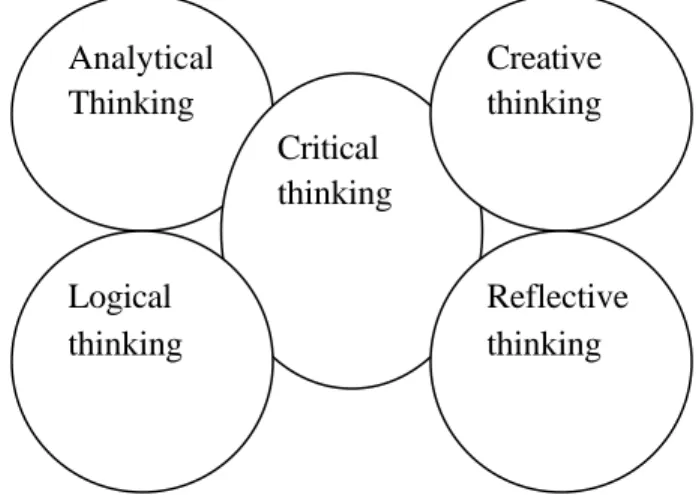
A number of skills, attitudes, and approaches can help us evaluate information and make decisions (Fig. 1). Analytical thinking asks, “How can I break this problem down into its constituent parts?” Creative thinking asks, “How might I approach this problem in new and inventive ways?” Logical thinking
asks, “How can orderly, deductive reasoning help me think clearly?” Critical thinking asks, “What am I trying to accomplish here and how will I know when I have succeeded?” Reflective thinking asks, “What does it all mean?”
Ability to think
37
a systematic, purposeful, and responsible manner. It shares many methods and approaches with other methods of reasoning but adds some important contextual skills, attitudes, and dispositions. Furthermore, it challenges us to plan methodically and to access the process of thinking as well as the implications of our decisions. Thinking critically can help us discover hidden ideas and, develop strategies for evaluating reasons and conclusions in arguments, recognize the differences between facts and values, and avoid jumping to conclusions.
Figure 1. Different approaches to thinking to solve different kinds of problems.
Table 1. Steps in critical thinking (Source: Macalester College, St. Paul, MN).
1 What is the purpose of my thinking?
2 What precise questions am I trying to answer? 3 Within what point of view am I thinking? 4 What information am I using?
5 How can I interpret that information?
6 What concepts or ideas are central to my thinking? 7 What conclusions am I aiming towards?
8 What am I taking for granted: what assumptions am I missing? 9 If I accept the conclusions, what are the implications?
10 What would the consequences be, if I put my thoughts into actions?
We can notice that many critical thinking processes are self-reflective and self-correcting. This form of thinking is sometimes called “thinking about thinking.” It is an attempt to plan rationally how to analyze a problem, to monitor your progress while you are doing it, and to evaluate how your strategy worked and what you have learned when you are finished. It is not critical in the sense of
Analytical Thinking
Critical thinking
Logical thinking
Creative thinking
M. H. Badii et al.
finding fault, but it makes a conscious, active, disciplined effort to be aware of hidden motives and assumptions, to uncover bias, and to recognize the reliability or unreliability of sources.
What do I need to think critically?
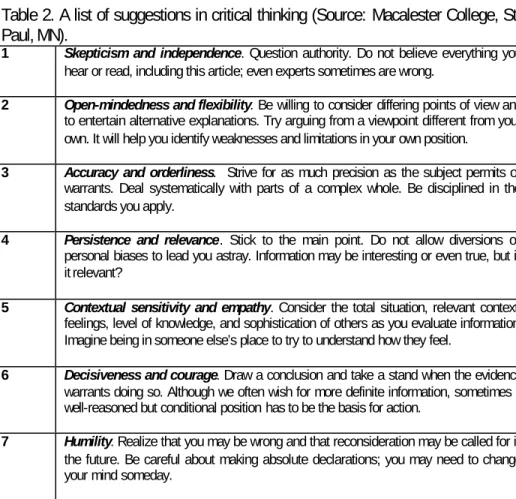
Certain attitudes, tendencies, and dispositions are essential for well-reasoned analysis. The followings are some suggestions in this respect.
Table 2. A list of suggestions in critical thinking (Source: Macalester College, St. Paul, MN).
1 Skepticism and independence. Question authority. Do not believe everything you hear or read, including this article; even experts sometimes are wrong.
2 Open-mindedness and flexibility. Be willing to consider differing points of view and to entertain alternative explanations. Try arguing from a viewpoint different from your own. It will help you identify weaknesses and limitations in your own position.
3 Accuracy and orderliness. Strive for as much precision as the subject permits or warrants. Deal systematically with parts of a complex whole. Be disciplined in the standards you apply.
4 Persistence and relevance. Stick to the main point. Do not allow diversions or personal biases to lead you astray. Information may be interesting or even true, but is it relevant?
5 Contextual sensitivity and empathy. Consider the total situation, relevant context, feelings, level of knowledge, and sophistication of others as you evaluate information. Imagine being in someone else’s place to try to understand how they feel.
6 Decisiveness and courage. Draw a conclusion and take a stand when the evidence warrants doing so. Although we often wish for more definite information, sometimes a well-reasoned but conditional position has to be the basis for action.
7 Humility. Realize that you may be wrong and that reconsideration may be called for in the future. Be careful about making absolute declarations; you may need to change your mind someday.
Ability to think
39
mental faculties just as you need to train for a sport. Traits such as intellectual integrity, modesty, fairness, compassion, and fortitude are not things you can use occasionally. They must be cultivated until they become your normal way of thinking.
Applying critical thinking
We all use critical or reflective thinking at times. Suppose a television commercial tells you that a new breakfast cereal is tasty and good for you. You may be suspicious and ask yourself a few questions. What do they mean by good? Good for whom or what? Does “tasty” mean simply more sugar and salt? Might the sources of this information have other motives in mind besides your health and happiness? Although you may not have been aware of it, you already have been using some of the techniques of critical analysis. Working to expand these skills helps you recognize the ways information and analysis can be distorted, misleading, superficial, prejudiced, unfair, or otherwise defective. Here are some steps in critical thinking.
1. Identify and evaluate premises and conclusions in an argument. What is the basis for the claims made here? What evidence is presented to supported these claims and what conclusions are drawn from this evidence? If the premises and evidence are correct, does it follow that the conclusions are necessarily true?
2. Acknowledge and clarify uncertainties, vagueness, equivocation, and contradictions. Do the terms used have more than one meaning? If so, are all participants in the argument using the same meaning? Are ambiguity or equivocation deliberate? Can all the claims be true simultaneously?
M. H. Badii et al.
4. Recognize and assess assumptions. Given the backgrounds and views of the protagonists in this argument, what underlying reasons might there be for the premises, evidence, or conclusions presented? Does anyone have an “axe to grind” or a personal agenda in this issue? What do they think you know, need, want, or believe? Is there a subtext based on race, gender, ethnicity, economics, or some belief system that distorts this discussion?
5. Distinguish the reliability or unreliability of a source. What makes the experts qualified in this issue? What special knowledge or information do they have? What evidence do they present? How can we determine whether the information is accurate, true, or even plausible?
6. Recognize and understand conceptual frameworks. What are the basic beliefs, attitudes, and values that this person, group, or society holds? What dominating philosophy, or ethics control their outlook and actions? How these beliefs and values affect the way people view themselves and the world around them? If there are conflicting or contradictory beliefs and values, how can these differences be resolved.
Some clues for unpacking an argument
In logic, an argument is made up of one or more introductory statements (called premises), and a conclusion that supposedly follows logically from the premises. Often in ordinary conversation, different kind of statements are mixed together, so it is difficult to distinguish between them or to decipher hidden or implied meanings. Social theorists call the process of separating and analyzing textual components unpacking. Applying this type of an analysis to an argument can be useful.
An argument’s premises are usually claimed to be based on facts; as,
because, assume that, given that, since, so, thus, therefore, it follows that,
consequently, the evidence shows, and we can conclude that. For instance, in the
Ability to think
41
Does one necessarily follow from the other? Reme mber that even if the facts in a premise are correct, the conclusions drawn from them may be false. Information may be withheld from the argument such as the fact that the cereal is also loaded with unhealthy amount of sugar.
Avoiding logical errors and fallacies
Formal logic catalogs a large number of fallacies and errors that invalidate arguments. Although we do not have room here to include all of these fallacies and errors, it may be helpful to review a few of the more common ones.
1. Red herring: Introducing extraneous information to divert attention from the important point.
2. Ad hominem attacks: Criticizing the opponent rather than the logic of the argument.
3. Hasty generalization: Drawing conclusions about all the members of a group based on the evidence that pertains only to a selected sample.
4. False cause: Drawing a link between premises and conclusions that depend on some imagined causal connection that does not, in fact, exist.
5. Appeal to ignorance: Because some facts are in doubt, therefore, a conclusion is impossible.
6. Appeal to authority: It is true because such person says so.
7. Begging the question: Using some trick to make a premise seem true when it is not.
8. Equivocation: Using words with double meanings to mislead the listener.
9. Slippery slope: A claim that some event or action will cause some subsequent action.
10. False dichotomy: Giving either/or alternatives as if they are the only choices.
Avoiding these fallacies yourself or being aware of them in another’s argument can help you be more logical and have more rational and reasonable discussions.
M. H. Badii et al.
As you go through this paper, you will have many opportunities to practice critical thinking skills. Are all parts of the paper true? No, probably not. They were the best information available at the writing of this paper, but some things are in the state of flux. Data change constantly as does our interpretation of them. Do the ideas presented here give a complete picture of the state of our knowledge? Unfortunately, they probably don’t. No matter how comprehensive our discussion is of this rather complex subject, it cannot capture everything worth knowing, nor can it reveal all possible points of view.
When reading any paper, try to distinguish between statements of facts and opinions. Ask yourself if the premises support the conclusions drawn from them. Although an author tries to be fair and even-handed in presenting controversies, he like everyone else, has biases and values -some of which we may not even recognize-that affect how one sees issues and present arguments. Watch for cases in which you need to think for yourself and utilize your critical and reflective thinking skills to find the truth.
Concept maps
Concept mapping is a learning strategy that many people find useful in understanding complex ideas and clarifying ambiguous relationships. Creating a graphic representation of a topic often can help you visualize key concepts and organize your knowledge more clearly than with other methods of study. You may find that the physical process of drawing a map of a topic engages a different part of your brain than does ordinary reading or taking notes. Taking time to think carefully about what is most important about a particular topic will help you remember better at a later date. It can also point out weaknesses in your understanding as well as areas in which you need more study. Practicing this technique as you think about the subject under study can help you comprehend difficult material and prepare you for the challenges ahead.
Ability to think
43
If you ask different people to construct a map of the same area of the city, you will probably get very different results. A young child, for instance, might draw in only the locations of his school, home, and playground. A commuter from the suburbs, on the other hand, might show the locations of the major office buildings, filling stations, freeway ramps, and the cheapest parking lots in that same city. Neither of these representations is wrong, they just emphasize the aspects of greatest importance to each person.
When we think about maps, we usually visualize physical features such as mountains, lakes, roads, buildings, and so forth. But we can also create maps of biodiversity, magnetic fields, economic flows, cultures, language families, or anything else that can be represented, in graphical form. A concept map is a two dimensional representation of the relationship between key ideas. It shows us how we think and suggests affinities and associations that might not otherwise be obvious. At first glance, a concept map looks like a flow chart in which key terms are placed in boxes connected by directional arrows. Based on educational psychology theories of how we organize information, concept maps are hierarchical, with broader, more general items at the top and more specific topics arranged in a cascade below them. They are meta-cognitive tools that empower the learner to take charge of his own learning in a highly organized and meaningful manner.
To create a concept map, start with what you already know. Build from what is familiar. What are the key components are ideas in the topic you are trying to understand? Label each concept in its own individual circle, box, or other geometrical shape! You might want to use different shapes to indicate relative levels, or types of ideas. Connect concept boxes with directional arrows to show relationships. Label each arrow with descriptive terms so that your diagram can be read as a statement or proposition by following interconnections from top down. For example, you can read the proposition that “concept maps are used to develop learning strategies that lead to knowledge acquisition that contribute to class performance” as one set of associations. Another association could be “values and beliefs that reflect learning strategies which help discover key concepts that clarify concept maps.”
Conclusion
M. H. Badii et al.
been created not to expand our knowledge, but to sell a product or further a new cause. It would be a real disaster to become cynical or empathic due to large load of information. It is essential, and indeed, it makes quite a difference to know how to think and act. Are there mechanisms to be used in order to make certain objectively that we are thinking logically, orderly, creatively, or critically when it comes to making decisions? Indeed, there are various skills and techniques that could help us in evaluating information and making the right decisions. Among these we could mention the followings. Analytical thinking i.e., what are the different components of a whole? Logical thinking, that is, what are the rationales behind our approach to different things? Creative thinking i.e., are there other alternatives to solve the problem? Reflective thinking i.e., what are the main purposes of doing this? And critical thinking i.e., what am I trying to accomplish? Practicing and using these techniques and skills in our approaches to different processes, phenomena, objects or events will help us to make better decisions characterized by precision, reliability and truthfulness.
References
http://www.afseee.org/
http://www.dep.state.pa.us/dep/pa_env-her/gifford_pinchot.htm http:www.enn.com
http://www.factbook/indexgeo.htm http://www.frogweb.gov/
http://www.infomanage.com/international/98hdi.htm http://www.memory.Ioc.gov/frd/cs/cshome.html http://www.mhhe.com/environmentalscience http://ehis.nies.nih.gov/topic/minority.htm/ http:www-personal.umich.edu%7Ejrajzer/nre/ http://www.pca.state.mn.us/hot/frogphotos.htm http://www.rachelcarson.org/
http://www.sierraclub.org/john_muir_exhibit/ http:www.undp.org/