.
.
'& %()*#&(%!$ ( (
*'#%+$$&
Abstract
We are immersed in a process of globalization in which economic transactions are constantly taking place. All companies have a large amount of economic documentation that needs to be translated in order to be understood beyond our borders. For this reason, economic translation is one of the most demanded fields by translation agencies. Thus, the aim of this study is to analyse and suggest translations to the various problems that may arise during the translation of economic documents. The text used for this purpose is "Face it, China totally owns the BRICS", a news report published on September 1st, 2017 in the online version of Forbes. This study deals with specialized economic translation, as well as the news report genre, from a theoretical-practical perspective with the translation of the news report and the subsequent analysis of the most problematic aspects that have arisen during the development of the translation.
Keywords: specialized language, news report, English, Spanish, economic translation
Resumen
Estamos inmersos en un proceso de globalización en el que las transacciones económicas
tienen lugar constantemente. Todas las empresas tienen una gran cantidad de documentación económica que precisa ser traducida para ser comprendida fuera de nuestras fronteras. Por esta razón, la traducción económica es una de las más demandadas por las agencias de traducción. Por ello, este trabajo tiene como objetivo principal, el análisis y la propuesta de traducción a los distintos problemas que surgen durante la traducción de documentos económicos. El texto utilizado para este objetivo es “Face it, China totally owns the BRICS”, una noticia publicada el 1 de septiembre de 2017 en la versión online de Forbes. Este trabajo aborda la traducción económica especializada, así como el género news report, desde una perspectiva teórico-práctica con la traducción de la noticia y el posterior análisis de los aspectos más problemáticos surgidos tras la traducción de la misma.
TABLE OF CONTENTS
1. INTRODUCTION ……… 7
2. STATE OF THE ART 2.1Specialized translation ……….. 8
2.2The language of economics ……….. 10
2.3News Reports ………. 10
3. MATERIALS AND METHODOLOGY 3.1 Materials ……….. 13
3.2. Methodology ……….. 14
3.2.1 Tools ……….. 14
3.2.2 Documentation ……….. 16
4. TRANSLATION 4.1 Type of translation ………... 19
4.2 Translation: ST/ TT ………. 20
5. TRANSLATION ANALYSIS AND DISCUSSION 5.1 Macro-textual elements ……….… 27
5.2 Cohesion ………..….. 29
5.3 Micro-textual elements ………..……… 31
6. CONCLUSION ……….. 41
7. LIST OF CITED WORKS ……….... 43
1. INTRODUCTION
I have chosen economic translation for this study because of the growing interest in this field. Nowadays, we are immersed in a process of increasing globalization and internationalization in which economic and business transactions, take place beyond the geographical borders of countries. According to the American Translation Association (ATA), the number of people employed in the translation and interpretation industry has doubled in the past seven years, and the number of companies in the industry has increased by 24 percent in the same time period. Through 2024, the employment outlook for those in the translation business is projected to grow by 29 percent, according to the Bureau of Labor Statistics.
Economy is present in many of the activities that we carry out on a daily basis. For this reason, it is one of the most demanded fields by companies from translation agencies. This could be due to the fact that companies have a large amount of economic and financial documentation, either because it is required by law or because it is part of their business.
2. STATE OF THE ART
As this study deals with translation, I would first like to define this concept. As most authors claim, translation is a very complex process, so it is impossible to define this concept by a single possible definition. Many different definitions of translation have been given throughout the years. Some authors define translation as an activity carried out between languages (Vinay et al., 1995), other authors define it as a textual activity (Catford, Seleskovitch and Lederer, 1995) and some others define it as an act of communication (Hatim and Mason, 2005). Hurtado Albir (1996) defines translation as a know how to, an operative knowledge and since operative knowledge is fundamentally
acquired by practicing, the translator need not be a theoretician. Vinay et al. (1995) define translation as an activity between languages arguing that a translation is a move from one language (A) to another language (B) in order to express the same reality. It seems that Seleskovitch and Lederer (1995) reply to this definition by stating that translating implies the transmission of the meaning of the messages contained in a text, but not converting the language in which it is formulated into another language. Another definition that focuses on translation as a textual activity is established by Catford (1965) who argues that translation deals with “the replacement of textual material in one language (SL) by equivalent textual material in another language (TL)” (1965: 20). Finally, translation is defined by Nord (1993) as an act of communication whose fundamental criterion is functionality. Likewise, Hatim and Mason (2005) define translation as a communicative process that takes places in a social context.
2.1 Specialized translation
be classified into three groups depending on their level of expertise, and those are experts, semi-experts and non-experts. Finally, it is important to note that the textual genre that is used is determined by the communicative situation. García Izquierdo (2005) defines communicative situation as a text that has a specific function in the source culture and it reflects the purpose of the emitter that can be predicted by the receiver.
After having explained the features that define a specialized text, I would like to define the concept of economic translation which is the type of translation that I will be dealing with in this study. The publication in 1776 of Adam Smith´s Inquire into the
Nature and Causes of the Wealth of Nations, coincides with the birth of economics. Since
then, the growth of economy has become one of the most relevant social sciences. The definition of economics is very controversial and there are many different opinions about it. The online dictionary Merriam-Webster defines economy as a “social science concerned chiefly with description and analysis of the production, distribution, and consumption of goods and services”. On the other hand, the Cambridge Dictionary defines economics as “the way in which trade, industry, or money is organized”.
When dealing with the definition of the concept of economic translation, the terminological variability has to be noted. There are several different denominations for the same term, such as economic translation, financial translation, economic-financial translation or legal-economic translation, among others. There are different definitions depending on the author. For example, Svendsen (Svendsen, 2001 in Gallego Hernández, 2016) defines economic translation by focusing on some aspects of either business, finance, or macroeconomics. Gallego Hernández (2015) is much more precise in his definition since he uses the term economic translation to cover every single type of specialized translation in such fields. However, authors such as Lahlali & Hatab (2014) include commercial translation in their definition. They give a definition of economic translation as something that is required for marketing and commerce, banking and the investment sector, the insurance industry, accounting and auditing, and marketing research.
specialized translation, arguing that strictly speaking, “every translation (literal, audiovisual, etc.) is specialized in the sense that it requires special knowledge and skills” (2001: 59). Likewise, Gamero (1998) argues that a translator of specialized texts is required to have a huge knowledge on the subject in order to understand and interpret the specific terminology but also to recognize the genre of the text.
2.2 The language of economics
Economics is a social science that uses specific terminology, language and style, and as such, it can be classified within specialized languages. From a purely stylistic point of view, the lexicon of economic language is hybrid because it uses both informal terminology and formal one. (Alcaráz Varó et al., 2000).
At this point, I would like to analyse the characteristics of the language of economics. As Dudley-Evans argues, economics uses “simplification and abstraction as means of furthering the development of the subject” (1990: 43). Economic terminology is hybrid because it embraces technical, semi-technical and general vocabulary.
Technical vocabulary includes terms that are unique to economics; semi-technical vocabulary covers words from related disciplines. Finally, general vocabulary includes common language words that have acquired specialized meanings. The language used is direct, informal, familiar, and far from what we might think at the beginning, it is full of colloquial and idiomatic expressions. In fact, there is a specific example of this in my text; the word “baddest” is a slang term and it means that something is great. Apart from that, metaphors and personifications are constantly used in news reports to convey the readers a sense of familiarity with the content; this is because they are helpful to represent more complex ideas. Another important aspect of the economic language is the use of neologisms and anglicisms. Many of the Anglo-Saxon terms used in economic texts are not translated from English into Spanish since they are used in an economic domain in both languages.
2.3 News Reports
and/or mode and they share the same function, usability and textual conventions (Hurtado Albir, 2001). However, news report is a genre that can deal with different topics including politics, sports, literature or economy, among many others. Typical written economic genres include research articles, abstracts, business reports, informative texts and news reports (Dudley-Evans, 1990).
The genre of the text that I have translated belongs to the category of news report. Press economic articles are aimed at a broad public with minimal or, at least, not a broad knowledge of the topic issued in the text. Since these texts are intended for a non-specialized audience, the writer must express the ideas as clearly and concisely as possible in order to be understood. One of the most relevant characteristics of this genre is the use of a large number of metaphors as well as other literary resources to embellish the text. Nevertheless, news reports use “factual, disinterested, impersonal and objective” language (Ventola, 2000: 379). Bhatia (1993) explains news report as a genre in which
the item that carries the highest surprise value has been chosen as the headline, and is
further elaborated in what in the newspaper world is known as the ‘lead’ or ‘intro’. Any
explanatory, background, or secondary materials, follow in that order. This principle of
organization gives news reports the structure of an inverted pyramid in which the most
important points of the story are given first, and the remainder of the story gives the items
in decreasing order of importance and increasing order of finer detail. The
lexico-grammatical system uses typical lexis, that is generally associated with newspaper
language. (Bhatia, 1993: 169-170)
After this explanation about news report, I will comment on the basic structure of Spanish and English publications. The structure of news reports is basically the same in both languages. The main differences that can be seen in both structures are the length of the headline in both languages, as well as the use of ‘key points’ in Spanish and ‘tale’ in English.
Ventola (2000) establishes the typical English news report structure as follows. It has an opening phrase that is known as the headline and a sentence below which is the lead. The headline should not have more than ten words. After the lead is written, “the body of the story will follow in the logical order of inverted pyramid style1” (Shrivastava,
1987: 24). The body specifies and broadens the “material presented in the opening, to
refer back to the headline or lead through a series of specifications” (Ventola, 2000: 387). The events told in the body are separated into different paragraphs in order to be easier to read. News reports, usually end up with the body, however, because of spatial economy on newspapers, sometimes journalists need to fill a certain amount of space and a last paragraph is included to fulfil that blank space. This last paragraph is known as tale and it does not convey any important information, in fact, if the tale is omitted, the rest of the text is not affected.
In Spanish, according to the RTVE Corporation's Style Manual2, news reports must include a headline, which is the most important element and it contains the basic data of the information. The headline should not have more than thirteen words. In Spanish, news reports may also include what are known as key points or bolitos that summarize the most important facts and indicate updated information about the events that have taken place. Key points are one-line long and no full stop is needed at the end. The lead must develop the headline; it cannot be a simple repetition of the headline without providing further information. After the lead, the body of the news is written, which serves to complete the information. It is worth mentioning that paragraphs should be short, and circumlocutions and repetition of ideas should be avoided.
To conclude with news reports, I would like to briefly explain the differences between ‘hard’ and ‘soft’ news. ‘Hard’ news is a term that condenses “stories about politics, the economy, social change or other events that take place in the public world” (Mendes, 2011: 26). ‘Soft’ news, on the other hand, “includes stories set in or affecting the private sphere and connotes non-pressing, light or unimportant events or issues” (Mendes, 2011: 26). Tuchman (1978) states that ‘soft’ news does not need immediate publication whereas ‘hard’ news is up-to-the-minute news and the events told require immediate publication. The text that I have translated, can be classified within hard news because the information included is updated and its translation must be done as soon as possible so that the target readers place the news report within the current context.
2
3. METHODOLOGY 3.1 Materials
As it was previously stated, the text that I have translated and worked with deals with a specialized topic. In specialized texts, the language used is different from the general and everyday language due to the fact that the terminology and phraseology, which appear in those texts, belong to a specific professional field. It is impossible for translators to be specialists in every single language and specialized field, so there is no alternative but to use documentation. Documentation is crucial for the correct understanding of the source text because previous knowledge on the field to be translated is required.
The aim of this study is to approach the economic translation of a specialized text. For that aim, the economic text that is to be analysed is a text titled “Face it, China totally owns the BRICS” by Kenneth Rapoza. This text was published on September 1st, 2017, in the online version of Forbes3. I have chosen this text because it deals with BRICS. This
acronym was created by the former chief economist of Goldman Sachs, Jim O´Neill, in 2009. It was created to define the emerging countries whose economies offered the greatest future growth prospects. The countries that make the acronym up are Brazil, Russia, India, China and South Africa. BRICS could become the lifesaver for the world economy, as they are increasingly buying and investing in their infrastructures. They consolidate financial and commercial strategies such as the creation of an interbank cooperation mechanism that will allow the establishment of infrastructure projects to be financed, both in BRICS and in developed countries.
This text has 1065 words and it is divided into several paragraphs. In the online version of Forbes, the paragraphs are divided by pictures and by other pieces of news. The text was originally written in English and it is intended for semi-experts on the field. According to what I have previously explained in specialized translation4, this text belongs to the genre news reports, in particular to what is known as ‘hard’ news. Apart from that, this text is considered a specialized one because the parameters established by Cabré Castellví (1993) in which the topic, user and communicative situation that a specialized text must have, are followed.
3
See annexes – (8.1) Source text
3.2 Methodology 3.2.1 Tools
The tools that I have used for this work5 have mainly been dictionaries
(monolingual, bilingual and specialized) and parallel texts, although I have also used and consulted different corpora, terminological databases and books related to the subject of my text.
Despite the main aim of this study is to analyse the difficulties of economic translation, I would also like to briefly study the usefulness of the dictionaries, parallel texts and terminological databases that I have used.
Dictionaries are one of the tools that have been more useful for my study. As there is a great variety of dictionaries, the most useful ones that I have found were electronic bilingual dictionaries. Specialized or monolingual dictionaries have not been really helpful for the development of my translation. Concerning specialized dictionaries, I would like to highlight the Dictionary of Economic, Financial and Commercial Terms6 since it proposes different synonyms for the same term. This is of great help when it comes to a long text in which some terms are repeated. This specialized dictionary has helped me when I searched purely economic terms. Nonetheless, as my text does not have a strict formal register, many terms are from the general language. I consider that in cases where the economic text is informative, these types of specialised dictionaries are only partially useful since the number of economic terms will not be as large as in purely economic texts such as audit reports, balance sheets or general accounting plans. Hence, specialized dictionaries have not been of great help to me since I think that they are not intended for the type of translation I have done.
Monolingual dictionaries, on the other hand, have not been very helpful to carry out this study. I have consulted the definition of some Spanish terms in the dictionary of the RAE7, but I did not look their translation up. When it comes to electronic dictionaries, the one I have used more frequently has been the Oxford English Dictionary. This dictionary has been useful in order to define certain terms that I have explained during this study. However, as in the case of the two previous dictionaries, it has not helped me to find a translation to any of the unknown terms of my text.
5 All the resources that I have used for this study can be found on the list of cited works. 6
Lastly, the use of non-specialized bilingual electronic dictionaries is to be highlighted. I have used them very frequently as opposed to print dictionaries because it is faster and they are updated, and in most cases, more specific and developed information on the searched terms is obtained. There are thousands of online dictionaries, however, as the lexicologist Henning Bergenholtz calculates, 99% of those dictionaries are very low quality. For this reason, I have decided to include the most frequently used ones, since if their use is increasing, it might be because of their quality. The electronic dictionaries that I have used and I have decided to include as a reference are: Cambridge Dictionary, Collins Dictionary, Merriam-Webster´s Dictionary and WordReference8.
To conclude with the use of dictionaries, I consider that the most useful ones for this study have been bilingual ones, in particular, those that had more synonyms, such as the Merriam-Webster’s Dictionary and the Collins Dictionary, since they have facilitated the completion of this study.
Parallel texts are undoubtedly the most useful resource that I have used to carry out my translation. As I will explain in the following section, parallel texts are texts whose topic, structure, genre and date of publication, are very similar and those texts must be “representative samples of corresponding text types in pairs of languages” (Hartmann, 1980: 112) The parallel texts that I have used were found on the economic, financial or international sections of newspapers. For this study, I have searched for parallel texts related to BRICS. Searching for these parallel texts have been a difficult task because not all the texts were suitable for my translation. I have chosen the texts whose structure, genre, terminology, field and date of publication were similar. I found many different news from the same period related to BRICS and this could be due to the fact that the date in which my text was published, a meeting with all the leaders of the BRICS was going to take place very soon. That is the reason why there was a huge variety of texts having the same topic, however, I found out that the register or the terms used in some of them did not coincide with my text, so I ended up not using them. I would like to highlight the usefulness of news reports that were published in the economic and international sections of the following Spanish newspapers: El Economista, La Vanguardia, and El País9. The parallel texts used in this study are included in the annexes.
To conclude with the tools that I have used, I would like to explain the usefulness of corpora and terminological databases. Sinclair (1991: 171) defined corpora as a “collection of naturally-occurring language text, chosen to characterize a state or variety of a language”. To carry out this study, I have not created a corpus, but I have consulted and used several corpora such as the Corpus of Contemporary American English (COCA), News On the Web Corpus (NOW) and iWeb Corpus. The two last ones, are innovative and early released corpora and they have been really useful because newer terms and expressions appeared. I have also used corpora from the RAE and although there are different corpora accessible from their webpage, I have only used a beta version of CORPES XXI, a corpus of the Spanish language of the 21th century. The corpora above may be freely accessed by all and there is no need to download any program. It is worth mentioning that I have not found any free specialized corpus of economics.
As well as corpora, I have also used some terminological databases. They have been useful because they include more information than dictionaries, for example, definitions, equivalents in other languages, usage examples, synonyms or abbreviations, among others. The terminological databases that I have used are IATE (Interactive Terminology for Europe), UNITERM (The United Nations Terminology database) and the database of the IMF (International Monetary Fund)10. These three terminology databases were really useful because they include both specialized and general language terms and therefore, most of the terms that appeared in my text, were found in those databases. Nevertheless, in some databases, not all the entries were complete and some information was missing. Although they have been useful in some cases, all the information provided in each entry was not necessary for the development of this study. This resource would be more useful for purely linguistic or terminological studies.
3.2.2 Documentation
Documentation is a crucial phase in translation, not only to understand the specialized terms that appear in the text but also to find the most appropriate translation in the TL that best suits the SL. Documentation serves to solve problems related not only to the analysis of the text of the SL but also to those related to the creation of a new text in the TL. “Professional translators may spend as much as 30% of their time retrieving documentary information. They do so mainly to obtain domain-specific and linguistic
information” (Mayoral, 1997 in Beeby et al., 2009: 111). Cabré Castellví (2001) further explains this idea by stating that
by domain-specific information we mean the information pertaining to the notions or
units of knowledge of a field or domain that allows translators to understand a text, and
that may be obtained from either the source or the target text language. By linguistic
information we mean information in either the source or the target text pertaining to a
text´s form as opposed to its content. It includes lexical and grammatical items related to
the microstructure of the text as well as items of style, genre and format related to the
macrostructure of the text. (Cabré Castellví (2001, in Beeby et al., 2009:111)
As I have explained in the previous section, some of the main resources that I have used and searched for in order to complete my study were parallel texts, corpora, terminological databases and specialized dictionaries.
In order to make a good translation, the translator must be an expert in the source and target languages and culture. Therefore, before starting a translation, a search for language resources and a search for resources on specialized translation must be done. Dictionaries, both monolingual and bilingual, as well as grammars, are necessary to solve possible doubts in either of the languages. Specialized dictionaries related to the field of the text play a crucial role in order to ensure that the equivalences chosen are the ones that best suit the meaning of the ST.
Apart from the search for language resources, information on the subject is also to be searched. As I have explained before, a minimum knowledge on the subject is required in order to fully understand the terminology used in the SL. Therefore, it is important to read articles and news about the topic of the text to have a clear and good knowledge of, at least, the basic aspects. I have read articles, but mainly news reports on BRICS and international economy to have a better idea of the background and current situation of that topic.
4. TRANSLATION
4.1 Type of translation
There are two main types of translations, that are known widespread as ‘free’ and ‘literal’ translation. A theoretical approach to these two types was proposed by Newmark (1981) between communicative and semantic translation:
Communicative translation attempts to produce on its readers an effect as close as
possible to that obtained on the readers of the original. Semantic translation attempts to
render, as closely as the semantic and syntactic structures of the second language allow,
the exact contextual meaning of the original (Newmark, 1981: 39).
All in all, semantic translation is more literal, whereas communicative translation focuses on the translation to sound natural and to be readable.
House (1997) followed the model proposed by Newmark, but she did some changes; she proposed ‘covert’ and ‘overt’ translations. A covert translation is “a translation which enjoys the status of an original source text in the target culture […] A covert translation is thus a translation whose source text is not specifically addressed to a particular source culture audience”. (House, 1997: 69). Those translations are intended not to be recognized as translations by the reader. In overt translations, the TT audience is not addressed in a direct way and therefore, there is no need to attempt to recreate a second version of the original (House, 1997). In this case, these translations are very close to the source culture and they can be clearly recognized as translations.
The problem lies on when to use a ‘covert’ or an ‘overt’ translation and House (1997: 118) solves it by saying that “the choice of an overt or a covert translation depends not just on the translator himself, or on the text but on the translator’s personal interpretation of the text”.
Considering the types of translation that have just been mentioned, I would like to specify the type of translation that I have followed in order to carry out the translation of my text. I have translated my text following what Newmark defines as communicative translation, so, I have not made a literal translation of my text but a translation into Spanish that was easy to understand and which was natural to the target readers.
4.2 Translation
There are elements highlighted in different colours and they indicate the different problems that I have faced during the translation. Elements highlighted in blue are related to cohesion; the ones in red are related to micro-textual elements. All those highlighted elements are explained in the next section.
Source text Target text
Face it, China totally owns the BRICS Hay que admitirlo, China lidera los
BRICS
1 Is it at all humiliating to the Russians, at least a little bit, that the Chinese are far and away the biggest, baddest BRICS nation? Russia used to be a
world superpower. It's a world oil
power. A world nuclear power. But
beyond that, China is more relevant to
the worldeconomythan the Russians.
¿No es un poco humillante para los rusos, que China sea la nación más poderosa de los BRICS? Rusia siempre ha sido una
superpotencia mundial. Es una
potencia tanto petrolera como nuclear.
Sin embargo, China es más importante
para la economíamundialque Rusia.
2 Brazil. What about them? For years, the commodity bubble made itseem Brazil was on its way to becoming the runaway leader of Latin America,
surpassing Mexico, whichis basically a U.S. import market. Brazil was, and is, a more diverse economy than Mexico.
They weren't dependent on any one nation, really. Then the commodity
bubble burst and Brazil's purchasing
power has dropped, putting it on par
¿Y qué ocurre con Brasil? Debido a la burbuja de las materias primas, parecía que Brasil estaba a punto de convertirse en el líder indiscutible de América Latina, superando incluso a México, cuyo principal mercado de exportación es Estados Unidos. Brasil era, y es, una
economía más diversificada que la de
México, que no depende de ningún país.
Además, la burbuja de las materias
with China's. GDP per capita is also similar. China's Happy Meal toy making economy has grown up and is home to more new billionaires than anywhere else. And as leaders from Brazil, Russia, India and South Africa meet in Xiamen on Sept. 3, itis clear to everyone watching that China is the
leader.
Brasil se redujo, situándolo a la par del de China. El PIB per cápita es también similar en ambos países. Hasta el juguete
del Happy Meal ha contribuido al
crecimiento económico de China y por ello cuenta con más nuevos multimillonarios que cualquier otro país. Tras la reunión que se celebró con los
dirigentes de Brasil, Rusia, India y
Sudáfrica el 3 de septiembre en Xianmen, se pudo ver que China era el líder
indiscutible.
3 Russia needs China because it is in a
never-ending feud with the West. They
have two things in common, generally:
commodities supply and demand, and a desire for a multi-polar world, though
this is probably more Vladimir Putin's thing than Xi Jinping's. China is at least
as dependent on the U.S. as Russia is dependent on Europe.
Rusia necesita a China porque se encuentra en una disputa interminable con Occidente. En general, tienen dos cosas en común: oferta y demanda de materias primas, así como un deseo por
un mundo multipolar, aunque quizá eso
incumba más a Vladimir Putin que a Xi Jinping. China es tan dependiente de Estados Unidos como Rusia lo es de Europa.
4 Brazil needs China because that's where all of its soybeans and iron ore goes. Brazil's agribusiness is vital to the economic recovery now just two
quarters young. In May, China and Brazil launched a jointinvestment fund
to increase productive capacity. The
fund has an initial sum of $20 billion
and will reportedly go to finance
investment projects in Brazil (not in
China) that are of interest to both
Brasil necesita a China porque exporta allí soja y hierro. El agronegocio brasileño es vital para la recuperación económica que comenzó dos trimestres
más tarde. En mayo, China y Brasil llevaron a cabo una inversión conjunta para aumentarsu capacidad productiva. Los fondos contaban con una suma inicial de 20.000 millones de dólares e irán destinados a financiar proyectos de
countries. Brazil's president, Michel Temer, is already in China. He wants to convince them to buy airports and
participate in other privatization bids
as Brazil tries to trim more fat from its
federal government.
interesen a ambos países. El presidente brasileño, Michel Temer, se encuentra actualmente en China. Quiere convencerles para que inviertan en
instalaciones aeroportuarias y
participen en licitaciones privadas
mientras que Brasil intenta recortar cada vez más los presupuestos de su gobierno federal.
5 Following the recent border skirmish,
India can probably do without China. India's main trading partners are the U.S. and United Arab Emirates. But if you include Hong Kong with China, then China is No. 2. More importantly, India's importsare heavily dependent on the Chinese. Some $59 billion worth of Chinese imports
moved into India in 2015, more than the
No. 2 Sweden and No. 3 U.S. combined. Bilateral trade volume between China and India also roseby 21.5% year-on-year to $47.52 billion between January
and July 2017, Indian customs data show.
Tras el reciente conflicto fronterizo, es posible que India pueda renunciar a China. Los principales socios comerciales de la India son Estados Unidos y los Emiratos Árabes Unidos. Sin embargo, si incluimos Hong Kong en China, éste se convierte en su segundo socio. Más importante es aún la dependencia de las
importaciones indias de China.
Importaciones chinas con valor de unos
59.000 millones de dólares fueron a parar a India en 2015, cifra superior a Suecia, segundo socio comercial y el tercero, Estados Unidos, juntos. El volumen del comercio bilateral entre China e India
también crecióun 21,5 % interanual hasta los 47.520 millones de dólares entre enero
y julio de 2017, según muestran los datos aduaneros de la India.
6 South Africa needs China investment
and Chinese buyers for its raw materials. China is its biggest export
market, accounting for around $12
billion. That beats South Africa's No. 2
Sudáfrica necesita inversiones y compradores chinos para sus materias primas. China es su mayor mercado de
exportación, con inversiones cercanas a
partner, the U.S., with around $7 billion in exports, both based on 2015 figures.
datos de 2015, esa cantidad supera a la de Estados Unidos, socio número dos de Sudáfrica, con exportaciones valoradas en unos 7.000 millones de dólares.
7 China is a total beast. South Africa,
Russia and Brazil are particularly at its
mercy.
China es una bestia mundial. Sudáfrica, Rusia y Brasil están completamente a su merced.
8 Although all five of these countries
stand to gain from closer commercial ties, China is the one that will gain the most. China has just about
enough money sitting in international
reserves to equal the economic output
of Brazil ($1.7 trillion), Russia ($1.3
trillion) and South Africa ($295 billion).
It's state owned enterprises have the funding to buy strategic assets abroad, like water and oil and gas infrastructure. And its new billionaires like Jack Ma, founder of the e-commerce giant Alibaba, has his eyes set on being the Jeff Bezos of emerging markets. He
basically already is.
A pesar de que estos cinco países se beneficiarán de los lazos comerciales, China es el país que más beneficiado resultará. China cuenta con suficiente dinero en reservas internacionales para igualar la producción económica de Brasil (1,7 billones de dólares), Rusia (1,3
billones de dólares) y Sudáfrica (295.000
millones de dólares). Las empresas de propiedad estatal disfrutan de financiación para comprar activos estratégicos en el extranjero, tales como agua e infraestructuras de petróleo y gas. Los nuevos multimillonarios como Jack Ma, fundador del gigante del comercio electrónico Alibaba, tiene como objetivo convertirse en el Jeff Bezos de los
mercados emergentes, y ya casi lo ha
conseguido.
9 The upcoming BRICS Summit will end
on Sept. 5 with the usual rhetorical messaging and memorandums of understanding about how they will all accelerate trade, investment and technological know-how. China's Commerce Ministry spokesman Gao
La próxima cumbre de los BRICS finalizará el 5 de septiembre con los habituales mensajes retóricos y memorandos de entendimiento sobre cómo impulsarán el comercio, la
inversión y los conocimientos
Feng saidon Friday that China wants to deepen international cooperation in improving industrial capacity. In convincing their emerging market
partners that they need to get more productive, China can sell them their
new robotic technologies. All those
Chinese workers replaced by automation, can work building the screws and attaching the wires and packaging up new robots to ship to Brazil instead.
de Comercio chino, Gao Feng, indicó el viernes que China quería reforzar la cooperación internacional para mejorar su capacidad industrial. Para convencer a
sus socios de mercados emergentes de que necesitan ser más productivos, China puede venderles lo último en tecnología robótica. Todos los trabajadores chinos remplazados por la automatización, pueden trabajar fijando los tornillos, conectando los cables y empaquetando los nuevos robots para enviarlos a Brasil.
10 A few BRIC country companies have
big business in China, too. It is not entirely a one way street. Brazil's Embraer jet manufacturer has a
facility in southern China, and builds
planes with their Chinese joint venture
partner.
Algunas empresas de los países del BRIC, también tienen grandes negocios
en China. Sin embargo, esto no beneficia a los dos países por igual. El fabricante de aviones brasileño, Embraer, cuenta
con una infraestructura en el sur de
China y construye aviones con su socio
chino en un joint venture.
11 Russian investment bank, VTB
Capital, set up shop in Shanghai in 2015.
El banco de inversiones ruso, VTB Capital, se estableció en Shanghai en 2015.
12 India's Tata Group family of companies
is in China. IT firm Tata Consultancy Services is there, with the usual tie-up with a Chinese firm. Tata Steel has two steel mills in China. Tata's Jaguar Land Rover unit has a JV with Chery Automobile to build the luxury cars in Changshu.
Las empresas de la familia del grupo
Automobile para fabricarcoches de lujo en Changshu.
13 South Africa's Old Mutual financial services firm used to have a foothold there butare now looking to dump their
insurance unit, at least.
La empresa sudafricana de servicios
financieros Old Mutual, tenía una buena posición, pero ahora, está buscando deshacerse de, al menos, su
departamento de seguros.
14 Meanwhile, here's a quick snapshot of
what China has accomplished, as
outlinedon Friday by China Daily:
Mientras tanto, he aquí un repaso rápido de los logros de China, tal y como
destacóel viernes China Daily:
14.1 • Gezhouba Group announcedMarch
30 that it will spend up to $200
million to acquire 100% stake of Sistema Produtor Sao Lourenco, a
water supply company in
Brazil, China Daily first reported.
• De acuerdo con China Daily, el Grupo Gezhouba hizo público el 30 de marzo que invertirá hasta 200 millones
de dólares para adquirir la totalidad de
la compañía brasileña de
abastecimiento de agua Sistema
Productor Sao Lourenco.
14.2 • China Investment Corp partnered
with Brookfield Asset Management in April to take a 90% percent stake in Nova Transportadora do Sudeste, a natural gas pipeline company owned by Petrobras.
• China Investment Corporation se asoció con Brookfield Asset Management en abril para adquirir el 90% de Nova Transportadora do Sudeste, una compañíade gasoductos naturales propiedad de Petrobras.
14.3 • Xiaomi enters the Russian smart
phone market.
• Xiaomi se introdujo en el mercado
ruso de teléfonos inteligentes.
14.4
• Shanghai-listed China Railway Group is building a $2.5
billion high-speed railway in
• China Railway Group, empresa que
cotiza en la Bolsa de Shanghai, está construyendo una línea ferroviaria
Russia. The deal was announcedin June.
en 2.500 millones de dólares. Este
acuerdo se publicóen junio.
14.5 • Alibaba's Ant Financial Unit opens
up Alipay in cahoots with Russia's VTB Group last month.
• El mes pasado, la plataforma de pago de Alibaba, Ant Financial, abrió Alipay en colaboración con VTB Group.
14.6 • China Petroleum Engineering &
Construction Corp. inked a deal
with Russia's Gazprom in April to an estimated $15 billion natural gas pipeline into China.
• China Petroleum Engineering & Construction Corporation firmó en abril un acuerdo de unos 15.000 millones de dólares para construir un gasoducto en China con la compañía rusa Gazprom.
14.7
• Alibaba Cloud, the cloud computing arm of Alibaba, plans to builda data center in Mumbai by the end of next March, the companysaid on June 9.
• Tal y como declaró Alibaba el 9 de junio, su departamento de computación en la nube, Alibaba Cloud, planea construir en Mumbai un centro de datos a finales del próximo marzo.
14.8 • Oil refiner Sinopec signed an
agreement to buy 75% of Chevron
South Africa's assets for $900 million in March.
• La refinería de petróleo Sinopec firmó
un acuerdo para comprar el 75% de
los activos sudafricanos de Chevron por unos 900 millones de dólares.
15 Itis clear whois the big buyer and who
is staking claim to turf long term. Brazil is selling; China is buying. South Africa is a seller, too. Sowhen Putin and other
leadersmeet in China on Sunday, they
will all know on many levels, that in terms of global finance andtrade, they
are no longer equals.
Está claro quién es el gran comprador y
quién está reclamando su territorio a
largo plazo. Brasil está vendiendo; China está comprando. Sudáfrica también
vende. Así que cuando Putin y otros
líderes se reúnan el domingo en China,
sabrán que, en cuanto a finanzas y
5. TRANSLATION ANALYSIS AND DISCUSSION
In order to carry out the translation analysis of my text, studies that were carried out by authors such as Renkema (2004), Halliday and Hasan (1976) and Pizarro (2011) were followed. Their studies have been really useful for the development of the analysis of my translation.
The analysis is divided into three fundamental parts that are macro-textual elements, cohesion and micro-textual elements. I have decided to start my analysis by explaining the macrostructural aspects of the text as they are necessary to translate properly. I have also analysed cohesion, which is a vital element to be taken into account when analysing a text. Within cohesion, the two types of cohesive devices will be briefly explained. Lastly, I have analysed and exemplified the microstructural elements. Due to space constraints, I have decided to exemplify the different translation elements and difficulties with only two or three examples in those cases in which they were constantly repeated.
Before analysing the main translation problems that I have encountered in the text, I would like to explain what translation problems are, and Nord (1993) defines them as problems that every translator has to solve during a translation task.
5.1 Macro-textual elements
Macro-textual elements are the main devices that make a discourse a discourse. By discourse, we can understand that is “something that runs from one person to another” (Renkema, 2004: 48). In order for a sequence of utterances to be a discourse, there are several criteria that those utterances must meet to qualify as a discourse. To analyse and interpret a text, four textual parameters are needed; those parameters are intentionality, acceptability, situationality and intertextuality. All of these elements can be analysed, either in the source text or in the target text, depending on the translation we want to carry out.
Acceptability depends on the target culture of the receiver who must recognize and accept the text as appropriate for its genre, content or form. The main aim of any translation is to achieve the acceptability of the receivers. In order for a TT to be acceptable, it must convey the specific characteristics of the translation assignment in several aspects such as function, mode, content, participants, sentence structure or non-verbal elements, among others. My translation was done taking into account syntax, structure of the news report, as well as its function and content so that the target readers recognize the text for its genre and content.
The analysis of the situationality of a text allows to analyse and place it in a specific space and time. Usually, in the translation of economic texts, the time in ST and in the TT, coincides. With regard to space, the translator must pay special attention to geographical and social linguistic variations. Within this situationality parameter, three elements of social context described by Halliday and Hasan (1976, 1990) must be analysed. The elements of social context are field, tenor and mode; those three elements constitute the ‘register’ of a text. Field refers to “the total event, in which the text is functioning, together with the purposive activity of the speaker or writer; it thus includes the subject-matter as one element in it” (1976: 22). The mode is the “function of the text in the event, including therefore the channel taken by the language and its genre” (1976: 22). Finally, the tenor refers to the “type of role interaction, the set of relevant social relations, permanent and temporary, among the participants involved” (1976: 22). In my translation, the time of the ST and the TT coincides and there are no specific social linguistic variations on them. Concerning the elements of social context, the field of my text is economics, in particular, BRICS. The function of the news report that I have translated is mainly informative and finally, concerning the tenor, the participants involved have the same aims that are knowing more about the BRICS Summit.
especially from paragraph 14, in which it is specified that the following information belong to China Daily publications.
5.2 Cohesion
The concept of cohesion is defined by Halliday and Hasan (1976: 4) as a semantic relation that “refers to relations of meaning that exist within the text and that define it as a text”. Cohesion is necessary to create a text because it “expresses the continuity that exists between one part of the text and another” (1976: 298).
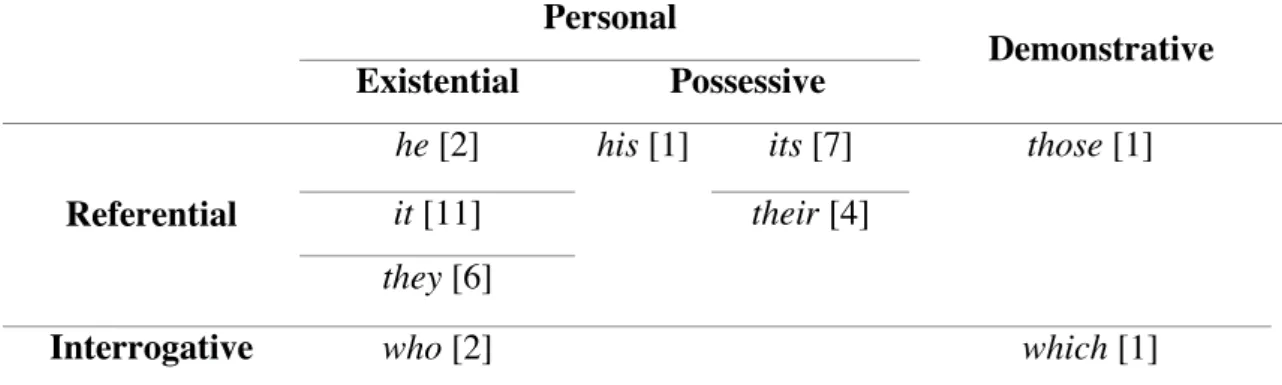
Within cohesion, two types of cohesion can be distinguished, those are grammatical and lexical cohesion. Reference, substitution, ellipsis and conjunctions are different forms of grammatical cohesive relations. Reference is the “relation between an element of the text and something else by reference to which it is interpreted in the given instance” (1976: 308). As established in a table11 proposed by Halliday and Hasan (1976) in which they established referential items, there are many instances of those items in my text. I have adapted their table and I have only included the reference pronouns and determiners that appear in my text with their frequency of use.
Personal
Demonstrative Existential Possessive
Referential
he [2] his [1] its [7] those [1]
it [11] their [4]
they [6]
Interrogative who [2] which [1] Table 1. Referential items. Adaptation from Halliday and Hasan (1976).
Moreover, reference deals with the relation between discourse elements and the element that follows, that is to say, that semantic relationships are concerned. On the other hand, substitution and ellipsis deal with the relationship that exists between grammatical units.
Substitution is “a relation between linguistic items, such as words or phrases […] It is a relation on the lexicogrammatical level” (Halliday and Hasan, 1976: 89). In other words, it is “the replacement of a word (group) or sentence segment by a ‘dummy’ word” (Renkema, 2004: 103). For instance, in my text, the most frequent type of substitution is
that of a noun and clause (“China Railway Group is building a $2.5 billion high-speed
railway in Russia” – the deal [Paragraph 14.4]). Ellipsis is very similar to substitution
and, in fact, it is sometimes referred as ‘substitution by zero’. When Halliday and Hasan (1976) explain ellipsis, they make specific reference to sentences, phrases and clauses whose structure is “such as to presuppose something preceding item, which then serves as the source of the missing information” (1976: 143). In my text, instances of nominal, verbal (“He wants to convince them to buy airports and Ø participate in other
privatization bids” [Paragraph 4]) and clausal (“Brazil´s Embraer jet manufacturer has
a facility in southern China, and Ø builds plans with their …” [Paragraph 10]) ellipsis
can be found.
The last type of cohesive relation is that of conjunction. Halliday and Hasan, (1976) determine that “conjunctive elements are cohesive not in themselves but indirectly, by virtue of their specific meanings” (1976: 226). There are four different categories of conjunctions that are additive, adversative, causal and temporal. In order to analyse the conjunctions that are used in my text, an adaptation of the summary table of conjunctive relations12 is provided. This rearranged table highlights the conjunctions that
appear in my text, the category each of them belongs to, their frequency of use, as well as an example from the text.
Conjunction Category Example
Additive and [30] External: additive - simple
… China and Brazil launched a joint …
Adversative
instead [1] Internal: Correction of
meaning
… new robots to ship to Brazil instead.
though [1] External: adversative
‘proper’ - simple
… though this is probably
more Vladimir …
but [3] External: adversative ‘proper’ - simple
… but are now looking to dump their insurance…
at least [3] Internal: Correction of
wording
… China is at least as dependent on the U.S as …
Causal
so [1] External: causal, general - simple
So when Putin and other leaders…
then [2] External: causal - simple
… then China is No. 2…
Temporal meanwhile [1] External: durative - complex
Meanwhile, here´s a quick
snapshot of … Table 2. Conjunctive relations. Adaptation from Halliday and Hasan (1976)
Moving on to lexical cohesion, there are two aspects to bear in mind to analyse a text, and those aspects are reiteration and collocation.
Reiteration is “a form of lexical cohesion which involves the repetition of a lexical item, at one end of the scale.” (1976: 278). Nonetheless, it not only deals with repetition but also with synonymy, antonymy, hyponymy, hypernonymy, and meronymy. The last three elements are not very relevant for this study because they are not frequently used in my text. However, it is worth mentioning repetition because there are many words that are constantly repeated throughout the text. By having a look at the repeated words, a general idea of what the text is about can be inferred. Those words are build, buy,
companies, countries, economy, import, investment, leader, market, power, sell and
world. Apart from those words, the countries included in what is known as BRICS are
regularly mentioned. Some instances of synonyms in my text are increase (rise), company
(firm), outlined (said / announce) and inked a deal (signed an agreement). On the other
hand, antonyms can also be found in my text. Some examples of antonyms are drop (rose
/ increase), supply (demand), export (import) and buy (sell).
Besides reiteration, collocation is another aspect of lexical cohesion that must be pointed out and “it is the habitual juxtaposition of a particular word with another word or words with a frequency greater than chance” (Oxford English Dictionary). Several examples of collocations can be found in my text such as bubble burst, GDP per capita,
supply and demand, investment projects, export market, import market and water supply.
5.3 Micro-textual elements
reflected in the morphosyntactic level which is unique and distinctive for each language, so it is necessary to identify the similarities and differences of each language pair through contrastive studies (Pizarro, 2010). According to Dijk (1980), grammatical cohesion at the micro-structural level, analyses aspects such as the order of words, verb tenses, possessives, adverbs and articles.
The order of words in English is much stricter than in Spanish; this is because English language has a fixed order that is subject-verb-object-complements. In Spanish, the order is more flexible and the same clause can be set up in many different ways due to the fact that the order of the elements in the clause can be moved.
There are several aspects worth mentioning concerning the use of the verb both in English and in Spanish, such as passive voice, mode, mood and non-personal tenses. The Oxford English Dictionary defines passive voice as “a form or set of forms of a verb in which the subject undergoes the action of the verb”. The use of this voice, as explained by Pizarro (2010), is very frequent in English mainly because of two reasons: the first reason deals with the desire to omit the subject of the active clause because the result of the action is more important than who performed it. The second reason is for mere stylistic reasons in texts with formal register. Economic, technical or academic texts, among others, use the passive voice to reflect impersonality, thus emphasizing the action instead of the subject. Apart from that, the high frequency of passive voice in English is also due to the fact that the subject is mandatory and the only way to omit it, is by using a passive clause without agent. The translation into Spanish of a large number of passive clauses becomes a problem for translators because the overuse of passive structures in Spanish would not sound natural. To avoid this, some resources such as the use of passives introduced by ‘se’, or the use of the active impersonal voice can be used instead; an example found in my text is “The deal was announced in June” that is translated as “Este
acuerdo se publicó en junio”.
Mood and mode express the attitude of the speaker towards something. In English, those aspects are expressed with the subjunctive mode and also with modal verbs. The nuances of possibility, desire, doubt, permission, obligation or probability -expressed in English with modal verbs-, are expressed with the subjunctive mode in Spanish.
Paragraph Source text Target text 5 … India can probably do without
China.
… es posible que India pueda
9 … China can sell them their new robotic technologies.
… China puede venderles lo último en tecnología robótica.
To end up with verbal tenses, I would like to highlight the use of non-personal tenses that are infinitives, gerunds and participles. The translation of participles and gerunds into Spanish may cause many problems. Participles are translated as such in Spanish. On the contrary, as gerunds are frequently used in English economic texts but not in Spanish ones, they should be translated into Spanish by using a preposition + noun, a preposition + noun + participle, ellipsis, ‘al’ + infinitive or an infinitive, rather than translating it as a gerund.
Paragraph Source text Target text
2 … surpassing Mexico… … superando incluso a México…
5 Following the recent border
skirmish…
Tras el reciente conflicto fronterizo…
9 … in improving industrial capacity. … para mejorar su capacidad
industrial.
Possessive pronouns and determiners are much more frequently used in English than in Spanish. Translations into Spanish usually use defined articles instead of possessive pronouns, however, sometimes the possessive pronoun is maintained. Some instances of this can be found in sentences such as “and its new billionaires like…” that is translated as “los nuevos multimillonarios como…” or “dump their insurance unit” in which the possessive pronoun is kept in Spanish “deshacerse de su departamento de
seguros”.
It is common in English, to form adverbs using the suffix –ly. The Spanish equivalent for this suffix is –mente; however, it is not used as frequently as in English and whenever possible, the adverb ending in –mente is substituted for another adverb without that suffix.
Paragraph Source text Target text 3 … have two things in common,
generally:
En general, tienen dos cosas en
común…
Regarding the use of the article in both languages, I have found three main differences. One difference lies in the use of the article before percentages in Spanish, unlike in English, where no article is needed. It can also be noted that the definite article 'the' is used less frequently in English than in Spanish as it is omitted before a plural noun used in a general sense. The last difference conveys the use of the article in Spanish preceding the days of the week. In English, there is no article before the days of the week.
Paragraph Source text Target text
1 … a world superpower. … una superpotencia mundial.
5 … also rose by 21.5% year-on-year …
... también creció un 21,5 %
interanual …
11 Ø Russian investment bank … El banco de inversiones ruso…
14 … as outlined on Friday by… … tal y como destacó el viernes
…
Moving on to lexical cohesive elements at the micro-structural level, it is important to remark that they mainly focus on aspects such as abbreviations, symbols, acronyms, anglicisms, false friends, metaphors and personifications.
Within the economic domain, abbreviations, acronyms and symbols are constantly used, thus, it is important to highlight their usage and translation.
An abbreviation is “a shortened form of a word or phrase” (Oxford English Dictionary). Some examples of this resource are Sept. (septiembre), No. (número) or
Corp. (corporación).
An acronym is “an abbreviation formed from the initial letters of other words and pronounced as a word” (Oxford English Dictionary). Some instances of acronyms in my text are BRICS, whose acronym does not vary (BRICS); GDP whose Spanish equivalent is PIB; and finally, JV. In the latter case, JV is also used in Spanish as an acronym, although, in many cases, the term joint venture is used.
More and more terms are being created with their corresponding terms in the English economic language, which are then exported to other languages. In Spanish, we import the concept, but we often import the term, either adapted or not to our language (Pizarro, 2011).
It is important to emphasize the use of loan words and the term coined in Spanish. In my text, there are loan words from English, known as anglicisms; which are “words or phrases borrowed from English into a foreign language” (Oxford English Dictionary). Examples of anglicisms are output (producción), business (negocios) and jointventure; in the latter case, joint venture is maintained untranslated in Spanish and some other times, negocios conjuntos is used. As I have just mentioned, there are anglicisms but there are also loan words that come from Latin. In my text, there is only one example of this kind, which is per capita (per cápita).
Another aspect that has to be taken into account, is the use of the false friends, which are “words or expressions that have a similar form to one in a person´s native language, but a different meaning” (Oxford English Dictionary). There are many false friends in the general language, but within the economic field, there are some that are used very often. In my text, there are false friends such as commodity (producto, materias primas), quarter (trimestre), billion (mil millones), trillion (billon) and announce (hacer público).
One of the most significant elements within lexical cohesion is the use of figurative language, in particular, metaphors and personifications. Economics discourse is full of metaphors but before starting with the examples of metaphors in my text, I would like to define this concept. A metaphor is “a figure of speech in which a word or phrase is applied to an object or action to which it is not literally applicable” (Oxford English Dictionary). Metaphors allow people to understand an abstract concept by means of another concept that is more familiar or, at least, not so complex.
Metaphors are the most important economic rhetoric devices, even though “they fall well outside the border of self-consciousness. It is the language economists use, and in particular its metaphors” (McCloskey, 1983: 502). Since Aristotle, metaphors have been seen as pure ornamentation. In 1980, Lakoff and Johnson published Metaphors We
Live By in which they highlighted the importance and frequent use of metaphors. They
3). As a result of this publication, economists and linguists such as McCloskey (1983), Henderson (1987), and Charteris-Black (2004) have studied metaphors in economic contexts in the past decade. They all agree that metaphors are crucial and indispensable in order to understand abstract economic theories.
There are many metaphors in my text and I have classified them following the different groupings of economic metaphors that authors such as Kövecses (2010) and Lakoff and Johnson (1980) have done.
Kövecses (2010) argues that the most common economic source domains are the human body, animals, plants, buildings, machines, games, and businesses. The human body is “an ideal source domain, since, for us, it is clearly delineated and (we believe) we know it well” (Kövecses, 2010: 18). Human beings can be healthy and on the contrary, they can also have illnesses, and those properties frequently constitute economic metaphorical source domains. Furthermore, human beings build houses and buildings, and the parts of the building, the action of building it, as well as the machines used, serve as common economic metaphorical source domains. Kövecses (2010) explains that people cultivate plants for many different purposes and when the concept of plant is used metaphorically, “we recognize the many different stages of growth that plants go through”. (Kövecses, 2010: 19). The last source domain is concerned with business. Kövecses explains that as humans are engaged in businesses of different kinds and it is familiar to us, and because of that, we are able to understand complex and abstract economic theories.
The most relevant economic metaphors in my text are classified according to the groupings of economic source domains that were established by Kövecses (2010). Apart from that, I have included the translation procedures followed for each of the metaphors.
Paragraph ST / TT Type of metaphor
Translation procedure
2
… to becoming the runaway
lider… / convertirse en el líder
indiscutible
Economy is a
human body 2
8 … has his eyes set on… / tiene como objetivo convertirse en…
Economy is a
human body 1
4 … trim more fat… / recortar cada vez más …
Economy is a
human body 4
6 South Africa needs China… / Sudáfrica necesita …
Economy is a
human body 1
7 China is a total beast / China es una bestia mundial.
Economy is a
human body 1
4 … the economic recovery … / la recuperación económica…
Economy is a
human body 1
2 … economy has grown up… /
crecimiento económico…
Economy is a
plant 1
11 … set up shop in Shanghai… /
se estableció en …
Economy is a
building 4
6 That beats South Africa´s … / supera a […] Sudáfrica …
Economy is a
game 2
2 … leader of Latin America … /
líder […] de América Latina …
Economy is a
sport 1
4 … a joint investment fund … / una inversión conjunta…
Economy is a
business 1
suitable source domain for describing equally invisible financial process” (Charteris-Black, 2004: 157). The other metaphor deals with the idea that the market changes are ways of moving in the air. “Extremely rapid market changes are conveyed with keywords such as drop” (Charteris-Black, 2004: 166).
Source text Type of metaphor
… bubbleburst and Brazil… The behaviour of the market is the behaviour of gas
… power has dropped … Market changes are ways of moving in the air
To conclude with micro-textual elements, I would like to analyse orthotypography; which is defined by Martínez de Sousa (2014) as the set of particular uses and conventions applied in writing by means of typographical elements in each language. Orthotypography deals with the combination of spelling and typography, in particular, with the way in which spelling is applied to printed works (upper and lower case, spacing, style of letters, punctuation, etc.). Within orthotypographic elements, we can find translation problems with decimals, currency units, dates, punctuation marks, capitalization and demonyms, among others.
Decimals are separated with a dot in English and a comma in Spanish. In both languages, the decimal point is placed at the lower part of the line.
Paragraph Source text Target text 5 … China and India also rose by
21.5% year-on-year …
… China e India también creció un
21,5 % interanual …
8 … ($1.7 trillion), Russia ($1.3
trillion) and …
… (1,7 billones de dólares), Rusia (1,3 billones de dólares) y …
The standard for thousands separator is international and therefore, it is the same in both Spanish and English. However, a dot is often used to separate thousands in Spanish and a comma is used in English.
Paragraph Source text Target text
5 … Some $59 billion worth of … Con valor de unos 59.000 millones de dólares …