COVER
UNIVERSIDAD TÉCNICA PARTICULAR DE LOJA
La Universidad Católica de Loja
ÁREA SOCIO HUMANÍSTICA
TITULACIÓN DE LICENCIADO EN CIENCIAS DE LA EDUCACIÓN
MENCIÓN INGLÉS
Teachers and students
’
perceptions of teaching English in
small classes in Ecuador.
TRABAJO DE FIN DE TITULACIÓN.
AUTOR: Povea Villagómez, Leonardo Patricio
DIRECTOR: González Torres, Paul Fernando Mgtr
.
CENTRO UNIVERSITARIO QUITO
ii
APROBACIÓN DEL DIRECTOR DEL TRABAJO DE FIN DE TITULACIÓN
Mgtr. González Torres, Paul Fernando
DOCENTE DE LA TITULACIÓN
De mi consideración:
El presente trabajo de fin de titulación: Teachers and students’ perceptions of teaching English in small classes in Ecuador realizado por Povea Villagómez Leonardo Patricio, ha sido orientado y revisado durante su ejecución, por cuanto se aprueba la presentación del mismo.
Loja, marzo del 2015
f)………
CI: ……….
iii
DECLARACIÓN DE AUTORÍA Y CESIÓN DE DERECHOS
Yo, Povea Villagómez Leonardo Patricio, declaro ser autor (a) del presente trabajo de fin de titulación: Teachers and students´ perceptions of teaching English in small classes in Ecuador, de la Titulación de Ciencias de la Educación mención Inglés, siendo Paúl Fernando González Torres director (a) del presente trabajo; y eximo expresamente a la Universidad Técnica Particular de Loja y a sus representantes legales de posibles reclamos o acciones legales. Además certifico que las ideas, conceptos, procedimientos y resultados vertidos en el presente trabajo investigativo, son de mi exclusiva responsabilidad.
Adicionalmente declaro conocer y aceptar la disposición del Art. 88 del Estatuto Orgánico vigente de la Universidad Técnica Particular de Loja que en su parte pertinente textualmente dice: “(…) forman parte del patrimonio de la Universidad la propiedad intelectual de investigaciones, trabajos científicos o técnicos y tesis o trabajos de titulación que se realicen con el apoyo financiero, académico o institucional (operativo) de la Universidad”.
f)………
iv
DEDICATION
This work is dedicated to my wife Cristina and my kids Martin and Thomas.
All the effort and support they gave me made all this possible and in the meantime put us
all closer and with visible goals and objectives to be achieved. Without my loving wife’s
motivation and patience this process would have been much more complex. I wish she knew how much I love her and admire her.
My lovely kids have always meant a world to me, and my first ideas and techniques were applied on them giving me a closer view of the language learning process.
v
CONTENTS
COVER ... i
APROBACIÓN DEL DIRECTOR DEL TRABAJO DE FIN DE TITULACIÓN ... ii
DECLARACIÓN DE AUTORÍA Y CESIÓN DE DERECHOS ... iii
DEDICATION ... iv
CONTENTS ... v
ABSTRACT ... 1
RESUMEN………..2
INTRODUCTION………..3
METHOD……….6
DISCUSSION………..8
Literature Review………..8
Description, Analysis, and Interpretation of Results ... 24
Conclusions ... 57
Recommendations ... 59
REFERENCES ... 60
1
ABSTRACT
The study overviews the perceptions of teachers and students about teaching and learning English in small classes, as well as the benefits of dealing with reduced groups and the positive implications in English language learning.
The study took place in a high school located in the northern part of Quito, where a total of 41 students of different age, sex and culture, from 8th to 13th grade and 4 teachers were surveyed and taken as a reference in the quantitative analysis. Key questions about aspects related to English language learning were included in the questionnaire and given to the students and teachers during their different classes as well as those questions related to the academic development of the students in small classes and the benefits of teaching to reduced groups.
It is clear that having small classes can benefit students and teachers since the groups tend to be more manageable in terms of discipline, and they are also easier to motivate or engage, providing them with a better environment to study and work.
2
RESUMEN
Este estudio visualiza las percepciones tanto de profesores como de estudiantes sobre la enseñanza y aprendizaje del idioma inglés en clases pequeñas, sus beneficios y las
implicaciones positivas que estas tienen sobre el aprendizaje de una lengua extranjera.
El estudio se llevó a cabo en un Colegio situado en el norte de la ciudad de Quito en dónde un total de 41 estudiantes de 8vo a 13vo grado de diferente sexo, edad, cultura, y fueron encuestados incluyendo 4 profesores de ESL y tomados como referencia para el análisis
cuantitativo. Preguntas claves sobre aspectos relacionados con el aprendizaje del Inglés fueron incluidas en los cuestionarios entregados a los estudiantes y profesores en sus distintas clases, así como también aquellas relacionadas con el desarrollo académico de los estudiantes en clases pequeñas y los beneficios de enseñar a grupos reducidos.
Es evidente que las clases pequeñas benefician tanto a estudiantes como profesores ya que el grupo se torna más manejable en términos de disciplina, y los estudiantes son más fáciles de enganchar y motivar, brindándose un mejor ambiente para estudiar y trabajar.
Palabras claves: percepciones, clases pequeñas, aprendizaje del idioma Ingles, grupos reducidos,
enseñanza.
3
INTRODUCTION
At present, teachers deal with many different challenges, but the one that can completely block the acquisition of a second language is dealing with large classes. Class size issues have lurked around educational grounds in Ecuador for enough time to be able to realize the formula is not working. Nowadays, providing students with a more personalized guidance to obtain results, having more time to interact with them, and being able to know the students well are some of the benefits small classes can offer.
Proper social interaction in small ESL classes can motivate students to overcome many aspects that can interfere or affect their L2 learning process. Blatchford (2005) observes that in small classes (25 or less), the contact between instructors and students was more individualized and task-oriented, giving pupils an active role in class.
The opportunity for small class instructors to interact with pupils will create an environment in class that can work as a great motivator for students, and it can also enhance
students’ oral production. Bakasa (2011) mentions that a great deal of research conducted by
4
Small classes can provide the teacher with enough time to prepare classes that will keep the group interested. To corroborate this, Blatchford et al. (2003) shows that children in large classes are more likely to be off task, distracted, not paying attention to the teacher and not focusing on their work when working by themselves.Firstly, having interested, motivated and actively engaged students are important aspects that need to be taken into account when teaching English as a second language. If students are not given information that helps their English skills increase, the mission as an ESL instructor will have failed. Secondly, In order for teachers to be
able to identify students’ strengths and weaknesses and to provide the right material for pupils to
work on or discuss about, teachers must be able to create an environment where the right interaction can take place.
Lumsden (2000) indicates that creating a comfortable, caring place for students, where they are respected and valued, can motivate students to have a participative role in class that will increase their skills. Similarly, evidence suggests that large groups are less effective and
productive, since it is hard to meet the needs of individual students within the groups (Blatchford et al, 2008, Blatchford et al, 2004; Kutnick et al, 2005). It is clear that class size can have a
positive impact on students’ performance and goal achieving behavior.
Therefore, this study is aimed at increasing teachers and students’ performance through the implicit opportunities that small classes can offer. The chain reaction small classes can cause can positively affect not only teachers and their pupils but also schools, parents, and can
contribute to obtain a more prepared group of citizens that will graduate from high school.
5
6
METHOD
Setting and participants
The research was conducted in a Private High School located in the North of Quito. In this research the participants involved were 41 ESL students of which 25 were male and 16 were female from 8th to 13th grade and with ranging in age from 13 to 18 years old. They also belonged to different levels starting with Pre-Beginners/Basic all the way up to Advanced. Students
belonged to 5 different groups and levels and took 3 different subjects in English: literature, grammar and speech and debate. Also 4 teachers participated, 3 males and 1 female from ages 26 to 48. Participants (students) were collaborative but the different skill levels inside 1 particular level might slightly interfere with results without affecting the final outcomes. The participants were randomly selected and possessed different English skills ranging from Basic to Advanced.
Procedures
A survey was designed and given to all participants, including questions related to how students and teachers perceive the effect of small classes when learning English. Participants were given the survey consisting of questions connected to class size such as activities,
interaction, time to practice more, materials, technological resources, among others. They were given plenty of time to answer all the questions and no one was forced to fill it out fast. Also the participants were clearly informed of the intention the survey had, in order not to confuse it with
a teacher’s evaluation.
7
obtained, that could later be compared with class observations to measure the influence of small classes.
The charts designed helped us to categorize and provide accurate percentages that gave us a clear idea of the effects of small classes upon ESL students and that also clarified a bit more the real situation of our educational system in terms of second language learning and its close relation with class size.
8
DISCUSSION
Literature Review
Learning a second language is a process that can turn into a nightmare if the right conditions in terms of class size, infrastructure, prepared teachers, and materials among others are not provided. In the past, the successful acquisition of English as a Second Language in Ecuador was not only an ordeal for students who tried to decipher grammar, but also a titanic task for teachers who were not prepared and did not have enough materials to use in class. The lessons were taught using simple phrases and commands which did not help students internalize the information received. On top of all these hurdles and impediments, teachers as well as students had to either deal with the harsh reality of being part of large classes where students
unfortunately could not receive a more personalized attention in order to achieve success, or with the fact that the instructor was not well prepared and could not motivate or engage students.
According to Brophy (1987) teachers should consider themselves as active
Socialization Agents, capable of motivating students to learn, likewise Lumsden (2000) indicates that creating a comfortable, caring place for students, where they feel accepted, can motivate students to interact in class.
Regrettably now in the 21st century this has not changed as it should have and it continues being a complex situation for authorities, teachers, students and even parents, who struggle to find the right place for their children to study and in the meantime learn English. It is of vital importance then to take into account the fact that many factors are involved when
9
There is not a perfect recipe or lesson plan that can actually set the pace to help teachers since
students and teachers’ perceptions are not quite similar, therefore, finding common goals or at
least mentioning them to students is a must in order to fight against that great burden that is having large classes.
Last but not least, the importance of the topics investigated gave this research the foundation required to be able to identify not only the problems that our education and schools are going through but also possible solutions to improve our education system and provide students with a nice environment in a normal size class where the learning process and the proper guided interaction can take place so that our society can become a more civilized one.
Managing Learning
According to Doyle (1980) the proper selection and organization of activities directly influence the behavior of students in class, but the effective control of a class also depends on what the teacher does while certain activity is taking place in the classroom, and it should be adaptable to different circumstances. Also, it is mentioned by the author that the teacher plays an important role since he/she must be able to continuously adjust activities in order to face the changing condition that a class possesses. Doyle (1980) also mentions that the most critical factor in class control is the control of time, and knowing when to act. A proper intervention of the teacher will give the student the idea that the instructor is in charge and knows what is happening, otherwise, this can cause errors in timing that can even affect a well-planned class.
10
activity. While the activity is in progress, the teacher must be attentive to the signs that can show the activity is taking more time than planned, due to discipline, or the activity itself: too short, too easy, too long among others. The decision to extend or shorten an activity must be well analyzed in order not to have dead time that will affect the normal development of the class.
Lyster and Ranta (1997) mentioned the use of data collected from different classrooms where a second language was being taught, examined the corrective feedback the instructor provided and found that it is a mandatory aspect for teachers to be able to provide feedback in a way that will not cause interference with the acquisition of a second language or its production. The term Metalinguistic feedback mentioned by the authors refers to the way correction is done by using comments that indicate there is an error but, without explicitly providing the correct form, so that the student realizes there was an error, and tries to correct it.
For instance when a student pluralizes an adjective in English in the exact same way Ecuadorians do it in their mother tongue Spanish, the correct way to handle error correction would be to remind the students that adjectives in English do not follow the same rules as the ones found in Spanish and therefore are not pluralized, for example, intelligents, beautifuls, among others, but using the same Metalinguistic feedback for example, Student: These shoes are beautifuls. Teacher: Excuse me, your shoes are…? Student: Oh, beautiful. Lyster and Ranta’s (1997) findings present important relevance, since L2 acquisition will eventually be reflected in
the student’s grades, oral production, correct use of grammar, among other features. Therefore, it
is of great importance the use of the right corrective feedback, in order not to cause discomfort or even make the student feel demotivated.
11
right time management skills are not part of the instructor’s repertoire. Hence the importance of what Gettinger and Seibert (2002) mentioned about the components of ALT (Academic Learning Time) which are allocated time, instructional time, engaged time and successful and productive learning time. First, allocated time is the time used for instructional activities; therefore , teachers must be aware of the amount of periods they have a week and that are specifically designed only for instructional activities, this is the amount of time teachers spend with students doing any relevant activity that can boost their learning process without having dead time.
Likewise, Gettinger and Seibert (2002) imply that instructors need to keep track of all the school programs, announcements, transitions, class visitors and any other source that can cause lost time and affect L2 acquisition.
Finally, it is the teachers’ responsibility to be able to cope with all kinds of threats that
can reduce the amount of time used specifically for learning. Being able to manage the students’ learning process through the use of correct feedback and the right use of instructional time, is an important for teachers who wish to have fun, organized classes where students learn and feel motivated.
Teacher-student and student-student interaction
Education is a social process that requires the right interaction of the participants to achieve common goals, learn and be able to socialize. Firstly, by setting goals teachers and students can work together to achieve them, since the teacher’s goals are very similar to the
student’s ones in terms of learning a second language. Johnson (1981) mentions that even though
12
The author also explains how educational psychology has traditionally considered that socialization, learning and development are the result of the interaction with teachers and that no student-student interaction is necessary.
On the other hand, the fact is that student-student interaction is the one that can lead pupils to educational success, and to make them part of a society that will eventually do its part and will contribute to the country. In brief, interaction can improve students’ learning pace as well as the way they perceive things and react, but it is imperative to also motivate the students’ interaction and socialization.
Erickson (1996) poses an excellent question: “How does the mutual influence we call teaching and learning take place in and through immediate social interaction?” The author recalls the importance of social interaction in learning, according to neo-Vigotskian work, which refers to the engagement of expert (teacher/instructor) and novice (students) in the zone of proximal development (ZPD), through which teachers who are part of the interchange or interaction, assist to complete and extend the actions and insights of the students. Erickson also states that if interaction is decisive for learning, then interaction itself should also be thoroughly analyzed in order not to focus only on the cognitive or linguistic changes and aspect that take place within the learner but on how to understand how these changes occur.
Class Size
13
including child protection and education, supports that in primary school classes, students remain seated and are asked to work in groups most of the time.
Undoubtedly, large classes sometimes require working in groups for many reasons such as time for the instructor to grade, easy to control, among others. Therefore, having small classes can give the instructor the opportunity to interact more closely with his/her pupils. On the other hand, large groups could be ideal for projects, role plays, and grammar games, among others, but the time required for L2 acquisition will definitely be affected. According to the Department for Education in UK, evidence suggests that large groups are less effective and productive, since it is hard to meet the needs of individual students within the groups (Blatchford et al, 2008, Blatchford et al, 2004; Kutnick et al, 2005). It is clear that small classes are more likely to obtain the necessary tools to succeed in terms of learning a second language, since teachers can spend more time on each student.
Social interaction in ESL classes can be a great motivator. Blatchford (2005) observes that in small classes (25 or less), the contact between instructors and students was more
individualized and task-oriented, giving pupils an active role in class. Also, when having large classes (31 or more), valuable time is spent on non-teaching activities like attendance, or controlling discipline.
On the other hand, Kutnick (2005) discovers that in small classes students were less involved in cooperative learning, which suggests that class size cannot always be taken for granted.
Brophy (1987) believes that teachers should consider themselves as active
14
creating a comfortable, caring place for students, where they are respected and valued, can motivate students to have a participative role in class that will increase their skills.
For this reason the importance of finding time or preparing different activities to know students more and be able to guide them.
In conclusion, there are many benefits that small classes have and that instructors should be aware of so that they can help their pupils to succeed. Small groups can have a more personalized attention and therefore achieve goals faster. Interaction plays an important role as it is the way students can communicate their ideas, needs among others.
The more the instructor knows the pupils the more learner centered the activities planned can be.
Teaching techniques, strategies or activities for teaching English in small classes
In The Trophy Kids Grow Up, Alsop (2008) notices that students have great teamwork
skills as well as technology skills, social networking and multitasking, and that they require guidance, attention and positive reinforcement. On top of this students need explicit guidelines, instructions and flexibility. This could give the teacher an idea of what to expect from pupils and what kind of class to plan to obtain expected results.
“In 1990,” Goldenberg (2008) mentions that “one in 20 public school
15
Today the figure is 1 in 9. Demographers estimate that in 20 years it
might be 1 in 4.”
Gardner (2007) in Five Minds for the Future mentions that Education is an inherent stimulating factor that gives humans values and goals to achieve. Law and Eckes (2010) mention
that what you do as a teacher needs to be determined by the teacher’s own value system and
instructors cannot completely rely on technology or science.
Learning environment in small classes
Law and Eckes (2010) acknowledge that the environment in class is a critical factor
and that students learn faster in a comfortable, safe environment. The atmosphere that prevails in class can be the difference between participative and quiet students. Law and Eckes (2010) also comment that students need to be part of a classroom where they are respected for who they are and for the contributions they can make, where they feel relaxed and not afraid of speaking without making mistakes or punishment, and where the students’ experiences can be used as part of the learning process.
Law and Eckes (2010) notice also that the importance of being able to familiarize students with the fact that errors are just part of learning is mandatory, in order not to make them feel afraid when being corrected. Samway and McKeon (2007) corroborate the fact that a
language can be acquired faster and easier if pupils understand errors as a normal-integral part of learning. Corder (1967) suggests that students’errors should be taken as stages in the pupil’s progress that will ensure competent reading, writing or speaking in the L2.
16
enough knowledge, attitudes and skills to identify their skills and emotions, set and achieve goals, display their caring and nurturing behavior, build and keep unequivocal relationships, make decisions in a responsible way, and manage interpersonal interactions efficiently.
Taking into account that the value of having a great environment in a class, regardless the size, it is the instructor’s job to provide, a great interaction among all the participants in the classroom, and the right materials and activities to engage the pupils and therefore learn, and what is more important to internalize words, phrases, grammar structures, among others.
Zeidner, Roberts & Matthews (2002) referred to this definition as benefit of any conceptual meaning, after an influential review published by Catalano (et al 2004) including approaches to obtain 1 or more of 15 different objectives. Unfortunately, only two were achieved, the promotion of social and emotional competence, therefore; for Zeidner, Roberts and Matthews (2002) this concept lacks somehow of something, and seems nebulous and amorphous.
What was not considered is the fact that this method, that could sound a bit general, needs to be unfolded by the instructor in class according to the necessities or goals, therefore it seems impossible to be more specific without knowing the group, or perhaps Catalano (et al 2004) did not provide a good interaction in class, and did not probably manage the Academic Learning Time properly, since more than two objectives could be easily achieved in a short period of time, if the instructor possesses the right attitude and skills.
All in all, a nice environment is a vital element in the L2 acquisition process, which
incentivizes and expands students’ minds, souls and bodies. The nicer the environment, the more
17
with ideal results. In conclusion, interaction plays an important role when designing the best environment for pupils to live, grow and learn.
Likewise, it is of vital importance to not only apply the terms discussed in the
literature, but also to be able to perceive the needs of students first hand and through real classes, that can actually provide the instructors with excellent tools to help students achieve goals. Studies that have been conducted for many years in real life scenarios have given teachers,
students and even parents, a clearer view of what implies to be part of a small class when learning a second language as well as all the requirements students and teachers must comply with in order to have a good school life.
Cakmak (2009) formulates various questions in the study conducted in Ankara, Turkey, in terms of class size and student achievement as well as how both parties perceive the effects of class size on their behavior. The importance of classroom management, teaching methods and techniques together with the proper assessment, are relevant aspects of the study. These research questions focus on many mandatory features required in every classroom to keep students interested in learning the English language. When referring to class size research
18
The results obtained from systematic observations demonstrates that children in large groups are more likely to be off task, not paying attention to the instructor and not focusing on their work when working by themselves.
Nevertheless, Zahoric et al. (2003) mention that that successful teachers provide students with clear rules, activities, rewards to motivate students and what is more important do not allow students to be distracted regardless the size, this is 20 or more students.
The results from systematic observations in this particular case showed that children in large classes are more likely to be off task, particularly in terms of not paying attention to the teacher and not focusing on their work when working on their own. On the other hand, several
student teachers stated different viewpoints on this issue. One participant stated that, “classroom
management depends on teachers’ skills even though doing this seems much easier in small size
class.” Similarly, another student teacher stated that “it is good to have small size class for
teachers, but I do not think this would affect classroom management strategies of teachers
directly.” It is clear then that class size matters, but when presented with a large class the way the
teacher conducts the class requires more time and classroom management experience
All in all, it could be said that providing teachers with the right tools and training in different learning styles and strategies to work either with small or large groups, is mandatory if success, in terms of language acquisition is expected. Likewise, it is clear that class size directly affects the learning process if the right skills are not part of the instructor.
An even more challenging study was conducted by Finn (2002) who mentions that the objective of the study was to provide a brief scrutiny of the current situation of class-size
19
answered, and to determine the long-term consequences of small classes, and why they are considered to be effective.
The relevance of the study in terms of proving its capacity to detect the effectiveness of teaching small groups shows the seriousness of the method used as well as the findings. The only way to be able to identify the real benefits of small classes is by being part of one, in order to obtain real feedback first hand.
Approximately 1200 students were involved at some point in the four-year study, where neither a special program was designed to train neither teachers nor a particular
curriculum. Norm-referenced and criterion-referenced achievement tests were given to students each year, also data related to teachers and students’ behavior was collected. All the students were monitored until they returned to full size classes in grade 4, and some other data was also gathered through high school.
According to Finn (2002) the results are conclusive since they prove that discipline can be controlled more easily, students’ engagement is increased, teacher morale is improved, and even aspirations to go to college are increased. However, this research found some conclusions that mention that small classes are more beneficial in the early primary years and those classes with 20 or fewer pupils can produce a moderate increase in academic achievement as well as the fact that students with economic problems are more likely to benefit from small classes.
20
interact as much as possible, to learn and internalize new phrases, words, idiomatic expressions among others.
As much as studies show evidence, the same techniques or strategies can not be applied for all the groups, since there are a lot of variables to be considered and that affect positively or negatively the normal development of a class, regardless its size. For example, if the instructor that has a small class is inexperienced, demotivated or lazy, the English learning environment will soon be deteriorated.
In the same way, Ehrenberg, Brewer, Gamoran & Willms (2001) tries to identify through achievement tests the benefits of small classes and its relationship with student
achievement, including timing and exposure. In order to achieve the expected results, two general strategies are included, one is to randomly select students and teachers and send them to classes of various sizes, and the other to collect data on the factors that affect the student learning process.
21
teaching position implies, in terms of taking attendance, grading, administrative work among others, the whole process will eventually collapse.
Ehrenberg et al. (2001) concludes that class size reduction implies the need of more workforces with similar characteristics to the ones existing, but unfortunately if the new
instructors do not possess the quality required to increase students’ learning skills the process will not take place for as much as the experimental results suggest it will.
Hence, the harsh reality and the heartbreaking need to properly train teachers and design new methods, materials, interactive classrooms to be able to cope with small or large groups, and succeed in providing the right tools to students, for the learning English process requires motivated, active and creative participants in a class.
Equally, Bakasa (2011) suggests the necessity of knowing if education, as it is known in terms of teaching, resources and learning in a large class is the same as the one provided in a small one as well as if the performance and achievement results are better in small or large classes. It is also mentioned the degree of active participation of students in small and large classes and the general preferences and attitudes of pupils towards class size.
Essentially, the researcher chose a qualitative approach to see if there is a real
connection between class size and performance using data collection techniques designed for this type of approach such as observation and spontaneous interviews for students and without any particular structure to interpret in this way the students’ feedback and interaction in the
22
To sum up, Bakasa (2001), based on information obtained from the study and despite some limitations such as irregular attendance and disparity between levels, concludes that there is a positive link between small classes and student’s achievement, and that also behavior improves in reduced groups as well as the fact that regardless the class size, instructors and students should find the best-fit methods to achieve goals.
The teaching and learning of English requires more than small classes to be successful such as proper infrastructure, nice environment, good salary, moderate paperwork, skilled instructors, intelligent authorities, resourceful materials, among others. Not everything has been said related to the benefits of small classes and not all the methods can be applied to different classrooms of different cities, countries and even continents since the cultural aspect plays an important role in the acquisition of a second language.
In developed and overpopulated countries the same controversy about small classes can be observed, and the basic questions are repeated over and over again without any action that could provide answers to the requirements of the participants. Din (1999) expresses the need to investigate what kind of factor class size represents and the benefits of small classes as well as what to do in large classes to obtain expected results and how Chinese teachers perceive these issues.
23
24
Description, Analysis, and Interpretation of Results
After students and teachers have completed the questionnaire, the tabulation of the results will take place according to the answers given by both sides. The percentage of students and teachers and their perceptions for each category will be obtained and analyzed together with the class observations to corroborate and obtain in this way a clearer view of both sides in terms of class size and English as second language learning development.
Qualitative and Quantitative Analysis
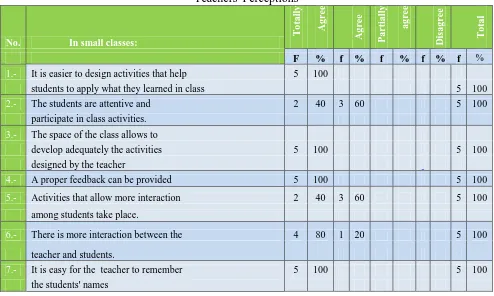
[image:29.612.84.578.349.645.2]What are the benefits of teaching and learning English in small classes?
Table 1
Teachers' Perceptions
No. In small classes:
T o ta lly A g re e Ag re e P a rt ia lly a g re e Dis a g re e T o ta l
F % f % f % f % f %
1.- It is easier to design activities that help 5 100
students to apply what they learned in class 5 100
2.- The students are attentive and 2 40 3 60 5 100
participate in class activities.
3.- The space of the class allows to
develop adequately the activities 5 100 5 100
designed by the teacher
4.- A proper feedback can be provided 5 100 5 100
5.- Activities that allow more interaction 2 40 3 60 5 100
among students take place.
6.- There is more interaction between the 4 80 1 20 5 100
teacher and students.
7.- It is easy for the teacher to remember 5 100 5 100
the students' names
Author: Leonardo Povea
25
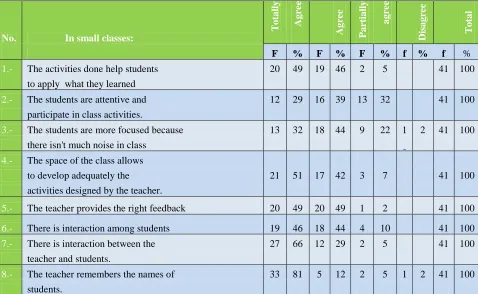
[image:30.612.88.566.141.435.2]What are the benefits of teaching and learning English in small classes?
Table 1 Students' Perceptions
No. In small classes:
T o ta lly Ag re e Ag re e P a rt ia lly a g re e Dis a g re e T o ta l
F % F % F % f % f %
1.- The activities done help students 20 49 19 46 2 5 41 100
to apply what they learned
2.- The students are attentive and 12 29 16 39 13 32 41 100
participate in class activities.
3.- The students are more focused because 13 32 18 44 9 22 1 2 41 100
there isn't much noise in class
4.- The space of the class allows
to develop adequately the 21 51 17 42 3 7 41 100
activities designed by the teacher.
5.- The teacher provides the right feedback 20 49 20 49 1 2 41 100
6.- There is interaction among students 19 46 18 44 4 10 41 100
7.- There is interaction between the 27 66 12 29 2 5 41 100
teacher and students.
8.- The teacher remembers the names of 33 81 5 12 2 5 1 2 41 100
students.
Author: Leonardo Povea
Source: Unidad Educativa Alexander Wandemberg Internacional
26
teachers with more time to focus on planning since there will be fewer papers to grade, less disruptive behavior in class, in general less work that can allow teachers to have time for other activities.
Experienced, motivated and creative teachers make a big difference. Brophy (1987) believes that teachers should consider themselves as Active Socialization Agents, capable of motivating students to learn. Regardless of the size, it is mandatory for instructors to approach the class with a variety of strategies and activities that can force students to practice what they
learned and that can technically change the direction of the class. The topics that interest pupils could be useful when trying to obtain their attention or when trying to convey with that grammar structure that has been causing some problems. For instance, music could be used to study grammar or expressions without using the book to introduce it. The success of a class can be dictated by the activities used in class or outside the class, and the motivation and attitude of the participants towards certain activities.
Similarly, students coincide on the fact that small classes provide time and space to develop activities that will most likely stimulate pupils in class. This can be seen in question one; where twenty (20) students that represent 49% totally agree that the activities prepared by the teacher help pupils apply what they have already learned in previous lessons. Out of the 41 students, 19 that are the 46% only agree on this matter. Only 2 students (5%) partially agree and none of the students (0%) disagree that in small classes activities are more meaningful.
27
terms of number of students varies from the general perception that a small class is made of at 20 students approximately. Some students consider a small class, a class with 5 or 7 students, more than that could cause behavioral issues that could affect the normal development of the class if the teacher in charge is not experienced enough. Law and Eckes (2010) mention that the environment in class is a very important and critical factor where students learn faster if a comfortable, safe, relaxed environment is provided.
Therefore, the importance not only of small classes but the capacity of the instructor to prepare and use activities that will enable students to increase their English skills as well as the attitude he/she must have in order to keep the class engaged. Based on the observation sheets, it is important to mention that even in small classes, instructors could face interaction problems, proper feedback issues, and even deal with classes that do not care or pay attention due to a high
TTT (Teacher Talking Time) or due to students’ English level, among others.
Nunan (1991) mentions that teachers should be aware of the time and kind of talking they do and also evaluate its effectiveness based on the pedagogical objectives. All these aspects need to be taken into account since they are all intertwined and at the same time directly
connected, therefore, it is not quite correct to rely only on class size. It does not really matter then how many students a teacher has, if he/she is not well prepared, L2 acquisition will not take place. It is definitely more difficult to deal with bigger groups, but what guarantees success is the quality of the instructor and not the quantity of the class.
28
stimuli that will keep us interacting to achieve either a common goal, discuss a topic, argue, and give opinions, among others. It seems clear then that socially speaking, good communication skills are necessary in order for people to understand each other in any aspect of life, using any means possible to convey ideas.
In table 1, question 2, related to class participation the percentages show that 40% of the teachers totally agree while the other 60% agree on this issue. The results confirm that in small classes teachers can have enough time to interact with students therefore it would be difficult for some students to be in class doing nothing.
On the other hand, after analyzing the results of the survey in question two, related to attentiveness and participation, we can see that the amount and percentages differ a bit from the previous results obtained from teachers. Here only 12 students that represent 29% totally agree on class participation and attentiveness in small classes, while 16 (39%) only agree and 13 (32%)
partially agree. Students’ attentiveness depends on how well the lesson was designed, materials
used and the activities and motivation the instructor possesses to lure students into participation.
Alsop (2008) indicates that children have great teamwork and technology skills as well as social networking and multitasking skills, but in the mean time they desperately need
guidance, attention and positive reinforcement plus explicit guidelines, instructions and
flexibility. In other words, if the instructor has what it takes to be a teacher and does not provide students with the right tools and activities that must be specially designed for the kind of group he/she is in charge, pupils will soon be bored and start doing something else.
Based on the observation sheets it is crucial to also mention that nowadays technology
29
necessary equipment and training, the quality of the teacher can go down even if he/she is a great instructor. Prensky (2001) mentions that the generation of students he calls Digital Natives, possesses a different brain structure and is accustomed to receiving information really fast and also likes to parallel process and multitask. In contrast, teachers or Digital Immigrants can have a hard time adapting themselves to certain types of activities and groups, and if not prepared, the attention of the class can be diverted.
Last but not least, the quality or capacity of the instructor to be able to engage students is the corner stone of a successful language acquisition. If the instructor does not create a good relationship with students, the last thing they would like to do is pay attention and participates in some boring activities.
It is important to use the benefits small classes give such as space in order to plan activities or games that will keep everybody alert and interested. If students have fun when participating in class, the battle is won. Therefore, the more engaged instructors keep students the faster they will learn.
According to the survey in question 3 and the class observation, the percentage (100%) confirms, according to the teachers that space plays an important role since it gives the teacher the opportunity to design interactive activities that require students to move around the
classroom, using their senses at all times and that can influence the acquisition process more than just working on the books.
30
On the other hand, the percentages in question four show a slight variation from that of the teacher, where 51% of the students (21 students) totally agree on this, 17 students that
represent 42% agree that space can favor different activities that require space, only 3 students that represent 7% of the total partially agree on this, and obviously 0% disagree since most students understand that if we as teachers designed a game, make students watch a movie or video, do role plays, among others, space could be our ally.
Space is one concern but noisy classrooms can also affect the learning process. The generations of students that go to school today possess a very close relationship with technology. As mentioned by Prensky (2001), at present, students can parallel process and multitask.
Depending on the activity, noise is not always a problem, unless it has turned the class into something else. Therefore, students need to interact and make noise, sing, dance, get dirty, taste, feel, among other sensations, to help themselves internalize concepts, ideas, words, phrases that will eventually come together in their parietal lobe to form speech. Since, kids are able to
multitask and parallel process, even if there is some noise, they can still focus on whatever task if properly engaged.
It can be clearly seen though, that most students that were part of the survey think that noise can be an issue, but it is important to mention that only disruptive noise will affect the proper development of the class. The number of students that totally agree to this third question was 13, that represent 32%, 18 students agree, and that is 44%, 9 more students partially agree (22%), and finally only 1 that represents 2% disagree.
31
language. They can also interact and what is more important internalize grammar rules,
vocabulary along with the fact that they will be able to improve their oral production since they will feel more confident in small groups with an appropriate physical space and noise level.
The information obtained through the observation sheet; demonstrate that most classes possess good space and a good matching number of students. In some classes that are designed for 40 students, sometimes only 5 students attend to ESL classes, and there is a bit of a problem with the acoustics. Even though it does not interfere much with the learning process but it is better to have big classes for big groups and vice versa.
According to question 4 and based on the 100% of the teachers who agree that proper feedback can be given to students in classes with few students, it could be said that the number of students in a classroom can provide teachers with more opportunities to interact with pupils and therefore to provide more accurate remarks on their assignments or skills.
On the other hand, after class observations, it was determined that experience and feedback are directly connected, and when dealing with youngsters the use of pedagogical tools is required if we want the learning process to succeed. Consequently, the instructor must be well prepared in order to be able to know when to correct students without interrupting such process.
32
In order for good communication to take place there are some aspects that require special consideration and feedback is among them as a crucial tool for teachers and students to realize how things are going, either academically or behaviorally.
Lyster and Ranta (1997) also clarified that it is of great relevance to be able to provide feedback to students in a way that will not interfere with their learning process. This means that instructors must be prepared to give feedback in a positive but honest way, trying not to make students feel bad in order not to stop the process. Instead, teachers should give motivational feedback to push students to achieve goals.
It is also important the results obtained from students that can help to support the
teachers’ opinions. In question five related to feedback, it was found that 20 students that
represent 49%, totally agree on this; exactly the same percentage (49%) agree on this topic; only 1 student, who represents 2%, partially agrees, and 0% disagree.
As it is clearly seen, feedback is easily given in small classes, and the teacher can have more time for individual needs such as pronunciation, complex grammar structures among others. Likewise, students have also time to let the teacher know how he/she feels or how they find themselves in terms of advancing and improving their skills.
Also, the information collected through class observation can corroborate the findings that are conclusive and that show that in small classes instructors have more time to provide all students with the correct feedback that will enable them to increase their capabilities and skills in the target language.
33
help humans to form words and phrases has been the cornerstone of social development as people know it. Consequently, instructors should be able to interact with students, in a nice and
respectable manner, so that they can do the same with their peers. This will set the pace for great classes were interaction is part of the fun.
One of the ways instructors can improve students’ language skills is through activities
that allow interaction among all participants. Erickson (1996) recalls the importance of social interaction in learning, according to neo-Vigotskian work, which refers to the engagement of expert (teacher/instructor) and novice (students) in the zone of proximal development (ZPD), through which teachers who are part of the interchange or interaction, assist to complete and extend the actions and insights of the students.
The opportunity for instructors to interact with pupils will create an environment in class that can work as a great motivator for students who are studying a second language for the reason that proper social interaction between the teacher and students and among students
themselves can enhance students’ oral production, giving students the chance and confidence to
use the target language spontaneously in different situations without the need of memorizing, or being forced to speak just to obtain a grade, whatever this might be, and which will not possess the features of a real assessment. To summarize, when proper interaction takes place in small groups, a second language can be learned in an easy and fun way as long as the instructor has his/her pupils motivated.
34
Johnson (1981) mentions that even though there are different types of relationships at school to achieve goals, the primary educational relationships are between teachers and students and among students themselves. It is clear that the interaction between teacher and students is of great importance because it can provide instructors the path to a nice school life or a very hard one. Consequently, it is important to allow students to interact in order not only to increase their English skills but to make them feel accepted for who they are and respected for their opinions.
Likewise, the numbers on table1, question six, can give us a better idea about how students perceive interaction; for example, out of 41 students surveyed, 19 that represent 46% totally agree on this topic, 18 which are 44% agree while only 4 students that represent 10% partially agree and none of them disagree (0%).
Students perceive interaction as an important aspect of their social development and if the instructor provides the right tools and activities, pupils will feel more relaxed and comfortable and also eager to interact. 10% of students partially agree, because some of them pertain to larger classes where it is hard to interact with everyone.
Class observation sheets can substantiate the information provided since 80% of the teachers believe there is more interaction to benefit from in reduced classes. Also, time plays an important role since small classes tend to provide teachers with enough time to plan or design activities that can engage students and motivate them to interact.
35
In the survey, question 6 says that 80% of the teachers totally agree and 20% agree that there is more interaction between the teacher and the students because fewer students represents more time and individualized attention for each one of them. The good use of class size can give instructors better results and faster.
To confirm this, the percentages listed in table 1, question seven that refers to students’ perceptions, shows that 27 students that represent 66%, totally agree on the fact that there is much more interaction in small classes, 12 students, 29% agree and only 2 which represent 5% partially agree. The data obtained and class observation clearly states that small classes can benefit many aspects of the learning process, making it easier, faster and fun.
Knowing the students can help teachers prepare classes that will keep the group interested. If students are not presented with interesting material, they will not learn, and the mission as an ESL instructor will have failed.
The first thing to do in order to have a nice interaction with students is to learn their names and use them every time the teacher is in contact with them since it will give the class environment a more familiar spirit that make students feel comfortable and noticed.
In question seven of the table, it is shown that 100% of the teachers surveyed agree that
it is much easier to remember students’ names in small groups, giving them the chance to know
them and in the meantime to become familiar with their needs. Also, class observation reflects the same results and corroborates the importance of being able to remember all the names.
36
students, representing 81%, 5 students (12%) that also agree, 2 students who partially agree (5%), and 1student, (2%) who disagrees.
It is clear that in a small class there are fewer names to remember, consequently it is a matter that cannot fall into oblivion; otherwise, it will turn against the teacher. According to the classes observed, teachers knew all the names of the students, even though at the beginning it might have been a bit hard. Calling students by their names made them feel that they are an important part in the learning process, and will treat teachers the same way providing with this a nice learning environment.
The benefits that teachers and students can obtain from small classes depend directly
on the teacher’s skills to motivate his/her pupils. Small classes provide infinite options to teachers
since even the workload will be diminished and instructors could have more time to plan and grade, giving them in this way the opportunity to have more time to interact with pupils
It is clear that small classes benefit all the participants included in the learning process but success is also determined by the quality of the teacher and his/her ability to interact with students to obtain results.
What are the strategies and resources that promote learning in small classes?
Table 2
Teachers' Perceptions
No. In small classes:
T o ta lly A g re e Ag re e P a rt ia lly a g re e Dis a g re e T o ta l
f % f % F % f % f %
8- Design an apply activities that allow to 5 100 5 100
practice listening skills.
37
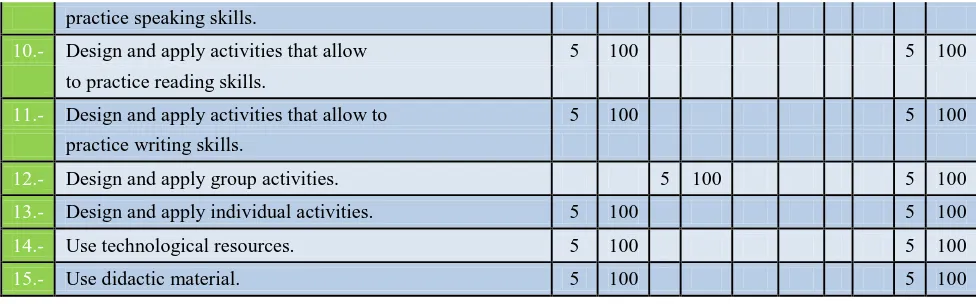
practice speaking skills.
10.- Design and apply activities that allow 5 100 5 100
to practice reading skills.
11.- Design and apply activities that allow to 5 100 5 100
practice writing skills.
12.- Design and apply group activities. 5 100 5 100
13.- Design and apply individual activities. 5 100 5 100
14.- Use technological resources. 5 100 5 100
15.- Use didactic material. 5 100 5 100
Author: Leonardo Povea
Source: Unidad Educativa Alexander Wandemberg Internacional
[image:42.612.89.577.84.236.2]What are the strategies and resources that promote learning in small classes?
Table 2 Students' Perceptions
No. In small classes:
T o ta lly A g re e Ag re e P a rt ia lly a g re e Dis a g re e T o ta l
f % f % F % f % f %
9.- Different activities that allow to 22 54 17 41 2 5 41 100
increase listening skills are used.
10.- Different activities that allow to 26 63 14 35 1 2 41 100
pactice speaking are used.
11.- Different activities that help to increase 16 39 20 49 5 12 41 100
reading skills.
12.- Different activities that allow to 20 49 17 41 4 10 41 100
practice writing are used.
13.- Group activities are used. 21 51 13 32 6 15 1 2 41 100
14.- Individual activities are used. 21 51 14 34 6 15 41 100
15.- Technological resources are used. 3 7 20 49 15 37 3 7 41 100
16.- Didactic materials are used. 14 34 16 39 9 22 2 5 41 100
Author: Leonardo Povea
38
When dealing with L2 learners, it is imperative for teachers to identify the level of students before applying tests, designing activities, preparing oral projects, among others. Some activities can be difficult for students to understand therefore, they need to be graded or designed for specific levels and given to students in a way that will not block their production.
Listening activities can be a big burden for students, and if not properly designed they can cause interference in the target language learning process. Richards (2008) mentions that listening as comprehension is the traditional perception about the nature of this activity, and its main function in second language acquisition is to facilitate understanding of spoken language.
In table 2, question eight, it can be seen that 100% of the teachers agree that it is easier to design and apply listening activities in small classes. As it has been mentioned, a small class represents less paperwork for teachers and more time to focus on activities that can really
increase language skills; therefore, instructors have more time to design or look for activities, and pupils that belong to a small class will receive more attention by the teacher since less students means more time for each pupil. This was clearly seen when observing classes, where students received more attention by the teachers due to class size.
Listening is one of the skills that require more practice due to different aspects that can make the process harder such as accent, slang, pronunciation, culture among others. It is
important to make students practice this kind of activity in a quiet, relaxed environment so that their brains can adapt to this interactive but complex process by which according to Lundsteen (1979) spoken language is turned into meaning in the brain.
39
definitely provide a better environment for listening activities, 17 students ( 41%) agree on the benefits of small groups and the opportunity they have to increase their listening skills, only 2 students (5%) partially agree and 0% disagree.
The perception students have and that is supported by observation is that in small groups, there will be more time for real listening activities and in a quiet environment that will allow them to relax and focus. Also since the groups are small, there is more interaction with every single participant in class helping them increase their confidence and in the mean time helping them to increase their skills.
Likewise, activities that can trigger speaking are considered an important asset throughout the process. Small classes can provide the perfect environment for debates, oral presentations, projects, or simply spontaneous English practice, among others. The size of a class can directly influence the outcomes and if not taken advantage of, common goals will not be achieved.
Small classes provide the opportunity to focus on speaking activities where all students can have an active role that will eventually enhance their oral skills. The more the students practice their oral skills, the more fluent they become and with the right feedback, the fewer errors they make.
40
Developing good speaking skills is not an easy task that can be done overnight. It requires time, dedication and the proper activities in order to succeed. Consequently, the
instructor needs to be ready to take on this challenge that will require experience from the teacher to obtain expected results. Doyle (1980) indicates that the proper selection and organization of activities can motivate and positively change the behavior of pupils, setting in this way the pace for a nice learning experience.
In the survey, results in question ten were conclusive since 26 students, representing 63%, totally agreed that in small classes it is easier for everybody to participate and interact, 14 which is 35%, agreed, only 1 student (2%) partially agreed and 0% disagrees. Similarly, the same results were found through class observations where all instructors dealing with small groups (10-12 students) were able to provide a more individualized guidance, and also capable of interacting with every student. On the other hand, in large classes instructors were not able to interact with all of them due to time limitations that do not allow teachers to communicate with every single student every day.
Nevertheless, large classes could be great for grammar games, contests, debates, role-plays, among other activities. It is important that the instructor knows how to deal with both groups and prepare activities that can trigger oral interaction.
41
The results in question ten show 100% support from teachers on the fact that in small classes many different reading activities can be more easily designed and applied in order for students to achieve the level of English that can allow them to interact in the same way they do it in their mother tongue. Reading activities will surely increase the level of English of any kind of learner as seen during class observation, where teachers and students seemed to be more relaxed and with more time to prepare classes, grade papers, and work.
Reading is a great way to learn vocabulary, grammar, and phrases, among other structures that can later be used in everyday English therefore it should be taken seriously in schools everywhere. Reading turns into a powerful tool when dealing with small groups because students have more chance to participate in different reading activities that will eventually require the use of their oral skills.
To corroborate this, the results obtained in the survey, question eleven, show that 16 students ( 39%) totally agree on the fact that in small groups the reading activities can be more collaborative and participative, 20 students (49%) agree, 5 (12%) partially agree, and 0%
disagree. It is clear then that students and teachers have the same perception about this matter, but then again, even with the best tools and equipment if the instructor is not prepared, the class could turn into a battlefield.
Likewise, small classes can be considered perfect when designing and applying writing activities since the amount of students represent the amount of essays or writing assignments the
instructor will have to grade. With more time in the teacher’s hands, the activities can be better
42
Table 2, question eleven, demonstrates that 100% of the teachers totally agree that it is easier to deal with writing if the group is small. When grading writing assignments teachers must make sure to follow many rules, use editing symbols, provide clear remarks or comments which tend to be time-consuming activities; therefore, when dealing with small classes, instructors must responsibly design activities that are worth it and make good use of the extra time small classes can provide.
Since writing requires many different skills to achieve the ideal parameters to comply with all the rules required, class size place an important role since it will provide teachers with more time to interact with pupils. Class observation showed an increase in the amount of time teachers have with students, and it seemed to be an asset that can help students achieve their goals.
Similarly, the students’ writing skills can be improved in small groups faster than in
large ones simply because the instructor will have enough time to make sure everybody understood what was explained.
In the chart, the percentages in question twelve demonstrate that 49 % of the students concur with the fact that in Academic Writing classes the fewer students the better, since the instructor has more time for individual concerns. 41% of the students (17) partially agree and 10% percent disagrees. The results are conclusive and go together with experience and the class observations that clearly show students have advantages when being part of small classes.
43
virtually make their lives miserable. Therefore it is crucial to provide students with an
experienced instructor that could use class size on his benefit and in the meantime knows how to teach writing.
In the same way group activities are a vital aspect to consider due to the importance and balance that interaction can bring to human beings. Blatchford (2005) observes that in small classes (25 or less), the contact between instructors and students was more individualized and task-oriented, giving pupils an active role in class. This active role can help students improve their English skills through interaction that can take place in group activities specially designed to
strengthen students’ skills.
In the survey, in question twelve, all teachers (100%) agree that designing and applying group activities is easier if the class is small because monitoring the activities is less time-consuming, and discipline can easily be controlled. Class observation gives us a clear view of how group activities can motivate students in order to learn a second language in reduced groups. It seemed easier for teachers to divide the class into groups and start working according to the planning.
In addition, group activities can also take place in small classes and can help students socialize, and increase teamwork skills as well as any other skill practiced and that is included in the assignment given.
44
The percentages in question thirteen, show positive results having 21 students (51%) that totally agree meaningful activities can take place in small classes, 13 students (32%) also agree on this issue, 6 students (15%) partially agree, and only 1 student (2%) disagrees.
When analyzing the results, it is important and plays an important role to know that the students are able to read between the lines. 17% of students do not completely agree, focusing on the fact that some of them are part of very small classes and those classes can not be divided into groups. Also, in some cases teachers prefer to advance and make students work individually since in groups there are more disruptions that can leave everybody in the class behind schedule
Correspondingly, individual activities can not be left aside since they provide teachers with a real assessment. It is important to know how each student is doing in class, and individual activities can provide a variety of choices that can help teachers to have a closer view of his/her pupils’ needs. Also, individual tasks can teach students to be more disciplined when they are on their own without any peer to provide help. In the same way, individual activities can motivate students to learn more and through fair competition.
In question thirteen, 100% of the teachers coincide on the matter that small classes are the perfect setting for individual activities but if not combined, students could be bored and the process will stop. Furthermore, individual activities can allow students to provide information they feel comfortable with, without the normal arguments that take place in group activities. As it was observed in all the classes, class size can provide a more personalized service, and individual activities can link teachers and students to achieve a common goal.
Similarly, individual activities can be performed in class in order to have a real
45
fourteen are very similar to the ones mentioned in the group activities section above: 21 students that represent 51% totally agree on the inclusion of individual activities, 14 students (34%) agree and 6 students (15%) partially agree. No disagreements were found.
It is clear that in small groups individual activities are also essential, without leaving aside the relevance of interaction, but even when interacting people need individual analysis to properly exchange thoughts, ideas, among others. Providing individual activities will give the
instructor a clearer view of his/her students’ strengths and weaknesses.
The 15% that partially agree might have related this question to the use of technology and individual activities. Some students do not consider working on the book an individual activity since they are sometimes not engaged and just try to fill it out. On the other hand, when using proper technology, digital natives and digital immigrants, as Prensky (2001) refers to students and teachers, can benefit from the use of it and its definite positive implications on the acquisition of a second language.
Another influential aspect in language development is the use of technological resources to keep students engaged. The generations of students that go to school today were born with technology and therefore it plays an important role in their lives. The use of technology or visual aids can enhance the presentation of a class and motivate students to participate and remain engaged in certain activity.