
Fostering Conflict Resolution Skills Through Collaborative Oral Tasks In An EFL Classroom
131
0
0
Texto completo
(2) CONFLICT RESOLUTON THROUGH COLLABORATIVE ORAL TASKS. 2. Fostering Conflict Resolution Skills through Collaborative Oral Tasks in an EFL Classroom. Maira Liliana Ramírez Cortés Thesis Director: Judith Castellanos Jaimes M.A. A thesis submitted as a requirement to obtain the degree of M.A. in Applied Linguistics to the Teaching of English.
(3) CONFLICT RESOLUTON THROUGH COLLABORATIVE ORAL TASKS. 3. Note of acceptance:. Thesis Director:. __________________________________________ Judith Castellanos Jaimes M.A. Juror:. __________________________________________ Carlos Arias M.A. Juror:. __________________________________________ Carlo Granados Beltrán PhD.
(4) CONFLICT RESOLUTON THROUGH COLLABORATIVE ORAL TASKS. Acuerdo 19 de 1988 del Consejo Superior Universitario.. Artículo 177: “La Universidad Distrital Francisco José de Caldas no será responsable por las ideas expuestas en esta tesis”.. 4.
(5) CONFLICT RESOLUTON THROUGH COLLABORATIVE ORAL TASKS. 5. Acknowledgements. This research project is the result of two and half years of learning and understanding deeply my labor as English teacher in Colombia, in special in the public sector; therefore, I would like to express my sincere thanks to my family: my parents, my siblings and my beloved husband for their constant support and motivation to carry out this project. Furthermore, I express my gratitude to my students for being my inspiration to improve and innovate my teaching practices to contribute to their English learning process. I also express thanks to my Master‟s teachers for encouraging this process, especially to my advisor, Judith Castellanos Jaimes MA who always supported this idea; with her experience, guidance and knowledge on conflict resolution and English language teaching, she inspired me to develop this research project being aware of its implications and contributions to the field of teaching EFL. Finally, I am also grateful to Harold Castañeda Peña PhD for his motivation and immense knowledge in the field of discourse analysis, as he encouraged me to look beyond English teaching being sensitive about different factors that may affect English learning..
(6) CONFLICT RESOLUTON THROUGH COLLABORATIVE ORAL TASKS. 6. Abstract. Bearing in mind the complex social issues currently emerging in educational environments, especially in public schools, EFL settings are considered ideal to reflect upon conflictive issues and can bring opportunities for learners to communicate their ideas and interact in the foreign language. This research aimed at examining the role of collaborative oral tasks based on conflict resolution in seventh graders‟ oral interaction at a public school in Bogotá; participants were 38 students ranging in age from 12 to 14 years old. The study focused on identifying students‟ skills in resolving conflicts while interacting in collaborative oral tasks, as well as interpreting the interactional patterns students co-construct when reflecting upon conflict resolution. The data for this research comprised transcribed video and audio recordings of students‟ interactions when working on tasks based on conflict issues, field notes and artifacts, which were qualitatively analyzed under the framework of a research action study. Findings reported that there is students‟ awareness on social conflicts when they are able to identify and propose solutions to conflicts in L2; in addition, students engaged in collaborative strategies of interaction to negotiate alternatives to resolve conflicts during tasks. Keywords: Conflict resolution, Oral tasks, Collaborative interaction, Oral discourses..
(7) CONFLICT RESOLUTON THROUGH COLLABORATIVE ORAL TASKS. 7. Table of contents Chapter I ......................................................................................................................................... 11 Introduction ................................................................................................................................ 11 Statement of the Problem ........................................................................................................ 12 Research Question .................................................................................................................. 14 Related Question ..................................................................................................................... 14 Main Objective........................................................................................................................ 14 Specific Objectives ................................................................................................................. 14 Rationale ................................................................................................................................. 14 Chapter II........................................................................................................................................ 17 Literature Review ....................................................................................................................... 17 Understanding Conflict in the School Context ....................................................................... 17 Conflict Resolution Strategies in the EFL Classroom ............................................................ 22 Collaborative Oral Tasks and Interaction ............................................................................... 26 State of the Art ........................................................................................................................ 30 Chapter III ...................................................................................................................................... 38 Research Design ............................................................................................................................. 38 Research Approach and Type of Study .................................................................................. 38 Context .................................................................................................................................... 40 Participants .............................................................................................................................. 41.
(8) CONFLICT RESOLUTON THROUGH COLLABORATIVE ORAL TASKS. 8. Instruments for Data Collection .............................................................................................. 42 Role of the Researcher ............................................................................................................ 45 CHAPTER IV ................................................................................................................................ 47 Instructional design..................................................................................................................... 47 Curricular Platform ................................................................................................................. 47 Pedagogical Intervention ........................................................................................................ 51 Materials and Human Resources ............................................................................................ 55 Sample of Lesson Plan and Class Materials ........................................................................... 61 Chapter V ....................................................................................................................................... 66 Data Analysis .............................................................................................................................. 66 Framework of Analysis ........................................................................................................... 66 Conversation analysis methodology ....................................................................................... 69 Findings................................................................................................................................... 70 Chapter VI ...................................................................................................................................... 99 Conclusions and Pedagogical Implications ................................................................................ 99 Conclusions ............................................................................................................................. 99 Pedagogical Implications ...................................................................................................... 101 Further Research ................................................................................................................... 102 References List of Appendices ....................................................................................................................... 113.
(9) CONFLICT RESOLUTON THROUGH COLLABORATIVE ORAL TASKS. List of Tables Table 1. A framework to describing tasks (Ellis, 2003) Table 2. Task-Based learning phases. (Ellis, 2006) Table 3. Syllabus of pedagogical intervention Table 4. Timetable of the pedagogical intervention Table 5. Categories and sub-categories of the research study.. 9.
(10) CONFLICT RESOLUTON THROUGH COLLABORATIVE ORAL TASKS. List of Figures Figure 1. Action Research Model (Kemmis and McTaggart (1988) Figure 2. Initial coding process. Field notes sample – Unit 2. Figure 3. First category, sub-categories and codes. Figure 4. Students‟ group work giving descriptions related to conflict in a classroom Figure 5. Students‟ group work giving descriptions related to conflict in a classroom Figure 6. Suggesting good behavior. Figure 7. Recognizing advantages and disadvantages of problems Figure 8. Second category, sub-categories and codes. Figure 9. Assessing group work Figure 10. Valuing collaborative tasks.. 10.
(11) CONFLICT RESOLUTON THROUGH COLLABORATIVE ORAL TASKS. 11. Chapter I Introduction Currently, Colombian society is facing a historical moment that is directly related to an era of post-conflict; whereby, pedagogical practices should be sensitive to these processes to contribute to understand our context and reality from a reflective and critical perspective in the EFL scenarios. Consequently, Chaux and Velásquez (2009) have stated that “[p]edagogical interventions can be developed to promote the individual competence required to develop peaceful and constructive relationships with others and confront community violence and conflicts in critical, assertive, and safe ways.” (p. 161). Hence, the EFL classroom may constitute an appropriate environment to aid these initiatives contributing from a micro level, to, probably, generate big changes in the future of Colombian society. In accordance to these realities, educational environments in our city show that there are conflicts such as verbal and physical aggressions among students. Recent research on the EFL field (Pérez, 2013) has shown that “these social realities suggest that teachers from public schools cannot overlook social situated aspects and must assume the challenge of involving social issues analysis as part of the curriculum which can interfere with learning” (p. 185). In general, one of the main reasons these conflicts arise in the classrooms relates to inappropriate ways of communication among students, which ends in conflicts and disputes. Research on the area of EFL has considered that when conflict appears in the classrooms, it tends to endure because students do not have the chance to interact with each other personally and rely instead on long-standing stereotypes (Tannenbaum & Renaud, 2013). However, they have also agreed on the fact that EFL classrooms are ideal scenarios to deal with intergroup conflict as they allow interaction while learners practice the language. Accordingly, it is undeniable that the short time designated for English classes in the public sector of education in.
(12) CONFLICT RESOLUTON THROUGH COLLABORATIVE ORAL TASKS. 12. Bogotá (two hours per week) and the low exposure of students to the language in their context result in the low levels of proficiency in the language. National tests such as Saber 11 have shown that until 2013 only 6% of 11th grade students reached level B1 in the Common European Framework of Reference for Languages (CEFRL), which is the standard by which students‟ proficiency levels are measured. These poor results may be due to the lack of English oral interaction because of the limitation in the number of hours to practice. In addition, to make the situation more complex, the presence of conflicts in the classroom may interfere with time on task that can be devoted to mastering the language. This is the reason why it is necessary to make a proposal to foster interactions among students that create collaborative and non-conflictive environments from an innovative and relevant perspective to the public context. Statement of the Problem Bearing in mind the concerns about social realities, my experience as an English teacher in Antonio García IED, a public school located in Ciudad Bolívar, and the needs analysis conducted with sixth grade students and teachers from different content areas, I formulated my research questions. The needs analysis included class observations, questionnaires and analysis of institutional documents. The results of these instruments have shown that students have difficulties when communicating assertively with peers; therefore, some conflicts within and outside the classroom arise. Most of these conflicts end in physical aggression. These situations make students to constantly miss their classes or even fail their courses. The needs analysis has indicated that 35% of the 38 students did not attend the class because they were solving their problems at the coordinator or the principal‟s office. Taking into account that English classes were held once a week for a total of 2 hours, this absence minimized even further their opportunities for in-class practice. If we consider the most recent results on.
(13) CONFLICT RESOLUTON THROUGH COLLABORATIVE ORAL TASKS. 13. English language proficiency in Colombian public schools, 59% of students have equivalent results to those who have had no exposure to the language and are located in the -A level of the CEFRL (MEN, 2014). As a matter of fact, these situations worsen their limited exposure to the language, which can be a significant problem in the English language learning processes. To continue, it was observed that 6 out of 10 teachers surveyed spend roughly 60% of the class time trying to solve different sorts of conflicts, as well as registering conflictive situations in the students‟ record; additionally, in one of the groups, 17 out of 37 students were involved in conflicts in 2014, according to a questionnaire answered by students. Furthermore, I reviewed the School Educational Institutional Project (PEI, its acronym in Spanish), which asserted that students should be able to solve conflicts using communication as the main effective means of achieving this. Although the PEI focuses its purpose on generating social transformation through science and technology and the students‟ profile highlights conflict resolution as an innate skill of this community, the reality and the expectations of the institution of such documents clearly show a mismatch between them. Consequently, it is crucial that the EFL class contribute to improving these students‟ communicative abilities and their conflict resolution skills. At this point it is necessary to consider that conflicts in the context of Ciudad Bolívar have been part of the population history since a high percentage of displaced people have moved to Bogotá and located in this area of the city; in most cases, they face poverty and violence from illegal armed forces that operate there. According to the Defensoría del pueblo (Citizens Defense) report (2007), Ciudad Bolivar has the highest rate of poverty in Bogotá, at 26%, affecting 150,000 people. Bearing in mind that there are some complex social issues which can affect the EFL environment of the learners in a public school in Bogota, as well as the needs regarding English.
(14) CONFLICT RESOLUTON THROUGH COLLABORATIVE ORAL TASKS. 14. language learning, the following questions emerged to conduct this study, with the aim of achieving assertive English learning and fostering conflict resolution skills: Research Question What does the implementation of collaborative oral tasks based on conflict resolution inform us about seventh graders‟ interaction in an EFL classroom? Related Question What interactional patterns are co-constructed by EFL students while developing collaborative oral tasks based on conflict resolution? What are the effects of such interaction on their EFL learning? Main Objective To identify students‟ skills in resolving conflicts while interacting in collaborative oral tasks. Specific Objectives (a) To interpret the interactional patterns students co-construct when reflecting upon conflict resolution; (b) To examine the effects of seventh graders‟ interaction on their EFL learning. Rationale This research study contributes to the classroom environment to solve conflicts collaboratively, considering that conflicts prevent seventh graders to achieve their academic goals assertively. Furthermore, teachers could take advantage of time to develop classes in an appropriate and positive scenario. According to the United States Institute of Peace (USIP, 2003),.
(15) CONFLICT RESOLUTON THROUGH COLLABORATIVE ORAL TASKS. 15. understanding conflicts in the EFL classroom “teaches us how to find non-violent, creative ways to deal with conflicts, how to build better relationships and how not to be afraid of the unknown” (p. 13). In addition, this study helps me as a teacher researcher to understand reasons for conflict and to propose a strategy to give assertive treatment to this problematic situation through English language learning with the aim of developing students‟ communication skills and the use of collaborative conflict resolution activities. Taking into account the particular context in which my teaching practices are carried out as well as the participants‟ age, it is necessary to see why conflicts are emerging in the EFL classroom to understand how to deal with them. Opotow (1995) has stated that “the effect of suburban in values and behavior in adolescents accruing thereof. Adolescents prefer to run physical risks, fighting (meaning that well-earned status) before enduring social isolation, humiliation or loss of status” (p. 45). These phenomena occur in the school because as the author has mentioned, being immerse in conflicts gives the learners a social status to access social relationships. In addition, it is important to consider that at their ages (12 to 14) students are starting adolescence and face different changes that influence their academic and personal lives in different ways. As a result, interaction at school settings plays an important role allowing or limiting learners to access to knowledge, as Hruska (2004) has stated, “Children‟s social interactions have such a significant impact on their access to English language” (p. 462) since these interactions take place in several circumstances inside and outside the school. Consequently, working with collaborative oral tasks in EFL may increase students‟ opportunities to interact in English and might help learners to both build understandings about conflict resolution and to promote active collaborative work among them. To achieve this aim, creating an appropriate environment for learning is a must; in fact, the educational policies in Colombia have recently recognized that, in general, the state, parents and teachers should.
(16) CONFLICT RESOLUTON THROUGH COLLABORATIVE ORAL TASKS. 16. guarantee positive scenarios for students who may face conflictive situations, for example. The policy 1620: Sistema Nacional de Convivencia Escolar y formación para el ejercicio de los Derechos Humanos, la Educación para la Sexualidad y la Prevención y Mitigación de la Violencia Escolar (Organization and functioning of the national training school for coexistence and practices of the human rights, sexual education and prevention and mitigation of school violence) (MEN, 2013) seeks to promote and strengthen school life, stating that every experience that students live in educational establishments, is crucial for the development of their personalities; in accordance, teachers have the responsibility to generate pedagogical strategies to face this kind of situations and help learners to understand them as aforementioned. Tudor (2001), for instance, has emphasized the relevance of the role of affect in the process of learning: “the social context of learning can also play an important affective role, especially the feeling of being part of a shared learning endeavor, and this is not limited to the classroom internal factors” (p. 101); hence, addressing and encouraging oral interaction in EFL learners is not easy since a great variety of teaching and learning factors are required. However, it has been proved that implementing task-based activities can be effective because they can be adapted in accordance to the levels of students in terms of complexity and difficulty. Also, “the task primary goal should reflect what learners need to do in real-life situations in the workplace (e.g. exchanging information, giving instructions, or presenting an oral report)” (Willis, as cited in González & Arias, 2009, p. 03). As a consequence, learners will be able to express themselves, share experiences, describe common situations to them and reflect upon those topics as they achieve different goals in the target language..
(17) CONFLICT RESOLUTON THROUGH COLLABORATIVE ORAL TASKS. 17. Chapter II Literature Review In this chapter I develop the main constructs of the study, namely, understanding conflict in the school context, conflict resolution strategies in the EFL classroom, collaborative oral tasks and interaction. In doing so, I discuss the construction of understanding and knowledge in groups allowing collaborative and dialogic ways of relating with others to see how these connections could contribute to foster conflict resolution in the EFL. Then, I describe the research that has been conducted in the field of EFL related to how to deal with conflict in the educational environment. Understanding Conflict in the School Context Undoubtedly, Conflict is inherent to social behavior; hence, special skills to deal with conflictive situations and to understand them are needed in all contexts, particularly in the educational scenario where they might emerge. Castellanos et al. (2012) have coined that conflict can be perceived differently by individuals, in conformity, “[a] conflict can be understood as a struggle, war and post-war situations. It can also be interpreted as having different opinions, perspectives or personalities.” (p.12); in accordance to this fact, there is currently a widespread awareness of the existence of school violence and conflicts of different sort that, in general, the government and especially the school cannot ignore. This awareness of the importance of the socio-cultural reality of children and adolescents in Colombia has generated different types of policies and laws that mostly relate with conflict resolution skills in educational scenarios. As mentioned in Chapter I, the Colombian Ministry of Education has generated national policies such as the Colombian Citizenship Competences Program, which seeks to develop citizenship skills in both, public and private schools (MEN,.
(18) CONFLICT RESOLUTON THROUGH COLLABORATIVE ORAL TASKS. 18. 2011), and the law: Sistema Nacional de Convivencia Escolar y formación para el ejercicio de los Derechos Humanos, la Educación para la Sexualidad y la Prevención y Mitigación de la Violencia Escolar (Organization and functioning of the national training school for coexistence and practices of the human rights, sexual education and prevention and mitigation of school violence), (MEN, 2013); on top of that, there is a district policy known as Proyecto Integral de Educación para la convivencía y la ciudadanía (Integral Education Project for Coexistence and Citizenship), (PIECC, its acronym in Spanish, 2011- 2015) which aims to develop skills and abilities to strengthen the children‟s rights through an array of initiatives arising from their interests to encourage their participation and empowerment as subjects of rights. Furthermore, the law on Children and Adolescents (Congreso de la República, 2006) has become a main effort to guarantee the rights of children in our country. To support these initiatives by the government, there have been other local school peace initiatives described by Chaux and Velásquez (2009), which have been implemented in different school contexts in Colombia, some of the main proposals recently implemented are Jóvenes Constructores de Paz (Young Peacebuilders) from the International Center for Education and Human Development CINDE (its acronym in Spanish), Hermes Project (Cámara de comercio de Bogotá, 2009), among others. Particularly, the latter is being currently implemented in Colegio Antonio García IED. Considering the factors involved in conflicts, some scholars in different countries, Fernández (1998), Funes (2000) and Fernández, Villaoslada and Funes, (2002) have broadly studied the concept of conflict in the educational area, logically concerning and proposing policy areas to prevent and address school conflict situations. These scholars have suggested strategies for teachers to achieve positive results when dealing with conflict in the classroom. There are a vast number of factors affecting conflict issues; the age of students, sociological, cultural and.
(19) CONFLICT RESOLUTON THROUGH COLLABORATIVE ORAL TASKS. 19. educational opportunities offered by the environment itself, are some of them; for this reason it is relevant to recognize this kind of concepts to assertively deal with them into the classroom. Understanding conflict in school context allows directives and teachers to consider social factors to enrich the learning-teaching process; as noted previously it is important to comprehend this concept to allow students to reflect upon these realities in the target language. Therefore, conflict can be the result of different social and intrapersonal dynamics and taking into account how individuals perceive it, conflicts can manifest themselves in different forms, which can range from considering that something is not right or it is unfair, going through verbal attacks up to physical disputes, which derive in violent behaviors. Learners perceive conflicts in different manners, Castellanos et al. (2002) and Chaux and Velásquez (2008) have explained that children may be involved in conflictive situations if they feel that something is not right or if something they value has been stolen or damaged, when someone is foolish, or when they do not receive their fair share. However, there are other conflictive situations that usually involve discrimination and power relationships between children of different ages, social status, religion differences and even gang presence in the sector. Funes (2000) has claimed that there is a strong tendency to consider that conflict is a negative fact. He has further asserted that the reasons are supported by the fact that: First, it is automatically associated with violence, the elimination or cancellation of a party and because there is the idea that dealing with conflict involves the investment of long time - probably inherently limited in educational scope - and at the same time, it will go through a time of great tension and even suffering. (p. 92).
(20) CONFLICT RESOLUTON THROUGH COLLABORATIVE ORAL TASKS. 20. However, conflict can be transformed into a positive element that enriches the parties, since it requires the use of certain skills and procedures such as mediation. Torrego (2005) has also studied conflict in the educational scope and agrees that “conflict is inevitable among people, but it does not mean that its natural consequence is violence ... it becomes a positive factor enabling the evolution and transformation of relations towards a better understanding, respect and even collaboration” (p. 11), which means that it can be also an opportunity for the individuals to think about their own behavior because manifestations of conflict, such as physical aggression are often common in children and adolescents when they live in violent contexts; nevertheless, every time the conflict appears it can represent a chance to understand and reflect upon their reality. The most common manifestations of conflict in school environments have been characterized by Enrique Chaux. His main interest of study is centered on conflictive issues in Colombia, focusing in policies and strategies on the educational field; in fact, this author has contributed to the development of programs such the Colombian Citizenship Competences Program. He has also found that physical and verbal aggression, as well as theft, possession of weapons, insecurity and intimidation (which should not be only related to bullying), are some phenomena that constantly raise conflicts in students from schools in Bogotá. Chaux & Velásquez (2008) have pointed out that students in Bogotá have a major range of conflictive situations such as possession of weapons, insecurity and intimidation in comparison with El Salvador, and this situation is worrying taking into account that El Salvador is one of the countries with the greatest problems of gangs and youth violence in the Americas (p. 32). For this reason, he recommends to take actions at school that contribute to develop the skills needed to.
(21) CONFLICT RESOLUTON THROUGH COLLABORATIVE ORAL TASKS. 21. interact peacefully with others; for instance, it is essential to learn to respond to attacks assertively using strategies such as active listening, mediation and negotiation. One of the concepts related to conflict which has gained strength in recent years in the school context is bullying, which, as explained by Chaux, does not always have to do with all forms of intimidation, but with peer victimization; nevertheless, it is a common term in schools, both of public and private sectors, and it is usually related to conflicts different from peer victimization. In that sense, (Chaux & Velásquez, 2008) have asserted that bullying is a repeated and systematic aggression against students who usually have no way to defend themselves and in which an imbalance of power occurs (p. 24); indeed, there are some specific behaviors related to this common sort of aggression among students, mainly in adolescents, which is the population treated in this study. In relation to the age of students and the moment in which conflicts are more common, studies “have considered relational aggression within a developmental context. Relational aggression has been shown to occur between girls of all ages, but is most salient during adolescence” (Owens et al., 2005 as cited by Kotze, 2008), as a matter of fact, this phenomena can be affecting students at different levels of education. Accordingly, Aguirre (2012) has explained that there are three main elements that feature bullying: “[A] repeated aggression…, meant to hurt or control another person… and a marked by imbalance of power, frequently related to differences in physical size… or cognitive abilities” (p. 22), however, it is necessary to make the caveat that the present proposal addresses different strategies that can be used to prevent different types of conflict which can be associated or not with bullying; i.e., that this study did not focus on bullying phenomenon per se. Undoubtedly, I agree with these scholars (Chaux & Velázquez, 2009; Aguirre, 2012; Rodríguez, 2014) on the fact that interventions with students should be done in the early years to generate awareness on.
(22) CONFLICT RESOLUTON THROUGH COLLABORATIVE ORAL TASKS. 22. this phenomena, and to prevent assertively conflicts of all sorts; it is a fact that students at early ages tend to legitimize aggression as part of their social behavior, as stated by (Rodríguez, 2014): “during the early years children can form their beliefs about the legitimacy of aggression, accommodating their views to their behavior, and by adopting their peers' ideas with respect to aggression, later their personal beliefs become important factors that together with environmental regulations, influence their behavior” (p. 14). For this reason, understanding conflict since the classrooms in early levels will allow learners to express their ideas to regulate their decisions within conflictive situations, although conflicts may occur occasionally and cannot involve violence or serious damage, initially, they could escalate into violence, and then it will be more difficult to treat them. Conflict Resolution Strategies in the EFL Classroom Within conflict resolution programs that contribute to a curriculum where conflict resolution is considered, generally what is sought is that students develop social and emotional skills enabling them to handle conflicts constructively; Rodríguez (2014) has claimed that such programs seek to avoid school failure, bullying situations, and intrapersonal violence. Alzáte, (2000) has stated that the purpose of conflict resolution is to reduce violence and improve coexistence between all members within a community towards a more simple and beneficial adaptation to them. This author explains that conflict resolution theory generates: a) Relations and social norms, b) Understanding of the conflict, c) Communication, d) Affirmation e) Selfesteem and confidence, f) Tolerance and diversity and g) Cooperation and participation. Most of these aspects of conflict resolution are pertinent for the development of this implementation,.
(23) CONFLICT RESOLUTON THROUGH COLLABORATIVE ORAL TASKS. 23. bearing in mind that it involves interactions among students, tolerance and confidence to express themselves. Funes (2000), Castellanos et al. (2002), Chaux and Velásquez (2008), and Silva, (2008) have stated that conflict is a natural phenomenon that occurs in any context, it is a fact that occurs in all societies in the same range as disagreements; this affirmation is done taking into account that conflict is an aspect that has accompanied human history along the years, as a matter of fact it requires a social change that involves changing the dynamics of communities. In accordance, (Ridao, 2007) has shown that the interest in conflict resolution is not only given from political perspectives, since in educational contexts, both schools and higher education institutions are aware this concern. This is the reason why it is found that in their curricula conflict resolution has been considered as an alternative to be tackled within the educational context and there is an emphasis on different alternatives for conflict resolution, an example of these can be the programs and laws implemented by the government in Colombia (see chapter I). One of the most widely used methods is mediation; in some countries this method (mediation) has more tradition, so they have also created academic programs teaching these alternatives such as the next twelve skills in conflict resolution suggested by Ridao (2007): 1. Win / Win: you try to change the conflict to be cooperative. 2. Modification of problems possibilities, using creative responses. 3. Generate empathic connections. 4. Assertiveness. 5. Cooperate to answer to the difference in opinions of others..
(24) CONFLICT RESOLUTON THROUGH COLLABORATIVE ORAL TASKS. 24. 6. Managing emotions. 7. Willingness to resolve conflicts. 8. Prioritize and define differences and common needs. 9. Fix differences creatively and in groups. 10. Negotiation: Sign with the difference, empathetic with the person, identify and classify needs, not positions, emphasize the points they have in common, and seek creative options using clear agreements. 11. Mediation: Attend parties present in conflict to seek solutions. 12. Evaluate the problem or conflict in a comprehensive manner, and view it from various perspectives. One of the strategies for conflict resolution work is the development of skills, among which are: citizenship skills: cognitive, emotional, integrative, communication skills; as described in the previous section, different institutions have focused on peace issues which have tackled conflict in the world and in Colombia addressing the previous strategies. In the case of EFL and its relationship with conflict resolution projects, The United States Institute of Peace (USIP) has developed a guide on conflict resolution as a resource for students and educators to help learners to develop the needed skills to negotiate the world and being effective and responsible individuals. The USIP has promoted a book to deal with conflict resolution in the EFL classroom, which will be described later. Elsewhere, an institution named Fundación para la Reconciliación (Reconciliation Foundation), which is supported by the organization Save the Children, visited four schools in Ciudad Bolívar locality in Bogota, including the institution.
(25) CONFLICT RESOLUTON THROUGH COLLABORATIVE ORAL TASKS. 25. where this study was conducted, during 2010 and 2011. Its proposal aimed to promote the ethics of care, mediation, reconciliation and strategies for conflict transformation affecting the educational communities. According to these institutions, it was relevant to implement knowledge and skills involved in changing the realities of the actors that are part of the educational community through the design of different strategies to build peace in these schools. Although this is a great contribution for the institution, unfortunately it was not implemented with the whole community, so the impact was not completed. As perceived in the previous contributions on the area of the development of conflict concepts and strategies, few of them connect this issue with the language learning processes; moreover they suggest different activities to be applied in environments not related with the classroom itself. Nevertheless, some scholars have attempted to achieve social skills in Colombian context, in these cases connecting social issues with the English language classroom, which later can be connected to conflict resolution. Pérez (2013) has portrayed a concern that has been relevant the last years related to communicative skills; therefore, the study proposes cooperative learning (CL) as an alternative to provide tools in EFL classrooms and to foster communicative skills in the students. Accordingly, the English as a second/foreign language (ESL/EFL) classroom has been considered as an ideal setting to deal with intergroup conflict. Different researchers in international contexts have proposed in their studies an approach for managing conflict by promoting interpersonal tolerance between students who have experienced intergroup conflict through effective communicative activities in English to share different experiences with respect (Tannenbaum, & Renaud, 2013). The results of this study, for instance, gave the researchers the.
(26) CONFLICT RESOLUTON THROUGH COLLABORATIVE ORAL TASKS. 26. opportunity “to learn a valuable lesson: how bridging the misconceptions about one another through positive interactions is one way to achieve peaceful and respectful co-existence” (p. 31). Another important resource for managing conflict in the EFL classroom is a guide designed by the USIP. This is a teachers‟ guide on conflict resolution as a resource for students and educators to help students develop the skills necessary to negotiate the world and to be effective, responsible individuals. This resource develops concepts as trust building, conflict, prejudice awareness and reduction, communication, and conflict management. Each section is focused on one segment of conflict resolution. The USIP has explained that the guide is designed to be flexible, allowing educators to use activities as they see fit. According to this organization, “the approach to conflict resolution used in this guide assumes that by first developing empathy, individuals will be open to listening to the thoughts, opinions, and experiences of people who are different from them” (p. 5). The activities can be adapted or changed according to each context and are relevant to this study because they describe how the basis of learning English as a Foreign Language develops effective communication skills, which is also the foundation of conflict resolution. Collaborative Oral Tasks and Interaction Different authors have attempted to give definitions of what a task is in the Englishlanguage environment; among the most prominent scholars the reader may recognize Bygate et al. (2001); Ellis (2003); Lee (2000); Nunan (1989); Willis (1996), among others. It is evident that the discussion about the elements and features of tasks has been enriched throughout many decades; the first discussions debated that tasks involved the use of language at any level, in contrast, some scholars mentioned above have asserted that tasks may relate to different kind of exercises or activities (terms which have been also controversial when defining a task) that.
(27) CONFLICT RESOLUTON THROUGH COLLABORATIVE ORAL TASKS. 27. involve paying attention more to meaning rather than to form; however, some recent discussions on the topic highlight the fact that they allow students to communicate and interact among them using the target language. Willis (1996) has pointed out that “tasks are activities where the target language is used by the learner for a communicative purpose (goal) in order to achieve an outcome” (p. 23) explaining that the emphasis should be done on communication and meaning rather than on producing language forms properly; whereas Ellis (2003) prefers to summarize those definitions by explaining that “[t]asks are activities that call for primarily meaning-focused language use” (p. 3), in addition, he addresses some dimensions a task can involve such as: a) the scope of a task, b) perspective from which a task is viewed, c) authenticity, d) language skills required, e) cognitive processes and f) the outcome of a task (p. 8). An important fact related to tasks in this study is that they are flexible and ideal to work with students in different levels, especially with beginners, as a matter of fact, Lee (2000) and Nunan (1989) have mentioned that tasks involve learners allowing them to interact in the target language; therefore, the obtainable goal is achieved by the interaction among participants which make tasks naturally collaborative. Furthermore, Ellis (2003) has clarified that even though tasks may address different language skills, most authors agree that tasks are directed at oral skills asserting that “materials for the task may also involve some reading and, if a planning stage is involved, learners may also be required to write, but the assumption is that the task itself is performed orally” (p. 7), it is evident that he recognizes that learners may require other skills and teachers should consider them into the material and planning design of the task, hence some activities developed on the pedagogical intervention follow this statement acknowledging that the other skills are important and necessary to perform the oral skill (see chapter IV)..
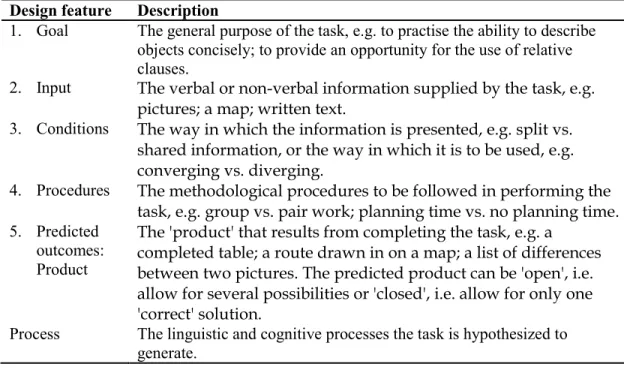
(28) CONFLICT RESOLUTON THROUGH COLLABORATIVE ORAL TASKS. 28. Table 1. A framework to describing tasks (Ellis, 2003) Design feature 1. Goal 2. Input 3. Conditions. 4. Procedures 5. Predicted outcomes: Product. Process. Description The general purpose of the task, e.g. to practise the ability to describe objects concisely; to provide an opportunity for the use of relative clauses. The verbal or non-verbal information supplied by the task, e.g. pictures; a map; written text. The way in which the information is presented, e.g. split vs. shared information, or the way in which it is to be used, e.g. converging vs. diverging. The methodological procedures to be followed in performing the task, e.g. group vs. pair work; planning time vs. no planning time. The 'product' that results from completing the task, e.g. a completed table; a route drawn in on a map; a list of differences between two pictures. The predicted product can be 'open', i.e. allow for several possibilities or 'closed', i.e. allow for only one 'correct' solution. The linguistic and cognitive processes the task is hypothesized to generate.. According to Ellis, there are multiple benefits to performing Task Based Learning TBL and it has resulted an interesting approach in language teaching; first of all, it enables teachers to see if students are developing the activity to communicate in an L2 or the target language, students are more likely to develop intrinsic motivation for accomplishing the activities, and it facilitates learning through the simultaneous development of interactional competence in L2. Recent research in the educational environment has focused on collaborative work, bearing in mind that learning is seen as “a social process and knowledge as jointly constructed phenomenon” (Lyle, 2008, p. 279), this idea is supported based on a socio-cultural perspective which took into account some Vygostskian theories that make emphasis on the idea that human beings construct their understanding and knowledge in dialogic ways with others. These conceptions of learning and the construction of knowledge are relevant for this study because they emphasize in the interaction, which is one of the purposes of the study, to achieve assertive ways of interacting and communicating to deal with conflict in the EFL..
(29) CONFLICT RESOLUTON THROUGH COLLABORATIVE ORAL TASKS. 29. Different researchers in Colombia as Mora (2009), Montenegro (2011) and Parga (2011) have highlighted the importance of peer interaction when learning because it is an opportunity for experimenting different dynamics in the classroom, they argue that when students work in groups they can also develop social competences and can accomplish better results than when working individually because they are able to participate, contribute and construct knowledge by helping each other. Since the perspective of Lyle (2008) and Bertucci et al (2010) to work with peers can facilitate understanding if the distribution of the students, for instance, leaders, in specific tasks is relevant to “assign roles in cooperative group work thus facilitating peer scaffolding” (Parga, 2011, p. 21) because this kind of features brings a positive impact to scaffolding processes. Therefore, collaboration “allows students to have a socially situated learning experience which can have a more positive and meaningful effect on learners” (Carreño, 2014, p. 214). When defining collaborative tasks it is evident that cooperation is brought to collation, therefore, according to Kozar (2010), it is necessary to establish the difference between collaborative work and cooperative work to better achieve results when suggesting practical activities to promote real collaboration in English as a Second Language (ESL) classroom, as a matter of fact, she points out that “cooperation can be achieved if all participants do their assigned parts separately and bring their results to the table; collaboration, in contrast, implies direct interaction among individuals to produce a product and involves negotiations, discussions, and accommodating others‟ perspectives” (2010, p.17), for this reason, for her collaboration it is not easy to achieve, but it is useful because somehow it is more connected with meaningful processes and “places more structural, interpersonal, and cognitive demands on individuals than more passive cooperative activities do” (p. 25)..
(30) CONFLICT RESOLUTON THROUGH COLLABORATIVE ORAL TASKS. 30. When we talk about collaboration, undoubtedly, it is necessary to tackle communication and interaction, something that has caught the attention of the scholars is that “schools and classrooms are full of talk, but little collaborative talk between learners” (Lyle, 2008, p. 280); acknowledging the importance of interaction in the process of learning language collaboratively when talking, Englander (2002) explains that “[i]nteraction involves not just expressing one‟s own ideas, but comprehending those of others” (P.09) and “[u]sing communicative tasks in the classroom is preferred because they involve the learners in comprehending, manipulating, producing, or interacting in the target language while attention is principally focused on meaning rather than form” (Nunan, 1989, as cited by Englander, 2002), therefore, interaction and collaboration among students can complement the affective factors when learning language and at the same time when negotiating meaning, which is relevant here when talking about conflict resolution. State of the Art This section discusses some studies which result pertinent for this research proposal since they provide theoretical, pedagogical and methodological considerations that may be relevant for this study. Descriptions of the studies that have been conducted in the field of EFL related to conflict resolution in the educational environment are discussed. Accordingly, the construction of understandings and knowledge in groups allowing collaborative and dialogic ways of interaction among peers is presented to examine how these connections could contribute to foster conflict resolution in the EFL. Recent research in the educational environment has focused on collaborative work, bearing in mind that learning is seen as “a social process and knowledge as jointly constructed phenomenon” (Lyle, 2008, p. 279), such theories are developed under the gaze of a socio-cultural.
(31) CONFLICT RESOLUTON THROUGH COLLABORATIVE ORAL TASKS. 31. perspective which considered Vygostskian theories emphasizing the idea that human beings construct their understanding and knowledge in dialogic ways with others. These conceptions of learning and the construction of knowledge are relevant for this study because they emphasize learners‟ interaction, which is one of the purposes of the study, to achieve assertive ways of interacting and communicating to deal with conflict resolution in the EFL context. Different researchers in Colombia such as Mora (2009), Montenegro (2012), González (2014) and Carreño (2014) have highlighted the importance of peer interaction in EFL scenarios because it is an opportunity for experimenting different dynamics in the classroom. In the qualitative studies of those authors, whose instruments of data collection were mostly audio recordings, field notes and individual conferences, it was found that when students work in groups they are able to develop social competences and can accomplish better results than working individually because they can participate, contribute and construct knowledge by helping each other. Moreover, those students at different ages participated in collaborative tasks and progressively built closer relationships and their sense of belonging to the group progressively increased. Consequently, the objectives and interests of these studies help to enrich the theoretical constructs of my project in relation to the interaction and collaborative work. Accordingly, in his study conducted in a public school in Bogotá, Parga (2011) aimed to determine how the application of cooperative learning structures of interaction affect the development of students‟ oral communication skills, particularly their oral presentation skills in EFL. The main objective of this research was to identify the oral communication strategies most frequently used by students when taking part in structured cooperative group work in the EFL classroom. To accomplish with the needs and special features of his research community the author used “the action research (AR) model proposed by Cohen and Manion, 2003” (p. 23); the research population consisted of thirty-eight 8th graders (20 girls and 18 boys) in the morning.
(32) CONFLICT RESOLUTON THROUGH COLLABORATIVE ORAL TASKS. 32. shift at a public school. This study is relevant for my inquiry because of its commonalities in terms of age and context of the population treated, and points out that the application of cooperative learning structures of interaction in an EFL classroom could be helpful for learners to enhance and develop oral presentation skills. The main findings of this research study were characterized by students gaining awareness of the crucial factors involved in effective oral communication and the importance of reporting information accurately for well-informed opinions and decisions. In addition, learners‟ improved in the oral communication processes and contributed significantly to a better classroom social environment for learning. In accordance with these findings, but especially in the data analysis it is possible to appreciate that students worked cooperatively, reported facts accurately, kept their speech fluency and argued and supported ideas. However, its pedagogical intervention did not tackle students reflecting upon conflict issues and the tasks did not contain this aspect per se; this fact clearly led the reader to consider why it is important to develop tasks based on conflict resolution to effectively decrease communication problems. Considering the EFL Colombian context, particularly public sectors in Bogota, Pérez (2013) carried out a qualitative research study which confronts issues of verbal and physical aggressions among tenth graders with their literacy practices. This study aimed to answer what EFL students‟ written reflections reveal about their social awareness when inquiring about social and physical aggressions at a public school. The instructional design was framed through a pedagogical intervention in which participants worked collaboratively to reflect upon social issues in their English language classes. The main constructs that supported this project were social awareness, social issues, literacy and inquiry. The research design was framed in a qualitative, descriptive, and interpretative perspective as well as an inquiry approach. The.
(33) CONFLICT RESOLUTON THROUGH COLLABORATIVE ORAL TASKS. 33. participants were a coeducational group of 40 tenth graders at a public school in Bogotá, whose ages ranged between 16 and 20. The project provides useful information about ways to determine students‟ insights about conflicts in the classroom taking into account their reflections. Despite the fact that it does not focus on collaboration in terms of patterns of interaction, the findings demonstrated that that inquiry along with writing about social issues in English allowed students to develop rationality and sensitivity towards violent acts. Furthermore, inquiry about their social problems encouraged students to work collaboratively, to reflect about their social conditions and to apply the use of the English language in contextualized situations. Another relevant study which focuses on oral interaction processes in EFL, and additionally, considers task-based learning approach on its pedagogical intervention is the one conducted by González and Arias (2009) in Córdoba, Colombia. The authors conducted their study in a public school, and it was based on action research methods. The participants were 35 students from eighth grade, ranging in age from 12 to 14 years old. The researchers found that task-based activities helped the students comprehend and manipulate information as well as interact meaningfully and spontaneously exploring personal interests; Moreover, they characterized some interactional patterns during oral interactions; nevertheless, there is a lack of social aspects learners‟ reflections regarding the implementation of the tasks, which reveals a gap, which in the case of this project, will potentially develop during the implementation, specifically in regards to conflict resolution skills. In regards to the speaking skills needed to encourage oral interaction, articles that deal with task-based teaching and collaboration were included. Contreras (2013) developed a qualitative study to analyze the effect of the collaborative and self-directed speaking tasks on speaking fluency. Participants were ten university students from a local university in Sincelejo,.
(34) CONFLICT RESOLUTON THROUGH COLLABORATIVE ORAL TASKS. 34. Sucre, and that according to the author, reported insecurity in the speaking activities. Their ages ranged between 20 and 21 years old. The pedagogical strategy focused on the use of collaborative tasks as a way to improve fluency in English and monitor their own learning. The findings show that participants expressed their motivation towards the activities and the quantitative results evidenced an improvement in their speaking fluency. At the international level some studies have also discussed the effect of collaborative tasks and interaction when learning a foreign language. Edstrom (2014), for example, documented a descriptive investigation to explore the SLA context, focusing specifically on the distribution of participation among learners, the frequency and nature of the LREs (Language Related Episodes) they produce to answer (a) how participation is distributed among learners of Spanish as a Foreign Language while drafting a written script in a triad? (b) To what extent these language learners engage in LREs while collaboratively drafting a written script in triads? And (c) What patterns of interaction characterize triadic group work during this task?; its pedagogical considerations included patterns of interaction that characterize triadic exchanges to characterize the nature of learners' interactions rather than attempts to establish a link between their performance and learning. To develop her study, Edstrom worked with 21 students (7 males, 14 females) from three sections of a third semester Spanish course at a mid-sized public university in the United States. The data were gathered from learners' conversations while they drafted a role play script during class when they imagined themselves in a hospital in the Dominican Republic after suffering an accident or becoming ill while on vacation. The findings of this study reported no evidence to indicate that triads are superior or inferior but do affirm the importance of true collaboration in group interaction. In addition, these participants almost exclusive used their first language in carrying out the task. As mentioned on the discussion of previous studies, this one does not.
(35) CONFLICT RESOLUTON THROUGH COLLABORATIVE ORAL TASKS. 35. consider conflict resolution or social realities of the learners; on the contrary, the topic for working the role play was completely detached from students‟ reality. However, the theoretical constructs in relation with peer interaction and collaborative work provide important considerations to the proposal. In a study carried out in Malaysia, Bharun, , Zakaria, & Hasim (2014) explored EFL how learners interacted during task completion using two different communication task types, specifically, jigsaw and decision making. The main interest of the researchers was the dynamics of learner interaction and the kind of oral discourse generated by the participants. This was a qualitative study in which data comprised transcriptions of recordings of learner interactions working on given tasks. Participants were eighteen EFL adult learners from a public university aged between 20 and 22 years old who shared the same L1 which was Malay language. The findings of this study revealed that these students attempted task completion collaboratively, and the collaborative interaction was characterized by argumentative episodes. Moreover, the study showed that students engaged more during decision making tasks that during jigsaw task types. These findings are highly relevant for this research in terms of its pedagogical implications, although its context and participants are quite different, because the tasks based on conflict resolution developed for the implementation also tackled this type of tasks: jigsaw and decision making, and they can be more effective in decision making task completion according to these findings. Nadeem (2013) conducted a study in which the results present the importance of theatrical techniques in the teaching of literature to enhance communications skills. It shows how that role play contributed to better understanding of texts and that the participants were more communicative, seemed encouraged and motivated in an experimental group. The study was conducted with M.A English students divided into controlled and experimental groups, 50 each,.
(36) CONFLICT RESOLUTON THROUGH COLLABORATIVE ORAL TASKS. 36. by giving them role play/drama/performance (theatrical technique) of different situations taken from G.B. Shaw‟s „Arms and the Man‟, followed by a written test/assignment on the situations presented. This research suggests that teachers may use theatrical techniques of teaching, therefore, one of the goals of its implementation was “to generate friendly environment, deep understanding of literature and enhancement of language skills; courses may be focused through role play to achieve better results in the learning of English language skills through literature at tertiary level” (p. 09). This study contributes to this research proposal as it addresses the development of communication skills and more friendly and comfortable learning environments for learners in the SLA process, since some role plays are implemented during the pedagogical intervention when students represent some common situations they have faced in their realities. To conclude, it is evident that just few studies have considered social issues and reflections upon realities that may contain conflictive scenarios in the EFL classroom. Recently in Bogotá, just two studies tackled this sort of issues, Parga (2011) and Pérez (2013). Additionally, none of the studies discussed included collaborative oral tasks based on conflict resolution. The next study addresses conflict resolution strategies inside and outside the classroom. Castellanos, Galán and Sánchez (2012) reflect upon the fact that “teachers‟ multiple tasks in Colombia involve not only dealing with teaching and learning-related issues but also coping with socio-cultural aspects that affect our children” (p.61). They consider that conflict inside and outside the classroom is one issue that demands special attention from teachers. The study aimed to reduce conflict inside and outside the classroom by the use of conflict resolution strategies. The project included as participants, teachers of pre-school and elementary school in the morning and afternoon shifts of two schools in Bogotá, Colombia, namely, José Asunción Silva and Aquileo Parra schools. The researchers organized a series of meetings and activities that took place between August 2012 and December 2013. For gathering data of this.
(37) CONFLICT RESOLUTON THROUGH COLLABORATIVE ORAL TASKS. 37. study, they collected feedback from the teachers in both schools and teachers‟ voices through surveys about their perceptions on conflict. They also conducted a group interview. They found on teachers‟ voices and reflections that “they stated that conflict implies pedagogical actions in class using specific strategies like the ones they received during the training sessions. However, these pedagogical actions need to be continuous” (p. 70). These statements and reflections are relevant because they propose to generate changes in the curriculum and to include the use of strategies to resolve conflicts in general even though the study was thought to be applied in the EFL context..
(38) CONFLICT RESOLUTON THROUGH COLLABORATIVE ORAL TASKS. 38. Chapter III Research Design In this chapter, the research design will be outlined to provide the readers with the general tenets that led to the methodological design of this research study, which has been conducted under the framework of a qualitative approach bearing in mind the nature of the objectives that support it. Essentially, a definition of the type of study implemented is presented; furthermore, a description of the context, participants, data collection instruments, ethical issues and role of the researcher in the study are portrayed. Research Approach and Type of Study This research study seeks to describe oral interactions in the EFL classroom when students develop tasks related to conflict resolution in the framework of collaborative work; therefore, a qualitative action research study is appropriate. Accordingly, this research proposal, carried out in a public school in Bogotá, aims to develop the objectives under the lens of the qualitative research approach since the personal meanings of individuals‟ experiences are analyzed. Recently, different scholars such as Burns (1999); Denzin and Lincoln (2005); and Ritchie and Lewis (2003) have concurred that the qualitative research perspective provides studies with descriptions and interpretations of natural social contexts; therefore, adopting this approach allows the researcher to interpret meanings of the research contexts to make sense of human behavior which may result in unexpected findings. Likewise, Denzin and Lincoln have pointed out that “[q]ualitative research is a situated activity that locates the observer in the world; it consists of a set of interpretive, material practices that make the world visible” (as cited in Creswell, 2007, p. 3). Consequently, the data collection.
(39) CONFLICT RESOLUTON THROUGH COLLABORATIVE ORAL TASKS. 39. tools in regards to oral interaction, collaboration, and conflict resolution among the students include observations, students‟ artifacts, video, and audio recordings analysis. These instruments are essential resources to analyze the nature of social behavior in regards to conflict at this public school and its incidence in the language learning process. In accordance to the aforementioned perspectives of qualitative research, the type of study proposed to answer the questions is action research. Its principles allow the researcher to deal with understanding, changing, and innovating classroom processes by collecting information so that teacher-researchers inquire about learning problems and reflect upon their pedagogical practices. According to Kemmis and Mac Taggart (1988), action research is an ongoing process of reflecting, redesigning and rethinking to improve pedagogical practice in each step; therefore: The linking of the terms action and research highlights the essential feature of the method: trying out ideas in practice as means of improvement and as means of increasing knowledge about the curriculum, teaching and learning. Action research provides a way of working which links theory and practice into the whole ideas in action. (p.81) Figure 1. Action Research Model (Kemmis and Mac Taggart (1988). PLAN. REFLECT. ACT. OBSERVE.
(40) CONFLICT RESOLUTON THROUGH COLLABORATIVE ORAL TASKS. 40. In more recent studies, Burns (2010) has explained that action research “is related to the ideas of „reflective practice‟ and „the teacher as researcher‟…AR involves taking a self-reflective, critical, and systematic approach to exploring your own teaching contexts” (p. 2). For this reason, the spiral or cycle of movements between action and research (Kemmis and McTaggart, 1988; Burns, 1999) are followed to plan, act, observe and reflect upon the research process, figure 1 displays this model. Even though this model has been criticized because it seems to follow a fixed sequence of procedures, it is currently used by different teacher-researchers because the model is flexible as it offers possibilities to implement changes in their practices, and the process of building interpretations from data leads to the construction of theories and knowledge (Burns, 1999, p. 32). Context This action research was conducted at Colegio Antonio García I.E.D, a public school located in Ciudad Bolívar locality, specifically in Sotavento neighborhood. As most of the public schools in Bogotá, it works with two shifts: morning and afternoon, at the moment it serves a total of 2564 students. Most of the students belong to 1 and 2 social strata and come from different neighborhoods such as Las Quintas del Sur, San Joaquín, La Estrella, El Divino Niño and El Lucero, among others. According to the Defensoría del Pueblo [Citizens Defense] report (2007), Ciudad Bolívar has the highest rate of poverty in Bogotá, at 26%, affecting 150,000 people; as a consequence several conflicts in the context have been part of the population history. The school recognizes these factors and has established in its PEI the goal of fostering social transformation processes through science and technology (Antonio García IED, 20082015) which allows the curriculum to be generated, negotiated and constructed by all members of the school community. Antonio García IED is a new school since it was founded in 2008 and it.
(41) CONFLICT RESOLUTON THROUGH COLLABORATIVE ORAL TASKS. 41. has adopted the curriculum organization by cycles proposed by Secretaría de Educación Distrital (Secretaty of Education, SED its acronym in Spanish); also, in agreement with Corporación Universitaria Uniminuto, 10th and 11th graders take subjects of first semester of undergraduate programs like Systems Engineering and Technical Drawing. It is important to note that in relation to English language learning, neither the vision or the mission of school include the issue of bilingualism, nor the programs in agreement with the university consider this topic. English classes are held during 2 hours per week in one block. The current English syllabus of the school is in general grammar-based and the resources for teaching this subject are limited. Students do not use a text book during the classes. Since 2008 the school‟s grades are grouped in 6 cycles, each one including several grades (Secretaría de Educación Distrital, SED, 2015). The organization by cycles includes specific English content for each cycle; for instance, in cycle three (5th, 6th and 7th grade), the development axes comprise inquiry and experimentation. Moreover, the cycle tackles social interaction through short conversations in English, which are vital to the development of this study. Participants This research study was carried out with 38 seventh graders in the morning shift, which was composed by 22 girls and 16 boys. These students were aged between 12 and 14 years old and were willing to actively participate in their English classes. Despite their limited exposure to the language and the fact that the school works a grammar-based curriculum, their interest in learning and experimenting with the language was imminent. Participants were selected using the non-probabilistic convenience sampling; this method for selecting people was applied because of the ease of their volunteering as well as their.
(42) CONFLICT RESOLUTON THROUGH COLLABORATIVE ORAL TASKS. 42. availability and easy access to the context, considering that they were the students that were assigned to my academic load. Furthermore, it may be argued that this selection criterion for obtaining the sample relates to the cost of locating elements of the population, the geographic distribution of the sample, and obtaining the desired data from the selected elements (Patton, 1990). A teacher-researcher should consider some ethical issues before applying the instruments to gather data in a research study considering the participants involved, even more when video and audio recordings are going to be implemented; thus, taking into account that the participants of this study were underage, I had to inform previously the institution, the participants and their parents how the information was going to be collected and used. For this reason, some consent forms were also designed, revised, corrected and validated to inform about the objectives of this research proposal (see Appendices A, B and C). Students were required to suggest their own pseudonyms to be identified on the audio and video transcriptions; this process gave them participatory field in the project as well as awareness of the activities to be developed during the implementation. Instruments for Data Collection Participant observation and field notes. In order to describe interactions between participants in the EFL classroom, participant observation and observation in general is crucial in this qualitative research. Different scholars (Hopkins, 1995; Lankshear & Knobel, 2004; Merriam, 2009) have supported that observation is a sensitive and an on-going process that takes place in natural settings. It is an activity that provides the opportunity of recording behaviour as it happens, and it is crucial in qualitative research. In addition, it requires specific skills from the researcher to interpret phenomena. According to Hopkins (1995), a successful practice of.
(43) CONFLICT RESOLUTON THROUGH COLLABORATIVE ORAL TASKS. 43. classroom observation could be achieved if the teacher is organized and plans his/her observations carefully, manages interpersonal skills, recognizes movement or transactions to gather appropriate information and provides feedback discussion (p. 79). Taking into consideration the nature of the questions of this study, a participant observation was carried out not only to observe interaction among students while developing oral tasks but also to observe my own practice as a participant observer, particularly in the framework of action research “all teacher researchers are participants to some extent” (Lankshear & Knobel, 2004, p. 82). In this sense, it was necessary to practice and acquire the skills to manage the instruments and the gathered information, hence, before the implementation of material design and instruments such as field notes formats, and audio/transcriptions formats, those were piloted with another course in the same level for two weeks before the implementation of each activity. A useful way of consolidating the information obtained from observations is taking notes, which is a “main tool in teacher-researcher repertoire” (Hubbard & Power, 1999, p. 83). The field notes format (Appendix D) proposed for the recording of observation in this study was organized bearing in mind that field notes can be presented in many forms, but they should include at least descriptions, direct quotations, and observer´s comments (Merriam, 2009, p. 137). Audio and video recording: Based on the fact that this research was focused on students‟ oral interactions, audio and video recording were important data collection instruments. Both audiotapes and videotapes are considered valuable tools that help teachers, particularly to find out “accurate information on patterns of interactional behaviour which may be obvious during the actual teaching process” and “to record small group interactions on different classrooms tasks”.
Figure

+2
Documento similar
