
The challenges of teaching statistics to undergraduate business and economics students in Spain
6
0
0
Texto completo
(2) ICOTS10 (2018) Invited Paper - Refereed. Rivera-Galicia. •. Postgraduate studies, leading to a PhD, require a previous Masters’ degree. The doctoral studies end with the public defense of a doctoral thesis as an original research work in a specific area. This usually takes between three to five academic years of study and research. Besides these official degrees, each university can offer a wide range of unofficial specific qualifications (Masters). These degrees, which are usually obtained in one or two years, require a prior graduate or postgraduate degree and are widely appreciated because of their value in the labor market. These degrees offer a highly practical training oriented to the different specialized professional sectors. The purpose of Bachelor degrees is to provide students with a broad but general knowledge, relevant to the labor market. Their structure contains several courses, including basic courses (minimum of 60 ECTS credits, at least 36 related with the knowledge field of the degree), compulsory courses, elective courses, and a final degree project. Some of them may include also internships. Each course is allocated a specific number of ECTS, depending on contact hours in the classroom, expected self-study time, written assignments and practical examinations. One ECTS credit is equivalent to 25 hours of student’s workload. Full time students are expected to obtain 60 credits each year. Cutting edge courses in Statistical methods for Business and Economics are taught mainly at the postgraduate level (Master or PhD degrees). Only postgraduate Business students can access to this educational level, thus making advanced statistics out of reach for the rest of undergraduate students. THE STUDIES OF BUSINESS AND ECONOMICS IN SPAIN In Spain, Bachelor degrees are organized in five areas of knowledge: Arts and Humanities, Sciences, Health Sciences, Social Sciences and Law, Engineering and Architecture. Table 1: Number of degrees and students by field of knowledge. 2016/17. Social Sciences and Law Engineering and Architecture Arts and Humanities Health Sciences Total. Degrees 977 (35.1%) 759 (27.1%) 434 (15.6%) 374 (13.4%) 237 (8.5%) 2,781 (100,0%). Students 604,243 (46.8%) 232,070 (18.0%) 131,860 (10.2%) 241,507 (18.7%) 81,508 (6.3%) 1,291,188 (100.0%). Source: MECD (2016). Table 1 shows that Social Sciences and Law is the most popular area of knowledge, as it accounts for 977 degrees (35.1%) and 604,243 students (46.8%). According to ISCED (International Standard Classification of Education, 2011), this broad area of education comprises different narrow fields of education, such as Social and Behavioral Sciences (including Economics, ISCED 0311), Journalism and information, Business and Administration (ISCED 041) and Law. In Spain, there are 51 degrees in Economics and 283 degrees in Business and Administration (see Table 2). Table 2: Number of degrees and students in Economics and Business Studies. 2016/17. Economics (0311) Business and Administration (041) Total. Degrees 51 283 334. Students 25,309 174,934 200,243. Source: MECD (2016). The organization and structure of Business and Economic Bachelor degrees in Spain follow the guidelines proposed in ANECA (2005). All degrees must include at least 160 ECTS in basic and compulsory courses, and the remaining is for elective courses. Table 3 shows the categories in which basic and compulsory courses are grouped:. -2-.
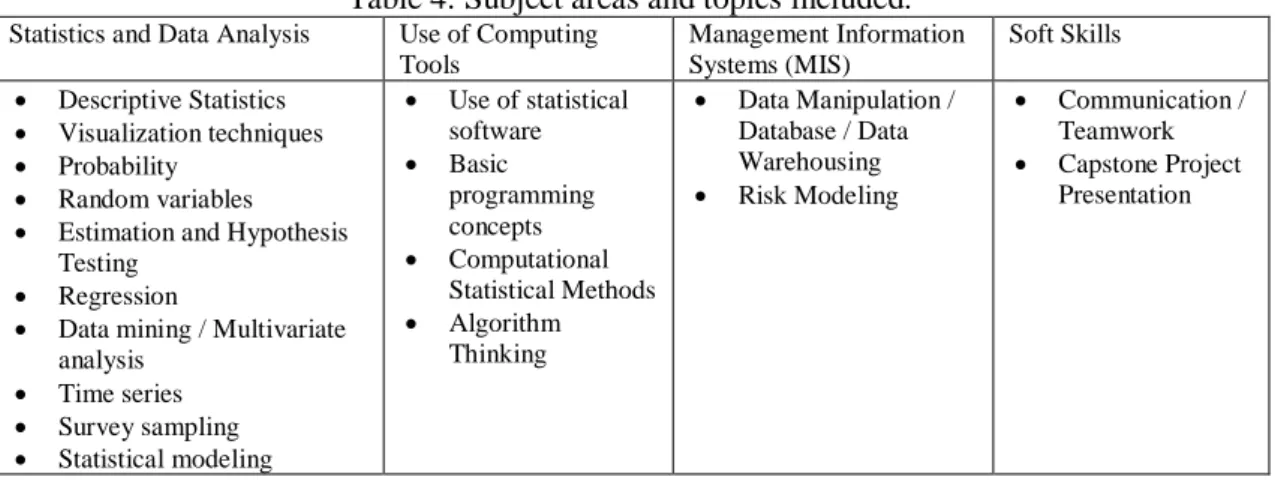
(3) ICOTS10 (2018) Invited Paper - Refereed. Rivera-Galicia. Table 3: Categories Economics Economic Analysis Public Economics Political Economics Business Environment Economic History Quantitative Methods. Business and Administration Accounting Management Finance Market Research Economic Environment Economic Analysis Quantitative Methods. Source: ANECA (2005). In both categories of studies (Economics and Business and Administration), Quantitative Methods should contain courses related to Mathematics, Statistics and Econometrics. The recommendation was to allocate at least 36 compulsory ECTS in the degrees in Economics, and 24 ECTS in the degrees in Business and Administration. However, Spanish Universities, in their degrees in Economics and Business and Administration, have allocated between 12 and 15 ECTS for Mathematics (Algebra and Calculus), and between 12 and 15 ECTS for Statistics. Some of them have designed their degrees including some elective courses in Statistics, in which the teachers may expand the contents taught in statistics. BIG DATA AND THE STATISTICS TOPICS IN BUSINESS AND ECONOMICS There is no single definition of Big Data, although this concept is more and more broadly used. De Mauro, Greco and Grimaldi (2016) propose the following definition: “Big Data is the information asset characterized by its High Volume, Velocity and Variety that requires specific technology and analytical methods for its transformation into value”. Analytics combines three areas of study: statistics, operation research and management information systems (Phelps and Szabat, 2017). Business analytics is the application of processes and statistical techniques that transform big data into meaningful information to improve business decision making (Wilder and Ozgur, 2015). It provides facts and information that can be used to improve decision making, enhance business agility and provide a competitive edge (Kennedy, Crossen and Szabat, 2015). Lustig, Dietrich, Johnson and Dziekan (2010) divided business analytics into three categories: • Descriptive Analytics, the use of data to understand and analyze business performance. • Predictive Analytics, the use of data and statistical techniques to uncover explanatory and predictive models of business performance. • Prescriptive Analytics, a set of mathematical techniques that computationally determine a set of high-value alternative actions or decisions given a complex set of objectives, requirements, and constraints, with the goal of improving business performance. According to ASA (2014), Statistical Science can be divided into four subject areas comprising different topics related with the tools that students should be taught in undergraduate programs, as shown in Table 4. Table 4: Subject areas and topics included. Statistics and Data Analysis • • • • • • • • • •. Descriptive Statistics Visualization techniques Probability Random variables Estimation and Hypothesis Testing Regression Data mining / Multivariate analysis Time series Survey sampling Statistical modeling. Use of Computing Tools • Use of statistical software • Basic programming concepts • Computational Statistical Methods • Algorithm Thinking. Management Information Systems (MIS) • Data Manipulation / Database / Data Warehousing • Risk Modeling. Source: Own elaboration, adapted from ASA (2014).. -3-. Soft Skills • •. Communication / Teamwork Capstone Project Presentation.
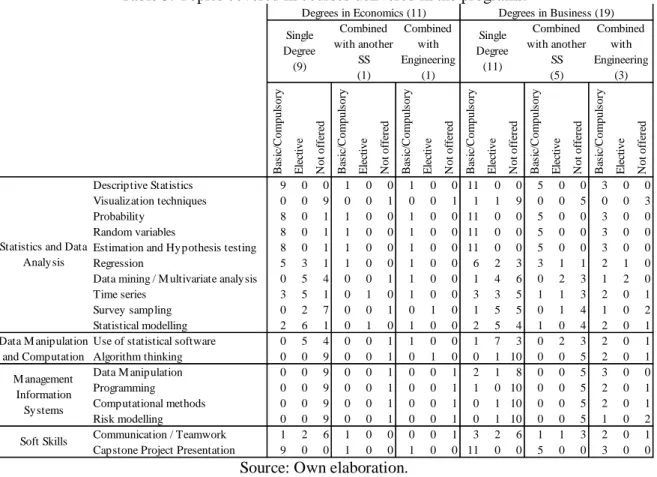
(4) ICOTS10 (2018) Invited Paper - Refereed. Rivera-Galicia. In the case of business or economic students, Universities need to design their programs to ensure graduates acquire a core set of useful skills. These should include the aforementioned areas of Statistics and Data Analysis, Use of Computing Tools and Soft Skills. Management Information Systems (MIS) is an area of interest for Engineers and Computer Scientists, and it may be difficult for Business or Economics students to develop the necessary skills for this area. In the following section, we present the methodology to get information on undergraduate business and economics programs and the results we have obtained. METHODOLOGY AND RESULTS Institutional programs in Universities’ websites have been reviewed, to analyze the degrees in Economics and Business. For the sake of simplicity, we have chosen the five public Universities located in the Madrid region, in Spain. These Universities are currently developing 30 different programs, with 23.234 students registered in academic year 2016-17. Every program is classified within its narrow field of education (19 programs in Business and 11 programs in Economics). Double degrees are considered separately, if associated with a Social Sciences degree or with an Engineering/Mathematics degree. Every program has been analyzed to confirm which topics are delivered. Table 5 shows the information gathered. Table 5. Topics covered in courses delivered in the programs.. Elective. 5 0 5 5 5 3 0 1 0 1 0 0 0 0 0 0 1 5. Not offered. 0 9 0 0 0 3 6 5 5 4 3 10 8 10 10 10 6 0. Basic/Compulsory. 0 1 0 0 0 2 4 3 5 5 7 1 1 0 1 1 2 0. Elective. 11 1 11 11 11 6 1 3 1 2 1 0 2 1 0 0 3 11. Not offered. 0 1 0 0 0 0 0 0 0 0 0 0 1 1 1 1 1 0. Not offered. 0 0 0 0 0 0 0 0 1 0 0 1 0 0 0 0 0 0. Basic/Compulsory. 1 0 1 1 1 1 1 1 0 1 1 0 0 0 0 0 0 1. Basic/Compulsory. Not offered. 0 1 0 0 0 0 1 0 1 0 1 1 1 1 1 1 0 0. Basic/Compulsory. 0 0 0 0 0 0 0 1 0 1 0 0 0 0 0 0 0 0. Elective. 1 0 1 1 1 1 0 0 0 0 0 0 0 0 0 0 1 1. Elective. 0 9 1 1 1 1 4 1 7 1 4 9 9 9 9 9 6 0. Not offered. 0 0 0 0 0 3 5 5 2 6 5 0 0 0 0 0 2 0. Not offered. Elective. 9 0 8 8 8 5 0 3 0 2 0 0 0 0 0 0 1 9. Basic/Compulsory. Basic/Compulsory Descriptive Statistics Visualization techniques Probability Random variables Statistics and Data Estimation and Hypothesis testing Analysis Regression Data mining / M ultivariate analysis Time series Survey sampling Statistical modelling Data M anipulation Use of statistical software and Computation Algorithm thinking Data M anipulation M anagement Programming Information Computational methods Systems Risk modelling Communication / Teamwork Soft Skills Capstone Project Presentation. Degrees in Business (19) Combined Combined with another with SS Engineering (5) (3). Single Degree (11). Elective. Degrees in Economics (11) Combined Combined with another with SS Engineering (1) (1). Single Degree (9). 0 0 0 0 0 1 2 1 1 0 2 0 0 0 0 0 1 0. 0 5 0 0 0 1 3 3 4 4 3 5 5 5 5 5 3 0. 3 0 3 3 3 2 1 2 1 2 2 2 3 2 2 1 2 3. 0 0 0 0 0 1 2 0 0 0 0 0 0 0 0 0 0 0. 0 3 0 0 0 0 0 1 2 1 1 1 0 1 1 2 1 0. Source: Own elaboration. Statistics and Data Analysis All the degrees include descriptive statistics as part of their compulsory courses. The visualization techniques topic is not present in most of the degrees analyzed, therefore being the weakest issue within Statistics and Data Analysis. Probability, random variables, estimation and hypothesis testing and regression are taught in almost every degree, from a classical perspective. However, data mining or multivariate analysis is considered a compulsory topic only in 3 out of 30 degrees (mainly combined with Engineering), while it is elective in 13 degrees and it is not delivered in 14 degrees. Survey sampling is taught only in 11 programs and Statistical modeling is delivered in 20 out of 30 programs.. -4-.
(5) ICOTS10 (2018) Invited Paper - Refereed. Rivera-Galicia. Use of Computing Tools Statistical Software is used in 18 programs. We have considered only those programs including professional statistical software, such as R, SPSS or SAS. However, these software tools are used just to make econometric or statistical modeling, as only 10% of programs teach basic programming concepts to students. These courses are taught in double degrees associated with Engineering or Mathematics. Computational statistical methods or algorithm thinking are taught only in an elective course in the simple degree Statistics and Business, and in compulsory courses in two double degrees of Business associated to Computer Science. Management Information Systems We confirm that data management/database/data warehousing and risk modeling are topics not thoroughly included in Business or Economics degrees. They are taught only in programs strictly combined with statistics or computer science. Soft Skills The Capstone project presentation is a compulsory course in every program in Spain. However, these projects can be related to any subject of the program, and the students do not need to deal with any statistical procedure. Communication and teamwork topic is included only in 13 programs, in 61.5% of them as a compulsory course and in the rest as an elective course. DISCUSSION Our research highlights some issues found in the undergraduate programs in Business or Economics. Most of degrees deliver courses that include the classical topics: descriptive statistics, probability and random variables, estimation and hypothesis testing, or regression and time series modeling. However, only double degrees in Economics associated with programs in Mathematics or Engineering, cover appropriately the subject area of Statistics and Data Analysis, as they include courses in data mining or multivariate analysis and statistical modeling, which are core concepts for business analytics. Most business or economic students are only exposed to introductory statistics courses, and they do not have access to more complex methods (such as visualization techniques or data mining), which are highly demanded to graduates by the labor market. The use of computing tools and the management information system are under-covered in the business and economics degrees. Programming concepts and database management are skills that should be taught to students to develop their capability to work in business analytics/data science. Students should be able to apply statistical reasoning to domain-specific questions (ASA, 2014). This capacity includes the communication ability or the knowledge to write effective technical reports. However, there are not specific courses in the business or economics programs, as they focus on more general aspects. Spanish Universities should make an effort to update their programs in Business or Economics Faculties to include some advanced statistical skills in their curricula, so that their students are better prepared for the labor market when they finish their bachelor degrees. This set of skills would also help students to face advanced studies (Master or PhD) with a better understanding of the issues related to Statistics. CONCLUSIONS AND LIMITATIONS The need for business professionals with analytical skill-sets is in continuing expansion. It is therefore important for Universities to adapt their curricula to expose students to the topics that should be included in business and economics degrees. First, this paper offers some insights on the necessary topics that should be delivered by these programs. Second, we analyze 30 programs in business and economics taught in Spain, to discover which business analytics topics are missing. Our findings show that our students are under-skilled in the use of computing tools and management information systems. Besides, classical statistical methods are widely delivered, but no modern statistical tools are being taught.. -5-.
(6) ICOTS10 (2018) Invited Paper - Refereed. Rivera-Galicia. The main limitation of this study is that only 30 programs in Economics and Business are analyzed, out of the more than 300 programs in Spain. Furthermore, only programs developed by public Universities are considered. Nevertheless, private Universities may adapt faster their programs to the changes in the field of business analytics and data science, as they are smaller organizations and are more dynamic. Future research should also consider private Universities, and extend the geographical extension to the whole country. REFERENCES ANECA (Agencia Nacional de Evaluación de la Calidad y Acreditación) (2005) Libro Blanco. Título de Grado en Economía y en Empresa (In Spanish). Madrid. ANECA. ASA (American Statistical Association) (2014) Curriculum Guidelines for Undergraduate Programs in Statistical Science, available at http://www.amstat.org/asa/files/pdfs/EDUguidelines2014-11-15.pdf. Davenport, T.H., & Patil, D.J. (2012) Data Scientist: The Sexiest Job of the 21st Century. Harvard Business Review, 90, 70-76. De Mauro, A., Greco, M., & Grimaldi, M. (2016) A formal definition of Big Data based on its essential features. Library Review, 65(3), 122-135. Kennedy, D., Crossen, D., & Szabat, K. (2015) Business Analytics and Big Data: Driving Organizational Change, in Tavana, M., & Puranam, K. (2015) Handbook of Research and Organizational Transformation through Big Data Analytics. Hershey, PA: IGI Global, 1-11. Lustig, I., Dietrich, B., Johnson, C., & Dziekan, C. (2010) The Analytics Journey. Analytics Magazine, November/December, 11-18. Manyika, J., Chui, M., Brown, B., Bughin, J., Dobbs, R., Roxburgh, C., & Hung Byers, A. (2011) Big Data: The Next Frontier for Innovation. Competition. and Productivity. Philadelphia, PA: McKinsey & Company. Available at http://www.mckinsey.com/insights/business_technology/ big_data_the_next_frontier_for_innovation. MECD (Ministry of Education. Culture and Sport) (2016) Facts and Figures of the Spanish University System. Academic Year 2015-2016 (In Spanish). Madrid: MECD. Secretaría General de Universidades. Phelps, A.L., & Szabat, K.A. (2017) The current Landscape of Teaching Analytics to Business Students at Institutions of Higher Education: Who is teaching what? The American Statistician, 71(2), 155-161. UNESCO (2014) ISCED fields of education and training. UNESCO: Institute for Statistics. Wilder. C.R., & Ozgur, C.O. (2015) Business Analytics Curriculum for Undergraduate Majors. Informs Transactions on Education, 15(2), 180-187.. -6-.
(7)
Figure

Documento similar