Review
A Review on Internet of Things for Defense and
Public Safety
Paula Fraga-Lamas *, Tiago M. Fernández-Caramés, Manuel Suárez-Albela, Luis Castedo and Miguel González-López
Department Electronics and Systems, Faculty of Computer Science, Universidade da Coruña, A Coruña 15071, Spain; [email protected] (T.M.F.-C.); [email protected] (M.S.-A.); [email protected] (L.C.); [email protected] (M.G.-L.)
* Correspondence: [email protected]; Tel.: +34-9-8116-7000 (ext. 6051)
Academic Editor: Kemal Akkaya
Received: 29 July 2016; Accepted: 29 September 2016; Published: 5 October 2016
Abstract: The Internet of Things (IoT) is undeniably transforming the way that organizations communicate and organize everyday businesses and industrial procedures. Its adoption has proven well suited for sectors that manage a large number of assets and coordinate complex and distributed processes. This survey analyzes the great potential for applying IoT technologies (i.e., data-driven applications or embedded automation and intelligent adaptive systems) to revolutionize modern warfare and provide benefits similar to those in industry. It identifies scenarios where Defense and Public Safety (PS) could leverage better commercial IoT capabilities to deliver greater survivability to the warfighter or first responders, while reducing costs and increasing operation efficiency and effectiveness. This article reviews the main tactical requirements and the architecture, examining gaps and shortcomings in existing IoT systems across the military field and mission-critical scenarios. The review characterizes the open challenges for a broad deployment and presents a research roadmap for enabling an affordable IoT for defense and PS.
Keywords: Internet of Things; defense and public safety; public safety responders; security; trust management; cloud computing; heterogeneous networks; wireless sensor networks; mission-critical networks; tactical environment; Machine-to-Machine communications
1. Introduction
The Internet of Things (IoT) is a distributed system for creating value out of data. It enables heterogeneous physical objects to share information and coordinate decisions. The impact of IoT in the commercial sector results in significant improvements in efficiency, productivity, profitability, decision-making and effectiveness. IoT is transforming how products and services are developed and distributed, and how infrastructures are managed and maintained. It is also redefining the interaction between people and machines. From energy monitoring on a factory [1] to tracking supply chains [2], IoT optimizes the performance of the equipment and enhances the safety of workers. Until today, it has allowed for more effective monitoring and coordination of manufacturing, supply chains, transportation systems, healthcare, infrastructure, security, operations, and industrial automation, among other sectors and processes.
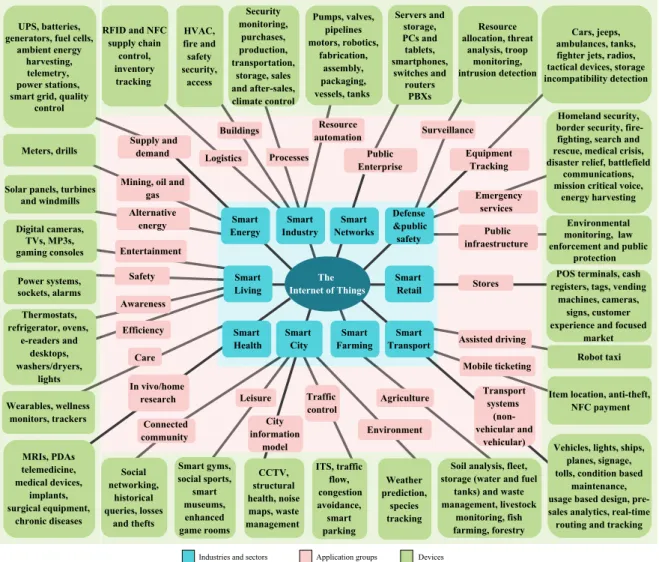
IoT is estimated to reach 50 billion connected devices by 2020 and the potential economic impact will be from $3.9 trillion to $11.1 trillion per year by 2025 [3]. Overall, IoT would allow for the automation of everything around us. The proliferation of devices and its applications is illustrated in Figure1.
Figure 1.Proliferation of devices and applications in the Internet of Things (IoT).
Regarding Machine-to-Machine (M2M) communications, traffic volume is expected to increase at an annual growth rate of 25 percent up to 2021. In total, in such a year there will be around 28 billion connected devices with more than 13.2 billion using M2M communications [4].
Currently, the industrial and business sector is leading the adoption of IoT. Businesses will spend $3 billion in the IoT ecosystem and deploy 11.2 billion devices by 2020, while customers will invest up to $900 million [5]. On the other hand, the public sector is estimated to increase significantly its adoption and spend up to $2.1 billion and install 7.7 billion devices, being the second-largest adopter of IoT ecosystems, particularly in areas like smart cities [6,7], energy management [8] and transportation [9].
IoT may include transducers that collect data on physical and environmental conditions. These devices transmit data over a wired or wireless communication network to servers and computers that store and process data using software applications and analytics. The knowledge gleaned from the analysis can be used for fault detection, control, prediction, monitoring, and optimization of processes and systems.
As it will be seen in Section3, IoT technologies have the potential to increase tactical efficiency, effectiveness, safety and deliver immense cost savings in the long-term. These technologies can help the military and first responders to adapt to a modern world in which adversaries are located in more sophisticated and complex suburban scenarios (smart cities) while budgets are shrinking.
Defense and Public Safety (PS) organizations play a critical societal role ensuring national security and responding to emergency events and catastrophic disasters. Instead of PS, some authors use the term Public Protection Disaster Relief (PPDR) [15] radio communications, defined in ITU-R Resolution 646 (WRC-12) as a combination of two key areas in emergency response:
• Public protection (PP) radio communication: communications used by agencies and organizations responsible for dealing with the maintenance of law and order, protection of life and property, and emergency situations.
• Disaster relief (DR) radio communication: communications used by agencies and organizations dealing with a serious disruption in the functioning of society, posing a significant, widespread threat to human life, health, property or the environment, whether caused by accident, nature or human activity, and whether they happen suddenly or as a result of complex, long-term processes.
Nowadays, the challenge of crisis management is in reducing the impact and injury to individuals and assets. This task demands a set of capabilities previously indicated by European TETRA [16], TCCA [17], and ETSI [18] standardization bodies and American APCO Project-25 [19], which includes resource and supply chain management, access to a wider range of information and secure communications. Military and first responders should be able to exchange information in a timely manner to coordinate the relief efforts and to develop situational awareness. FY 2016 SAFECOM Guidance [20] provides an overview of emergency communications systems and technical standards. Communication capabilities need to be provided in very challenging environments where critical infrastructures are often degraded or destroyed. Furthermore, catastrophes, natural disasters or other emergencies are usually unplanned events, causing panic conditions in the civilian population and affecting existing resources. In large-scale natural disasters, many different PS organizations (military organizations, volunteer groups, non-government organizations and other local and national organizations) may be involved. At the same time, commercial communication infrastructure and resources must also be functional in order to alert and communicate with the civilian population. In addition, specific security requirements including communication and information protection can also exacerbate the lack of interoperability. Sharing various types of data is needed in order to establish and maintain a Common Operational Picture (COP) between agencies and between field and central command staff.
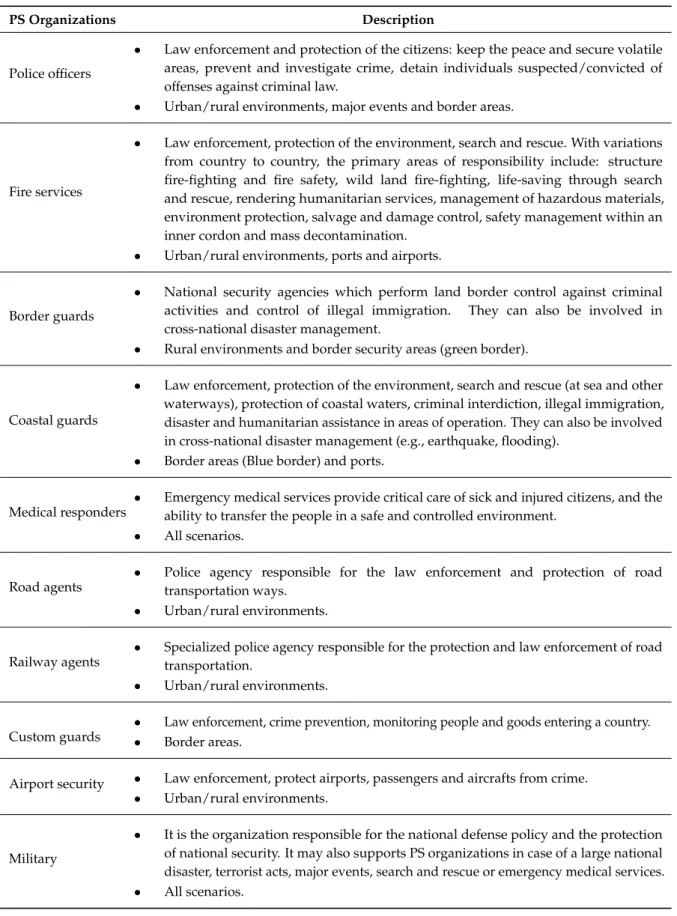
Typically, first responders include police officers, firefighters, border guards, coastal guards, emergency medical personnel, non-governmental organizations (NGOs) and other organizations among the first on the scene of a critical situation. These organizations can provide one or more of the functions described above. The relationships between them may depend on the national legislation or the context. Table1provides an overview of the main functions and the potential relationships among the agents of the different PS organizations.
Table 1.Public Safety (PS) agents.
PS Organizations Description
Police officers
• Law enforcement and protection of the citizens: keep the peace and secure volatile areas, prevent and investigate crime, detain individuals suspected/convicted of offenses against criminal law.
• Urban/rural environments, major events and border areas.
Fire services
• Law enforcement, protection of the environment, search and rescue. With variations from country to country, the primary areas of responsibility include: structure fire-fighting and fire safety, wild land fire-fighting, life-saving through search and rescue, rendering humanitarian services, management of hazardous materials, environment protection, salvage and damage control, safety management within an inner cordon and mass decontamination.
• Urban/rural environments, ports and airports.
Border guards
• National security agencies which perform land border control against criminal activities and control of illegal immigration. They can also be involved in cross-national disaster management.
• Rural environments and border security areas (green border).
Coastal guards
• Law enforcement, protection of the environment, search and rescue (at sea and other waterways), protection of coastal waters, criminal interdiction, illegal immigration, disaster and humanitarian assistance in areas of operation. They can also be involved in cross-national disaster management (e.g., earthquake, flooding).
• Border areas (Blue border) and ports.
Medical responders
• Emergency medical services provide critical care of sick and injured citizens, and the ability to transfer the people in a safe and controlled environment.
• All scenarios.
Road agents
• Police agency responsible for the law enforcement and protection of road transportation ways.
• Urban/rural environments.
Railway agents
• Specialized police agency responsible for the protection and law enforcement of road transportation.
• Urban/rural environments.
Custom guards
• Law enforcement, crime prevention, monitoring people and goods entering a country. • Border areas.
Airport security • Law enforcement, protect airports, passengers and aircrafts from crime. • Urban/rural environments.
Military
• It is the organization responsible for the national defense policy and the protection of national security. It may also supports PS organizations in case of a large national disaster, terrorist acts, major events, search and rescue or emergency medical services. • All scenarios.
network architecture toward 5G in order to support emerging PS networks [26–28]. With respect to IoT, there are several published papers that cover different aspects of the IoT technology applied to defense and PS. For example, Chudzikiewicz et al. [29] propose a fault detection method that is based on a network partitioned into clusters for the military domain. Yushi et al. [30] introduce a layer architecture and review some application modes. They also include the example of a weapon control application. Butun et al. [31] propose a lightweight, cloud-centric, multi-level authentication as a service approach that addresses scalability and time constraints for IoT devices surrounding PS responders. References [10,32–34] contain short surveys for leveraging the IoT for a more efficient military. The authors of [35–37] focus on security challenges, while TCG drafts a guideline for securing IoT networks [38].
Unlike recent literature, the contribution of this article focuses on providing a holistic approach to IoT applied to defense and public safety (PS) with a deeper study of the most relevant operational requirements for mission-critical operations and defense, an overview of the key challenges, and the relationship between IoT and other emerging technologies. Besides, the aim of this article is to help the defense industry to exploit the opportunities created by using commercial IoT applications in mission-critical environments.
The remainder of this paper is organized as follows. Section 2analyzes the state of the art of current Commercial Off-The-Shelf (COTS) technologies and its application for defense and PS. Section3presents some promising scenarios for mission-critical IoT. Section4introduces the main operative requirements and capabilities, and analyzes their applicability to defense and PS. Section5
reviews the basics of the IoT architecture for tactical and emergency environments. Section6describes the main shortcomings, and outlines the primary technical and cultural challenges that stand in the way of leveraging IoT technologies at a broader scale. It also identifies further research areas to enable COTS IoT for tactical and emergency environments. Finally, Section7is devoted to conclusions.
2. Compelling COTS IoT Applications
The introduction of the Network-Centric Warfare (NCW) paradigm [39,40] transformed traditional military approaches by reversing the policy of expanded communication gateways, and by connecting battlefield assets back to headquarters. Through sharing data between both legacy assets and new deployments, this military vision creates advantages through force projection and secure timely exchanges of information between users. The NCW paradigm integrates three domains: the physical domain, generating data where events happen and operations are conducted; the information domain, in which data are transmitted and stored; and the cognitive domain, in which data are processed and analyzed supporting decision-making. The three domains of NCW translate directly into the foundations of today’s commercial IoT.
Consequently, this driving paradigm has led to the adoption of IoT-related technologies in key areas. Today, military and homeland security are struggling to equip its workforce with the basic functions provided by COTS technologies, i.e., commercial smart phones or Radio-frequency identification (RFID). Indeed, defense continues to drive innovation regarding advanced sensors, surveillance and reconnaissance drones, satellite communication systems, and control systems, and has invested significantly in mobile technologies, including tactical mobility for warfighters.
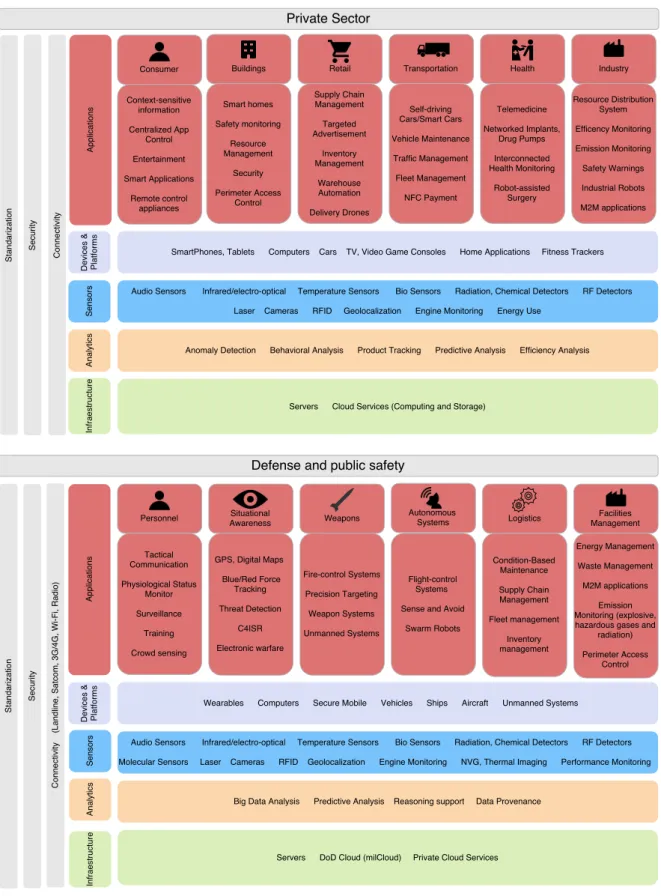
Figure 2.Private sector vs defense and public safety technology stack.
where the civil deployment has achieved significant benefits that can be leveraged by the military. They include transportation, energy efficiency, inventory managements, or mining.
• Transportation: Telogis [41], which builds engine-monitoring systems for General Motors (GM) vehicles, estimates that its smart engine reduces fuel consumption by 25%, around 30% in idle time, increases fleet use by 25%, and workforce productivity by 15%.
• Energy efficiency: IoT-based energy management systems can reduce energy use in office by 20% [3]. Smart thermostats and HVAC (Heating, Ventilation and Air Conditioning) save consumers as much as 10%–15% on heating and cooling. Additionally, smart appliances for home automation systems [42] are now being researched [43]. IoT-based use cases for smart cities have been also identified, like traffic monitoring [44], surveillance [45] and pollution monitoring [46]. Within this scenario, the content of the samples acquired may expose critical information. For example, in the case of noise pollution monitoring applications, the noise may also contain private conversations.
• Inventory management: USTRANSCOM’s Global Transportation Network (GTN) [47] and DLA (Defense Logistics Agency) developed a common information platform that enables the military to improve end-to-end supply visibility, service and logistics processes. The platform includes a single repository and universal access to logistics data so that any user or developer can easily access or manage supply chain information. Also, such a platform facilitates the development of new applications that run on the same backbone. Another contribution of USTRANSCOM is fleet management, which uses RFID trackers to monitor palletized shipments among major transit hubs.
• Mining: embedded sensors on equipment and vehicles offer a more precise picture of ground operations and enable real-time monitoring of equipment. This new technology, together with autonomous mining systems, is transforming daily operations. An IoT deployment reduces expenditure on infrastructure and machines by reducing outages and maintenance, energy consumption and environmental impact, while significantly improving productivity and mine safety by reducing injuries and fatalities. A renowned example is the autonomous drilling system of Rio Tinto (Perth, Australia), which includes tunneling machines, trains, autonomous haulage systems, and driverless trucks. This mission-control site manages operations of 15 mines, 31 pits, 4 port terminals and a 1600 km rail network [48].
The above-mentioned examples illustrate some of the ways in which the private sector is leveraging IoT and enabling new business models. Today, European research projects like RERUM [49], RELYonIt [50], FIESTA-IoT [51], BIGIoT [52], or bloTope [53] intend to tackle the most relevant shortcomings of commercial IoT. Among the different projects, EU-funded METIS-II [54] must be highlighted: the researchers created a 5G radio-access network design and provided the technical enablers needed for an efficient integration. Other concerns, like environmental issues or green deployment schemes for IoT [55], still remain open.
3. Target Scenarios for Mission-Critical IoT
In this section we provide an overview of the most promising IoT scenarios, which are depicted in Figure3. Until now, the deployment of IoT-related technologies for defense and public safety has been essentially focused on applications for Command, Control, Communications, Computers, Intelligence, Surveillance and Reconnaissance (C4ISR), and fire-control systems. This is driven by a predominant view that sensors serve foremost as tools to gather and share data, and create a more effective Command and Control (C2) of assets. IoT technologies have also been adopted in some applications for logistics and training, but their deployment is limited and poorly integrated with other systems.
data from unmanned sensors and reports from the field. These commanders benefit from a wide range of information supplied by sensors and cameras mounted on the ground, and manned or unmanned vehicles or soldiers. These devices examine the mission landscape and feed data to a forward base. Some of the data may be relayed to a Command Center where it is integrated with data from other sources.
Figure 3.Promising target scenarios for defense and public safety.
3.1. C4ISR
C4ISR systems use millions of sensors deployed on a range of platforms to provide advanced situational awareness. Radar, video, infrared or passive RF detection data are gathered by surveillance satellites, airborne platforms, UAVs (Unmanned Aerial Vehicles), ground stations, and soldiers in the field. These data are delivered to an integration platform that analyzes them and delivers information up and down the chain of command. These platforms provide a Common Operational Picture (COP) allowing for enhanced coordination and control across the field.
High-level military echelons are provided with comprehensive situational awareness through central operations centers, which receive data feeds from platforms. Lower levels (i.e., platoon, soldiers) also have access to the data in their area. In the case of combat pilots, they receive prioritized data feeds integrated with data from their own sensor systems.
3.2. Fire-Control Systems
targets [57]. Furthermore, the military has invested in the use of long endurance UAVs to engage high-value targets and introduce multi-UAVs applications [58].
3.3. Logistics
Logistics is an area where multiple low-level sensors are already being used in defense. Currently, their deployment remains constrained to benign environments with infrastructure and human involvement. The military has already deployed some IoT technologies in non-combat scenarios in order to improve back-end processes. For example, RFID tags have been used to track shipments and manage inventories between central logistics hubs.
In the following subsections, we describe examples that belong to two main categories: fleet management and individual supplies.
3.3.1. Fleet Monitoring and Management
Fleet monitoring can be represented by aircraft and ground vehicle fleets with on-board sensors that monitor performance and part status. For example, they track vehicle status and subsystems, and indicate when resupplying low-stock items (i.e., fuel or oil) is needed. Sensors would issue alerts, potentially reducing the risk of fatal failures. The aim is to facilitate condition-based maintenance and on-demand ordering of parts, reduce maintenance staff, and decrease unanticipated failures or unnecessary part replacements. Although IoT deployment carries up-front costs, it can enable significant long-term savings by transforming business processes across logistics. Defense has an opportunity to take advantage in the auto and industrial sectors, and exploit performance data on existing data links, like Blue Force Tracker transponders (already in place on many military vehicles) to limit new security risks. By extension, IoT-connected vehicles could also share information, for example, about available spare parts.
Real-time fleet management includes geolocation, status monitoring, speed and engine status, total engine hours, fuel efficiency, and weight and cargo sensors. Besides, when tracking shipments, the position and status of the containers can be monitored to identify potential problems.
Regarding aircraft, modern jet engines are equipped with sensors that produce several terabytes of data per flight. This information combined with in-flight data can improve engine performance to reduce fuel costs, detect minor faults or shorten travel duration [59]. Furthermore, it enables preventive maintenance resulting in a long lifecycle (slowing or preventing breakage) and less downtime spent in repairs. The flight data can be tracked in real-time by operators and analysts on the ground.
3.3.2. Individual Supplies
The deployment of RFID tags, sensors and standardized barcodes allow for tracking individual supplies. IoT provides real-time supply chain visibility (whether it is being shipped, transferred, deployed, consumed . . . ), and allows the military to order supplies on demand and simplify logistics management for operational units. This smarter procurement of goods avoids delays caused by out-of-stock parts or inventory-carrying costs. Likewise, it can increase accountability, enhance mission reliability, reduce losses and theft of military equipment, and help with the time criticality on the military maintenance.
3.4. Smart Cities Operations
In denied area environments, existing IoT infrastructures could be reused in military operations. Ambient sensors can be used to monitor the existence of dangerous chemicals. Sensors monitoring human behavior may be used to assess the presence of people acting in a suspicious way. Leveraging information provided by pre-existing infrastructures might be critical. Several security issues may arise, such as equipment sabotage or deceptive information. The authors of [60] categorize such attacks into four areas: (1) system architecture, firewalls, software patches; (2) malware, security policies and human factors; (3) third-party chains and insider threat; and (4) database schemas and encryption technologies.
3.5. Personal Sensing, Soldier Healthcare and Workforce Training
Body-worn devices are increasingly available [61,62]. Fitness trackers [63] enable monitoring of physical activity along with vital signs. This information has an obvious value for the users, but there is also a significant potential in examining aggregate values of communities. Body-worn sensors, when deployed on a community scale, offer information to support C4ISR. We have to distinguish between participatory and opportunistic sensing. The last one may be of particular relevance for under-cover personnel involved in reconnaissance missions in urban environments. Technologies for monitoring both workforce and their surroundings could aid when inferring physical or psychological states as well as assessing the risk of internal injury based on prior trauma [64]. Soldiers can be alerted of abnormal states such as dehydration, sleep deprivation, elevated heart rate or low blood sugar and, if necessary, warn a medical response team in a base hospital. These wide range of health and security monitoring systems, enables an effective end-to-end soldier health system, including re-provisioning of health services when needed.
In addition, IoT can be used in some training and simulation exercises, i.e., wearable receivers to mimic live combat. An example of live training may use cameras, motion and acoustic sensors to track force during training exercises. The system would send data to trainers’ mobile devices, who can coach in real time and produce edited video and statistics to review after the exercise.
Other examples are Cubic’s I-MILES (Instrumented-multiple Integrated Laser Engagement System) training solutions [65] which simulate combat using lasers and visual augmentation. They use connectivity, computer modeling and neuroscience-based learning tools to provide a more comprehensive real-time training experience. The solutions simulate artillery fire and provide a battle effect simulator, which include explosive devices like land mines, booby traps, and pyrotechnics.
The previously referred applications, and others yet-to-be imagined, could be part of the equipment of the soldiers of the future. A likely evolution of such equipment can be seen in Figure4.
3.6. Collaborative and Crowd Sensing
Collaborative sensing involves sharing sensing data among mobile devices combined with robust short range communications. IoT nodes would be able to utilize placement or other sensors to supplement their own sensing methods. Once security issues (such as trust and authentication) are resolved, the information can be made available to the users. Long-term maintenance of IoT services yield multiple benefits, such as trend or fault detection. Individual sensor parameters must be considered to assign a particular relevance to a given reporting device and its feedback can be improved upon data fusion approaches.
IoT can ease ad-hoc mission-focused Intelligence, Surveillance and Reconnaissance (ISR) via pairing sensors with mission assignments [66]. Thus, sensors and sensor platforms would not have to be burdened with excessive equipment to handle mission scenarios on their own. For example, multiple devices entering an area of interest, each with their own mission but relying on collaborative sensing to accommodate new or unanticipated requirements. In the case of a soldier, its situational awareness increases, allowing for improved survival and mission success.
Resource-rich devices might collect data from several sources to form a COP. This would allow for storing much of the collection and for processing the data locally. Higher level functions would aid reducing response times, improving decision-making and reducing backhaul communications requirements.
Crowdsensing promises to be an inexpensive tool for flexible real time monitoring of large areas and assessment for mission impact, hence complementing services potentially available in smart cities. Researchers have devised services that allow for decoupling applications from the hardware [67]. Crowdsensing services might offer both recruitment (devices that should be instructed to perform sensing) and data collections (the system returns data directly). These applications entail challenges. First, there is a large number of users that have to served while offering them tangible benefits or incentives [68]. Secondly, they are required to ensure a desired level of quality of the data collected.
From the perspective of gathering data from a community, deception could be achieved by compromising individual devices. Consequently, the security level is proportionate to the number of present devices, each representing a possible attack vector. Moreover, the paradigm "Bring your own Device" (BYOD) [69] introduces potential security concerns, since the user may have full access and make use of multiple heterogeneous devices that are difficult to control.
Data validation is another domain-dependent task in the context of crowd sending, and, likewise, it is further complicated by the high heterogeneity of the devices. Even individual devices may vary in capabilities and performance over time. For example, for a smart phone, low battery levels could lead to infrequent GPS position updates, thus resulting in geo-tagging errors. Approaches to ensure data quality often rely on oversampling and filtering of outlier values [70], reputation schemes that provide trustworthy sensing for public safety [71], or trust network-based human intervention approaches.
Moreover, potential threats to privacy can compromise crowdsensing services. Many of these activities require geo-tagging and timestamps, which can lead to disclosing the locations visited by the users. Another privacy issue is the metadata collected about devices performing a sensing activity.
3.7. Energy Management
The U.S. DoD is already reducing its demand on facility energy by investing in efficiency projects on its installations [72]. The introduction of data and predictive algorithms can help to understand usage patterns better and significantly decrease military’s energy costs.
3.8. Surveillance
and ships, make possible to control the maritime activities and traffic in large areas, keep track of fishing boats, and supervise environmental conditions and dangerous oil cargos.
Other examples can be the monitoring of hazardous situations: combustion gases and preemptive fire conditions to define alert zones, monitoring of soil moisture, vibrations and earth density measurements to detect dangerous patterns in land conditions or earthquakes, or distributed measurement of radiation levels in the surroundings of nuclear power stations to generate leakage alerts.
4. Operational Requirements
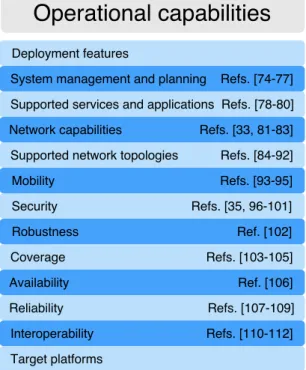
The military has unique operational requirements [73]. Security, safety, robustness, interoperability challenges, as well as bureaucratic and cultural barriers, stand in the way of the broad adoption of new IoT applications. In this Section a set of operational requirements grouped by capabilities (represented in Figure5) are assessed in order to cover the scenarios previously discussed.
Figure 5.Operational Capabilities assessed to cover mission-critical scenarios.
4.1. Deployment Features
One of the biggest constraints in a battlefield environment is power consumption. IoT devices are likely to be powered by batteries or solar power, and charged on-the-move from solar panels, trucks, or even by motion while walking. In either case, they should last for extended periods of time (at least for the duration of the mission). Therefore, devices and sensors need to be power-efficient, and end-users have to use them appropriately. Likewise, it is not easy to recharge IoT devices periodically or swap out batteries in deployed devices. Even in the case of body-worn devices, it is impractical to expect soldiers to carry additional batteries on top of their current equipment.
The exploitation of emerging embedded hardware within the military, probably through specialized software components designed to run on those innovative platforms, could lead to a significant increase in processing power and a decrease in energy consumption.
devices is already designed for harsh industrial environments, and, thus, they would be relatively well suited for the adoption in defense environments.
4.2. System Management and Planning
One of the largest gaps in the defense and public safety data ecosystem is digital analytics (data collection, transformation, evaluation and sharing). Much of the massive information collected by sensors is never used, and, as for the information that is used, it often depends on manual entry and processing, which incur in significant delays when getting important information in mission-critical scenarios. Those delays can cause missions fail or stall, or force decision-making without relevant facts. For example, USTRANSMCOM bulk supplies are tracked between major hubs using RFID tags, but when supplies are broken down and distributed beyond the central hubs, they are replaced manually. Officers in the field sign for orders on paper and enter serial numbers into computers by hand. This approach is burdensome and poses risks due to human errors.
Much of the value of IoT is generated by automation, allowing systems to react quicker and with more precision than humans. Few military systems include fully autonomous responses. For example, most unmanned systems deployed are not autonomous but remotely controlled by operators.
This management effort needs the development of new lightweight management protocols. For example, monitoring the M2M communications of IoT objects is important to ensure constant connectivity. LightweightM2M [74] is a standard developed by the Open Mobile Alliance (OMA) to interface between M2M devices and servers to build an application-agnostic scheme for the remote management of a variety of devices. The NETCONF Light protocol [75] is an Internet Engineering Task Force (IETF) effort for the management of resource-constrained devices. In [76], the authors propose a framework for IoT management based on the concept of intercepting intermediary nodes in which they execute heavy device management tasks on the edge routers or gateways of constrained networks. The OMA Device Management working group specifies protocols for the management of mobile devices in resource constrained environments [77].
4.3. Supported Services and Applications
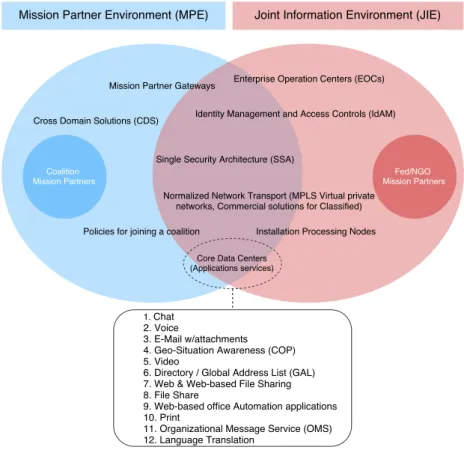
A number of commercial devices and electronic equipment have been explored to provide the services required, like chat, push-to-talk voice, geo-situational awareness, SRTV (Secure Real-Time Video) or web sharing. A complete list of requirements and application services can be seen in Figure6. The diagram represents the vision of the Joint Information Environment (JIE), which ensures that DoD military commanders, civilian leadership, warfighters, coalition partners, and other non-DoD mission partners, access information and data provided in an agile DoD-wide information environment. This shared IT infrastructure includes enterprise services, and a Single Security Architecture (SSA). The Mission Partner Environment (MPE) is integrated with and enabled by JIE. It corresponds to an operating environment that enables C2, within an specific coalition, for operational support planning and execution on a network infrastructure at a single security level with a common language. Regarding the small circles of the diagram, they represent the different participants within a specific partnership or coalition (e.g., the intelligence community, U.S. government agencies, allies, and other mission partners, such as industry organizations and Non-Governmental Organizations (NGOs)).
Figure 6.Requirements and application services for commanders.
Figure 7.DoD Enterprise Mobile Devices Management (MDM) evolution.
The U.S. Air Force (Hurlburt Field, Okaloosa County, FL, USA) has developed apps on commercial iPads. For example, programmers at Scott Air Force Bases created in 2014 an app to plan loads for the KC-10 cargo aircraft [79], winning an award for government innovation. Such an application was designed to automatically gauge pre-flight distribution of cargo in a weight and balance computation, considering the crew, fuel and cargo in a drag-and-drop interface.
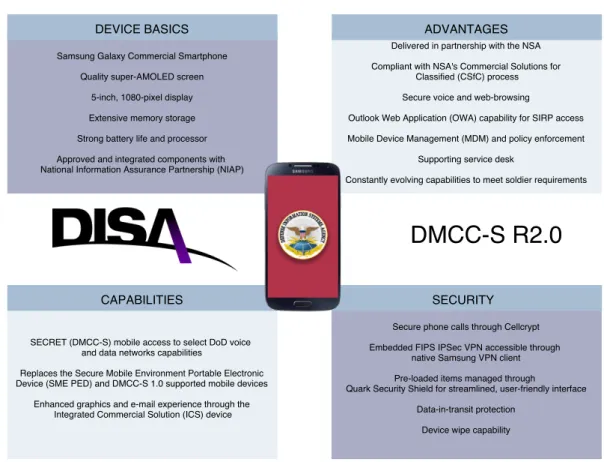
Figure 8.Main characteristics of DMCC-S R2.0.
4.4. Network Capabilities
Military network infrastructures are severely limited by frequent disconnections, partitioning, and fluctuations of radio channel conditions. This can lead to issues in sensing availability and constraints on the usage of transducers. The military IoT networks operate over tactical radios that establish and maintain mobile and fixed seamless C2 communications between operational elements and higher echelon headquarters. Tactical radios provide interoperability with all services, various agencies of the U.S. Government, commercial agencies, and allied coalition forces. High-bandwidth radios that could constitute integrated networks are still under development. For example, Harris Corporation (Melbourne, FL, USA) will deliver the first batch of RF-335M tactical radio systems in September 2017 to U.S. Special Operations Command (USSOCOM) [81].
Currently, each military force has its own infrastructure, both for connectivity and for the back-office systems. Transitioning to a combat cloud infrastructure will offer greater ability to export both assets and data in the field for joint operations. Also a combat cloud will allow information and control to move forward when appropriate, providing the operational flexibility to deal with coalitions.
Nowadays, any army in the world can have the network infrastructure needed to handle, process and distribute the massive flow of data that would be generated by a widespread IoT [33]. In order to make effective use of IoT, the devices must be able to connect to global networks to transmit sensor data and receive actionable analytics.
4.5. Supported Network Topologies
Mobile ad-hoc networks (MANET) [84,85] and hybrid wireless sensor networks (WSNs) [86,87] are the main tactical topologies.The authors of [88] evaluate the performance of network coding in the context of multi-hop military wireless networks. The researchers prove its efficiency in multicast and broadcast communications. They also test the optimal capacity of the system and its ability to recover from lost packets. Network coding operates well even with highly lossy and unreliable links.
Interest has grown in opportunistic sensing systems [89], particularly on those that take advantage of smartphone-embedded sensors [90]. A network of opportunistic sensing systems can automatically discover and select sensor platforms based on the operational scenario, detecting the appropriate set of features and optimal means for data collection, obtaining missing information by querying resources available, and using appropriate methods to fuse data. Thus, the system results in an adaptive network that automatically finds scenario-dependent objective-driven opportunities with optimized performance. For example, Mission-Driven Tasking of Information Producers (MTIP) [91], is a prototype system for sharing of airborne sensors that focuses on the effective allocation of a large number of potentially competing individual tasks to individual sensors. Nevertheless, specific protocols are needed for advancing autonomous sensing that not only ensures effective utilization of sensing assets but also provides robust optimal performance [92].
Moreover, the development of a decentralized infrastructure is needed to avoid a single point of failure. Bandwidth is perhaps one of the most precious resources in a tactical environment. It is expected that in dynamic battlefield environments large-scale data analysis will be conducted in near real-time. This fact implies constraints on data analysis coupled with connectivity challenges. Decentralizing computational resources by creating multiple and local cloudlets is insufficient if the overall approach still consists in sending raw data from transducers to a local cloud for processing.
4.6. Mobility Capabilities
Mobility is another challenge for the IoT implementations because most of the services are expected to be delivered to users on the move. Service interruption can occur when the devices transfer data from one gateway to another. To support service continuity, Ganz et al. [93] propose a resource mobility scheme that supports two modes: caching and tunneling. These methods allow applications to access IoT data when resources become temporarily unavailable. The evaluation results show a reduction of service loss in mobility scenarios of 30%.
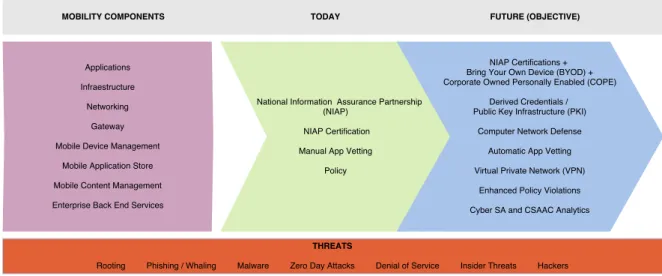
The huge number of smart devices in IoT systems also requires efficient mechanisms for mobility management (the components and their needs are illustrated in Figure9). For instance, a feasible approach for M2M communications is presented in [94]. In the scheme presented, group mobility is managed by a leader based on the similarity of their mobility patterns.
Figure 9.Mobility components and their security.
4.7. Security Capabilities
Security is a paramount challenge that needs to be addressed at every level of IoT, from the high volume of endpoint devices that gather data and execute tasks, to cloud-based control systems through network infrastructure [35]. Several protection mechanisms and Electronic Protection Measures (EPM) features have been identified within TRANSEC such as Low Probability of Interception (LPI) (e.g., secure PN-sequence generators to prevent easy sequence estimation, scrambling of transmission data and control information), Low Probability of Detection (LPD) (e.g., frequency hopping and spread-spectrum techniques) and Anti-Jamming (AJ), INFOSEC (e.g., NATO Level 3 security including IP security protocols (IPSec/HAIPE) as well as IP tunneling protocols), COMSEC and NETSEC capabilities.
Privacy issues and profile access operations between IoT devices without interference are critical. IoT nodes require a variety of widely-used and well-established security mechanisms (e.g., SSL, IPSec, PKI) that perform numerous computationally intensive cryptographic operations [96]. The use of smaller cryptographic key sizes is examined in [97]. Sensitive data needs a transparent and easy access control management. Several proposals can be used, such as grouping devices, or present only the desired devices within each virtual network. Another approach is to support access control in the application layer on a per-vendor basis. Relevant projects that estimate the network location of objects to perform context-aware services are reviewed in [98]. Current methods for location estimation are based on IP. However, Named Data Networking (NDN) is one of the candidates for naming infrastructure in the future Internet [99].
Military equipment can be subject to either interference, sabotage, potential manipulation or disruption of data flows between different units, resulting either in service interruptions, intrusions, propagation of misinformation, or misleading the COP on the needs of support units. These failures in equipment can compromise both intelligent gathering and planned operations having obvious mission and life-threatening consequences.
For example, inadequately secured networks can provide the enemy with intelligence (location, deployment), allowing the adversary to anticipate movements of forces.
Furthermore, security vulnerabilities could allow enemies to take control or disable automated systems, preventing workforce from carrying out their mission, or even using their own assets against them. Next, we describe the main security challenges:
backbone storage and processing functions, which can include other potential vulnerabilities. One of the ways to enhance the security of a complex network is to limit the number of nodes that an attacker can access from any given entry point. This approach conflicts with IoT, which generates much of its value from the integration of different systems. Securing a broad range of devices is also difficult. Many of them have limited capacity with no human interface and depend on real-time integration of data. This complicates traditional approaches to security, like multi-factor authentication or advanced encryption, which can hinder the exchange of data on the network, requiring more computing power on devices, or needing human interaction.
• Insider misuse: cyber risks and insider threats are a challenge for large organizations. A single mistake from a single user can allow an attacker to gain access to the system.
• Electronic warfare: most technologies communicate wirelessly on radio frequencies. Adversaries can use jamming techniques to block those signals making the devices unable to communicate with backbone infrastructure. Wireless connections also raise the risk of exposing the location through radio frequency emissions. Transmitters can serve as a beacon detectable by any radio receiver within range, and the triangulation of such emissions can compromise the mission.
• Automation: the full automation of equipment and vehicles extends the reach of cyber threats to the physical domain.
The authors of [100] propose integrity attestation as a useful complement to subject authentication. Thus, the provision of a data structure can convey integrity assurances and be validated by others. This is particularly useful for IoT, considering that the limited capacity of the computers and communication channels do not allow for complex protocols to detect malfunctions. The document [101] outlines the DoD security model to leverage cloud computing along with the security requirements needed for using commercial cloud-based solutions.
4.8. Robustness Capabilities
Communication technologies will provide robustness to signal interference and/or loss of network operation. When deployed in locations with other tactical networks (i.e., vehicular deployment), proper measures to avoid interference from adjacent users will be needed. For mesh or Point-to-Multi-Point (PMP) modes, the network will provide redundancy and be robust to a single point of failure. Systems should be robust to jamming, supporting techniques to actively track jamming signals and applying automatic jamming avoidance measures. It should include cognitive radio and dynamic spectrum management techniques to automatically overcome bad conditions in the communications environment.
The operational requirements for robustness also include the physical attributes of the device. Generally, this is addressed by the target platform requirements, which, in turn, is dependent on the deployment scenario. Equipment should be also physically robust to environmental damage, i.e., shock- and water-proof. The IoT system should provide mechanisms to allow for fast switching between the technology chosen and back-up/legacy communications in the event of failure. Although there are many metrics available to assess the performance of IoT devices, evaluating their performance is a challenge since it depends on many components as well as the behavior of the underlying technologies. The evaluation of routing protocols, information processing [102], application layer protocols, and QoS have been reported in literature, but there is a lack of a thorough performance evaluation for IoT services.
4.9. Coverage Capabilities
CubeSat: nano satellites that can be deployed in large number to create potentially more resilient constellations [103]. CubeSat deployment is also faster than in larger satellites, as they can be launched into orbit in clusters or piggybacked on other loads. It supports Software Defined Radio (SDR) to enable reconfigurability of data management, protocols, waveforms, and data protection.
Other technologies are High-Altitude Platforms (HAPs) and Unmanned Air Vehicles (UAVs), such as drones that operate above the range of terrestrial communication systems and can be equipped with communication relays. Unlike satellites, which eventually become defunct, HAPs can be upgraded and enhanced as technologies evolve. They also have significant advantages over manned communications platforms, as they can stay airborne continuously for long periods.
The U.S. military has already deployed four EQ-4B Global Hawk Block 20 Drones with the Battlefield Airborne Communications Node (BACN) system, but it will need significantly greater capacity to deliver connectivity to a full suite of connected devices across multiple theaters. DoD is now involved in the development of Northrop Grumman RQ-4 Global Hawk Block 30 and 40, ground stations, and Multi-Platform Radar Technology Insertion programs. The U.S. Navy will get a persistent maritime ISR capability through the MQ-4C Triton. DoD is now funding the procurement of two Low Rate Initial Production (LRIP) systems and continues to fund development activities associated with software upgrades [104,105].
4.10. Availability
Availability must be taken into account in the hardware, with the existence of devices compatible with IoT functionalities and protocols; and in the software, with available services for everyone at different places. One solution to achieve high availability is to provide redundancy for critical devices. Moreover, there are studies on assessing the availability of IoT applications at the first design stages [106].
4.11. Reliability
The critical part to increase the success rate of IoT service delivery is the communication network. The authors of [107] propose a reliability scheme at the transmission level to minimize packet losses. Other authors [108] exploit probabilistic model methods to evaluate the reliability and cost-related properties of the service composition in IoT systems. The survey [109] reviews applications of the Markov decision process (MDP) framework, a powerful decision-making tool to develop adaptive algorithms and protocols for WSNs, like data exchange and topology formation, resource and power optimization, area coverage, event tracking solutions, and security and intrusion detection methods.
4.12. Interoperability Capabilities
Taking advantage of the full value of IoT is about maximizing the number of hardware and software systems, nodes and connections in the data ecosystem. However, defense lacks a cohesive IT architecture. The different and heterogeneous systems are developed independently and according to different operational and technical requirements. Frequently, multiple services are involved in an operation, or several departments are involved in a process, but information has to be adapted between their systems manually. The usage of different hardware designs and data standards can impact the cohesion of defense infrastructure, leading to stove pipe systems. The fragmentation of the architecture also complicates the use and development of common security protocols. Adequate interoperability between devices is often not achieved given the variety of functions served by defense hardware, the integration across partners, or when potentially useful devices in an area of operations are to be leveraged (i.e., smart city deployment). IoT capabilities across an enterprise as broad as defense can only be delivered through a suite of common standards and protocols.
rapid configuration, and composability with dynamic workflows. SoAs in the tactical domain could help to leverage commercial IoT capabilities and attempt to address the interoperability challenges specific to C4ISR.
Both military computers and sensor networks should have longer service lives than commercial equivalents, resulting in greater needs to maintain legacy systems. One of the key weaknesses of legacy systems is their lack of interoperability. This limits significantly the ability to integrate new platforms into the defense digital ecosystem, and to leverage existing systems in innovative ways.
DISA is implementing a cohesive digital architecture through the Joint Information Environment (JIE) initiative [110] to unify capabilities, facilitate collaborations with partners, consolidate infrastructure, create a single security architecture, and provide global access to services.
TacNet Tactical radios [111] help to demonstrate how an open systems architecture can enable improved interoperability between next-generation and legacy fighter aircrafts. Lockheed Martin performed tests on a F-22 and F-35 Cooperative Avionics Test Bed (CAT-B). Those aircrafts were flown to assess the capability to share real-time information among varied platforms. The ability to transmit/receive Link-16 communications on F-22 was proven, also the software reuse and reduction of the aircraft system integration and the use of Air Force UCI messaging standards.
U.S. Army CERDEC NVESD [112] has developed ISA under the Deployable Force Protection program. ISA is an interoperability solution that allows components to join a tactical network and use its functionality without requiring neither prior knowledge of the resources available on that network, nor physical integration. ISA uses dynamic discovery to find other ISA-compliant systems, regardless of platform. This dynamic discovery is accomplished by requiring all members to announce the data they provide and functionality they can perform when they connect to the network. Members can change their capabilities on the fly and search for others that provide either data or the functionality they need. ISA understands the capabilities of those sensors and shares their information with operators. When future sensors come online to a network, they can register and communicate their capabilities. Assets and sensors on that network can then subscribe to the types of information they are interested in. ISA seeks to provide the critical capabilities needed for a forward operating base to defend itself. It improves the mobile Soldier’s situational awareness by enabling him to query different sensors as he moves through an area and access to information that was previously unseen to him, such as event messages.
4.13. Target Platforms
The complexity and high cost of defense systems mean that they will remain in service for years. As we have previously indicated, the longevity of ground/airborne/seaborne platforms, and a form factor designed for handheld or manpack use, creates interoperability issues as well as operational challenges when enhancing their capabilities and attaching them to the combat cloud. New technologies such as multi-core silicon and virtualization can create affordable solutions. On legacy single-core processors this virtualization would have a direct impact on platform performance. The processor will have to run both legacy and new code while maintaining strict separation for safety and security reasons. With multi-core technology the performance and separation risks can be mitigated in silicon (with separated cores for legacy and new environments, and separated networks).
5. Building IoT for Tactical and Emergency Environments
Figure 10.IoT landscape.
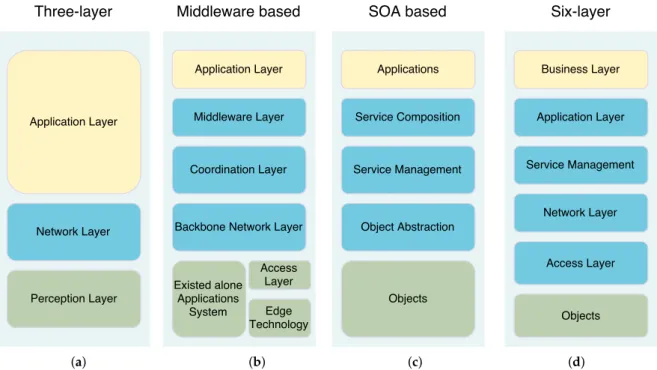
The increasing number of IoT proposed architectures has not converged to a reference model [113] or a common architecture [114]. In the latest literature, it can be distinguished among several models, as it can be seen in Figure11. For example, the basic model which has three layers (application, network and perception layers) was designed to address specific types of communication channels and does not cover all the underlying technologies that transfer data to an IoT platform.
(a) (b) (c) (d)
Figure 11. The IoT architecture. (a) Three-layer; (b) Middleware-based; (c) Service-Oriented Architecture (SOA)-based; (d) Six-layer.
resource-constrained devices, while a layer like “Service Composition” in the SOA-based architecture takes a rather big fraction of the time and energy of the device.
Next, we provide a brief description on the functionality of the most common layers.
• Perception layer: this first layer represents the physical elements aimed at collecting and processing information. Most COTS IoT devices are designed for benign environments and currently focus on home automation, personal services and multimedia content delivery. Miniaturized devices such as transducers (sensors and actuators), smartphones, System on Chips (SoCs) and embedded computers are getting more powerful and energy efficient. The next generation of processors includes new hardware features aimed at providing highly trusted computing platforms. For example, Intel includes an implementation of the Trusted Platform Module (TPM) designed to secure hardware through cryptography. Technologies such as ARM TrustZone, Freescale Trust Architecture, and Intel Trusted Execution enable the integration of both software and hardware security features [32]. Plug-and-play mechanisms are needed by this layer to configure heterogeneous networks. Big data processes are initiated at this perception layer. This layer transfers data to the Object Abstraction layer through secure channels.
• Object Abstraction Layer: it transfers data to the Service Management layer through secure channels. To transfer the data, the protocols used in the COTS IoT nodes either use existing wireless standards, or an adaptation of previous wireless protocols in the target sector. Typically, IoT devices should operate using low power under lossy and noisy conditions. Other functions like cloud computing and data management processes are handled at this layer [117].
• Service Management Layer or Middleware: this layer enables the abstraction of specific hardware platforms. It processes the data received, takes decisions and delivers the services over network protocols [118].
• Application Layer: it provides the services requested to meet users’ demands.
• Business Management Layer: this layer designs, analyzes, develops and evaluates elements related to IoT systems, supporting decision-making processes based on Big Data. The control mechanisms for accessing data in the Applications layer are also handled by this layer. It builds a business model based on the data received from the Application layer. Moreover, this layer monitors and manages the underlying four layers, comparing the output of each one with the output expected to enhance services and maintain users’ privacy [119]. This layer is hosted on powerful devices due to its complexity and computational needs.
A generic IoT architecture is presented in [120]. It introduces an IoT daemon consisting in three layers with automation, intelligence and zero-configuration: Virtual Object, Composite Virtual Object, and Service layer. An example of a possible military architecture can be seen in Figure12.
The process of sensing consists in collecting data from objects within the network, and sending them back to a data warehouse, a database or a cloud system, to be analyzed and act. Four main classes of IoT services can be categorized:
• Identity-related services: these services are employed to identify objects, but are also used in other types of services.
• Information Aggregation services: these services collect and summarize raw measurements.
• Collaborative-Aware services: these services act on top the Information Aggregation services and use the obtained data to make decisions.
• Ubiquitous services: these collaborative-aware services function anytime to anyone, anywhere. Most existing applications provide the first three types of services. The ultimate goal are the ubiquitous services.
the Resource Description Framework (RDF), the Web Ontology Language (OWL), or Efficient XML Interchange (EXI), adopted as a W3C recommendation.
5.1. IoT Standardized Protocols
The U. S. Defense Standards, also called Military Standards (MIL-STD), are used to help achieve standardization objectives. These documents are also used by other non-defense government organizations, technical organizations, and industry. The ASSIST database [122] gathers these documents and also includes international standardization agreements, such as NATO standards, ratified by the United States and International Test Operating Procedures. Furthermore, the DoD is starting to use civilian standards, since numerous contributions to the deployment and standardization of the IoT paradigm come from the scientific community. Among them, the most relevant are the ones provided by the European Commission and the European Standards Organisations (i.e., ETSI, CEN, CENELEC), by their international counterparts (i.e., ISO, ITU), and by other standards bodies and consortia (W3C, Institute of Electrical and Electronics Engineers (IEEE), EPCglobal). The M2M Workgroup of the European Telecommunications Standards Institute (ETSI) and some IETF Working Groups are particularly important.
In this section we provide an overview of some of the standardized protocols that could be used for providing the IoT services described in the previous sections.
5.1.1. Application Layer Protocols
The following are the most popular Application Layer protocols: Constrained Application Protocol (CoAP), Message Queue Telemetry Transport (MQTT), Extensible Messaging and Presence Protocol (XMPP), Advanced Message Queuing Protocol (AMQP) and Data Distribution Service (DDS). Performance evaluations and comparisons between them have been reported in the literature [123]. Each of these protocols may perform rather well in specific scenarios, but there is no evaluation of all these protocols together. Consequently, it is not possible to provide a single prescription for all IoT applications, just that they must be designed from the ground up to enable extensible operations [124].
5.1.2. Service Discovery Protocols
Resource management mechanisms are able to register and discover resources and services in a self-configured, efficient and dynamic way. Such protocols include CoAP resource discovery, CoAP Resource Directory (RD), and DNS Service Discovery (DNS-SD) which can be based on mDNS (Multicast DNS). A detail description of their characteristics can be seen in [125].
5.2. Enabling Technologies
Most popular communication technologies include CAN bus, Common Industrial Protocol (CIP), Ethernet, UPB, X10, Insteon, Z-wave, EnOcean, nanoNET, IEEE 802.15.4 (6LowPAN, Zigbee), IEEE 802.11 (Wi-Fi [126]), Bluetooth (Bluetooth Low Energy). The work in [127] investigates IEEE 802.15.4 against IEEE 802.11ah. The latter achieves better throughput than IEEE 802.15.4 in both idle and non-idle channels, although the energy consumption of IEEE 802.15.4 outperforms the values of IEEE 802.11ah, especially in dense networks. Furthermore, cellular networks include WiMAX [128,129] and 4G/5G LTE [130]. In particular, 4G LTE uses carrier aggregation up to 100 MHz, downlink and uplink spatial multiplexing, multipath propagation and heterogeneous networks to provide higher throughput, greater bandwidth and efficiency, and facilitate simultaneous connection. Highly integrated chipsets exist for most of these protocols, allowing for easy hardware integration. The protocols mentioned have supporting development environments and in some cases manufacturers offer open source APIs.
5.3. Enabling Protocols
This subsection briefly addresses two main concerns: network routing and identification, and RFID identification protocols. Regarding routing protocols, Routing Protocol for Low Power and Lossy Networks (RPL) is an IETF routing protocol based on IPv6 created to support minimal routing requirements through a robust topology (Point-to-Point (PtP), PMP).
On the other hand, the unique addresses follow two standards today, Ubiquitous ID and EPC Global. The EPC (Electronic Product Code) is a unique identification number stored on an RFID tag that is used basically in the supply chain management to identify items. In order to decrease the number of collisions in the EPC Gen-2 protocol, and to improve tag identification procedure, researchers have proposed to use Code Division Multiple Access (CDMA) instead of the dynamic framed slotted ALOHA. A performance analysis of the RFID protocols in terms of the average number of queries and the total number of transmitted bits required to identify all tags in the system can be seen in [131]. The expected number of queries for tag identification using the CDMA technique is lower that of the EPC Gen-2 protocol, because CDMA decreases the number of collisions. However, when comparing the number of transmitted bits and the time to identify all tags in the system, EPC Gen-2 protocol performs better. The EPC Global architectural framework is based on the EPC Information Service, which is provided by the manufacturer, and the ONS (Object Naming Service) that offers features similar to DNS (Domain Name Service). Being a central lookup service, the root of the ONS can be controlled or blocked by a company/country, unlike the DNS system.
Identification methods, such as ubiquitous codes (uCode) and Electronic Product Codes (EPC), are not globally unique, although they provide a clear identity for each object within the network. Addressing methods of IoT objects, that include IPv4/IPv6, assist to uniquely identify objects.
5.4. Computation
5.4.1. Hardware and Software Platforms
The growth of smart phone use in the last years has provided the basis for IoT hardware platforms. This tendency derives into new products being presented to the market at a fast pace. SoCs with very low power consumption, small form factor and oriented at supporting wireless communication technologies such as Wi-Fi and BLE, are being developed and enhanced. Arduino, Raspberry Pi, UDOO, FriendlyARM, Intel Galileo, Gadgetter, ESP8266, BeagleBone, Cubieboard, Zolertia Z1, WiSense, Mulle, and T-Mote Sky are just some examples of popular hardware platforms. Most of such devices are built on top of hardware solutions based on ARM Cortex M microcontrollers or ARM Cortex A microprocessors, but some use their own SoCs.
All these hardware platforms can be divided into two groups. On the one hand, there are SBCs (Single-Board Computers) like Raspberry Pi and Intel Galileo, which are powerful, and usually run some kind of modified Linux distribution. They support a vast set of security and communication alternatives, but their power consumption is high. On the other hand, the second type of platforms includes the motes. The ESP8266 or T-Mote Sky are good examples. They are much less power-hungry, being able to run on standard batteries for extended periods of time. However, they lack the processing capabilities of SBCs, and run on proprietary or ad-hoc software. In addition, one of the main problems of the currently available commercial motes is their lack of support for secure communication protocols and encryption. Nonetheless, motes recently presented address such an issue: for instance, the Arduino MKR1000 includes hardware acceleration for Elliptic Curve Cryptography (ECC), and the ESP32 has support for AES-256, SHA2, ECC and RSA-4096.
the Open Auto Alliance (OAA) [132] to bring additional features to the Android platform to advance in the Internet of Vehicles paradigm.
5.4.2. Cloud Platforms
Connected devices need mechanisms to store, process, and retrieve data efficiently. However, the amount of data collected in an IoT deployment may exceed the processing power of regular hardware and software tools. Moreover, IoT applications have to able to detect patterns or anomalies in the data when processing large amounts of data.
The emerging and developing technology of cloud computing is defined by the U.S. National Institute of Standards and Technology (NIST) as an access model to an on-demand network of shared configurable computing sources. Cloud computing enables researchers to use and maintain many resources remotely, reliably and at a low cost. The storage and computing resources of the cloud present the best choice for the IoT to store and process large amounts of data. There are some platforms for big data analytics like Apache Hadoop and SciDB [133]. The DoD is also trying to accelerate the adoption of commercial clouds [134]. The cloud security model [101] defines six information impact levels from 1 (public information) to 6 (classified information up to secret). As of May of 2015, there were 26 Level 2 (Unclassified, Low-Impact) commercial cloud services approved with more on the way. Regarding Level 4/5 (Controlled Unclassified Information), there were one milCloud [135] and one commercial cloud solution with more on the way. With respect to Level 6, there was one milCloud.
In term of resources, besides the powerful servers in data centers, a lot of smart devices around us offer computing capabilities that can be used to perform parallel IoT data analytic tasks. Instead of providing applications specific analytics, IoT needs a common big data analytic platform which can be delivered as a service to IoT applications. Such an analytic service should not impose a considerable overhead on the overall IoT ecosystem.
The three most popular cloud paradigms are Infrastructure as a Service (IaaS), Platform as a Service (PaaS), and Software as a Service (SaaS). Their structure and corresponding security risks are represented in Figure13.
Figure 13.Cloud paradigms: security inheritance and risks.
time series data with very little overhead on the IoT system. TSaaaS is implemented as an extension to the Time Series Database service and it is accessible by RESTful web interfaces. Pattern searches are 10-100 times faster than other existing techniques, and the additional storage cost for the service provider accounts for only about 0.4% of the original time series data.
Other feasible solution for IoT big data is to just keep track of the interesting data. Existing approaches include Principle Component Analysis (PCA), pattern reduction, feature selection, dimensionality reduction, and distributed computing methods [133].
IoT can use numerous cloud platforms with different capabilities and strengths such as Google Cloud, AWS [137,138], Bluemix IoT Solutions [139], GENI, ThingWorx, OpenIoT, Arkessa, Axeda, Etherios, LittleBits . . . besides PS providers such as Avaya, Huawei Enterprise, West, or Microsoft.
For example, Xively [140] provides an open source PaaS solution for IoT application developers and service providers. It aims to securely connect devices to applications in real-time, it exposes accessible Application Programming Interfaces (APIs), and it provides interoperability with many protocols and environments. It enables the integration of devices with the platform by libraries and facilitates communication via HTTP(s), Websocket, or MQTT. It integrates with other platforms using Python, Java, and Ruby libraries; and distributes data in numerous formats such as JSON, XML and CSV [141]. It also allows users to visualize their data graphically and to remotely control sensors by modifying scripts to receive and send alerts. It is supported by many Original Equipment Manufacturers (OEM) like Arexx, Nanode, OpenGear, Arduino or mBed.
Nimbits [142] connects smart embedded devices to the cloud, it performs data analytics and generates alerts. Moreover, it connects to websites and can store, share and retrieve sensor’s data in various formats, including text based, numeric, GPS, JSON or XML. It uses XMPP to exchange data or messages. The core is a server that provides REST web services for logging and retrieving raw and processed data.
The authors of [143] summarize some of the characteristics of a number of available cloud platforms. The metrics include: support of gateway devices to bridge the short range network and wide area network, support of discovery, delivery, configuration and activation of services, provision of a proactive and reactive assurance of platform, support of accounting and billing of services, and, finally, support of standard application protocols. All the platforms analyzed by the authors support sensing or actuation devices, a user interface to interact with them, and a web component to run the business logic of the application on the cloud. None of such platforms supports the DDS protocol.
Voegler et al. [144] propose a novel infrastructure to provide application packages on resource-constrained heterogeneous edge devices elastically in large-scale IoT deployments. It enables push-based (commands down to the tactical units) as well as pull-based (from ground to decision-making) deployments supporting different topologies and infrastructure requirements.
The efficient use of cloud based resources requires the previous selection of software architectures for both communications and processing. Centralized cloud approaches, in which raw data is transmitted to the cloud for analysis, are non-viable in tactical environments, as some of the main restrictions in military IoT scenarios are time and resources. Furthermore, even if a device has a high-bandwidth link to a local resource, it is not likely that all devices will have good connectivity to the same cloud-based platform. Thus, relying on tactical wireless networks, any approach that requires a centralized cloud infrastructure is not likely to work properly. Moreover, in a centralized cloud infrastructure, processing represents a complex and computationally expensive procedure, which leverages sophisticated big data tools. Finally, there is a significant delay between the time of the IoT data generation and when the results become available.