The effect of a booster dose of HPV tetravalent
vaccine after 51 months: implications
for extended vaccination schedules
Eduardo Lazcano-Ponce, PhD,(1) Martha Carnalla-Cortés, MD, MSc,(1)Tonatiuh Barrientos-Gutiérrez, MD, PhD,(1) Leticia Torres-Ibarra, MSc,(1) Aurelio Cruz-Valdez, PhD,(1) Jorge Salmerón, MD, DSc,(1,2) Mauricio Hernández-Avila, PhD.(3)
(1) Centro de Investigación en Salud Poblacional, Instituto Nacional de Salud Pública. Cuernavaca, Morelos, Mexico.
(2) Centro de Investigación en Políticas, Población y Salud, Facultad de Medicina, Universidad Nacional Autónoma de México. Ciudad de México, México. (3) Universidad de Guadalajara. Guadalajara, Jalisco, Mexico.
Received on: November 13, 2018 • Accepted on: November 27, 2018
Corresponding author: Mtra. Martha Carnalla-Cortés. Instituto Nacional de Salud Pública. Av. Universidad 655, col. Santa María Ahuacatitlán. 62100 Cuernavaca, Morelos, México.
E-mail: [email protected]
Lazcano-Ponce E, Carnalla-Cortés M, Barrientos-Gutiérrez T, Torres-Ibarra L, Cruz-Valdez A, Salmerón J, Hernández-Ávila M. The effect of a booster dose of HPV tetravalent vaccine after 51 months: implications for extended vaccination schedules Salud Publica Mex. 2018;60:666-673. https://doi.org/10.21149/10183
Abstract
Objective. To asses the non-inferiority between two
differ-ent vaccination schedules one month after the administration of the third dose. Materials and methods. We evaluated the anti-HPV 16/18 antibody titers induced by quadrivalent HPV vaccine administered using two different schedules in girls 9 to 10-year-old girls: a traditional (0-2-6) and an alterna-tive (0-6-50). Blood samples were collected at month 7, 21 and 51. Results. The antibody geometric mean titer ratios one month after the application of the third dose –month 51 for the alternative and month 7 for the traditional– were 1.55 for HPV16 (95%CI, 1.15-2.08) and 1.53 for HPV18 (95%CI, 1.12-2.09). The seropositive rate was above 99% in both groups. Conclusions. The application of an alternative 3-dose schedule in 9 to 10-year-old girls induces a non-inferior immune response compared to the standard one month after the last dose. Further research is needed to understand the minimal number of doses and their timing to provide the best coverage for HPV infection.
Keywords: HPV vaccine; immunization, secondary; immuno-genicity, vaccine; alternative vaccination schedules
Lazcano-Ponce E, Carnalla-Cortés M, Barrientos-Gutiérrez T, Torres-Ibarra L, Cruz-Valdez A, Salmerón J, Hernández-Ávila M. El efecto de un refuerzo de la vacuna
tetravalente de VPH después de 51 meses:
implicaciones para un esquema de vacunación extendido Salud Publica Mex. 2018;60:666-673.
https://doi.org/10.21149/10183
Resumen
Objetivo. Evaluar la no inferioridad entre dos diferentes
esquemas de vacunación un mes después de la administración de la tercera dosis. Material y métodos. Se evaluaron los títulos de anticuerpos anti-VPH 16/18 inducidos por la vacuna contra VPH tetravalente administrada en niñas de 9 a 10 años utilizando dos esquemas diferentes: tradicional (0-2-6) y alternativo (0-6-50). Se recolectaron muestras en los meses 7, 21 y 51. Resultados. La media geométrica de títulos de anticuerpos un mes después de la aplicación de la tercera dosis –mes 51 para la alternativa y mes 7 para el tra-dicional– fueron 1.55 para HPV16 (95% IC 1.15-2.08) y 1.53 para HPV18 (95% IC 1.12-2.09). La tasa de seropositividad fue superior a 99% en ambos grupos. Conclusiones. la aplica-ción de un esquema alternativo de tres dosis (0-6-50 meses) en niñas parece inducir una respuesta inmune no inferior al esquema tradicional un mes después de la última dosis. Se necesitan más estudios para determinar las dosis mínimas e intervalos óptimos para obtener la mejor cobertura para la infección por VPH.
C
ervical cancer can be eradicated because highly cost-effective prevention strategies exist, particularly vaccination against human papillomavirus (HPV).1 Toexpand the global strategy for primary prevention of cervical cancer, it will be necessary to expand the cov-erage of HPV vaccination, and alternative vaccination schedules should be evaluated in different contexts of low and high cervical cancer incidence rates. Given the possibility of incorporating HPV vaccine booster doses for unprecedented scenarios in populations that live in endemic areas2,3 and/or that have a high prevalence of
immunosuppression due to HIV, it is necessary to con-sider the relevance, feasibility, and possible long-term effect of alternative schedules. There are recent examples of infectious diseases for which the incorporation of a booster dose at different time periods after the last ap-plication has been evaluated,4,5 which consists of the
application of an additional dose to increase and prolong the immunogenicity of individuals.
While the efficacy and safety of HPV vaccines has been established, increasing vaccine coverage remains challenging. By 2014, only 1.4% of the population in low- and middle-income countries had a complete vac-cine schedule, and 1.7% had at least one dose.6 Barriers
to increase the population’s coverage by HPV vaccines include vaccine prices, difficulties in implementing multiple dose schedules, and the need to include larger age groups to allow a longer implementation time.7
Recently, calls for the evaluation of alternative and more flexible vaccination scenarios have been made, as new data suggests that shorter schedules could be non-inferior to the three-dose schedule.8,9 As in other
low- and middle-income countries, Mexico requires flexible vaccine schedules to increase coverage. Al-ternative schedules have been studied in girls and women.* A recent study evaluated the non-inferiority of a 0–6 schedule using bHPV in girls followed by a bHPV or quadrivalent HPV (qHPV) vaccine booster at month 60, finding it non-inferior to the standard 0–2–6 schedule.10
We aimed to analyze the non-inferiority of an alter-native qHPV vaccine schedule compared to the standard schedule. Through a non-randomized trial conducted in 9- to 10-year-old girls, we performed a non-inferiority analysis one month after the last dose of two schedules: the standard (0–2–6 months) and an alternative schedule (0–6–50 months). This comparison is expected to capture
the peak immunogenicity elicited by either schedule. We hypothesize that, one month after the last dose, the alternative schedule will produce a non-inferior immu-nogenic response relative to the traditional schedule.
Materials and methods
This report is a sub-analysis of an open-label, non-randomized clinical trial (NCT01717118)27 to evaluate the immunogenicity induced by the qHPV6/11/16/18 vaccine administered using an alternative (0–6 months) and traditional (0–2–6 months) vaccination schedules.8
We made an extension of the original clinical trial, adding a booster dose at month 50 in the alternative schedule group.
Group 1. One hundred forty-five girls aged 9 to 10 years
were vaccinated with an extended alternative vaccina-tion schedule with the qHPV vaccine for the months 0–6–50.
Group 2. One hundred fifty girls aged 9 to 10 years were
vaccinated with a traditional vaccination schedule with the qHPV vaccine for the months 0–2–6.
The trial was conducted following the International Conference on Harmonization Good Clinical Practice Guidelines. This study was approved by the ethical, research and biohazard committees established in the National Institute of Public Health of Mexico (INSP), received the corresponding annual authorization (registration number 883) and was registered as CAS/ OR/01/CMN/113300410A0246-2779/2011 in the Fed-eral Commission for Protection against Health Risks of Mexico (Comisión Federal para la protección contra Riesgos
Sanitarios de México – Cofepris). For the following phases
of the study, the amendments for the years 2010, 2011, 2012, 2013, 2014, 2015 and 2016 were approved.
Study population
This study was conducted in the metropolitan area of Cuernavaca in Mexico. The study population consisted of 9- to 10-year-old female students, recruited at 18 public primary schools selected from a group of 97 that offered a morning shift. At the time of the study, a parallel HPV vaccine study was being performed; the 18 schools were selected based on fieldwork feasibility and because the parallel study had not recruited them. The girls were divided into school clusters: the first cluster was the alternative vaccination schedule (seven schools), and the second (11 schools) was the control cluster. Fifty months later, the girls who were currently between 14 and 15 years old and in years 2 and 3 of
secondary school received the third dose to evaluate the booster effect. From these groups, we recruited 150 participants to reach the predefined total sample size per arm (figure 1).
Vaccine and antibody titer determination
We used the qHPV (types 6, 11, 16, and 18) vaccine Gar-dasil (Merck, Whitehouse Station, NJ, USA), provided by the Mexican Ministry of Health. Peripheral blood
samples were obtained at months 7, 21 and 51 after the application of the first dose from the participants in both groups to assess the antibody response. Merck cLIA testing was performed at Merck Research Laboratories as previously described,11 and antibody levels were
expressed as milli-Merck units (mMU) per ml. The PsV NAb assay was performed as previously described.10
Briefly, HPV16 and HPV18 PsV containing a reporter plasmid encoding red fluorescent protein (RFP) were prepared and titrated in 293TT cells. The sera were
Figure 1. CONSOrT FlOwdidgramOFgirlS’ parTiCipaTiONiNTheSTudy. CuerNavaCa, mOrelOS, 2018
N= 300
Girls aged 9-10 years from public elementary schools in Cuernavaca, Morelos, México
Initial alternative schedule (M 0-6 (n=150)
Received intervention (n=148) Did not received intervention (n=2 Moved from area (n=1 Consent withdrawn (n=1
Month 7 and 21 Loss of follow-up (n=8) Could not be contacted (n=6) Consent withdrawn (n=2)
Month 51
Received intervention (booster) (n=58)
Loss of follow-up (n=82) Could not be contacted (n=79) Serological data missing (n=3)
Analyzed (n=55)
Standard schedule (M 0-2-6) (N=150) Received intervention (n=150) Did not received intervention (n=0)
Month 7 and 21 Loss of follow-up (n=4) Could not be contacted (n=2) Consent withdrawn (n=1) Serological data missing (n=1)
Month 51 Loss of follow-up (n=17) Could not be contacted (n=17)
serially diluted, mixed with 100 infectious units of the respective HPV PsV, and inoculated onto 293TT cells in microtiter plates. The cultures were read by fluorescence microscopy after four to six days. The endpoint was the highest dilution of serum that completely blocked the expression of RFP (100% neutralization). Then, 7-, 21- and 51-month samples were tested in duplicate in the same assay run, and GMTs were calculated. The subjects were considered to have positive neutralizing antibodies for the respective HPV type if the GMT was 20 and 24 mMU/ml for HPV 16 and 18, respectively, according to previous validation studies.12 The testing laboratories
were blinded to the dosing regimens.
Safety
The study staff recorded safety profile assessments of local symptoms (pain and redness at the injection site) and general symptoms (fever, headache, fatigue, nausea, vomiting, diarrhea and/or abdominal pain, arthralgia, myalgia, and rash) at the next scheduled appointment after the administration of each vaccine. The staff also inquired regarding serious adverse events at each con-tact and among women withdrawing from the study.
Statistical analysis
The immunogenicity analysis was conducted on study participants who complied with the protocol procedures and had available data for all antibodies. Immunoge-nicity data (GMTs) with a 95% confidence interval (CI) were computed for HPV16/18 antibodies at months 7,
21, and 51 for both groups. Seronegative subjects were not included in the GMT computation.
The primary outcome was non-inferiority (95%CI, lower bound > 0.5) of the GMT ratios for HPV16/18 one month after the third dose, that is, at month 51 in the alternative schedule compared to month 7 in the standard schedule. Our non-inferiority definition was based on criteria previously used in immunogenicity clinical trials of the qHPV vaccine13 that included results
from Mexican women.14 All statistical analyses were
performed with STATA Version 14.0.*
Results
One hundred fifty participants were recruited in each group. One hundred percent of the girls received the first dose in the full standard schedule group (0–2–6) and 98.6% the first dose in the alternative schedule group (0–6–50). By month 7 and 21, the loss of follow-up was 5.3% (n=8) for the alternative schedule and 2.6% (n=4) for the standard in girls. At month 51, 58 girls of the alternative group were followed-up and received the qHPV booster dose, representing 39.1% of girls who received the first dose in the alternative schedule group; in contrast, 85.3% of girls in the standard schedule were followed up by month 51.
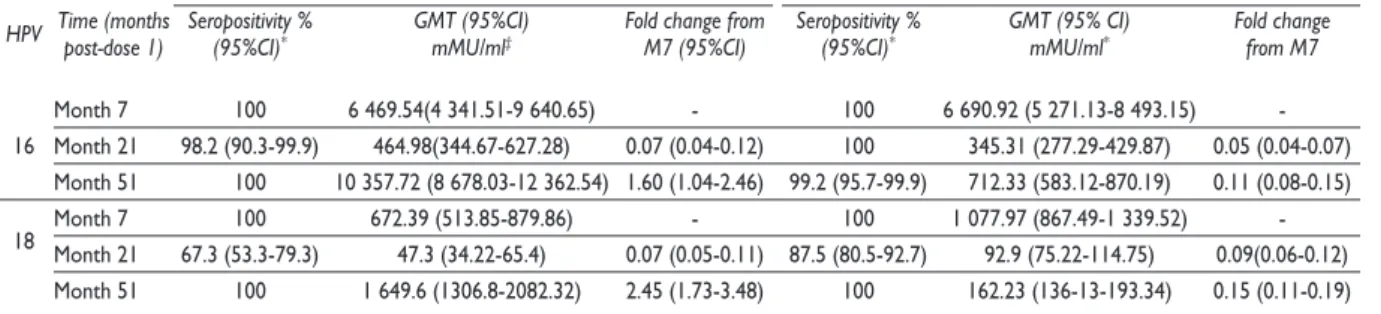
Table I presents the GMTs and seropositive rate for HPV 16/18 of each group at months 7, 21, and 51. At
* Stata Corp. College Station, TX, USA.
Table I
SerOpOSiTiviTyaNdaNTibOdy gmT FOr hpv16/18 iNmONTh 7, 21 aNd 51 iNgirlSwiTh TradiTiONalaNdalTeraNTiveSChedule. CuerNavaCa, mOrelOS, 2018
Girls alternative schedule (M 0,6,60) n=55 Girls standard schedule (M 0,2,6) n=128
HPV Time (months post-dose 1) Seropositivity % (95%CI)* GMT (95%CI)mMU/ml‡ Fold change from M7 (95%CI) Seropositivity % (95%CI)* GMT (95% CI)mMU/ml* Fold changefrom M7
16
Month 7 100 6 469.54(4 341.51-9 640.65) - 100 6 690.92 (5 271.13-8 493.15)
-Month 21 98.2 (90.3-99.9) 464.98(344.67-627.28) 0.07 (0.04-0.12) 100 345.31 (277.29-429.87) 0.05 (0.04-0.07) Month 51 100 10 357.72 (8 678.03-12 362.54) 1.60 (1.04-2.46) 99.2 (95.7-99.9) 712.33 (583.12-870.19) 0.11 (0.08-0.15)
18 Month 7Month 21 67.3 (53.3-79.3)100 672.39 (513.85-879.86)47.3 (34.22-65.4) 0.07 (0.05-0.11) 87.5 (80.5-92.7)- 100 1 077.97 (867.49-1 339.52)92.9 (75.22-114.75) 0.09(0.06-0.12)
-Month 51 100 1 649.6 (1306.8-2082.32) 2.45 (1.73-3.48) 100 162.23 (136-13-193.34) 0.15 (0.11-0.19)
* The cut-off values for seropositivity were 20 mMU/ml for HPV16 and 24 mMU/ml for HP18
‡ Antibodies were determined using immunoasssay (competitive Luminez Immunoassay; Merck)
month 7, a higher immune response was observed in the standard schedule group; at that point, the alterna-tive group was non-inferior for HPV16, and margin-ally no-inferior for HPV18 when compared with the standard schedule (table II). One month after the third dose (month 51), the alternative group showed higher antibody GMTs compared to one month after the second dose (month 7) in girls in the standard schedule. The seropositive rate by month 7 was 100% in both groups for the HPV16 and 18 types. By month 21, the rate was above 96% except for HPV18, which decreased to 67.3% for the alternative schedule, and 87.5% for the standard group. By month 51, both HPV types’ seropositive rates increased above 99%.
Table II summarizes the comparison of non-inferior-ity of the alternative compared to the standard schedule at months 7 and 51. At month 7, the alternative schedule was non-inferior for serotype 16 compared with the standard schedule in the same month. For serotypes 18, it was marginally inferior when compared to standard schedule (table II). The data showed non-inferiority for the alternative schedule group for HPV types at month 51 compared to the standard schedule at month 7—one month after the third dose was applied, which was when the most substantial immunogenic response was to be expected.
The adverse effects reported for the booster dose were pain at the site of injection (7%, n=4) and hypoten-sion (2%, n=1). No serious adverse effects associated with the vaccination were reported.
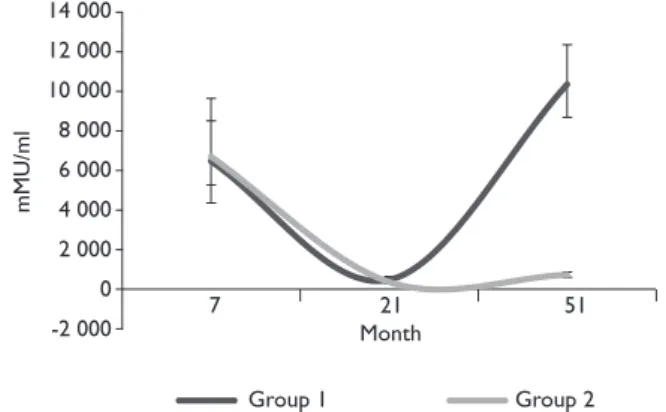
The figures 2 and 3 show the geometric mean titer (GMT) ratio and confidence interval between girls with the alternative (0-6-50) and standard (0-2-6) vaccination schedules. The antibodies GMT’s show the same trend
over time in both schedules until month 51 when the booster is applied, leading to the increase of antibody GMT’s in the alternative schedule group.
Discussion
The levels of immunogenicity observed in Mexican girls who received the qHPV vaccine extended schedule (0–6–50 months) were higher than among those who Table II
aNTibOdygeOmeTriCmeaNTiTerraTiObeTweeN girlSwiThalTerNaTive (0-6-50) verSuSgirlS
wiThSTaNdardSChedule (0-2-6) SChedule.
CuerNavaCa, mOrelOS, 2018
GMT ratio alternative schedule girls/standard schedule girls*
HPV16 Month 7/7 0.97 (0.61-1.53)
Month 7/51 1.55 (1.15 - 2.08)
HPV18 Month 7/7 0.62 (0.44-0.88)
Month7/51 1.53 (1.12 - 2.09)
* ratio with 95% confidence interval in brackets
HPV: human papilloma virus, GMT: geometric mean titer
Figure 2. aNTi-hpv16 geOmeTriC meaNTiTerS FOrmONTh 7, 21 aNd 51 FOr girlS wiThalTer -NaTiveSChedule (0-6-50) (grOup 1), aNdwiTh TradiTiONal SChedule (grOup 2). CuerNavaCa,
mOrelOS, 2018
14 000 12 000 10 000 8 000 6 000 4 000 2 000 0
-2 000 7 21 51Month
mMU/ml
Group 1 Group 2
Figure 3. aNTi-hpv18 geOmeTriC meaNTiTerS FOrmONTh 7, 21 aNd 51 FOr girlS wiThalTer -NaTiveSChedule (0-6-50) (grOup 1), aNdwiTh TradiTiONal SChedule (grOup 2). CuerNavaCa,
mOrelOS, 2018
2 500 2 000 1 500 1 000 500 0
7 21 51 Month
mMU/ml
received the traditional vaccination schedule (0–2–6 months). In this respect, the effect of a booster dose is similar in magnitude to that observed when the first dose of the HPV vaccine is administered. Recently, the possibility of incorporating a third dose of the nonava-lent vaccine in women who have previously received two doses of tetravalent vaccine has been established. Documentary evidence of the effect of booster doses on HPV vaccines, as in the case of Mexican women, is of particular importance from a public health perspective and in scenarios of alternative vaccination schedules because it provides support for the application of a booster dose in those scenarios of very low vaccination coverage, including 1-dose, in areas of high cervical cancer (CC) incidence or mortality or in vaccination and screening trials with HPV testing for adult women.15,16
One of the main limitations of the study is the lack of randomization, which might result in differential exposure to HPV. However, in Mexico, a small percent (<20%) of women are sexually active before age 16,17
and when both groups were compared month at 7, there was non-inferiority in HPV16; thus, we can infer that both groups are homogeneous in month 7. Besides, the prevalence of the two types of HPV in the vaccine in women younger than 34 years is less than 2.2%,18
hus the results are unlikely to be a consequence of the response to exposure, through sexual intercourse; even if differential, the prevalence is low and would have a very small effect in GMT´s. We experienced substantial loss-to-follow-up in the alternative schedule group, but they were blinded to their seropositive status; thus, it is unlikely for loss-to-follow-up to be informative of immunogenicity.
The evaluation of alternative HPV vaccination schedules is necessary for low- and middle-income countries, even though second-generation HPV vaccines are highly effective,19 including in men.20 In this context,
in developed countries, 11 years after the introduction of HPV vaccination, the impact on actual conditions in geographic areas with more than 60% vaccination cover-age (without implying complete schedules of three doses of vaccination) has been an estimated reduction in HPV 6/11/16/18 infections of nearly 90%.21 Additionally, a
reduction of up to 90% for genital warts,22 45% for low
grade cytological abnormalities,23 and 85% for high
grade histological lesions24 has been documented. The
herd effect on unvaccinated men has been consistently reported as well.25 However, the optimal demographic
protection of vaccination against HPV has not been achieved, and currently, there is significant inequity in low- and high-income countries in the control of CC. That is, lesions produced by HPV infection remain a significant cause of morbidity and mortality worldwide,
and the priority need from a public health perspective is to implement universal vaccination programs against HPV with high population coverage, considering the enormous effect on the low coverage population ob-tained in the second and third doses.26
Alternative HPV vaccination schedules are necessary to increase coverage. They are justified because CC is still considered a disease of poverty in 2017 and is caused by persistent HPV infections in 100% of cases. During the last 25 years in Mexico, more than 135 000 deaths from CC have been officially reported, and since 2006, it consti-tuted the second leading cause of death due to malignant tumors in women, after breast cancer. Although there has been a significant decrease in CC mortality since the 1990s, which is largely attributed to declining birth rates, there remains a large increase in the number of cases due to CC in rural and marginalized areas in Mexico; thus, optimal prevention and control responses must be implemented. For this reason, immediate actions must be taken to address what has been called the unfinished agenda: to provide an innovative public health response to the thousands of women who are currently suffering from cervical neoplasia and/or who are at risk of cervi-cal neoplasia. According to the knowledge of the natural history of CC, women are mostly infected by HPV at the beginning of their sexual life.
In this context, the National Institute of Public Health was commissioned by the Mexican Ministry of Health to coordinate an inter-institutional group to recommend a vaccination policy against HPV. Derived from this consultation, in 2009, the National Vaccina-tion Council of Mexico adopted, from a public health perspective, an extended schedule of universal vaccina-tion against HPV focused on 9-12-year-old girls, with an alternative schedule of three doses at 0, 6, and 50 months –for the case of the tetravalent vaccine– which is different from that established by the pharmaceutical industry of three doses during a period of six months.
The primary objective of this recommendation was to achieve maximum protection just before sexual activ-ity, with the hypothesis that delaying the administration of the third dose could increase the level of antibodies and simultaneously, after five years, obtain scientific evidence for not administering the third dose.
In April 2014, the Council officially ruled to adopt a vaccination schedule against HPV exclusively with two doses, with a periodicity of zero and six months. The justification is that immune response of girls nine to 11-year-old after two doses of the HPV vaccine is similar or greater than that obtained after two doses in women aged 16 to 26 years.
coverage and provides more flexibility in the applica-tion of the second dose. In other words, alternative schedules with two doses and a third at 50 months in girls aged 9–12 years can offer: a) improvements in the medium- and long-term immune responses because there is evidence that new exposure to HPV increases the expression of antibodies logarithmically, and b) advantages in its administration because it is simpler to organize these schedules within the schools. This conse-quently leads to a better chance of being able to obtain greater coverage and adherence to complete schedules in a captive population before finishing mandatory schooling. However, although the recommendation is plausible from an immunological point of view, there is no evidence from clinical trials of efficacy to support that determination, particularly for ethical reasons. For this reason, the impact of HPV and the attributed abnormalities and lesions in the population of women subject to alternative schedules with two or even one dose of the HPV vaccine must be evaluated.
Conclusions
The application of an alternative three-dose booster schedule (0–6–50 months) in girls aged 9-12 years old seems to induce a non-inferior immune response than the three-dose standard schedule (0–2–6 months) one month after the last dose. Further research is needed to understand the minimal number of doses and their timing to provide the best coverage for HPV infection. However, our study suggests that using a booster dose could provide an adequate immune response, giving governments a larger period to implement the full vaccine schedule. Our results need to be replicated with a stronger methodological design, including randomization and better follow-up. Aside from this study’s methodological limitations, these findings provide initial evidence for the potential application of extended vaccine schedules in the Mexican context, where the highest coverage in girls is with one dose, and the possibility of adding a booster later in life could be relevant.
Financial support
This work was supported by the Mexican Ministry of Health and by the Gonzalo Río Arronte Foundation (grant S.552).
Disclaimer
To allow for comparisons to results of previous studies, Merck provided the immunogenicity testing. Merck had
no role in the design and conduct of the study; collection, management, analysis, and interpretation of the data; or preparation, review, or approval of the manuscript.
Disclosure of Potential Conflicts of Interest. ELP and JS have received funding
through their institutions for research projects from Qiagen, GSK, Merck, Roche, Becton Dickinson, Gen-Probe, DICIPA, Silanes, and Arbor Vita. None of the other authors has potential conflicts of interest to report.
References
1. World Health Organization [internet]. WHO; c2018- [cited 2018 Nov 8]. Director-General calls for all countries to take action to help end the suffering caused by cervical cancer; [about 2 screens]. Available from: https://www.who.int/reproductivehealth/call-to-action-elimination-cervical-cancer/en/
2. Gómez-Dantés H, Lamadrid-Figueroa H, Cahuana-Hurtado L, Silverman-Retana O, Montero P, González-Robledo MC, et al. The burden of cancer in Mexico, 1990-2013. Salud Publica Mex. 2016;58(2):118-31. https://doi. org/10.21149/spm.v58i2.7780
3. Bray F, Piñeros M. Cancer patterns, trends and projections in Latin America and the Caribbean: A global context. Salud Publica Mex. 2016;58(2):104-17. https://doi.org/10.21149/spm.v58i2.7779 4. Brandon D, Kimmel M, Kuriyakose SO, Kostanyan L, Mesaros N. Antibody persistence and safety and immunogenicity of a second booster dose nine years after a first booster vaccination with a reduced antigen diphtheria-tetanus-acellular pertussis vaccine (Tdap) in adults. Vaccine. 2018;36:6325-33. https://doi.org/10.1016/j.vaccine.2018.08.051 5. Kadlecek V, Borja-Tabora CF, Eder-Lingelbach S, Gatchalian S, Kiermayr S, Sablan B Jr, et al. Antibody persistence up to 3 years after primary immunization with inactivated Japanese encephalitis vaccine IXIARO in Philippine children and effect of a booster dose. Pediatr Infect Dis J. 2018;37(9):e233-40. https://doi.org/10.1097/INF.0000000000002124 6. Bruni L, Diaz M, Barrionuevo-Rosas L, Herrero R, Bray F, Bosch FX, et al. Global estimates of human papillomavirus vaccination coverage by region and income level: a pooled analysis. Lancet Glob Health. 2016;4(7):e453-63. https://doi.org/10.1016/S2214-109X(16)30099-7
7. Gilca V, Salmerón-Castro J, Sauvageau C, Ogilvie G, Landry M, Naus M, et al. Early use of the HPV 2-dose vaccination schedule: leveraging evidence to support policy for accelerated impact. Vaccine. 2018;36(32PartA):4800-5. https://doi.org/10.1016/j.vaccine.2018.02.004
8. Hernández-Ávila M, Torres-Ibarra L, Stanley M, Salmerón J, Cruz-Valdez A, Muñoz N, et al. Evaluation of the immunogenicity of the quadrivalent HPV vaccine using 2 versus 3 doses at month 21: an epidemiological surveillance mechanism for alternate vaccination schemes. Hum Vaccin Immunother. 2016;12(1):30-8. https://doi.org/10.1080/21645515.2015.1058458 9. Dobson SR, McNeil S, Dionne M, Dawar M, Ogilvie G, Krajden M,
et al. Immunogenicity of 2 doses of HPV vaccine in younger
adoles-cents vs 3 doses in young women: a randomized clinical trial. JAMA. 2013;309(17):1793-802. https://doi.org/10.1001/jama.2013.1625 10. Krajden M, Cook D, Yu A, Chow R, Mei W, McNeil S, et al. Human papillomavirus 16 (HPV 16) and HPV 18 antibody responses measured by pseudovirus neutralization and competitive Luminex assays in a two- ver-sus three-dose HPV vaccine trial. Clin Vaccine Immunol. 2011;18(3):418-23. https://doi.org/10.1128/CVI.00489-10
12. Dias D, Van Doren J, Schlottmann S, Kelly S, Puchalski D, Ruiz W, et al. Optimization and validation of a multiplexed luminex assay to quantify an-tibodies to neutralizing epitopes on human papillomaviruses 6, 11, 16, and 18. Clin Diagn Lab Immunol. 2005;12(8):959-69. https://doi.org/10.1128/ CDLI.12.8.959-969.2005
13. Block SL, Nolan T, Sattler C, Barr E, Giacoletti KE, Marchant CD, et al. Comparison of the immunogenicity and reactogenicity of a prophylactic quadrivalent human papillomavirus (types 6, 11, 16, and 18) L1 virus-like particle vaccine in male and female adolescents and young adult women. Pediatrics. 2006;118(5):2135-45. https://doi.org/10.1542/peds.2006-0461 14. Reisinger KS, Block SL, Lazcano-Ponce E, Samakoses R, Esser MT, Erick J, et al. Safety and persistent immunogenicity of a quadrivalent human papillomavirus types 6, 11, 16, 18 L1 virus-like particle vaccine in preado-lescents and adopreado-lescents: a randomized controlled trial. Pediatr Infect Dis J. 2007;26(3):201-9. https://doi.org/10.1097/01.inf0000253970.29190.5a 15. Salmerón J, Torres-Ibarra L, Bosch FX, Cuzick J, Lörincz A, Wheeler CM, et al. HPV vaccination impact on a cervical cancer screening program: methods of the FASTER-Tlalpan Study in Mexico. Salud Publica Mex. 2016;58(2):211-9. https://doi.org/10.21149/spm.v58i2.7790
16. Torres-Ibarra L, Lazcano-Ponce E, Franco EL, Cuzick J, Hernández-Ávila M, Lorincz A, et al. Triage strategies in cervical cancer detection in Mexico: Methods of the FRIDA study. Salud Publica Mex. 2016;58(2):197-210. https://doi.org/10.21149/spm.v58i2.7789
17. Gayet C, Gutiérrez JP. Sexual debut in Mexico: a comparison of house-hold national surveys. Salud Publica Mex. 2014;56(6):638-47. https://doi. org/10.21149/spm.v56i6.7391
18. Lazcano-Ponce E, Herrero R, Muñoz N, Cruz A, Shah KV, Alonso P, et al. Epidemiology of HPV infection among Mexican women with normal cervi-cal cytology. Int J Cancer. 2001;91(3):412-20. https://doi.org/10.1002/1097-0215(20010201)91:3<412::AID-IJC1071>3.0.CO;2-M
19. Joura EA, Giuliano AR, Iversen OE, Bouchard C, Mao C, Mehlsen J, et al. A 9-valent HPV vaccine against infection and intraepithelial neoplasia
in women. N Engl J Med. 2015;372(8):711-23. https://doi.org/10.1056/ NEJMoa1405044
20. Van Damme P, Meijer CJ, Kieninger D, Schuyleman A, Thomas S, Lux-embourg A, et al. A phase III clinical study to compare the immunogenicity and safety of the 9-valent and quadrivalent HPV vaccines in men. Vaccine. 2016;34(35):4205-12. https://doi.org/ 10.1016/j.vaccine.2016.06.056 21. Markowitz LE, Liu G, Hariri S, Steinau M, Dunne EF, Unger ER. Prevalence of HPV after introduction of the vaccination program in the United States. Pediatrics. 2016;137(3):e20151968. https://doi.org/10.1542/ peds.2015-1968
22. Ali H, McManus H, O’Connor CC, Callander D, Kong M, Graham S, et al. Human papillomavirus vaccination and genital warts in young Indigenous Australians: National sentinel surveillance data. Med J Aust. 2017;206(5):204-9. https://doi.org/ 10.5694/mja16.00597
23. Thorsteinsson K, Storgaard M, Katzenstein TL, Ladelund S, Rønsholt FF, Johansen IS, et al. Prevalence and distribution of cervical high-risk human papillomavirus and cytological abnormalities in women living with HIV in Denmark - the SHADE. BMC Cancer. 2016;16(1):866. https://doi. org/10.1186/s12885-016-2881-1
24. Garland SM, Kjaer SK, Muñoz N, Block SL, Brown DR, DiNubile MJ, et al. Impact and effectiveness of the quadrivalent human papillomavirus vac-cine: a systematic review of 10 years of real-world Experience. Clin Infect Dis. 2016;63(4):519-27. https://doi.org/10.1093/cid/ciw354
25. Machalek DA, Chow EP, Garland SM, Wigan R, Cornall AM, Fairley CK,
et al. Human papillomavirus prevalence in unvaccinated heterosexual men
after a national female vaccination program. J Infect Dis. 2017;215(2):202-8. https://doi.org/10.1093/infdis/jiw530