(1) Centro de Investigación en Evaluación y Encuestas. Cuernavaca, Morelos, México. (2) Centro de Investigación en Nutrición y Salud. Cuernavaca, Morelos, México. (3) Instituto Nacional de Geriatría. México DF, México.
Received on: February 27, 2013 • Accepted on: October 15, 2013
Corresponding author: Karla Moreno-Tamayo. Av. Universidad 655, Col. Santa María Ahuacatitlán. 62100 Cuernavaca, Morelos, México. E-mail: [email protected]
Short-term effect of physical activity
and obesity on disability in a sample
of rural elderly in Mexico
Betty Manrique-Espinoza, D en C,(1) Karla Moreno-Tamayo, MSc,(1) Martha Ma. Téllez-Rojo Solís, D en C,(1)
Vanessa Vianey De la Cruz-Góngora, MSc,(2) Luis Miguel Gutiérrez-Robledo, D en CM,(3) Aarón Salinas-Rodríguez, MSc.(1)
Manrique-Espinoza B, Moreno-Tamayo K, Téllez-Rojo Solís MM, De la Cruz-Góngora VV, Gutiérrez-Robledo LM, Salinas-Rodríguez A. Short-term effect of physical activity and obesity on disability in a sample of rural elderly in Mexico. Salud Publica Mex 2014;56:4-10.
Abstract
Objective. To estimate the effects of physical activity (PA) and obesity on the cumulative incidence of disability on the basic activities of daily living in the elderly. Materials and methods. Longitudinal study. We selected 2 477 participants aged 65-74 years from the impact evaluation study of a non-contributory pension program in Mexico. Participants were without disability at baseline. Katz index was used to assess disability both at baseline and follow-up. PA, body mass index, and covariates were measured at baseline. Results. After 14-months of follow-up, the cumulative incidence of disability reached 10.1%. High PA was found to reduce disabilityrisk (OR=0.64; 95%CI [0.43-0.95]), and the association between obesity and disability was marginally significant (OR=1.36; 95%CI [0.96-1.95]). Conclusions. There is a need to perform a functional assessment of older adults in primary care to identify patients with functional dependence , and to promote physical activity to maintain muscle mass and thus reduce the incidence of disability.
Key words: disability; physical activity; obesity; aged
Manrique-Espinoza B, Moreno-Tamayo K, Téllez-Rojo Solís MM, De la Cruz-Góngora VV, Gutiérrez-Robledo LM, Salinas-Rodríguez A.
Efecto a corto plazo de la actividad física y la obesidad sobre la discapacidad en una muestra de ancianos rurales en México. Salud Publica Mex 2014;56:4-10.
Resumen
Objetivo. Estimarel efecto de la actividad física (AF) y la obesidad sobre la incidencia acumulada de discapacidad en actividades básicas de la vida diaria en adultos mayores (AM). Material y métodos. Estudio longitudinal. La muestra procede del estudio de evaluación de impacto del Progra-ma 70 y más; seleccionamos 2 477 AM de 65-74 años sin discapacidad en la medición basal. La AF, el índice de masa corporal y otras covariables se midieron en el estudio basal. Resultados. La incidencia acumulada de discapacidad, a 14 meses de seguimiento, fue de 10.1%. Después de ajustar por covariables, la AF alta disminuyó el riesgo de discapacidad (RM=0.64; IC95% 0.43-0.95). La obesidad se asoció margi-nalmente con el riesgo de discapacidad (RM=1.36; IC95% 0.96-1.95). Conclusión. Se requiere incorporar la valoración funcional de los adultos mayores en los niveles primarios de atención para identificar sujetos con dependencia funcional y fomentar la actividad física para mantener la masa muscular y así disminuir la incidencia de la discapacidad.
T
he negative consequences of disability in the el-derly are multifold. It undermines their health, self-esteem, perception of well-being, and quality of life;1,2exacerbates the burden on hospital services, heightens the demand for health care3 and constitutes an important
mortality predictor.4
Numerous health conditions can lead to disability: cognitive impairment, depression, specific co-morbidi-ties, arthritis, visual, and hearing problems, falls, lower extremity function limitations and slow gait, in addition to current smoking and alcohol consumption.5,6
Obesity has also been mentioned in the literature as a correlate of disability, and has been associated with high risk for limited physical mobility,7-10 which in turn
leads to the development and acceleration of disability among the elderly.11-14
Regarding physical activity (PA), several prospec-tive studies have also identified that regular PA8,9,15
or intense PA7,16,17 decreases the risk of disability or
mobility problems. However, little has been studied about these relationships among rural populations in Mexico.
In Mexico, older adults (OA) represent the highest-growth segment and constitutes almost 10 million individuals aged 60 and older (8.9% of the total popu-lation), of whom 27% reside in rural communities.18
Lack of access to health services poses a particularly critical issue for the rural elderly, most of whom have never worked in the formal sector of the economy and therefore reach old age without retirement pensions or health care.19,20 This translates into inadequate health
care, undiagnosed illnesses and, consequently, not op-portune treatment.21
Furthermore, it has been reported that the poorer the elderly, the more likely they are to develop func-tional limitations,22 thus confirming that the frequency
of many chronic conditions affecting physical function escalates among populations suffer greater economic vulnerability. Mexico, for example, has reported a high prevalence of disability in rural elderly (30%), reflecting a heavy burden of this disease in this population.23 The
present study was conducted with the aim of estimating the effect of obesity and PA on the cumulative incidence of basic activities of daily living (ADL) disability within a sample of poor rural elderly in Mexico.
Materials and methods
Design and sample
The elderly in our analytic sample were part of the impact evaluation study of Program 70 y más that was conducted in Mexico during 2007-2009. 70 y más was a
program of non-contributory social pension which ini-tially benefited older people, ≥70 years, residing in locali-ties with a population of up to 2 500 inhabitants in 2007 and was expanded to localities of up to 30 000 inhabitants in 2008. The evaluation was designed to estimate the ef-fect of 70 y más on the lives of its beneficiaries in terms of income, physical and mental health, and nutritional status. Details of the methodology of evaluation as well as the sampling procedures have been previously report-ed.24 Nevertheless; we summarize some of the overall
characteristics of the previously stated study.
The evaluation study consisted in a prospective study of 6 000 elderly aged 65 to 74 years in 2007, and residents of seven Mexican states. The response rate for the evaluation study in the basal measurement (2007) was 91%. Additionally, follow-up measurements were conducted in November 2008 and March 2009.
The present study used a subsample selected from the larger 70 y más sample. From the full 70 y más base-line sample of 5 465, with the purpose of obtaining the cumulative incidence of disability, we selected OA who did not present the event of interest at baseline, that is, those who had no difficulty executing any basic ADLs in 2007. In addition to the 681 (12.5%) elderly excluded and who showed at least one disability in basic ADLs, we also excluded who: presented incomplete informa-tion on basic ADLs (n=17), were unable to move (n=12) and lacked body mass index (BMI) or PA data (n=1 654). This procedure left a follow-up sample of 3 101 individuals, of whom 624 were excluded due to: death (n=9), impossibility of achieving the interview (n=150), as well as missing values in study covariates (n=465). Our analytical sample was thus composed of 2 477 subjects (figure 1); which corresponds to 51% of original cohort.
The OA excluded from the analysis generally shared similar characteristics with the subjects in the analytical sample in the following variables: age, literacy, living arrangement, smoking status, and current alcohol con-sumption. However, OA excluded were significantly different in the following characteristics: more women (52 vs. 48.9%, p=0.033), higher visual problems (15.9 vs. 11.6%, p<0.001) and greater number of chronic diseases (0.78±0.96 vs.0.68±1.04, p=0.002).
Data Collection
Measurement of variables
Outcome. Disabilitywas evaluated (based on self-report) in relation to the basic ADLs. The elderly were asked whether they needed help in performing any ADLs (ie., walking, bathing, eating, going to bed or using the bathroom) and, based on Katz’s index,25 a dichotomous
variable was defined, where 1 was attributed to reports of at least one difficulty in performing ADLs and 0 oth-erwise. Disability incidence was established at follow-up (after 14 months) and only among those subjects who presented no disability at baseline.
Exposure variables. Physical activity was assessed using the same short version of the International Physical Activity Questionnaire (IPAQ) administered in the Mexican National Health and Nutrition Survey 2006.26
The IPAQ collects data on the frequency (days/week) and duration (minutes/day) of three domains (vigor-ous activity, moderate activity and walking), and asks for activities of work, leisure-time, house and garden
work, and transportation. Participants self-reported the number of days and the time spent in the last seven days. Since many elderly performed activities of the primary sector of the economy, questions were adjusted and examples were provided. Vigorous activity in-cluded: aerobics, bicycling at high speed, lifting heavy objects, digging and performing agricultural tasks, such as harvesting, etc. Moderate activity included: lifting light objects and moving them from one place to another, bicycling at normal speed, etc. Walking ques-tion included: walks for work, exercise, recreaques-tion or transport. According to these responses, total PA was calculated by adding the number of MET/minutes/ week for each domain with the following mean values: 8.0 MET for vigorous activity, 4.0 MET for moderate activity and 3.3 MET for walking.27 Then, total PA
was categorized into low (<600 MET/minutes/week), moderate (≥600 to <3000 MET/minutes/week), and high (≥3000 MET /minutes/week). Low PA was the reference group.
Analytical sample n= 2 477 Follow-up sample n= 3 101 Baseline sample n= 5 465
With ADL disability= 249 Without ADL disability= 2 228
Excluded from the baseline sample 1 654 Missing values in BMI
and physical activity data 681 With ADL disability 12 Cannot move
17 Missing values in several ADLs
Excluded from the follow-up sample 150 Impossible to achieve interview: 3 inappropriate informants 7 refusals to provide information 7 disabled household dwellers 38 absent household dwellers 46 could not be located 49 other reasons
465 Missing values in covariables 9 Dead
Standardized personnel measured weight and height at baseline according to a protocol.28,29 BMI was
calculated as kg/m2, and classified into: underweight
(<18.5 kg/m2), normal (18.5-24.9 kg/m2), overweight
(25.0-29.9 kg/m2) and obesity (≥30.0 kg/m2). Subjects
with normal BMI were taken as the reference group.30
Covariates. We included several socio-demographic and health-related characteristics measured at baseline, spe-cifically: sex (1=female), age, literacy (1=could read and write, and 0 otherwise), and living arrangements (1=lived alone and 0 otherwise). Co-morbidities were measured asking participants if a physician had diagnosed them with hypertension, diabetes, dyslipidemia, myocardial infarction, angina pectoris, heart disease, stroke, chronic lung disease, osteoporosis, and cancer. We computed the number of co-morbidities, and the sum ranged from 0 to 8 diseases. Data on current smoking status (1=if at the time of interview, reported smoking at least 100 cigarettes, and 0=otherwise), current alcohol consumption (1=if at the time of interview, reported alcohol consumption, and 0=otherwise), visual problems (1=self-report of poor or severe impairment of distant or near vision even if they wear glasses and 0=otherwise), and cognitive impair-ment, which was operationalized by using five variables that assessed the following dimensions: spatio/temporal orientation, primary and secondary verbal memory, lan-guage, and motor activity (1= yes and 0=no).
Statistical analysis
Descriptive statistics are presented as percentages for categorical variables. Age and co-morbidities are pre-sented as mean±SD. Chi-square statistic or t test was used to determine the differences in the onset of disabil-ity by socio-demographic and health-related character-istics. A logistic regression model was used to estimate the effect of PA and BMI on the cumulative incidence of disability. We adjusted two consecutive models: the first reports the effect of PA and BMI without the covariates adjustment; while the second includes the covariates. Both models were evaluated in terms of residual analy-sis, influence measures and collinearity. Differences were considered statistically significant if p<0.05, and considered marginally significant if 0.05<p<0.10. All analyses were performed using STATA 11.0.
Ethical review
The Research and Ethics Committees of Mexico’s Na-tional Institute of Public Health approved the original study. Participants received a detailed explanation of the procedures and signed an informed consent declaration before data collection occurred.
Results
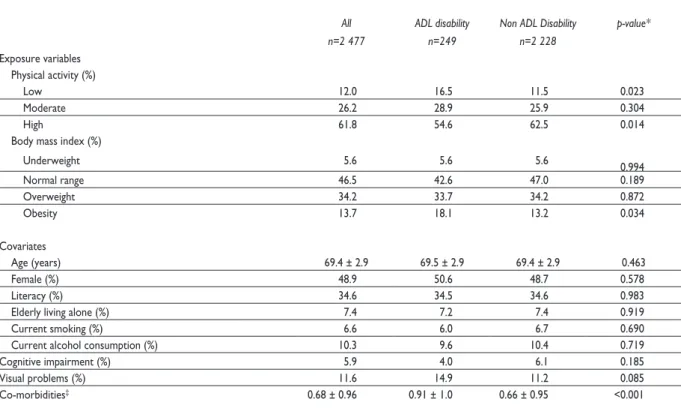
Table I shows the baseline characteristics of the elderly in our sample. Mean age was 69.4±2.9 years, nearly 50% were female, 34.6% were literate, 7.4% lived alone, 61.8% performed high levels of PA and 13.7% were obese.
At the 14-month follow-up, the cumulative inci-dence of disability in basic ADLs was 10.1%. Table I compares the baseline characteristics according to ADL disability status at the follow-up. Differences were not statistically significant in terms of current smoking, current alcohol consumption, cognitive impairment and BMI; but significant in terms of high PA (p=0.022), visual problems (p=0.085), and co-morbidities (p<0.001).
Table II presents the results of the logistic regression model for the cumulative incidence of disability, for both models, with and without covariates adjustment. Being engaged in high PA reduced disability risk significantly, for both the unadjusted (OR=0.61; CI95% 0.42-0.89) and the adjusted model (OR=0.64; CI95% 0.43-0.95). There was no significant association between moderate level of PA and incidence of disability; however, it is possible to observe a trend of decreases in the risk of disability when PA increases. Regarding BMI, the model without covariates indicated that obese elderly were particularly prone to developing disability (OR=1.51; CI95% 1.07-2.13). Likewise, the model adjusted for baseline charac-teristics showed a lower but still marginally significant relationship between obesity and disability (OR=1.36,
p<0.10; CI95% 0.96-1.95). Being under- or overweight did not associate with the incidence of ADL disability in the study sample.
Discussion
The results of our study found that, at the 14-month follow-up, high PA is a protective factor against dis-ability, and that obesity is associated with increased risk of disability. Over the years, human beings become less physically active,31 but the elderly in our study sample
remained highly active; six in ten subjects reported participating in activities that, as a whole, generated a considerable requirement (high PA). Some prospective studies have showed that high levels of PA in the elderly have a protective impact.15-17,32 Among OA in our study,
dwelling in rural areas constituted a potential factor that determined greater levels of PA and, thus, a more active lifestyle.
Table II
eFFectoFphySicalactivityandobeSityoncumulativeincidenceoF adl diSability. mexico 2007-2009
Model 1
Without covariates With covariates*Model 2
OR CI95% OR CI95%
Physical activity
Low 1.00 Reference 1.00 Reference
Moderate 0.78 (0.52-1.18) 0.80 (0.52-1.22)
High 0.61** (0.42-0.89) 0.64‡ (0.43-0.95)
Body mass index
Underweight 1.11 (0.62-1.97) 1.09 (0.60-1.98)
Normal range 1.00 Reference 1.00 Reference
Overweight 1.09 (0.81-1.46) 1.01 (0.74-1.36)
Obesity 1.51‡ (1.07-2.13) 1.36§ (0.96-1.95)
OR= odds ratio CI= confidence interval
* Adjusted for covariates: age, sex, literacy, living arrangements, current smoking, current alcohol consumption, cognitive impairment, visual problems, and number of co-morbidities
‡ p-value < 0.05 § p-value < 0.10
Table I
baSelinecharacteriSticSbyincident adl diSability. mexico 2007-2009
All ADL disability Non ADL Disability p-value*
n=2 477 n=249 n=2 228
Exposure variables Physical activity (%)
Low 12.0 16.5 11.5 0.023
Moderate 26.2 28.9 25.9 0.304
High 61.8 54.6 62.5 0.014
Body mass index (%)
Underweight 5.6 5.6 5.6 0.994
Normal range 46.5 42.6 47.0 0.189
Overweight 34.2 33.7 34.2 0.872
Obesity 13.7 18.1 13.2 0.034
Covariates
Age (years) 69.4 ± 2.9 69.5 ± 2.9 69.4 ± 2.9 0.463
Female (%) 48.9 50.6 48.7 0.578
Literacy (%) 34.6 34.5 34.6 0.983
Elderly living alone (%) 7.4 7.2 7.4 0.919
Current smoking (%) 6.6 6.0 6.7 0.690
Current alcohol consumption (%) 10.3 9.6 10.4 0.719
Cognitive impairment (%) 5.9 4.0 6.1 0.185
Visual problems (%) 11.6 14.9 11.2 0.085
Co-morbidities‡ 0.68 ± 0.96 0.91 ± 1.0 0.66 ± 0.95 <0.001
* Chi-square test or t-test comparing the incident ADL and Non-ADL disability groups
health status, the elderly are compelled to continue performing occupational activities.34
The idea that a high level of PA is associated with lower risk of disability is based on the fact that more demanding activities play a key role increasing insulin sensitivity, reducing risk of cardiovascular diseases and increasing life expectancy, and these mechanisms might have positive effects on posture balance, inflammation biomarkers, and maintaining muscular strength.35 Some
studies have suggested that resistance training programs improve physical condition and independence.36
Some studies have found that obesity is associated with disability11,12,14 but we only found a marginal
as-sociation. However, this is consistent with findings on the association between obesity and risk of disability in Hispanic populations.37,38 In this context, our study can
contribute to a better understanding of the association between body weight and disability, particularly among rural populations. It is possible that the marginal effect of BMI on disability can be explained by the particular profile of our study group. The elderly in our study belong to a select group that has survived conditions of shortage, deprivation, infections and diseases through-out their lives and the effect of BMI could have been more evident. Another explanation may reside in the use of BMI, which in itself is not an optimum indicator among elderly people. While BMI captures total body fat, it is seriously limited in its ability to distinguish body-fat distribution or between fat mass and lean mass.39 This is relevant, as loss of lean mass is a part of
ageing and therefore linked to loss of independence.40
Even so, evidence has shown that is necessary a com-plete and exhaustive revision about the use of BMI, and the appropriateness of its cutoffs to the older adult population.41
Our study revealed that 10.1% elderly had devel-oped disability. This number is similar to those reported for Mexican and Hispanic populations, where disability incidence ranged between 6.5% and 10.9% in a two year period. 7,21 Given that our follow-up term was barely
over a year and our sample of elderly participants per-tained to the younger segment of the OA (65-74 years), the incidence under our research can be considered high. Results suggest that unobserved variables, such as the environment, may influence disability. With mobility identified as the basic activity most affected in this population,14 it can be argued that settings with
substantial obstructions (i.e., badly paved streets, insuf-ficient sidewalks, hillside dwellings, uneven terrain, limited infrastructure and deficient public services)22
may be responsible for falls and then cause disability. This is an issue of great concern, because it has been reported that functionally disabled individuals residing
in marginalized social contexts have fewer labor oppor-tunities, lower incomes and less tools to face adversity. Additionally, they commonly lack access to medical and rehabilitation services.4,15,25
The main limitation of this study is the duration of our follow-up which did not allow for identifying which OA were in the process of functional impairment. A longer follow-up period would have probably revealed a higher disability incidence. Another limitation was the self-reported functional status and PA assessment, which could be subject to recall bias. In general, people tend to over-report PA.42 However we use standardized
instruments to obtain reliable information on functional status and PA, and professional and fully standardize interviewers followed a detailed protocol. An additional limitation of our study is the definition of the analytical sample; elderly excluded from the analytical sample, were mostly women, with vision problems, and had a greater number of co-morbidities. In all likelihood, this means that the elderly excluded from the analysis, may have been in a position of greater disability and that it may be susceptible to selection bias.
Finally, the evidence presented here should prompt health personnel to refine routine check-ups with an as-sessment of ADL performance in the elderly as a means of detecting the risk of disability. In fact, this functional assessment could be performed in the primary care health services. On the other hand, assuming PA is im-portant to minimize the impact of disability, it should be included as part of a strategy in maintaining muscle mass.36 Specially, exercise programs like the
multicom-ponent strength training, appear to be the most effective interventions to delay disability.43
Declaration of conflict of interests. The authors declare that they have no conflict of interests.
References
1. Dorantes-Mendoza G, Ávila-Funes JA, Mejía-Arango S, Gutiérrez-Robledo LM. Factores asociados con la dependencia funcional en los adultos mayores: un análisis secundario del Estudio Nacional sobre Salud y Envejecimiento en México, 2001. Rev Panam Salud Publica 2007;22:1-11. 2. Guralnik JM, Ferrucci L, Balfour JL, Volpato S, Di Iorio A. Progressive ver-sus catastrophic loss of the ability to walk: implications for the prevention of mobility loss. J Am Geriatr Soc 2001;49:1463-1470.
3. Mor V, Wilcox V, Rakowski W, Hiris J. Functional transitions among the elderly: patterns, predictors, and related hospital use. Am J Public Health 1994;84:1274-1280.
survival in elderly persons. A community-based, longitudinal study. J Intern Med 2009;265:288-295.
6. Menéndez J, Guevara A, Arcia N, León-Díaz EM, Marin C, Alfonso JC. Enfermedades crónicas y limitación funcional en adultos mayores: estudio comparativo en siete ciudades de América Latina y el Caribe. Rev Panam Salud Publica 2005;17:353-361.
7. Brach JS, Simonsick EM, Kritchevsky S, Yaffe K, Newman AB, Health A,
et al. The association between physical function and lifestyle activity and exercise in the health, aging and body composition study. J Am Geriatr Soc 2004;52:502-509.
8. He XZ, Baker DW. Body mass index, physical activity, and the risk of decline in overall health and physical functioning in late middle age. Am J Public Health 2004;94:1567-1573.
9. Lang IA, Guralnik JM, Melzer D. Physical activity in middle-aged adults reduces risks of functional impairment independent of its effect on weight. J Am Geriatr Soc 2007;55:1836-1841.
10. Woo J, Leung J, Kwok T. BMI, body composition, and physical function-ing in older adults. Obesity (Silver Sprfunction-ing) 2007;15:1886-1894.
11. Al Snih S, Ottenbacher KJ, Markides KS, Kuo YF, Eschbach K, Goodwin JS. The effect of obesity on disability vs mortality in older Americans. Arch Intern Med 2007;167:774-780.
12. Houston DK, Stevens J, Cai J. Abdominal fat distribution and functional limitations and disability in a biracial cohort: the Atherosclerosis Risk in Communities Study. Int J Obes (Lond) 2005;29:1457-1463.
13. Lang IA, Llewellyn DJ, Alexander K, Melzer D. Obesity, physical func-tion, and mortality in older adults. J Am Geriatr Soc 2008;56:1474-1478. 14. Song J, Chang HJ, Tirodkar M, Chang RW, Manheim LM, Dunlop DD. Racial/ethnic differences in activities of daily living disability in older adults with arthritis: a longitudinal study. Arthritis Rheum 2007;57:1058-1066. 15. Stessman J, Hammerman-Rozenberg R, Maaravi Y, Cohen A. Effect of exercise on ease in performing activities of daily living and instrumental activities of daily living from age 70 to 77: the Jerusalem longitudinal study. J Am Geriatr Soc 2002;50:1934-1938.
16. Balzi D, Lauretani F, Barchielli A, Ferrucci L, Bandinelli S, Buiatti E, et al. Risk factors for disability in older persons over 3-year follow-up. Age Ageing 2010;39:92-98.
17. Gerst K, Michaels-Obregon A, Wong R. The Impact of Physical Activity on Disability Incidence among Older Adults in Mexico and the United States. J Aging Res 2011;2011:420714.
18. Instituto Nacional de Estadística y Geografía (INEGI). Censo de Población y Vivienda 2010. Información Nacional por Entidad Federativa y Municipios: Porcentaje de población de 60 años y más, 2010. [Consultado agosto 2011]. Disponible en: http://www.inegi.org.mx/sistemas/mexicocif-ras/default.aspx?src=487
19. Gutierrez LM. México y la revolución de la longevidad. Envejecimiento Humano: Una visión transdisciplinaria. México: Secretaría de Salud, 2010. 20. Wallace SP, Gutierrez VF. Equity of access to health care for older adults in four major Latin American cities. Rev Panam Salud Publica 2005;17:394-409.
21. Wong R, Diaz J. Health care utilization among older Mexicans: health and socioeconomic inequalities. Salud Publica Mex 2007;49 Suppl 4:S505-S514.
22. Louie GH, Ward MM. Socioeconomic and ethnic differences in disease burden and disparities in physical function in older adults. Am J Public Health 2011;101:1322-1329.
23. Manrique-Espinoza B, Salinas-Rodríguez A, Moreno-Tamayo K, Téllez-Rojo MM. Prevalencia de dependencia funcional y su asociación con caídas en una muestra de adultos mayores pobres en México. Salud Publica Mex 2011;53:26-33.
24. Instituto Nacional de Salud Pública. Resumen Ejecutivo. Primer Seguimiento a la evaluación de impacto del programa de atención a
adultos mayores de 70 años y más en zonas rurales. [Consultado agosto 2011]. Disponible en: http://www.sedesol.gob.mx/work/models/SEDESOL/ Resource/1746/1/images/Resumen_Ejecutivo.pdf
25. Katz S, Branch LG, Branson MH, Papsidero JA, Beck JC, Greer DS. Ac-tive life expectancy. N Engl J Med 1983;309:1218-1224.
26. Gomez LM, Hernandez-Prado B, Morales M del C, Shamah-Levy T. Physical activity and overweight/obesity in adult Mexican population: the Mexican National Health and Nutrition Survey 2006. Salud Publica Mex 2009;51 Suppl 4:S621-S629.
27. IPAQ. Guidelines for Data Processing and Analysis of the International Physical Activity Questionnaire (IPAQ). [Consultado septiembre 2010]. Disponible en: http://www.ipaq.ki.se/scoring.pdf. 2005
28. Habicht JP. Estandarizacion de métodos epidemiológicos cuantitativos sobre el terreno. Bol Oficina Sanit Panam 1974;76:375-384.
29. Lohman T, Roche A, Martorell R. Anthropometric Standardization Reference Manual: Champaign(IL): Human Kinetics Books, 1991. 30. World Health Organisation. Technical Report Series N° 916. Diet, Nu-trition and the Prevention of Chronic Diseases. Report of a Joint WHO/ FAO Expert Consultation. 2003.
31. Charansonney OL. Physical activity and aging: a life-long story. Discov Med 2011;12:177-185.
32. Song J, Chang RW, Dunlop DD. Population impact of arthritis on dis-ability in older adults. Arthritis Rheum 2006;55:248-255.
33. Instituto Nacional de Salud Pública. Diagnóstico sobre las condi-ciones de vida y bienestar de los beneficiarios del Componente para Adultos Mayores (AM) del Programa Oportunidades 2006. [Consul-tado agosto 2011] Disponible en: http://evaluacion.oportunidades.gob. mx:8010/es/wersd53465sdg1/docs/2006/insp_2006_adultos_mayores_ oportunidades.pdf
34. Salgado de Snyder VN, González-Vázquez TT, Jáuregui-Ortiz B, Bonilla-Fernández P. “No hacen viejos los años, sino los daños”: envejec-imiento y salud en varones rurales. Salud Publica Mex 2005;47:294-302. 35. Avila-Funes JA, Garcia-Mayo EJ. Beneficios de la práctica del ejercicio en los ancianos. Gac Med Mex 2004;140:431-436.
36. Venturelli M, Lanza M, Muti E, Schena F. Positive effects of physical training in activity of daily living-dependent older adults. Exp Aging Res 2010;36:190-205.
37. Al Snih S, Graham JE, Kuo YF, Goodwin JS, Markides KS, Ottenbacher KJ. Obesity and disability: relation among older adults living in Latin America and the Caribbean. Am J Epidemiol 2010;171:1282-1288. 38. Al Snih S, Graham JE, Ray LA, Samper-Ternent R, Markides KS, Otten-bacher KJ. Frailty and incidence of activities of daily living disability among older Mexican Americans. J Rehabil Med 2009;41:892-897.
39. Snijder MB, van Dam RM, Visser M, Seidell JC. What aspects of body fat are particularly hazardous and how do we measure them? Int J Epidemiol 2006;35:83-92.
40. Fielding RA, Vellas B, Evans WJ, Bhasin S, Morley JE, Newman AB, et al. Sarcopenia: an undiagnosed condition in older adults. Current consensus definition: prevalence, etiology, and consequences. International working group on sarcopenia. J Am Med Dir Assoc 2011;12:249-256.
41. Berraho M, Nejjari C, Raherison C, El Achhab Y, Tachfouti N, Serhier Z, et al. Body mass index, disability, and 13-year mortality in older French adults. J Aging Health 2010;22(1):68-83.
42. Shephard RJ. Limits to the measurement of habitual physical activity by questionnaires. Brit J Sports Med 2003;37:197-206.