Contaduría y Administración 63 (2), Especial 2018, 1-17 Accounting & Management
Relevant competences in public accounting and finance:
Is there a consensus among employers, professors and
students?
Competencias relevantes en contaduría pública y finanzas: ¿existe consenso
entre empleadores, profesores y estudiantes?
Javier Montoya del Corte
a,*and Gabriela María Farías Martínez
baUniversidad de Cantabria, Spain bTecnológico de Monterrey, Mexico
Received 11 November 2016; accepted 28 March 2017 Available online 30 May 2018
Abstract
This article intends to analyze what competences are relevant for the adequate professional perfor-mance of the Public Accounting and Finances (CPA) from the perspective of the market –employers- and the university –professors and students-, and verify to what extent there is agreement. To achieve this objective, a quantitative investigation based on an online survey was made. Afterwards, a qualitative research based on a focus group was conducted. The collected information was analyzed with the support of the SPSS and NVivo program, respectively. The obtained evidence shows the existence of a general consensus on the major importance of values, ethics and attitudes, above skills and, primarily, above knowledge. However, some significant differences that reveal certain deviations between university edu-cation and labor market requirements were identified. That is why this article advises of the need to align in greater measure the academic education with the demands and requirements of the working market by increasing the approach between universities and business fields, as well as putting major effort in the students’ self-sufficient learning processes.
JEL Classification: A22, G00, M40.
Key words: Skills training; College; employability; Public accounting; Finance.
* Corresponding author.
E-mail address: [email protected] (J. Montoya del Corte)
Peer review under the responsibility of Universidad Nacional Autónoma de México.
http://dx.doi.org/10.22201/fca.24488410e.2018.1265
Resumen
El artículo busca analizar qué competencias son relevantes para el adecuado desempeño profesional de la Contaduría Pública y las Finanzas (CPF) desde la perspectiva del mercado –empleadores– y de la universidad –profesores y estudiantes–, y comprobar en qué medida existe coincidencia. Para lograr este fin, se llevó a cabo una investigación cuantitativa basada en una encuesta online. Posteriormente, se realizó una investigación cualitativa basada en un grupo focal. La información recabada se analizó con apoyo en los programas SPSS y NVivo, respectivamente. La evidencia obtenida muestra la existencia de un consenso general acerca de la mayor trascendencia de los valores, la ética y las actitudes, por encima de las habilidades y, sobre todo, de los conocimientos. No obstante, se identifican algunas diferencias significativas que revelan ciertas desviaciones entre la formación universitaria y los requerimientos del mercado laboral en la actualidad. Es por esto que se advierte la necesidad de alinear en mayor medida la formación académica con las demandas y requisitos del mercado laboral aumentando el acercamiento entre la universidad y el ámbito empresarial, así como poner un mayor énfasis en el aprendizaje autónomo de los estudiantes.
Códigos JEL: A22, G00, M40.
Palabras clave: Formación de competencias; Universidad; Empleabilidad; Contaduría pública; Finanzas.
Introduction
During the last decades, globalization and technological development stand out as determining factors for changes that are becoming increasingly fast and transcendental. As indicated by Delors (1996), in order to achieve an adequate adaptation to said changes, the job
market demands professionals that are highly qualified in three complementary areas: cognitive
(“knowing”), procedural (“knowing how to do”) and attitudinal (“knowing how to be and do”).
In this situation, the university system has been forced to react, carrying out a structural reform that allows approximating the academic offer to the demands of present society, increasing the employability of its graduates. It is in this regard that competence-based learning surfaces (Martínez and Echeverría, 2009), a term that encompasses the set of knowledges, skills and values, ethics and attitudes that determine the capacity of a person to adequately respond to
the demands of a specific job position (Biemans, Nieuwenbuis, Poell, Mulder and Wesselink,
2004).
The objective of this research is to delve into the analysis of the competence-based training
in the specific area of Public Accounting and Finance (CPF) for the specific case of Mexico,
The empirical study carried out is based on a mixed research methodology, which combines
a first quantitative stage with a subsequent qualitative one. Firstly, an internet-based survey was
done by the professional members of the Mexican Institute of Public Accountants (IMCP for its acronym in Spanish) and the Mexican Institute of Finance Executives (IMEF for its acronym in Spanish), as well as by the professors and students of Public Accounting and Finance (LCPF for its acronym in Spanish) of several Mexican universities. Below, and in order to enrich and add value to the interpretation of the collected information, we present a focus group in which the representatives of the three surveyed groups participate.
Among the main results obtained, it is important to highlight the existence of a consensus
regarding the greater significance that the three studied groups give to values, ethics and attitudes, above skills and, above all, knowledge. However, some significant differences are identified;
mainly, intergroups, which reveal certain deviations between the level of training offered by
the university and that required by the current job market. With this study, we contribute to the
scarce empirical literature that exists in Latin America, in general, and particularly in Mexico, and has three practical implications both in the academic and managerial areas.
The remaining of this work is structured in the following manner. After this introduction,
it briefly describes the theoretical bases that, at both the standard and empirical levels, serve
to contextualize the subject at hand. Below, the methodological aspects of the research are more broadly explained. The fourth section analyzes the results obtained. Finally, the main conclusions are presented along with the limitations and future lines of research that are derived, as well as the bibliography that was consulted.
Standard framework and previous literature on competencies in CPF
In order to achieve the professional success of university graduates in a job market that has become increasingly more global, changing, and dynamic since the last century, some experts began promoting the relevance of the competence-based training approach (McLagan, 1997; Bennett, Dunne and Carré, 1999), and more particularly, in managerial practice in the administration of companies (Varela, 2003). In the CPF, the disciplines that are the subject of this work have been built on an important referent at a global level, the International Education Standards (IES), issued by the International Education Standards Board (IAESB) of the International Federation of Accountants (IFAC).
This standard framework defines competence as “the ability of a person to do a task
in compliance with a specific standard in real work environments”. Similarly, it defines capabilities as “the set of knowledge, professional skills and values, ethics and attitudes required to demonstrate competence” (IFAC, 2014, pp. 20-21). These two definitions convey that in order for a professional to be competent, then they need to be trained in three different and complementary areas: cognitive (-technical- knowledge), procedural (abilities -skills-) and attitudinal (values, ethics and attitudes -behavior-).
In this regard, IFAC (2014) offers a series of orientations on the specific aspects that should
be noted for these three areas. These is done in the documents that are indicated below, which along with the previous cited literature were then used as reference when elaborating the information collection instrument for the quantitative research of this work:
IES 4. Initial professional development. Professional values, ethics, and attitudes.
Regarding the academic aspects of this line of research, works concerning the determination of the objectives and functions of universities as Higher Education Institutions have proliferated in order to clarify what society can and should demand of them (Rubio, 2005). In this regard, there is consensus agreeing that one of the main tasks of the university is to contribute to the employability of the graduates, which entails developing and strengthening the competences that are considered necessary in each discipline (Caballero, López, and Lampón, 2014).
Focusing on the general area of business administration, and more specifically regarding CPF, there is sufficient and diverse empirical evidences at an international level that supports the idea that employers in the job market are of the opinion that university graduates are not sufficiently
prepared in the different areas of the required competences.
Within the English-speaking world, in Australia, Kavanagh and Drennan (2008) state that
employers manly indicate the lack of a better knowledge of the real world and businesses, as well as a good understanding of the basic accounting concepts and greater analytical skills as a weakness. Pan and Perera (2012) provide evidence of the need to promote a better understanding on how accounting must be interpreted and how it can be used to improve a business, as well as
a greater capacity to solve problems and manage time. Tempone, Kavanagh, Segal, Hancock, Howieson and Kent (2012) demonstrate that employers especially value the ability of graduates to communicate, work in teams, and self-manage. Similarly, in the United States, Lin, Krishnan
and Grace (2013) indicate that employers demand graduates to have a greater capacity to communicate verbally and in writing, as well as greater interpersonal abilities to relate to
others. Lastly, in the UK, Senik, Broad, Mat and Kadir (2013) reveal a lack of training in the basic understanding and use of specific software related to accounting, auditing, and taxes.
In the Ibero-American context, in Spain, Arquero (2000) and Arquero, Donoso, Jiménez
and González (2009) provide evidence on important educational deficiencies in several
non-technical abilities, especially oral and written communication and problem-solving. Marzo, Pedraja and Rivera (2009) state that there is a greater deviation in the practical education received by university graduates. Furthermore, these have major shortcomings in skills such as initiative and oral communication (social areas), the practical application of knowledge, creativity, the ability to adapt to new situations and the implementation of standards and regulations (methodological abilities), the building of relationships with senior positions, negotiation and the ability to motivate others (participative abilities). Pujol-Jover,
Riera-Prunera and Abio (2015) state that employers find shortcomings concerning the ability of
graduates to adequately manage time, adapt to changes, communicate, work in teams and have an entrepreneurial vision. Bartual and Turmo (2016) emphasize the relevance given by employers to generic competences. Nevertheless, value differences are found according to
the type of company. Similarly, there is a deficit in some relevant respects such as practical
training and initiative, analysis or organizational abilities. In Colombia, Cabeza, Castrillón
and Lombana (2012) find that the competences related to information technologies and
communication, criticism and self-criticism, abstraction capacity, analysis and synthesis, risk and time management, the confrontation of new situations, commitment with the environment, and openness to international contexts must be developed. For their part, Castrillón, Cabeza
and Lombana (2015) identify the five generic and specific competences that are most important
and solve problems, and team work. As specific: development of tactical, operational and
strategic planning, the use of leadership to achieve the goal of the organization, manage and develop human talent in the organization, identify and optimize the business processes of
the organizations, and interpret accounting and financial information for decision-making. Furthermore, they state that employers consider that the identification and optimization of the
business processes of the organizations and the detection of opportunities to carry out new business or develop new products must be improved.
Methodology
To obtain the necessary information, it was considered appropriate to use a mixed research methodology, so a structured and self-applied survey was implemented (quantitative) to a focus group (qualitative).
Design of the quantitative research: the survey
After reviewing the international standards and the previous literature on the subject, an instrument was created, which was subsequently subjected to a pilot test in which 10 employers,
10 professors and 20 students participated. The final version of the survey was comprised of
four sets of questions regarding the sociodemographic characteristics of the subjects and the set of knowledge, skills and values, ethics and attitudes (competences) that were previously considered relevant for the professional exercise of the CPF. Although the same instrument was used, three versions were created to adapt it to each of the participating groups: the employers were asked about the competences required for the execution of the CPF; the professors were asked about the competences that were the focus of the training of the students regarding CPF; and students were asked about the competences that they were able to develop during their CPF studies. The assessment of the competences was captured in a Likert scale “1= little”
to “5= A lot”. The survey was internet-based and self-applied in May 2015, with the support
of the National Education and Research Network of the University Corporation of Internet Development (CUDI for is acronym in Spanish) in Mexico.
As previously mentioned, the survey was aimed towards three different groups that are considered important to adequately address the subject matter. As representatives of the market, practicing professionals associated with the Mexican Institute of Public Accountants (IMCP) and the Mexican Institute of Finance executives (IMEF) were used. As representative of the university, we asked for the collaboration of full-time professors and senior students of the LCPF from a total of 12 public and private institutions in the country. Two emails were sent
to the members of these groups, an initial one and another one that served as reminder fifteen
days later. These emails contained a brief explanation of the research and included a link to the website of the survey, which was only possible to access with a username and password. The responses of the participants were automatically recorded in a database. After cleaning said database, the total number of valid answers received for the market was 992, divided among 899 associates of the IMCP and 93 associates of the IMEF; while for the university there was a total number of 827, divided among 134 professors and 693 students.
Table 1. According to Nunnally (1978) and Segars (1997), there are high reliability levels in the instrument, as the index is above 0.70 in all cases.
Table 1
Reliability of the survey
COMPETENCES IMCP IMEF Professors Students Total
Knowledge 0.945 0.945 0.966 0.954 0.955
Skills 0.964 0.960 0.981 0.971 0.973
Values, ethics, and attitudes 0.910 0.885 0.945 0.935 0.936
Source: own elaboration.
The analysis of the results is based on the study of the mean scores obtained for each variable or indicator of the 24 knowledges, 30 skills and 7 values, ethics, and attitudes considered. The possible differences between groups are also examined by means of an analysis of variance (ANOVA), using the market/university variables (IMCP+IMEF versus professors+students) and the type of subject (IMCP, IMEF, professor, and student) as a segmentation factor. This analysis was carried out using the Statistical Package for the Social Sciences (SPSS) version 22.
Design of the qualitative research: focus group
With the aim of delving into the interpretation of the results obtained in the survey, in
August 2015, a session was organized to carry out a debate with the focus group, following the
stages defined by Ivankovich and Araya (2011). For this research, we had the collaboration and
contacts of a Mexican university that had previously participated in the survey, managing to create a group with 10 people, who were divided in the following manner:
–Three employers. A Public Accountant and Auditor who works as an Associate in one of the Big-4; a Public Accountant, Auditor, and Tax Executive who works as an Associate in a
small tax consultancy office; and a Public Accountant, Auditor, and Tax Executive who works
as Administrative Director in a large Bank.
–Three professors. A professor and career director of the LCPF; a professor and career director for the degree of Financial Administration; and a professor of the LCPF, who also
directs a small administrative consulting office.
–Four Students. Two from LCPF and two others from the bachelor degree in Financial Administration.
The session was moderated by the researchers, presenting two fundamental matters for the debate on the subject matter of this work: (1) level of relevance of the three areas of competence—knowledge, skills and values, ethics and attitudes—for the execution of the CPF at a professional level; and (2) training that should be taught or that is already taught to CPF
university students. The duration of the session was one hour and fifteen minutes, and the clean
transcript comprised 10,032 words.
coded, patterns can be identified, emerging issues can be discovered, and word frequency
queries can be made, to mention a few.
Results analysis
Quantitative analysis
Table 2 compiles the mean scores obtained for the set of knowledge, skills and values, ethics and attitudes that were considered, organizing the results by columns for the total respondents, for the market (employers of the IMCP and IMEF), for the universities (professors and students), and for each of the individual collectives.
Table 2
Mean scores for the competences
COMPETENCES Total Market University IMCP IMEF Professors Students
Knowledge 3.80 4.03 3.59 4.04 3.94 3.65 3.58
Skills 4.06 4.35 3.82 4.35 4.32 3.68 3.85
Values, ethics, and attitudes 4.22 4.53 3.99 4.54 4.42 3.83 4.02
Source: Own elaboration.
As can be observed, in all cases there are more elevated averages for values, ethics and attitudes, followed by skills and then by knowledge. Furthermore, the averages of the market are superior to those of the university, in the three cases, with very similar levels among the collectives that it comprises. In order to delve into the analyses, the following sections are examined separately for each of the three areas of competence.
Knowledge
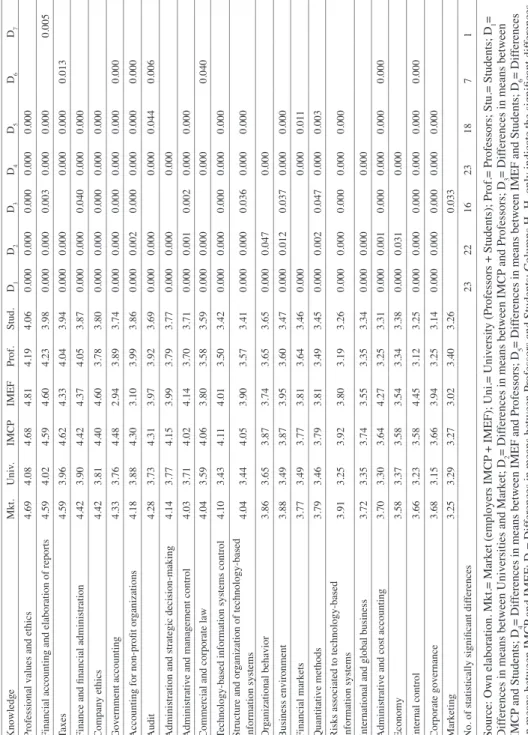
Table 3 presents the results obtained with regard to the level of knowledge that a university graduate in CPF must have based on a total of 24 subjects to be able to properly carry out their professional activity. The data are divided depending on where they come from, the opinion of the market (employers of the IMCP and IMEF) or from the universities (professors and students) and are organized from a greater to smaller difference in the means of both collectives.
It is indicated that only for “Marketing” the level of knowledge is similar between the market and the university, with it being the least important subject and the fourth least relevant, respectively in the training of CPF. Thus, 23 out of the 24 subjects considered in this research
present significant differences between the demand level of the market and the training level of
the university, with high mean scores in all cases in favor of the market. Therefore, this result shows some of the shortcomings regarding education in CPF that Mexican universities currently have, particularly concerning subjects such as “Government Accounting”, “Technology-based information systems control”, “Risks associated to technology-based information systems” and “Taxes”, “Professional values and ethics”, “Audit”, “Financial accounting and the elaboration
of finance reports”, and “Finance and financial administration”.
Nevertheless, it is necessary to indicate that when structuring the mean values of the subjects
all cases. The only subjects for which there was some distancing were: “Technology-based information systems control” and “Risks associated to technology based-information systems”, which are situated a little higher in the market ranking than in the university one.
Table 3 Averages and mean dif
ferences of all the collectives with regard to knowledge
Knowledge Mkt. Univ . IMCP IMEF Prof. Stud. D1 D2 D3 D4 D5 D6 D7
Professional values and ethics
4.69 4.08 4.68 4.81 4.19 4.06 0.000 0.000 0.000 0.000 0.000
Financial accounting and elaboration of reports
4.59 4.02 4.59 4.60 4.23 3.98 0.000 0.000 0.003 0.000 0.000 0.005 Taxes 4.59 3.96 4.62 4.33 4.04 3.94 0.000 0.000 0.000 0.000 0.013
Finance and financial administration
4.42 3.90 4.42 4.37 4.05 3.87 0.000 0.000 0.040 0.000 0.000 Company ethics 4.42 3.81 4.40 4.60 3.78 3.80 0.000 0.000 0.000 0.000 0.000 Government accounting 4.33 3.76 4.48 2.94 3.89 3.74 0.000 0.000 0.000 0.000 0.000 0.000
Accounting for non-profit or
ganizations 4.18 3.88 4.30 3.10 3.99 3.86 0.000 0.002 0.000 0.000 0.000 0.000 Audit 4.28 3.73 4.31 3.97 3.92 3.69 0.000 0.000 0.000 0.044 0.006
Administration and strategic decision-making
4.14 3.77 4.15 3.99 3.79 3.77 0.000 0.000 0.000
Administrative and management control
4.03 3.71 4.02 4.14 3.70 3.71 0.000 0.001 0.002 0.000 0.000
Commercial and corporate law
4.04 3.59 4.06 3.80 3.58 3.59 0.000 0.000 0.000 0.040
Technology-based information systems control
4.10 3.43 4.1 1 4.01 3.50 3.42 0.000 0.000 0.000 0.000 0.000
Structure and or
ganization of technology-based
information systems 4.04 3.44 4.05 3.90 3.57 3.41 0.000 0.000 0.036 0.000 0.000 Or ganizational behavior 3.86 3.65 3.87 3.74 3.65 3.65 0.000 0.047 0.000 Business environment 3.88 3.49 3.87 3.95 3.60 3.47 0.000 0.012 0.037 0.000 0.000 Financial markets 3.77 3.49 3.77 3.81 3.64 3.46 0.000 0.000 0.01 1 Quantitative methods 3.79 3.46 3.79 3.81 3.49 3.45 0.000 0.002 0.047 0.000 0.003
Risks associated to technology-based information systems
3.91 3.25 3.92 3.80 3.19 3.26 0.000 0.000 0.000 0.000 0.000
International and global business
3.72 3.35 3.74 3.55 3.35 3.34 0.000 0.000 0.000
Administrative and cost accounting
3.70 3.30 3.64 4.27 3.25 3.31 0.000 0.001 0.000 0.000 0.000 0.000 Economy 3.58 3.37 3.58 3.54 3.34 3.38 0.000 0.031 0.000 Internal control 3.66 3.23 3.58 4.45 3.12 3.25 0.000 0.000 0.000 0.000 0.000 0.000 Corporate governance 3.68 3.15 3.66 3.94 3.25 3.14 0.000 0.000 0.000 0.000 0.000 Marketing 3.25 3.29 3.27 3.02 3.40 3.26 0.033
No. of statistically significant dif
ferences 23 22 16 23 18 7 1
Source: Own elaboration. Mkt.= Market (employers IMCP
+ IMEF); Uni.= University (Professors + Students); Prof.= Professors; Stu.= Students; D
1
=
Dif
ferences in means between Universities and Market; D
2
= Dif
ferences in means between IMCP
and Professors; D
3
= Dif
ferences in means between
IMCP
and Students; D
4
= Dif
ferences in means between IMEF and Professors; D
5
= Dif
ferences in means between IMEF and Students; D
6
= Dif
ferences
in means between IMCP
and IMEF; D
7
= Dif
ferences in means between Professors and Students; Columns H
1
-H7
only indicate the significant dif
ferences
Skills
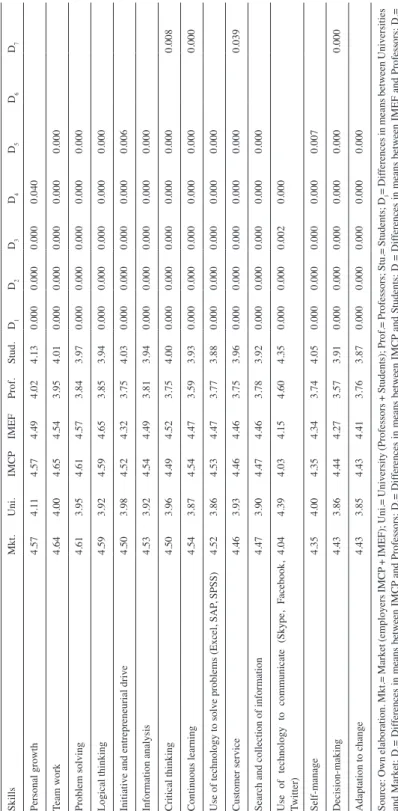
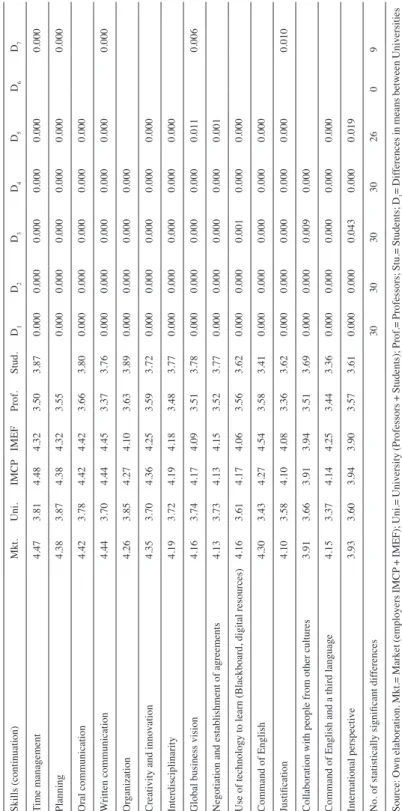
Table 4 presents the results obtained with regard to the skill level of a recent CPF graduate with respect to a total of 30 skills in order for them to be able to properly carry out their professional activity. The data are divided according to the source of opinion, market (employers of the IMCP and the IMEF) or university (professors and students) and are organized from a greater to smaller difference in means between both groups.
It is indicated that the 30 skills considered in this research have significant differences
between the level of demand of the market and the training level of the universities. Except for the case of “Use of technology to communicate”, the mean scores are superior in the market area. Again, this result shows certain shortcomings in Mexican universities regarding training in CPF, specially concerning aspects such as the “Use of technology to solve problems”, “Command
of Spanish and English”, “Command of Spanish, English, and another language”, “Written
communication”, “Time management”, “Continuous learning”, and “Logical thinking”. However, it is necessary to indicate that when structuring the mean scores of the skills
Table 4 Averages and mean dif
ferences of all collectives regarding skills
Skills Mkt. Uni. IMCP IMEF Prof. Stud. D1 D2 D3 D4 D5 D6 D7 Personal growth 4.57 4.1 1 4.57 4.49 4.02 4.13 0.000 0.000 0.000 0.040 Team work 4.64 4.00 4.65 4.54 3.95 4.01 0.000 0.000 0.000 0.000 0.000 Problem solving 4.61 3.95 4.61 4.57 3.84 3.97 0.000 0.000 0.000 0.000 0.000 Logical thinking 4.59 3.92 4.59 4.65 3.85 3.94 0.000 0.000 0.000 0.000 0.000
Initiative and entrepreneurial drive
4.50 3.98 4.52 4.32 3.75 4.03 0.000 0.000 0.000 0.000 0.006 Information analysis 4.53 3.92 4.54 4.49 3.81 3.94 0.000 0.000 0.000 0.000 0.000 Critical thinking 4.50 3.96 4.49 4.52 3.75 4.00 0.000 0.000 0.000 0.000 0.000 0.008 Continuous learning 4.54 3.87 4.54 4.47 3.59 3.93 0.000 0.000 0.000 0.000 0.000 0.000
Use of technology to solve problems (Excel, SAP
, SPSS) 4.52 3.86 4.53 4.47 3.77 3.88 0.000 0.000 0.000 0.000 0.000 Customer service 4.46 3.93 4.46 4.46 3.75 3.96 0.000 0.000 0.000 0.000 0.000 0.039
Search and collection of information
4.47 3.90 4.47 4.46 3.78 3.92 0.000 0.000 0.000 0.000 0.000
Use of technology
to communicate (Skype, Facebook, Twitter) 4.04 4.39 4.03 4.15 4.60 4.35 0.000 0.000 0.002 0.000 Self-manage 4.35 4.00 4.35 4.34 3.74 4.05 0.000 0.000 0.000 0.000 0.007 Decision-making 4.43 3.86 4.44 4.27 3.57 3.91 0.000 0.000 0.000 0.000 0.000 0.000
Adaptation to change
4.43 3.85 4.43 4.41 3.76 3.87 0.000 0.000 0.000 0.000 0.000 Source: Own elaboration. Mkt.= Market (employers IMCP + IMEF); Uni.= University (Professors + Students); Prof.= Professors; Stu.= Students; D1 = Dif ferences in means between Universities and Market; D2 = Dif ferences in means between IMCP and Professors; D 3 = Dif ferences in means between IMCP and Students; D4 = Dif ferences in means between IMEF and Professors; D5 = Dif ferences in means between IMEF and Students; D6 = Dif ferences in means between IMCP and IMEF; D7 = Dif ferences in means between Professors and Students; Columns H1 -H7 only
indicate the significant dif
Table 4 (continuation) Averages and dif
ferences in means of all the collectives regarding skills
Skills (continuation) Mkt. Uni. IMCP IMEF Prof. Stud. D1 D2 D3 D4 D5 D6 D7 Time management 4.47 3.81 4.48 4.32 3.50 3.87 0.000 0.000 0.000 0.000 0.000 0.000 Planning 4.38 3.87 4.38 4.32 3.55 0.000 0.000 0.000 0.000 0.000 0.000 Oral communication 4.42 3.78 4.42 4.42 3.66 3.80 0.000 0.000 0.000 0.000 0.000 W ritten communication 4.44 3.70 4.44 4.45 3.37 3.76 0.000 0.000 0.000 0.000 0.000 0.000 Or ganization 4.26 3.85 4.27 4.10 3.63 3.89 0.000 0.000 0.000 0.000
Creativity and innovation
4.35 3.70 4.36 4.25 3.59 3.72 0.000 0.000 0.000 0.000 0.000 Interdisciplinarity 4.19 3.72 4.19 4.18 3.48 3.77 0.000 0.000 0.000 0.000 0.000
Global business vision
4.16 3.74 4.17 4.09 3.51 3.78 0.000 0.000 0.000 0.000 0.01 1 0.006
Negotiation and establishment of agreements
4.13 3.73 4.13 4.15 3.52 3.77 0.000 0.000 0.000 0.000 0.001
Use of technology to learn (Blackboard, digital resources)
4.16 3.61 4.17 4.06 3.56 3.62 0.000 0.000 0.001 0.000 0.000
Command of English
4.30 3.43 4.27 4.54 3.58 3.41 0.000 0.000 0.000 0.000 0.000 Justification 4.10 3.58 4.10 4.08 3.36 3.62 0.000 0.000 0.000 0.000 0.000 0.010
Collaboration with people from other cultures
3.91 3.66 3.91 3.94 3.51 3.69 0.000 0.000 0.009 0.000
Command of English and a third language
4.15 3.37 4.14 4.25 3.44 3.36 0.000 0.000 0.000 0.000 0.000 International perspective 3.93 3.60 3.94 3.90 3.57 3.61 0.000 0.000 0.043 0.000 0.019
No. of statistically significant dif
ferences 30 30 30 30 26 0 9
Source: Own elaboratio
n. Mkt.= Market (employers IMCP
+ IMEF); Uni.= University (Professors
+ Students); Prof.= Professors;
Stu.= Students; D
1
= Dif
ferences in means between Universities
and Market;
D2
= Dif
ferences in means between IMCP
and Professors; D
3
= Dif
ferences in means between IMCP
and Students; D
4
= Dif
ferences in means between IMEF and Professors; D
5
=
Dif
ferences in means between IMEF
and Students; D
6
= Dif
ferences in means between IMCP
and IMEF; D
7
= Dif
ferences in means between Professors
and Students; Columns H
1
-H7
only
indicate
the significant dif
Values, ethics and attitudes
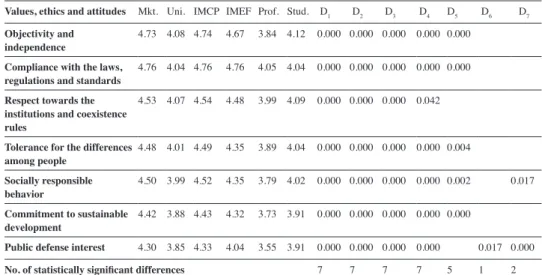
Table 5 presents the results obtained related to the level of awareness that a person who recently graduated in CPF has concerning a total of 7 values, ethics, and attitudes in order to carry out their professional activity. The data are divided according to the source of the opinion, market (employers of the IMCP and the IMEF) or university (professors and students) and are organized from a greater to smaller difference in means between collectives.
In this case it is also indicated that the 7 values, ethics, and attitudes considered in this
research present significant differences between the level of demand of the market and the
training level of the university, with mean scores that are superior in all cases in favor of the market. This situation is another aspect regarding the weaknesses in the education and
skills identified in the CPF of Mexican universities, in particular regarding matters such as
“Compliance of the laws, regulations, and standards” and “Objectivity and independence”.
Table 5
Averages and differences in means of all the collectives regarding values, ethics, and attitudes
Values, ethics and attitudes Mkt. Uni. IMCP IMEF Prof. Stud. D1 D2 D3 D4 D5 D6 D7
Objectivity and
independence 4.73 4.08 4.74 4.67 3.84 4.12 0.000 0.000 0.000 0.000 0.000
Compliance with the laws,
regulations and standards 4.76 4.04 4.76 4.76 4.05 4.04 0.000 0.000 0.000 0.000 0.000
Respect towards the institutions and coexistence rules
4.53 4.07 4.54 4.48 3.99 4.09 0.000 0.000 0.000 0.042
Tolerance for the differences
among people 4.48 4.01 4.49 4.35 3.89 4.04 0.000 0.000 0.000 0.000 0.004
Socially responsible
behavior 4.50 3.99 4.52 4.35 3.79 4.02 0.000 0.000 0.000 0.000 0.002 0.017
Commitment to sustainable
development 4.42 3.88 4.43 4.32 3.73 3.91 0.000 0.000 0.000 0.000 0.000
Public defense interest 4.30 3.85 4.33 4.04 3.55 3.91 0.000 0.000 0.000 0.000 0.017 0.000
No. of statistically significant differences 7 7 7 7 5 1 2
Source: Own elaboration. Mkt.= Market (employers IMCP + IMEF); ); Uni.= University (Professors + Students); Prof.= Professors; Stu.= Students; D1= Differences in means between Universities and Market; D2= Differences in means between IMCP and Professors; D3= Differences in means between IMCP and Students; D4= Differences in means between IMEF and Professors; D5= Differences in means between IMEF and Students; D6= Differences in means between IMCP and IMEF; D7= Differences in means between Professors and Students; Columns H1-H7 only indicate the significant differences in means at 0.05.
Qualitative analysis
Figure 1 serves as a first approximation to the results of the focus group, which presents the
Figure. 1. More specific terms by the focal group
Source: own elaboration with data from NVivo v. eleven.
Regarding the first matter presented to the focus group, the three employers agree with the
results of the survey regarding the order of importance given to the three areas of competence:
in the first place, values, ethics and attitudes, followed by skills and thirdly, knowledge. These
are some of the more interesting considerations made by them with regard to this subject: “I have always said that attitudes are more important than skills, because attitudes are what give you the ability to develop skills: to arrive early to work, to avoid being just thinking that it is almost six o’clock and that I have to leave work already, and instead, to think about finishing my work and doing it better every time; if I do not know something,
then I ask; etc.” (Employer 1).
“New graduates have this idea that when they finish their studies they are the kings of the world, and that they can do whatever they like. And most of the problems are in these attitudes taken, that is, their values. It is a fact that hierarchies are not respected, and everyone is seen the same way, the language with which they express themselves also says
a lot, because often they behave as if they were still in school” (Employer 2).
“Of course, academic education is very important, but having the right attitude is even more important because you will learn throughout your life. It is not only what you learn in University what you will use, but what you learn in practice that will add to what you have already learned, and you will increase that knowledge. But, to have a position with more responsibilities, or to achieve any objective that you have, you will need the sum of all we have mentioned: attitude, skills, and knowledge. And I believe that they go in that
During their turn to speak, one of the professors made the following comment:
“Well, first of all, I agree on the importance of attitude. Although I do consider it convenient for there to be a balance, since, in our field, there are evaluations with different employers
that are brutally technical” (Professor 2).
Now, regarding the formation in values, ethics and attitudes, and linking this to the second matter presented to the focus group, there is a certain discrepancy regarding whether the university should be responsible. For example:
“Attitudes and values are more family related, or rather, they are inherent to every person” (Employer 3).
“I do not 100% agree that it is not the responsibility of the University to educate students on values/attitudes and skills. Indeed, I do agree that family is fundamental and that everyone has their own personality, but I also believe that, as professors, it should be our responsibility to combine our efforts to reinforce the students through examples and communication, and make them aware that if they have not developed these values (ethics,
professionalism, delivery, honesty, etc.), they will not make it far.” (Professor 3).
“Values shape us. They are originally acquired through our family, of course, but as a
university we also need to promote them and make sure they are always present” (Professor 1).
“The academic institution should do a little bit more to reinforce values and attitudes, since we have knowledge, which is sometimes a little vague, that was acquired through
memorization” (Student 3).
With regard to this last point mentioning memorization for the acquisition of knowledge, it
seems appropriate to highlight the following observation:
“I think that what we sometimes forget is to make them understand what is being taught, planting the seed, and once the seed is there, it will start to grow with the skills and values
that we develop” (Professor 1)
Once the employers were asked about what they look for when incorporating new graduates to their team works, these were some of their comments:
“For them to have a degree that is relevant to the field with an acceptable qualification, along with extracurricular activities and for them to have international experience, not only regarding languages, but for them to have cultural experience from other countries” (Professional 1).
“I coincide with that. We look for people who have a balance in the three components that were mentioned. And I believe that it depends on the position that you are contracting, as
the stronger characteristics of the person required for the job will change” (Professional 3).
Conclusions
This work contributes to the scarce previous empirical literature on the study of competences that are relevant to the professional performance of the CPF in Latin America, and particularly for the case of Mexico (Montoya, Farías and Mancina, 2013). In the same line of previous research, the results obtained are indicative of a considerable gap between the educational offer of universities and the demands of the labor market in terms of knowledge, skills and values, ethics and attitudes. In this way, a better knowledge of the current situation is provided, which leads to important practical implications, both at the academic and managerial levels.
Firstly, this work is of interest to those responsible for designing academic programs in universities, as well as to the professors teaching within them, as it provides information that can serve as a guide for them to review training strategies and actions to meet the current needs of labor practice. On the other hand, from a business standpoint, this work is relevant for organizations such as IFAC, at the international level, and the IMCP and IMEF, at the national level of Mexico, with a view to reviewing and adapting the different regulatory frameworks that regulate training for the practice and professional performance of the CPF.
In this regard, it is fundamental to achieve a greater approximation and dialogue in the university-enterprise binomial, in order to avoid information asymmetries between the two spheres and mismatches related to the employability of graduates such as those shown in this
study (Frecka and Reckers 2010; Hancock, Howieson, Kavanagh, Kent, Tempone and Segal,
2010). Furthermore, it is necessary to encourage the acquisition of practical experience during university studies (Paisey and Paisey, 2010), as well as greater implementation and use of active teaching methodologies, such as Project Oriented Learning, Problem-Based Learning or Case Studies, which favor the development of competences by giving students a greater role and demanding more autonomous work (Stoner and Milner, 2010); Robledo, Fidalgo, Arias and Álvarez, 2015). All of this would make it possible for universities to have better prepared
graduates, and companies and professional firms to receive people with a profile that are more
in line with their employment needs in their recruitment processes (Apostolou, Dorminey, Hassell and Rebele, 2015).
The interpretation of all of the above should be done with due caution. The results of the survey are based on the opinions of a sample of IMCP and IMEF members, on the professional side, and of a number of professors and students from some Mexican universities, on the academic side. Consequently, these results may not be extrapolated to other countries, other similar groups or other types of professional activities in which a person with university studies
related to the CPF could fit. Future work along these lines could be extended to other Latin
American countries, including other groups, such as the authorities responsible for regulation
in the academic and professional fields. In addition, further research should be carried out into
References
Apostolou, B., Dorminey, J. W., Hassell, J. M. & Rebele, J. E. (2015), “Accounting education literature review
(2013-2014)”, Journal of Accounting Education, 33 (2), 69-127. http://dx.doi.org/10.1016/j.jaccedu.2015.04.001
Arquero, J. L. (2000), “Capacidades no técnicas en el perfil profesional en Contabilidad: las opiniones de docentes y
profesionales”, Revista Española de Financiación y Contabilidad, 29 (103), 149-172. (Available in: https://www. jstor.org/stable/42781362?seq=1#page_scan_tab_contents. Accessed: 17/07/2016).
Arquero, J. L., Donoso, J. A., Jiménez, S. A. & González, J. M. (2009), “Análisis exploratorio del perfil demandado
para Administración y Dirección de Empresas: implicaciones para el área contable”, Revista de Contabilidad, 12 (1) 43-66. doi:10.1016/S1138-4891(09)70006-8
Bartual, M. T. & Turmo Garuz, J. (2016), “Educación superior y competencias para el empleo. El punto de vista de los
empresarios”, Revista Complutense de Educación, 27 (3),1211-1228. doi:10.5209/rev_RCED.2016.v27.n3.47645
Bennett, N., Dunne, E. & Carré, C. (1999), “Patterns of core and generic skill provision in higher education”, Higher
Education, 37 (1), 71-93. doi:10.1023/A:1003451727126
Biemans, H., Nieuwenbuis, L., Poell, R., Mulder, M. & Wesselink, R. (2004), “Competence based VET in the Ne -therland. Background and piftalls”, Journal of Vocational Education and Training, 56 (2),523-538. http://dx.doi. org/10.1080/13636820400200268
Caballero, G., López, M. J. & Lampón, J. (2014), “La universidad y su implicación con la empleabilidad de sus gradua -dos”, Revista Española de Investigaciones Sociológicas, 146 (1), 23-46. http://dx.doi.org/10.5477/cis/reis.146.23
Cabeza, L., Castrillón, J. & Lombana, J. (2012), “Determinación y análisis de las competencias por fortalecer para la
gestión en Colombia”, Innovar, 22 (46), 5-20. (Available in: https://revistas.unal.edu.co/index.php/innovar/article/ view/39320; Accessed: 23/06/2016).
Castrillón, J., Cabeza, L. & Lombana, J. (2015), “Competencias más importantes para la disciplina administrativa en
Colombia”, Contaduría y Administración, 60 (4), 776-795. http://dx.doi.org/10.1016/j.cya.2015.07.009
Delors, J. [Coord.] (1996), La educación encierra un tesoro, Ediciones UNESCO, Madrid. (Available in: http://www. unesco.org/education/pdf/DELORS_S.PDF. Accessed: 25/05/2016).
Frecka, T. J. & Reckers, P. M. J. (2010), “Rekindling the debate: What’s right and what’s wrong with masters of
accountancy programs: The staff auditor’s perspective”, Issues in Accounting Education, 25 (2), 215-226. http:// dx.doi.org/10.2308/iace.2010.25.2.215
Hancock, P., Howieson, B., Kavanagh, M., Kent, J., Tempone, I. & Segal, N. (2010), Accounting for the future, Accoun-ting Education at a Crossroad in 2010 (pp. 54-62). Australia: The Institute of Chartered Accountants in Australia. International Federation of Accountants. (2014), Handbook of International Education Pronouncements. New
York: International Accounting Education Standards Board, June. (Available in https://www.ifac.org. Accessed: 02/09/2015).
Ivankovich, C. I. & Araya, Y. (2011), “Focus groups: Técnica de investigación cualitativa en investigación de merca -dos”, Ciencias Económicas, 29 (1), 545-554. (Available in: https://revistas.ucr.ac.cr/index.php/economicas/article/ view/7057. Accessed: 09/11/2015).
Kavanagh, M. H., & Drennan, L. (2008), “What skills and attributes does an accounting graduate need? Evidence
from student perceptions and employer expectations”, Accounting and Finance, 48 (2), 279-300. http://dx.doi. org/10.1111/j.1467-629X.2007.00245.x
Lin, P., Krishnan, S. & Grace, D. (2013), “The effect of experience on perceived communication skills: Comparisons
between accounting professionals and students”, Advances in Accounting Education: Teaching and Curriculum Innovations, 14, 131-152. doi: 10.1108/S1085-4622(2013)0000014012
Martínez, P. & Echeverría, B. (2009), “Formación basada en competencias”, Revista de Investigación Educativa, 27 (1), 125-147. doi: 10.6018/rie.27.1.94331
Marzo, M., Pedraja, M. & Rivera, P. (2009), “Curricular profile of university graduates versus business demands: Is there a fit or mismatch in Spain?”, Education and Training, 51 (1), 56-69. http://dx.doi.org/10.1108/00400910910931832
Montoya del Corte, J., Farías Martínez, Mª G. & Mancilla Rendón, Mª E. (2013), “Competencias profesionales de los
McLagan, P. (1997), “Competencies: The Next Generation”, Training and Development, 51 (5), 40-47. Nunnally, J. C. (1978), Psychometric Theory. New York: McGraw Hill.
Paisey, C. y Paisey, N. J. (2010), “Developing skills via work placements in accounting: Student and employer views”, Accounting Forum, 34 (2), 89-108. http://dx.doi.org/10.1016/j.accfor.2009.06.001
Pan, P. & Perera, H. (2012), “Market relevance of university accounting programs: Evidence from Australia”,
Accoun-ting Forum, 36 (2), 91-108. http://dx.doi.org/10.1016/j.accfor.2011.11.001
Pujol-Jover, M., Riera-Prunera, C. & Abio, G. (2015), “Competences acquisition of university students: Do they match
job market’s needs?”, Intangible Capital, 11 (4), 612-626. http://dx.doi.org/10.3926/ic.625
Robledo, P., Fidalgo, R., Arias, O. & Álvarez, M. (2015), “Percepción de los estudiantes sobre el desarrollo de com -petencias a través de diferentes metodologías activas”, Revista de Investigación Educativa, 33 (2), 369-383. http:// dx.doi.org/10.6018/rie.33.2.201381
Rubio, R. M. (2005), “Aims and functions of the university in the European Space of Higher Education”, Revista Es-pañola de Pedagogía, 63 (230), 17-42. (Available in: https://dialnet.unirioja.es/servlet/articulo?codigo=1142807. Accessed: 23/04/2016).
Segars, A. H. (1997), “Assessing the unidimensionality of measurement: A paradigm and illustration within the context of information Systems research”, Omega, 25 (1), 107-121. doi: 10.1016/S0305-0483(96)00051-5
Senik, R., Broad, M., Mat, N. & Kadir, S. A. (2013), “Information technology (IT) knowledge and skills of accounting
graduates: Does an expectation gap exist?”, Journal Pengurusan, (38), 87-100. (Available in: http://ejournals.ukm. my/pengurusan/article/view/4615. Accessed: 25/05/2016).
Stoner, G. & Milner, M. (2010), “Embedding generic employability skills in an accounting degree: Development and
impediments”, Accounting Education, 19 (1-2), 123-138. http://dx.doi.org/10.1080/09639280902888229
Tempone, I., Kavanagh, M., Segal, N., Hancock, P., Howieson, B. & Kent, J. (2012), “Desirable generic attributes for accounting graduates into the twenty-first century: The views of employers”, Accounting Research Journal, 25 (1), 41-55. http://dx.doi.org/10.1108/10309611211244519