a relative deprivation approach
1Fecha de recepción: 07.04.2014 Fecha de aceptación: 27.05.2014
Abstract
This research analyzes the individual qualities and microeco
-nomic profiles from mexican workers in Mexico, which under relative deprivation conditions, take the choice to leave the country as an alternative way to improve their life expecta
-tions. It is found that mexican assistance programs encompass heterogeneous results and thus, are not a generalized signal of improvement for the families. Using a Multinomial Logit spec
-ification we found that public assistance programs reinforce relative deprivation of non-migrants families on those who have relatives who migrated. Human capital attributes pres
-ent a direct relation with the process of migration not only for traditional exporting labor regions, but also for the north-bor
-der of the country. The south supports the relative deprivation hypothesis meanwhile, is not the case for the USA-mexican border States.
Keywords: migration, occupational choice, relative depriva
-tion, remittances
Jel Clasification: C11, C35, J24, J39, J61, O15
Cuauhtémoc Calderón Villarreal
El Colegio de la Frontera Norte
El perfil de los asalariados y las remesas en México: un enfoque de privación relativa
Resumen
Esta investigación estudia las cualidades individuales y los perfiles microeconómicos de los trabajadores mexicanos, que bajo condiciones de privación relativa, toman la decisión de abandonar el país con vistas a mejorar sus condiciones de vida. Nuestro trabajo encuen
-tra que los programas que impulsa el gobierno mexicano para combatir la pobreza no son muy eficientes. Usando un modelo Logit Multinomial encontramos que los programas de asistencia pública tienden a reforzar la privación relativa de las familias no migrantes frente a las familias que tienen algún familiar que ha emigrado.
Palabras clave: Migracion, privacion reltiva, remesas y seleccion ocupacional Calsificación Jel: C11, C35, J24, J39, J61, O15
Introduction
Massive migration from Mexico to the United States of America (US) has been a recent common denominator of the Mexican economy. In 2000, Mexican illegal immigration represented about 60% of the total illegal workforce in USA (INS, 2002). From the main causes behind this situation, it can be found not only the economic asymmetries between both countries, but also, the lack of opportunities to become a regular wage-earner or working as self-employed.
This process has tended to strengthen a social network of migration in Mexico as well as in the USA, resulting from family relationships, reception of remittances and specific group of workers according to the American labor market demand. In Mexico, the social network has been the vehicle through remittances as a very im
-portant part of the low income families, increasing not just consumption, but also the entrepreneurial capacity of the rest of the members’ network (Woodroff and Zenteno, 2001; Meza, 2006).
Thus, it is thought that the economic impact of remittances will tend to be greater for those regions with higher relative and absolute concentration of international migrants. Standard economic theory sees migration as a natural process where
1 We would like to thank anonymous referees for they comments. Luis Huesca agradece al CONACYT por su
apoyo en modalidad de Estancia Sabática en el Extranjero (ES1-10010-2013-01) en Canadá, Université La
migrants move to another country in order to improve their living standard. This sort of theories considers migration as a rational response to expected income differentials between destiny and origin areas (Todaro, 1969). In this case, pure differentials in income would be the key explanation variable as a reason for sear
-ching new jobs and higher wages. However, there exists another factors not being accounted for in the traditional economic theory, such as the cost of migration, attitude with regards to risk, relative deprivation hypothesis and the role of social capital or networks (Stark and Bloom, 1985, Stark, 1991).
This research explores the effect produced by relative deprivation on the incen
-tives to be an earner of remittances from the US for the Mexican families. From our point of view, social networks hold a complete process that includes not only a decision from the household head, but also a decision depending on the complete family, upon the abilities and attributes of its members.
The goal of the paper is aimed at providing a clear picture of the individual’s profile receiving remittances in comparison with his non-migrants counterpart. In doing so, we carry out a micro-econometric analysis to understand the behavior and profile of these sort of workers at an individual and regional level in Mexico. Most of the studies available up to date, refer to this analysis as a purely macro perspective event with aggregate data.
The article is divided in four parts. The first part shows the framework and makes a survey of the research found at this time; the second part illustrates the technical aspects, data and methods implemented; third part show the empirical applica
-tions; and the fourth summarizes the results. Theoretical approaches and evidence of NELM
Immigration is observed as an alternative job, that allows not only helping people excluded from the labor market, but also to acquire more labor experience and skills. It is said that these labor experience is applied when they come back to its place of origin (Meza, et al. 2006). Initially, it was thought that domestic migra
-tion would be a promptly process through which, the excess of labor –in the rural sector– could be transferred to modern sectors busting economic growth (Todaro, 1995). Domestic migration had been seen as a catalyst for human resources mo
Baudasse, and Calderón (2009) analyse the impact of liberalization policies in agriculture in developing countries. He suggests that agricultural liberalization in developing countries increases inequality of wages and the migration. They use a sample of 54 countries for the periods 1980–1990 and 1980–2000 and apply cross–sectional estimations to study Kuznets–Ahluwalia effects. They found that for countries where the share of alimentary products in the consumption basket is small, liberalization of agriculture tends to increase inequality and Migration as opposed to those where such share is larger, in which case liberalization tends to diminish income inequality as suppose the World Bank
With the opening of traditional agricultural markets and less efficient makes its products enter in competition with imports from countries with higher benefits and subsidized products. This situation causes a reduction in national price of food commodities and the decrease of agricultural revenues, issue that brings with it the increase of internal and international migratory movements, the rise in unemploy
-ment and the emergence of the informal sector of the economy.
We departure from combining two theoretical approaches: New Economics of La
-bor migration –NELM– and Relative Deprivation –RD–. In order to understand migration, NELM and RD examine the incentives and implications of the decision taken by the family, in a sense of maximizing their well-being in the searching for better alternatives of jobs when emigrating (Stark and Bloom, 1985; Stark and Qiang, 2000). RD comes out as similar to the relative income hypothesis stated by Veblen (1934) and Duesenberry (1942). Decision to migrate is found to be related with the interaction between conditions that “pushes” and “attracts” the migrant workers in its place of origin.
According to Shiff (1999a, 1999b and 2002), free trade does not affect social capi
-tal, meanwhile migration does. Social capital can influence the flow of migration. These evidence show that migration acts like a channel inducing a balance in the labor markets due to surplus or short-fall of workers. For the emigration country, social capital decreases with the level of migration, meanwhile for the immigra
Stark and Qiang (2000) demonstrate a theory of migration where RD is a deter
-minant variable –among others– in the process of migration. His work ascertain that the conditions depriving them tend to increase when there are no conditions for migration to arise as a real choice for the individuals, proving that the opposite outcome emerges when there exists at least, one migration choice out of their place of origin. RD is seen as the condition for non-migrants to compare their situation with those emigrating as long as their incomes and living conditions improve uti
-lity grows, so that they take the choice of moving abroad.
Quinn (2006) presents an internal-external migration analysis, for USA and Mexi
-can workers. His work demonstrates that the Harris-Todaro model correctly fits for the migration for both countries; meanwhile the RD focus supports better the migration flows of workers within each country (Quinn, 2006: 136). The last evi
-dence suggests that Mexican-American migration could be increasing the RD of the non-migrants in the Mexican localities, and proposes a set of “pull” and “push” factors affecting the migration decision of the family.
Migration is also a way to lessen the impact from the failures presented in the credit, capital and insurance markets for the less developed economies (Stark and Bloom, 1985, Stark and Lucas, 1988, Sana y Massey, 2005, and Meza, et al. 2006), where these authors consider an implicit or explicit contractual arrangement be
-tween the family and their peer emigrant, in the same way an initial investment is run in order to recover it in the future through the flow of remittances.
We found that most of the studies about the subject for Mexico have just focused on macroeconomic aspects from migration and remittances (Zárate-Hoyos, 2004, Muñoz, 2006a and 2006b, Calderón and Mendoza, 2006 and 2007, and Calderón and Hernández, 2007), leaving for a reduced evidence that considers the NELM hypothesis (Stark, Taylor and Yitzhaki, 1986; Taylor and Martin, 2001; Brauw, et al., 2001; Meza, et al., 2006; and Quinn 2006). These last studies explore remit
-tances and migration with focuses related on welfare and distribution (Stark, et al. 1986), human capital (Taylor and Martin, 2001, and Quinn, 2006), or micro-en
Data and Methods
We departure from the RD approach establishing that migration will assumed a trade-off between deprivation and absolute income plus additional needs, in other words, it will depend on the level of aversion that a family or a group of families and individuals will feel with respect to the relative deprivation when comparing to the group of emigrants.
In order to capture the economic aspect that impulses an individual to emigrate, we consider a relative scheme with a point of reference as the average value of a vec
-tor of needs of the individual’s own community of origin, as a function of relative deprivation that compares a household in the following manner:
(1)
Where represents absolute average income, the average needs considered for a family, as a vector of individual attributes of the workers, and as a vector of household characteristics. Following Stark and Qiang (2000), RD for a finite
and discrete case of individuals with incomes , where
is defined as
(2) with where refers to the probability of emigrants with income higher or equal to , that is, .
Access to Mexican micro-data level information has been easier and widely used in the last decade, therefore, this work focuses in using a multinomial Logit model in order to disaggregate at an individual level the impacts and influence for each characteristic on the earnings likelihood of receiving remittances. The model fo
-llows a discrete regression equation where the dependent variable takes the alter
-natives of the next form:
(3)
where M is the dependent variable which specifies the migration condition as the group of j alternatives for any individual considering the restriction on income es
in migration condition M takes five possible outcomes. Non-migrant individual ( j = 0 ), emigrate as wage-earner ( j = 1), emigrate as agricultural worker ( j = 2 ), emigrate as self-employed ( j = 3) or, emigrate as owner of a business ( j = 4). The base category from the model is set to M = 0, the non-migrant workers. The con
-stant term is , the vector of individuals and household characteristics affecting the alternatives are y respectively, and the error term satisfying the habitual conditions of normality is .
The estimates are obtained from a maximum likelihood process. Formula (4) represents the likelihood for an individual with attributes and selecting the referred segment. Probabilities have been obtained as follows:
(4)
Where m is the discrete dependent choice, z and x as the average values of the individuals attributes, and as the coefficients obtained from the multinomial re
-gression for each outcome M with J alternatives. All the estimations have been carried out using STATA version 12.
Empirical application
In this section we proceed to infer about the microeconomic exploration of the in
-dividual’s profile receiving remittances and carry out the test for the RD hypothesis in Mexico in 2005. Ramos and Silber (2005) tested empirically a multidimensional model of life satisfaction in relation to human development with a nicely speci
-fication, and despite they leave clear the complexity about capturing standards of living and quality of life, their approach allow to measure the valuation of the goodness of life according to an achievement of some vector of commodities and capabilities with which an individual is endowed.
Despite Ramos and Silber (2005) conceive a theoretical framework in order to specify their model (Nayaran, et al., 2000; Cummins, 1996; and Allardt, 1993) we carried out the Bayesian Information Criteria (BIC) before running them, because our point of departure is simply to consider those variables affecting to the migra
BIC has been proposed by Raftery (1996) and easily applied by Scott and Freese (2006) in Statistical Analysis Software (STATA), when comparing two models (one as base and another alternative) and it is based as the number of regressors in the equation and the estimation of the maximum likelihood ratio. The criteria consists on applying the test while observing that as long as more negative the BIC the better specification of the model will be.
Using equation (2) we run two models to select a better specification of a k model as follows:
(7) where as the maximum likelihood of model and as the number of covariates. When , the first model should be selected meanwhile, if the condition is observed the second model would be the best option.2
Two specifications have been compared: Both have the same dependent variable described in the previous section, but the first one comprise a group of individual covariates in a vector including education, age, age squared to capture expe
-rience, gender, household head, urban-rural condition, marital status, condition of having debit or credit card for expenditures, and regional dummies for the coun
-try3; whereas the vector of household variables includes a dependent economic ratio of its members, if there are any children, number of members greater than the average, a relative deprivation variable over a set of needs called prvj (phone, own home, automobile, washer-machine and refrigerator). For the second model we have added to the previous specification in two variables of the most known social public programs applied in Mexico (Oportunidades and Procampo) and the one referred to income deprivation variable named as pry.4
Table 1 shows individual incomes as averages from the data base according to the migration condition. An interesting feature can be seen as long as non-migrant
2 Raftery (1996) shows empirical evidence favoring the model over the model when , based on the results of the next differences: 0 – 2: weak, 2 – 6: positive; 6 – 10: strong; y > 10: very strong.
3 Regional geographic location follows Hanson (2004), such that people can belong to the Border, North, Center, Capital, South, and Yucatan peninsula. See table A1 in Appendix for more details.
workers present the lowest average income from the sample, having the greater homogeneity as well, meanwhile for the rest of the emigrating groups, a greater dispersion of incomes can be seen. The latter situation is a result of the great he
-terogeneity of remittances as an important source of household income, being this more relevant in the case of the self-employed workers.
Table 1
Sample of data. Migration condition and relative deprivation criteria in Mexico, 2005
(Third quaterly current pesos)
Migration
condition Obs. % Income and remmitancesMean Std. dev.
Non-migrant 4009 72.4 4,023 1,648
Wage-earner 670 12.1 6,126 7,491
Agricultural worker 212 3.9 5,153 7,870
Self-employed 570 10.2 6,937 10,557
Business’ owner 76 1.4 8,050 8,307
Total 5537 100.0 6,389 8,863
Source: Authors’ elaboration based on ENIGH, 2005.
Table 2
Bayesian information criteria for Specification in multinomial Logit
Difference
Testing mlogit mlogit
4039 4039 0
(17)(4) = 68 (20)(4) = 80 12 2176.757(68) 4133.305(80) 1956.548(12)
0.000 0.000 0.000
0.294 0.558 0.264
-1612.102 -3469.004 -1856.903
Note: = Number of covariates by the number of the categories in dependent variable, minus omitted category (M=0; non-migrants).
Bayesian criteria test is computed and results are shown in table 2. It can be seen a difference of 1856.9 favoring the second model with a better adjustment and vali
-dation for specification. It is the model considering social public programs – Opor-tunidades and Procampo- and the income deprivation variable (pry).
Migration condition and labor position
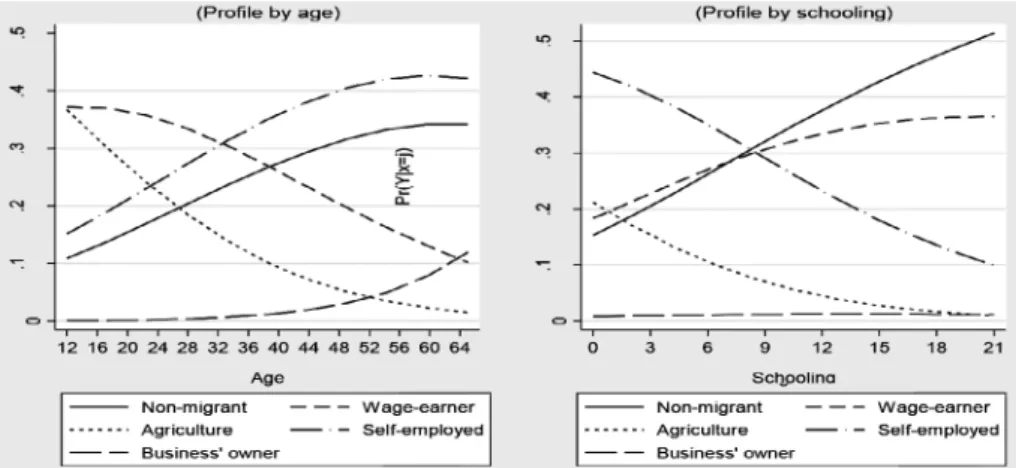
The model including relative deprivation variables and social public programs as best predictors has been estimated. Education as well as age have been introduced in a continuous form so that, we are able of predicting the likelihood pattern for both variables, holding constant the rest of the covariates at their mean. In order to be able of testing the hypothesis of dissimilar country patterns of migration and remittances’ impulse, probabilities have been depicted at a regional level as well. We also want to prove that deprivation variables present a positive impact towards migration choice with a greater incidence for the non-migrant individuals.5
First, we present results according to the migration and labor condition from Figu
-res 1 to 3, second, focus on the relative deprivation variables and their impact on migration condition in tables 3 and 4. Considering age as a proxy for experience and schooling of individuals, it can be observed for the country as a whole in figure 1 that non-migrants increase gradually its participation, however with likelihood levels approaching 25% for age and 34% for schooling. The self-employed con
-dition shows a positive relation as they acquire experience and have an inverse incidence with more education, whereas the salaried migrants exhibits an opposite pattern as pure signal of a depressed Mexican labor market with no conditions of more qualified labor absorption; not at the same pace of labor supply growth for this sort of workers at least.
Figure 1. Likelihood of remittances’ earner and labor position in Mexico, 2005.
Source: Authors’ elaboration according to the data-base of ENIGH, 2005.
Agricultural workers show an inverse performance with greater likelihood for the youth which confirms these sort of workers -as the least qualified and lower expe
-rience- to be those taking the choice of migration, having an average of 33 years old and with no elementary school fulfilled. It can be seen that departing 40 years old, a business’ owner begins to increase the incidence but with a low pace until having the official retirement age level of 65 with a likelihood of 12%.
Figures 2 and 3 show the profiles by regions and it can be seen two generalized worker’s behavior by age as well as schooling: 1) Regional tendency is similar by migration and labor condition (except for the Capital); and 2) non-migrants concentrates more in the capital with an average constant likelihood of 80%. The first evidence bears a resemblance of greater incidence for the agricultural workers in the Center and North regions –traditionally as labor exporter regions– and for the self-employed depicting an U inverse profile for the South region having a break-point around 45 years old with a likelihood close to 75%; the second evi
Figure 2. Regional likelihood of remittances’ earner condition and labor position in Mexico, 2005.
(Profile by age)
Source: Authors’ elaboration according to the data-base of ENIGH, 2005.
Results are in line according to recent empirical evidence (Quinn, 2006, Meza, et al. 2006; Huesca and Calderón, 2007) when finding an inverse relation between schooling and migration incidence for both agricultural and self-employed wor
-kers. Wage-earners are the exception due to the lack of opportunities for this sort of workers having more qualification within Mexico and its regions (Huesca and Calderón, 2007).
Regions with greater incidence of emigration are those known as “traditionals” – the Center and the North of Mexico– but an interesting feature is the Border region which has become an exporter of qualified labor as shown by the evidence in this research. The latter region depicts a positive relation between education and mi
Figure 3. Regional likelihood of remittances’ earner condition and labor position in Mexico, 2005.
(Profile by schooling)
Source: Authors’ elaboration according to the data-base of ENIGH, 2005.
Migration condition and relative deprivation
In order to infer the impacts produced by relative deprivation and public social programs, probabilities and marginal effects are computed and shown in tables 3 and 4 at both, country and regional level.6 It can be observed that categories with a lower incidence of deprivation are those migrating where the non-migrants reveal greater probabilities of suffering a higher lack of needs and so, more deprivation. From table 3 it can be seen that prvj and pry induce a national incidence of 80.2 and 72.3%, respectively for the non-migrants, whereas the rest of occurrence is distributed for the rest of migrant workers, where the wage-earners and self-em
-ployed assemble the highest incidence with no more than 11.6% in the latter group.
Another indicator for deprivation is captured by the social public programs imple
-mented by the federal Mexican government. Those are distributed with a greater share in the non-migrant category, followed by the wage-earners, the self-emplo
yed and the agricultural workers. The migration condition of a business’ owner does not have a relevant influence. It rings a bell that deprivation by needs (prvj) shows a great change in probability with a positive marginal effect of 20 points.
Table 3
Probabilities and marginal effects by migratory condition, position and relative deprivation en Mexico, 2005
Variables migrantsNon- earnerWage- Agricultural worker employedSelf- Business owner Total
Probabilities
Deprivation income (pry) 72.26 10.80 4.12 11.63 1.19 100.0
Deprivation for needs (prvj) 80.23 8.03 3.36 7.81 0.57 100.0
For oportunidades 76.68 10.01 2.69 9.72 0.90 100.0
For Procampo 73.88 11.94 4.10 9.33 0.75 100.0
Marginal effects
Deprivation income (pry) 0.72 -2.27 0.13 1.69 -0.27 0.0
Deprivation for needs (prvj) 20.04 -9.24 -1.69 -7.31 -1.79 0.0
For oportunidades 5.70 -2.21 -1.64 -1.35 -0.50 0.0
For Procampo 2.10 0.09 0.05 -1.62 -0.61 0.0
Source: Authors’ elaboration according to ENIGH, 2005.
In other words, marginal effect for prvj implies that passing to not achieving the norm of needs attained by the community or region in this case; strengthen the condition as non-remittance earner, whereas it changes the sign for the rest of labor positions, verifying the opposite event for this concept.
Counting on the social assistance programs Oportunidades and Procampo reveal the same pattern though, with lower incidence for the non-migrants and change its sign for the rest or workers receiving remittances. Marginal effects for Procampo are not that strong for the wage-earners and agricultural workers since those are near cero. It can be inferred that receiving Procampo assistance does not modify the condition in a significant way for a household with remittances and migrants.
According to our findings and following the NELM hypothesis, Huesca and Cal
-derón (2007) discovered the fact that owning a house increase the likelihood of re
-ceiving remittances and migration for the agricultural and self-employed workers, meanwhile it is reduced for the wage-earners.
The first testable hypothesis in this paper is not confirmed. RD does not increase the likelihood of migration at first sight, but corroborate individuals as non-mi
-grants as well as not being earners of remittances; after individuals have entered into the process of the migration-remittances network RD looses significance exp
-laining the flow of remittances and migration; in contrast, the second hypothesis is confirmed since the empirical evidence does support an positive relation between the level of satisfaction in needs with respect to the probability of receiving remit
-tances regardless the place of origin.
Table 4
Probabilities and marginal effects by regions and relative deprivation in Mexico, 2005
Variables Frontera Norte Centro Capital Sur Península Suma
Probabilidades
Deprivation income (pry) 7.88 10.16 37.76 1.72 28.60 13.88 100.00 Deprivation for needs (prvj) 8.08 10.21 38.59 1.83 28.54 12.75 100.00 For oportunidades 12.41 6.88 36.62 3.89 25.86 14.35 100.00 For Procampo 11.19 13.06 44.03 3.36 15.30 13.06 100.00 Efectos Marginales
Deprivation income (pry) -1.31 -2.63 -0.69 -0.25 3.57 1.31 0.00 Deprivation for needs (prvj) -0.98 -2.84 1.23 -0.02 3.87 -1.25 0.00 For oportunidades 4.69 -5.41 -1.75 2.46 -1.29 1.29 0.00 For Procampo 2.89 1.79 6.37 1.63 -12.47 -0.23 0.00
Source: Authors’ elaboration according to ENIGH, 2005.
It is confirmed that social assistance programs are not a signal of improvement for both the individuals and families, or at best, those have had a reduced coverage and restrained budget. Empirical evidence in this research proved that social assistance programs in Mexico reinforce deprivation with greater incidence in households not receiving remittances and with non-migrants workers.
showing an impulse towards migration, meanwhile, the border was found to be the opposite case where counting on public social assistance increases its labor participation for the same region. The north region observes a negative change of probability in the Oportunidades program with 5.4 percentage points. Last but not least, the center and border regions have a positive impact of Procampo where this program does help to increase the people’s permanency by 6.4 and 2.4 percentage points, respectively.
Our results conform to those obtained in Meza, et al. (2006), Skeldon (2003), Woodruff and Zenteno (2001) and Lozano-Ascencio (2003), where remittances are explained to be good in terms of meeting consumption needs and to cope with basic relative deprivation. Well-fed and healthier individuals can make a greater contribution to their personal development and their regions as Skeldon (2003) remarks. Although, it has been shown that remittances contribute to alleviate po
-verty, their potential to be used partly for wealth creation with jobs and invest
-ments has strongly been criticized. Relative deprivation has forced those families to be joined as important networks, where they even have changed their own en
-vironment when contributing to public infrastructure endowments; parallel to the not sufficient work done by the Mexican Government in those issues, such as the obligation of providing public lighting, paving and sewer, the provision of clean water for domestic service among other services that must have been provided by the public sector, and not paid or financed by the remittances.
Conclusions
This paper analyzes the individual qualities and microeconomic profile of workers that in order to improve well-being expectations in their community, under relative deprivation circumstances, consider the option of migration. Relatively deprived individuals consider their situation as less than a regional standard. It has been con
-sidered variables connected to the NELM hypothesis such as human capital, expe
-rience and a vector of needs additional to income. The results suggest that Mexi
-co-US migration may be increasing relative deprivation in Mexican regions. By regions, it is observed an inverse relation between schooling and being an earner of remittances for traditionally labor exporter regions –Center and North-; meanwhile the Border region shows a positive relation between those variables.
One contribution of this research is to assess the impact of two social assistan
-ces. It is confirmed that the programs have heterogeneous results without having a generalized signal of improvement for the families, or at best, those have been insufficiently applied for the most vulnerable population. Oportunidades and Pro-campo reinforce deprivation of non-migrant individuals relative to those receiving remittances or migrating out of the country. The south is the region with greater evidence holding this fact and the opposite case stands for the Border region. The most traditional regions (Center and North) present a greater expulsion of more qualified workers and it has found the border with a new pattern depicting a posi
-tive relation between schooling and remittances.
There are current facts that can diminish the flow of remittances and migration different from the Mexican internal labor dynamics, such as the anti-immigrant laws applied currently by the US or its economic deceleration; therefore, desig
-ning a public policy must be relevant. Credits and infrastructure oriented to those zones that traditionally push out individuals should be of concern, with the goal of optimizing the possible reduction of the remittance flows. For the Center region should be targeted to the youth, whereas in the border to those elderly groups. The south region observes the need towards the set of entrepreneurial workers, ending up getting a higher social return within this region over the productive activities of households and individuals connected to the network of remittances and migration.
References
Allardt, E. (1993). Having, Loving, Being: An Alternative to the Swedish Mo
-del of Welfare Research. In M. Nussbaum and A. Sen (eds.), The Quality of Life.Oxford: Clarendon: 88-94.
Bourdieu, P. (1980). Le Capital Social, notes provisoires. Actes de la Recherche en Sciences Sociales: 2-3.
Baudasse, T. and C. Calderón Villarreal (2009). Integración comercial del sector agrícola y desigualdad económica en los países en vías de desarrollo. In-vestigación Económica 68 (269): 37-72. Disponible en http://www.scielo. org.mx/scielo.php?script=sci_arttext&pid=S0185-16672009000300002&l
Brauw, A. de, J. Edward Taylor and S. Rozelle (2001). Migration and Incomes in Source Communities: A New Economics of Migration Perspective from China. Mimeo, University of California, Davis.
Calderón, C. and E. Mendoza, (2005), ¿Existen efectos de las remesas y la migra
-ción hacia los EE,.UU. sobre el crecimiento de México? En J. I. Aguirre Ochoa y Z. Tamar Infante (coords.). Remesas y Desarrollo en México. Mé
-xico: Instituto de Investigaciones Económicas y Empresariales de la Univer
-sidad Michoacana de San Nicolás de Hidalgo, Chihuahuense de Cultura y El Colegio de Tlaxcala.
(2006). Impactos regionales de las remesas en el crecimiento econó
-mico de México. Papeles de Población 12 (50): 197-221.
Carriles, J., F. Reyes, A. Vargas and G. Vera (1991). Las remesas familiares pro
-venientes del exterior. Marco conceptual y metodología de medición, Banco de México, Documento de Trabajo 67, julio.
Cummins, R. A. (1996). Domains of Life Satisfaction: An Attempt to Order Chaos. Social Indicators Research 38 (3): 303-328.
Duesenberry, J. (1949). Income, Saving and the Theory of Consumer Behavior. Cambridge: Harvard University Press.
Fei, J. C. H. and G. Ranis (1961). A Theory of Economic development. American Economic Review 51: 533-565.
Fields, G. (1975). Rural-Urban Migration, Urban Unemployment, and Underem
-ployment, and Job Search Activity in LDC’s. Journal of Development Eco-nomics 2 (2): 165-187.
Hanson, G. H. (2004). What Has Happened to Wages in Mexico Since NAFTA? In T. Stevadeordal et al. (eds.). FTA A and Beyond: Prospectsfor Integration in the Americas. Cambridge: Harvard University Press.
Harris, J. R. and M. P. Todaro (1970). Migration, unemployment and develop
Huesca, L. and C. Calderón (2007). Exploración microeconómica regional del perfil de los perceptores de las remesas en México. En J. I. Aguirre Ochoa y Z. Tamar Infante (coords.). Remesas y Desarrollo en México. México: Instituto de Investigaciones Económicas y Empresariales de la Universidad Michoacana de San Nicolás de Hidalgo, Chihuahuense de Cultura y El Co
-legio de Tlaxcala: 205-227.
Immigration and Naturalization Service (INS) (2002). 2001 Statistical Yearbook of the Immigration and Naturalization Service, Washington, DC: Govern
-ment Printing Office.
Lewis, W.A. (1954). Economic development with Unlimited Surplus of Labour. The Manchester School of Economic and Social Studies 20: 139-192. Lozano-Ascencio, F. (1993). Bringing It Back Home. Remittances to Mexico from
Migrant Workers in the United States. Center for US-Mexican Studies: Uni
-versity of California San Diego, Monograph Series No. 37.
Meza, L., C. Pederzini and S. Martínez-Pellegrini (2006). El autoempleo como mecanismo de arraigo de la población en México; caso de cuatro localida
-des. Estudios Demográficos y Urbanos 21 (3): 547-623.
Muñoz, A. R. (2006a). Impacto macroeconómico de las remesas familiares en México, 1950-2004. Tesis doctoral, Universidad Autónoma de Barcelona.
(2006b). Remesas Familiares y su Impacto en el Crecimiento Econó
-mico, 1950-2004. Análisis Económico XXI (46): 23-57.
Narayan, D., R. Chambers, M. K. Shah and P. Petesch (2000). Voices of the Poor. Crying out for Change. New York: Oxford University Press for the World Bank.
Quinn, M. A. (2006). Relative Deprivation wage differentials and mexican migra
-tion. Review of Development Economics 10 (1): 135-153.
Ramos, X. and J. Silber (2005). On the application of efficiency analysis to the study of the dimensions of human development. Review of Income and Weatlh 51 (2): 285-309.
Sana, M. and D. S. Massey (2005). Household Composition, Family Migration, and Community Context: Migrant Remittances in four countries. Social Science Quarterly 86 (2): 509-565.
Schiff, M. (1999a). Trade, Migration and Welfare: The impact of social capital. Policy Research Working Paper WPS 2044, The World Bank.
(1999b). Labor market integration in the presence of social capital.
Policy Research Working Paper WPS 2222, The World Bank.
(2002). Love the neighbor: trade, migration, and social capital.
Euro-pean Journal of Political Economy 18: 87-107.
Scott, J. and J. Freese (2006). Regression Models for Categorical Dependent Va-riables Using Stata, 2nd ed. Texas: Stata Press.
Stark, O. and D. Bloom (1985). The New Economics of Labor Migration. Ameri-can Economic Review 75: 173-178.
, E. Taylor and S. Yitzhaki (1986). Remmitances and Inequality. The
Economic Journal 96 (383): 722-740.
and R. E. B. Lucas (1988). Migration, Remittances, and the Family.
Economic Development and Cultural Change 36 (3): 465-481.
and Y. Q. Wang (2000). A theory of Migration as a Response to Rela
-tive Deprivation. German Economic Review 1 (2): 131-143.
Skeldon, R. (2003). Migration and Poverty. United Kingdom-China: University of Sussex and University of Hong Kong.
Taylor, E. J. and P. L. Martin (2001). Human Capital: Migration and rural po
Todaro, M., (1969). A Model of Labor Migration and Urban Unemployment in Less Developed Countries. American Economic Review 59: 138-148.
(1995). Reflections on Economic Development: Selected essays of
Michael Todaro. Vermont: Edward Elgar Publishing Co.
Veblen, T. (1934). The Theory of the Leisure Class. New York: The Modern Library.
Woodruff, C. and R. Zenteno (2001). Remittances and Microenterprises in Méxi-co, mimeo, San Diego, University of California, August.
Appendix
This part shows the construction of the two variables of relative deprivation used in the empirical analysis, according to the migration condition for an individual or a household having remittances captured in the period of the survey at the third quarterly of 2005, in the Encuesta Nacional de Ingresos y Gastos de los Hogares (ENIGH). Individuals as non-migrants are those not receiving remittances with an average household income less than the standard average income in their commu
-nity or region.
The first variable of deprivation is based on income (pry) defined as a ratio of the individual’s income when it is compared to the regional average income from remittances. The norm cannot be the sample average of remittances for the whole data due to two reasons: 1) RD theory establishes that an individual compares his situation with his “neighbor migrant”, and 2) using the average income from their own region avoids the multicollinearity problems that come about when joining it to the rest of the variables concerning deprivation in the same specification. The formula for income deprivation is
where as the average incomes from non-migrants with a probabilis
-tic restriction explained in the main text in equation (2); and as the average income from remittances in the region j.
The same procedures used in order to elaborate the second deprivation variable of needs (prvj), adding a number of discrete variables codified cero/one in the data base at a household unit level
Table A1
Descriptive statistics of the sample Mexico, ENIGH 2005
Variables Mean Std dev Min Max Obs.
Individuals
Non migrant 0.724 0.390 0 1 5537
Wage-earner 0.121 0.233 0 1 5537
Agricultural worker 0.039 0.088 0 1 5537
Self-employed 0.103 0.187 0 1 5537
Business’ owner 0.014 0.043 0 1 5537
Border 0.087 0.281 0 1 5537
North 0.121 0.327 0 1 5537
Center 0.378 0.485 0 1 5537
Capital 0.023 0.151 0 1 5537
South 0.258 0.438 0 1 5537
Peninsula 0.132 0.339 0 1 5537
Schooling 6.198 4.000 0 19 5537
Age 38.116 15.555 12 65 5537
Age squared 1694.723 1224.466 144 4225 5537
Sex 0.578 0.494 0 1 5537
Household head 0.487 0.500 0 1 5537
Zone 0.367 0.482 0 1 5537
Marital status 0.402 0.490 0 1 4137
Debit/credit card 0.049 0.217 0 1 5537
Household
Home 0.833 0.373 0 1 5464
Dep. ratio 1.613 1.856 0 13 5486
Children 0.567 0.496 0 1 5537
Household size 0.396 0.489 0 1 5537
Phone 0.230 0.421 0 1 5537
Car for work 0.093 0.291 0 1 5537
Refrigerator 0.444 0.497 0 1 5537
Whasing machine 0.284 0.451 0 1 5537
Oportunidades 0.184 0.388 0 1 5537
Procampo 0.070 0.255 0 1 5537
Pry -0.890 3.039 -25 1 5537
Prvj 0.263 0.454 -1 1 5464
Note: Regions have been assembled as follows, Border: Baja California, Chihuahua, Coahuila, Nuevo León, Sonora, Tamaulipas; North: Aguascalientes, Baja California Sur, Durango, Nayarit, SLP, Sinaloa, Zacatecas; Center: Colima, Guanajuato, Hidalgo, Jalisco, Michoacán, Morelos, Puebla, Querétaro, Tlaxcala, Veracruz; Capital: DF, Estado de México; South: Chiapas, Guerrero, Oaxaca; and Peninsula: Campeche, Tabasco, Quintana Roo, Yucatán.