Coping and emotional discomfort in
primary caregivers of cancer patients
Ivonne Nalliely Pérez-Sánchez,* María Luisa Rascón-Gasca,** José de Jesús Salvador Villafaña-Tello***
*Universidad Nacional Autónoma de México, **Instituto Nacional de Psiquiatría Ramón de la Fuente Muñiz. *** Instituto Mexicano del Seguro Social.
ARTÍCULO ORIGINAL
Afrontamiento y malestar emocional
en el cuidador primario del paciente con cáncer
RESUMEN
Objetivos. Evaluar las propiedades psicométricas del índice de evaluación del manejo del cuidado. Comparar estilos de afrontamiento de cuidadores de pacientes con cáncer terminal (CPCT) y cuidadores de pacientes en tratamiento oncológico (CPTO). Revisar la asociación entre estilos de afrontamiento, variables sociodemográficas y malestar emocional en el cuidador. Material y métodos. Se realizó un estudio trasversal y correlacional en el que se entrevistaron a 133 cuidadores, 59 CPTO y 74 CPCT. Se midió malestar emocional (depresión, ansiedad y síndrome de carga) y estilos de afrontamiento. Resultados. El instrumento quedó confor-mado por tres factores (percepción alternativa de eventos, afrontamiento activo y regulación emocional), con una con-sistencia interna de α = 0.78. La percepción alternativa de eventos es el único estilo de afrontamiento con diferencias estadísticamente significativas entre CPCT y CPTO, su pun-tuación fue mayor en CPTO. Además los distintos estilos de afrontamiento permiten predecir con mayor precisión el mal-estar emocional de los CPCT, quienes presentan mayor can-tidad de síntomas de ansiedad, depresión, síndrome de carga y malestares físicos. Tanto en CPCT como en CPTO se encon-tró una alta frecuencia de diversos comportamientos, como llorar, gritar, fumar, comer por ansiedad o beber alcohol, conductas que se relacionaron con malestar emocional intenso. Las puntuaciones de afrontamiento activo fueron mayores cuando los cuidadores tenían apoyo social y un nivel educativo superior (licenciatura o posgrado). Las puntua-ciones de afrontamiento activo disminuían cuando se afectaban distintas áreas de la vida del cuidador, cuando había síntomas físicos o psicológicos y cuando el cuidador tenía más tiempo realizando este rol.
Palabras clave. Afrontamiento. Cuidador primario. Cáncer. Ansiedad. Depresión. Síndrome de carga. Enfermedad terminal.
ABSTRACT
Objectives. To assess the psychometric properties of the Carer’s Assessment of Managing Index. To compare coping styles in caregivers of patients with terminal cancer (CPTC) and caregivers of patients on oncologic treatment (CPOT). To revise the association between coping styles, socio-demogra-phic variables, and emotional discomfort in caregivers. Mate-rial and methods. A cross-sectional and correlational study was conducted, in which 133 caregivers, 59 CPOT and 74 CPTC, were interviewed. Emotional discomfort (depression, anxiety, caregiver’s burden) and coping styles were measured. Results. The instrument was defined by three factors (alternate perception of events, active coping, and emotional regulation), with an internal consistency of α = 0.78. The alternate perception of events was the only coping style with statistically significant difference between CPOT and CPTC, and CPOT score higher in this regard. Different coping styles allow for more accurate prediction of emotional discomfort in CPTC, which showed more symptoms of anxiety, depression, caregiver’s burden and physical illness. The study found a high occurrence of behaviors such as crying, screaming, smok-ing, anxiety eating and alcohol consumption in both CPOT and CPTC, all of which related to intense emotional dis-comfort. Active coping scores were higher when the caregivers had social support and a higher level of education (bachelor’s degree or postgraduate studies). Active coping scores went down when different aspects of the caregiver’s life were affec-ted, when physical or psychological symptoms were present, and when the caregivers had more time in their role.
tients,20 due to the suffering they witness,4 which is
caused by various intense symptoms,21 physical and
mental decline, and increased limitations and de-pendence,22,23 which means an increase in the
amount of time the caregiver has to devote to his or her role.24-26 Furthermore, one must not forget that
caregivers not only help patients cope with death; they also work on their own mourning.8
The effects of poor stress management affect the physical health of caregivers even after the patient has died; the risk of suicide increases in elderly car-egivers,27 as does the risk of dying from physical
and mental health problems.28,29 Additionally,
inade-quate coping also affects the ability of patients to adapt to their illness10,11,14 and the quality of the
attention they receive, since it is associated with dehumanized assistance, anger,30 lack of
organiza-tion, low performance, and attention and memory problems.31
With regard to this, the objectives of this study include:
• To assess the psychometric properties of the Car-ers Assessment of Managing Index.
• To identify any possible differences between the coping styles between caregivers of patients with terminal cancer and caregivers of patients on on-cologic treatment, and
• To measure the relationship between coping styles, socio-demographic variables and emotion-al distress in caregivers (caregiver burden and symptoms of depression and anxiety).
MATERIAL AND METHODS
A non-experimental, correlational study was con-ducted, with the participation of 133 primary car-egivers (identified by their patients), who had been working as caregivers for at least three months. All of them were adults in charge of cancer patients un-dergoing oncologic treatment (chemotherapy, radio-therapy or awaiting surgery) or in charge of terminal cancer patients (under palliative treatment to con-trol the symptoms, since their cancer was consid-ered irreversible and would lead to death in a few months). All the patients received medical care at the Pain and Palliative Treatment Clinic at the High Specialty Medical Unit, in the oncology hospi-tal at Centro Médico Nacional Siglo XXI, in Mexico City. The study was approved by the ethics com-mittee at said institution, and all participants signed their informed consent, establishing the condi-tions of their participation and its anonymous and vol-INTRODUCTION
Being a primary caregiver causes several negative effects such as sleep disorders, lack of free time, economic stress, depression, anxiety,1 poor
self-care,2 low antibody production,3 and therefore, a
high predisposition towards infectious disease, slow cicatrization,4 headaches, insomnia, gastrointestinal
and cardiovascular illness, etc.5,6
These negative effects of caregiving can be medi-ated by the type of coping used by the caregiver and the social support he or she receives.7 The higher
the demands of the illness in relation to the resourc-es of the caregiver to cope with it, the more likely these problems are to develop.8,9
Most studies support the idea that active coping strategies (such as research, planning and problem-solving), or coping strategies oriented to modify emotion (reappraisal, relaxation, etc.), are associat-ed with better results.10 Training caregivers in
problem-solving strategies improves their social functioning and decreases depression and emotional distress.11
On the other hand, it seems that reappraisal reduces caregiver burden,12,13 since it creates the
impression of control over the disease,10 can reduce
health problems, and increases growth and personal well-being. Nevertheless, reappraisal depends on resources such as spirituality and social support.14
Other variables associated with adaptive coping styles are having a caucasian background4,9,15 and
personality traits such as dominance, optimism, and low neuroticism.12
Less adaptive coping styles, i.e. evasive or divert-ing behaviors such as ventdivert-ing negative emotions, avoiding the solution of problems, criticizing or blaming oneself, consuming alcohol or drugs, and denial, are associated with feelings of depression, sleep disorders, low self-esteem, guilt and caregiver burden.7,9,12,16 These coping styles are linked to high
levels of stress,17 multiple roles,18 and a Latin, African
or Asian background.4,9,15 It is worth noting that
certain studies suggest that these coping styles are associated with relapse or the terminal phase in cancer.1,19 However, such studies do not make a
clear comparison between caregivers of patients with terminal cancer (CPTC) and caregivers of patients on oncologic treatment (CPOT), in order to observe any possible differences between their coping styles and ascertain whether coping is associated with the psychological distress suffered by caregivers.
pa-untary nature, as well as their right to leave the study.
The interview with the caregiver allowed the ap-plication of the measuring instruments: coping, anx-iety symptoms, depression symptoms, caregiver’s burden and other socio-demographic variables.
Psychometric instruments
• Zarit Burden Interview. Measures subjective bur-den with 22 Likert-type items with four options; the original instrument was first published in 1980 by Zarit, Reever and Bach-Peterson,32 has
been validated in several languages, and is among the most widely used. Divergence regard-ing evaluation exists. Originally, each item was marked 0-4 points, with a maximum score of 88. However, in Spain the items are often marked 1-5, which can increase the number of caregivers di-agnosed with caregiver burden.
Regarding the cut-off point, some propose that a score under 46 must be interpreted as the absence of caregiver burden, 47-55 as light car-egiver burden, and over 56, heavy carcar-egiver bur-den. However, Zarit himself did not establish any criteria for the cut-off point,33 only in 2006 did a
study suggest that a score between 24 and 26 may identify with 72% accuracy the depressed caregivers diagnosed using the Geriatric Depres-sion Scale, CES-D.34 This study used the
valida-tion established by Alpuche, et al.,32 developed
with 141 caregivers of patients with chronic
degenerative disease. It uses a 0-4 scale for scor-ing, has an internal consistency of α = 0.90, and its concurrent validity with the Perceived Stress Query and the GHQ-28.31 General Health Query. • Hospital Anxiety and Depression Scale (HADS).
Created in 1983 by Zigmod and Snaith, it meas-ures anxiety and depression, excluding somatic symptoms. It consists of 14 Likert-type items with four options. The cut-off point for the de-pression subscale is seven, and eight for the anxiety subscale. In México, it has been validat-ed on subjects with morbid obesity, chronic renal failure, drug dependency, burn victims, elderly people, and women in high risk pregnancy. Its reliability is between α = 0.81 and α = 0.86, and its validity is convergent with structured clinical interview, Beck Depression Scale, Clinical Anxiety Scale and Montgomery-Asberg Rating Scale.35
• Carers Assessment of Managing Index. Created in 1995 by Nolan, Keady and Grant36 to measure
coping strategies in caregivers in charge of Alzheimer patients, it has been validated on car-egivers in charge of elderly or learning-impaired patients. It uses a four-point Likert scale. A high score suggests more effective coping. The origi-nal instrument has 38 items (α = 0.86) and three subscales:
° Problem solving and coping (α = 0.77). ° Alternate perception of events (α = 0.76), and ° Stress symptom-delaying strategies (α = 0.70).
. a
Table 1. Socio-demographic data (sex, education, marital status).
Socio-demographic data Caregivers χ2
(n = 133) CPOT (n = 58) CPTC (n = 75) χ2 p
Sex of the caregiver Male (n = 41) 22 (37.93%) 20 (26.66%) 1.92 0.11 Female (n = 91) 36 (62.07%) 55 (73.33%)
Sex of the patient Male (n = 58) 24 (41.37%) 34 (58.62%) 1.48 0.14 Female (n = 75) 39 (52%) 36 (48%)
Education Elementary (n = 47) 23 (39.65%) 25 (33.33%) 0.878 0.64 High school (n = 47) 19 (32.75%) 28 (37.33%)
College (n = 39) 16 (27.58%) 22 (29.33%)
Marital status Single (27) 10 (17.24%) 17 (22.66%) 3.15 0.36 Married (87) 42 (72.41%) 45 (60%)
Divorced (9) 4 (6.89%) 6 (8%) Domestic partnership (9) 2 (3.44%) 7 (9.33%)
A later study with European caregivers resulted in seven subscales and eliminated one item (α = 0.84). The resulting subscales were:37
• Reasons and realization: α = 0.80. • Internal or external help: α = 0.74. • Free time: α = 0.74.
• Emotional expression: α = 0.69.
• Positive thought and behavior: α = 0.74. • Routine and planning: α = 0.69, and • Stoicism: α = 0.64.
The instrument was translated and validated for this study and the McKeea, et al., version was used.37
• Informal Primary Caregiver Health Query. Creat-ed in 2006 by Ramos, Barcelata, Alpuche, Islas and Salgado,38 it consists of 73 multiple-choice
questions, organized into five sections: socio-demographic characteristics, patient care, perceived social support, preventive health practices, and health perception (checkup at-tendance, exercise, physical symptoms, alcohol and tobacco consumption). It was designed for Mexican caregivers.39
Procedure
The subjects attended out patients at the clinic. Each was asked for his or her voluntary participa-tion, and the instruments were applied via individu-al interview at the doctor’s office, after informed consent was signed. After the interview, the results were explained to each caregiver, and, when neces-sary treatment options were offered. Afterwards, the data were captured for their analysis.
For the validation of the Carers Assessment of Managing Index, the international norms for health instrument adaptation were used;40 the first
transla-tion from English was done by two psychologists whose first language was Spanish. The second translation was independently done by two
psychol-ogists whose first language was English. Two Span-ish-speaking psychologists (different from those who had done the first translation) simultaneously revised all translations in order to choose the most adequate version for each item. Lastly, five judges (psychologists with at least one year of clinical expe-rience with cancer patients or palliative care pa-tients) checked the consistency of the items with regard to the objectives of the test and the coherence of the language, using the Osterlind’s item-objective congruence index.
For the data analysis, the Statistical Program for Social Sciences IBM SPSS, version 21 was used; to check the psychometric properties of the Carers As-sessment of Managing Index, an analysis of internal consistency with Cronbach alpha reliability analysis was conducted, as well as a factorial analysis test and a confirmatory factorial analysis with structur-al equation modeling, using the AMOS Graphics software for SPSS 21.
Next, Pearson correlation tests and linear re-gression were applied in order to analyze the relationship between coping and emotional distress. Student’s t-tests and analysis of variance (ANOVA) were used to compare coping styles with regard to emotional distress and socio-demographic variables, with a reliability level of α < 0.05 in all tests.
RESULTS
Of the 152 caregivers interviewed, only 133 met the criteria for inclusion. The mean age of the car-egivers was 49 years old (SD = 14). The 31.57% (42) of the participants were men and 68.42% (91) were women. The average time elapsed since the cancer diagnosis was 36.27 months (SD = 46.68). 43.6% (58) were caregivers of patients with terminal can-cer (CPTC) and 56.3% (75) were caregivers of pa-tients on oncologic treatment (CPOT) No statistically significant differences were found be-tween the caregivers with regard to sex, education, marital status (Table 1), age or time elapsed since the cancer diagnosis.
Table 2. Comparison of emotional distress between caregivers of patients with terminal cancer (CPTC) and caregivers of patients on oncologic treatment (CPOT).
Emotional distress variables t CPTC, mean (SD) CPOT, mean (SD)
Depression symptoms 2.15* 9.40 (4.60) 7.75 (4.14)
Anxiety symptoms 2.21* 7.35 (4.47) 5.72 (3.96)
Caregivers burden 3.39** 30.09 (15.17) 21.98 (12.29)
Validation of the Carers Assessment of Managing Index
• Review by judges. The percentage of agreement between judges for the Osterlind’s item-objective congruence index, was 84%. Twenty-seven out of 31 items scored a high degree of congruence, two items scored a medium degree, and two scored a low degree. Some items were rewritten. A Stu-dent’s t-test was conducted to ensure that the items acknowledged the difference between high and low scores, as well as an analysis of internal consistency with Cronbach alpha reliability analy-sis. Items 2, 7, 16, and 22 were removed in these steps. Next, an exploratory factorial analysis with orthogonal rotation was conducted. Its adjust-ment measures were KMO = 0.805 and Bartlett’s test of sphericity χ2 = 879.94, p < 0.001, which
resulted in seven factors that explained 57.58% of the variance. The items with high scores in more than one factor were deleted and the analysis was repeated. The adjustment measures were KMO = 0.785, χ2 = 398.20, p < 0.001, with four factors
that explained 52.53% of the variance. The instru-ment was subjected to a confirmatory factorial analysis with structural equations, in which one of the factors was deleted. The adjustment meas-ures for the final test were satisfactory: χ2 =
86.48, gl = 74, p = 0.153, IFI = 0.95, TLI = 0.94, CFI = 0.95, RMSEA = 0.036 IC [0, 0.064].
The scale had an internal consistency of α = 0.78, and consisted of 14 items grouped in three factors:
• Active coping (α = 0.719), which is the search for information or support from the health profes-sionals and problem-solving activities.
• Emotional regulation (α = 0.618), which in-cludes venting emotions, exercising, searching for free time and activities not related with the patient, and
• Alternate perception of events (α = 0.606), in-cluding humor, pleasant memories, positive com-parisons, and focusing on the present.
Coping styles: comparison between CPTC and CPOT.
CPTC scored higher on symptoms of depres-sion, anxiety and caregiver burden. These differ-ences were found to be statistically significant (Table 2).
Regarding the differences between coping styles, alternate perception of events (t = 3.31, p = 0.001) was higher among CPOT (mean = 6.7, SD = 2.47) than among CPTC (mean = 5.3, SD = 2.29); no sig-nificant differences were found among the other cop-ing styles.
.
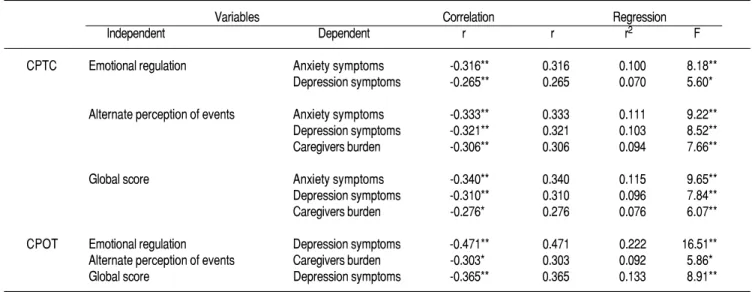
Table 3. Relationship between coping styles and emotional distress.
Variables Correlation Regression
Independent Dependent r r r2 F
CPTC Emotional regulation Anxiety symptoms -0.316** 0.316 0.100 8.18** Depression symptoms -0.265** 0.265 0.070 5.60*
Alternate perception of events Anxiety symptoms -0.333** 0.333 0.111 9.22** Depression symptoms -0.321** 0.321 0.103 8.52** Caregivers burden -0.306** 0.306 0.094 7.66**
Global score Anxiety symptoms -0.340** 0.340 0.115 9.65** Depression symptoms -0.310** 0.310 0.096 7.84** Caregivers burden -0.276* 0.276 0.076 6.07**
CPOT Emotional regulation Depression symptoms -0.471** 0.471 0.222 16.51** Alternate perception of events Caregivers burden -0.303* 0.303 0.092 5.86* Global score Depression symptoms -0.365** 0.365 0.133 8.91**
Association between coping,
socio-demographic variables and emotional distress in the caregiver
Regarding emotional stress variables (symptoms of anxiety, depression and caregiver burden), the re-gression analysis showed that global coping (score of the whole scale), emotional regulation and alter-nate perception of events predict emotional distress variables better for CPTC than for CPOT (Table 3).
Regarding non adaptive ways of coping with events, no differences were found between CPTC and CPOT. It must be stressed that 62.8% of the caregiv-ers sampled vent their anger by screaming. Among them, the scores are higher for symptoms of depres-sion (t = 3.76, p < 0.001, mean = 7.60, SD = 4.39) and caregiver burden (t = 2.04, p < 0.05, mean = 28.26, SD = 14.90), in contrast to caregivers who do not exhibit such behavior. These have the following data for symptoms of depression: mean = 4.95,
T l
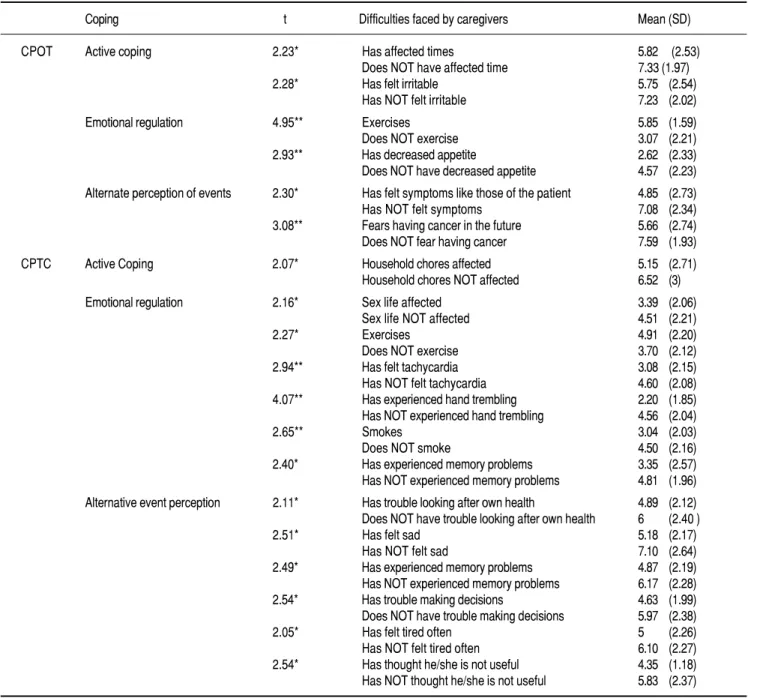
Table 4. Coping styles and difficulties faced by CPTC and CPOT.
Coping t Difficulties faced by caregivers Mean (SD)
CPOT Active coping 2.23* Has affected times 5.82 (2.53) Does NOT have affected time 7.33 (1.97) 2.28* Has felt irritable 5.75 (2.54)
Has NOT felt irritable 7.23 (2.02)
Emotional regulation 4.95** Exercises 5.85 (1.59) Does NOT exercise 3.07 (2.21) 2.93** Has decreased appetite 2.62 (2.33) Does NOT have decreased appetite 4.57 (2.23)
Alternate perception of events 2.30* Has felt symptoms like those of the patient 4.85 (2.73) Has NOT felt symptoms 7.08 (2.34) 3.08** Fears having cancer in the future 5.66 (2.74) Does NOT fear having cancer 7.59 (1.93)
CPTC Active Coping 2.07* Household chores affected 5.15 (2.71) Household chores NOT affected 6.52 (3)
Emotional regulation 2.16* Sex life affected 3.39 (2.06) Sex life NOT affected 4.51 (2.21)
2.27* Exercises 4.91 (2.20)
Does NOT exercise 3.70 (2.12) 2.94** Has felt tachycardia 3.08 (2.15) Has NOT felt tachycardia 4.60 (2.08) 4.07** Has experienced hand trembling 2.20 (1.85) Has NOT experienced hand trembling 4.56 (2.04)
2.65** Smokes 3.04 (2.03)
Does NOT smoke 4.50 (2.16) 2.40* Has experienced memory problems 3.35 (2.57) Has NOT experienced memory problems 4.81 (1.96)
Alternative event perception 2.11* Has trouble looking after own health 4.89 (2.12) Does NOT have trouble looking after own health 6 (2.40 )
2.51* Has felt sad 5.18 (2.17)
Has NOT felt sad 7.10 (2.64) 2.49* Has experienced memory problems 4.87 (2.19) Has NOT experienced memory problems 6.17 (2.28) 2.54* Has trouble making decisions 4.63 (1.99) Does NOT have trouble making decisions 5.97 (2.38) 2.05* Has felt tired often 5 (2.26) Has NOT felt tired often 6.10 (2.27) 2.54* Has thought he/she is not useful 4.35 (1.18) Has NOT thought he/she is not useful 5.83 (2.37)
SD = 3.60 and caregivers burden mean = 23.10, SD = 13.54.
Besides, 73% of the caregivers vent their emo-tions through weeping. It was found that these score higher on depression symptoms (t = 2.20, p < 0.05, mean = 7.10, SD = 4.27), compared with those who do not vent through weeping (mean = 5.26, SD = 4.16).
On the other hand, it is important to note that half the caregivers smoked or drank alcohol to cheer up, although only 25% of these were regular smok-ers and 16.54% were regular drinksmok-ers. Also, 46.96% thinks they ate more than usual in the last months, and anxiety symptoms were more common among them (t = 2.62, p < 0.05), as well as caregiver bur-den (t = 2.09, p < 0.05).
With regard to the time the caregivers have been working as such, it was found that the scores for ac-tive coping are higher among caregivers who have been caring their patient for a shorter time (caregiv-ers who have been with a patient for less than a year: mean= 4.69, SD = 2.38; 1 to 3 years: mean = 4.09, SD = 2.19; over 4 years: Mean = 3.42, SD = 2.20; F = 3.09, p < 0.05, gl = 3, 130, 132).
As for the habits of the caregivers, it is important to note that those who smoked and/or did not exer-cise scored lower on emotional regulation, unlike those whose hobbies or household chores were af-fected by their current job like caregiver, and who scored lower on active conping
The coping scores were also reduced when the caregivers had difficulties looking after their own
health, found in themselves symptoms similar to those of their patients, expressed fear of suffering cancer in the future, or showed symptoms such as sadness, lack of appetite, fatigue, tachycardia, trem-bling hands, thoughts of futility, memory loss, or difficulty making decisions (Table 4).
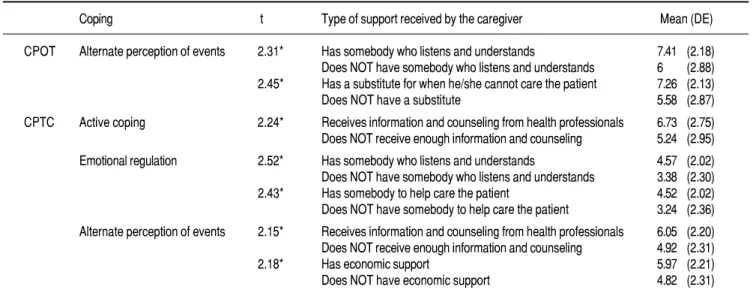
With regard to the support received by the car-egivers, information and counseling from health professionals were associated with higher active cop ing scores in CPTC and higher alternate perception of events scores for both kinds of caregivers. But it was also observed that alternate perception of events scores were higher for CPTC with economic support and CPOT with somebody who could care the patient if the caregiver could not be present.
Alternate perception of events was higher for both kinds of caregivers when they had somebody who could listen to them, understand them or help with caregiving tasks. This kind of support was also associated with higher emotional regulation scores, but only for caregivers of terminal patients (Table 5). Lastly, coping scores were higher for caregivers with college education (graduate and postgraduate), and in those who are the children of the patient un-der their care. These differences only came up among caregivers of terminal patients (Table 6).
DISCUSSION
Regarding the adaptation of the Carers Assess-ment of Managing Index, compared to previous ad-aptations,36,37 several active coping items were
T l e
Table 5. Social support and coping in caregivers.
Coping t Type of support received by the caregiver Mean (DE)
CPOT Alternate perception of events 2.31* Has somebody who listens and understands 7.41 (2.18) Does NOT have somebody who listens and understands 6 (2.88) 2.45* Has a substitute for when he/she cannot care the patient 7.26 (2.13) Does NOT have a substitute 5.58 (2.87)
CPTC Active coping 2.24* Receives information and counseling from health professionals 6.73 (2.75) Does NOT receive enough information and counseling 5.24 (2.95)
Emotional regulation 2.52* Has somebody who listens and understands 4.57 (2.02) Does NOT have somebody who listens and understands 3.38 (2.30) 2.43* Has somebody to help care the patient 4.52 (2.02) Does NOT have somebody to help care the patient 3.24 (2.36)
Alternate perception of events 2.15* Receives information and counseling from health professionals 6.05 (2.20) Does NOT receive enough information and counseling 4.92 (2.31) 2.18* Has economic support 5.97 (2.21) Does NOT have economic support 4.82 (2.31)
deleted due to their low frequency, such as problem prevention, testing different solutions, planning schedules or activities, and identifying priorities, among others, however, it is important to test if these results reoccur with other Mexican caregiv-ers. For now, previous studies4,9,15 suggest that
Latin caregivers use these strategies less often than Caucasian caregivers. The results seem to conform to this. The test is an important contribu-tion of the study; the quescontribu-tions show the activities in the everyday experience of caregivers, and since the test is short, its application is easy.
As for the second objective of the study, to ascer-tain if there are any differences between the coping styles of CPTC and CPOT, only alternate perception of events shows differences and it is higher for CPOT, since CPTC are less capable of using this strategy due to stressing situations increasing when the patient gets worse22,23 and demand for care
grows.24-26 The same reasons can influence
emotion-al distress in the caregiver, as in other studies, where such distress is higher for CPTC.20
The last objective was to measure the relation-ship between coping, socio-demographic variables, and emotional distress in caregivers (caregiver bur-den, depression and anxiety symptoms), It was found that emotional regulation was inversely relat-ed to emotional distress, especially in CPTC, while active coping was not related in any way. These re-sults were unexpected, given that in other stud-ies,10,11 active coping reduces emotional distress and
emotional regulation strategies increase it.9,10,12,16
On the other hand, alternate perception of events showed an inverse relationship with caregivers bur-den, which has been documented before,12,13 but also
showed an inverse relationship with anxiety and de-pression symptoms, a result that reflects important cultural differences, since, according to other stud-ies, Latin caregivers use more coping styles focused on reappraisal or emotional regulation,4,9,15
appar-ently due to the emotional discharge they cause. Furthermore, the caregivers said there were not many situations they could foresee or control re-garding the health of their patients.
Table 6. Relationship between coping styles, education and kinship of terminal patient caregivers.
Coping Caregivers ANOVA Tukey test
(n = 75) Mean SD g l F Mean difference
• Education
Active coping
Elementary (n = 24) 4.12 2.99 2 7.95** Elementary High school -2.44** High school (n = 28) 6.57 2.53 72 Elementary College -2.87** College (n = 23) 7 2.57 74
Emotional regulation
Elementary 3.25 2.11 2 5.76** Elementary College -2.01** High school 3.85 2.36 72 High school College -1.40*
College 5.26 1.62 74
Alternate perception of events
Elementary 4.7 2.42 2 3.91* Elementary College -1.76* High school 5.21 2.06 72
College 6.47 2.23 74
Global score
Elementary 12.03 6.59 2 8.81** Elementary College -6.65** High school 15.64 5.27 72
College 18.73 4.13 74
• Kinship
Global score
Parent (n = 6) 12 5.16 3 2.98* Child Spouse 4.04* Child (n = 32) 17.35 5.59 70
Spouse (n = 30) 13.26 5.53 74 Sibling (n = 7) 19.16 6.3
As for non-adaptive coping styles, activities such as weeping, screaming, smoking, eating and drink ing alcohol to decrease anxiety were associated with higher emotional distress. Other studies9,10,12,16 have
also pointed to their negative effect on caregivers, but, unlike previous research,1,19 this study did not
find a higher occurrence of these activities in CPTC. They were more frequent, however, in caregivers with low coping scores, perhaps because a lack of coping causes a higher perception of stress.17
A lack of coping is also associated with decreased self-care behavior (difficulties looking after their own health, lack of exercise, smoking) and health concerns (looking for symptoms similar to those of the patient or fear of getting cancer); decreased self-care behavior has also been associated with stress.2
Problems with coping are also associated with de-cline in different areas of life (sexuality, household chores and hobbies) and several symptoms such as lack of appetite, irritability,30 tachycardia, trembling
hands, sadness, memory loss,31 difficulty making
de-cisions, and fatigue. CPTC showed these negative consequences more often.
This makes sense in light of transactional stress model: CPTC have higher demands, and those with low social support7 and low coping scores
(regard-less of the type of patient under their care) have few-er resources; this lack of balance between demands and resources can cause the observed negative ef-fects: more symptoms, health concerns, and de-creased self-care behavior.8,9
Lastly, among the limitations to this study, it is important to note that there are few males in the sample. This limitation is shared with other studies, where the number of male caregivers does not usu-ally exceed one fourth of the samples. This is, no doubt, due in no small part to the roles culturally assigned to each gender, and it hinders the observa-tion of differences between men and women.
Another important limitation of this study is the fact that most patients were referred to the clinic for the treatment of pain. The stress caused by this symptom on caregivers15 might affect the reported
emotional distress scores. Another point that could be expanded upon in future research is the use of non-adaptive behaviors for coping with stress.
ACKNOWLEDGEMENTS
The first author received funding from the Na-tional Science and Technology Counsel’s naNa-tional grant program for her doctorate degree, under the supervision of the second author.
The authors wish to thank the caregivers inter-viewed for this study, as well as the personnel work ing at the Pain and Palliative Treatment Clinic at the High Specialty Medical Unit, in the Oncology Hospital at Centro Médico Nacional Siglo XXI, and doctors Rebeca Robles Garcia and Angelica Rivers Rosas for their feedback and encouragement.
REFERENCES
1. Stajduhar K, Martin W, Barwich D, Fyles G. Factors Influenc-ing Family Caregivers’ ability to cope with providInfluenc-ing end-of-life cancer care at home. Cancer Nursing 2008; 31(1): 77-85. 2. Nguyen M. Nurse’s assessment of caregiver burden. Medsurg
nursing 2009; 18(3): 147-51.
3. Janevic M, Connell C. Exploring self-care among dementia caregivers: The role of perceived support in accomplishing ex-ercise goals. J Women & Aging 2004; 16(2): 71-86.
4. Herbert R, Schulz R. Caregiving at the End of Life. Journal of palliative medicine 2006; 9(5): 1174-87.
5. Araya L, Guamán M, Godo C. Estrés del cuidador de un enfer-mo terminal, Universidad Austral de Chile, 2006. Disponible en: http://medicina.uach.cl/saludpublica/diplomado/contenido/ t r a b a j o s / 1 / L a % 2 0 S e r e n a % 2 0 2 0 0 6 / Estres_de_%20cuidado_%20de_%20enfermo_terminal.pdf. 6. Expósito. C. La calidad de vida en los cuidadores primarios de
pa-cientes con cáncer. Revista Ciencia Médica La Habana 2008; 7(3). Disponible en http:// scielo.sld.cu/scielo.php?script=sci_arttext& pid=S1729-519X2008000300004&lng=es.
7. Lavretsky H. Stress and depression in informal family caregiv-ers of patients with Alzheimer’s disease. Aging Healt 2005; 1(1): 117-33.
8. Hudson P. A conceptual model and key variables for guiding sup-portive interventions for family caregivers of people receiving pal-liative care. Palpal-liative and Supportive Care 2003; 1(5): 353-65. 9. Pinquart M, Sörensen S. Ethnic differences in stressors,
re-sources, and psychological outcomes of family caregiving: A meta-analysis. The Gerontologist 2005; 45(1): 90-106. 10. Lambert S, Girgis A, Turner J, McElduff P, Kayser K,
Vallen-tine P. A pilot randomized controlled trial of the feasibility of a self-directed coping skills intervention for couples facing pros-tate cancer: Rationale and design. Health and Quality of Life Outcomes 2012; 10: 119-30.
11. Ko C, Malcarne V, Varni J, Roesch S, Banthia R, Greenbergs H, et al. Problem-solving and distress in prostate cancer pa-tients and their spousal caregivers. Support Care Cancer 2005; 13(6): 367-74.
12. Carter P, Acton G. Personality and coping predictors of de-pression and sleep problems among caregivers of Individuals who have cancer. Journal of Gerontological Nursing 2006; 32(2): 45-53.
13. Di Mattei V, Prunas A, Novella L, Marcone A, Cappa S, Sarno L. The burden of distress in caregivers of elderly demented pa-tients and its relationship with coping strategies. Neurological Sciences 2008; 29(6): 383-9.
14. Jones P, Winslow B, Lee J, Burns M, Zhang X. Development of a caregiver empowerment model to promote positive out-comes. Journal of Family Nursing 2011; 17(1): 11-28. 15. Farran C. Family caregiver intervention research: where have
we been? Where are we going? Journal of Gerontological Nursing 2001; 27(7): 38-45.
17. Mora de la Rubia J, Martínez J. Reacción ante el diagnóstico de cáncer de un hijo: estrés y afrontamiento. Psicología y Salud 2009; 19(2): 189-96.
18. Bernard L, Guarnaccia C. Two Models of caregiver strain and bereavement adjustment: A comparison of husbands and daughter caregivers of breast cancer hospice patients. The Ger-ontologist 2003; 43(6): 808-16.
19. Espada M, Grau C, Fortes M. Enseñar estrategias de afrontamiento a padres de niños con cáncer a través de un cortometraje. Anales del Sistema Sanitario de Navarra 2010; 33(3): 259-69.
20. Hodges L, Humphris G, Macfarlane, G. A meta-analytic inves-tigation of the relationship between the psychological distress of cancer patients and their carers. Social Science & Medicine 2005; 60(1): 1-12.
21. Dumont S, Turgeon J, Allard P, Gagnon P, Charbonneau C, Vezina L. Caring for a loves one with advanced cancer: Deter-minants of psychological distress in family caregivers. Journal of Palliative Medicine 2006; 9(4): 912-21.
22. Gaugler J, Linder J, Given C, Kataria R, Tucker G, Regine F. Family cancer caregiving and negative outcomes: The direct and meditational effects of psychosocial resources. Journal of Family Nursing 2009; 15(4): 417-44.
23. Jordhoy M, Ringdal G, Helbostad J, Oldervoll L, Loge J, Kaa-sa S. Assessing physical functioning: A systematic review of quality of life measures developed for use in palliative care. Palliative Medicine 2007; 21(8): 673-82.
24. Barzil K, Bedard M, Willson K, Hode M. Caregiving and its impact on families of the terminally ill. Aging and Mental Healt 2003; 7(5): 376-82.
25. Kim J, Spillers R. Quality of life of family caregivers at 2 years after a relative’s cancer diagnosis. PsychoOncology 2010; 19 (4): 431-40.
26. Mendez-Luck C, Kennedy D, Wallace S. Concepts of burden in giving care to older relatives: A study of female caregivers in Mexico City neighborhood. Journal of Cross-Cultural Gerontology 2008; 23(3): 265-82.
27. Hill S. Self-Care in Caregiving. Journal of Human Behavior in the Social Environment 2007; 14(1): 95-115.
28. Harding R, Higginson J. What is the best way to help caregiv-ers in cancer and palliative care? A systematic literature review of interventions and their effectiveness. Palliative Medicine 2003; 17(1): 63-74.
29. Mittelma M. Taking care of the caregivers. Geriatric Psychia-try 2005; 18(6) 633-09.
30. Halm M, Treat-Jacobso D, Lindquist R, Savik K. Caregiver burden and outcomes of caregiving of spouses of patients who undergo coronary artery bypass graft surgery. Heart & Lung 2007; 36(3): 170-87.
31. Mackenzie C, Smith M, Hasher L, Leach L, Behil P. Cognitive functioning under stress: Evidence from informal caregivers of
palliative care. Journal of Palliative Medicine 2007; 10(3): 749-58.
32. Alpuche V, Ramos B, Rojas M, Figueroa C. Validez de la en-trevista de carga de zarit en una muestra de cuidadores primari-os informales. Psicología y Salud 2008; 18(2): 237-45. 33. Álvarez L, González AM, Muñoz P. El cuestionario de
sobre-carga del cuidador de Zarit. Cómo administrarlo e interpretar-lo. Gaceta Sanitaria 2008; 22(6): 618-20.
34. Schreiner A, Morimoto T, Arai Y, Zarit S. Assessing family car-egiver’s mental health using a statistically derived cut-off score for the Zarit Burden Interview. Aging & Mental Health 2006; 10(2): 107-11.
35. López J, Vázquez V, Arcilla D, Sierra A, González J, Salin R. Exactitud y utilidad diagnóstica del Hospital Anxiety and De-pression Scale (HAD) en una muestra de sujetos obsesos mexi-canos. Rev Invest Clin 2002; 54(5): 403-9.
36. Yeh PM, Bull M. Influences of spiritual well-being and coping on mental health of family caregivers for elders. Gerontologi-cal Nursing 2009; 2(3): 173-81.
37. McKeea K, Spazzafumob. L, Nolana M, Wojszelc. B, Lamu-rab. G, Bienc. B. Components. of the difficulties, satisfactions and management strategies of carers of older people: A princi-pal component analysis of CADI-CASI-CAMI. Aging & Men-tal Health 2009; 13(2): 255-64.
38. Ramos del Río B, Barcelata J, Alpuche R, Islas S, Salgado G. Evaluación diagnóstica del síndrome de burnout y entrenami-ento para el manejo del estrés en cuidadores primarios infor-males de enfermos crónico degenerativos. México: Facultad de Estudios Superiores Zaragoza, UNAM. 2006.
39. Islas-Salas NL, Ramos del Río B, Aguilar-Estrada MG, García-Guillén ML. Perfil psicosocial del cuidador primario informal del paciente con EPOC. Revista del Instituto Nacional de Enferme-dades Respiratorias 2006; 19(4): 266-71. Disponible en: http:// www.scielo.org.mx/scielo.php?script=sci_ arttext& pid=S0187-75852006000400006&lng=es.
40. Costa N, De Brito E. Adaptación cultural de instrumentos utili-zados en salud ocupacional. Revista Panamericana de Salud Pública 2002; 11(2): 109-11.
Reimpresos:
Ivonne Nalliely Pérez-Sánchez Felix Palavicini, Núm. 13 Col. Constitución de 1917 09260, México, D.F. Tel.: 5612-7759
Correo electrónico: [email protected]