a. Division of Nephrology, Department of Medicine, University of Tennessee Health Science Center, Memphis, TN, United States;
b. Nephrology Section, Memphis VA Medical Center, Memphis, TN, United States;
c. Department of Pediatrics, Perelman School of Medicine at the University of Pennsylvania, Philadelphia, PA, United States;
d. CNR - IFC Clinical Epidemiology and Pathophysiology of Renal Diseases and Hypertension, Reggio Calabria, Italy
Obesity and kidney disease:
hidden consequences of the epidemic
a,b c d
Kovesdy Csaba P. , Furth Susan , Zoccali Carmine , on behalf of the
World Kidney Day Steering Committee*
Abstract
Obesity has become a worldwide epidemic, and its prevalence has been projected to
grow by 40% in the next decade. This increasing prevalence has implications for the
risk of diabetes, cardiovascular disease and also for Chronic Kidney Disease. A high
body mass index is one of the strongest risk factors for new-onset Chronic Kidney
Disease. In individuals affected by obesity, a compensatory hyperfiltration occurs to
meet the heightened metabolic demands of the increased body weight. The increase in
intraglomerular pressure can damage the kidneys and raise the risk of developing Chronic Kidney Disease in the long-term. The
incidence of obesity-related glomerulopathy has increased ten-fold in recent years. Obesity has also been shown to be a risk factor
for nephrolithiasis, and for a number of malignancies including kidney cancer. This year the World Kidney Day promotes
education on the harmful consequences of obesity and its association with kidney disease, advocating healthy lifestyle and health
policy measures that makes preventive behaviors an affordable option.
Key words:
obesity, chronic kidney disease, nephrolithiasis, kidney cancer, prevention
Correspondence:
World Kidney Day
International Society of Nephrology, in collaboration with International Federation of Kidney Foundation Rue de Fabriques 1B, 1000, Brussels, Belgium
E-mail: [email protected]
Revista Médica MD
40
Csaba y cols.
Study Patients Exposure Outcomes Results Comments
Prevention of Renal and Vascular End-Stage Disease (PREVEND)
8 Study
7,676 Dutch individuals without diabetes
Elevated BMI (overweight and obese*), and central fat distribution (waist-hip ratio)
-Presence of urine albumin 30-300 mg/24h -Elevated and diminished GFR
-Obese + central fat: higher risk of albuminuria -Obese +/- central fat: higher risk of elevated GFR
-Central fat +/- obesity associated with diminished filtration
Cross sectional analysis
Multinational study of hypertensive
20 outpatients
20,828 patients from 26 countries
BMI and waist circumference
Prevalence of albuminuria by dip stick
Higher waist circumference associated with albuminuria independent of BMI
Cross sectional analysis
Framingham Multi-Detector Computed Tomography (MDCT)
22 cohort
3,099 individuals Visceral adipose tissue (VAT) and
subcutaneous adipose tissue (SAT)
Prevalence of UACR >25 mg/g in women and >17 mg/g in men
VAT associated with albuminuria in men, but not in women
Cross sectional analysis
CARDIA (Coronary Artery Risk
Development in Young 11 Adults) study
2,354 community-dwelling individuals with normal kidney function aged 28-40 years
-Obesity (BMI >30 kg/m2)
-Diet and lifestyle-related factors
Incident microalbuminuria
Obesity (OR 1.9) and unhealthy diet (OR 2.0) associated with incident albuminuria
Low number of events
Hypertension Detection and Follow-Up 10 Program 5,897 hypertensive adults
Overweight and obese BMI* vs. normal BMI
Incident CKD (1+ or greater proteinuria on urinalysis and/or an eGFR <60 mL/min/1.73 m2)
Both overweight (OR 1.21) and obesity (OR 1.40) associated with incident CKD
Results unchanged after excluding diabetics
Framingham Offspring 9
Study
2,676 individuals free of CKD stage 3
High vs. normal BMI* -Incident CKD stage 3 -Incident proteinuria
-Higher BMI not associated with CKD3 after adjustments -Higher BMI associated with increased odds of incident proteinuria Predominantly white, limited geography Physicians' Health 13 Study
11,104 initially healthy men in US
-BMI quintiles -Increase in BMI over time (vs. stable BMI)
Incident eGFR <60 2 mL/min/1.73 m
-Higher baseline BMI and increase in BMI over time both associated with higher risk of incident CKD
Exclusively men
Nation-wide US Veterans Administration
14 cohort
3,376,187 US veterans with baseline eGFR ≥60
2 mL/min/1.73 m
BMI categories from 2 <20 to >50 kg/m
Rapid decline in kidney function (negative eGFR slope of >5 2 mL/min/1.73 m )
2 BMI >30 kg/m associated with rapid loss of kidney function
Associations more accentuated in older individuals
Nation-wide population-based study
12 from Sweden
926 Swedes with moderate/advanced CKD compared to 998 controls
2
BMI ≥25 vs. <25 kg/m CKD vs. no CKD Higher BMI associated with 3x higher risk of CKD
-Risk strongest in diabetics, but also significantly higher in non-diabetics -Cross sectional analysis
Nation-wide population 17 based study in Israel
1,194,704 adolescent males and females examined for military service
Elevated BMI (overweight and obesity) vs. normal BMI*
Incident ESRD Overweight (HR 3.0) and obesity (HR 6.89) associated with higher risk of ESRD
Associations strongest for diabetic ESRD, but also significantly higher for non-diabetic ESRD
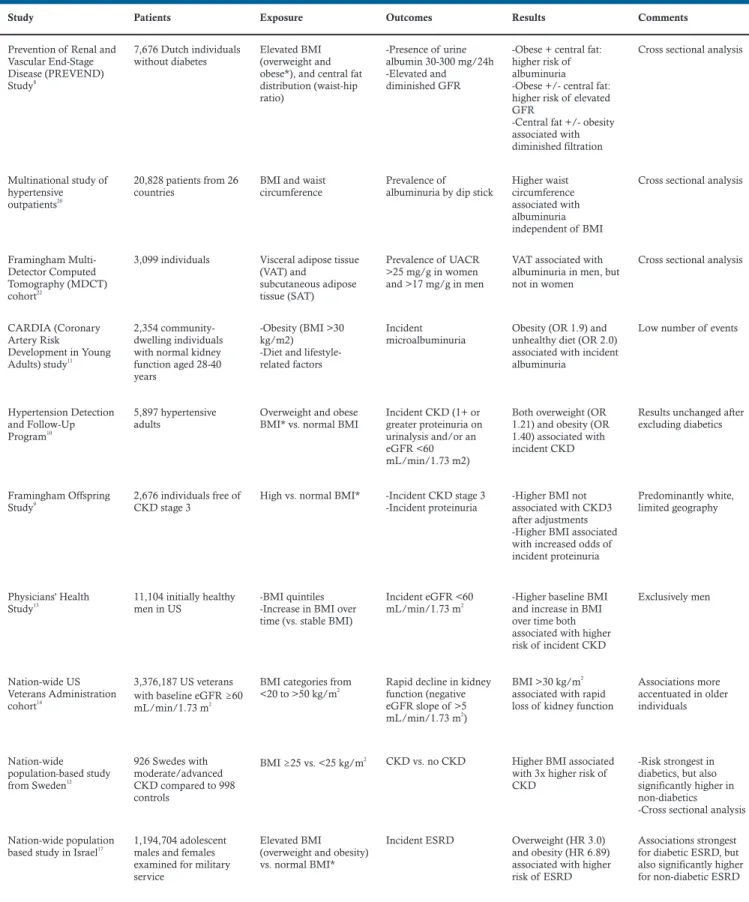
Cuadro 1.
Studies examining the association of obesity with various measures of CKD
2 2 2 2 2
*Normal weight: BMI 18.5 to 24.9 kg/m ; overweight: BMI 25.0 to 29.9 kg/m ; class I obesity: BMI 30.0 to 34.9 kg/m ; class II obesity: BMI 35.0 to 39.9 kg/m ; class III obesity: BMI ≥40 kg/m
BMI, body mass index; CKD, chronic kidney disease; DM, diabetes mellitus; eGFR, estimated glomerular filtration rate; ESRD, end stage renal disease; HR, hazard ratio; OR, odds ratio; UACR, urine albumin-creatinine ratio
Obesity and kidney disease
The Nord-Trøndelag Health Study
(HUNT-15 1)
74,986 Norwegian adults
BMI categories* Incidence of ESRD or renal death
2 BMI >30 kg/m associated with worse outcomes
Associations not present in individuals with BL <120/80 mmHg
Community-based screening in Okinawa,
16 Japan
100,753 individuals >20 years old
BMI quartiles Incidence of ESRD Higher BMI associated with increased risk of ESRD in men, but not in women
Average BMI lower in Japan compared to Western countries
Nation-wide US Veterans Administration
19 cohort
453,946 US veterans with baseline eGFR<60
2 ml/min per 1.73 m
BMI categories from <20 to >50 kg/m2
-Incidence of ESRD -Doubling of serum creatinine -Slopes of eGFR
Moderate and severe obesity associated with worse renal outcomes
Associations present but weaker in patients with more advanced CKD
Kaiser Permanente 18 Northern California
320,252 adults with and without baseline CKD
Overweight, class I, II and extreme obesity; vs. normal BMI*
Incidence of ESRD Linearly higher risk of ESRD with higher BMI categories
Associations remained present after adjustment for DM, hypertension and baseline CKD
REGARDS (Reasons for Geographic and Racial Differences in
21 Stroke) Study
30,239 individuals Elevated waist circumference or BMI
Incidence of ESRD BMI above normal not associated with ESRD after adjustment for waist circumference -Higher waist circumference associated with ESRD
Association of waist circumference with ESRD became on-significant after adjustment for comorbidities and baseline eGFR and proteinuria
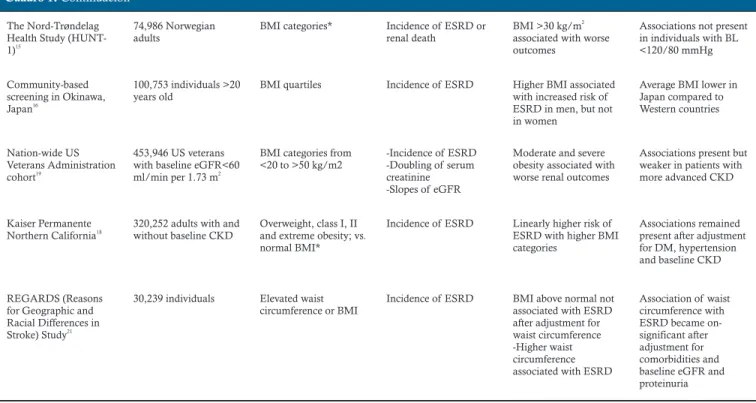
Cuadro 1.
Continuación
2 2 2 2 2
*Normal weight: BMI 18.5 to 24.9 kg/m ; overweight: BMI 25.0 to 29.9 kg/m ; class I obesity: BMI 30.0 to 34.9 kg/m ; class II obesity: BMI 35.0 to 39.9 kg/m ; class III obesity: BMI ≥40 kg/m
Csaba y cols.
Revista Médica MD
Volumen 8, número 2; noviembre 2016 - enero 2017
42
Figure 1. Putative mechanisms of action whereby obesity causes chronic kidney disease.
Csaba y cols.
Revista Médica MD
Volumen 8, número 2; noviembre 2016 - enero 2017
44
Obesity and kidney disease
Referencias bibliográficas
1. Forouzanfar MH, Alexander L, Anderson HR, et al. Global, regional, and national comparative risk assessment of 79 behavioural, environmental and occupational, and metabolic risks or clusters of risks in 188 countries, 1990-2013: a systematic analysis for the Global Burden of Disease Study 2013. Lancet
386:2287-2323, 2015
2. Flegal KM, Kruszon-Moran D, Carroll MD, et al.: Trends in Obesity Among Adults in the United States, 2005 to 2014. JAMA 315:2284-2291, 2016 3. Cattaneo A, Monasta L, Stamatakis E, et al.
Overweight and obesity in infants and pre-school children in the European Union: a review of existing data. Obes Rev 11:389-398, 2010
4. Olaya B, Moneta MV, Pez O, Bitfoi A, et al. Country-level and individual correlates of overweight and obesity among primary school children: a cross-sectional study in seven European countries. BMC Public Health 15:475, 2015
5. Subramanian SV, Perkins JM, Ozaltin E, Davey SG: Weight of nations: a socioeconomic analysis of women in low- to middle-income countries. Am J Clin Nutr 93:413-421, 2011
6. Tsujimoto T, Sairenchi T, Iso H, et al. The dose-response relationship between body mass index and the risk of incident stage >/=3 chronic kidney disease in a general japanese population: the Ibaraki prefectural health study (IPHS). J Epidemiol 24:444-451, 2014
7. Elsayed EF, Sarnak MJ, Tighiouart H, et al. Waist-to-hip ratio, body mass index, and subsequent kidney disease and death. Am J Kidney Dis 52:29-38, 2008 8. Pinto-Sietsma SJ, Navis G, Janssen WM, de ZD,
Gans RO, de Jong PE: A central body fat distribution
is related to renal function impairment, even in lean subjects. Am J Kidney Dis 41:733-741, 2003 9. Foster MC, Hwang SJ, Larson MG, et al.
Overweight, obesity, and the development of stage 3 CKD: the Framingham Heart Study. Am J Kidney Dis 52:39-48, 2008
10. Kramer H, Luke A, Bidani A, et al. Obesity and prevalent and incident CKD: the Hypertension Detection and Follow-Up Program. Am J Kidney Dis
46:587-594, 2005
11. Chang A, Van HL, Jacobs DR, Jr., Liu K, et al. Lifestyle-related factors, obesity, and incident microalbuminuria: the CARDIA (Coronary Artery Risk Development in Young Adults) study. Am J Kidney Dis 62:267-275, 2013
12. Ejerblad E, Fored CM, Lindblad P, et al. Obesity and risk for chronic renal failure. J Am Soc Nephrol
17:1695-1702, 2006
13. Gelber RP, Kurth T, Kausz AT, et al. Association between body mass index and CKD in apparently healthy men. Am J Kidney Dis 46:871-880, 2005 14. Lu JL, Molnar MZ, Naseer A, et al.Association of
age and BMI with kidney function and mortality: a cohort study. Lancet Diabetes Endocrinol 3:704-714, 2015
15. Munkhaugen J, Lydersen S, Wideroe TE, Hallan S: Prehypertension, obesity, and risk of kidney disease: 20-year follow-up of the HUNT I study in Norway.
Am J Kidney Dis 54:638-646, 2009
16. Iseki K, Ikemiya Y, Kinjo K, et al. Body mass index and the risk of development of end-stage renal disease in a screened cohort. Kidney Int 65:1870-1876, 2004
17. Vivante A, Golan E, Tzur D, et al. Body mass index in 1.2 million adolescents and risk for end-stage renal disease. Arch Intern Med 172:1644-1650, 2012
18. Hsu C, McCulloch C, Iribarren C, et al. Body mass index and risk for end-stage renal disease. Ann Intern Med 144:21-28, 2006
19. Lu JL, Kalantar-Zadeh K, Ma JZ, et al.Association of body mass index with outcomes in patients with CKD. J Am Soc Nephrol 25:2088-2096, 2014 20. Thoenes M, Reil JC, Khan BV, et al. Abdominal
obesity is associated with microalbuminuria and an elevated cardiovascular risk profile in patients with hypertension. Vasc Health Risk Manag 5:577-585, 2009
21. Kramer H, Gutierrez OM, Judd SE, et al. Waist Circumference, Body Mass Index, and ESRD in the REGARDS (Reasons for Geographic and Racial Differences in Stroke) Study. Am J Kidney Dis 67:62-69, 2016
22. Foster MC, Hwang SJ, Massaro JM, et al. Association of subcutaneous and visceral adiposity with albuminuria: the Framingham Heart Study.
Obesity (Silver Spring) 19:1284-1289, 2011
23. Postorino M, Marino C, Tripepi G, Zoccali C: Abdominal obesity and all-cause and cardiovascular mortality in end-stage renal disease. J Am Coll Cardiol
53:1265-1272, 2009
24. Kovesdy CP, Czira ME, Rudas A, et al. Body mass index, waist circumference and mortality in kidney transplant recipients. Am J Transplant 10:2644-2651, 2010
25. Scales CD, Jr., Smith AC, Hanley JM, Saigal CS: Prevalence of kidney stones in the United States. Eur Urol 62:160-165, 2012
26. Curhan GC, Willett WC, Rimm EB, et al. Body size and risk of kidney stones. J Am Soc Nephrol 9:1645-1652, 1998
293:455-462, 2005
28. Bhaskaran K, Douglas I, Forbes H, et al. Body-mass index and risk of 22 specific cancers: a population-based cohort study of 5.24 million UK adults. Lancet 384:755-765, 2014
29. Arnold M, Pandeya N, Byrnes G, et al. Global burden of cancer attributable to high body-mass index in 2012: a population-based study. Lancet Oncol 16:36-46, 2015
30. Renehan AG, Tyson M, Egger M, et al. Body-mass index and incidence of cancer: a systematic review and meta-analysis of prospective observational studies. Lancet 371:569-578, 2008
31. Bluher M: The distinction of metabolically 'healthy' from 'unhealthy' obese individuals. Curr Opin Lipidol
21:38-43, 2010
32. Sharma K: The link between obesity and a l b u m i n u r i a : a d i p o n e c t i n a n d p o d o c y t e dysfunction. Kidney Int 76:145-148, 2009
33. Wolf G, Ziyadeh FN: Leptin and renal fibrosis.
Contrib Nephrol 151:175-183, 2006
34. Ellington AA, Malik AR, Klee GG, et al. Association of plasma resistin with glomerular filtration rate and albuminuria in hypertensive adults. Hypertension 50:708-714, 2007
35. Bastard JP, Maachi M, Lagathu C, et al. Recent advances in the relationship between obesity, inflammation, and insulin resistance. Eur Cytokine Netw 17:4-12, 2006
36. Furukawa S, Fujita T, Shimabukuro M, et al. Increased oxidative stress in obesity and its impact on metabolic syndrome. J Clin Invest 114:1752-1761, 2004
37. Ruan XZ, Varghese Z, Moorhead JF: An update on the lipid nephrotoxicity hypothesis. Nat Rev Nephrol
5:713-721, 2009
38. Ruster C, Wolf G: The role of the renin-angiotensin-aldosterone system in obesity-related renal diseases. Semin Nephrol 33:44-53, 2013 39. Oterdoom LH, de Vries AP, Gansevoort RT, et al.
Fasting insulin modifies the relation between age and renal function. Nephrol Dial Transplant 22:1587-1592, 2007
40. Reaven GM: Banting lecture 1988. Role of insulin resistance in human disease. Diabetes 37:1595-1607, 1988
41. Kambham N, Markowitz GS, Valeri AM, et al. Obesity-related glomerulopathy: an emerging epidemic. Kidney Int 59:1498-1509, 2001
42. de Vries AP, Ruggenenti P, Ruan XZ, et al. Fatty kidney: emerging role of ectopic lipid in obesity-related renal disease. Lancet Diabetes Endocrinol 2:417-426, 2014
43. Foster MC, Hwang SJ, Porter SA, et al. Fatty kidney, hypertension, and chronic kidney disease: the Framingham Heart Study. Hypertension 58:784-790, 2011
44. Henegar JR, Bigler SA, Henegar LK, et al.Functional and structural changes in the kidney in the early stages of obesity. J Am Soc Nephrol
12:1211-1217, 2001
45. Knight SF, Quigley JE, Yuan J, et al. Endothelial dysfunction and the development of renal injury in spontaneously hypertensive rats fed a high-fat diet.
Hypertension 51:352-359, 2008
46. Tsuboi N, Utsunomiya Y, Kanzaki G, et al. Low glomerular density with glomerulomegaly in obesity-related glomerulopathy. Clin J Am Soc Nephrol 7:735-741, 2012
47. Ribstein J, du CG, Mimran A: Combined renal effects of overweight and hypertension. Hypertension
26:610-615, 1995
48. Maalouf NM, Sakhaee K, Parks JH, Coe FL, Adams-Huet B, Pak CY: Association of urinary pH with body weight in nephrolithiasis. Kidney Int
65:1422-1425, 2004
49. Lemann J, Jr., Pleuss JA, Worcester EM, et al. Urinary oxalate excretion increases with body size and decreases with increasing dietary calcium
intake among healthy adults. Kidney Int 49:200-208, 1996
50. Siener R, Glatz S, Nicolay C, Hesse A: The role of overweight and obesity in calcium oxalate stone formation. Obes Res 12:106-113, 2004
51. Taylor EN, Stampfer MJ, Curhan GC: Diabetes mellitus and the risk of nephrolithiasis. Kidney Int
68:1230-1235, 2005
52. Klisic J, Hu MC, Nief V, et al. Insulin activates Na(+)/H(+) exchanger 3: biphasic response and glucocorticoid dependence. Am J Physiol Renal Physiol 283:F532-F539, 2002
53. Chobanian MC, Hammerman MR: Insulin stimulates ammoniagenesis in canine renal proximal tubular segments. Am J Physiol 253:F1171-F1177, 1987
54. Daudon M, Lacour B, Jungers P: Influence of body size on urinary stone composition in men and women. Urol Res 34:193-199, 2006
55. Sinha MK, Collazo-Clavell ML, Rule A, et al.Hyperoxaluric nephrolithiasis is a complication of Roux-en-Y gastric bypass surgery. Kidney Int
72:100-107, 2007
56. Calle EE, Kaaks R: Overweight, obesity and cancer: epidemiological evidence and proposed mechanisms. Nat Rev Cancer 4:579-591, 2004 57. Dalamaga M, Diakopoulos KN, Mantzoros CS:
The role of adiponectin in cancer: a review of current evidence. Endocr Rev 33:547-594, 2012 58. Lamas O, Marti A, Martinez JA: Obesity and
immunocompetence. Eur J Clin Nutr 56 Suppl 3:S42-S45, 2002
59. Lim C, Savan R: The role of the IL-22/IL-22R1 axis in cancer. Cytokine Growth Factor Rev 25:257-271, 2014
60. Grivennikov SI, Greten FR, Karin M: Immunity, inflammation, and cancer. Cell 140:883-899, 2010 61. Kovesdy CP, Anderson JE, Kalantar-Zadeh K:
Paradoxical association between body mass index and mortality in men with CKD not yet on dialysis.
Am J Kidney Dis 49:581-591, 2007
62. Kalantar-Zadeh K, Kuwae N, Wu DY, et al. Associations of body fat and its changes over time with quality of life and prospective mortality in hemodialysis patients. Am J Clin Nutr 83:202-210, 2006
63. Beddhu S, Pappas LM, Ramkumar N, et al. Effects of body size and body composition on survival in hemodialysis patients. J Am Soc Nephrol 14:2366-2372, 2003
64. Curtis JP, Selter JG, Wang Y, et al. The obesity paradox: body mass index and outcomes in patients with heart failure. Arch Intern Med 165:55-61, 2005 65. Wilson DO, Rogers RM, Wright EC, Anthonisen
NR: Body weight in chronic obstructive pulmonary disease. The National Institutes of Health Intermittent Positive-Pressure Breathing Trial. Am Rev Respir Dis 139:1435-1438, 1989
66. Escalante A, Haas RW, del R, I: Paradoxical effect of body mass index on survival in rheumatoid arthritis: role of comorbidity and systemic inflammation. Arch Intern Med 165:1624-1629, 2005 67. Kalantar-Zadeh K, Kilpatrick RD, Kuwae N, Wu
DY: Reverse epidemiology: a spurious hypothesis or a hardcore reality? Blood Purif 23:57-63, 2005 68. Noori N, Kopple JD, Kovesdy CP, et al. Mid-arm
muscle circumference and quality of life and survival in maintenance hemodialysis patients. Clin J Am Soc Nephrol 5:2258-2268, 2010
69. Dekker FW, de MR, van Dijk PC, et al. Survival analysis: time-dependent effects and time-varying risk factors. Kidney Int 74:994-997, 2008
70. Snyder JJ, Foley RN, Gilbertson DT, et al. Body size and outcomes on peritoneal dialysis in the United States. Kidney Int 64:1838-1844, 2003 71. Lee PS, Sampath K, Karumanchi SA, et al. Plasma
gelsolin and circulating actin correlate with hemodialysis mortality. J Am Soc Nephrol 20:1140-1148, 2009
72. Horwich TB, Fonarow GC, Hamilton MA, et al. The relationship between obesity and mortality in patients with heart failure. J Am Coll Cardiol 38:789-795, 2001
73. Stenvinkel P, Marchlewska A, Pecoits-Filho R, et al. Adiponectin in renal disease: relationship to phenotype and genetic variation in the gene encoding adiponectin. Kidney Int 65:274-281, 2004 74. Mohamed-Ali V, Goodrick S, Bulmer K, et al.
Production of soluble tumor necrosis factor receptors by human subcutaneous adipose tissue in vivo. Am J Physiol 277:E971-E975, 1999
75. Rauchhaus M, Coats AJ, Anker SD: The endotoxin-lipoprotein hypothesis. Lancet 356:930-933, 2000
76. Jandacek RJ, Anderson N, Liu M, et al. Effects of yo-yo diet, caloric restriction, and olestra on tissue distribution of hexachlorobenzene. Am J Physiol Gastrointest Liver Physiol 288:G292-G299, 2005 77. Kramer HJ, Saranathan A, Luke A, et al. Increasing
body mass index and obesity in the incident ESRD population. J Am Soc Nephrol 17:1453-1459, 2006 78. Postorino M, Mancini E, D'Arrigo G, et al. Body
mass index trend in haemodialysis patients: the shift of nutritional disorders in two Italian regions.
Nephrol Dial Transplant 2016
79. 2008-2013 Action Plan for the Global Strategy for the Prevention and Control of Noncommunicable Diseases. 2009. World Health Organization. 80. O'Donoghue DJ, Stevens PE: A decade after the
KDOQI CKD/guidelines: a perspective from the United Kingdom. Am J Kidney Dis 60:740-742, 2012 81. Bolignano D, Zoccali C: Effects of weight loss on
renal function in obese CKD patients: a systematic review. Nephrol Dial Transplant 28 Suppl 4:iv82-iv98, 2013
82. Chang Y, Ryu S, Choi Y, et al. Metabolically Healthy Obesity and Development of Chronic Kidney Disease: A Cohort Study. Ann Intern Med
164:305-312, 2016
8 3 . Wi n g R R , B o l i n P, B r a n c a t i F L , e t a l . Cardiovascular effects of intensive lifestyle intervention in type 2 diabetes. N Engl J Med
369:145-154, 2013
84. Mallamaci F, Ruggenenti P, Perna A, et al. ACE inhibition is renoprotective among obese patients with proteinuria. J Am Soc Nephrol 22:1122-1128, 2011
85. Friedman AN, Wolfe B: Is Bariatric Surgery an Effective Treatment for Type II Diabetic Kidney Disease? Clin J Am Soc Nephrol 11:528-535, 2016 86. Chang AR, Chen Y, Still C, et al. Bariatric surgery is
associated with improvement in kidney outcomes.
Kidney Int 90:164-171, 2016
87. Jamal MH, Corcelles R, Daigle CR, et al. Safety and effectiveness of bariatric surgery in dialysis patients and kidney transplantation candidates. Surg Obes Relat Dis 11:419-423, 2015