Vol. 18 No. 4 Diciembre de 2015
CHRONIC FATIGUE SYNDROME: A
CROSS-CULTURAL APPROXIMATION
Yesica Danitzel Montiel Orihuela1, Abril Berenice Macías Torres2, Andrea Feliciano Cruz3, Norma Coffin Cabrera4, Leonard A. Jason5, Brenda Lara6 Madison
Sunnquist7.
Facultad de Estudios Superiores Iztacala Universidad Nacional Autónoma de México
ABSTRACT
The Chronic Fatigue Syndrome (CFS) is a rather frequent disorder linked to pathological fatigue that causes discomfort and alters an individual’s lifestyle quality. Since the CFS has a multi-etiological nature, it is not easy to make a timely diagnosis, since currently diagnosis is based on the exclusion of medical or psychiatric causes. Research has demonstrated that the CFS may be found in several countries with diverse socio-cultural conditions. Only a handful of studies have been conducted in Mexico that tackle the subject of the commonness of the CFS from a cross-cultural perspective. So this study shows both the differences and similarities found in the commonness of the CFS among students of the DePaul University and students of the Universidad Nacional Autónoma de México.
Key words: Chronic Fatigue Syndrome, multi-etiological, cross-cultural and prevalence.
*Thanks are due to the UNAM and DGAPA for the UNAM Grant: PAPIME PE 304713 for the preparation of this study.
1Psychology student of the Facultad de Estudios Superiores Iztacala, Universidad Nacional Autónoma de México. E-mail address: [email protected]
2Psychology student of the Facultad de Estudios Superiores Iztacala, Universidad Nacional Autónoma de México. E-mail address: [email protected]
3Psychologhy student of the Facultad de Estudios Superiores Iztacala, Universidad Nacional Autónoma de México. E-mail: [email protected]
4B TC Distinguished Professor, Psychology Career, Facultad de Estudios Superiores Iztacala, Universidad Nacional Autónoma de México.. E-mail: [email protected] Person responsible for the project.
5Ph.Dfrom DePaul University, Chicago, Ill., USA.[email protected] 6B. A from DePaul University, Chicago, III., USA. [email protected] 7B.S from DePaul University, Chicago, IlI., USA. [email protected]
Revista Electrónica de Psicología Iztacala
I Z T A C A L A
S
Í
NDROME DE FATIGA CR
Ó
NICA: UNA
APROXIMACI
Ó
N TRANSCULTURAL
RESUMEN
El Síndrome de Fatiga Crónica es un fenómeno común que hace referencia a una fatiga patológica, que produce malestar y altera la calidad de vida del individuo que la padece. Se considera que el SFC es de naturaleza multietiológica, lo cual dificulta su diagnóstico oportuno, puesto que actualmente está basado en la exclusión de causas médicas o psiquiátricas. Diversas investigaciones han demostrado que el SFC está presente en varios países con condiciones socioculturales diferentes. En México, se han realizado pocos estudios que dan cuenta de la prevalencia del SFC desde una perspectiva transcultural. Así, este estudio demuestra las diferencias y similitudes que se encontraron en la prevalencia del SFC entre estudiantes de la Universidad De Paul y de la Universidad Nacional Autónoma de México.
Palabras clave: Síndrome de Fatiga Crónica, multietiologica transcultural y prevalencia.
Fatigue is a common phenomenon characterized by a feeling of lack of energy, exhaustion or tiredness, and it may be a normal response to physical and/or mental effort, to emotional stress, to boredom or lack of sleep. Tiredness, fatigue and sleep are common complaints during the adolescence period. Cubillo (2013) mentioned that as much as 70% of adolescents say they feel very sleepy or tired during the daytime, and this is due to the presence of a chronic deficit of sleep hours and also to inadequate sleep “hygiene”. However, Cubillo emphasizes that it is important to set apart the group of those who simply have to organize their schedules in a different manner, the group of those that require evaluation and treatment, whether medical or psychiatric, and the group of those that may suffer CFS.
The CFS / ME has been internationally defined and accepted as Chronic Fatigue Syndrome, Myalgia Encephalomyelitis or Mialgic Encephalopathy, and it makes reference to pathological fatigue, that is, a symptom that produces unwellness and alters the quality of an individual’s lifestyle. Its etiology is not yet known with precision and treatment is not definitive (Coffin, Jason, Jiménez, Bejar, Bejar, Cedillo, Miralrio & Álvarez, 2011).
The main characteristic consists in the presence of persistent and unexplainable fatigue which appears even after having exerted little physical or mental effort (Friedberg & Jason, 2002). With respect to the appearance of the CFS and its stigmatization, the authors explain that the psychological impact of the appearance of CFS, combined with the experience of social stigmatization of the condition, imposes an enormous weight on patients. In order to fully understand what this condition represents, it is necessary to explain the central concepts of perceived energy and fatigue. Persistent fatigue may be regarded as a loss of energy. The role of perceived energy (or lack thereof), in daily performance is very profound. It is capable of ravenously depriving a patient of his or her energy, cognition, sleep, immune function and his or her feeling of wellness, and therefore competent care of such patients may be productive and gratifying (John & Oleske, 2008).
Historically, the existence of CFS / ME dates back to several centuries, although it has been classified by the World Health Organization as a new neurological type condition that has an infectious, recurrent and resilient character to medicine. This might be due to the fact that populations in general, as well as health professionals are scarcely aware of it, despite the fact that at present this phenomenon has a high degree of prevalence in our society (Arroyo & Morera, 2012).
over the past 30 years several groups of patients around the world have been demanding from their governments that they be diagnosed and treated, and this has brought about the financing of research programs now that the CFS / ME has been acknowledged as an illness.
Up to this moment, CFS research has focused on the setbacks of diagnosing the syndrome, given that it is based on the exclusion of medical or psychiatric causes that may lead to mistaking CFS with other conditions (Barbado, Gómez, López, & Vázquez, 2006).
Due to the fact that physicians usually fail to find a medical explanation for fatigue syndromes (based on the negative results of physical examination and routine laboratory tests), patients tend to rest at ease thinking that they are fine or that there is nothing wrong with them. Physicians feel compelled to explain to patients the symptoms of depression and usually say “you are just depressed”, and recommend a psychiatric consultation. Persons suffering from CFS perceive a condescending tone on the part of the physician who apparently is labeling them as “nuts”, since they also tend to minimize patient complaints.
During a survey carried out by a self-help CFS organization, 57% of those who answered it mentioned they were very badly or at least badly treated by the attending practitioners (David, Wessely & Pelosi, 1991). Friedberg and Jason, 2002, additionally report that a recent study showed that out of 609 patients who submitted themselves to a CFS auto-identification (information was gathered by means of a questionnaire), 66% of the persons who participated mentioned that they felt worse under the care of their doctor, compared to 22% of patients who consult a general practitioner (Twemlow, Bradshaw, Coyne & Lerna, 1995, 1997). Likewise, they mentioned that skeptical doctors, such as Shorter (1995), regard CFS as a cultural invention perpetuated by hypochondriac patients and not so well oriented physicians.
majority of the group suffering fatigue mentioned they were not consulting a physician. Such group produced an estimated prevalence of 200 out of 100,000) (Jason, Taylor, Wagner, Holden, Ferrari, Plioplys, Plioplya, Lipkin & Papernik, 1995), which is almost twenty times higher than the calculation of the Illness Control Center (ICC).
Another study that suggests similar rates to those found by Jason, Taylor, et al, (1995), as well as rates higher than the original study of ICC, involved a random sample of 4,000 persons working in a health maintenance organization in the area of Seattle (Buchwald, Umali, Umali, Pearlman & Komaroff, 1995). The estimated prevalence rate of CFS was of 75 to 267 out of 100,000. Subsequently, the ICC carried out its own survey with a population based in San Francisco (Steele, Dobbins, Fukuda, Reyes, Randall, Koppelman & Reeves, 1998). The prevalence of CFS as a disorder was estimated in 200 cases out of 100,000. Unfortunately, the aforementioned study gathered self-reported data where there was no medical or psychiatric examination. Based on the prevalence of such recent findings, epidemiologists of the ICC have modified all the monitoring efforts in communitarian surveys. ICC has now included CFS in the list of One-priorities under the heading of “New and Emerging Infectious Illnesses”, indicating that the CFS is at present defined by ICC as a priority (other conditions regarded as One-priorities include E-Coli and Tuberculosis).
Taking into account that there is not a precise diagnosis of CFS due to its multi-ethology and as a consequence of it many people do not receive appropriate care, a new point of view has appeared to determine if the prevalence of such syndrome varies depending on the social and cultural context. An option would be to carry out cross-cultural studies that would make it possible to determine the manner in which it appears and its presence, or its own existence (Moreno-Jiménez, Garrosa, Benavides and Gálvez, 2003).
CFS in the United Sates, 82 in the United Kingdom, and 65 in Germany, using the eight subscales of the general Short Form Health Survey (SF-36). The result obtained was a notable similarity in the lifestyle quality of all patients with CFS, independently of their location, thus concluding that the quality of life of such patients is deficient in all three sampled countries.
Following the same line of thought, Marques, De Gucht, Leal and Maes (2013), agree that there are few studies that focus on the cross-cultural differences of the CFS. For such reason and with the idea of contributing to the enrichment of cross-cultural investigation of the CFS, the authors carried out a study with the following objectives: to compare the severity of fatigue and deterioration, somatic complaints, psychological disorders and quality of life in a population of Portuguese and Dutch women with CFS, in order to explore the differential contribution of determinant behavior and cognitive factors of severity the fatigue, and lastly, to investigate the relationship between the severity of fatigue and somatic complaints, on the one hand, and the quality of life on the other hand, in both groups of women.
cultures and the psychological determinants of CFS are relevant in arriving at a diagnosis and prescribing treatment.
Cho, Menezes, Hotopf, Bhugra and Wessely (2009), worked on a study to compare prevalence, medical acceptance and diagnosis of CFS in London and Sao Paulo. To that effect they sampled 2,459 patients in London and 3,914 in Sao Paulo, both groups presenting similar characteristics and pertaining to primary care. The survey was applied to determine prevalence of CFS in both groups and in accordance with the 1994 criteria of the Control of Illnesses Centers; they detected only eleven cases diagnosed as CFS in London and none in Sao Paulo. It is important to note that the physicians mention that it is not possible to accept and label CFS as a discreet disorder in Brazil, but rather that acceptance of this illness but not the illness itself, may be culturally induced. The foregoing notwithstanding, the authors mention that prevalence of primary care of CFS was similar in both countries, which are different from each other from a cultural and economic point of view.
It is important to emphasize that the authors mention that incomplete medical records for fatigue evaluation limited their study in Brazil. In addition to the foregoing, medical records in Brazil were not kept digitally, and they frequently lack information relative to the outcome of examinations. Another setback was that the Brazilian practitioners were not familiar with the CFS concept, and they therefore rarely used it in practice. However, despite all the above limitations, the authors made a direct comparison of a subject rarely explored in two countries that are culturally and economically different, using the same method as before, and applied the same cross-cultural method of validated fatigue measures and psychological disorders.
Rademaker, Huang, McCready and Frankenberry (1999) found out that a larger percentage of Latin origin people reported prolonged or chronic fatigue.
It is important to stress that one of the characteristics of cross-cultural research is that it permits to detect any differences or similarities present among different variables circumscribed within the culture of a specific place. Due to the foregoing and the high prevalence of the syndrome and the existence of patients diagnosed with the CFS in Mexico, the purpose of this article is to present the definition, characteristics and data of cross-cultural prevalence of the CFS with the idea of contributing towards obtaining further knowledge about such illness.
Methods
Sample: The current study compared two samples of undergraduate students: a sample of 51 students from DePaul University who identified as Caucasian (not Latino), and a sample of 156 students of Latino origin from Universidad Nacional Autónoma de México (UNAM).
Measures: Both samples completed the DePaul Symptom Questionnaire (DSQ), rating the frequency and severity of 54 ME/CFS symptoms, and the Medical Outcomes Study 36-item short-form health survey (SF-36). For latin population, Coffin et al. (2011), standardized the DSQ for Mexico.
Statistical Analysis: The frequency and severity scores of each DSQ symptom were averaged to create one score for each symptom. The 54 symptoms were grouped into seven categories, and MANOVAs were conducted on each symptom category. One-way ANOVAs were used to compare SF-36 subscale scores.
Results
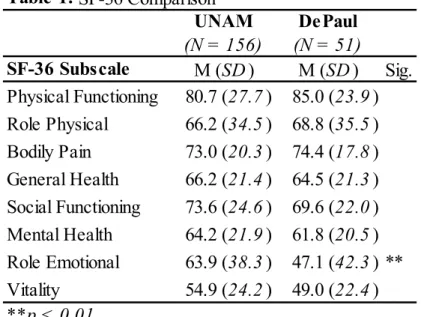
Cross-cultural comaparison was made in terms of knowing which subscale scores were related. Role emotional subscale showed a significant difference (see Table1).
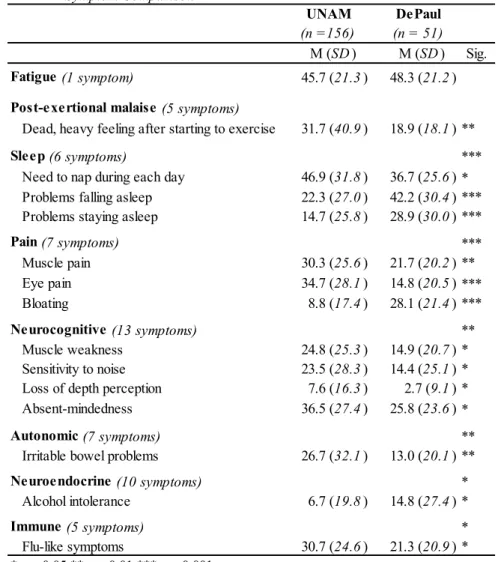
Also, The DePaul and UNAM samples showed significant differences in 14 of the 54 ME/CFS symptoms examined; neither group demonstrated more severe symptoms (see Table 2).
Table 1. SF-36 Comparison
UNAM DePaul
(N = 156) (N = 51)
SF-36 Subscale M (SD) M (SD) Sig. Physical Functioning 80.7 (27.7) 85.0 (23.9) Role Physical 66.2 (34.5) 68.8 (35.5) Bodily Pain 73.0 (20.3) 74.4 (17.8) General Health 66.2 (21.4) 64.5 (21.3) Social Functioning 73.6 (24.6) 69.6 (22.0) Mental Health 64.2 (21.9) 61.8 (20.5) Role Emotional 63.9 (38.3) 47.1 (42.3) ** Vitality 54.9 (24.2) 49.0 (22.4)
**p < 0.01
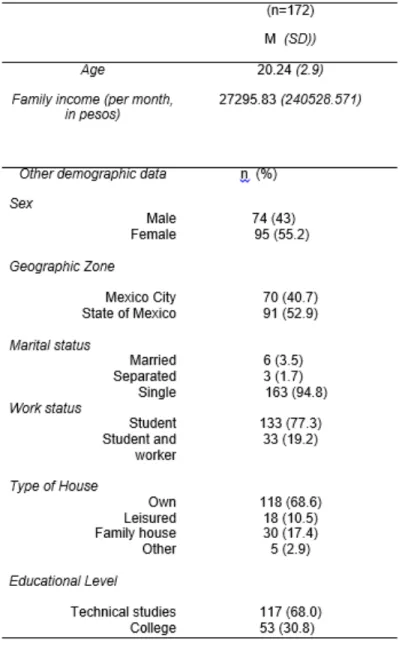
Table 3 shows demographic data concerning to age, gender, marital status, work status, and educational level. A correlation was found in educational level, between both samples.
Table 2. Symptom Comparison
UNAM DePaul
(n =156) (n = 51)
M (SD) M (SD) Sig.
Fatigue (1 symptom) 45.7 (21.3) 48.3 (21.2)
Post-exertional malaise (5 symptoms)
Dead, heavy feeling after starting to exercise 31.7 (40.9) 18.9 (18.1) **
Sleep (6 symptoms) ***
Need to nap during each day 46.9 (31.8) 36.7 (25.6) * Problems falling asleep 22.3 (27.0) 42.2 (30.4) *** Problems staying asleep 14.7 (25.8) 28.9 (30.0) ***
Pain (7 symptoms) ***
Muscle pain 30.3 (25.6) 21.7 (20.2) **
Eye pain 34.7 (28.1) 14.8 (20.5) ***
Bloating 8.8 (17.4) 28.1 (21.4) ***
Neurocognitive (13 symptoms) **
Muscle weakness 24.8 (25.3) 14.9 (20.7) *
Sensitivity to noise 23.5 (28.3) 14.4 (25.1) * Loss of depth perception 7.6 (16.3) 2.7 (9.1) *
Absent-mindedness 36.5 (27.4) 25.8 (23.6) *
Autonomic (7 symptoms) **
Irritable bowel problems 26.7 (32.1) 13.0 (20.1) **
Neuroendocrine (10 symptoms) *
Alcohol intolerance 6.7 (19.8) 14.8 (27.4) *
Immune (5 symptoms) *
Flu-like symptoms 30.7 (24.6) 21.3 (20.9) *
*p < 0.05 **p < 0.01 ***p < 0.001
Table 3. Demographic data
Discussion
• Of the eight SF-36 subscales, only the Role Emotional subscale showed a significant difference, with the DePaul group reporting worse scores. No physical health subscales showed significant differences.
• The DePaul and UNAM samples showed significant differences in 14 of the 54 ME/CFS symptoms examined. However, neither group demonstrated a consistent pattern of more severe symptoms.
• Based on previous research (Jason et al., 1999), we expected to find a significant difference in fatigue severity between groups, but the current study did not support this hypothesis. This discrepant finding may be a result of sampling students of Latino origin who reside in Mexico, as opposed to the U.S.
BIBLIOGRAPHIC REFERENCES
Arroyo, A.R y Morera, H.H. (2012). Síndrome de Fatiga Crónica. Revisión bibliográfica. Revista Científica Odontológica, 8 (2), 29-33.
Barbado H. F. J., Gómez C. J., López R. M. y Vázquez R. J.J. (2006). El síndrome de fatiga crónica y su diagnóstico en Medicina Interna. Anales de Medicina Interna (Madrid) 23 (5), 238-244.
Buchwald, D., Umali, P., Umali, J., Kith, P., Pearlman, T., and Komaroff, A. L. (1995). Chronic fatigue and chronic fatigue syndrome: Prevalence in a Pacific Northwest health care system. Annals of Internal Medicine, 123: 81-88.
Coffin, N., Jason, L., Jimenez, L., Bejar, C., Bejar, F., Cedillo, B., Miralrio, C and Álvarez, M.(2011). Síndrome de Fatiga Crónica. Validación de un
instrumento para la población mexicana. México: Facultad de Estudios Superiores Iztacala. UNAM.
Cubillo, B. B. (2013). Síndrome de fatiga crónica. Revista Médica de Costa Rica y Centroamérica, 70 (607), 423-428.
Cho, HJ, Menezes, PR, Hotopf, M., Bhugra, D., y Wessely, S. (2009). Comparative epidemiology of chronic fatigue syndrome in Brazilian and British primary care: prevalence and recognition. The British Journal of Psychiatry, 194 (2), 117-122.
David, A. S., Wessely, S. and Pelosi, A. J. (1991). Chronic fatigue syndrome: Signs of a new approach. British Journal of Hospital Medicine, 45: 158-163.
Friedberg, F. and Jason, L. (2002) Understanding Chronic Fatigue Syndrome. Ed. American Psychological Association.
Friedman, J. K. (2008). “Fisiopatología del SFC”. En Van Riel, C. y Garcia
Fructuoso, F. J. (Trad.), Manual de consenso para la atención del síndrome de fatiga crónica en la asistencia primaria. (pp. 9-15).
Hardt, J., Buchwald, D., Wilks, D., Sharpe, M., Nix, WA, and Egle, UT (2001). Health-related quality of life in patients with chronic fatigue syndrome: an international study. Journal of Psychosomatic Research , 51 (2), 431-434.
fatigue syndrome from a community based sample: A pilot study. American Journal of Community psychology, 23: 557-568.
Jason, L. A., Jordan, K. M., Richman, J. A., Rademaker, A. W., Huang, C. F., McCready, W., and Frankenberry, E. L. (1999). A community-based study of prolonged fatigue and chronic fatigue. Journal of health psychology, 4(1), pp 9-26.
Jiménez, B. M., Hernández, E. G., Benevides-Pereira, A. M., y Herrer, M. G. (2003). Estudios transculturales del burnout: los estudios transculturales Brasil-España. Revista Colombiana de psicología, (12), 9-18.
John, Jr., J.F and Oleske, J. M. (2008). “prologo”. En Van Riel, C. & García
Fructuoso, F. J. (Trad.), Manual de consenso para la atención del síndrome de fatiga crónica en la asistencia primaria.
Marques, M ., De Gucht , V., Leal, I. and Maes ,S (2013). A Cross-Cultural
Perspective on Psychological Determinants of Chronic Fatigue Syndrome: a Comparison Between a Portuguese and a Dutch Patient Sample.
International Journal of Behavioral Medicine, 20 (2), 229-38.
Moreno-Jiménez, B., Garrosa Hernández, E., Benavides-Pereira, A.M., Gálvez Herrer, M. (2003). Estudios transculturales del burnout. Los estudios transculturales Brasil-España. Revista Colombia de Psicología, 12, 9-18.
Sandín, B. (2005). El síndrome de fatiga crónica: características psicológicas y terapia cognitivo-conductual. Revista de Psicopatología y Psicología Clínica, 10 (1), 85-94.
Song, S., Jason, L. A., Taylor, R. R., (1999). The relationship between ethnicity an fatigue in a Community-Based sample. Journal of Gender, culture and health, Vol. 4 (4), 255-268.
Song, S., Jason, L. A., Taylor, R. R., Torres-Harding, S. R., Helgerson, J., and Witter, E. (2002). Fatigue severity among African Americans: gender and age interactions. Journal of Black Psychology, 28(1), 53-65.
Steele, L., Dobbins, J. G., Fukuda, K., Reyes, M., Randall, B., Koppelman, M., and Reeves, W. C. (1998). The epidemiology of chronic fatigue in San
Francisco. The American Journal of Medicine, 105: 835-905.