RELAXATION PROCESSES IN SOLUTIONS OF D-GLUCOSE ON THE ACOUSTIC AND OPTICAL DATA
ULTRASONIC RELAXATION PROCESSES IN GASES, LIQUIDS AND SOLIDS
Maksimochkin Gennady
Moscow State Academy of Instruments Engineering and Computer Science Stromynka, 20, 107996 Moscow, Russia.
Phone/fax: (095) 320-18-20 E-mail: [email protected]
ABSTRACT
The results of experimental investigations of the velosity and the absorption of ultrasound (in a range of frequencies 0,2-200 MHz), the density and the viscosity of water solutions of D-glucose in a range of concentration 0,0001-0,05 m.s. and temperatures 273-363 K are presented. The values of adiabatic compressebility, volume viscosity and parameters of ultrasonic relaxation processes are calculated. The system of hydrogen connections in the same solutions is experimentally investigated by a method of optical spectroscopy. The influence of the small impurities of the dissolved substance on acoustic properties of water solutions of D-glucose is investigated. The experimental data are analysed in the framework of the relaxation theory and existing models of structure of water and water solutions.
Water and water solutions shows a series of abnormal, inherent to it by one, properties. For example, adiabatic compressibility of water with growth of temperature decreases, passes through a minimum at temperature 337 K, and then grows with the further increase of temperature. The speed of ultrasound in water with growth of temperature passes through a maximum at temperature 347K. In all other liquids compressibility and speed of ultrasound in temperature dependence have no extremes. For an explanation of specified and other abnormal property of water a number of the models which are taking into account ability of molecules of water to formation of directed intermolecular hydrogen bonds is offered that can result in formation of molecular structures of various types. The so-called two-structural model is most developed, according to which water represents a mix of two components: "normal" components having close-packed structure, and "abnormal", having loosely packed structure. At increase of temperature the part of molecules passes in emptiness of loose structure, that results in reduction compressibility. On the other hand, at increase of temperature of water, average distance between molecules grows, that corresponds to increase compressibility. The presence of two opposite tendencies results in extreme dependence compressibility from temperature [1]. Now remain debatable questions: about number and kind of molecular structures, existing in water, about presence of the broken off hydrogen bonds, about character of reorganization of loosely packed structure. The study of influence of pressure on a situation of a minimum compressibility of water is of interest for finding - out of the specified questions [2,3] and study of spectra of absorption of water in the field of frequencies of fluctuations of groups OH [4].
solutions of D-glucose in a range of concentration 0,0001-0,05 m.s. and temperatures 273-363 K and pressure 0.1-180Mpa are presented. The values of adiabatic compressebility, volume viscosity and parameters of ultrasonic relaxation processes are calculated. The system of hydrogen connections in the same solutions is experimentally investigated by optical spectra of absorption of water in an interval of lengths of waves 650-810 nm The influence of the small impurities of the dissolved substance on acoustic properties of water solutions of D-glucose is investigated. The experimental data are analysed in the framework of the relaxation theory and existing models of structure of water and water solutions.
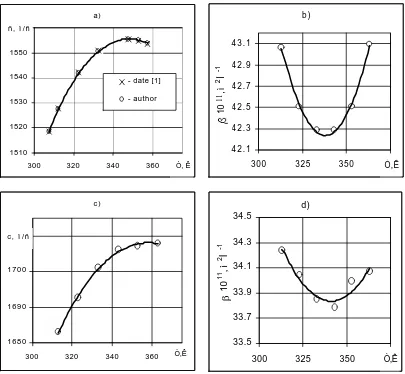
[image:2.596.97.502.188.562.2]The speed of ultrasound was measured by a impulse-phase method with an error about 0,01 %. The design of installation for measurement of speed of ultrasound and density at high pressure is described in work [5]. In a fig. 1 are shown speed of ultrasound (a) and adiabatic compressibility (b) of water depending on temperature at pressure 0,1 MPa and the same one at pressure 100 MPa, accordingly (c) and (d). Besides in a fig. 1a are shown known literary date [6] on speed of ultrasound in water at normal pressure. The divergences between our and literary data on speed of a sound do not exceed 0,02 %. The situation of a minimum compressibility in temperature dependence is displaced with growth of pressure from 337K at 0,1MPa up to 341K at 100 MPa. The situation of a maximum of speed of ultrasound under the same conditions is displaced from 347 up to 358 K. The measurements at other meanings of pressure in the investigated range result in the same law: to displacement extremes of speed
Fig. 1. Speed of ultrasound (a) and adiabatic compressibility (b) of water depending on
temperature at pressure 0,1MPa and the same one at pressure 100MPa, accordingly (c) and (d).
a)
1510 1520 1530 1540 1550 1560
300 320 340 360 Ò, Ê
ñ , ì / ñ
- date [1]
- author
b )
4 2 . 1 4 2 . 3 4 2 . 5 4 2 . 7 4 2 . 9 4 3 . 1
300 325 350 Ò,Ê 375
10
11,ì
2 Í
-1
c)
1 6 8 0 1 6 9 0 1 7 0 0 1 7 1 0
300 320 340 360 Ò,Ê
c , ì / ñ
d)
33.5 33.7 33.9 34.1 34.3 34.5
300 325 350 Ò,Ê 375
β
10
11 ,ì
2 Í
and compressibility in the party of the large temperatures with growth of pressure. It specifies faster reduction compressibility "normal" components of water including close-packed structures, in comparison with compressibility "abnormal" loose components. The displacement of a minimum compressibility can be connected to growth of pressure in area of higher temperatures that with increase of pressure the average distances between molecules decrease. It complicates introduction of molecules in emptiness of loosely packed structures and the complete reorganization of loosely packed structures in close-packed a condition is finished at higher temperatures.
The reorganization of structure of water with growth of temperature is possible is to judged on optical spectral displays of groups OH. In spectra of absorption of solutions of water in infra-red area the following laws are revealed [4]. At small concentration of water in a solution, when the molecules of water practically are free from intermolecular association, in infra-red spectra the strip of absorption on frequencies about ν1=3800 ñì
-1
was observed, that OH corresponds to frequencies of fluctuations of free groups, not connected by hydrogen bonds with the next molecules. With growth of concentration of water easing the specified strip was observed. At the same time, the absorption amplified in the field of frequencies about
ν2=3300 ñì -1
. To these frequencies there correspond frequencies of fluctuations of groups ÎÍ, included in hydrogen bonds. Thus, the process of formation of a grid of intermolecular hydrogen bonds between molecules of water was observed. With increase of concentration of water in a solution the strip of absorption at ν1=3800 ñì-1 vanished, that has resulted in the assumption that in water all groups ÎÍ are included in a grid of intermolecular hydrogen bonds, and broken off the hydrogen bonds are not present in general [7]. The assumption expressed that the current of water is carried out only at the expense of a bend of hydrogen bonds and is not accompanied by their break. Thus it is difficult to explain processes of transmitting movement demanding break of intermolecular hydrogen bonds. It is possible, that the rather small number of the broken off hydrogen bonds in water is not shown in infra-red area because of small accuracy of measurements. The study of a spectrum of absorption of water in seen area of a spectrum on frequencies appropriate to harmonics of fluctuations of groups OH is of interest for finding - out of this question where the accuracy of measurements can be higher. In particular, it is possible to expect occurrence in a spectrum of water of strips of absorption appropriate to the third harmonics of fluctuations of groups OH, at 4ν1=14400 ñì
-1
(658 nm) and 4ν2=13200 ñì -1
(758 nm).
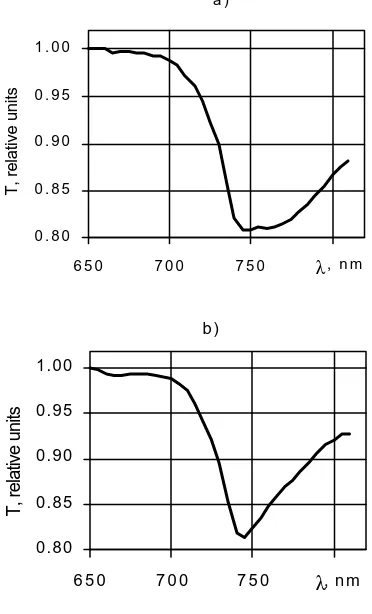
We investigate optical spectra of absorption of water in a range of lengths of waves 650-810 nm and temperatures 293-363Ê. The experiments are executed on the spectral computer complex ÊÑÂÓ-23Ì. Length used optical cell made 100 mm. In a fig. 2 the dependence of factor of passage (Ò) of water from length of a wave (λ) is submitted at temperatures 297Ê (a) and 363Ê (b). Here strips of absorption close 658 and 758 nm, as expected, are visible. First of the specified strips of absorption can be referred to fluctuations of groups OH, free from hydrogen bonds. Thus assumption of existence in water of processes accompanying with break of hydrogen bonds, apparently, is fair. The strip of absorption at 758 nm undergoes significant
a )
0 . 8 0 0 . 8 5 0 . 9 0 0 . 9 5 1 . 0 0
6 5 0 7 0 0 7 5 0 λ8 0 0, n m
T, relative units
b ) 0.80 0.85 0.90 0.95 1.00
6 5 0 7 0 0 7 5 0
λ
8 0 0, n m [image:3.596.99.285.220.527.2]T, relative units
Fig. 2. Spectra of absorption of water in a
range 650-810 nm at temperature
changes with growth of temperature, that is characteristic for hydrogen bonds. Thus, there are enough bases to attribute it to harmonics of fluctuations of groups OH, hydrogen bonds, included in a grid. Besides in the form of the given strip of absorption two components are looked through: first - at 745 nm, second - at 770nm. With growth of temperature the intensity of the first component practically does not vary, the intensity of the second component falls with growth of temperature. It is possible to assume, that spectral display of two groups of energetically not equivalent hydrogen bonds in this case takes place. The component of absorption at 745 nm can be related to close-packed structure of water, and component at 770 nm - to loosely packed structure of water.
Then the easing of absorption at 770 nm with growth of temperature can be examined as spectral display of reorganization of loosely packed structure of water accompanying by transition of molecules of water in emptiness and break of intermolecular hydrogen bonds. It will be coordinated to some increase of intensity of a strip of absorption at 665 nm with growth of temperature. It is more difficult to explain a constancy of absorption at 745 nm with growth of temperature; the reorganization of loosely packed structures in a close-packed condition, apparently, should result in increase of intensity of a strip of absorption connected with
close-a)
0.9998 1.0000 1.0002 1.0004 1.0006 1.0008 1.0010
0.0001 0.0010 0.0100 Õ, ì .s.0.1000
Ñ/Ñî
b)
0 10 20 30 40 50 60 70
0.0001 0.0010 0.0100 X, ì .s.0.1000
a/f^2,10^-15
ì
[image:4.596.164.386.99.484.2]^-1c^2
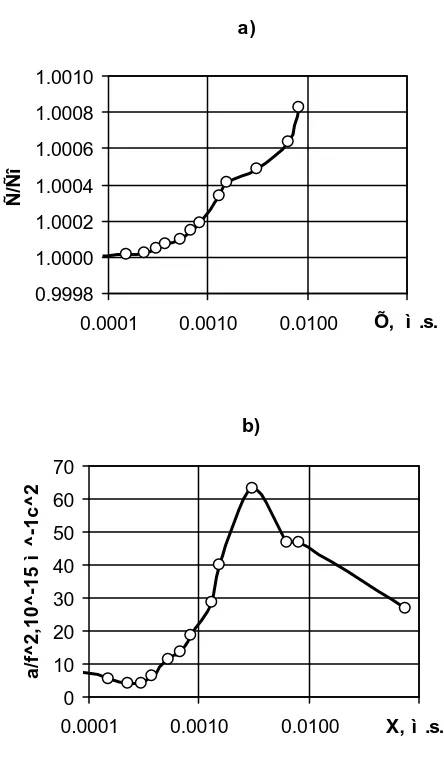
Fig.3. The Speed (a) and the Absorption (b) of ultrasound in solutions of D-glucose in the area of
packed structure. It is possible to assume, that the condition of a close-packed structure after reorganization not the same one to a condition of close-packed structure of water and part of the hydrogen bonds which have collapsed at reorganization of loosely packed structure, is not restored any more.
Thus, it is possible to present, that fast relaxation processes in water and water solutions, is especial at small concentration, are connected to break of hydrogen bonds forming loosely structures. It results in formation of known superfluous absorption of ultrasound in water with a wide spectrum of times of relaxation. At dissolution of glucose in water also it is necessary to expect primary destruction of loosely structures of water and reduction of an abnormal component of compressebility and acoustic properties of a solution.
On Fig.3 are submitted received by us experimentally given on to speed (Ñ) and absorption of ultrasound (a) in solutions of D-glucose in the area of a small concentration at frequency 2.715MHz and temperature 346.8K. Temperature is chosen in area of a maximum of speed for reduction of influence of temperature errors in measurements. Sensitivity of installation to relative changes of speed and the absorption of ultrasound in these measurements were supplied at a level 0,001 and 0,1 % accordingly. The measurements were carried out(spent) in the chamber with constant acoustic base by a method of a resonance. Length of acoustic base L=0,1ì. Working frequency 2,715ÌÃö. The duration of used pulses made about 100 L/C. Change of speed of a sound judged on displacement of frequency of the resonance arising at concurrence of phases of all reflected signals. Factor of absorption of ultrasound and its change were calculated on a exponential resonance signal. The concentration of a solution changed at constant temperature by addition of drops of a glucose solution with beforehand known concentration. The final meaning of concentration was defined by account.
As it is visible from fig3, the features in behaviour of speed and absorption of ultrasound are found out in the field of concentration 0.002-0.003 ì.ä. The break in dependence of speed on concentration and extreme behaviour of factor of absorption of ultrasound is observed. Such behaviour of acoustic parameters can be connected to formation of a liotropic liquid crystal phase in a solution. In this case formation micell can occur to participation mainly of molecules of water included in of loosely structure, with break of the appropriate intermolecular hydrogen bonds. It is impossible to exclude that variant, that the found out effect can be connected to dynamics of very fine gas inclusions in a solution.
0 50 100 150 200 250 300
1 10 100 1000
f, ÌHz
[image:5.596.157.381.480.660.2]a/f^2, 10^-15 c^2/ì
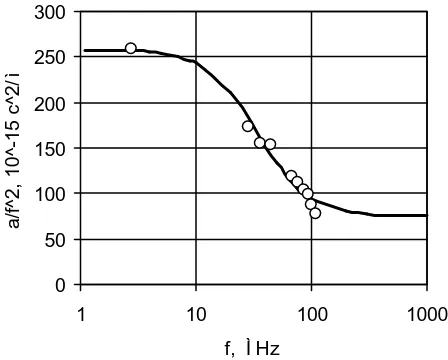
Fig.4. Acoustic relaxation in the concentrated water solution of D-glucose. Concentration 0.075 m.s.
The primary destruction loosely structure of making water with growth of temperature and increase of concentration of a solution should result to symplify of a spectral set of intermolecular hydrogen bonds and in narrowing an acoustic spectrum of relaxation times. Really such law is observed at transition from water to the concentrated water solutions, where the most part of loosely structures of water is already destroyed.
On fig.4 the dependence, received by us experimentally, of factor of absorption of ultrasound in the concentrated water solution D-ãëþêîçû. The measurements were spent by a difraction acoustooptic method . Factor of absorption was from a corner of an inclination of dependence of the logarithm of intensity of the reflected beam of light from distance, past ultrasonic wave. Uniformity of an acoustic field and adjustment of installation were supervised on deviations of points of readout from of linear dependence. The mistake of measurement did not exceed 5 %. The experimental data within the limits of mistakes of experience will be coordinated to the elementary model of relaxatin process with one relaxation time. It can be connected that the most part of hydrogen bonds forming loosely structures of water already is destroyed by molecules of the dissolved substance. In too time the dissolved molecules can form among themselves stronger hydrogen bonds resulting to relaxation process with one relaxation time. At other temperatures are received qualitatively similar relaxation curves. A deviation of separate points on frequencies be higher 100ÌHz downwards from model with one relaxation can is connected to a methodical error and to be caused too close located of ultrasound generator.
R E F E R E N C E S
1. Michailov I. G., Soloviov V.A., Syrnikov Y.P. Bases of molecular acoustics.- M.: a Science, 1964. p. 104-115, 143-162.
2. Ydin Y. M., Maksimochkin G.I. Influence of pressure on compressibility of water solutions of glucose.
A Magazine of physical chemistry. 1990. vol. 64. ¹ 10. p. 2806-2809.
3. Ydin Y. M., Maksimochkin G.I., Nozdrev V.F. Influence of pressure on acoustic and thermodynamic of property of water solutions of mannose. A Magazine of physical chemistry. 1991. vol. 65. ¹ 12. p. 3392 - 3396.
4. Pimental Dg., Mar-Klellan O. About. Hydrogen bond. - M.: the World, 1964. p 76-91. 5. Ydin Y. M., Maksimochkin G.I., The express train - control of physical properties of liquids at high pressure. Factory laboratory. 1990. vol 56. ¹ 10. p. 41-42.
6. Greenspan M., Tschiegg C., Tables of the speed of sound in water, JASA, vol.31, p.75, 1959