
UNIVERSIDAD DE MURCIA
FACULTAD DE MATEM ´
ATICAS
Going further in the
L
p-Brunn-Minkowski theory:
a
p
-difference of convex bodies
(Ampliando la teor´ıa
L
pde Brunn-Minkowski:
una
p
-diferencia de cuerpos convexos)
Llegado este punto es inevitable mirar atr´as y acordarse de todas aquellas personas que de un modo u otro han contribuido a la realizaci´on de este trabajo.
En primer lugar, tengo que manifestar mi m´as sincero agradecimiento a mis directoras de tesis, las profesoras Mar´ıa de los ´Angeles Hern´andez Cifre y Eugenia Saor´ın G´omez, por su dedicaci´on, saber guiarme en todo momento, su confianza, sus buenas ideas y la gran paciencia que han tenido a la hora de las correcciones. Su ayuda ha sido fundamental para hacer m´as ameno el salto entre la carrera y la investigaci´on en matem´aticas y no tengo la menor duda de que sin ellas este camino habr´ıa sido much´ısimo m´as tortuoso y dif´ıcil.
Me gustar´ıa mencionar tambi´en la ayuda prestada por Eugenia y su fa-milia durante mi estancia en Magdeburg, acogi´endome con cari˜no desde el primer d´ıa, y facilit´andome todo lo que necesit´e durante esos tres meses.
Podr´ıamos decir que mis conocimientos en matem´aticas antes de empezar esta tesis se han consolidado por etapas: En primer lugar, agradezco a Jos´e Juan L´opez Esp´ın por convertir las matem´aticas en la asignatura m´as f´acil de mi Educaci´on Secundaria. En segundo lugar, en mi paso por Ingenier´ıa Aeron´autica en Madrid aprend´ı much´ısimas cosas, pero lo que m´as agradezco fue conocer al profesor Juan de Burgos Rom´an. De ´el aprend´ı que las matem´aticas son algo m´as que echar cuentas m´as o menos mec´anicas, que hab´ıa que pensar y razonar. Tambi´en fue el principal culpable de que yo me decidiera a empezar la carrera de Matem´aticas. A ´el le agradezco de coraz´on los acertados consejos que me dio por entonces y en las veces que nos hemos visto a˜nos despu´es. Seguidamente, quisiera agradecer todo lo que he aprendido, tanto acad´emica como personalmente, de los profesores del Dpto. de Matem´aticas de la Universidad de Murcia, especialmente a los profesores V´ıctor Jim´enez L´opez por hacer de psic´ologo y amigo durante estos a˜nos, y a Luis Al´ıas Linares, por su constante apoyo y preocupaci´on. Por ´ultimo, agradezco a los profesores que tuve en el M´aster Fisymat de la Universidad de Granada todo lo que all´ı me ense˜naron.
No puedo terminar estas l´ıneas sin hacer menci´on al apoyo fundamental de mis amigos: Gracias a mis compa˜neros de despacho, especialmente a
Antes de terminar, quisiera dedicarle unas palabras a mi familia. Gracias pap´a, por tu apoyo incondicional en todo momento. Gracias mam´a, por tu amor y por ser una madraza. Juanfran y Virgi, gracias por ser mis hermanos. Gracias David, por tu sentido del humor y ser m´as que un cu˜nado. Gracias a mis sobrinas Ana e Irene, por esa alegr´ıa y felicidad que transmit´ıs.
Las palabras m´agicas son: amor, humor y libertad.
Contents
Contents
Introducci´on/Preface xi
1 Preliminaries 1
1.1 Convex bodies and their properties . . . 1
1.2 Minkowski’s difference . . . 4
1.3 The full system of parallel bodies . . . 6
1.4 p-sum of convex bodies . . . . 8
1.5 Mixed volumes and quermassintegrals . . . 9
1.6 Inequalities for mixed volumes and other related results . . . 10
1.7 On hypergeometric functions . . . 11
2 p-difference of convex bodies: First properties 13 2.1 p-difference of convex bodies. Definition and first properties . . . . 13
2.2 p-inradius andp-kernel . . . . 18
2.3 p-inner parallel bodies . . . . 21
2.3.1 On the continuity and the concavity of the family ofp-parallel bodies. . . . . 21
2.3.2 p-inner parallel bodies of special families of sets. . . . 26
3 Differentiability properties of the family of p-parallel bodies 31 3.1 Introduction and preliminary results . . . 31
3.1.1 +p-concavity . . . 32
3.2 Quermassintegrals of Kλp as functions ofλ . . . 34
3.2.1 Differentiability of quermassintegrals at λ= 0 . . . 41
x
4 Bounding quermassintegrals of p-inner parallel bodies 47
4.1 Extreme vectors and related notions . . . 47
4.1.1 Extreme normal vectors ofp-inner parallel bodies . . . . 49
4.2 Thep-form body . . . . 51
4.3 Differentiability properties of the support function . . . 54
4.4 Inequalities for quermassintegrals ofp-inner parallel bodies . . . . 57
Introducci ´
on/Preface
Introducci ´
on/Preface
La teor´ıa de Brunn-Minkowski puede considerarse como el n´ucleo de la Geometr´ıa de Cuerpos Convexos. Sus or´ıgenes se remontan a finales del siglo XIX y comienzos del siglo XX, principalmente con los trabajos de Cauchy, Steiner, Brunn y, en particular, Minkowski.
La teor´ıa de Brunn-Minkowski es el resultado de combinar dos conceptos elementales para con-juntos en el espacio eucl´ıdeo: lasuma de Minkowski + (suma vectorial), y elvolumenvol(·) (medida de Lebesgue). Esto conduce a la noci´on de vol´umenes mixtos y a la famosa y fundamental desigual-dad de Brunn-Minkowski. Un hecho crucial, y en cierto modo sorprendente, en este contexto, fue descubierto por Steiner en 1840 en el caso particular de la bola eucl´ıdea: el volumen de la suma de Minkowski de un cuerpo convexoK y un dilatado positivoλEde un cuerpogauge E (lo que se conoce comocuerpo paralelo exterior relativo deK a distanciaλ), viene dado por un polinomio de grado a lo sumonen la variable λ, laf´ormula de Steiner relativa. De forma precisa,
vol(K+λE) = n
X
i=0 µ
n i
¶
Wi(K;E)λi. (†)
Sus coeficientes son, salvo constantes, medidas particulares asociadas aKy aE, las llamadas quer-massintegrales relativas. El volumen W0(K;E) = vol(K) es un caso particular de tales medidas.
Resulta natural considerar una operaci´on “opuesta” a la suma de Minkowski de cuerpos con-vexos, la denominadadiferencia de Minkowski,∼:
K ∼E={x∈Rn:x+E⊆K}.
As´ı se pueden definir loscuerpos paralelos interiores deK respecto aE, que, junto con los cuerpos paralelos exteriores considerados anteriormente, conducen a la definici´on de sistema completo de cuerpos paralelos:
Kλ =
(
K ∼ |λ|E si −r(K;E)≤λ≤0,
K+λE si 0≤λ <∞,
donde r(K;E) = max{r≥0 :∃x∈Rn conx+rE⊆K} es elinradio relativo deK respecto a E. La f´ormula de Steiner (†) permite obtener f´acilmente la f´ormula de Minkowski, la cual establece que la derivada por la derecha en 0 del funcional volumen vol(λ) = vol(Kλ) es nveces la primera quermassintegral relativa:
nW1(K;E) = lim λ→0+
vol(Kλ)−vol(K)
xii Introducci ´on
A mediados del siglo XX, Bol, Hadwiger y Matheron demostraron la derivabilidad de vol(λ) en todo el intervalo¡−r(K;E),∞¢, proporcionando la f´ormula expl´ıcita
d
dλvol(λ) =nW1(Kλ;E). (♠)
Recientemente, Hern´andez Cifre y Saor´ın G´omez han estudiado la derivabilidad de las quermass-integrales relativas Wi(Kλ;E) como funciones del par´ametro λ ∈
¡
−r(K;E),∞¢. En particular, gracias a la conocida expresi´on polin´omica en λ≥0 para Wi(Kλ;E), se obtienen la derivabilidad y el valor expl´ıcito de la derivada, cuando λ≥0: para todoi= 0, . . . , n−1,
d
dλWi(Kλ;E) = (n−i)Wi+1(Kλ;E). (♣) Adem´as, dado un cuerpo convexo K, su funci´on soporte h(K,·) : Sn−1 −→ R, definida sobre la esfera unidadSn−1, esh(K, u) = sup©hx, ui:x∈Kª, dondeh·,·i denota el producto escalar usual
en Rn. As´ı, tiene sentido estudiar la derivabilidad de la funci´on soporteh(K
λ, u) con respecto al par´ametro λ ∈ ¡−r(K;E),∞¢. Heur´ısticamente, esta derivada juega el papel de la velocidad de crecimiento de los cuerpos paralelos Kλ con respecto a λ. En 1979, Chakerian y Sangwine-Yager demostraron que una cota inferior para la derivada deh(Kλ, u) es siempre la funci´on soporte deE,
d
dλh(Kλ, u)≥h(E, u), (♥)
siempre que tal derivada exista, probando que la igualdad se da para todo u ∈ Sn−1, y para casi
todo punto en£−r(K;E),0¤, si, y s´olo si, K=K−r(K;E)+ r(K;E)E.
Por otro lado, el hecho de que un cuerpo convexo est´a determinado de forma ´unica por su funci´on soporte, permiti´o a Firey introducir, en 1962, la p-suma de dos cuerpos convexos K, E conteniendo el origen, para 1≤p≤ ∞, como el cuerpo convexo cuya funci´on soporte es
h(K+pE, u) =¡h(K, u)p+h(E, u)p¢1/p.
El caso p= 1 es la suma de Minkowski, mientras que si p=∞ se obtiene la envoltura convexa de los conjuntos,K+∞E = conv(K∪E). Estap-suma de cuerpos convexos fue el punto de partida de
la hoy en d´ıa conocida como teor´ıaLp de Brunn-Minkowski (o teor´ıa de Firey-Brunn-Minkowski).
Introducci ´on xiii
La memoria comienza con un primer cap´ıtulo introductorio, en el que se establece la notaci´on a seguir y se presentan brevemente los conceptos y resultados que ser´an fundamentales en el pos-terior desarrollo de los contenidos, tanto de convexidad, en general, como de teor´ıa (Lp) de Brunn Minkowski, en particular. As´ı, en una primera secci´on, se recuerdan las nociones b´asicas, como la de suma de Minkowski, cuerpo convexo, funci´on soporte, hiperplano soporte, etc. A continuaci´on, se introduce la diferencia de Minkowski, estableciendo las relaciones elementales que tiene con la suma de Minkowski. En este contexto, consideramos tambi´en la noci´on de Wulff-shape asociada a un subconjunto cerrado Ω ⊆ Sn−1 de la esfera y a una funci´on no-negativa ψ : Ω −→ [0,∞),
se˜nalando algunas propiedades importantes que se usar´an m´as adelante. La suma y la diferencia de Minkowski conducen a los conceptos de inradio relativo y sistema completo de cuerpos parale-los. Una propiedad clave de esta familia de conjuntos es la concavidad. Tambi´en recordamos la noci´on de cuerpo tangencial y el importante resultado de Schneider que caracteriza estos conjuntos como los ´unicos cuerpos convexos cuyos cuerpos paralelos interiores son copias homot´eticas de ellos. Proseguimos el cap´ıtulo con la teor´ıa Lp de Brunn-Minkowski, estudiando la noci´on y principales propiedades de la p-suma de cuerpos convexos (que contienen al origen). Finalmente, tras intro-ducir los vol´umenes mixtos y las quermassintegrales, establecemos varias desigualdades conocidas de la teor´ıa (Lp) de Brunn-Minkowski, las cuales jugar´an un papel importante en el desarrollo de esta memoria.
El segundo cap´ıtulo est´a dedicado a estudiar el concepto principal de nuestro trabajo, la p-diferencia ∼p de cuerpos convexos, que desempe˜na el papel de operaci´on “opuesta” a la p-suma. En la primera secci´on, establecemos la definici´on dep-diferencia de dos maneras distintas, probando que, de hecho, son equivalentes, y estudiamos las primeras propiedades de esta nueva operaci´on. En particular, obtenemos que lap-diferencia de dos cuerpos convexos puede verse como una Wulff-shape asociada a las funciones soporte de ambos conjuntos. Tal y como ocurre cuando se trabaja con la suma y la diferencia de Minkowski cl´asicas, se obtienen las correspondientes relaciones naturales entre la p-suma y la p-diferencia, as´ı como la no-continuidad de la p-diferencia con respecto a la m´etrica de Hausdorff. En la segunda secci´on discutimos la necesidad de trabajar con una subfamilia particular de cuerpos convexosKn
00(E) para un cuerpo gauge fijoE⊂Rn, con el fin de desarrollar
un estudio estructurado y sistem´atico de la p-diferencia, que tambi´en sea v´alido cuando p = 1. Tambi´en introducimos el concepto de p-n´ucleo de K respecto a E, kerp(K;E), y probamos que, como en el caso cl´asico, ´este nunca tiene dimensi´onn. Finalmente, la ´ultima secci´on est´a dedicada a definir y estudiar el llamadosistema completo de cuerposp-paralelos, esto es, la colecci´on de todos loscuerpos p-paralelos exteriores e interiores:
Kλp =
(
K ∼p |λ|E si −r(K;E)≤λ≤0, K+pλE si 0≤λ <∞.
xiv Introducci ´on
λ respecto a la m´etrica de Hausdorff. Llegados a este punto, introducimos unap-suma +p en R, con el fin de establecer los resultados de forma precisa. Esta definici´on extiende lap-media cl´asica de n´umeros reales positivos (salvo una constante). Tambi´en estudiamos, en la ´ultima parte de esta secci´on, el comportamiento de los cuerpos p-paralelos interiores para dos familias especiales de cuerpos convexos: los cuerpos tangenciales, y aquellos conjuntos obtenidos como p-paralelos exteriores de conjuntos de menor dimensi´on. En particular, caracterizamos los cuerpos tangenciales como los ´unicos cuerpos convexos cuyos p-paralelos interiores son copias homot´eticas de ellos, generalizando de esta forma al casop >1 el ya mencionado resultado de Schneider.
En eltercer cap´ıtulo abordamos el estudio de la derivabilidad de las quermassintegrales relativas Wi(Kλp;E) respecto a la familia uniparam´etrica de los cuerposp-paralelos. En la primera secci´on, recordamos la definici´on de la quermassintegral mixta Wp,i(K, L;E), 0 ≤ i≤ n−1, un concepto clave en el desarrollo de la teor´ıaLp de Brunn-Minkowski, definidas por Lutwak en 1993 mediante un argumento variacional que involucrap-sumas:
Wp,i(K, L;E) = np−i lim ε→0+
Wi
¡
K+pε1/pL;E
¢
−Wi(K;E)
ε .
Tambi´en recordamos que estas quermassintegrales mixtas admiten una representaci´on integral muy ´
util a trav´es de funciones soporte y medidas de ´area de superficie mixtas.
Con el fin de estudiar la posible derivabilidad de Wi(Kλp;E), consideramos una propiedad de +p-concavidad para funciones reales definidas en un intervalo I ⊆ R, y probamos que esta propiedad est´a relacionada con la concavidad usual y, en particular, con la quasi-concavidad. A continuaci´on, en la segunda secci´on del cap´ıtulo, nos centramos en el estudio de la derivabilidad de las quermassintegrales relativas. En particular, probamos que la funci´on Wi(λ) = Wi(Kλp;E) es derivable en (0,∞), siendo su derivada
W0i(λ) =λp−1(n−i)Wp,i(Kλp, E;E).
Observamos que este resultado extiende (♣) cuandop= 1, ya que W1,i(Kλ, E;E) = Wi+1(Kλ;E). El argumento para obtenerlo es, sin embargo, completamente diferente, ya que no existe una ex-presi´on polin´omica para las quermassintegrales de una p-suma. Seguidamente, se demuestra que hay derivabilidad tambi´en en λ= 0 sip >1, siendo el valor de la derivada siempre 0. La secci´on, y el cap´ıtulo, finalizan con el caso m´as especial del volumen: profundos resultados de Lutwak nos permiten probar que, como en el caso cl´asico (cf. (♠)), el funcional volumen vol(Kλp) es siempre derivable en λ ∈ ¡−r(K;E),∞¢, proporcionando la expresi´on expl´ıcita para su derivada. Como consecuencia de ello, obtenemos una f´ormula integral para el volumen de K en funci´on de sus cuerpos p-paralelos interiores.
Introducci ´on xv
p-forma, que ser´a ´util para obtener, en la ´ultima secci´on, (nuevas) desigualdades que proporcionan cotas para las quermassintegrales de los cuerposp-paralelos interiores. Antes de esto, estudiamos la derivabilidad de la funci´on soporte h(Kλp,·) respecto a la familia uniparam´etrica de cuerpos p-paralelos interiores. En primer lugar probamos que, para cuerpos convexos adecuadosK, E,
d dλh(K
p λ, u)≥
|λ|p−1h(E, u)p h(Kλp, u)p−1
para casi todo punto en¡−r(K;E),0¤, con igualdad, para todou∈Sn−1 y para casi todo punto en £
−r(K;E),0¤si, y s´olo si,K = kerp(K;E) +pr(K;E)E. Este resultado es elLp-an´alogo de (♥), y nos permitir´a caracterizar los cuerpos convexos para los cuales la quermassintegral (n−1)-´esima Wn−1(Kλp;E) es derivable. En particular, obtenemos que W0
n−1(λ) =|λ|p−1Wp,n−1(Kλp, E;E) para λ∈¡−r(K;E),0¢si, y s´olo si,K = kerp(K;E) +pr(K;E)E. Adem´as, y de forma an´aloga al caso cl´asico, la anterior cota inferior para la derivada de la funci´on soporte puede mejorarse usando el cuerpo forma de los cuerposp-paralelos interiores.
Brunn-Minkowski’s theory is the classical center of the geometry of convex bodies. Its origin goes back to the end of the nineteenth century and the beginning of the twentieth century, mainly due to the works of Cauchy, Steiner, Brunn and, essentially, of Minkowski.
One could say that Brunn-Minkowski’s theory is the result of combining two elementary notions for sets in the Euclidean space: theMinkowski sum + (i.e., the vectorial addition), and thevolume
vol(·) (the Lebesgue measure). It leads to the notion of mixed volumes and to the famous and fundamental Brunn-Minkowski inequality. A very relevant and somehow amazing look like fact in this context was discovered by Steiner (1840) in the particular case of the Euclidean ball: the volume of the Minkowski addition of a convex bodyK and a positive dilationλEof agaugeconvex bodyE (the so-calledrelative outer parallel body of K at distance λ), is a polynomial of degree at mostnin the variable λ, therelative Steiner formula. More precisely,
vol(K+λE) = n
X
i=0 µ
n i
¶
Wi(K;E)λi. (?)
The coefficients are, up to constants, particular measures associated to K and E, the so-called
relative quermassintegrals. The volume W0(K;E) = vol(K) is a particular case of these measures.
It is natural to consider an operation somehow “opposite” to the Minkowski addition of convex bodies, the so-calledMinkowski difference,∼:
K ∼E ={x∈Rn:x+E⊆K}.
Then,inner parallel bodiesof K with respect toE can be defined, which, together with the previ-ously considered outer parallel sets, lead to the definition offull system of parallel bodies:
Kλ =
K ∼ |λ|E if −r(K;E)≤λ≤0,
K+λE if 0≤λ <∞,
where r(K;E) = max{r ≥0 : there exists x ∈Rn with x+rE ⊆K} is the relative inradius of K with respect toE. Relative Steiner’s formula (?) allows us to easily obtain the so-calledMinkowski formula, which states that the right-hand derivative at 0 of the volume functional vol(λ) = vol(Kλ) isn times the first (relative) quermassintegral:
nW1(K;E) = lim λ→0+
vol(Kλ)−vol(K)
Preface xvii
Later, in the middle of the twentieth century, Bol, Hadwiger and Matheron proved the differentia-bility of vol(λ) on the full interval¡−r(K;E),∞¢, providing the explicit formula
d
dλvol(λ) =nW1(Kλ;E). (\)
Recently, Hern´andez Cifre and Saor´ın G´omez studied the differentiability of the relative quermass-integrals Wi(Kλ;E) regarded as functions in the parameterλ∈
¡
−r(K;E),∞¢. In particular, due to the known polynomial expression in λ ≥ 0 for Wi(Kλ;E), both, the differentiability and the explicit value of its derivative, can be obtained whenλ≥0: for all i= 0, . . . , n−1,
d
dλWi(Kλ;E) = (n−i)Wi+1(Kλ;E). (]) Moreover, given a convex body K, its support function h(K,·) : Sn−1 −→ R, defined on the
unit sphereSn−1, ish(K, u) = sup©hx, ui:x∈Kª, whereh·,·idenotes the standard inner product
in Rn. Thus, it makes sense to study the differentiability of the support function h(Kλ, u) with respect to the parameter λ ∈ ¡−r(K;E),∞¢. Heuristically, this derivative plays the role of the
growth velocity of the parallel bodiesKλ with respect toλ. In 1979, Chakerian and Sangwine-Yager proved that the support function ofE is always a lower bound for the derivative of h(Kλ, u),
d
dλh(Kλ, u)≥h(E, u), (1)
wherever it exists, showing that equality holds for allu∈Sn−1, almost everywhere on£−r(K;E),0¤,
if and only if K=K−r(K;E)+ r(K;E)E.
On the other hand, the fact that a convex body is uniquely determined by its support function allowed Firey to introduce in 1962 the p-sum of two convex bodies K, E containing the origin, 1≤p≤ ∞, as the convex body whose support function is given by the expression
h(K+pE, u) =¡h(K, u)p+h(E, u)p¢1/p.
Minkowski’s addition is obtained when p = 1, whereas for p = ∞ we get the convex hull of the sets,K+∞E = conv(K∪E). Thep-sum of convex bodies was the starting point of the nowadays
known as theLp-Brunn-Minkowski (or Firey-Brunn-Minkowski) theory.
xviii Preface
The work starts with an introductory first chapter in which we establish the notation and introduce the concepts and results that will be needed further on, both, about general Convexity and, in particular, about (Lp-)Brunn-Minkowski theory. Thus, in a first section, we recall the basic notions, such as Minkowski’s addition, convex body, support function, support hyperplane, etc. Next, Minkowski’s difference is introduced, stating the elementary relations that it has with the Minkowski addition. In this context, we also consider the notion of Wulff-shape associated with a closed subset Ω⊆Sn−1 of the sphere and a non-negative continuous function ψ: Ω −→[0,∞),
pointing out some important properties which will be used later on. Minkowski’s addition and subtraction lead to the concepts of relative inradius and of full system of parallel bodies. A key property satisfied by this family of sets is the concavity. We also recall the notion of tangential body and the important result of Schneider characterizing these sets as the only convex bodies whose inner parallel bodies are homothetic copies of them. Next we move to the Lp-Brunn-Minkowski theory, studying the notion and main properties of the p-sum of convex bodies (containing the origin). Finally, after introducing the mixed volumes and quermassintegrals, we state several known inequalities in the (Lp-)Brunn-Minkowski theory, which will play an important role in the development of our work.
The second chapter is devoted to the main concept of this work, thep-difference ∼p of convex bodies, 1 ≤p≤ ∞, which plays a role of “opposite” operation to thep-sum of convex bodies. In the first section, we define the p-difference in two possible ways, we prove that they are in fact equivalent, and we study the first properties of this new operation. In particular, we obtain that thep-difference of two convex bodies can be regarded as a Wulff-shape associated with the support functions of both sets. As it occurs when dealing with the classical Minkowski sum and difference, we show the corresponding natural relations between thep-sum and thep-difference, as well as the non-continuity of the p-difference with respect to the Hausdorff metric. In the second section we discuss the necessity of working on a restricted subfamily of convex bodiesKn
00(E) for a fixed gauge
convex body E ⊂ Rn, in order to develop a structured and systematic study of the p-difference, valid forp= 1 too. We also introduce the concept ofp-kernel ofK with respect to E, kerp(K;E), and we prove that, as in the classical setting, it can never have dimensionn. Finally, the last section is devoted to define and study the so-calledfull system ofp-parallel bodies, i.e., the collection of all p-outer and inner parallel bodies:
Kλp=
K∼p |λ|E if −r(K;E)≤λ≤0,
K+pλE if 0≤λ <∞.
Preface xix
parallel bodies for two special families of convex bodies: tangential bodies, and those sets obtained as p-outer parallel bodies of a lower dimensional set. In particular, we characterize tangential bodies as the only convex bodies such that their p-inner parallel bodies are homothetic copies of them, generalizing in this way top >1 the already mentioned result by Schneider.
In thethird chapter we focus on the differentiability of the relative quermassintegrals Wi(Kλp;E) with respect to the one-parameter family of thep-parallel bodies. In the first section, we recall the definition ofmixed quermassintegral Wp,i(K, L;E), 0≤i≤n−1, a key concept in the development of theLp-Brunn-Minkowski theory, which was defined by Lutwak in 1993 via a variational argument involvingp-sums:
Wp,i(K, L;E) = np−i lim ε→0+
Wi(K+pε1/pL;E)−Wi(K;E)
ε .
We also recall that these mixed quermassintegrals do admit a very useful integral representation by means of support functions and mixed surface area measures.
In order to study the possible differentiability of Wi(Kλp;E), we consider a +p-concavityproperty for real-valued functions defined on an interval I ⊆ R, and prove that it is related to the usual concavity. More particulary, it is related to quasi-concavity. Then, in the second section of the chapter, we focus on studying the differentiability of the relative quermassintegrals. In particular, we prove that the function Wi(λ) = Wi(Kλp;E) is differentiable on (0,∞), being its derivative
W0i(λ) =λp−1(n−i)Wp,i(Kλp, E;E).
We notice that this result extends (]) when p = 1, because W1,i(Kλ, E;E) = Wi+1(Kλ;E). The approach is, however, completely different, since it is known that there is no polynomial expression for the quermassintegrals of ap-sum. Next, we prove that the there is also differentiability atλ= 0 if p >1, being the value of the derivative always 0. The section, and the chapter, finish with the most special case of the volume: deep results by Lutwak allow us to prove that, as in the classical case (cf. (\)), the volume functional vol(Kλp) is always differentiable at λ∈ ¡−r(K;E),∞¢, providing the explicit expression for its derivative. As a consequence, we obtain an integral expression for the volume ofK in terms of its p-inner parallel bodies.
In thefourth and lastchapter of this dissertation we deal with the structure of the boundary of thep-inner parallel bodies of a convex body: we study theirextreme vectors, and relate them to the ones of the original set. They will allow us to define a new convex body, thep-form body, which will be useful to obtain, in the last section, (new) inequalities providing bounds for the quermassintegrals of the p-inner parallel bodies. Previous to this, we also study the differentiability of the support functionh(Kλp,·) with respect to the one-parameter family ofp-inner parallel bodies. First we prove that for suitable convex bodiesK, E,
d dλh(K
p λ, u)≥
xx Preface
almost everywhere on ¡−r(K;E),0¤, with equality for all u ∈ Sn−1 and almost everywhere on £
−r(K;E),0¤, if and only if K = kerp(K;E) +p r(K;E)E. This result is the Lp-analogue of (1), and will allow us to characterize the convex bodies for which the (n−1)-st quermassintegral Wn−1(Kλp;E) is differentiable. In particular, we get that Wn0−1(λ) = |λ|p−1Wp,n−1(Kλp, E;E) for
λ∈¡−r(K;E),0¢if and only if K = kerp(K;E) +p r(K;E)E. Moreover, and analogously to the classical case, the above lower bound for the derivative of the support function can be improved using the form body of the p-inner parallel bodies.
Chapter 1
Preliminaries
Preliminaries
In this first chapter we make a brief survey of the main definitions, properties and results of convex bodies and Brunn-Minkowski theory which will be needed throughout this dissertation.
1.1
Convex bodies and their properties
We will use the following standard notation. We writeRnto denote then-dimensional Euclidean space, endowed with the standard inner producth·,·iand the Euclidean norm| · |. We denote byei thei-th canonical unit vector inRn,i= 1, . . . , n. LetBn be then-dimensional unit ball and Sn−1 the (n−1)-dimensional unit sphere of Rn. We will use C
n = [−1,1]n to denote then-dimensional cube of edge-length 2 centered at the origin.
The closure of a setM ⊆Rnis denoted by clM, its boundary by bdM and its interior by intM. The dimension of M, i.e., the dimension of the smallest affine subspace containing M (its affine hull, affM) is denoted by dimM. Regarding the dimension ofM, we write relintM to denote the relative interior ofM, i.e., the interior of the setM relative to its affine hull. Givenx, y∈Rn, the notation [x, y] stands for the line segment with end pointsx and y
The following definitions and properties are well known and can be found in any book on Convexity, for instance [2, 10, 27].
2 Preliminaries
Definition 1.1.2. Aconvex body K( Rn is a non-empty compact convex set. Moreover, a convex
body is called strictly convex if its boundary does not contain a segment.
From now on Kn will denote the set of all convex bodies in Rn, andKn
0 will denote the subset
of Kn consisting of all convex bodies containing the origin 0. We also denote byKn
n (respectively, K(0)n ) the subset of Kn having interior points (0 as an interior point).
The Minkowski sum of two non-empty sets A, B⊆Rn is their (vectorial) addition, i.e.,
A+B ={a+b:a∈A, b∈B},
and we write A+x := A+{x}, for x ∈ Rn. Moreover, λA = {λx : x ∈ A}, for λ∈ R, and we shortenA−B=A+ (−B) =A+ (−1)B.
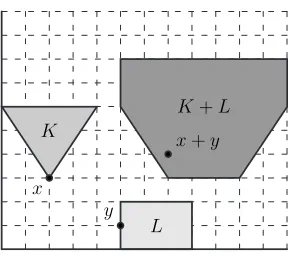
If K, L ∈ Kn, then clearly K +L ∈ Kn (see Figure 1.1). Two convex bodies K, L ∈ Kn are calledhomotheticifK =λK+tfor somet∈Rnandλ >0. Moreover, we say thatLis asummand
of K if there exists a convex body M ∈ Kn such that K=L+M.
L y K
x
K+L
[image:22.595.229.373.328.456.2]x+y
Figure 1.1: The Minkowski (vectorial) addition.
The intersection of all convex sets containing M ( Rn is the convex hull of M, and it will be denoted by convM; thus convM is the smallest convex set containing M. We denote by posM thepositive hull of M, namely, posM ={λx:λ≥0, x∈M}. Finally, thelinear hull ofM, linM, is the intersection of all linear subspaces in Rn containing M. The convex hull of a compact set is always a convex body. In particular, the convex hull of a finite number of points is so and the family of all of them defines a very important class of convex bodies:
Definition 1.1.3. A polytope is the convex hull of finitely many points in Rn (its vertices).
In spite of the fact that many of the following properties and definitions are valid for closed convex sets, in order to simplify the exposition we will restrict them to compact ones, since later we will always work under the hypothesis of compactness.
Definition 1.1.4. A hyperplaneH is a supporting hyperplane of K ∈ Kn if H∩K6=∅ andK is
1.1 Convex bodies and their properties 3
The following classical results concerning supporting hyperplanes will be needed in the following.
Theorem 1.1.5. At every boundary point of K ∈ Kn there exists a supporting hyperplane to K.
Furthermore, for all u∈Sn−1 there is a supporting hyperplane of K with outer normal vector u.
Supporting hyperplanes are used to characterize convexity: if K ( Rn is compact, intK 6= ∅, then K is convex if and only if for every x ∈bdK there is a supporting hyperplane to K. As a consequence, we get that any convex body is the intersection of its supporting halfspaces. Moreover:
Theorem 1.1.6. Any K ∈ Kn with intK 6= ∅ is the intersection of its supporting halfspaces at
regular points, i.e., those boundary pointsxsuch that the supporting hyperplane toK atxis unique.
Definition 1.1.7. A convex bodyK ∈ Kn is said to be regularif everyx∈bdK is aregular point.
We observe that ifK ∈ Kn is regular, then necessarily intK6=∅.
There is no doubt that convex functions play an important role in the theory of convex bodies.
Definition 1.1.8. A functionf :Rn−→Ris convex if for any x, y∈Rn and 0≤λ≤1,
f¡(1−λ)x+λy¢≤(1−λ)f(x) +λf(y).
A functionf is concave if−f is convex.
The following properties of convex functions will be needed later. For references and further study we refer for instance to [24, 27].
Proposition 1.1.9. A convex function f :Rn−→R is continuous in int domf and, ifn= 1:
i) The left and right derivatives, denoted respectively by(d−/dx)f(x)and(d+/dx)f(x), do exist
at every pointx∈R and they are increasing functions. Moreover,
d−
dxf(x)≤ d+
dxf(x).
ii) If f : [a, b]−→R, the left (respectively, right) derivative exists at x=b (respectively, x=a).
Lemma 1.1.10 ([23, Problem/Remark B, p. 13]). If f :I −→ R is a convex (or concave) function, whereI ⊆Ris an interval, then f is absolutely continuous on I.
Definition 1.1.11. The support function of a convex body K ∈ Kn in the direction u ∈ Sn−1,
denoted by h(K, u), is the real valued function defined on the sphere by
h(K, u) = max©hx, ui:x∈Kª.
4 Preliminaries
Proposition 1.1.12. Let K, L∈ Kn and u, v∈Sn−1.
i) h(K+L, u) =h(K, u) +h(L, u) and h(λK, u) =λh(K, u) for allλ≥0. ii) If K ⊆L thenh(K, u)≤h(L, u).
iii) h(K, λu) =λh(K, u) for allλ≥0, i.e., h(K,·) is positively homogeneous. iv) h(K, u+v)≤h(K, u) +h(K, v), i.e., h(K,·) is subadditive.
In particular, h(K,·) is convex. The above last two properties are usually expressed by saying thath(K,·) is sublinear. In fact, it turns out that they characterize support functions:
Theorem 1.1.13. Let h be a sublinear (real-valued) function defined on Sn−1. Then there is a
uniqueK∈ Kn such thath=h(K,·). Moreover, anyK∈ Knis determined by its support function.
We observe that ifK ∈ Kn, then
K =©x∈Rn:hx, ui ≤h(K, u) for everyu∈Sn−1ª, or equivalently,
K = \
u∈Sn−1
©
x∈Rn:hx, ui ≤h(K, u)ª. (1.1) Property i) in Proposition 1.1.12 allows to prove the cancellation law for (Kn,+), this is, if K+M =L+M forK, L, M ∈ Kn, thenK=L.
The space of convex bodies Kn is endowed with theHausdorff metric δ
H, namely
δH(K, L) = min{λ≥0 :K⊆L+λBn, L⊆K+λBn} forK, L∈ Kn. (1.2) From now on we will consider the continuity of functionals defined onKn, as well as the convergence of convex bodies, with respect to the topology determined by the Hausdorff metric. We finish this section by formulating the famousBlaschke selection theorem, which provides a very useful tool in providing the existence of convex bodies with specific properties. The proof of this theorem can be found, for instance, in [27, Theorem 1.8.6].
Theorem 1.1.14 (Blaschke’s selection theorem). Every bounded sequence of convex bodies in
Rn has a convergent subsequence (in the Hausdorff metric δ
H) to a convex body.
1.2
Minkowski’s difference
Minkowski’s difference (though it was not introduced by Minkowski) can be regarded as the subtraction counterpart of the Minkowski sum: for two non-empty setsA, B⊆Rn, the Minkowski difference of A andB is defined by
A∼B ={x∈Rn:B+x⊆A}, (1.3)
1.2 Minkowski’s difference 5
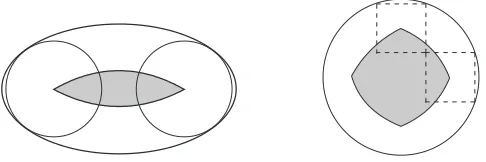
Figure 1.2: Inner parallel body of an ellipse (relative toB2) and a circle (relative to the square).
Next lemma collects some useful rules which relate Minkowski’s addition and subtraction.
Lemma 1.2.1. Let A, B, C ⊆Rn be non-empty sets. Then
i) (A+B)∼B ⊇A. If A, B∈ Kn, then there is equality.
ii) (A∼B) +B ⊆A. If A, B∈ Kn, equality holds if and only ifB is a summand of A. iii) (A∼B) +C⊆(A+C)∼B.
iv) (A∼B)∼C=A∼(B+C).
v) A+B ⊆C if and only if A⊆C∼B.
As we shall see later, Minkowski’s difference gives rise to the notion of inner parallel bodies, a notion which has many applications in the geometry of convex bodies: according to [27, Section 7.5] “some of the deeper investigations of inequalities for mixed volumes make essential use of the method of inner parallel bodies”; we refer the reader to [27, Note 2 for Section 7.5] for further applications of inner parallel bodies.
For convex bodiesK, E∈ Kn, the Minkowski difference K∼E can be also defined as
K ∼E = \
u∈Sn−1
©
x∈Rn:hx, ui ≤h(K, u)−h(E, u)ª. (1.4) Unlike what happens with the Minkowski sum (Proposition 1.1.12 i)), the support function of the Minkowski differenceK ∼Ecannot be given, in general, by an easy combination of the support functions ofK and E. Nevertheless, one can easily get the following bound:
h(K ∼E, u)≤h(K, u)−h(E, u) for all u∈Sn−1.
We would like to point out that, in general, there is no equality in the above inequality relating support functions (cf. Lemma 1.2.1 ii)).
Definition 1.2.2. Let ψ:Sn−1−→[0,∞) be a non-negative continuous function andΩ⊆Sn−1 be
a closed subset, not lying in a closed hemisphere. The Wulff-shapeassociated with(Ω, ψ) is the set
WS(Ω, ψ) = \ u∈Ω
©
x∈Rn:hx, ui ≤ψ(u)ª.
6 Preliminaries
For further details about Wulff-shapes we refer to [27, Section 7.5] and the references therein.
Remark 1.2.3. WS(Ω, ψ)is a convex body containing the origin ([27, Section 7.5]), and moreover,
h¡WS(Ω, ψ), u¢≤ψ(u) for all u∈Ω. Equality holds for particular vectors (see Remark 4.1.4).
We observe that the difference body K ∼ E of two convex bodies K, E ∈ Kn can be seen as the Wulff-shape associated with the function ψ(u) =h(K, u)−h(E, u).
The following lemma can be found in [27, Lemma 7.5.2]:
Lemma 1.2.4. IfKj = WS(Ω, ψj) for j∈N∪ {0} and if(ψj)j∈N converges uniformly to ψ0, then
(Kj)j∈N converges toK0 with respect to the Hausdorff metric.
We have seen two equivalent geometric constructions giving rise to the Minkowski difference, namely, equations (1.3) and (1.4). The first definition makes use of the natural connection of the subtraction with the Minkowski sum: K ∼ E should be maximal among all convex bodies which (Minkowski) added to E keep the result within K. The second definition takes advantage of the connection of the Minkowski sum with the support function via a Wulff-shape, since differences of support functions need not be support functions.
1.3
The full system of parallel bodies
When dealing with the Minkowski difference of convex bodies, the notions of inradius and kernel play a prominent role (see e.g. [25, 27] and the references therein).
Definition 1.3.1. For two convex bodiesK, E∈ Kn, therelative inradius r(K;E)ofK with respect to E is defined by
r(K;E) = max©r≥0 :x+rE⊆K for some x∈Rnª, (1.5)
whereas
ker(K;E) =K ∼r(K;E)E
is the set of relative incenters of K, usually called kernel of K with respect toE.
It is well-known (see [2, p. 59]) that the dimension of ker(K;E) satisfies
dim ker(K;E)≤n−1. (1.6)
For two convex bodies K, E∈ Kn, and a non-negative real numberλ, the outer parallel body of
1.3 The full system of parallel bodies 7
For E ∈ Kn, joining outer and inner parallel bodies, the full system of relative parallel bodies ofK is defined as
Kλ =
K∼ |λ|E if −r(K;E)≤λ≤0,
K+λE if 0≤λ <∞.
Obviously we have K0 = K and K−r(K;E) = ker(K;E). Moreover, for K, L∈ Kn and arbitrary µ≥ −r(K;E), σ≥ −r(L;E), the rule
Kµ+Lσ ⊆(K+L)µ+σ (1.7)
is valid (see [27, (3.20)]). As a consequence, a very useful property of the full system of relative parallel bodies of a convex set is obtained: it is concave with respect to inclusion and Minkowski’s addition (see [27, Lemma 3.1.13]), i.e.,
(1−λ)Kµ+λKσ ⊆K(1−λ)µ+λσ. (1.8) A special family of convex bodies for which their inner parallel bodies can be easily characterized, are the so-called tangential bodies. Tangential bodies can be defined in several equivalent ways; here we will use the following one:
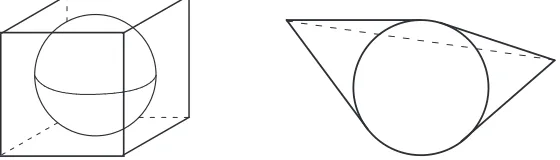
Definition 1.3.2. A convex body K∈ Kn containingE ∈ Kn, is called a tangential bodyof E, if
[image:27.595.162.442.457.537.2]through each boundary point ofK there exists a support hyperplane to K that also supports E.
Figure 1.3: Examples of tangential bodies ofBn.
We notice that if K is a tangential body of E, then r(K;E) = 1. Then-dimensional cube Cn is an example of this type of bodies for E = Bn (see Figure 1.3). For an exhaustive study of the more general defined p-tangential bodies we refer to [27, Section 2.2 and p. 149].
The following result was proved by Schneider and characterizes tangential bodies as the only convex bodies whose inner parallel bodies are homothetic copies of them.
Theorem 1.3.3 ([27, Lemma 3.1.14]). Let K, E ∈ Kn
n and let λ∈
¡
8 Preliminaries
1.4
p
-sum of convex bodies
In 1962 Firey [6] introduced the following generalization of the classical Minkowski addition.
Definition 1.4.1. For p ≥ 1 and K, E ∈ Kn
0, the p-sum (or Lp-sum) of K and E is the convex
bodyK+pE∈ Kn
0 whose support function is given by
h(K+pE, u) =
³
h(K, u)p+h(E, u)p
´1/p
, u∈Sn−1. (1.9) When p= 1, the latter defines the usual Minkowski addition, whereas forp=∞ we have that
h(K+∞E, u) = max
©
h(K, u), h(E, u)ª, this is,
K+∞E= conv(K∪E) (1.10)
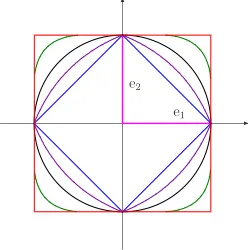
(see Figure 1.4). We notice also that when combining thep-sum with the scalar multiplicationµK, the following facts hold: for all K, E∈ K0n,µ, λ >0 andp≥1,
µK+pµE=µ(K+pE)
and
µK+pλK =
¡
[image:28.595.73.526.349.517.2]µp+λp¢1/pK. (1.11)
Figure 1.4:[−2e1,2e1] +pB2, wherep= 1,1.5,10.
Moreover, in [6, Theorem 1] it is shown that for all 1≤p≤q≤ ∞,
K+qE⊆K+pE (1.12)
and
1
2(p−1)/p(K+E)⊆K+pE. (1.13) We notice that the cancellation law for convex bodies K, L, M ∈ Kn0 also works for the p-sum +p for all 1≤p <∞, i.e., if K+pM =L+pM, thenK =L.
1.5 Mixed volumes and quermassintegrals 9
The works [19, 20] of Lutwak, where a systematic study of means of convex bodies is taken up, constitute the outstanding rising of the nowadays known as Lp-Brunn-Minkowski theory. In the last years many important developments of this theory have come out. For further details, as well as detailed bibliography on the topic we refer to [27, Chapter 9] and the references therein.
1.5
Mixed volumes and quermassintegrals
Given a convex body K ∈ Kn, its volume is defined as its Lebesgue measure and it will be denoted by vol(K). Therefore, vol(·) satisfies the following known properties:
Lemma 1.5.1. Let K, L∈ Kn.
i) If dimK=n, then vol(K)>0. IfdimK ≤n−1, then vol(K) = 0. ii) vol(λK) =λnvol(K) for λ≥0.
iii) The volume vol :Kn−→[0,∞) is a continuous function on the space of convex bodies. iv) If L⊆K thenvol(L)≤vol(K) and equality holds, for dimL=n, if and only if L=K.
Combining the notions of volume and Minkowski sum, the concept of mixed volume appears. For a detailed study of mixed volumes we refer to Section 5.1 in [27].
Theorem 1.5.2. LetK1, . . . , Km∈ Knandλ1, . . . , λm≥0. There are coefficientsV(Ki1, . . . , Kin),
1≤i1, . . . , in≤m, called mixed volumes, which are symmetric in the indices and such that
vol¡λ1K1+· · ·+λmKm
¢
= m
X
i1,...,in=1
V(Ki1, . . . , Kin)λi1· · ·λin. (1.14)
We notice that the polynomial expression given in (1.14) does not exist for thep-sum +p when p >1 (see e.g. [7]).
Further, for K1, . . . , Kn ∈ Kn it is known that there exist finite Borel measures on Sn−1, the
mixed surface area measuresS(K2, . . . , Kn,·), such that V(K1, . . . , Kn) = n1
Z Sn−1
h(K1, u) dS(K2, . . . , Kn, u). From now on, for the sake of brevity we will use the abbreviation
¡
K1[r1], . . . , Km[rm]
¢
:=
³
K1,(. . ., Kr1) 1, . . . , Km,(. . . , Krm) m
´
.
If only two convex bodiesK, E∈ Knare involved, the mixed volume V¡K[n−i], E[i]¢= W
i(K;E) is called the i-th quermassintegrals of K (relative to E), i = 0, . . . , n. In particular, we have W0(K;E) = vol(K) and Wn(K;E) = vol(E). We notice that
Wi(K;E) = n1
Z Sn−1
10 Preliminaries
Some useful properties of the mixed volumes and mixed surface area measures are listed in the following proposition; they will be needed throughout this work.
Proposition 1.5.3. Let K, L, K1, . . . , Kn∈ Kn. The following properties hold:
i) V(K, . . . , K) = vol(K).
ii) S(K2, . . . , Kn,·) is symmetric in the indices for any permutation.
iii) V(rK+sL, K2, . . . , Kn) = rV(K, K2, . . . , Kn) +sV(L, K2, . . . , Kn) for every r, s ≥ 0, and S(rK +sL, K2, . . . , Kn−1,·) = rS(K, K2, . . . , Kn−1,·) + sS(L, K2, . . . , Kn−1,·), i.e., mixed
volumes and surface area measures are linear in each argument.
iv) Mixed volumes are continuous functions on(Kn)n, and rigid motion invariant. Mixed surface
area measures are weakly continuous on(Kn)n−1.
v) If K ⊆L then0≤V(K, K2, . . . , Kn)≤V(L, K2, . . . , Kn).
If only two convex bodies are considered, Theorem 1.5.2 yields the so-called relative Steiner formula orMinkowski-Steiner formula.
Theorem 1.5.4 (The (relative) Steiner formula. Steiner, [28]). Let K, E∈ Kn. The volume
of the outer parallel body of K with respect toE at distance λ≥0 is expressed as
vol(K+λE) = n
X
i=0 µ
n i
¶
Wi(K;E)λi. (1.16)
We notice that if E ∈ Kn
n, then the polynomial on the right-hand side of (1.16), the so-called
relative Steiner polynomial, has degreen, i.e., the dimension of the space.
Taking into account that quermassintegrals are particular cases of mixed volumes, the following
Steiner formula for the relative quermassintegrals can be also obtained.
Theorem 1.5.5 (Steiner formula for relative quermassintegrals). LetK, E∈ Knandλ≥0. The relative i-th quermassintegral, i = 0, . . . , n, of the outer parallel body of K (relative to E),
K+λE, can be expressed as a polynomial in the parameter λ,
Wi(K+λE;E) = n−i
X
k=0 µ
n−i k
¶
Wi+k(K;E)λk. (1.17)
1.6
Inequalities for mixed volumes and other related results
1.7 On hypergeometric functions 11
Theorem 1.6.1 (Brunn-Minkowski’s inequality). For convex bodiesK, L∈ Kn andλ∈[0,1],
vol¡(1−λ)K+λL¢1/n ≥(1−λ)vol(K)1/n+λvol(L)1/n. (1.18)
Equality for some λ∈(0,1) holds if and only if K and L either lie in parallel hyperplanes or are homothetic.
Using the monotonicity of the volume (Lemma 1.5.1) and properties relating Minkowski sum and difference (Lemma 1.2.1), one gets a Brunn-Minkowski inequality for the Minkowski difference:
vol(K ∼L)1/n≤vol(K)1/n−vol(L)1/n. (1.19) In the setting of theLp-Brunn-Minkowski theory, theLp-Minkowski inequality, i.e., a Brunn-Minkowski type inequality for thep-sum, establishes that if K, L∈ Kn
(0), 1≤p <∞, then
vol(K+pL
¢p/n
≥vol(K)p/n+ vol(L)p/n, (1.20)
with equality if and only ifK andL are homothetic (see e.g. [27, Theorem 9.1.3]).
There exists also a general Brunn-Minkowski theorem stating an analogous inequality for mixed volumes (see [27, Theorem 7.4.5]), and in particular, for every (relative) quermassintegral, which we will need later: if K, L, E∈ Kn and λ∈[0,1], then, for all i= 0, . . . , n−2,
Wi
¡
(1−λ)K+λL;E¢1/(n−i)≥(1−λ)Wi(K;E)1/(n−i)+λWi(L;E)1/(n−i), whereas
Wn−1 ¡
(1−λ)K+λL;E¢= (1−λ)Wn−1(K;E) +λWn−1(L;E).
In the setting of theLp-Brunn-Minkowski theory, the corresponding inequality takes the following form (see [27, Corollary 9.1.5]):
Theorem 1.6.2. For convex bodies E ∈ Knn, K, L∈ K(0)n , and for all p≥1, i∈ {0, . . . , n−1},
Wi
¡
K+pL;E
¢p/(n−i)
≥Wi(K;E)p/(n−i)+ Wi(L;E)p/(n−i). (1.21) An additional inequality that we will need throughout the thesis is Minkowski’s inequality for sums (see e.g. [10, Corollary 1.6]). It states that ifx1, y1, . . . , xn, yn≥0 andp≥1, then
³
(x1+y1)p+· · ·+ (xn+yn)p
´1/p
≤¡xp1+· · ·+xpn¢1/p+¡y1p+· · ·+ynp¢1/p (1.22)
1.7
On hypergeometric functions
In this final section, we collect some well-known functions, as Euler’s Beta and Gamma func-tions, as well as their relation with the so-calledhypergeometric function2F1. This will allow us to
12 Preliminaries
The Beta function of Euler, B : (0,∞)×(0,∞)−→R, is defined by
B(p, q) =
Z 1 0
tp−1(1−t)q−1dt, and theGamma function of Euler, Γ : (0,∞)−→R, is given by
Γ(p) =
Z ∞ 0
tp−1e−tdt. Both functions are related by means of
B(p, q) = Γ(p)Γ(q) Γ(p+q).
The so-calledhypergeometric function 2F1(a, b;c;x), given by the integral representation 2F1(a, b;c;x) = Γ(b)Γ(cΓ(c)−b)
Z 1 0
(1−xt)−atb−1(1−t)c−b−1dt, (1.23) with|x|<1,a∈Randc > b >0 (see e.g. [8, (1.11.10)]), happens to be related with the Beta and Gamma functions and will appear in some inequalities at the end of the work.
In the last chapter the following integral expression, closed related with the above defined hypergeometric function, will be needed: forα∈R, r>0 and p≥1, let
Iα,p(λ) :=
Z λ
−r
|t|p¡rp− |t|p¢α/pdt, −r< λ≤0. (1.24)
Lemma 1.7.1. Let p≥1,α >−p andr>0. Then, for all −r< λ≤0,
Iα,p(λ) = r α+p+1
p
"
B
µ
p+ 1 p ,
p+α p
¶
− p p+ 1
|λ|p+1
rp+1 2F1 µ
−α p,
p+ 1 p ;
2p+ 1 p ;
|λ|p rp
¶ #
.
Proof. With the change of variable u=¡|t|/r¢p, we have Iα,p(λ) =
Z λ
−r
|t|p¡rp− |t|p¢α/pdt= rα
Z 1 (|λ|/r)p
rp+1
p u
1/p(1−u)α/pdu
= r α+p+1
p
ÃZ 1 0
u1/p(1−u)α/pdu−
Z (|λ|/r)p
0
u1/p(1−u)α/pdu
!
= rα+p+1 p
Ã
B
µ
1 +1 p,1 +
α p
¶
−
Z (|λ|/r)p
0
u1/p(1−u)α/pdu
!
.
Finally, taking into account (1.23), we get the value of the integral in the above expression:
Z (|λ|/r)p
0
u1/p(1−u)α/pdu= |λ| p+1
rp+1 Z 1
0
s1/p
µ
1−|λ| p
rp s
¶α/p
ds
= |λ|p+1 rp+1
Γ
³
1 +1p
´
Γ(1)
Γ
³
2 +1p
´ 2F1 µ
−α p,1 +
1 p; 2 +
1 p; |λ|p rp ¶ = p p+ 1
|λ|p+1
rp+1 2F1 µ
−α p,1 +
1 p; 2 +
Chapter 2
p
-difference of convex bodies: First
properties
p-difference of convex bodies: First
properties
As it was stated in the previous chapter, Minkowski’s difference is the subtraction counterpart of the Minkowski sum. In this chapter we introduce the notion ofp-difference, which is an extension of the Minkowski difference in the setting of the Lp-Brunn-Minkowski theory. We prove several properties of this new operation, introducing also the notion ofp-(inner) parallel bodies. We prove an analog of the concavity of the family of classical parallel bodies for thep-parallel ones, as well as the continuity of this new family, in its definition parameter. Further results on inner parallel bodies are extended top-inner ones; for instance, we show that tangential bodies are characterized as the only convex bodies whosep-inner parallel bodies are homothetic copies of them. The original work that we collect in this chapter can be found in [21].
2.1
p
-difference of convex bodies. Definition and first properties
There are several definitions of Minkowski’s difference, all of which turn out to be equivalent (see [27, p. 146]). On one hand, as mentioned already in Section 1.2, the Minkowski difference of two non-empty sets A, B ⊆Rn can be defined by (1.3). On the other hand, for convex bodies K, E ∈ Kn, the Minkowski difference K ∼E can be obtained as the Wulff-shape of the function ψ(u) =h(K, u)−h(E, u), as in (1.4).
14 p-difference of convex bodies: First properties
Definition 2.1.1. Let K, E ∈ Kn
0, E ⊆ K, and let p ≥ 1. The p-difference of K and E is the
largest convex body K∼p E∈ K0n such that
(K ∼p E) +pE⊆K. (2.1)
On the one hand, it is clear from the above definition that
K∼p E= [ M∈Kn
0
M+pE⊆K
M, (2.2)
because the above union is a convex body. Indeed, writing F = {M ∈ Kn0 : M +p E ⊆ K}, if K1, K2 ∈ F then also conv(K1 ∪K2) ∈ F, which implies that the above standard union is a
convex set. Now given a sequence of points (xn)n⊆SM∈FM with limn→∞xn=x, there exists a sequence (Mn)n ⊆ F with xn ∈ Mn for each n∈ N. By Blaschke’s Selection Theorem 1.1.14 we can choose (Mn)n to be convergent to a convex bodyM, and it is clear that M ∈ F. Therefore, x∈M ⊆SM∈FM.
Taking (1.10) into account, it is easy to check that K ∼∞E =K, and for p= 1 we obviously
obtain the classical Minkowski difference ofK and E.
On the other hand, and looking back at (1.4), it would be desirable that such a kind of expression also works for thep-difference, in order to use the powerful Wulff-shape structure and its connection with the support function. The following theorem shows that this is the case. First we will assume that 1≤p <∞. The casep=∞ will be treated later.
Theorem 2.1.2. Let 1≤p <∞ and let K, E∈ Kn
0 with E⊆K. Then,
K∼p E=
\
u∈Sn−1
n
x∈Rn:hx, ui ≤¡h(K, u)p−h(E, u)p¢1/p
o
. (2.3)
Proof. We show (2.3) using the already known expression (2.2) for K ∼p E. Let
L= \
u∈Sn−1
n
x∈Rn:hx, ui ≤¡h(K, u)p−h(E, u)p¢1/p
o
.
Remark 1.2.3 ensures that
h(L, u)≤¡h(K, u)p−h(E, u)p¢1/p,
and so we have h(L, u)p+h(E, u)p≤h(K, u)p for all u∈Sn−1. It yields L⊆K∼p E.
Conversely, ifx∈K ∼pE, then there existsM ∈ Kn0 satisfyingM+pE ⊆K, such thatx∈M, and from this condition we obtain that
h(M, u)p+h(E, u)p≤h(K, u)p for all u∈Sn−1.
It implies that hx, ui ≤ ¡h(K, u)p −h(E, u)p¢1/p for all u ∈ Sn−1, i.e., x ∈ L, which shows the
![Figure 1.4: [ −2 e 1 , 2 e 1 ] +pB 2 , where p=1 , 1 . 5 , 1 0 .](https://thumb-us.123doks.com/thumbv2/123dok_es/5324770.98837/28.595.73.526.349.517/figure-e-e-pb-p.webp)
![Vista de [ES] LOS DOS CUERPOS DE CARLOS II // THE TWO BODIES OF CHARLES II
| Librosdelacorte.es](data:image/gif;base64,R0lGODlhAQABAIAAAP///wAAACH5BAEAAAAALAAAAAABAAEAAAICRAEAOw==)