ADVERTIMENT. La consulta d’aquesta tesi queda condicionada a l’acceptació de les següents condicions d'ús: La difusió d’aquesta tesi per mitjà del servei TDX (www.tesisenxarxa.net) ha estat autoritzada pels titulars dels drets de propietat intel·lectual únicament per a usos privats emmarcats en activitats d’investigació i docència. No s’autoritza la seva reproducció amb finalitats de lucre ni la seva difusió i posada a disposició des d’un lloc aliè al servei TDX. No s’autoritza la presentació del seu contingut en una finestra o marc aliè a TDX (framing). Aquesta reserva de drets afecta tant al resum de presentació de la tesi com als seus continguts. En la utilització o cita de parts de la tesi és obligat indicar el nom de la persona autora.
ADVERTENCIA. La consulta de esta tesis queda condicionada a la aceptación de las siguientes condiciones de uso: La difusión de esta tesis por medio del servicio TDR (www.tesisenred.net) ha sido autorizada por los titulares de los derechos de propiedad intelectual únicamente para usos privados enmarcados en actividades de investigación y docencia. No se autoriza su reproducción con finalidades de lucro ni su difusión y puesta a disposición desde un sitio ajeno al servicio TDR. No se autoriza la presentación de su contenido en una ventana o marco ajeno a TDR (framing). Esta reserva de derechos afecta tanto al resumen de presentación de la tesis como a sus contenidos. En la utilización o cita de partes de la tesis es obligado indicar el nombre de la persona autora.
Analysis and Architectural Support
for Parallel Stateful Packet Processing
A Dissertation Presented
in Partial Fulfillment of the Requirements for the Degree of Doctor of Philosophy
Doctor per la Universitat Polit´ecnica de Catalunya
by
Javier Verd´u Mul`a
Analysis and Architectural Support
for Parallel Stateful Packet Processing
Author: Javier Verd´u Mul`a
Advisors: Mario Nemirovsky
Mateo Valero Cort´es
A Dissertation Presented
in Partial Fulfillment of the Requirements for the Degree of
Doctor of Philosophy
Doctor per la Universitat Polit´ecnica de Catalunya
Departament d’Arquitectura de Computadors Universitat Polit´ecnica de Catalunya
vii
Acknowledgements
Per comenc¸ar voldria agrair aquesta tesis als meus Pares, al Josep, a l’Anna i a la resta de la fam´ılia per ajudar–me a cr´eixer com a persona i pel seu recolzament en els estudis. I des de fa pocs anys a la meva nova fam´ılia, pares i germans de l’Ester. Tamb´e al Mart´ın i a la Lidia, dos molt bons amics tant llunyans com propers. A tots ells GR `ACIES per haver estat amb mi en diferents moments de la meva vida.
Per`o sobretot a l’Ester, per haver sacrificat tots aquells caps de setmanes, vacances, ponts ... i per aquelles nits i matinades en qu havia de treballar. Aix´ı que, prepara’t, ara comenc¸arem a viure!!!!
Gr`acies als meus directors de Tesis, Mario i Mateo, els quals sense ells no hagus aprs a espavilar–me i per tant, a treure endavant la tesis. Tamb´e a nivell professional, agraeixo a Jorge Garc´ıa per la gran ajuda que em va donar especialment al principi de la tesis i a Enrique per haver–me obert les portes a un viatge doctoral que avui acaba.
El comenc¸ament del doctorat va suposar molts canvis en la meva vida, que van ser m´es f`acils de pair al conviure amb bons amics. Fran, amb qui vaig comenc¸ar l’aventura del doctorat, i Germ´an i Oliver, amb aquelles converses nocturnes inacabables.
Des de fa temps a l’Alex i al Rub´en fan que els esmorzars es converteixin en un m´on ple d’emocionants projectes, dels quals no descartem que algun dia es facin realitat.
viii Acknowledgements
he necessitat, i als que em van ajudar quan vaig he estat a Estats Units, Mario i Laura, Enric i Encarna, i Rodolfo.
ix
Abstract
This dissertation focuses on the processing of packets in network nodes. The demand of packet processing differ in significant ways from other typical processing required by office applications or scientific data crunching. The system throughput requirements lead to the exploitation of parallelism through parallel architectures. Massive multithreaded processors emerge as a good alternative to provide the required resource capabilities.
Advanced network applications keep state information of processed packets. The state can be related to packets of a given flow or packets across different flows. These applications, called stateful, arise dependencies among packets and reduce the amount of available parallelism. Moreover, current execution models of network applications don’t take advantage of the massive multithreaded capabilities.
In this thesis, we address the limitations of parallelism in stateful network appli-cations to maximize the throughput of advanced network devices. Furthermore, this dissertation comprises three complementary sets of contributions focused on: network analysis, workload characterization and architectural proposal.
The network analysis evaluates the impact of network traffic on stateful network applications. We specially study the impact of network traffic aggregation on memory hierarchy performance.
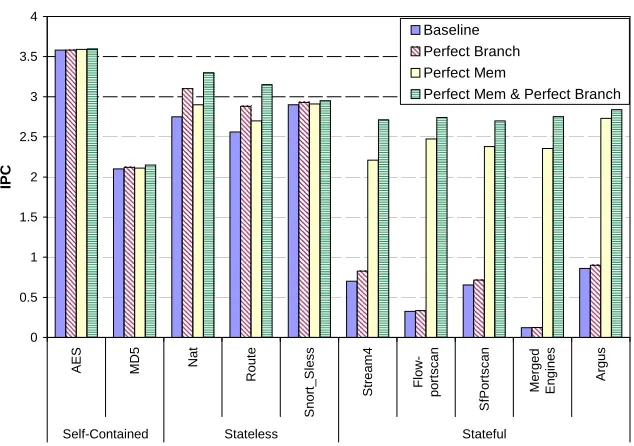
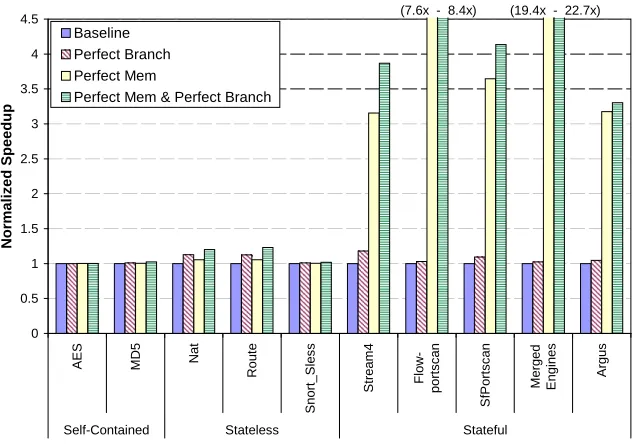
We categorize and characterize network applications according to their data man-agement. The results point out that stateful processing presents reduced instruction level parallelism and high rate of long latency memory accesses.
x Abstract
hierarchy and alleviates the contention in critical sections of parallel stateful workloads. The main goal of MLP is to maximize the throughput of massive multithreaded archi-tectures.
xi
Contents
List of Figures xv
List of Tables xvii
1 Introduction 1
1.1 Trends of Packet Processing in the Internet . . . 3
1.2 Emerging of Massive Multithreaded Architectures . . . 5
1.3 Problem Statement . . . 7
1.4 Contributions . . . 8
1.4.1 Primary Contributions . . . 8
1.4.2 Other Contributions . . . 11
1.5 Organization . . . 12
2 Background 15 2.1 Deep Packet Inspection . . . 15
2.2 Statefulness . . . 17
2.3 Dependencies Among Packets . . . 18
3 Network Traffic Analysis 21 3.1 Chapter Roadmap . . . 22
3.2 Network Properties Under Analysis . . . 22
3.2.1 Sanitization . . . 22
3.2.2 Traffic Aggregation . . . 24
3.3 Validation of Sanitized Traffic Traces . . . 25
3.3.1 Methodology . . . 26
3.3.2 Evaluation . . . 28
xii CONTENTS
3.4.1 Traffic Aggregation . . . 32
3.4.2 Methodology . . . 34
3.4.3 Evaluation . . . 36
3.5 Related Work . . . 41
3.6 Chapter Summary . . . 42
4 Characterization of Networking Applications 45 4.1 Chapter Roadmap . . . 46
4.2 Workload Classification . . . 46
4.3 Environment and Methodology . . . 48
4.3.1 Traffic Traces . . . 48
4.3.2 Benchmark Selection . . . 48
4.3.3 Evaluation Methodology . . . 49
4.4 Characterization of Network Workloads . . . 51
4.4.1 Stateful Data Requirements . . . 51
4.4.2 Instruction Mix . . . 53
4.4.3 Instruction Level Parallelism . . . 55
4.4.4 Data Cache Behavior . . . 57
4.4.5 Branch Prediction . . . 59
4.4.6 Performance Evaluation . . . 59
4.5 Characterization of Stateful Workloads Throughout a Flow . . . 61
4.5.1 Computational Workload . . . 62
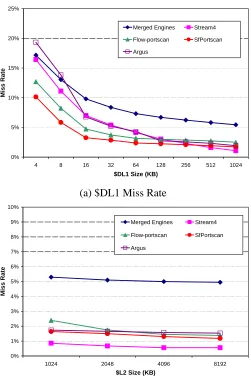
4.5.2 Data Cache Behavior . . . 64
4.5.3 Branch Prediction . . . 65
4.5.4 Performance Variations . . . 68
4.6 Related Work . . . 70
4.7 Conclusions . . . 71
5 Principles of Parallel Stateful Processing 73 5.1 Motivation . . . 74
5.2 Workload Breakdown . . . 75
5.3 Critical Sections . . . 79
5.4 Order–of–Seniority . . . 81
5.5 Parallel Execution Models . . . 82
5.5.1 Run–to–Completion . . . 82
CONTENTS xiii
6 MultiLayer Processing 87
6.1 Chapter Roadmap . . . 87
6.2 MultiLayer Processing . . . 88
6.2.1 The Ideal Parallel Stateful Processing . . . 89
6.2.2 MultiLayer Paradigm . . . 89
6.2.3 Identification of Processing Layers . . . 92
6.2.4 Load Balancing . . . 95
6.2.5 Processor Architecture . . . 96
6.3 Methodology . . . 99
6.3.1 Traffic Traces . . . 99
6.3.2 Workload . . . 99
6.3.3 Simulator . . . 100
6.4 Evaluation . . . 102
6.4.1 Affinity among Streams . . . 102
6.4.2 Lock Contention . . . 108
6.4.3 Performance Scalability . . . 110
6.5 Related Work . . . 116
6.6 Chapter Summary . . . 119
7 Conclusions and Future Work 121 7.1 Main Contributions . . . 121
7.2 Future Work . . . 125
7.2.1 Network Traffic Processing Issues . . . 125
7.2.2 Parallel Programming Tradeoffs . . . 125
7.2.3 MultiLayer Processing . . . 126
xv
List of Figures
1.1 Internet Architecture Layers . . . 3
1.2 OSI Model . . . 4
1.3 Thesis Overview . . . 11
2.1 Packet Processing Flow Path . . . 17
2.2 Example of Order–of–Seniority Conflict . . . 19
3.1 IP address structure of a traffic trace (directly taken from [39]) . . . 23
3.2 Example of Unique Flow Rates . . . 25
3.3 Workload of a given TCP flow . . . 29
3.4 Real versus sanitized traffic . . . 30
3.5 Sanitized traffic from multiple bandwidth links . . . 31
3.6 Traffic aggregation methodology . . . 33
3.7 Example of aggregated traffic trace . . . 34
3.8 Traffic aggregation of several bandwidth links . . . 35
3.9 Example of theoretical memory requirements . . . 37
3.10 Traffic aggregation impact on L1 Data Cache . . . 38
3.11 Traffic aggregation impact on L2 Data Cache . . . 39
3.12 L2 Data Cache Requirements . . . 40
4.1 Network Processing Workload Categories . . . 47
4.2 Evaluation Methodology . . . 50
4.3 Lifetime of State Categories . . . 52
4.4 Statefulness of Benchmarks . . . 54
4.5 Instruction Mix of Stateful Benchmarks . . . 55
4.6 Available Instruction Level Parallelism . . . 56
xvi LIST OF FIGURES
4.8 Branch Prediction Hit Rate . . . 60
4.9 Performance Impact of Architectural Bottlenecks . . . 61
4.10 Normalized impact on IPC of Architectural Bottlenecks . . . 62
4.11 Workload per packet during the flow lifetime . . . 63
4.12 Data Cache Behavior . . . 65
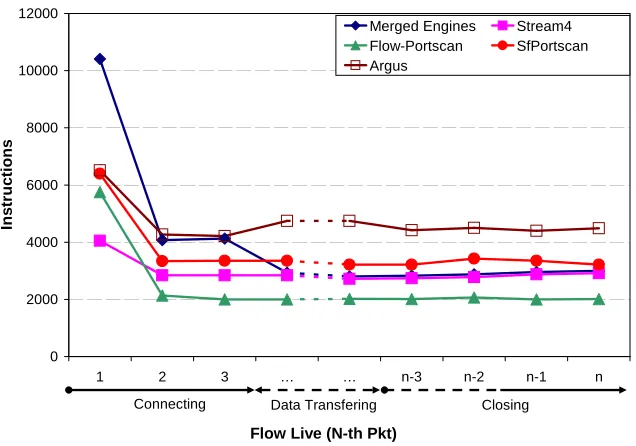
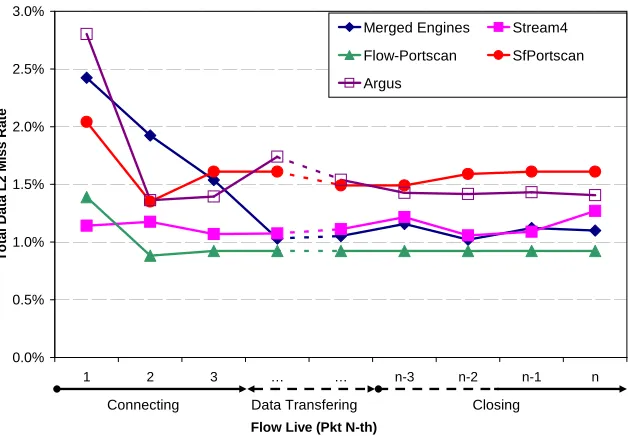
4.13 L2 Cache Misses per packet during the flow lifetime . . . 66
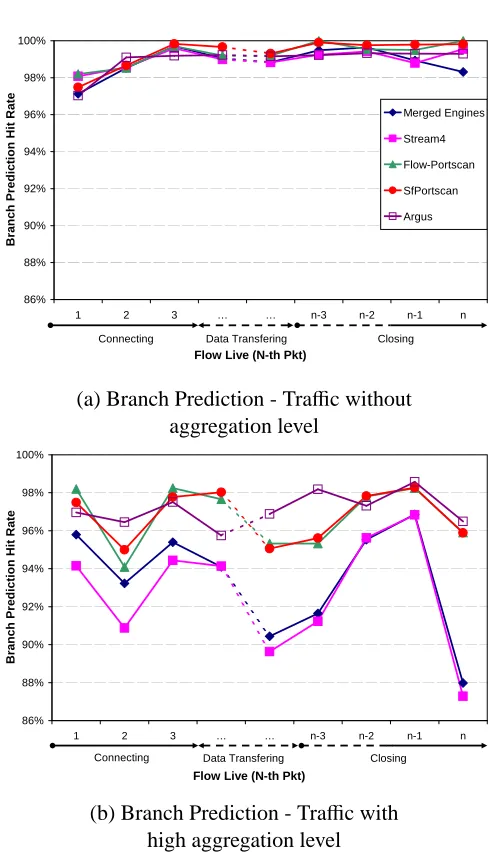
4.14 Branch prediction study during the flow lifetime . . . 67
4.15 Performance per packet during the flow lifetime . . . 68
4.16 Variations of IPC per packet during the flow lifetime . . . 69
5.1 Massive multithreaded size to sustain stateful DPI for a 10Gbps link . . 74
5.2 Snort packet processing loop . . . 75
5.3 Multithreaded Snort packet processing . . . 76
5.4 Snort workload distribution according to the processing stages . . . 78
5.5 Example of nested locking due to stateful processing . . . 80
5.6 Distribution of critical sections and nested levels . . . 81
5.7 Run–To–Completion Execution Model . . . 83
5.8 Software Pipeline Execution Model . . . 85
6.1 Stateful data classification of Snort–MT . . . 90
6.2 MLP execution model of Snort–MT . . . 91
6.3 Example of stateful packet processing code . . . 92
6.4 Intermediate representation of Function ”Processing” . . . 93
6.5 Example of stateful MLP code . . . 94
6.6 Migrations in the ”Processing” Function . . . 95
6.7 Baseline Processor Block Diagram . . . 97
6.8 I$ Miss Rate with Core and Stream Scaling . . . 104
6.9 I$ Miss Rate Comparison . . . 105
6.10 D$ Miss Rate with Core and Stream Scaling . . . 106
6.11 D$ Miss Rate Comparison . . . 107
6.12 Example of Lock Contention . . . 109
6.13 Lock Conflict Rates . . . 110
6.14 Normalized Reduction of Lock Conflict . . . 111
6.15 Average Occupancy Time per Core . . . 112
6.16 Performance scalability . . . 114
xvii
List of Tables
3.1 Example of resulting sanitized traffic . . . 26
3.2 Traffic Traces . . . 27
3.3 Selected Benchmarks . . . 36
4.1 Benchmark Classification . . . 49
4.2 Baseline Configuration . . . 51
5.1 Workload Mixes . . . 77
6.1 Workload Mixes . . . 100
6.2 Simulation Parameters . . . 101
1
Chapter 1
Introduction
The evolution of the technology in communications and processing capabilities, as well as other sociologic factors (e.g. social progress, global networking, working connected on remote devices), leads to the fact that both the entire Internet and a large range of individual institutions nearly double the network traffic each year since 1997 [16, 61].
”Gilder’s Law” predicts that the need for bandwidth will grow at least three times faster than computing power [25]. Regarding semiconductors, ”Moore’s Law” predicts that the number of transistors that fit on a chip will double every eighteen months [56]. Even if there are studies that suggest the near end of ”Moore’s Law” [23, 52], it is ex-pected that ”Gilder’s Law” will still hold true for the next years. Thus, as the gap between network bandwidth and computing power widens, improved processor architectures are needed to process network traffic without limiting system throughput.
The evolution of network services is closely related to the network technology trend. Originally network nodes forwarded packets from a source to a destination in the net-work by executing lightweight packet processing, or even negligible net-workloads. As links provide more complex services, packet processing demands the execution of more com-putational intensive applications. Complex network applications deal with both packet header and payload (i.e. packet contents) to provide upper layer network services, such as enhanced security, system utilization policies, and video on demand management. Van Jacobson suggests the beggining of a new big step forward on the evolution of In-ternet towards ubiquitous computing [35].
2 Introduction
the required network processing performance as well as other demands, such as memory and I/O bandwidth. There are different processor architectures depending on the shar-ing degree of hardware resources among streams (i.e.hardware context). Multiprocessor architecture presents several processors in which there are no hardware resource shared among processors, except the main memory and interconnection bus. Multicore archi-tectures present multiple processing engines within a single chip that share cache levels of memory hierarchy and interconnection network. Finally, multithreaded architectures integrates multiple streams in a single processing engine sharing functional units, regis-ter file, fecth unit, and inner levels of cache hierarchy. Scalable multicore multithreaded architectures emerge as a solution to overcome the requirements of high throughput sys-tems. Nevertheless, the efficient utilization of massively multithreaded architectures1 depends on the application characteristics. On one hand, emerging network applications show large computational workloads with significant variations in the packet process-ing behavior. Then, it is important to analyze the behavior of each packet processprocess-ing to optimally assign packets to threads (i.e. software context) for reducing any negative interaction among them. On the other hand, network applications present Packet Level Parallelism (PLP) in which several packets can be processed in parallel. As in other paradigms, dependencies among packets limit the amount of PLP. Lower network layer applications show negligible packet dependencies and PLP can be maximized. In con-trast, complex upper network applications show dependencies among packets leading to reduce the amount of PLP.
Multiple proposals maximize system throughput of low layer processing by exploit-ing PLP in massively multithreaded architectures. In contrast, they doesn’t perform well with upper layer applications due to the characteristics of the packet processing.
This thesis analyzes stateful network applications focused on the upper network lay-ers. Statefulness is the capability for keeping information about previous packet process-ing. The results will be used as basis to propose a new processing approach as well as to describe the required software and hardware support. The code of the application in-cludes information that allows the mechanism to identify multiple levels of parallelism that enhance the PLP. As a result, the proposed architecture leverages the synergy among streams for both data and instruction management. That is, enhancing the probability that streams that use the same data and instructions are combined together. In addition, this mechanism provides control thread management that reduces parallelism contention in critical sections compared to other network processing approaches.
1We call massively multithreaded architectures to the architectures that comprise tens to hundreds of
1.1 Trends of Packet Processing in the Internet 3
1.1
Trends of Packet Processing in the Internet
The concept of Internet as a global network of networks was created during the seven-ties [45]. Since then it has experienced an astonishing growth, both in traffic volume and supported applications. The Internet design is largely built on the end–to–end principle proposed by Saltzer et al. [73]. The core of the network just routes packets in a stateless fashion, whereas the intelligence of network services is assigned to the endpoints.
Core Network
[image:22.595.154.436.308.516.2]Edge Network End Hosts
Figure 1.1: Internet Architecture Layers
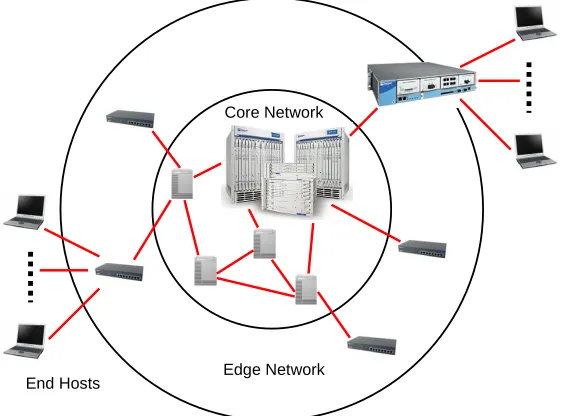
Figure 1.1 shows the three main layers of current Internet design in which the pre-vious design principle is applied. The core network comprises several powerful back-bone routers that forward packets based on destination addresses, without processing the packet contents. When the packet arrives to the edge of the Internet, some additional functions are performed to the packet, such as lightweight security filtering. Finally, the end host manages the full packet contents as well as interacting with the user. In fact, the end host is the responsible of doing complex packet processing.
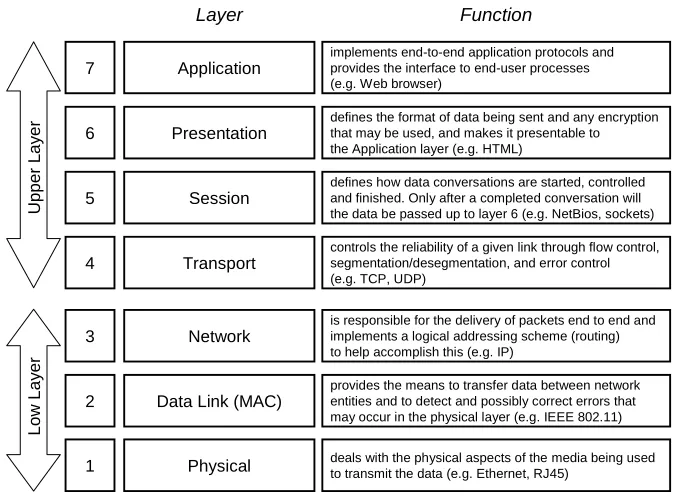
4 Introduction
Physical 1
Data Link (MAC) 2 Network 3 Transport 4 Session 5 Presentation 6 Application 7
deals with the physical aspects of the media being used to transmit the data (e.g. Ethernet, RJ45)
provides the means to transfer data between network entities and to detect and possibly correct errors that may occur in the physical layer (e.g. IEEE 802.11) is responsible for the delivery of packets end to end and implements a logical addressing scheme (routing) to help accomplish this (e.g. IP)
controls the reliability of a given link through flow control, segmentation/desegmentation, and error control (e.g. TCP, UDP)
defines how data conversations are started, controlled and finished. Only after a completed conversation will the data be passed up to layer 6 (e.g. NetBios, sockets) defines the format of data being sent and any encryption that may be used, and makes it presentable to the Application layer (e.g. HTML)
implements end-to-end application protocols and provides the interface to end-user processes (e.g. Web browser)
[image:23.595.127.465.189.437.2]L o w L a y e r U p p e r L a y e r Layer Function
Figure 1.2: OSI Model
Due to the nowadays evolution of society and technology, the users demand new kinds of network services. For this reason, the Internet starts to experience an interest-ing transformation in which a part of the intelligence of the end hosts is moved to the network. Some studies show that in the near future the Internet will be like a distrib-uted ubiquitous computing system [35]. As a result, more complex network services are assigned to the edge nodes.
1.2 Emerging of Massive Multithreaded Architectures 5
To understand the impact of the Internet evolution on the packet processing require-ments, we describe the following example. Consider two averaged bandwidth links of 10 Gbps (OC–192 links2) and 40 Gbps (OC–768 links). Assuming a traffic that presents a packet size of 500 bytes on average. Then, the network links require to sustain 2,5 Million Packets Per Second (MPPS) for OC–192 links and 10 MPPS for OC–768 links. That is, a given packet has about 400ηsec and 100ηsec to be processed, respectively.
On the other hand, lighweight packet processing requires tens of instructions, whereas complex applications need thousands of instructions [53]. Besides the above mentioned packet processing time requirements, we assume a packet processing work-load of 10K instructions, and a processor frequency is 1GHz. As a result, the required processing performance is about 25 Instructions Per Cycle (IPC) for OC-192 links and nearly 100 IPC for OC-768 links. Therefore, processor architectures must provide high system performance to maximize the sustained throughput.
1.2
Emerging of Massive Multithreaded Architectures
Network processing requires high throughput as we discussed in the previous section. The computer architects aim to maximize the throughput of systems by properly exploit-ing parallel processexploit-ing paradigms. However, a variety of dependency sources reduce the amount of parallelism that can be exploited.
There is a wide range of applications that exhibit a large Instruction Level Paral-lelism (ILP). Superscalar processors address this fine–grain paralParal-lelism by executing small sections of code of a given thread3 in parallel. The compiler is able to signifi-cantly reduce the impact of control dependencies (i.e. the execution flow is changed by a control flow instruction, such as conditional branch) and data dependencies (i.e. an instruction can start its execution when all its input dependencies are resolved) by re-arranging the instructions. In addition, superscalar processors include mechanisms for speculatively execution of instructions to further exploit ILP (e.g. branch predictor). Unfortunately, the available ILP from a thread is limited to the mentioned dependencies, and other factors such as hardware area and complexity constraints [96].
Other workloads, such as scientific applications, show large Data Level Parallelism
2Optical Carrier (OC) levels describe the signal rate multiples for transmitting digital signals on the
network. The base rate (OC–1) is 51.84. Other levels are given as OC–n.
3Throughout this thesis we use the word thread to refer to the software context and stream to refer to the
6 Introduction
(DLP) since a given computation is repeated on multiple data items of large data struc-tures, such as vectors or matrices. Vector processors address this paradigm with hard-ware and compiler support that properly uses an specialized ISA (e.g. Multimedia Ex-tensions, such as MMX [32], 3DNow! [4] by AMD, and SSE and SSE2 [33] by Intel Corp). Vector processors are capable of hiding the memory latency by maximizing the use of available memory bandwidth as well as reducing branch mispredictions by using vector mask registers and predicated execution instead of conditional branches.
Even if the performance can be increased with ILP and DLP, there are systems that need to exploit further levels of parallelism than the ones comprised within a sigle thread. Multithreaded architectures are a good alternative, since they pursue increasing the sys-tem performance by executing instructions from more than one thread, also known as Thread Level Parallelism (TLP). TLP is orthogonal to the parallel paradigms exploited inside a given thread (e.g. ILP, DLP). Depending on the architectural approach, mul-tithreading can either increase the performance of a single program thread by concur-rently executing several threads from a single sequencial program (e.g. trace proces-sor [71], speculative multithreaded procesproces-sor [49]) or increase the performance of a multiprogramming or multithreaded workload (e.g. HEP system [80], Sun MAJC [88], Piranha [9]). Multicore and/or multithreaded architectures are suitable for this type of applications.
Recently there are processors that include additional resource sharing levels between multithreaded and multicore processors (e.g. Sun UltraSPARC T2 [26]), where the streams are partitioned into two pipelines and groups. The multithreaded processors in which threads share the issue width present different execution approaches. A coarse– grain multithreaded processor [2, 85] issues instructions from a single thread in a given cycle. The processor switches to a different thread when it experiences a long latency operation (e.g. an outer cache miss). In contrast, a fine–grain multithreaded proces-sor [3, 66, 42, 80] switches to a different thread after each instruction fetch. Finally, a simultaneous multithreaded processor [78, 104, 103, 29, 90, 22] can issue instructions from multiple threads in a given cycle.
1.3 Problem Statement 7
specific network capabilities [21] were developed such as the Intel IXP network proces-sor family [34] and the IBM PowerNP family [31]. The NPs exploit the TLP of network workloads by leveraging multicore and/or multithreaded architectures.
NPs mostly focus on low network layer packet processing. As new network ser-vices become common, NPs are not capable to provide the required capabilites for in-tensive upper layer network workloads. For example, NPs are optimized to execute reduced workloads that present well differentiated pipeline stages. In contrast, upper layer processing presents large complex workloads with high demand for memory ac-cess. Thus, architectures capable of running large number of streams in parallel are needed to sustain the packet processing throughput required by the evolution of the In-ternet as mentioned in the previous section. For this reason, massively MT architectures provide the best alternative to contemporary network workloads.
Massive multithreaded processors comprise tens to hundreds of threads distributed across multiple cores on a chip. In fact, there are several massive multithreaded proces-sors mostly focused on network processing, such as Consentry Networks processor [18], UltraSparc T1&T2 [86, 26], Cavium [12], Tilera64 [8]. One of the main challenges for these processors is to maximize the utilization of large amount of available resources by properly distributing parallel network workloads across multiple cores.
1.3
Problem Statement
While network applications can take advantage of packet level parallelism, stateful work-loads present limitations that reduce the system throughput. Not only packet dependen-cies limit the amount of parallelism, but the significant variations on packet processing leads to significant negative interaction among threads. That is, the processing of several packets can demand quite different instructions and data working set. For example, the processing of a given packet may need to update statistics of a particular user, whereas the following packet may only need to update the statistics of the connection and trigger an action.
The natural question is: how can we exploit massively multithreaded architectures
to maximize system throughput of stateful packet processing?
8 Introduction
in massively multithreaded architectures. The dissertation demonstrates that stateful ap-plications integrate multiple levels of parallelism suitable to be exploited in the above mentioned architectures.
1.4
Contributions
This is the first thesis that challenges maximizing system throughput of stateful appli-cations on parallel architectures. This dissertation describes the work done to achieve this goal which comprises three main steps: firstly, analyzing network traffic properties that affect stateful packet processing; secondly, workload characterization of network applications and especially of stateful deep acket inspection workloads; thirdly, the de-scription of the MultiLayer Processing (MLP) proposal.
1.4.1 Primary Contributions
This thesis makes three main contributions:
1. Network Traffic Analysis. Acquiring network traffic traces has always been a difficulty to overcome, due to technical reasons and confidentiality issues. Several network sites, such as NLANR [59], CAIDA [11], and RedIRIS [68] provide pub-licly available traffic traces with different network bandwidth. The traces comprise just a few bytes of each packet with anonymized IP addresses, thus preventing the study of spatial IP address distribution. As a result, experimental packet process-ing based on IP addresses can show misleadprocess-ing results.
The behavior of stateful DPI workload is related to the network connections, un-like the lower layer applications that are sensitive to IP address distribution among packets. Thus, it is important for stateful research to analyze the impact of traf-fic aggregation (i.e. number of active flows within a window of packets) on the network processing performance.
1.4 Contributions 9
Then, we study the impact of traffic aggregation on a variety of network applica-tion categories. We analyze the differences between stateful processing and other network applications. Further details can be found in Chapter 3.
2. Workload Characterization. There are several network benchmark suites in the community, such as CommBench [100], Netbench [54], and NpBench [44]. The authors characterize each benchmark and analyze architectural bottlenecks. How-ever, the mentioned suites do not include stateful applications and the authors do not study the differences among applications according to the network layer processing.
Throughout Chapter 4 we propose a classification for better identifying the re-quirements of network applications. This is the first taxonomy proposal of net-work net-workloads according to data management during the packet processing. We show there are several categories of network processing workloads depending on the data management. We analyze representative network workloads according to the proposed classification and, for the first time in the research community, stateful DPI applications are characterized.
Stateful DPI presents different workload behavior depending on the goal of the ap-plication. A number of stateful applications show constant workload when most of the traffic presents similar packet processing, such as network monitoring. Yet other stateful applications can show significant workload variations (e.g. network security), due to the knowledge obtained by previous processing of packets of the same flow. For example, complex network security presents computational inten-sive workloads. However, once a given flow is marked as either a safe connection or an attack hazard, it is likely to execute lightweight workloads.
In addition to the previous mentioned study, we characterize different stateful DPI applications throughout the life of a particular network connection. We will es-pecially discuss issues related to the impact of statefulness on the memory hierar-chy. The conclusions provide key understanding of the processing requirements of non–constant stateful workloads. Further details are available in Chapter 4.
10 Introduction
mechanisms have to consider the additional characteristics of stateful applications. Parallel stateful DPI applications expose additional dependencies that can reduce the amount of PLP. Instead, stateful DPI workloads present a different type of par-allelism that can be exploited in addition to PLP. Stateful DPI applications com-prise a variety of different code categories that are closely related to the TCP/IP network layer stack. Each code category is called processing layer. Although there are dependencies within the same processing layer, there are marginal de-pendencies between different layers. Current compilers cannot detect processing layers, since they are related to network knowledge about the stateful data struc-tures. But, the developer can introduce information in the code to provide the processing layer identification.
We propose the MultiLayer Processing (MLP) as an execution model to take ad-vantage of the additional levels of parallelism of stateful applications. In fact, this is the first approach focused on stateful applications that maximized the through-put of massive multithreaded architectures. The mechanism is based on thread migration and it is complementary to other proposals for network processing, such as software pipelining. We describe the software and hardware support for MLP implementation. The methodology uses the information of the code to split the packet processing workload into a variety of processing layers. Then, a thread that processes a given packet migrates from one core to another according to the processing layer of the workload. The key issues of this approach are to identify the variety of exploitable processing layers and to properly distribute the workload among threads.
The goal of MLP is to increase the system throughput by a) increasing the positive aliasing among threads in the memory hierarchy, and b) alleviating the contention of parallel workloads in critical sections. The experiments assume stateful DPI benchmarks with sub–optimal parallel design and manual processing layer detec-tion. We will show that MLP presents better performance scalability than other proposals for parallel network processing. Further details can be found in Chap-ter 6.
1.4 Contributions 11
Chapter 3
Chapter 4
Chapter 5
Chapter 6
Synthetic Aggregation of Network Traffic
Parallelization of Stateful DPI Workloads
Network Traffic
Network Applications
Processor Architecture
MultiLayer Processing: .- Generic Implementation .- Performance Scalability .- Contention on critical sections .- Sinergy among Streams
Validation of
Network Traces Traffic Aggregation Impact
Network Workloads: Characterization
& Classification
MultiLayer Processing
Figure 1.3: Thesis Overview
parallelization of current single–threaded stateful DPI benchmarks. Finally, we combine the knowledge of network traffic and workload characterization to propose a mechanism that maximizes the system throughput of stateful DPI in massive multithreaded architec-tures.
1.4.2 Other Contributions
The thesis also presents other contributions:
12 Introduction
2. First technique that increases the traffic aggregation of a network link and over-comes the lack of representative publicly available traffic traces. The mechanism linearly scales the bandwidth of the base traffic. The resulting aggregated traffic presents larger amount of unique flows between two packets of the same flow.
3. First taxonomy proposal of network workloads according to data management during the packet processing. This classification allows the identification and characterization of the different packet processing stages within the stateful DPI applications.
1.5
Organization
Chapter 2 provides background information to better understand the disertation. We pro-vide information about stateful DPI and describe limitations of packet level parallelism of such applications.
Chapter 3 analyses network traffic traces. First, we validate sanitized network traffic to be used with stateful applications for research purposes. We describe a mechanism that synthetically generates traffic traces with more active flows than the original ones. Finally, we study the impact of several traffic aggregation levels on memory hierarchy performance.
Chapter 4 characterizes network workloads. Network applications present a variety of workload requirements. Thus, we introduce a network workload categorization to classify applications according to data management. We analyze the key differences among categories in order to understand why current network processors are not suitable for stateful processing. We also characterize the application behavior throughout the lifetime of a TCP connection. The results point out significant variations on processing requirements among related packets.
Chapter 5 introduces background information of parallel stateful DPI applications. We demonstrate the need of parallel stateful DPI and describe key characteristics of the parallel code. Besides, we present current proposals that distribute parallel network applications into multithreaded architectures.
1.5 Organization 13
architecture. Finally, we evaluate this mechanism and analyze the results compared to current proposals for parallel network applications.
15
Chapter 2
Background
This dissertation focuses on the processing of packets in network nodes. The demands of packet processing differ in significant ways from other typical processing required by office applications, or scientific data crunching. In this chapter we set the stage by reviewing the basics of packet processing.
This chapter is organized as follows. In Section 2.1 we address a particular type of packet processing, called deep packet inspection, followed by a discussion of state-ful packet processing in Section 2.2, and a specific discussion of the issues raised by dependencies between packets in Section 2.3.
2.1
Deep Packet Inspection
16 Background
strictly implemented according to the end–to–end principle, has no business in inspect-ing the content of a packet, or in keepinspect-ing any sort of state. The end–to–end principle, which was a radical departure break from the centralized architecture of the existing telephone network, served well the Internet through its nascent and rapid growth peri-ods. Pushing the responsibilities of guaranteeing a reliable transport to the endpoints allowed for a rapid expansion of the network and enabled an explosive growth of the applications.
Nowadays, the Internet touches every aspect of daily life. From the playground of mutually trusting early researchers, it has become the lifeblood of business, social interaction, and cultural and academic organizations. This expansion has brought its own malaise, in that the Internet is no longer the safe sandbox of yore. Today we expect much more than the ”best effort” delivery of a message or a file. Financial transactions, video streaming, interactive voice and video impose demands that far exceed those of the early years. Sure enough, the available bandwidth, due to the advances in optical communications, is many orders of magnitude higher than in the early days [61]. Yet, the need for differentiated services has challenged the end–to–end principle. So has the need to support security. The Internet growth in volume and applications was accompanied by a proliferation of so called ”middle-boxes”, which in many ways violate the end–to– end principle. The trend towards ubiquitous computing accentuates the push of complex services from the end points to the Internet cloud. Van Jacobson, a primary contributor to the TCP/IP stack, offers a compelling perspective of this trend [35].
To address this evolution, network applications push to process upper layer network layers involving deep packet inspection (DPI). We call DPI to those operations that ex-amine the packet payload, typically searching for a matching string or regular expression. This is akin to our mailperson opening the envelope and actually reading the content of the letter. Pattern matching has some heavy processing requirements, but it does not necessarily require keeping state.
2.2 Statefulness 17
Figure 2.1 depicts packet processing stages, namely: receiving (Rx), decoding, processing, and transmitting (Tx). Receiving and transmitting show no special require-ments, since they only read/write from/to memory buffer associated to the network card. The decoding stage, although being actually part of the packet processing, it is depicted as an isolated stage since it is performed before any packet processing. As we previously mentioned, DPI tends to show heavy workload at the processing stage versus lower layer applications.
Packets IN
Packets OUT Packet
Processing
Rx
State Management
Tx
Decoding Processing
P
H
Y
/
M
A
C
P
H
Y
/
M
A
C
Network Node
Figure 2.1: Packet Processing Flow Path
2.2
Statefulness
18 Background
of packets within a flow, or packets across different flows. In most cases, DPI also involves stateful DPI.
A stateful application requires maintaining a data structure by checking/updating in-formation. In contrast, a stateless application accesses to data structures only to compare packet contents to find a particular pattern (e.g. lookup table or rule based pattern match-ing). The state information kept may be simple, such as the flow state required by layer 4 applications, or more complex, such as user state required by upper layer applications. In Section 4.4.1 we discuss state categories handled by stateful applications.
Security, monitoring/billing, enhanced VoIP, management policies are some exam-ples of stateful network processing. The action triggered by the processing of a packet depends on the packet itself and previously processed packets. Upper layer network processing tends to show more statefulness in handling the relation between packets. There are many other areas where applications may perform stateful processing besides networking, such as e-commerce and databases. In general, it is likely that applica-tions that process data input items may require stateful processing to provide enhanced services.
This thesis focuses on stateful processing performed by Network Intrusion Detection Systems (NIDSs) as representative stateful DPI applications. NIDSs trigger alerts when detects malicious activity, attacks, or anomalous traffic. NIDS is an ever–evolving area in which stateful processing is a key requirement to detect sophisticated attack methods in several security areas, such as malware, anomaly traffic detection, stateful worm de-tection, stateful packet inspection. The attackers take advantage of stateless firewalls that cannot look beyond the single individual packet while inspecting network traffic. For in-stance, in 2001 a worm called Code Red infected over 350,000 hosts over a week and the infection rate was doubling in about 37 minutes. Two years later, the Sapphire/Slammer worm infected more than 90 percent of vulnerable hosts in the world within only 10 minutes [30]. More complex NIDS with stateful capabilities are being developed to catch these most recent attacks.
2.3
Dependencies Among Packets
2.3 Dependencies Among Packets 19
sake of readibility we describe state–dependency and order–of–seniority processing.
Depending in the degree of statefulness, the application maintains information of middle layers (e.g. flow) or upper layers (e.g. user). The higher the layer, the higher the probability is that a particular state is shared by two or more in–flight packets, or that two packets belong to the same user than to the same flow.
Order–of–seniority requires a particular input of data to be processed following a certain order. In the network environment, the packets sometimes have to be processed in the order of arrival to the network node. This feature specially impacts the performance of systems that exploit packet processing parallelism. Due to a variety of reasons, a given packet can be processed faster by a thread than others. That is, a thread can reach a checkpoint before other threads, which are processing ”older” packets. If the checkpoint needs order–of–seniority, the thread has to wait until the processing of previous packets reaches that checkpoint.
In general, checkpoints are associated to updates of the stateful data, and the consis-tency of the data is determined by the original order of arrival of the packets from the network. However, order–of–seniority is not a requirement in all stateful applications.
Host A Host B
Pkt1: SYN
Pkt2: SY N + ACK
Pkt3: ACK Network
Node
Network Node Packet Processing
T
im
e
Pkt2 Pkt3
1
1
2 2
3
3
4
4
20 Background
For example, NIDSs that detect TCP protocol based attacks need order–of–seniority to update stateful data. If the three–step TCP handshake protocol is not correctly per-formed, an alert is triggered. Otherwise, the system can trigger false positive alerts (i.e. a false attack is detected) and false negative detections (i.e. a real attack is not detected). Figure 2.2 depicts this scenario. On the left part of the graph, we can ob-serve the three–step TCP handshake protocol between two hosts A and B. In the middle, there is a network node that performs stateful packet processing for security services. The right part of the graph shows the packet processing of second and third packets. In this scenario we assume both packets are processed in parallel. Each numbered block represents a section of code for processing the packet. The section number 3 requires order–of–seniority processing (e.g. updating the flow state). For different reasons, al-though packet 3 starts to be processed after packet 2, it can process the section 3 earlier than the other packet. Then, this packet processing has to be stalled until the packet 2 has finished the section 3.
21
Chapter 3
Network Tra
ffi
c Analysis
Representative network traffic traces are mandatory to do research in network process-ing. Applications present significant performance variations according to the network traffic features. Thus, it is critical to preserve key real traffic characteristics.
For reasons of confidentiality, most of the original packet data (both header and pay-load) is faked or suppressed in the publicly available traffic traces. For example, IP ad-dresses are anonymized in order to avoid revealing any real IP address. The anonymiza-tion lead to lose some key network traffic properties, such as IP address distribution. Indeed, network research community has demonstrated that anonymized traffic traces are not useful to do research in lower network layers, but there is no study about the impact on stateful.
The problem is stressed in stateful applications. Packet processing requires high traffic bandwidth to simulate traffic of current and future network edge–nodes as well as bidirectional traffic (i.e. source to destination traffic and vice versa) to correctly keep track of states due to statefulness. Nowadays, the sites that provide public traffic present many traces with unidirectional high bandwidth traffic and few traces with bidirectional low bandwidth traffic.
22 Network Traffic Analysis
aggregation from a particular bandwidth link to another.
3.1
Chapter Roadmap
Section 3.2 introduces key network properties that are under study in this chapter. Sec-tions 3.3 and 3.4 show the two studies of this chapter focused on the effects of sanitized traffic processing and the impact of traffic aggregation on network processing, respec-tively. The former compares the data memory workload of sanitized traffic to real traffic processing. The latter shows the impact of traffic aggregation on the memory perfor-mance of several network applications, especially comparing layer 2 to stateful layer 4+ network processing.
Related work is presented in Section 3.5 and a summary of the chapter in Section 3.6.
3.2
Network Properties Under Analysis
Network traffic features have serious implications in the analysis of network applications and systems. Network workloads are sensitive to a variety of traffic characteristics. Thus, if experimental traffic has a lack of critical features, the results can be misleading. This section introduces two network traffic properties that affect the performance of networl applications.
3.2.1 Sanitization
Sanitization is the procedure to anonymize any content with private data. In the network area, sanitization means the modification of packet contents in order to skip any private data (e.g. real IP addresses). Moreover, most of the publicly available traffic traces show few bytes of every packet (i.e. 40 bytes of TCP/IP header plus a parametrized number of bytes of the payload) to skip private payload. Thus, sanitized traffic presents fake source/destination IP addresses and therefore it involves the loss of real IP address distribution [39].
3.2 Network Properties Under Analysis 23
use to examine the data, you see similar patterns. Kohler et al. [39] explore multifractal models and present an example of self–similar IP address distribution (Figure 3.1). In this figure we can observe histograms of IP addresses with two succesive 32x magnifi-cations from Figure 3.1(a) to Figure 3.1(c). There is a box for every non–empty address prefix shown in the X axis. The Y axis is the prefix length. We can see the prefix distribution patterns are similar in every prefix scale.
(a) (b)
(c)
Figure 3.1: IP address structure of a traffic trace (directly taken from [39])
There are several sanitization proposals. Some of them are: K. Cho [15] anonymizes tcpdump traces by stripping packet contents and rewriting packet header fields; the Crypto-pan [102] methodology provides a consistent prefix–preserving scheme by using a shared cryptographic key; Pang et. al. [62] propose transformation scripts that operate on application–level data elements and include packet payload in the result. Overall, methodologies cannot keep all the real traffic features and some of them are lost.
24 Network Traffic Analysis
modify temporal locality traffic properties. However, when the packet processing de-pends on IP address distribution (e.g. IP forwarding), sanitized traces can lead to unfair results. The question that comes out is whether the sanitized traces can be used as rep-resentative traffic for stateful processing. In Section 3.3.2 we answer to this question.
3.2.2 Traffic Aggregation
We define traffic aggregation as the distribution of packets from unique flows during a period of time. On one hand, it is related to the bandwidth link. Higher traffic bandwidth shows more packets during a time interval. On the other hand, traffic aggregation is also related to the network utilization. The more users connected and the more network utilization, the more unique flows in a period of time. Thus, traffic aggregation is defined by the unique flow rate and the packet inter–arrival distribution.
We define unique flow rate as the ratio of active flows within a window of packets (i.e. traffic window), as shown in Equation 3.1. The traffic window size is defined by the traffic interval between two packets of the same flow. A ratio of 0 denotes that packets of a given flow are consecutively received. A ratio of 1 means that each packet belongs to a different flow. The distribution of unique flow rates over the traffic is modeled by the packet inter–arrival distribution.
Unique Flow Rate=Avg Unique f lows
T ra f f ic Window S ize
!
(3.1)
Figure 3.2 depicts two different scenarios of unique flow rates. On the left of the figure, there is a of packets (boxes) of different flows (letters). We assume the window of packets is defined by the packets between two packets of the flow ”A”. On the top of the figure, there is a scenario in which every packet of the window belongs to a different flow. Therefore, the unique flow is 1. On the bottom of the figure, we can observe other scenario that shows several packets that belongs to the same flow (”B” and ”C”). In this case, the unique flow is 0.5.
3.3 Validation of Sanitized Traffic Traces 25
Figure 3.2: Example of Unique Flow Rates
distinguish intra– and inter–flow temporal distribution. The former shows packet distri-bution from a particular connection given by the flow control mechanism of the transport protocol (e.g. TCP Window). The later shows the distribution of packets from multiple flows between two packets of the same flow. More than 50% of the traffic presents distance between two packets of the same flow from hundreds to thousands of packets in low and high bandwidth links, respectively. Nevertheless, the distance between two packets of the same flow is inherently sensitive to the intra–flow temporal distribution.
Traffic aggregation increases inside of the Internet core. However, current Internet evolution leads to increments of traffic aggregation on the edge–nodes of the network. Thus, high traffic aggregation shows high unique flow rate between two packets of the same flow. We analyze the impact of traffic aggregation on memory hierarchy perfor-mance running a variety of network applications with different processing requirements.
3.3
Validation of Sanitized Tra
ffi
c Traces
26 Network Traffic Analysis
3.3.1 Methodology
3.3.1.1 Traffic Traces
We use real traffic traces as baseline traffic. We take such traces from an OC–3 link (155 Mbps) that connects the Scientific Ring of Catalonia [5] to RedIRIS [68], the Spanish national research network. The Scientific Ring of Catalonia comprises about 40 insti-tutions (research centres and other organizations) connected through roughly 25 access points.
Real Sanitized Traffic Traffic SN1 SN2 SN3
192.161.35.48 10.0.0.1 10.0.0.1 147.83.53.35 145.32.148.23 10.0.0.2 10.0.1.1 158.109.7.38 192.161.35.48 10.0.0.1 10.0.0.1 147.83.53.35 137.239.42.12 10.0.0.3 10.1.1.1 146.19.5.248 195.232.62.17 10.0.0.4 11.1.1.1 65.167.55.24 131.25.105.36 10.0.0.5 11.1.1.2 211.243.8.86
Table 3.1: Example of resulting sanitized traffic
We develop three techniques to sanitize network traffic that are representative of san-itized traffic traces publicly available. The sanitization only modifies source/destination IP addresses of the packets. Table 3.1 shows an example of resulting sanitized traffic. The top left column provides real IP addresses from the baseline traffic. The remaining columns present the proposed sanitizing methodologies. SN1 uses a counter that incre-ments the last octet of the IP address every time a new address is found. SN2 is similar than SN1, but the incremented octet is selected by round robin. SN3 uses random ad-dresses for every unique real IP address. Most of the publicly available traffic traces are sanitized by the SN1 approach.
3.3 Validation of Sanitized Traffic Traces 27
Theoretical Bandwidth
Label Site Link (Mbps)
ANL Argonne National Laboratory OC-3 155
MRA Merit Abilene OC-12 620
IPLS Abilene IPLS router instrumentation OC-48 2480
Table 3.2: Traffic Traces
3.3.1.2 Workload
Most of the benchmark suites for network processing presents layer 2–3 applications: NetBench [54], Commbench [100], NP Forum [60], and NpBench [44]. Only one bench-mark initially included in the NetBench suite provides stateful DPI, called Snort [81].
Snort is a Network Intrusion Detection System (NIDS) for real–time traffic moni-toring, packet logging, and detecting attacks on a system [10]. The packet processing works as follows: decoding, where the application decodes the packet header and keeps (if necessary) the packet payload; preprocessing, where some ”smart” preprocessors deal with the packet to detect attack attempts; rule–matching, where multiple patterns are checked against packet header and/or content. The stateful processing is found in several preprocessing engines (e.g. keeping track the state of connection reliable flows). Our configuration enables stateful preprocessors and the default rule set of 3200 rules.
3.3.1.3 Metrics
We instrument the binary code using the ATOM tool [84]. We use checkpoints to identify start and end of packet processing. Instrumented code generates the memory access footprint as well as the number of memory accesses per packet processing.
28 Network Traffic Analysis
more likely to find variations by comparing footprint size.
Equation 3.2 provides the relative error of the number of data memory accesses between sanitized packets, MemS anit, and the packets of the original trace, MemOrig. In
addition, Equation 3.3 calculates the relative error for complete flows. We focus this study on TCP traffic because it represents over 90% of Internet traffic and Snort stateful processing is focused on TCP connections.
Packet Relative Error=
MemS anit−MemOrig
MemOrig
·100% (3.2)
Flow Relative Error=Avg.
MemS anit(i) −MemOrig(i)
MemOrig(i)
·100% (3.3)
We take metrics after a warm up period of 10K packet processing. We collect sta-tistics of 50K packets and 5K complete flows. Larger traffic traces show no significant variations.
3.3.2 Evaluation
Snort uses SplayTree data structures[79] as well as other hash tables. A SplayTree is a self adjusting form of a binary search tree. The tree is autobalanced every time it is accessed. That is, the last accessed node is the new root. The tree keeps the most recently accessed nodes in the upper levels. Flow state nodes are sorted using the 5–tuple flow identification (i.e. source/destination IP and port addresses and protocol). Node rotation leads to different distributions depending on the sorting values. When memory has to be released due to the lack of free memory, the first victim nodes are selected from the lower levels, since they are not recently accessed.
3.3 Validation of Sanitized Traffic Traces 29
0 5000 10000 15000 20000 25000 30000
0 1 2 3 4 5 6 7 8 9 10 11
Packet
N
u
m
b
e
r
o
f
M
e
m
o
ry
A
c
c
e
s
s
e
s
Baseline Trace Sanitized Trace
Figure 3.3: Workload of a given TCP flow
workloads is similar, although they are triggered by different n–th packets. In our ex-ample, the baseline trace shows large workloads in the 3rd, and 5th packets, while the sanitized trace shows large workloads in the 3rd and 7th packet.
Figure 3.4(a) and Figure 3.4(b) present the packet and flow relative error of memory access workload, respectively, between the baseline trace and sanitized traces. The X axis indicates the relative error according to the Equations 3.2 and 3.3 for packet error and flow error, respectively. The Y axis denotes the accumulated percentage of the traffic trace.
30 Network Traffic Analysis 60 65 70 75 80 85 90 95 100
5 10 15 20 30 40 50 60 70 80 90 100
Packet Relative Error (%)
T ra ff ic T ra c e ( P a c k e ts % ) SN1 Sanitized SN2 Sanitized SN3 Sanitized
(a) Packet relative error
60 65 70 75 80 85 90 95 100
5 10 15 20 30 40 50 60 70 80 90 100
Flow Relative Error (%)
T ra ff ic T ra c e ( F lo w s % ) SN1 Sanitized SN2 Sanitized SN3 Sanitized
(b) Flow relative error
Figure 3.4: Real versus sanitized traffic
3.3 Validation of Sanitized Traffic Traces 31 60 65 70 75 80 85 90 95 100
5 10 15 20 30 40 50 60 70 80 90 100
Packet Relative Error (%)
T ra ff ic T ra c e ( P a c k e ts % )
Real Traffic (SN1) ANL (SN1) MRA (SN1) IPLS (SN1)
(a) Packet relative error
60 65 70 75 80 85 90 95 100
5 10 15 20 30 40 50 60 70 80 90 100
Flow Relative Error (%)
T ra ff ic T ra c e ( F lo w s % )
Real Traffic (SN1) ANL (SN1) MRA (SN1) IPLS (SN1)
(b) Flow relative error
Figure 3.5: Sanitized traffic from multiple bandwidth links
Figure 3.5 shows the relative error of multiple bandwidth links (see Table 3.2). We compare SN1 sanitized traces from ANL, MRA, IPLS sites to the original publicly avail-able traces. The baseline traffic is the real traffic trace employed in the previous exper-iments. Thus, the SN1 sanitized baseline trace is the same trace plotted in Figure 3.4. The baseline trace shows similar bandwidth than the ANL traffic (OC–3).
32 Network Traffic Analysis
higher percentage of packets with the lowest relative error than the baseline traffic. The reason behind this is that the original sanitized traces show more similar IP distribution than the real traffic, but the impact on memory access workload per packet is marginal. Overall, the traces present about 95% of packets with relative error lower than 20%, re-gardless the bandwidth link. Figure 3.5(b) depicts the flow relative error that manifest higher similarity between flows, regardless bandwidth link. In fact, ANL traffic shows about 98% of flows with relative error lower than 5%.
Above results validate that stateful processing show marginal impact on memory access workload due to sanitization traffic. Moreover, we can see there is no relationship between traffic bandwidth and the impact of sanitization.
3.4
Impact of Tra
ffi
c Aggregation
The goal of this section is to analyze the impact of traffic aggregation on memory hier-archy performance running network applications. To do this, we propose a mechanism to aggregate traffic from a narrow bandwidth link. In this section we also provide a de-scription of the experimental methodology. Finally, we evaluate the cache performance running applications of multiple network layers.
3.4.1 Traffic Aggregation
In order to measure the impact of traffic aggregation, a particular link must provide traf-fic traces with multiple aggregation rates. However, this environment is not currently available. Thus, we develop a methodology to synthetically generate traffic by aggregat-ing traffic from a given link. We assume linear network workload scalability, although network utilization depends on many factors (e.g. time of the day, social events, users connected). Thus, our methodology scales traffic aggregation as follows: traffic keeps similar unique flow rate while lineraly increases the traffic window size (i.e. number of packets between two packets of the same flow) and, therefore the packet inter–arrival distribution (self–similarity and long range dependency are preserved).
3.4 Impact of Traffic Aggregation 33
Traffic Trace
Filter Filtered Traffic Trace
Aggregation Engine
Aggregated Traffic Trace
Simulation
Figure 3.6: Traffic aggregation methodology
due to packets with the same timestamp difference. In these cases an additional mech-anism selects the merging order in a round robin fashion. We select the oldest local timestamp and normalize the resulting trace timestamps. Finally, a new sanitized traffic trace presents roughly N times wider network bandwidth than the original link, where N is the number of merged baseline traces.
In Figure 3.7 we can observe an example of aggregated traffic trace that integrates 4 different traces. Each box represents a packet and each pattern means the traffic from a particular traffic trace. The packets are combined according to the normalized timestamp of the trace. Thus, it behaves as a network node with 4 network links.
34 Network Traffic Analysis
Trace 1
Trace 2
Trace 3
Trace 4
Aggregated Trace
Time
Figure 3.7: Example of aggregated traffic trace
3.4.2 Methodology
3.4.2.1 Traffic Traces
For this study we use publicly available traffic traces. As discussed in Section 3.3.2 stateful processing is not significantly sensitive to sanitization effects [92]. Although in this study we run other types of network applications that can be sensitive to the lost of IP address distribution, there is no other way to do this analysis.
3.4 Impact of Traffic Aggregation 35 0 1000 2000 3000 4000 5000 6000 7000 8000 9000 10000
ANL (OC-3) MRA (OC-12) IPLS (OC-48)
Bandwidth Link A v g . T ra ff ic W in d o w S iz e 0 5 10 15 20 25 30 35 40 45 50 U n iq u e F lo w R a te ( % ) Packets Unique Flows Unique Flow Rate
Figure 3.8: Traffic aggregation of several bandwidth links
bandwidth link.
Besides the highest unique flow rate, the MRA link provides the only trace with bi–directional network traffic (i.e. packets from source to destination and vice versa). This traffic feature is mandatory for stateful processing. Otherwise flow states can not be correctly updated. Thus, we use MRA as the baseline set of traces to aggregate traffic by using the methodology proposed in Section 3.4.1. Thus, the baseline trace (MRA) presents a real bandwidth of 100 Mbps and we synthetically generate four additional traces of 400 Mbps, 1.6 Gbps, 6.4 Gbps, and 25 Gbps.
3.4.2.2 Benchmarks Selection
36 Network Traffic Analysis
Category App. Bench. Suite
Layer 2 AES NpBench
MD5 NpBench
Layer 3 NAT NetBench
Route NetBench
Layer 4+(Stateful) Snort NetBench
Table 3.3: Selected Benchmarks
the state of previous packet processing; for example, TCP termination requires to keep the state of the flows, unlike the other applications.
We select two applications that show similar cache performance than the average of every workload category[54, 100, 44]. Regarding Layer 4 (stateful) workloads, there is only one benchmark, Snort[10], which is configured to enable stateful packet processing.
3.4.2.3 Measurement
As in Section 3.3.1.3, we instrument the binary code of applications using the ATOM tool [84]. Applications are compiled with -O3 optimization. We use checkpoints to iden-tify start and end of packet processing. The instrumented code generates data memory access traces that are provided to a cache simulator.
We run every benchmark the same number of packets for each traffic trace. We warmed up the environment by processing 10K packets. The memory access traces are generated by processing 50K packets per application. All experiments show stable results with these processing periods.
3.4.3 Evaluation
3.4 Impact of Traffic Aggregation 37
requirements in Bytes to keep stateful data for each active flow. Although Snort can demand larger stateful data structures, we assume a Snort configuration that demands 500 Bytes to point out the memory requirements of stateful applications even presenting lightweight statefulness.
1000 10000 100000 1000000
OC-12 OC-48 OC-192 OC-768
Bandwidth Link
A
c
ti
v
e
F
lo
w
s
Full Network Utilization 25% Network Utilization
(a) Traffic Aggregation
100 1000 10000 100000 1000000
OC-12 OC-48 OC-192 OC-768
Bandwidth Link
M
e
m
R
e
q
u
ir
e
m
e
n
ts
(
K
B
y
te
s
)
Full Network Utilization 25% Network Utilization
(b) Memory Requirements
Figure 3.9: Example of theoretical memory requirements
38 Network Traffic Analysis
to keep active states for roughly 20K active flows. The data working set can be expo-nentially higher depending on the state size handled by the application. Current Internet evolution leads to increase traffic aggregation in the network. It is very likely the near future stateful DPI shows larger statefulness. For these reasons, upcoming network links that provide complex stateful DPI will likely demand hundreds or thousands of MBs for sustaining active stateful data structures.
0 1 2 3 4 5 6 7 8 9 10 1 6 K 6 4 K 2 5 6 K 1 M 1 6 K 6 4 K 2 5 6 K 1 M 1 6 K 6 4 K 2 5 6 K 1 M 1 6 K 6 4 K 2 5 6 K 1 M 1 6 K 6 4 K 2 5 6 K 1 M
AES MD5 NAT ROUTE SNORT
D a ta M is s R a te ( % )
100Mbps 400Mbps 1,6Gbps 6,4Gbps 25Gbps
Figure 3.10: Traffic aggregation impact on L1 Data Cache