ADVERTIMENT. La consulta d’aquesta tesi queda condicionada a l’acceptació de les següents
condicions d'ús: La difusió d’aquesta tesi per mitjà del servei TDX (www.tesisenxarxa.net) ha estat autoritzada pels titulars dels drets de propietat intel·lectual únicament per a usos privats emmarcats en activitats d’investigació i docència. No s’autoritza la seva reproducció amb finalitats de lucre ni la seva difusió i posada a disposició des d’un lloc aliè al servei TDX. No s’autoritza la presentació del seu contingut en una finestra o marc aliè a TDX (framing). Aquesta reserva de drets afecta tant al resum de presentació de la tesi com als seus continguts. En la utilització o cita de parts de la tesi és obligat indicar el nom de la persona autora.
ADVERTENCIA. La consulta de esta tesis queda condicionada a la aceptación de las siguientes
condiciones de uso: La difusión de esta tesis por medio del servicio TDR (www.tesisenred.net) ha sido autorizada por los titulares de los derechos de propiedad intelectual únicamente para usos privados enmarcados en actividades de investigación y docencia. No se autoriza su reproducción con finalidades de lucro ni su difusión y puesta a disposición desde un sitio ajeno al servicio TDR. No se autoriza la presentación de su contenido en una ventana o marco ajeno a TDR (framing). Esta reserva de derechos afecta tanto al resumen de presentación de la tesis como a sus contenidos. En la utilización o cita de partes de la tesis es obligado indicar el nombre de la persona autora.
WARNING. On having consulted this thesis you’re accepting the following use conditions:
Enhancing the Efficiency and Practicality of Software
Transactional Memory on Massively Multithreaded
Systems
G¨
ok¸cen Kestor
Department of Computer Architecture
Universitat Polit`ecnica de Catalunya
A thesis submitted for the degree of Doctor of Philosophy
Yesterday is history. Tomorrow is a mystery. Today is a gift. That’s why we
call it “The Present”.
—Alice Morse Earle
Our greatest glory is not in never falling, but in rising every time we fall..
Abstract
Chip Multithreading (CMT) processors promise to deliver higher
perfor-mance by running more than one stream of instructions in parallel rather
than by increasing the processor’s frequency. CMT processors come with
different architectures: Chip Processor (CMP), Simultaneous
Multi-Threading (SMT), or a combination of them. To exploit CMT’s capabilities,
users have to parallelize their applications. Unfortunately, the complexity
of parallel programming and the difficulty of writing efficient and correct
code limit the effective use of these systems.
Transactional Memory (TM) is one of programming models that aims at
simplifying synchronization by raising the level of abstraction, breaking the
connection between semantic atomicity and the means by which that
atom-icity is achieved. Programmers indicate atomic section in the source code
without explicitly locking individual shared memory locations. An
underly-ing TM system executes such transactions concurrently whenever possible,
generally by means of speculation – optimistic but checked execution,
roll-backing when conflicts arise. While TM is a promising programming model
to simplify synchronization among parallel threads, there are still
impor-tant challenges that must be addressed to make TM more practical and
efficient in mainstream parallel programming. This dissertation presents
work towards improving the practicality of TM across three dimensions.
The first challenge addressed is that of making the evaluation of TM
pro-posals more solid with realistic TM benchmarks and being able to run the
same benchmarks on different STM systems. As researchers work to
de-velop robust, mature STM, it becomes increasingly important to be able
to effectively and fairly compare STM designs with benchmarks that are
introduce a benchmark suite, RMS-TM, a comprehensive benchmark suite
to evaluate hardware and software TM implementations. RMS-TM consists
of seven applications from the Recognition, Mining and Synthesis (RMS)
domain that are considered representative of future workloads for multi-core
systems. RMS-TM features current TM research issues such as nesting, I/O
and system calls inside transactions, while also providing a mix of short
and long transactions with small/large read and write sets with
low/medi-um/high contention rates. On the other hand, most STM systems were
implemented as user-level libraries: the programmer was expected to
man-ually instrument not only transaction boundaries, but also individual loads
and stores within transactions. This library-based approach was adequate
for early experiments with micro-benchmarks, but it becomes increasingly
tedious and error prone for larger applications. The use of different library
interfaces in different research groups has also made it difficult to share
ap-plications across groups, or to make reliable performance comparisons. To
enable researches to perform an “apples-to-apples” comparison, we then
de-velop a software layer that allows researchers to test the same applications
with interchangeable STM back ends.
The second challenge addressed is that of enhancing performance and
scal-ability of TM applications running on aggressive multi-core/multi-threaded
processors. Performance and scalability of current TM designs do not always
meet the programmer’s expectation, especially at scale. This is especially
true for STM designs, where the overhead of instrumentation and
transac-tions’ management severely limits application’s performance at large scale.
To overcome this limitation, we propose a new STM design,STM2, based on
an assisted execution model in which time-consuming TM operations are
of-floaded toauxiliary threadswhileapplication threads optimistically perform computation. Surprisingly, our results show that is often more convenient to
use additional processing elements to support computation rather than
per-formance computation: STM2provides, on average, speedups between 1.8x and 5.2x (and up to 12.8x) over state-of-the-art STM systems. Moreover, we
notice that assisted-execution systems may show low processor utilization.
enriched STM2 with a runtime mechanism that automatically and
adap-tively detects application and auxiliary threads’ computing demands and
dynamically partition hardware resources between the pair. In order to
bias the allocation of hardware resources in favor of computing intensive
application threads or overloaded auxiliary threads, we leverage the
hard-ware thread prioritization mechanism implemented in POWER machines.
This dynamic mechanism further improvesSTM2’s performance (up to 85% over the standardSTM2 design) and efficiency.
The third challenge addressed is that of defining a notion of what it means
for a TM program to be correctly synchronized. Since TM has reached a
maturity level and several STM and HTM implementations are available, it
is important to provide debugging tools that automatically check the
cor-rectness of C/C++ TM programs. The current definition of transactional
data race requires all transactions to be totally ordered “as if” serialized
by a global lock, which limits scalability of TM designs. To remove this
constraint, we first propose to relax the current definition of transactional
data race to allow a higher level of concurrency. Based on this relaxed
def-inition, we propose the first practical race detection algorithm for C/C++
applications, namely TRADE, and implement the corresponding race
de-tection tool. Then, we introduce a new definition of transactional data race
that is more intuitive, transparent to the underlying TM implementation,
can be used for a broad set of C/C++ TM programs, enables a wide range
of implementation techniques to be used. Based on this new definition, we
proposed T-Rex, an efficient and scalable race detection tool for C/C++ TM applications. Using TRADE and T-Rex, we have discovered subtle
transactional data races in widely-used STAMP applications which have
not been reported in the past. Our experiments also show that T-Rex is order or magnitude faster than TRADE, which increase programmer
Acknowledgements
I would like to thank my advisors, Osman Unsal, Adrian Cristal and Mateo
Valero, for their sincere help and support during my graduate studies. They
are not only technically solid researchers but also kind advisors.
I would also like to thank other professors who have been greatly influential
to me during my Ph.D study. First, I am truly grateful to Tim Harris and
Serdar Tasiran who have helped and advised me during a very decisive part
of this work. I am also sincerely thankful to Michael L. Scott who guided
me in the dark and taught me a lot about research and working discipline.
Without the love and support of my family, this would have been a very
hard journey. They have guided me with their priceless wisdom and have
always prayed for me with their heartfelt love. I thank my sister, Gokben,
for giving me strength when I felt hopeless and disappointed and my mother,
Serpil, without whom I would not be the person that I am today.
I would also like to thank my great friend Gulay for many years of true
friendship, and for believing in me and encouraging me in this winding
road. We exchanged ideas about technical problems and shared a fun time
while having awesome coffees. I only regret that I did not spend more time
with her.
It is the luck of my lifetime to meet Ilker and Justine and to have them
as my friends. Many thanks for loyal friendship and all the unforgettable
times we have spent together.
My love, my heart, my husband Roberto. Ever since I met him, my life
has changed to be better, happier and brighter. I promise that I will do
whatever it takes to protect a blessed life of ours. Thank him so much to
Contents
I Introduction 1
1 Introduction 3
1.1 The Difficulty of Parallel Programming . . . 3
1.2 Transactional Memory and Challenges . . . 4
1.3 Contributions . . . 6
1.4 Organization . . . 8
1.5 Publications . . . 8
2 Transactional Memory 11 2.1 TM Programming Model . . . 11
2.1.1 Semantics . . . 12
2.1.2 Programming . . . 13
2.2 Implementation Options . . . 16
2.2.1 Eager and Lazy Data Versioning . . . 16
2.2.2 Eager and Lazy Conflict Detection . . . 17
2.2.3 Software and Hardware . . . 19
2.2.4 Commonly Used STMs . . . 21
II Comprehensive Evaluation of TM Systems 25 3 RMS-TM Benchmark Suite 27 3.1 Introduction . . . 27
3.2 The Transactification Process . . . 29
3.2.1 Pre-Transactification Phase . . . 29
Contents
3.2.1.2 Dynamic Pre-Transactification . . . 32
3.2.2 Transactification Phase . . . 33
3.2.2.1 STM Implementation . . . 33
3.2.2.2 HTM Implementations . . . 34
3.3 RMS-TM Overview . . . 35
3.4 Evaluation . . . 36
3.4.1 Intel STM Results . . . 36
3.4.1.1 Transactional Behavior . . . 37
3.4.1.2 Performance Analysis . . . 38
3.4.2 EazyHTM Results . . . 40
3.4.2.1 Transactional Behavior . . . 41
3.4.2.2 Performance Analysis . . . 42
3.4.3 ScalableTCC Results . . . 43
3.4.3.1 Transactional Behavior . . . 43
3.4.4 Comparison of RMS-TM and STAMP . . . 44
3.5 Related Work . . . 46
3.6 Conclusions . . . 48
4 Interchangeable Back Ends for STM Compilers 49 4.1 Introduction . . . 49
4.2 Design and Implementation . . . 51
4.2.1 Draft Specification for TM in C++ . . . 51
4.2.2 Intel ABI Overview . . . 52
4.2.3 Design Details . . . 54
4.3 Experimental Setup . . . 55
4.4 Experimental Results . . . 57
4.4.1 Overhead Analysis of Automatic Instrumentation . . . 57
4.4.2 Back-end Comparisons . . . 59
4.5 Related Work . . . 64
Contents
III Design and Implementation of a High Performance STM 67
5 STM2: A Parallel STM for High Performance SMT Systems 69
5.1 Introduction . . . 69
5.2 Motivation . . . 72
5.3 STM2 Design and Implementation . . . 73
5.3.1 Application/Auxiliary Thread Synchronization . . . 76
5.3.2 Writing to a shared memory location . . . 77
5.3.3 Reading from a shared memory location . . . 79
5.4 Experimental Setup . . . 80
5.5 Experimental Results . . . 81
5.6 Related Work . . . 87
5.7 Conclusion . . . 88
6 Enhancing the Performance of Assisted Execution Runtime Systems through Hardware/Software Techniques 91 6.1 Introduction . . . 91
6.2 Hardware resource partitioning . . . 93
6.3 Static Fine-Grained resource partitioning . . . 95
6.3.1 Embarrassingly parallel phases . . . 96
6.3.2 Load imbalance inside transactions . . . 99
6.3.2.1 Overloaded application threads . . . 100
6.3.2.2 Overloaded auxiliary threads . . . 102
6.4 Adaptive Fine-Grained resource partitioning . . . 106
6.5 Experimental results . . . 112
6.5.1 Eigenbench . . . 113
6.5.2 STAMP applications . . . 114
6.6 Related work . . . 119
Contents
IV Correctness Semantics for TM applications 123
7 TRADE: Precise Dynamic Race Detection for Scalable Transactional
Memory Systems 125
7.1 Introduction . . . 125
7.2 Background . . . 128
7.3 Preliminaries . . . 130
7.3.1 Strict Transactional Happens-Before Relation . . . 130
7.3.2 Relaxed Transactional Happens-Before Relation . . . 131
7.4 Transactional Race Detection Algorithms . . . 135
7.4.1 s-TRADERace Detection Algorithm . . . 136
7.4.2 TRADERace Detection Algorithm . . . 138
7.4.3 Extensions . . . 142
7.5 Design and Implementation . . . 143
7.5.1 Binary instrumentation Framework . . . 143
7.5.2 TRADEInstrumentation State and Code . . . 143
7.6 Evaluation . . . 146
7.7 Related Work . . . 152
7.8 Conclusions . . . 153
8 T-Rex: A Dynamic Race Detection Tool for C/C++ Transactional Memory Applications 155 8.1 Introduction . . . 155
8.2 Motivation . . . 157
8.3 Preliminaries . . . 160
8.4 Design and Implementation . . . 164
8.4.1 Threads Data Access Table . . . 164
8.4.2 Non-Transactional Memory Accesses . . . 165
8.4.3 Transactional Memory Accesses . . . 166
8.4.4 T-Rex Race Detection . . . 167
8.5 Experimental results . . . 170
8.5.1 T-Rex Race Detection Coverage . . . 170
8.5.2 Overhead analysis . . . 173
Contents
V Conclusions 177
9 Conclusions 179
List of Figures
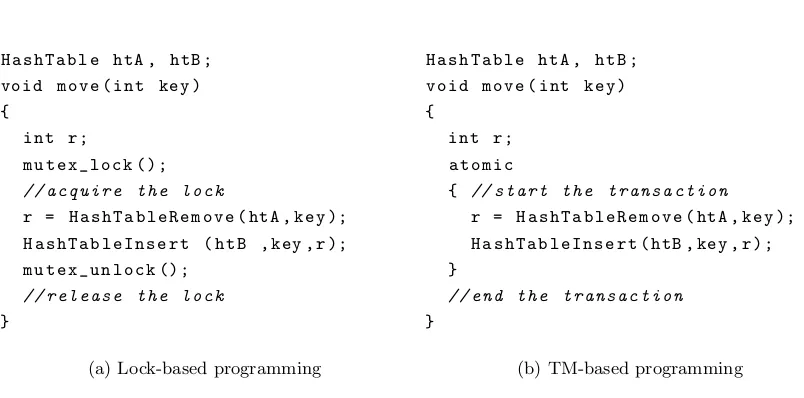
2.1 Lock-based vs. TM-based Programming . . . 13
2.2 Nesting: The transaction within swap() is nested within the outer
trans-action by the program control flow . . . 14
2.3 Example code for the use of “retry” primitive: If the retry statement is
reached, the transaction is aborted and re-executed. . . 16
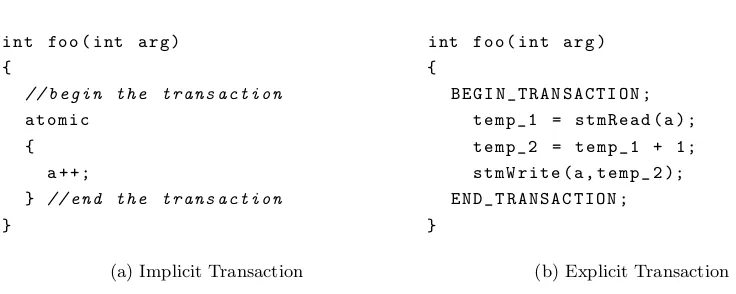
2.4 Type of Used Transactions in Programming Languages . . . 19
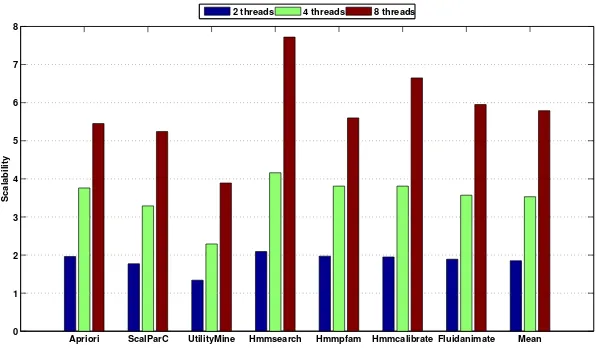
3.1 Scalability of the lock-based applications, with the largest data sets,
normalized to single-threaded lock execution time. . . 32
3.2 Scalability of the lock-based and TM-based applications, with the largest
data sets, normalized to single-threaded lock and TM execution time,
respectively, with Intel STM. . . 39
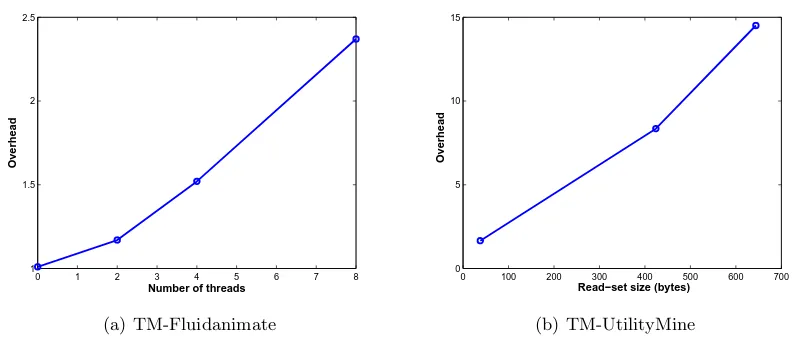
3.3 Runtime overhead ofTM-Fluidanimate andTM-UtilityMine . . . 40 3.4 Scalability of the lock-based and TM-Based applications normalized to
single-threaded lock and TM execution time, respectively, using EazyHTM. 42
3.5 Scalability of the lock-based and TM-based applications normalized to
single-threaded lock and TM execution time, respectively, with
Scal-ableTCC. . . 44
3.6 Scalability of the STAMP applications normalized to single-threaded TM
execution time. . . 45
4.1 Automatic read/write instrumentation of a simple TM program . . . 53
4.2 Execution time of compiler-instrumented code, relative to manually
List of Figures
4.3 Throughput results for the microbenchmarks. Y axis shows total number
of transactions per second: higher is better. . . 60
4.4 Scalability results for STAMP and RMS-TM. . . 62
5.1 TinySTM per-transaction overhead breakdown for STAMP applications
with respect to instrumented single thread version. . . 72
5.2 STM2offloads time-consuming STM operations to sibling hardware threads. 74 5.3 Pseudo-code for application and auxiliary thread STM write . . . 78
5.4 Pseudo-code for application and auxiliary thread STM read . . . 79
5.5 Performance comparison of different STMs with STAMP benchmarks. . 82
5.6 Speedups ofSTM2over tested STMs for STAMP applications using the same amount of hardware resources (32 hardware threads). . . 83
6.1 Performance impact of reducing the priority of auxiliary threads when
varying the percentage of time spent performing embarrassingly parallel
computation and the value of ∆p. . . 97
6.2 Frequently idle auxiliary threads within a transaction. . . 99
6.3 Performance impact of reducing the priority of auxiliary threads in
pres-ence of load imbalance within transactions (overloaded application threads).101
6.4 Execution trace of overloaded auxiliary threads. . . 102
6.5 Performance impact of increasing the priority of overloaded auxiliary
threads when varying the number of read-set validations per
transac-tional operation and ∆p. . . 105
6.6 Irregular transactions with bursts of transactional operations. In this
example Eigenbench executes a burst of transactional operations in the
middle of the transaction. . . 106
6.7 The adaptive solution automatically changes the value ofAxTp
accord-ing to the structure of the transaction and the computaccord-ing demand of
application and auxiliary threads. . . 111
6.8 Performance of static (best values among all combinations) and
adap-tive solutions for application with not-uniform transaction structure and
varying size/position of burst of shared accesses. . . 114
6.9 Performance impact of static (best values among all combinations) and
List of Figures
6.10 Labyrinth’s transactions: alternation of a large local computation phase
(white in the figure) with a burst of transactional operations (colored
bars) at the end. . . 117
7.1 Doesready=true imply thatThread 2sees data=42? . . . 129
7.2 Speedup of STAMP applications with various STMs. . . 132
7.3 This program has a transactional data race, as Thread1 and Thread2 may access x concurrently. . . 133
7.4 Example trace for the program in Figure 7.3 running on an STM that implements SGLA. No strict transactional data races detected. . . 138
7.5 Example trace for the program in Figure 7.3 running on an STM that does not implement SGLA semantics. HB detects a transactional data race in a given execution. . . 141
7.6 Implementation of theTRADEalgorithm. . . 144
7.7 SSCA2 code snapshot. . . 147
7.8 TRADEruntime overhead over s-TRADE. . . 148
8.1 This program is intuitively racy but a race detection tool based on re-laxed transactional data race definition produces different results accord-ing to thread interleavaccord-ing: if Thread 2 fully executes before Thread 1 then the tool does not detect any transactional data races in a given execution. . . 158
8.2 Initially shared = trueand x = 0. This program is intuitively correct but may result in incorrect behavior, depending on the underlying STM implementation. . . 159
8.3 T-Rex bookkeeping data structures: a) per-thread DAT; b) entry in the per-thread DAT. . . 165
List of Tables
3.1 Applications that pass the Static Pre-Transactification step. . . 30
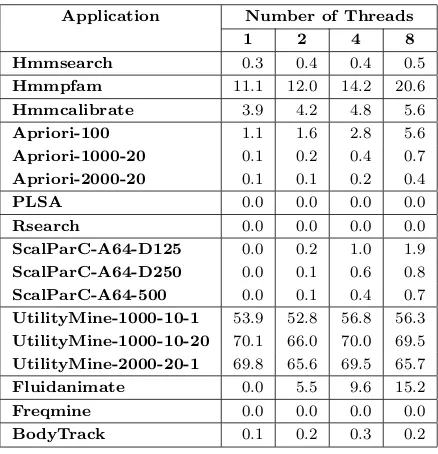
3.2 Percentage of time spent inside critical sections with respect to total
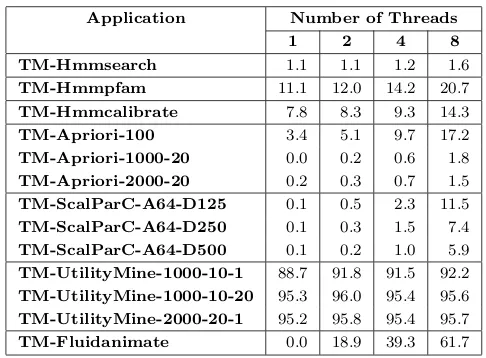
parallel time for the lock-based applications. The data sets used are
appended to the application name. . . 31
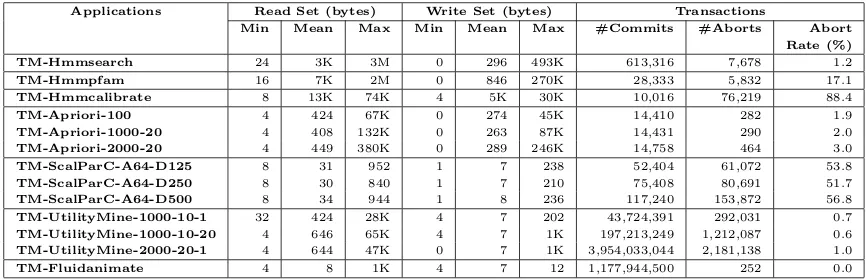
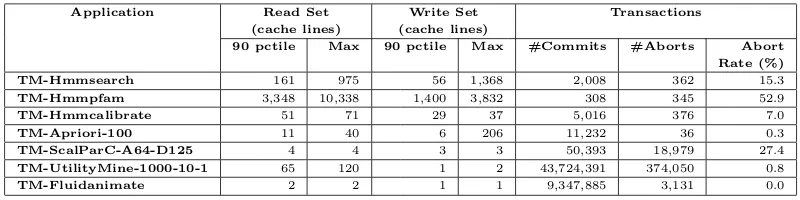
3.3 Basic TM characteristics (with eight threads) of the RMS-TM
applica-tions, with Intel STM. . . 37
3.4 Percentage of time spent inside atomic blocks with respect to total
par-allel time for RMS-TM applications. . . 38
3.5 Configuration of the simulated system. . . 41
3.6 Transactional behavior of the RMS-TM applications with eight threads,
with EazyHTM. . . 41
3.7 Transactional behavior of the RMS-TM applications with eight threads,
with ScalableTCC. . . 43
4.1 Abort Rates (percentage of all dynamic transaction instances that abort)
for 2, 4 and 8 threads. . . 59
6.1 Hardware thread priority levels in the IBM POWER7 processor. . . 94
7.1 Number of transactional data races detected byTRADEand s-TRADE
without and with bug-injection. ∗Intruder crashed because of the in-jected bug. . . 146
7.2 STAMP applications’ characteristics. . . 150
7.3 Performance comparison betweenTRADErunning on LLT and s-TRADE
List of Tables
8.1 Number of detected transactional data races for STAMP applications for
the original version and a version with synthetic bugs injected. ∗Intruder
crashed because of the injected bug. . . 170
Part I
Introduction
Multi-core systems have the potential for significant performance improvements, but
the complexity of parallel programming and the difficulty of writing efficient and correct
code limit the effective use of these systems. New programming models have been
pro-posed to ease the development of parallel applications that perform well on multi-core
architectures. Transactional Memory (TM) is one of such programming models that
enables programmers to perform multiple memory operations atomically without
wor-rying about the complexity issues associated with other programming models such as
locks. Chapter 1 summarizes the thesis’ contributions by highlighting the new research
directions taken and the main results. Chapter 2 provides the necessary background
on transactional memory: its definition, properties, implementation details and design
Chapter 1
Introduction
The performance of microprocessors has been continuously improving over the years
thanks to advances in manufacturing technologies. In recent years, however,
conven-tional techniques for improving single-threaded performance have begun hitting
funda-mental challenges such as the limited amount of instruction-level parallelism (ILP) [159]
and the undesirable levels of power consumption caused by increasing clock
frequen-cies [7].
In response, processor manufactures have shifted to Chip Multi-threading
proces-sors (CMTs) [56, 90, 107]. Multiple simpler processor cores in CMT systems promise
to deliver higher performance by running more than one stream of instructions in
paral-lel (thread-level paralparal-lelism (TLP)) in a power-efficient manner [124]. CMT processors
may come with different architectures: Chip Multi-Processor (CMP), Simultaneous
Multi-Threading (SMT), or a combination of them. With wide availability of CMTs,
the burden of achieving scalable performance on CMTs has now been placed on
pro-grammers who must deal with the complexity of parallel programming to take the
advantages of multiprocessors/multithreading.
1.1
The Difficulty of Parallel Programming
To increase parallelism on CMTs, programmers should create and synchronize several
parallel tasks. For shared memory systems, the synchronization of parallel tasks is
commonly handled by lock-level synchronization primitives. These primitives guarantee
1.2. Transactional Memory and Challenges
Unfortunately, parallel programming with locks is quite difficult due to the
trade-off between programming simplicity and scalability of the performance [72]. While
adding coarse-grained locks to a program is relatively straightforward, it may
drasti-cally degrade performance since it introduces unnecessary serialization points during
the execution. On the other hand, while fine-grained locking permits greater
concur-rency, its programming complexity is significantly higher, which even not result in a
better performance than an equivalent coarse-grained version. The higher programming
complexity may also cause various problems such as deadlock, convoying, or priority
inversion [96].
1.2
Transactional Memory and Challenges
Transactional Memory [72] (TM) is a programming model to simplify synchronization
by raising the level of abstraction, breaking the connection between semantic atomicity
and the means by which that atomicity is achieved. Programmers indicate atomic
sec-tions in the source code (e.g., using language constructs such asatomic blocks, or using macros such as BEGIN TRANSACTIONand END TRANSACTION) without explicitly locking
individual shared memory locations. An underlying TM system executes such
trans-actions concurrently whenever possible, generally by means of speculation—optimistic
but checked execution, with rollback and retry when conflicts arise. There have been
significant efforts to develop hardware (HTM) [42, 63], software (STM) [39, 43, 133] or
hybrid TM systems [40, 91, 114].
While TM is a promising programming model to simplify the synchronization among
parallel threads, there are still main important challenges that must be addressed to
make TM more practical and efficient in mainstream parallel programming. First,
real-istic TM benchmarks and additional auxiliary software should be provided to make the
evaluation of TM proposals more solid. Current benchmarks used to analyze the TM
proposals do not include realistic applications that address ongoing TM research issues
such as handling nested transactions, I/O operations, system and library calls inside
transactions, and that provide the potential for straightforward comparison against
locks. Thus, it is important to understand performance bottlenecks of TM on real
applications and enable TM researchers to conduct their research by using changeling
1.2. Transactional Memory and Challenges
the programmer was expected to manually instrument not only the transaction
bound-aries, but also individual loads and stores within the transactions. This library-based
approach was adequate for early experiments with micro-benchmarks, but it becomes
increasingly tedious and error prone for larger applications [37]. The use of different
library interfaces in different research groups has also made it difficult to share
ap-plications across groups, or to make reliable performance comparisons: experiments
with different versions of the application source code inevitably raise the questions of
fairness and confidence. For C++ on the x86 architectures, significant steps in this
direction have been made by compilers from Intel, the University of Dresden, and the
GNU Project, which aim to accept the same application programming interface (API)
and target the same runtime application binary interface (ABI). Unfortunately, these
three compilers currently connect to only two main STM libraries (SkySTM [95] and
TinySTM [133]). In the interest of greater interoperability, it is important to make
works on STM systems compatible with recent compilers.
Second, it is essential to design a TM system for high performance, aggressive
multi-threading systems. Most STM systems, so far, suffer from poor performance because
the overhead introduced by the STM runtime system outweighs the performance gain
achieved by the parallelism [24]. Some authors report drastic slow-downs when using
STM (e.g., only breaking even with optimized sequential code after using 8 cores [24]).
Even state-of-the-art TM systems typically require at least two threads to achieve
performance that matches the performance of the optimized sequential code [39, 68].
To achieve the best possible performance on systems with the increasing number of
cores/threads, it is significantly important to reduce STM runtime overhead and use
all available resources effectively.
Third, TM should be supported with software development tools and integrated
en-vironment to help programmers debug and analyze TM applications. Perhaps the most
important among these is race detection tools. A race condition occurs when a
pro-gram’s execution contains concurrent two accesses to the same memory location where
at least one of the accesses is a write. Race conditions are particularly problematic
because they typically cause problems only on certain rare interleavings, making them
extremely difficult to detect, reproduce, and eliminate. Thus, it is crucial to support
1.3. Contributions
1.3
Contributions
In this dissertation, we present studies conducted towards improving the efficiency and
practicality of STM across three dimensions that we explain below. Specifically, this
dissertation makes the following contributions:
1. Comprehensive evaluation of TM systems
First, we introduce RMS-TM, a Transactional Memory benchmark suite
com-posed of seven real-world applications from the Recognition, Mining and
Synthe-sis (RMS) domain [86, 87]. In addition to featuring current TM research issues
such as nesting and I/O and system calls inside transactions, the RMS-TM
ap-plications also provide a mix of short and long transactions with small/large read
and write sets with low/medium/high contention rates. These characteristics, as
well as providing lock-based versions of the applications, make RMS-TM a useful
TM benchmark suite. Our experiments show that RMS-TM is scalable, which
is useful for evaluating TM designs on high core counts. Second, to allow TM
research groups to run each other’s code and to perform apples-to-apples
compar-isons of implementation alternatives, we have implemented a “shim” library [81],
which adapts the word-based “back end” libraries of the Rochester STM suite
to the common ABI. This work makes the Rochester STM back ends available,
for the first time, to programs written with language-level transactions. We also
describe experience at both the ABI and API levels, and present performance
comparisons relative to the Intel standard back end.
2. Design and Implementation of a high performance STM
We have designed a novel parallel STM implementation, namelySoftware Trans-actional Memory for Simultaneous Multi-threading systems (STM2) pronounced asSTM-squared [82]. STM2 reduces the runtime overheads by offloading read-set
validation, bookkeeping, transaction state management and conflict detection to
an auxiliary thread running on a sibling core/hardware thread, i.e., a processing element that shares some levels of hardware resource (like the L1 or L2 cache) with
theapplication thread. Application threads optimistically perform their computa-tion with minimal support from the underlying STM system. All synchronizacomputa-tion
1.3. Contributions
This means that application threads experience minimal overhead. Auxiliary
threads, instead, validate read-sets, maintain transaction states and detect
con-flicts in parallel with the application threads’ computation. We exploit the fact
that, on modern multi-core processors, sets of cores can share L1 or L2 caches.
This lets us achieve closer coupling between the application thread and the
aux-iliary thread (when compared with a traditional multi-processor systems). We
show that our approach outperforms several well-known STM implementations
for various TM applications. In particular, STM2 shows speedups between, on average, 1.8x and 5.2x over the tested STM systems with peaks up to 12.8x.
Fi-nally, we propose an approach to effectively partition processor resources between
application and auxiliary threads in STM2 [83, 84]. In order to bias the alloca-tion of hardware resources in favor of computing intensive applicaalloca-tion threads
or overloaded auxiliary threads, we leverage the hardware thread prioritization
mechanism implemented in POWER machines. Our experiments show that
effec-tive hardware resource partitioning performs, in general, better than the original
STM2, up to 86% performance improvement.
3. Providing Correctness Semantics for TM applications
We propose a novel and precise race detection algorithm for TM applications,
namely TRADE that is based on a weakened definition of the happens-before
relation and does not pose design constraints on the underlying STM system [88].
As a result, our algorithm can be used with a broader set of high-performance,
scalable TM systems. Based on this definition, we implement a race detection
tool for C/C++ TM applications. Our experiments reveal thatTRADEprecisely
detects transactional data races. However, tools based on happens-before come
with different kinds of issues such as high overhead, sensitivity to compiler and
hardware optimizations and high dependency on the thread interleaving produced
by the scheduler. In order to deal with those problems, we refine the definition of
transactional data race and proposeT-Rex [85]. T-Rex presents a new definition of transactional data race that follows the programmer’s intuition of racy accesses,
is independent of thread interleaving, can accommodate popular STM designs,
1.4. Organization
overhead to a race detection tool based on happens-before algorithm. Our results
show thatT-Rex is considerably faster thanTRADE.
1.4
Organization
The rest of this thesis is organized as follows: Chapter 2 briefly reviews Transactional
Memory. Chapter 3 presents RMS-TM benchmark suite and our methodology to choose
candidate TM benchmarks from a set of real-world applications. Chapter 4 describes
our “shim” library implementation which targets a fair comparison among several
pro-posed STM systems. Chapter 5 describes the design of STM2 and provides in-depth details of our current implementation. Moreover, it shows the performance numbers
of STM2 over tested STMs. Chapter 6 details our adaptive resource partitioning pro-posal with the POWER7 hardware thread priority mechanism and its impact onSTM2. Chapter 7 and Chapter 8 describes our transactional race detection algorithms based
on a weakened definition of the happens-before relation and the definition that follows
the programmers intuition of racy accesses, respectively. Finally, Chapter 9 concludes
this dissertation.
1.5
Publications
1. G. Kestor, O. Unsal, A. Cristal and M. Valero, Transactifying Lock-Based RMS
Applications, HiPEAC International Summer School on Advanced Computer
Ar-chitecture and Compilation for Embedded Systems (ACACES), Poster Section,
July, 2008, L’Aquila, Italy.
2. G. Kestor, S. Stipic, O. Unsal, A. Cristal and M. Valero, RMS-TM: A
Transac-tional Memory Benchmark for Recognition, Mining and Synthesis Applications,
The 4th ACM SIGPLAN Workshop on Transactional Computing (TRANSACT),
February 2009, Raleigh, NC.
3. G. Kestor, V. Karakostas, O. Unsal, A. Cristal, I. Hur and M. Valero, RMS-TM:
A Comprehensive Benchmark Suite for Transactional Memory Systems (Best
Paper Award), The 2nd ACM International Conference on Performance
1.5. Publications
4. G. Kestor, L. Dalessandro, A. Cristal, M. L. Scott and O. Unsal, Interchangeable
Back Ends for STM Compilers, The 6th ACM SIGPLAN Workshop on
Transac-tional Computing (TRANSACT), June 2011, San Jose, CA.
5. G. Kestor, R. Gioiosa, T. Harris, A. Cristal, O. Unsal, M. Valero and I. Hur,
STM2: A Parallel STM for High Performance Simultaneous Multi-Threading
Systems, The 20th IEEE International Conference on Parallel Architectures and
Compilation Techniques (PACT), October 2011, Galveston Island, TX.
6. G. Kestor, R. Gioiosa, O. Unsal, A. Cristal and M. Valero, Enhancing the
Perfor-mance of Assisted Execution Runtime Systems., The 17th Architectural Support
for Programming Languages and Operating Systems (ASPLOS), Poster Section,
March 2012, London, UK.
7. G. Kestor, R. Gioiosa, O. Unsal, A. Cristal and M. Valero,
Hardware/Soft-ware Techniques for Assisted Execution Runtime Systems, The 2nd Workshop on
Runtime Environments, Systems, Layering and Virtualized Environments
(RE-SoLVE), March 2012, London, UK.
8. G. Kestor, R. Gioiosa, O. Unsal, A. Cristal and M. Valero, Enhancing the
Per-formance of Assisted Execution Runtime Systems through Hardware/Software
Techniques, 26th ACM/SIGARCH International Conference on Supercomputing
(ICS), June 2012, Venice, Italy.
9. I. Kuru, H. S. Matar, A. Cristal, G. Kestor and O. S. Unsal, PaRV: Parallelizing
Runtime Detection and Prevention of Concurrency Errors, The 3th International
Chapter 2
Transactional Memory
In this chapter we first describe the Transactional Memory programming model and
then we compare TM to classical lock-based programming model, highlighting pros and
cons of each. Finally, we conclude the chapter by reviewing the implementation options
of TM systems.
2.1
TM Programming Model
While innovations in process technology increase the number of transistors on a die,
the performance gains achieved from more complex cores and larger caches diminish.
Therefore, chips with multiple cores have quickly become a de-facto standard.
Multi-core systems have the potential for significant performance improvements, but the
complexity of parallel programming and the difficulty of writing efficient and correct
code limit the effective use of these systems.
New programming models have been proposed to ease the development of
paral-lel applications that perform well on multi-core architectures. Transactional Memory
(TM) [46, 66, 72] allows programmers to mark compound statements in parallel
pro-grams as atomic (in C++, transaction), with the expectation that the underlying
run-time implementation will execute such transactions concurrently whenever
possi-ble, generally by means of speculation—optimistic but checked execution, with rollback
and retry when conflicts arise. The principal goal of TM is to simplify synchronization
by raising the level of abstraction, breaking the connection between semantic atomicity
2.1. TM Programming Model
to improve performance, most notably when the practical alternative is coarse-grained
locking.
2.1.1 Semantics
Transactions have been used in database systems for a long time [51, 127]. In the
database world, a transaction consists of a list of operations on the database
explic-itly declared by the programmer. These operations can be performed in an arbitrary
order and do not take permanent effects until the transaction is committed. If there
are conflicts caused by other transactions that are concurrently modifying the same
data sets, the transaction may be aborted (rolling back its effects) and restarted. TM
programming model is based on the same principles and aims to abstract away the
complexity of parallel programming from the programmer.
TM systems provide the following properties, which are also referred asACI prop-erties:
• Atomicity: A transaction encloses a group of instructions to be executed in an
atomic way, which means that transactions either complete these instructions in
their entirety or behave as if they had never happened.
• Consistency: Transactions may execute in unpredictable orders, which may lead
to an incorrect program execution. A TM system should schedule transactions
logically so that their final effect is equivalent to performing transactions serially.
• Isolation: The execution of transactions performed on shared data does not
affect the result of transactions executed concurrently.
Blundell et al. [15, 106] introduced the terms “weak isolation” and “strong
isola-tion”. TM systems with weak isolation guarantee transactional atomicity only among
transactions, i.e., accesses to shared memory locations within transactions appear as
atomic operations to other transactions. TM systems with support for strong
isola-tion, instead, also guarantee transactional semantics between transactional and
non-transactional code, hence normal non-non-transactional accesses are serialized by the TM
with any concurrent transactions. Many Hardware TM implementations naturally
pro-vide strong isolation, and there has been substantial progress in developing STMs that
2.1. TM Programming Model
H a s h T a b l e htA , htB ; v o i d m o v e ( int key ) {
int r ;
m u t e x _ l o c k ();
// a c q u i r e the l o c k
r = H a s h T a b l e R e m o v e ( htA , key ); H a s h T a b l e I n s e r t ( htB , key , r ); m u t e x _ u n l o c k ();
// r e l e a s e the l o c k
}
(a) Lock-based programming
H a s h T a b l e htA , htB ; v o i d m o v e ( int key ) {
int r ; a t o m i c
{ // s t a r t the t r a n s a c t i o n
r = H a s h T a b l e R e m o v e ( htA , key ); H a s h T a b l e I n s e r t ( htB , key , r ); }
// end the t r a n s a c t i o n
}
[image:36.595.98.500.135.334.2](b) TM-based programming
Figure 2.1: Lock-based vs. TM-based Programming
for programmers by shifting the management of transactional and non-transactional
memory accesses from the programmer to the system: non-transactional accesses are
ordered with transactional accesses in a sequential schedule. However, strong isolation
requires extra instrumentation barriers that introduce large runtime overhead,
espe-cially on STM designs.
2.1.2 Programming
When using TM, programmers replace locks with new language constructs such as
transaction{A}: this construct executes the statements included in the block of
in-structions labeled as A, as a single transaction. Figure 2.1 illustrates how the atomic
constructs can be used in pseudocode. The code in Figure 2.1a shows a possible
lock-based implementation of a program that attempts to remove a key from a hash table
and add the key to another hash table. Using locks, the programmer explicitly forces
all threads to execute any operation between acquiring and releasing the lock serially.
Only one thread at a time is allowed to perform any operation on the hash tables.
Writing a parallel program as shown in Figure 2.1a is straightforward since the kind of
locking used is a coarse-grained lock (we will see later that the price to pay in order to
obtain this simplicity is low speedup and, thus, poor scalability).
In Figure 2.1b shows the same algorithm but this time the program uses the
2.1. TM Programming Model
H a s h T a b l e htA , htB ; \\ s h a r e d H a s h t a b l e s int s w a p ( H a s h T a b l e ht , int key , int n e w V a l ) {
a t o m i c {
int r = H a s h T a b l e R e m o v e ( ht , key ); H a s h T a b l e I n s e r t ( ht , key , n e w V a l ); }
r e t u r n r ; }
... a t o m i c {
int x = s w a p ( htA , key , y ); H a s h T a b l e I n s e r t ( htB , key , x ); }
Figure 2.2: Nesting: The transaction within swap() is nested within the outer transac-tion by the program control flow. All modificatransac-tions performed by swap and the outer transaction are executed as one larger transaction; When the transaction in swap()
commits, its changes appear in the outer transaction and not globally visible until the outer transaction commits.
HashTableRemove() and HashTableInsert() in the transaction should be performed
atomically with respect to other threads, as if they were done in a single execution
step. Unlike the lock-based implementation, the transactional implementation lets all
the threads call the functions concurrently as long as they work on different entries
of the HashTable but any updates on the hash tables become visible only when the
transaction commits.
Moreover, transactions provide better scalability than the equivalent lock-based
im-plementation as long as the data-access patterns allow transactions to execute
concur-rently. Firstly, transactions let two or more threads read the same variable concurrently
while basic locking mechanisms do not. This problem can be solved with special
read-/write locks which allow multiple concurrent readers at the same time. However, the
cost of this improvement is completely on the programmer, who has to make more effort
while implementing the algorithm. Secondly, transactions allow concurrent read and
write operations to different variables. This is equivalent to write a lock-based program
2.1. TM Programming Model
with locks, the burden is completely on the programmers. Moreover, beside being a
difficult task, the risk of introducing bugs, such as deadlocks, increases.
Summarizing, transactions enable concurrent read accesses to the same memory
location and concurrent read and write accesses to disjoint variables while providing the
simplicity of coarse-grained locking and achieving the performance that can be obtained
by fine-grained locking. The example in Figure 2.1b illustrates these properties: two
threads can read the hash-table buckets concurrently and perform a move operation
concurrently from different hash-table buckets.
Besides the basic TM primitives intended to start and stop transactions and to
annotate memory accesses as transactional accesses, there are advanced TM primitives
provided by some TM systems. Nested transactions (see Figure 2.2) allow programmers
to create a transaction inside another transaction. The simplest way to support
trans-actional nesting is the flattening model which encloses all transactions in the outermost
transaction. With flat nesting a conflict in an inner transaction forces all its ances-tors to abort. Closed and open nesting transaction models try to solve this problem. With the closed nesting model [116], nested transactions commit or abort on exit: if a
nested transaction commits, its effects become visible only to its parent transaction. If
the transaction aborts, its effects are discarded but the parent transaction stays alive.
After that, the aborted nested transaction can be re-executed independently from its
parent. Open nesting models [120] have more concurrency as compared to closed
nest-ing models: when an open nested transaction commits, all the other transactions can
see its updates immediately and continue their work with the new data earlier,
with-out delaying until the with-outer transaction commits. This may explore more concurrency
when shared resources are simultaneously accessed by several large transactions.
Another advanced TM primitive is the “retry”: this primitive enables waiting on
multiple conditions such as the “select” system call described in the POSIX standard.
Figure 2.3 demonstrates the use of the retry primitives where a thread attempts to find
an available data item from a collection of lists. If all of the lists are empty, then the
2.2. Implementation Options
a t o m i c {
for ( int i =0; i < N U M _ L I S T ; i ++) {
int e ;
if (! l i s t [ i ]. e m p t y ()) {
e = li s t [ i ]. g e t _ e l e m e n t (); }
r e t u r n e ; }
r e t r y ; }
Figure 2.3: Example code for the use of “retry” primitive: If the retry statement is
reached, the transaction is aborted and re-executed.
2.2
Implementation Options
The key mechanisms of TM systems are data versioning and conflict detection. TM
systems must simultaneously manage multiple versions of data while the transactions
are still active. In order to achieve this goal, new data versions created by transactional
writes are isolated from the rest of the system by maintaining either an undo-log or a
write-buffer. When the transaction commits, the new version becomes globally visible.
On the other hand, if the transaction aborts, the old version of data remains to be the
visible one.
In order to provide a conflict detection, memory accesses in a transactions must
be tracked. If a conflict is detected between two transactions, one of them aborts and
either restores the old versions of its data from the undo-log or discards its write-buffer,
depending on the approach used for data versioning.
2.2.1 Eager and Lazy Data Versioning
As mentioned before, the goal of data versioning in TM systems is to manage different
versions of data in a memory and to perform actions when a transaction commits or
aborts. More specifically, the data versioning system updates the memory locations
with the new values produced by a transaction atomically when the transaction
2.2. Implementation Options
data safely.
There are two types of data versioning: eager and lazy data versioning, which can be summarized as follows:
• Eager versioning[115] stores transactional write accesses to memory as a new
version as soon as possible, and buffers the old version in an undo-log. If the
transaction commits, there is no further action required to make the new versions
visible. If the transaction aborts, the eager versioning introduces some delay to
restore the old versions of data from the undo-log to the memory.
• Lazy versioning[43] writes all the new data versions in a write-buffer until the
transaction commit phase starts. If the transaction commits, the new versions are
copied from the write-buffer to the memory. If the transaction aborts, no further
action on the data structures is required and the write-buffer is simply discarded.
Unlike eager versioning, lazy versioning introduces delay on the transaction
com-mit phase, since it needs to update the memory locations with the latest version
of the data.
2.2.2 Eager and Lazy Conflict Detection
In order to decide whether a conflict between transactions occurs, TM systems track
memory accesses through a read-set and a write-set per transaction. The read-set
includes addresses read by the transaction and the write-set contains memory addresses
written by the transaction. A conflict happens when two transactions access the same
address and one of them is a write operation. In particular, conflict detection relies
on comparing the read- and write-set of each transaction with all the other read- and
write-sets. A conflict is detected when a variable in the write-set of a transaction is
also in any set of other transactions.
There are two types of conflict detections: eager and lazy.
• Systems with eager conflict detectioncheck for conflicts as transactions read
and write a memory location. Read and write operations are allowed to complete
only when they do not cause any conflicts. Under eager conflict detection, conflicts
are detected before the end of the transaction so that they can be handled as soon
2.2. Implementation Options
by aborting transactions. However, the performance of eager conflict detection
system depend on which technique is used to resolve conflicts.
• The other technique islazy conflict detection: this approach assumes that
con-flicts among transactions are rare, thus this technique delays conflict detections to
the end of the transaction. While executing a transaction, all the read and write
operations are allowed without performing any control. Before committing, the
transaction is validated by comparing the read/write sets against the read/write
sets of other transactions. If there are no read-write or write-write conflicts, the
transaction commits and all temporary data are stored to memory. Lazy conflict
detection does not introduce overhead to each read and write as eager conflict
detection does, since it postpones all the checks until the end of the transaction.
TM systems can detect conflicts at various granularities.Word-level granularity (the smallest possible granularity) provides the highest accuracy but might introduce
ex-cessive overhead to track and compare read- and write-sets. This overhead is reduced
as the granularity of the conflict detection strategy increases, though the risk of
incur-ring false conflicts increases too. False conflicts are generally undesirable because they
might cause more transactions to abort although no real conflicts have actually
oc-curred, which degrades the performance. Cache-line-level granularity provides a good trade-off between the false conflicts and the runtime overhead of conflict detection: this
design choice divides the memory addresses into a finite set of strips and each strip is
mapped to memory locations by using a hash function. The risk of of false conflicts
might still be high, depending on the cache line size. Object-level detection is an al-ternative, intended to be used by object oriented applications. Depending on the size
of the object, it may reduce the overhead in terms of time (to compare the read sets
and the write sets) and space (to track the read sets and the write sets) needed for
conflict detection. With this approach, false conflicts only occur when two transactions
perform write operations on two different fields of an object. Comparing the three
approaches, the word-level granularity is the one with the highest precision and the
highest overhead (in terms of both time and space) while the object-level granularity
provides the lowest overhead but has a high false conflict risk. The cache-line-level
granularity resides between the other two approaches in terms of overhead and the
2.2. Implementation Options
int foo ( int arg ) {
// b e g i n the t r a n s a c t i o n
a t o m i c {
a ++;
} // end the t r a n s a c t i o n
}
(a) Implicit Transaction
int foo ( int arg ) {
B E G I N _ T R A N S A C T I O N ; t e m p _ 1 = s t m R e a d ( a ); t e m p _ 2 = t e m p _ 1 + 1; s t m W r i t e ( a , t e m p _ 2 ); E N D _ T R A N S A C T I O N ; }
[image:42.595.97.465.144.291.2](b) Explicit Transaction
Figure 2.4: Type of Used Transactions in Programming Languages
granularity conflict detection systems are not language-level entities, which results in
more programming effort to reduce the number of conflicts.
2.2.3 Software and Hardware
Researchers have proposed several different implementations of transactional memory
classified into Software Transactional Memory (STM), Hardware Transactional Mem-ory (HTM) and Hybrid Transactional Memory. Software TM systems [5, 43, 65, 67, 70, 71, 104, 133, 135] implement transactional memory entirely in software. An STM
implementation instruments all shared memory reads and writes inside atomic sections
by using read and write barriers. The instrumentation can be inserted by a compiler in
an implicit way (see Figure 2.4a) [35, 138]. In an explicit way, the programmer uses a
set of low-level APIs to manually annotate memory accesses in transactions, as shown
in Figure 2.4b [23, 43, 104, 133]. As mentioned before, tracking the shared memory
accesses is essential for data versioning and conflict detections.
In STM Systems, each transaction has a transaction descriptor that describes the
transaction’s state which consists of the read/write set (including transaction records),
the undo-log (for eager versioning) or the write-buffer (for lazy versioning). Moreover,
the transaction’s descriptor might include additional data to handle nested transaction
with partial rollback. With eager versioning, the write barrier acquires a lock on the
transaction record corresponding to the memory location to be updated, then an old
value from this memory location is added to the undo-log and then the memory location
2.2. Implementation Options
to the write-buffer with the write barrier; if the transaction commits, the transaction
acquires all lock on the all needed transaction records and store all new values from the
write-buffer to the memory. In order to detect conflicts among transactions, conflict
detection techniques compare version numbers of transaction records in transactions’
read/write sets. If a conflict is detected, STM systems provide effective conflict
res-olution schemes such as stalling one of the transactions or aborting one transaction
selected randomly and re-executing the aborted transaction later.
STM systems also provide flexible transactional semantics such as nested
transac-tions with partial rollback. Moreover, STM implementatransac-tions can accommodate modern
language features (e.g, garbage collection (GC), exception handling) and useful tools
(e.g, debugger, performance analyzers). However, in general, they incur performance
degradation due to the instrumentation required for transactional memory accesses.
Hardware TM systems [10, 27, 62, 72, 115, 131, 155] do not need code
instrumen-tation in the atomic section to manage data versioning and track conflicts, instead,
they use a set of instructions in the Instruction Set Architecture (ISA) to provide a
low-level transactional interface. In order to guarantee a good performance, it is crucial
to cope with data versioning and conflict detection by using hardware resources. Since
there is no need to instrument any code, HTM systems are also able to handle more
general cases than STM, such as two versions of the same function called from inside
transactions or outside of the transaction.
Caches implement data versioning by storing transactional read and write
opera-tions to either an undo-log (for eager versioning) or a write-buffer (for lazy versioning).
With eager versioning, before performing a new cache line write, the cache line and
its address are added to the undo-log by performing additional cache writes. If the
transaction aborts, the undo-log must be restored to a memory. With lazy versioning
systems, a cache line write is added to the write-buffer with the W tracking bit set,
which indicates that there is an ongoing write operation. If the transaction aborts, the
write-buffer is flushed without performing any validation. If the transaction commits,
the data in the write-buffer becomes visible to other transactions and the TM system
resets all the Wbit for each cache line involved in the transaction.
Cache coherence protocols provide communication between read sets and write sets
to detect conflicts. With the eager conflict detection mechanism, when a transaction
2.2. Implementation Options
cache line. A conflict is detected if there is any copy of the cache line with the R
(read) or W (write) bit set by any processors. The lazy conflict mechanism uses the
same coherence message protocol but send all the requests from the write set when the
transaction commits.
Even though hardware TM systems offer superior performance, they exhibit
ad-ditional challenges. Managing data versioning and tracking conflicts transparently by
using cache hierarchies and cache coherency protocols are not trivial. Besides that, a
long transaction can lead to cache overflow since there is a limited space to store all the information related to read/write sets tracking, write buffering and undo logging.
Moreover, their restricted semantics do not support transactional language constructs
such as deeply nested transactions with partial rollback, blocking primitives and
inter-rupts.
An alternative approach to blend the performance of HTM with the flexibility of
STM is Hybrid Transactional Memory [40, 91, 114]. In Hybrid transactional memory
implementations, transactions start in the HTM mode, if the HTM system fails due
to an excessive resource requirement, the transactions are roll-backed and restarted in
the STM mode. Therefore, they are faster than Software TM systems but slower than
Hardware TM systems.
There are hundreds of millions of multi core machines already in the field. We
believe that, for the sake of backward compatibility, emerging TM-based
program-ming models will need to be implemented in software on these machines. Moreover,
a growing consensus holds that STM will be needed as a “fall-back” mechanism when
hardware transactions fail due to buffer space limitations, interrupts, or other transient
or deterministic causes [36, 42, 91, 144].
2.2.4 Commonly Used STMs
Throughout the dissertation, we use and compare various STM implementations. In
the following we summarize the main design choices, characteristics and trade-offs of
these popular STMs.
TL2 is an STM that implements a lazy data versioning [43]. A transaction begins
by reading the valuetin a global “clock.” Ownership records (orecs), found by address
hashing, indicate the last time at which one of the corresponding location was
2.2. Implementation Options
inconsistent, aborts, and retries. At commit time, the transaction locks the orecs for
all locations that need to be modified, checks to make sure that all of the locations it
read still have a timestamp earlier than t, increments the global time, stores the new
time into all the locked orecs, writes out all the updates, and then unlocks the orecs.
TinySTM implements an eager conflict detection along with an eager versioning
system with extendable timestamps [133]. Extendable timestamps avoid false positives
in which a transaction is aborted despite having seen a consistent view of memory. If
a transaction encounters a location that was written after start time t, it checks to see
whether any previously read location has been modified since t. If not, it re-reads the
global clock and continues, pretending it started at this new time t0 instead oft.
TL2 and TinySTM do not support safe privatization. Both require additional code
(and nontrivial overhead, not included in our experiments) for correct execution of
pro-grams in which data transitions back and forth between shared and private state [105].
RSTM suite includes a variety of STM algorithms, some of which have several
variants. The selection of an STM library can be handled simply by re-compiling the
code with a different back end. Among the word-based back ends, TML, LLT, ET,
NOrec and Pipeline reflect popular but divergent points in the STM design space.
These STMs are briefly described below.
• TML is an eager conflict detection, eager versioning system with a single
se-quence lock [92]. TML allows concurrent read-only transactions with no logging
overhead, but only one system-wide writer is allowed. This approach is effective
in workloads where reads are the common case. However, using a single sequence
lock without logging means that conflict detection is extremely conservative: any
writer conflicts with any other concurrent transaction.
• LLTis a canonical lazy versioning STM implementation patterned after TL2 [43].
• ET starts with the basic LLT infrastructure, adds the ability to operate in both
eager conflict detection/eager versioning and eager conflict detection/lazy
ver-sioning mode, and adds extendable timestamps as in TinySTM [133].
• NOrec [39], like LLT, is a lazy versioning system: it delays the resolution of
conflicts until a transaction is ready to commit. It uses a single sequence lock [92],
2.2. Implementation Options
transaction checks, after each read, to see if any writer has committed since start
time t; if so, it performs value-based validation [123] to see if its prior reads, if
performed right now, would return the values previously seen; if so, as in ET, it
reads a new start time from the global clock and continues. Writers can speculate
in parallel, but only one can commit at a time. This serialization ultimately limits
scalability, but the simplicity of the system yields surprisingly good performance
for up to a few dozen cores. Moreover, NOrec is inherentlyprivatization safe.
• Pipelineextends ET with lazy conflict detection/lazy versioning and it adds the
start time linearization approach proposed by Menon et al. [110] to provide single
global lock atomicity (SGLA) in Java. SGLA is a basic, pragmatic semantics,
where a program is required to behave “as if” transactions were protected by
a single global lock. Although SGLA simplifies the design, implementation and
testing of STM systems, the implementation of SGLA semantics reduces the
Part II
Comprehensive Evaluation of TM
Systems
As researchers work to develop robust, mature STM, it becomes increasingly important
to be able to effectively and fairly compare STM designs with benchmarks that are
rep-resentative of real-world applications. Chapter 3 describes RMS-TM, a comprehensive
benchmark suite to evaluate (hardware and software) TM implementations. RMS-TM
consists of several applications from the RMS domain that are considered
representa-tive of future workloads for multi-core systems. Moreover, researchers should be able
to share applications, compilers, and run times among groups, and to be able to modify
one layer of the system stack while keeping the others constant, for “apples-to-apples”
comparison. To this extent, we developed a software layer that allows researchers to
Chapter 3
RMS-TM Benchmark Suite
3.1
Introduction
Muultiple Software TM (STM) [70, 104, 133, 135] and Hardware TM (HTM)
imple-mentations [27, 62, 115, 155] have been proposed in the literature. Although some of
implementations have reached maturity level, there are still open research issues, in
addition to performance, such as handling nested transactions, I/O operations, system
and library calls inside transactions. Moreover, performance comparison of TM-based
applications against their equivalent lock-based versions is crucial for the justification
of further research in this area as well as for convincing the industry to implement TM
systems in commercial products. One major aspect of performing functional and
per-formance evaluation of TM systems is the development of an emerging TM benchmark
suite.
We identify six desired properties for a TM benchmark suite: (1) the suite should
include both the lock-based and TM-based versions of the same benchmarks, (2) the
benchmarks should have high scalability, (3) the benchmarks should represent
real-world applications, (4) the benchmarks should encompass a wide range of different TM
behaviors, (5) the benchmarks should include open research issues for TM researchers,
and (6) the benchmark suite should be useful in evaluating both STM and HTM
sys-tems.
Although there are multiple benchmark suites [11, 22, 59, 163, 168] proposed for
evaluating TM systems, none of those has all of the above-mentioned properties. For
3.1. Introduction
its applications, SPLASH-2 [163] does not provide a wide range of TM characteris-tics, Atomic Quake [168] cannot be used to evaluate HTM systems. Previous work by Hughes et al. [74] also pointed out that existing TM workloads have similar
character-istics in terms of transactional behaviors and that there is need of more comprehensive
benchmarks. In this chapter, we introduce such a benchmark suite,RMS-TM (Recog-nition, Mining, and Synthesis - Transactional Memory). Apart from having a wide
range of transactional and run-time characteristics, RMS-TM presents challenging
fea-tures such as nested transactions, I/O operations and library calls inside transactions,
which are common operations in real applications.
To construct our benchmark suite, we develop a step by step methodology for
choosing candidate TM benchmarks from among a set of real-world applications, and
we reimplement the selected applications by using the TM programming model. The
final result is a new benchmark suite that includes different applications from the
Recognition, Mining, and Synthesis (RMS) domain. We use RMS applications because
these applications have high relevance to mainstream workloads, and they are proposed
as emerging workloads to evaluate future multi- and many-core systems [97].
In this chapter we make the following contributions:
• We introduce a new benchmark suite, RMS-TM, that consists of lock-based and
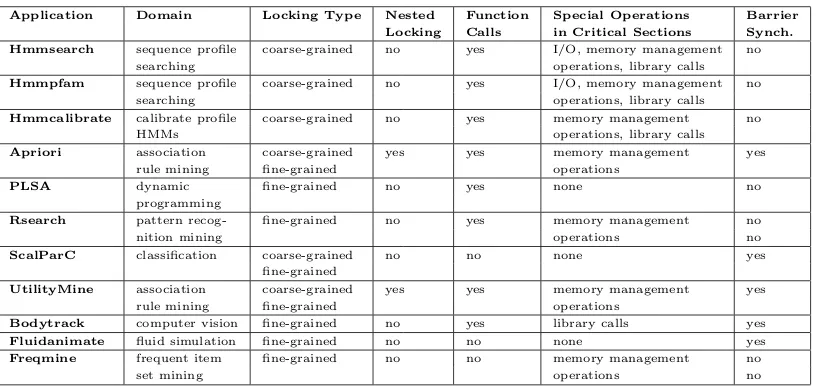
transactified versions of seven applications fromBioBench [8],MineBench [119], and PARSEC [13] benchmark suites. RMS-TM has a wide range of transac-tional and run-time characteristics that qualify it as a new and comprehensive
benchmark suite for evaluating both STM/HTM designs. The applications in
our benchmark suite feature the following: 1) representative real-world
applica-tions, 2) nested transactions [116, 120], 3) large amount of I/O operations [12],
system [150] and library calls inside atomic blocks, 4) complex function calls and
control flow inside atomic blocks, 5) various mix of long/short transactions with
different sizes of read/write sets, 6) low/medium/high contention rates, and 7)
high scalability.
• We develop a methodical procedure to construct our benchmark suite from
candi-date applications. We first divide the application selection process intostatic and