Understanding the Future of Global
Software Production
Investigating the Network in India
Pratyush Bharati
Management Science and Information Systems College of Management
University of Massachusetts, Boston Boston, MA 02125-3393 USA
[email protected] WWW home page:
http://www.management.umb.edu/faculty/bharati_pratyush.php
Abstract. The software industry in India that mostly exports information technology (IT) services has emerged in the last decade as an important constituent of the world software industry. The industry is organized into MNC networks, whose structural, relational, and territorial dimensions has been investigated. The quasi-disintegration and internationalization of MNC production activities, the commodification of services, the availability of highly skilled low cost personnel, and Indian IT services firms link with MNCs have aided in the emergence of IT services industry in India. The research elucidates that MNCs are key drivers in this complex and inter-dependent network that involve important Indian firms. This is the first study to investigate the Indian IT services industry in the context of global software production network.
1 Introduction
presence in custom application development and application outsourcing segments of the market.
The organization in the Indian software industry has not been investigated in detail. This research studies the organization of the Indian firms and Multi-National Corporations (MNCs) in the software industry. It investigates the firms in the IT services industry, specifically studies the structural, relational and territorial dimension of the IT services network. The research questions that are being investigated are: What are the different economic agents and their links in the network? What is the governance structure in the network? What is the spatial dispersion or concentration of production units, location of suppliers and clients?
2 Brief Literature Review
The MNCs are the major clients and owners of the Indian IT services industry. The growth of IT services is largely driven by the Multi National Corporations’ (MNCs) desire to outsource their IT services. The organization of IT services industry into MNC networks and the network’s structural, relational, and territorial dimensions have to be investigated in order to have a more profound understanding of this industry.
2.1 MNCs’ Newer Organizational Arrangements
MNCs are constantly in pursuit of the best balance between vertical integration and reliance on the market for inputs [4]. Efficiency is one of the driving forces as a way to achieve global competitiveness for labor-intensive products, thus, MNCs have moved to low wage countries. This strategy of flexible centralization is complementing the benefits of scale economies with the advantages of low input costs [5].
The oft-cited strategy is that of General Electric (GE) management’s 70-70-70 outsourcing strategy. This strategy mandates that 70% of GE’s IT service requirement will be outsourced, out of which, 70% will be given to strategic suppliers, who will in turn execute 70% of the work outside of high wage countries. It is estimated that GE currently sources more than $ 500 million worth of IT services from India and that is about 8 % of the Indian IT services export [2]. As firms continue to transform themselves from a large, vertical corporation several organizational arrangements continue to emerge.
The metaphor of chain has been employed in different disciplines with slightly different terminology such as value chain, commodity chain, supply chain and filieres [10]. The commodity chain and value chain approaches have numerous similarities between them. As “a firm’s value chain is an interdependent system or network of activities, connected by linkages. Linkages occur when the way in which one activity is performed affects the cost or effectiveness of other activities” [11]. In case of a commodity chain “all firms or other units of production receive inputs and send outputs. Their transformation of the inputs that result in outputs locates them within a commodity chain (or quite often within multiple commodity chains)” [12].
Study of the Unites States (US) in late nineteenth and early twentieth centuries has found that the commodity chains were incorporated within the organizational boundaries of vertically integrated corporations. Then the “visible hand” of corporate management served as the governance structure of these corporations [13]. “Under these circumstances, the governance structure, which is essential to the coordination of transnational production systems, is no longer synonymous with a corporate hierarchy” [14]. In the last several decades of the twentieth century the commodity chains have become more internationalized. Some of the links that were internal to the vertically integrated corporation are being outsourced as tasks to be performed by a network of independent firms [14].
“In today’s global factory, the production of a single commodity often spans many countries, with each nation performing tasks in which it has a cost advantage. The components of a Ford Escort, for example, are made and assembled in fifteen countries across three continents” [14]. This complex international disaggregation of stages of production and consumption under the organizational structure of densely networked firms or enterprises applies to both manufacturing and services [11,15,16].
The Indian information technology (IT) services firms since the beginning have been part of the external networks of MNCs. MNCs, because of their re-organization of IT services, have increasingly sourced IT services from India. MNC’s international network of production of goods and services “combines a lead firm, its subsidiaries and joint ventures, its suppliers and subcontractors, its distribution channels, VARs [Value Added Resellers], as well as its R&D [Research and Development] alliances and a variety of cooperative agreements…. The lead firm outsources not only manufacturing, but also a variety of high-end support services.” [17]. This international organization of production and consumption led by the major MNCs is an important reason for the outsourcing of IT services in India.
2.2 Organization of Services in Networks
internationalization of production has increased the role of service activities. MNCs have been attracted to the concept of sourcing services not only for cost reductions but also to gain greater flexibility and access to specialized skills [19].
Despite their increasing importance in the world economy, services have been neglected in the commodity chain and network analysis research. In the product commodity chains, the service activities provide links between production segments within international commodity chains. They not only link the overlapping commodity chains but also link larger spheres of production and distribution. As a result of atomization, fragmentation and internationalization of production, service firms are increasingly producing services by internationally coordinated service activities.
Global commodity chain (GCC) research has not investigated the commodity chains where the services play an important role. The focus has been conceptualized as a series of activities where the product input and output dominate. Services have not been examined in GCCs and thus have become mechanical configuration without much theoretical depth.
The GCCs have been examined even less in industries where the predominant activity is services. Service activities in service industries such as financial services, software and health care are increasingly being fragmented and internationalized. In manufacturing industries such as information technology (IT) hardware industry, numerous service activities that are integral to their GCC such as research and development, design, and development have been internationalized [8,20].
The MNCs now manage their product commodity chains as networks of internationally located subsidiaries, affiliates, joint ventures, and sub-contractors. A similar phenomenon is taking place for service activities within the MNC commodity chains. IT services of major MNCs are being sourced from specialized IT services firms with international locations [21]. A specific network’s structure is constituted by nodes and their links. The nodes comprise of agents that are linked together with investments. The durability of the capital links are an important element of the network that includes both inter and intra firm links [22]. This study will investigate the nodes and links in the IT services network in India.
A hurdle in conducting research on the IT services industry is the unavailability of data because of absence of proper classifications. For instance, the United States also has not consistently classified the IT services industry. The computer software industry was not classified separately even until 1972 [23]. United Nations (UN) has also acknowledged that there is a wide gap between data needs and availability and narrowing it is bound to be a long term exercise. To resolve this gap, the UN has a taskforce to classify and collect more and better internationally comparable data on services trade in the future [24]. This study had to overcome these serious shortcomings of data unavailability.
3 Methodology
Global, Mergent Online and Thompson Research. Finally, data was also collected from firm websites. The data had to be collected from numerous sources because a consolidated and complete database of all IT services is not available. Since the private firms disclose minimal data and MNCs provide negligible data on their subsidiaries, despite sourcing data from numerous databases, the data availability has varied in the database. The database will be continuously updated to ensure better depth and breadth of data and might be employed for other analyses. Currently, the total number of IT services firms in the database is 551. The data was analyzed to study the organizations and the IT services network in India along the structural, relational and territorial dimensions. This method has been adopted in studies of global commodity chains and production networks [14,20].
4 Analysis
4.1 Structural Dimension
Structural dimension studies the different economic agents and their links in the network. The IT services network in India consists mostly of India based private IT services firms, India based public IT services firms, MNC subsidiaries and joint ventures (Table 1). Among India based firms the public firms are older than the private firms. While the India based private firms and MNC subsidiaries were founded in early 1990s the public firms were founded in the late 1980s. Both MNCs and India based public firms prefer stock exchanges and world headquarters in their country of origin. For the MNCs the most popular stock exchange is the NASDAQ while the India based public firms prefer the Mumbai Stock Exchange (BSE). The difference is revenue is stark as a median MNC is more than 60 times bigger than an India based public IT services firm.
Table 1. IT Services Firms in India – Summary
Category Private
(N=145)
Public (N=57 )
MNC Subsidiary
(N=43)
Median Founding Year 1991 1988 1993
Median Revenues ($M) - 27.10 1696.12
Median No. of Employees - 1250 5617
Stock Exchange (Most Popular) - BSE NASDAQ
World Headquarters India India US
Primary Work Location in India Bangalore Mumbai Bangalore
No. of CMM Certified Firms 30 29 8
No. of ISO Certified Firms 49 38 11
Data Sources: Firm websites, Nasscom, Compustat Global, Mergent Online, Thompson Research, and US Securities and Exchange Commission (SEC) filings.
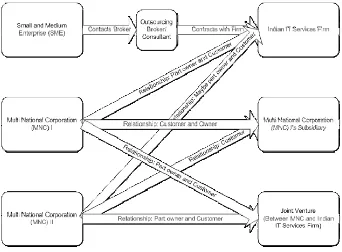
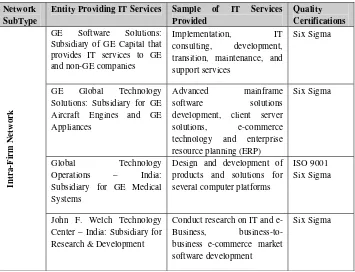
will either employ an India based IT services firm directly or through a sourcing consulting firm. GE’s network exemplifies a MNC IT services network in India (Table 2). The network providing IT services to GE has been categorized into inter-firm, intra-firm (subsidiary) and joint venture network. GE’s intra-firm provider network encompasses firm subsidiaries or those of different business units delivering IT services. The inter-firm network consists of major Indian IT services providers with a long term relationship with GE mostly as a customer and sometimes even an investor. The joint venture network comprises of IT services firms jointly owned by GE and Indian firms.
Fig. 1. India’s IT Services Network
4.2 Relational Dimension
Relational dimension investigates the governance structure in the network. It studies the strategic drivers and how they exert influence on other economic agents, focusing on power and authority relationships. The IT services network in India is bound together with the help of equity and non-equity forms of ownership and control. Networks are bound together usually through equity holdings, debt holdings, shared directors, and equipment leases. The MNCs are owners of their subsidiaries and the major ones are General Electric (GE) India, IBM Global Services India, Microsoft India and Oracle India. GE is also part equity owner of Patni Computer Services (PCS) and several joint ventures together with other IT service providers (Table 2).
[image:6.612.140.482.182.434.2]of the IT services industry is a laundry list of major MNCs. GE is not only a major customer of all its subsidiaries and joint venture firms but also one of the largest customers of PCS. GE constitutes about 20 % and 38% of Satyam and iGATE sales respectively. TCS has also negotiated a $ 100 million outsourcing deal, one of the largest outsourcing deals in the industry, with GE (Table 2). The historical connection with MNCs, which was the basis of the industry, has been maintained in the present network. This connection has been maintained through a record of providing high quality service at a low price. For example, the private, public and MNC IT services firms in India have the highest number of Capability Maturity Model (CMM) certifications in the world (Table 1 and 2).
Table 2. GE’s IT Services Provider Network
Network SubType
Entity Providing IT Services Sample of IT Services Provided
Quality Certifications GE Software Solutions:
Subsidiary of GE Capital that provides IT services to GE and non-GE companies
Implementation, IT consulting, development, transition, maintenance, and support services
Six Sigma
GE Global Technology Solutions: Subsidiary for GE Aircraft Engines and GE Appliances
Advanced mainframe software solutions development, client server
solutions, e-commerce technology and enterprise resource planning (ERP)
Six Sigma
Global Technology Operations – India: Subsidiary for GE Medical Systems
Design and development of products and solutions for several computer platforms
ISO 9001 Six Sigma
Intra-Firm N
et
w
ork
John F. Welch Technology Center – India: Subsidiary for Research & Development
Conduct research on IT and e-Business, business-to-business e-commerce market software development
Network SubType
Entity Providing IT Services Sample of IT Services Provided
Quality Certifications Tata Consultancy Services
(TCS): Largest Indian IT service provider. TCS won one of the largest deals in the Indian industry of $ 100 million from GE.
Global development center conducts development on most platforms and also employs object-oriented analysis and design techniques ISO 9001 People Capability Maturity Model (PCMM) level 4 Capability Maturity Model (CMM) level 5 Patni Computer Services
(PCS): Seventh largest Indian IT service provider. GE is one of the largest customers providing more than $ 108 million of IT services. GE Equity has about a $ 100 million stake in PCS.
Enterprise application solutions, e-business, implementation, and consulting
ISO 9001 CMM level 5 PCMM level 3 Six Sigma
Satyam Computer Services: Fourth largest Indian IT service provider. GE is one of the largest customers of the firm accounting for 20 % of sales.
Global development center provides consulting, application development, enterprise application integration, data warehousing and customization
ISO 9001 CMM level 5
iGATE Global Solutions: A mid-size IT service provider. GE is a large customer, especially the employee reinsurance group, which accounts for 38 % of revenues.
Application maintenance and data management
ISO 9001 CMM level 5 Six Sigma In ter-Firm Net w ork
Nucleus Software: An IT service provider and product firm for GE Capital.
Consulting, software development, support and maintenance services related to its product
CMM level 5
Joint
Ve
ntur
e
Network
Satyam – GE Software Services (India Design Center): Satyam Computer Services and GE Industrial Systems
Design and develop new products and software solutions for embedded systems, e-commerce, and human machine interface
Network SubType
Entity Providing IT Services Sample of IT Services Provided
Quality Certifications GE Medical Systems
Information Technology: Joint venture between GE Medical Systems and Citadel Health, a niche Indian IT firm.
Develop software products for GE Medical Systems
Six Sigma
BirlaSoft: GE is a major customer. GE Equity has a 20 % equity stake in the firm.
Develop software solutions at global development center
Six Sigma CMM level 5 ISO 9001
[image:9.612.135.490.261.472.2]Sources: The table was constructed by integrating data from firm websites, database and Internet searches, Nasscom (2003 and 2005), and Dataquest (www.dqindia.com).
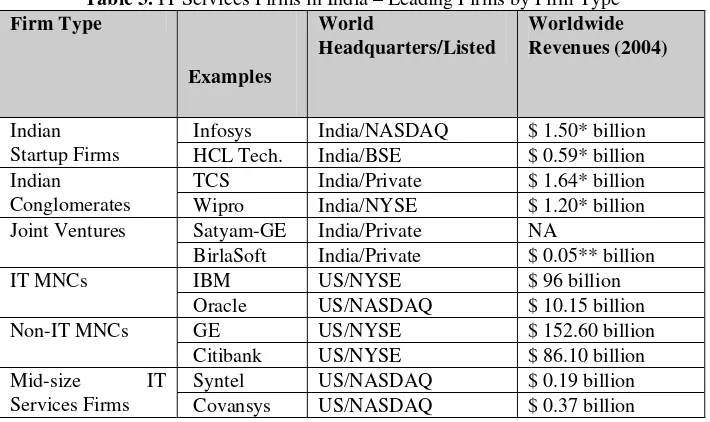
Table 3. IT Services Firms in India – Leading Firms by Firm Type
Firm Type
Examples
World
Headquarters/Listed
Worldwide Revenues (2004)
Infosys India/NASDAQ $ 1.50* billion Indian
Startup Firms HCL Tech. India/BSE $ 0.59* billion TCS India/Private $ 1.64* billion Indian
Conglomerates Wipro India/NYSE $ 1.20* billion Satyam-GE India/Private NA Joint Ventures
BirlaSoft India/Private $ 0.05** billion
IBM US/NYSE $ 96 billion
IT MNCs
Oracle US/NASDAQ $ 10.15 billion
GE US/NYSE $ 152.60 billion
Non-IT MNCs
Citibank US/NYSE $ 86.10 billion Syntel US/NASDAQ $ 0.19 billion Mid-size IT
Services Firms Covansys US/NASDAQ $ 0.37 billion
Notes: BSE: Mumbai Stock Exchange; NA: Not Available; NASDAQ: National Association of Securities Dealers Automated Quotation; NYSE: New York Stock Exchange; *: 2004-05; **: 2001-02; Data Sources: Firm websites, Nasscom, US Securities and Exchange Commission (SEC) filings. Updated from source: [21].
4.3 Territorial Dimension
the cost in these locations has risen drastically, firms are exploring newer locations. Unlike manufacturing the IT services industry does not have several layers of suppliers for the MNCs (Table 2). The Indian IT services firms continue to grow and the top three firms now have revenues of more than $ 1 billion with offices all over the world (Table 3). TCS, the largest Indian IT services firm, is already part of Tata Sons that is a giant Indian conglomerate. As in the past the state continues to assist with tax incentives, establishment of software parks and export processing zones.
5 Brief Conclusions
The quasi-disintegration and internationalization of MNC production activities, the commodification of services, the availability of highly skilled low cost personnel, and Indian IT services firms link with MNCs have aided in the emergence of IT services industry in India. The Indian IT services firms have had a relationship with MNCs since the very beginning. These close links have been strengthened with the MNCs serving as critical customer and sometimes important investors in the Indian IT services firms. The Indian IT services firms on the other hand have gained in reputation and size. It is possible that some of these large firms may become Indian MNCs.
The IT services network is not as layered as compared to a manufacturing network. Presently the service work cannot be packaged more effectively and efficiently with better results, although it is possible that might change. Despite the fact that both MNCs and Indian IT services firms are exploring newer work locations both in India and in other countries, some cities have emerged as hubs for IT services work. The research elucidates that MNCs are key drivers of this complex and inter-dependent network that involve important Indian firms. This is the first study that has investigated the Indian IT services industry as part of the global production network.
References
1. International Data Corporation, Global Impact Report 2005, BSA Publication.
2. Nasscom. Strategic Review Report 2003, Nasscom Publications, New Delhi, 2003.
3. Nasscom. Strategic Review Report 2005, Nasscom Publications, New Delhi. 4. M. Castells. The Rise of the Network Society. Revised Blackwell, Oxford (2000). 5. C.A. Bartlett. and S. Ghoshal. Managing Across Borders: The Transnational Solution. 2nd Ed., Random House, London (1998).
6. M. Aoki.Information, Incentives, and Bargaining in the Japanese Economy. Cambridge University Press, Cambridge (1988).
7. M. Kenny and R. Florida. Beyond Mass Production: The Japanese System and Its Transfer to the U.S., Oxford University Press, Oxford (1993).
8. J. Dedrick and K.L. Kraemer. Asia’s Computer Challenge: Threat or Opportunity for the United States and the World. Oxford University Press, Oxford (1998).
9. T.K. Hopkins and I. Wallerstein. Commodity Chains in the World-Economy Prior to 1800, Review, Vol. 10, No. 1, pp. 157-170 (1986).
Tradition, presented at the ODA/NRSP Socio-Economics Methodology (SEM) Workshop, ODI: London, 29-30 April (1996).
11. M. Porter. The Competitive Advantage of Nations, New York, Free Press (1990).
12. T.K. Hopkins and I. Wallerstein. Commodity Chains in the Capitalist World-Economy Prior to 1800, in Commodity Chain and Global Capitalism Ed. Gereffi, G. and Korzeniewicz, M., Praeger, CT (1994.
13. A.D. Chandler, Jr. The Visible Hand, Harvard University Press, Cambridge, MA (1977).
14. G. Gereffi, M. Korzeniewicz, and R.P. Korzeniewicz. Introduction: Commodity Chains, in Commodity Chain and Global Capitalism Ed. Gereffi, G. and Korzeniewicz, M., Praeger, CT (1994).
15. P. Dicken. Global Shift: Reshaping the Global Economic Map in the 21st Century, 4th ed., Guilford, New York, NY (2003).
16. R.B. Reich. The Work of Nations: Preparing Ourselves for 21st Century
Capitalism, Alfred A. Knopf, New York, NY (1991).
17. D. Ernst. From Partial to Systemic Globalization: International
Production Networks in the Electronics Industry. Sloan Foundation
Report on Globalization in the Data Storage Industry, University of
California, San Diego and Berkeley Roundtable on the International
Economy (1997).
18. World Trade Organization (WTO), Measuring Trade in Services, Economic Research and Statistics Division (2003).
19. T.H. Davenport. The Coming Commoditization of Processes, Harvard Business Review, June, pp. 100-108 (2005).
20. T.S. Poon. Competition and Cooperation in Taiwan’s Information Technology Industry. Quorum Books, Westport (2002).
21. P. Bharati. India’s IT Services Industry: A Comparative Analysis, IEEE Computer, Vol. 38, No. 1, pp. 71-75 (2005).
22. C. Karlsson and L. Westin. Patterns of a Network Economy: An Introduction, Johansson, B., Karlsson, C., and Westin, L.(Eds.), Patterns of a Network Economy, Springer-Verlag (1994).
23. S.E. Siwek and H.W. Furchtgott-Roth. International Trade in Computer Software, Quorum Books, Westport, CT (1993).