A R T I C U L O
Cerámica y Vidrio
Novel SiO
2-C composite adsorptive material
A.N. SCIAN1, C. VOLZONE2
Centro de Tecnología de Recursos Minerales y Cerámica - CETMIC, 1CETMIC-CONICET-UNLP, 2CETMIC-CONICET. La Plata. Argentina.
The present work is about the development of a Novel Composite that has several properties in only one material. This material is composed by a silica network with a sharpened pore size distribution - diameter near 1000 Å - intercrossed with another carbon network that has carbonaceous microdomains of high activity. The first network facilitates the entrance of big molecules to the interior of the material grains so they quickly reach the active sites of the carbonous network, minimizing the diffusional resistance observed when high performance activated carbons are used in adsorption processes or catalytic applications. These two intercrossed structures are self-supporting and independent among them, so one from the other can be isolated without losing the original shape and volume of the starting composite, then, their possible uses may be multiplied. The Novel Composite is stable with respect to other support or adsorbent materials due to its high obtention temperature (1550 oC). The obtention methods of the composite and its isolated structures are described. The material was characterized by different techniques (XRD, IR, Loss on ignition, pore size distribution, specific surface area, adsorption desorption isotherms, methylene blue adsorption and SEM).
Keywords: Porous composite; Silica Carbon network; Adsorptive material; Intercrossed networks.
Nuevo material compuesto adsorbente SiO2C
En el presente trabajo se describe el desarrollo de un nuevo material compuesto que reúne distintas propiedades en un solo material. Dicho material está formado por una red de sílice con distribución de tamaño de poro estrecha - diámetro cercano a los 1000 Å - entrecruzada con otra red de carbón pseudografítica donde los microdominios carbonosos son de alta actividad. La primer red facilita la entrada de grandes moléculas al interior de los granos del material permitiendo su rápido acceso a los sitios activos de la red carbonosa, esto minimiza la resistencia difusional observada cuando se utilizan carbones activados de alto rendimiento en los procesos de adsorción o aplicaciones catalíticas. Las dos estructuras entrecruzadas descritas son autoportantes e independientes entre ellas, pudiéndose aislar una de otra sin pérdida de la forma y tamaño del material compuesto original, entonces su posible uso tecnológico puede ser multiplicado. El nuevo material compuesto es estable con respecto a otros soportes ó materiales adsorbentes debido a su alta temperatura de obtención (1550 oC). Se describe su método de preparación, el de las estructuras derivadas aisladas y su caracterización (DRX, IR, PxC, distribución de tamaño de poro, superficie específica, isotermas de adsorción desorción, adsorción de azul de metileno y SEM).
Palabras clave: Material compuesto poroso; Red sílice-carbono; Material adsorbente; Redes entrecruzadas.
1. INTRODUCTION
During the last years the scientific bibliography referred to siliceous or carbonaceous based microporous materials and their properties [1-13] became not only of academic interest, but also these materials were technologically developed up to obtain international patents.
Among the materials mentioned it is possible to find compounds of siliceous structure with open pores rarely above 100 Å in diameter (MCM-41; MCM-48; M41S; laminar phases; intercalation products, etc.), while in the case of carbonaceous materials ("activated carbons", "carbon molecular sieves" -CMS-, etc.) the pore diameter range is near 10 Å.
These two types of materials have very different chemical, textural and structural characteristics, so they may be used for
different purposes and fulfill distinct functions. For example: molecular sieves, catalysts, catalyst supports, adsorbent material, etc. In all these functions the characteristics of the material (chemistry, structure, pore size, etc.) must be adjusted to the proper characteristics of the molecules that will interact with it and to the physicochemical process used because some problems may arise impeding the normal development of such function. For example, if the molecule sizes are similar or greater than the pore sizes of the material, diffusional and/or steric problems affecting the efficiency of a determined process will be observed.
Respect to carbonaceous structures, although species of high surface activity and selectivity were developed, it was not possible to exceed in a large scale parameters of pore diameter of 10 Å. Then, in the case of interaction with molecules which size is greater than the observed, the working capacity of the carbons will occur only on the external surface of the particles and not in the inner part of the pores.
The present work is about the development of a novel composite [14] that develops the two properties searched in only one material. This composite has an amorphous silica network with a sharpened pore size distribution - diameter near 1000 Å - intercrossed with other thin carbonaceous network of high surface activity. This allows an easy access of great molecules to the interior of material grains minimizing diffusional problems.
This new composite has the property of generating other two types of materials of high technological applications since the two intercrossed structures are self-supported and may be isolated one from the other without losing its original external volume. The carbonaceous structure can be removed from the composite by calcination in air, and on the other hand, the siliceous structure can be removed from the composite by HF acid attack.
The following are some other interesting characteristics: the obtention process is relatively simple, it uses conventional raw materials and it is obtained by thermal treatment at high temperatures making it extremely stable when thermal working conditions are severe.
2. EXPERIMENTAL
2.1. Synthesis of SiO2-C novel composite.
The gelation property of TEOS (Tetraethylortosilicate) in alcoholic medium is used in order to include in its structure a liquid phenol-formaldehyde resin, which with subsequent curing and pyrolisis in reducing atmosphere leaves high amount of residual carbon. The characteristics of each raw material are given in Table I.
TEOS solution and the resin with 2:1 ratio were mixed in a flask with a magnetic stirrer; enough amount of ethanol was added until to obtain an homogeneous transparent solution (20 g TEOS, 10 g resin and 23 ml ethanol). Necessary water for TEOS gelation was provided by the ethanol water content, the resin water content and the water produced by the etoxi-phenoxi ligands reaction. Then this solution was kept at room temperature in a closed flask up to complete gelation (48 h). The gel was dried in air up to constant weight and then it was heated gradually (5 oC/h) up to 180 °C, maintaining this temperature for 3 h up to complete polymerization of the resin. Under this conditions a light brown solid mass was obtained.
This solid was just poured into coke powder inside of sealed refractory crucibles and thermally treated during 3 h at 1550 oC (heating rate 5oC/min). A porous black solid material was obtained and identified as SC-155.
The nomenclature corresponds to: S silica structure, C carbonaceous structure, and 155 the obtention temperature in °C/10.
Other two materials called S-155 and C-155 were obtained from the original SC-155: a) S-155, without C, was prepared by calcination of SC-155 in air atmosphere up to 1000 °C; this product was a self-supported high porosity amorphous SiO2
solid; b) The C-155, without SiO2, was obtained by leaching the SC-155 material with 20 % HF acid solution and subsequent elimination of the remaining fluorsilicic acid, resulting a self-supported high porosity C solid. These two materials maintained the shape and size of the original SC-155 pieces.
A commercial activated carbon with high surface area named AC-ref was used as comparative material in all the tests performed.
2.2. Characterization of the materials.
X ray diffraction (XRD) patterns were obtained with a generator and a Philips vertical goniometer (PW 1732/0 and PW 1050/70, respectively) using CuKa radiation (λ=1.5405 Å) and a Ni filter at 40 kV and 20 mA.
The infrared (IR) spectra were obtained from Bruker 113V spectrophotometer with a scanning range between 4000 and 400 cm-1on samples prepared as tablets diluted in KBr.
Surface area (BET) was calculated from the first part of the N2adsorption isotherm (P/Po < 0.3). The N
2isotherms were obtained at liquid nitrogen temperature in a Micromeritics Accusorb 2100E equipment.
Pore size and pore volume distribution of the material in the range 37-75000 Å radius was performed using mercury porosimetry Carlo Erba 2000.
Adsorption test using methylene blue solutions was performed by two different methods: 1) in dynamic condition by eluting a 100 mg/l methylene blue solution through a bed of 100 mg of adsorbent material; and 2) in two different batch conditions: a) with mechanical stirring during periodic time intervals of 12 h (2 litres of 100 mg/l solution and 100 mg of material), and b) with a continuous magnetic stirring (2 litres of 10 mg/l solution and 100 mg material). In all the cases the particle size distribution of the materials was the same. The amount of methylene blue adsorbed was measured by UV Visible spectroscopy at wavelength of 665 nm colour using a Hewlett Packard model 8453 spectrophotometer.
Loss on ignition at 1000 oC was performed in order to obtain the C/SiO2ratio.
Scanning Electron Microphotographs of SC-155, S-155 and C-155 were obtained using a Philips 505 electron microscope.
3. RESULTS AND DISCUSSION
The SC-155 loss on ignition was 26.34 % while the AC-ref loss on ignition was 96.80 %, then, the first showed approximately 3.5 times less carbon than the reference sample.
[image:2.595.306.538.125.212.2]In graphite there are two-dimensional infinite covalent networks [15]. Each carbon atom is bonded to three others in such a way that all atoms in a single plane are linked in a sheetlike structure (in plane carbon-carbon bond). These infinite sheets of atoms are packed in a layer structure in which the attractive forces between different layers are of the van der Waals type. The distance between alternate planes determines the "basal plane" of graphite.
AC-ref microstructure as well as SC-155 microstructure seen through X ray diffraction (Fig.1) showed a centered band
at 3.48 Å (25.6 °2θ) and other of lower intensity with
maximum at 2.07 Å (43.6-43.7 °2θ); the SC-155 showed
besides a great centered band at 4.07 Å (21.8 °2θ) assigned to amorphous silica (XRD bands were observed instead of peaks because amorphous phases or short order atomic arrangements were present).
The first mentioned band has an intermediate value between the corresponding to graphite basal plane -3.34 Å-and the one calculated by Foley at al. [4] for the called turbostratic carbonaceous structures -3.82 Å-, while the second one would correspond to those in-plane carbon-carbon bond that according to Foley would be at 2.03 Å. This would indicate that the carbonaceous structure of both materials would be associated to a sub-graphitic structure where the two types of carbon-carbon bond would be expanded with respect to a normal graphitic structure.
So, AC-ref would show a similar structure to graphitic but more expanded, while SC-155 would show a similar structure to AC-ref but intercalated with other network of amorphous silica.
Infrared spectrum of SC-155 sample showed only the characteristic bands corresponding to silica, which correlated with what was observed by XRD would corroborate that it is a network of silica intercrossed with other of carbonaceous base (Fig. 2).
Curves of accumulative pore volume vs. pore radius for AC-ref and SC-155 materials (mercury porosimetry) are shown in Fig. 3. The curve corresponding to SC-155 sample presents a sharpened pore size distribution, with radius within the zone corresponding to 500 Å providing the greatest part of the total porosity, then it increases slightly for smaller pores.
The curve corresponding to AC-ref shows a wide pore radius distribution but without a defined and delimited size, and with lower total pore volume than the SC-155; the shape of the curve in the region lower than 500 Å is quite similar to the one of SC-155. This would indicate that in SC-155 sample the curve zone corresponding to radii smaller than 500 Å and up to 40 Å corresponds to internal mesoporosity of carbonaceous network while the great jump observed in the 500 Å zone would correspond to the porosity developed between walls of carbonaceous network and of silica network. This technique did not allow to observe open porosities smaller than 35 Å, range in which micropores of activated carbons are found.
Fig. 4 corresponds to the adsorption-desorption nitrogen isotherms performed over AC-ref and SC-155 samples. This figure shows curves with hysteresis loop that corresponds to the H3 type according to Gregg and Sing [16], and can be formed by very wide pores having narrow short openings, or by pores formed by parallel plates at some distance like graphite structure.
[image:3.595.319.525.103.216.2]This technique shows that the carbonaceous texture of both materials is nearly similar, but noting that the curve
[image:3.595.320.523.267.377.2]Figure 1: X-ray diffraction of the AC-ref (a), and SC-155 (b) samples. In the enlarged zone of the SC-155 a little shoulder corresponding to pseudo graphite basal plane is observed.
[image:3.595.320.520.411.539.2]Figure 2: Infrared spectrum of the SC-155 sample. Only bands corresponding to silica are observed.
Figure 3: Pore size distribution as Accumulative pore volume vs. Pore radius./ AC-ref (z) and SC-155 (). - Mercury porosimetry –
Figure 4: Adsorption-desorption nitrogen isotherms of the AC-ref and SC-155 / Adsorbed volume (cm3/g) vs. P/P
[image:3.595.348.495.573.741.2]corresponding to AC-ref sample shows greater amount of adsorbed nitrogen than the SC-155 due to its higher carbon content. Furthermore it can be seen that the desorption part of these curves denote that it is more difficult for AC-ref than for SC-155 to release the adsorbed molecules. This observation could be explained considering that SC-155 has very big pores surrounding the carbon microdomains, and as a consequence the molecular diffusion of the desorbed gas is facilitated.
[image:4.595.310.535.105.264.2]The BET specific surface area of the materials are summarized in Table II. The difference of the surface area between SC-155 and S-155 (145 m2/g) may be attributed to the carbon network.
Fig. 5 shows the result of elution test of a methylene blue solution (100 mg/l) through a bed of 100 mg of SC-155 and AC-ref at a flow rate of 70 ml/h.
Methylene blue was selected since according to Därr and Ludwig [17] the dimensions of the non-solvated molecule (1.7x7.6x3.25 Å3) would be just in the range of pore size of an activated carbon, but as with its solvation layer its dimensions would be slightly increased, some problems of comparative diffusional resistance could be observed among materials studied.
Fig. 5 shows that in the first 200 ml eluted, the SC-155 showed higher kinetic performance (adsorption rate) than the AC-ref in spite of having lesser carbon amount than the last one, that is to say, the SC-155 retained more amount of solute. Starting from 200 ml eluted, the adsorption capacity of SC-155 became exhausted due to complete saturation of its active sites; instead, the AC-ref showed a tendency to continue adsorbing, which would be explained by the existence of an equilibrium between the amount of available active sites and the diffusional resistance.
The same behaviour was observed for the adsorption of methylene blue in batch conditions but with mechanical stirring, that is to say, higher adsorption rate for SC-155 than for AC-ref during the first times (6 days), then the exhaustion of SC-155 activity was observed, but the AC-ref showed a tendency to continue adsorbing methylene blue. In this test the concentration of the starting solution was the same that in the case of dynamic one (100 mg/l).
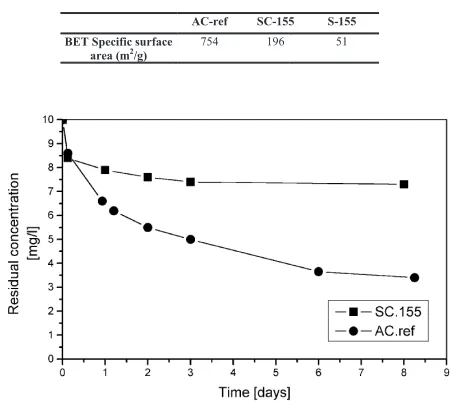
When the batch test was performed with continuous magnetic stirring instead of mechanical agitation, the performance for both materials showed anomalies that required special interpretation. In this case, 2 liters of one order of magnitude less concentration of methylene blue aqueous solution (10 mg/l) was used for almost the same amount of adsorbent material than in the previous case (mechanical agitation). Results can be observed in Fig. 6.
A very pour adsorption was observed for both materials compared with the adsorption test performed with mechanical stirring and with more concentrate solutions. If the values obtained without magnetic stirring are extrapolated from 100 mg/l to 10 mg/l as in this test, a complete decoloration of solutions (total adsorption of methylene blue) might have been observed within 2 days treatment.
No difference was observed in this test between both samples at times shorter than 0.3 days (Fig.6), but for longer times, the SC-155 showed a slight adsorption up to 3 days almost without activity after that time; the AC-ref instead, continued adsorbing through time although it did not reach complete decoloration of solution during 8.5 days test.
The different behaviour in adsorption when the two types
of stirring (mechanical and magnetic) are used, may be explained since the adsorption property of the carbons is assigned to their high electronic density zones corresponding to the exposed electrons in subgraphitic microdomains.
In a graphitic structure the hexagonal plates are sufficiently near, then the electrons in the basal plane may provide electric conduction capacity, so, in this way, few electrons would work as "free radicals" available for "adsorption" or "trapping" of molecules.
Instead, activated carbons have sub-graphitic structures where the hypothetic distance of the basal plane is larger than for the graphite, and/or pilings are formed by few layers without showing long-range important arrangements, so most of these pseudo-graphitic bonds are available for adsorption phenomena.
TABLEII. BET SPECIFIC SURFACE AREA OF THEACREF, SC. SC-155 ANDS-155. Figure 5: Accumulative Methylene Blue retained (mg) vs. eluded ml of a 100 mg/l coloring solution, passed through a bed of 100 mg material at 70 ml/h. AC-ref (z) and SC-155 ()
[image:4.595.309.535.324.526.2]When a variable magnetic field is applied to an electric conductor an induced electric current is originated; consequently, in carbonaceous-graphitic or sub-graphitic systems as the ones of these materials, this phenomenon occurs. Then, the electrons that normally work as “free radicals” in graphite like structures change their functionality when they are submitted to a variable magnetic field, passing from the stage of “free radicals” to the band of electrical conductivity, losing the capability to form stable bonds with substances of high electronic density as methylene blue
molecules. Probably for this reason both compounds (AC-ref and SC-155) have their adsorptive capacity minimized in systems submitted to magnetic stirring. This effect is enhanced in SC-155 and would be explained by the fact that its carbonaceous microdomains would be smaller than the corresponding of AC-ref, and/or, pilings formed by a few layers of hexagonal platelets would be immersed into big pores of silica network, so, these electrons would be more movable and with less energetic requirement to reach bands of electric conduction.
As it was previously described, the SC-155 material may be used as precursor to obtain other structures potentially useful in catalysis and/or treatment of gases and liquids by elimination of the carbonaceous network (S-155) or the silica network (C-155). Both structures are self-supported, and would be applied as they were obtained or by subsequent impregnation with catalytic substances providers of selective properties.
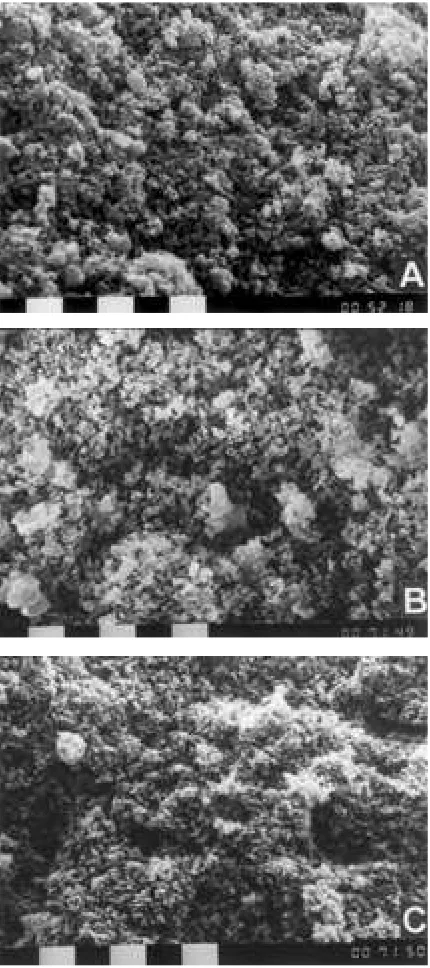
Fig. 7 shows the microphotographs of S155, S-155 and C-155 materials (scale 1µm). The sponge type structure can be observed in SC-155 being maintained when any of the networks of the composite were removed. This confirms that
SC-155 is composed by a SiO2 network intercrossed with a
carbonaceous network, and that both of them are independent and self-supported.
The isolated silica network (S-155) did not act as an adsorbent when it was submitted to methylene blue solutions adsorption tests. This behaviour is due to the high temperature that it was supported during its synthesis; under this condition the silica remains as a porous sintered structure without active sites available for adsorption.
It must be pointed out that this type of material (obtained at 1550 °C) has a high stability at temperatures lower than the mentioned one with the adequate working atmosphere, so a new advantage appears with respect to uses where other porous materials are thermally unstable.
As this new material is capable to adsorb efficiently and in short periods of time great molecules with high electronic density (non-saturations, aromatic rings, radicals with free electrons, amino groups, etc.), could be used in previous treatment of the sea water desalinization plants, because the high hydrocarbons present in petroleum contaminated water affect the inverse osmosis membranes of the processing equipments [18], as it is observed in the Persic Gulf region.
Finally, we have to mention that taking into account the properties of electric conduction of sub-graphitic structure and that it is continuously immersed into another inorganic network, a prototype device (a little cylindrical rod) was made in experimental way and with the same type of processing used to obtain SC-155. This device, whose oxidic structure was a porous network of mullite (3Al2O3.2SiO2) of high mechanical strength intercrossed with a carbonaceous network, was tested as electrode detector of ammonia gas. The electric resistance of the device was increased when electrons available for conduction -supplied by the carbonaceous network- were used to form bonds with the free electrons of the ammonia molecules, this variation was detected with a high sensitivity digital multimeter instrument.
[image:5.595.68.283.102.586.2]Several researches must be done to develop and study this type of compounds, on the materials as they were obtained and described in this work as well as on the possibilities of creating and developing with this technique new materials with useful properties for the society.
I N T E R N A T I O N A L C O N F E R E N C E
A
DVANCED
C
ERAMICS
F
OR
T
HIRD
M
ILLENIUM
NOVEMBER 5-9, 2001
K i e v U k r a i n e
Information support from
Ukrainian Industrial Journal / “MM&Money” Technologies
I. Frantsevich Institute For Problems Of Materials Science • E-mail: [email protected] 4. CONCLUSIONS
A new type of porous composite material of generic formula SiO2-C and with narrow range of pore size
distribution may be obtained through a sol-gel technique and subsequent thermal treatment at high temperatures.
The obtaining process is relatively simple and does not need expensive raw materials.
The adsorption activity of this material is similar to the ones of commercial activated carbons, but it has higher performance from the kinetic point of view, especially in its interaction with big molecules.
The adsorptive properties of this material may be blocked when it works in presence of variable magnetic fields.
The material developed has a sponge texture, formed by a network of amorphous SiO2 intercrossed with other network
of active carbon.
The structures above mentioned may be isolated one from the other obtaining other self-supported structures that may be applied to several uses (catalysis, environment, etc.).
As this composite was obtained at very high temperatures, it is very stable in uses where other materials are notably affected.
REFERENCES
1. S.B. McCullen, J.C. Vartuli, C.T. Kresge, W.J. Roth, J.S. Beck, K.D. Schmitt, M.E. Leonowiks, J.L Schlenker, S.S. Shih, J.D. Lutner. “A New Family of Mesoporous Molecular Sieves”. In Access in Nanoporous Materials, Ed. by T. J. Pinnavaia and M.F.Thorpe, Plenum Press, New York, (1995), 1-12.
2. P.T. Tanev, T.J. Pinnavaia. “Recent Advances in Synthesis and Catalytic Applications of Mesoporous Molecular Sieves”, ibid., 13-28.
3. M.T. Anderson, J.E. Martin, J. Odinek, P. Newcomer. “Synthesis of Surfactant-Templated Mesoporous Materials from Homogeneous Solutions”, ibid., 29-38.
4. H.C. Foley, M. S. Kane, J. F. Goellner. “New Directions with Carbogenic Molecuar Sieve Materials”, ibid., 39-58.
5. C.J. Brinker, S. Wallace, N.K. Raman, R. Sehgal, H. Samuel, S. M. Contakes. “Sol-Gel Processing of Amorphous Nanoporous Silicas: Thin Films and Bulk”,ibid., 123-140.
6. B.C. Dave, B. Dunn, J. I. Zink. Chemical an Electrochemical Reactions in Porous Sol-Gel Materials”, ibid., 141-160.
7. G.C. Coe. “Structural Effects on the Adsorptive Properties of Molecular Sieves for Air Separation”, ibid., 213-230.
8. U. Cielsa, M.Grün, T. Isajeva, A.A. Kurganov, A.V. Neimark, P. Ravikovitch, S. Schacht, F. Schüth, K.K. Unger. “Critical Appraisal of The Pore Structure of MCM-41”, ibid., 231-240.
9. S. Mrozowsky. “The nature of artificial carbons”. In Proc. of Ind. Carbon an Graphite Conference. London 1957. Soc. of Chem. Industry, London (1958) 7-18.
10. D.J.E. Ingramand, D.E.G. Austen. “Interaction on the trapping of free electrons in carbon”, ibid., 19-25.
11. A.F. Adamson, H.E. Blayden. “The magnetic susceptibility of mesomorphous carbons and graphites”, ibid., 28-35
12. A.R.G. Brown, W. Watt. “The preparation and properties of high temperature pyrolitic carbon”, ibid., 86-100.
13. F.H. Winslow, W. Matreyek, W.A. Yager. “Carbonization of vinil polymers”,
ibid., 190-196.
14. A.N.Scian, Patent Under Tramitation – INPI (Instituto Nacional de la Propiedad Intelectual) –“Material compuesto poroso y su procedimiento de obtención” - Argentina - NoP 98-0-06222 – (1998).
15. B.H. Mahan. In “University Chemistry”. Fondo Educativo Interamericano Ed. Bogotá (1968) p84.
16. S.J. Gregg, K.S.W. Sing. “Adsorption Surface Area and Porosity”. Academic Press, London, (1982) p 303.
17. G.M. Därr, U. Ludwig. “Determination of the specific surface by adsorption from solution”. Matériaux et Constructions, 6[33], 233-237 (1973). 18. Tecno Japan. Fuji Technology Press Ltd. 31 [6], 62 (1998).