CACIC 2005 - XI Congreso Argentino de
Ciencias de la Computaci´on
Workshop de Agentes y Sistemas Inteligentes (WASI)
Adaptive Decision Making Systems
Pilar Bulacio, Luis Magdalena Elizabeth Tapia ETSI Telecomunicaci´on Escuela de Ingenier´ıa Electr´onica Universidad Polit´ecnica de Madrid Universidad Nacional de Rosario
Spain Argentine
{pb,llayos}@mat.upm.es [email protected]
Abstract
Given a population of classifiers, we consider the problem of designing highly compact and error adaptive decision making systems. A selection approach based on misclassification diversity and potential cooperation among classifiers is proposed. The compactness constraint allows us the efficient implementation of fuzzy integral combination rules regarding both the interpretability of fuzzy measures and low complexity of fuzzy integral operator. Experimental results show the feasibility of our approach.
Keywords:Scalability, multiclassifier system, fuzzy integral.
1
Introduction
Current decision making systems are mainly designed in a sequential approach. Usually, two stages are involved [26]. The first one, which is typically highly problem specific, is concerned with the design of a population of base classifiers. Assuming that diversity is a useful property in the design of decision making systems [14, 15, 25], a highly diverse population of base classifiers is constructed in this stage. In addition, the second stage is concerned with the design of combination rules over individual classification results, which is generally application independent. At this stage, combining rules enforcing complementarity are implemented. It should be noted, however, that a rich population of classifiers in terms of diversity might not be entirely errors complementary, i.e., there is no explicit measure of diversity involved in the sequential design [14].
combination rules [7] complexity problems arise due to the estimation of a huge number of parame-ters, and estimation simplifications might also imply inconsistent results. Therefore, with a growing population of classifiers an alternative design strategy should be considered.
In this paper, a proposal for the design of highly scalable multiclassifier systems is presented. The proposal is based on the selection of a reduced subset of potentially cooperating classifiers. The target subset is constructed in a greedy fashion using a heuristic method, which takes into account both the performance and errors distribution of selected classifiers according to the intended combination rule. At a first glance, our proposal might be considered as an instance of previous solutions of large multiclassifier systems, like choose the best[18] or test and select[22] methods. We recall that the
choose the bestmethod considers only the individual accuracy of classifiers under the assumption of a uniform distributed diversity. In our work, the uniform distributed assumption is not mandatory. In addition, test and select methods are basically brute force approaches because a target subset is searched in the set of all available subsets of classifiers. In the present work, a target subset is selected using a single scanning over the set of error patterns of classifiers. At this scanning process, classifiers selection is performed taking into account the accuracy and complementarities of misclassifications per class. Computational complexity of this selection process scales linearly w.r.t. the number of available classifiers.
In this paper, we focus on Fuzzy Integral (FI) combination rules. Due to the selection process, FI parameters can be easily computed. As a fact, the estimation of FI parameters might be computa-tionally unaffordable if the whole population of classifiers were used. Furthermore, even in the case those FI parameters were simplified by the use of decomposable measures, like λ-measures, preci-sion problems might arise instead. For the sake of simplicity, we constrain ourselves to minimalist FI rules, i.e., target subsets of three classifiers. The proposed subset size is tightly linked to our recent work about the design of scalable decision making systems based on the selection of multiple, not necessarily disjoint but still small, subsets of classifiers [3]. We expect the present work enlightens the computational cost vs. robustness of joint decision. This paper is organized as follows. In sec-tion 2, we present the problem. In secsec-tion 3, we propose the design cycle of scalable multiclassifiers systems. We also give a briefly review of FI combination rules before going into details about the core selection process. In Section 4, we present experimental results. In Section 5, we present the conclusions and further work.
2
Problem Statement
Multiclassifier systems are effective if individual misclassifications can be overcame by a cooperative work among classifiers. The joint decision is achieved by combining individual results. The use of trained combination rules, like fuzzy integrals, allows us to overcome hard classification scenarios, where few classifiers in the given population are strongly fitted to the target classification problem [21] and consequently, simple combination rules, like majority voting, might fail. In addition, com-binations of a growing population of classifiers might yield to inconsistent results or increase their computational complexity. Therefore, a proper selection of a small subset of complete classifiers, complete enough to cover the problem, joint with the use of a powerful combination rule may provide a framework for solving a general scalability problem.
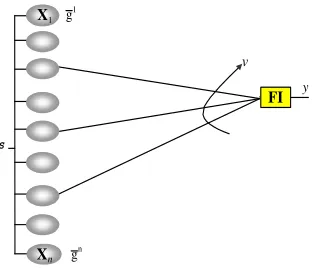
The aim of this work is to propose a systematic process to make possible scalable joint decision makings when a general combination rule is used. To do that, we propose a simple selection of the most error complementary and task redundant subset of classifiers (figure 1) regarding FI combination rules.
y
S
Xn
X1
v
g1
gn
[image:3.595.201.357.103.241.2]FI
Figure 1: Scalable decision making system
has sense if there is redundancy in the analysis and if classifiers are different. Previous studies on joint decision making agree with the need of diversity in base classifiers [6, 14, 21].
Let us assume that a population ofnclassifiers,{X1, ..., Xn}, non specialized on the set of possible
alternatives,W ={w1, ..., wc}, is given. The selection process computes the individual accuracy and
error distribution of classifier.
We assume that available data comes into train and test data sets. In addition, we presume that enough training data is available, so that, two training data sets can be generated: one for training the base classifiers and the other for training the combination rule, e.g., for fuzzy measures estimations. Hereafter, we will refer to training data sets as classifiers training data set orT1, andcombination rule training data setorT2; and thetesting data setis calledT3.
The distributions of errors related to classifiers are estimated during the training of the combi-nation rule. To do that, each classifier will analyse the samples of T2. When individual classifiers
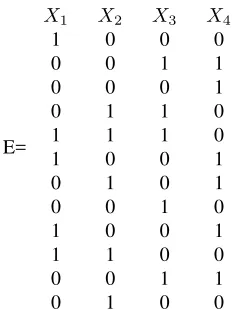
disagree their decisions are piled up in one matrix calledmatrix of error patternorE. Assuming that classifiers disagree ink samples, E will be a k×n binary matrix with each column composed of a classifier performance, where 0 implies error and 1 implies non error in the current sample.
The selection of a suitable subset, hereafter named O and v its cardinality, takes into account the constraint related to the estimation of FI parameters, and the individual and joint behaviour of classifiers related to misclassifications.
3
Adaptive Design Cycle of Decision Making Systems
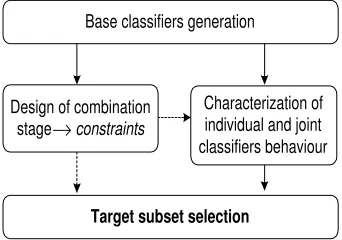
Concerning the adaptability issues in the design of scalable decision making systems, we will consider the selection of a subset of classifiers based on both their accuracy and their distribution of errors. The overall proposed design involves the following stages:
• Base Classifiers Generation: Aiming the generation of a highly diverse population of classi-fiers, different artificial intelligent techniques are implemented and different parameters in the generation of knowledge bases are used.
• Combination Rule Formulation: Aiming the induction of highly descriptive combination rules, FI rules involving a numberv<<nare trained. For the sake of simplicityv=3 is adopted.
character-ization process also takes into account the selected combination rule constraints, e.g., scalable fuzzy densities and measures computation.
• Target Subset Selection:This stage simultaneously takes into account the two previous stages.
The above mentioned design steps are summarized in the diagram2.
Base classifiers generation
Target subset selection
Characterization of individual and joint classifiers behaviour Design of combination
[image:4.595.213.384.194.314.2]stage constraints
Figure 2: Multiclassifiers design cycle based on misclassifications complementariness
We will concentrate in the last three points, the first one is a huge line of research [2], which involves methods of manipulation of training parameters such as training data sampling [1, 8, 12],
data preprocessing[20], andmodification of feature space[10, 17].
In what follows, we briefly revise FI combination rules regarding their use in the error adaptive design of decision making systems. After that, we will describe the subset selection procedure.
3.1
Decision Integration with FI
Fuzzy integrals have been shown to be a useful method for combining results of multiple sources of information. Its definition with respect to a fuzzy measure [23] or capacity [5] provides a good framework to represent the imprecise knowledge associated with classifiers. In the literature, prac-tical implementations [4, 13] only combine 2 or 3 classifiers due to the constraint of the parameter estimation with a large number of classifiers.
We will consider the discrete Choquet and Sugeno FIs. See [9, 16] for theoretical details.
Assuming a multiclassifier system composed ofnclassifiers, andCpossible alternatives for input samples (s), that belong to ap-dimension feature space,s∈ ℜp, we callf(X
i(s))orfi : ℜp→[0,1]C,
the classification function that supplies the individual decision through a vector of C components. Each component of this vector represents the degree of support given by the classifier Xi to the
hypothesis thatscomes fromwj, withj = 1, ..., C. The joint decision is obtained by aggregating all
partial classifiers evidences weighed by ability degrees (g).
Letgbe a fuzzy measure onX, whose elements are denotedX1, ..., Xn. The Sugeno integral [23]
of a functionf:X→[0,1]w.r.t. gis defined by
Sg(f) := n
max
i=1 {min(f(X(i)), g(A(i)))} (3.1.0)
The (discrete) Choquet integral [5] of a functionf :X→[0,1]w.r.t. gis defined by
Cg(f) := n X
i=1
Where ·(i) indicates the permutation of indices 0≤ f(X(1)) ≤ . . . ≤ f(X(n)) ≤1, f(X(0)):=0, and
A(i):={X(i), . . . , X(n)}.
A fuzzy measure or capacitygonXis a functiong : 2X →[0, 1] if
1. g(∅) = 0,
2. g(X)= 1,
3. A⊂B⊂X ⇒ g(A)≤g(B).
In our case,g(A(i))quantifies the ability ofA(i)to classify the input on theW space. In particular,
whengis related to a single element,Xi withi ∈ {1, ..., n}, is calledfuzzy densityof theith source
orgi.
The estimation of fuzzy measures can be done in different ways, e.g., using probabilities of mis-classification [9, 19], through iterative algorithms to diminish the quadratic error [9, 11] or using genetic algorithms [24]. In general, fuzzy measures cannot be evaluated from fuzzy densities.
Though FI operators provide a useful framework for the design of fuzzy adaptive decision making systems, they require the estimation of 2n−1 parameters for n classifiers, which even for small n
values might be computationally unaffordable.
In an attempt to overcome the complexity estimation of fuzzy measures, Sugeno introduced λ -fuzzy measures, which are decomposable measures related to -fuzzy densities, that fulfil the further property:
gλA,B =gλ(A [
B) = gλ(A) +gλ(B) +λgλ(A)gλ(B)
for every disjoint subsets A, B ofX and for someλ ∈ (-1,∞). λ can be uniquely determined for a finite set by means of the second property of fuzzy measure (g(X) = 1), which leads to solving a polynomial of (n−1)th degree. Consequently, dealing with large groups of classifiers would imply a difficulty in the polynomial root determination, but we use small coalitions to attend the precision constraint:λvalue propagates the estimation errors of all fuzzy densities.
The use ofλ-measure simplification reduces ton−1the number of parameters to be estimated, but also limits the flexibility in fuzzy measures relationship.
3.2
Systematic Selection of Complementary Classifiers
In this section, we describe the core selection process. Main inputs to the process are fuzzy densities and joint distribution of errors over the training data of combination rules.
In the first step, we seek the classifier exhibiting the lowest amount of misclassifications (seek X1∗
method of algorithm 1). In this way, an initial O subset is defined and its greedy augmentation starts. We compute the performance value, in each class, related to the current subset of classifiers (O ={X1∗}).
withOis generated per class (Eo[wj]) and its density of 1s is evaluated. At first,Eois initialised with
the error pattern related toX1∗.
3.2.1 Example:
In order to illustrate the selection methodology, we shall see a toy example. Let us consider the following matrix of the error pattern of 12 samples, table 3.2.1, associated with 4 classifiers and 3 classes. The first five samples are related tow1, the next three are related tow2, and the last fourth are fromw3.
[image:6.595.236.352.241.396.2]E= X1 1 0 0 0 1 1 0 0 1 1 0 0 X2 0 0 0 1 1 0 1 0 0 1 0 1 X3 0 1 0 1 1 0 0 1 0 0 1 0 X4 0 1 1 0 0 1 1 0 1 0 1 0
Table 1: Matrix of the error pattern
The first selected classifier isX4(X1∗) due to its coverage (density of 1s) on the 12 samples. Next,Eis divided into
E[w1],E[w2], andE[w3]associated withw1,w2andw3respectively.
E[w1]=
X1 1 0 0 0 1 X2 0 0 0 1 1 X3 0 1 0 1 1 X4 0 1 1 0 0
E[w2]=
X1 1 0 0 X2 0 1 0 X3 0 0 1 X4 1 1 0
E[w3]=
X1 1 1 0 0 X2 0 1 0 1 X3 0 0 1 0 X4 1 0 1 0
So, the coverage of classifiers ofO ={X4}(first time onlyX1∗) on the subset of samples computed in each class
(comput perf)is:W P erf[1] = 2
5,W P erf[2] = 2
3,W P erf[3] = 2
4. Therefore, the next classifier to be included is in order to improvew1(the lowest performance class).
The class yielding the lowest performance,w(−), is used in order to guide the addition of the next classifier (X∗). As a fact, we seek the best classifier in terms of complementarity and quantity of errors w.r.t. to the poorest class using its error pattern,E[w(−)]. Regarding this purpose, a new matrix of errors (Ek) is computed by a simpleoroperation (denoted byk) between the current vector of the subset error pattern (Eo[w(−)]) and each column ofE[w(−)]. Non zero entries in this new matrix points
3.2.2 Example:
Following the previous example, the computation of the error pattern of the current subset w.r.t. the worst class (w(−)=
w1) and the evaluation of complementarity of remaining classifiers is shown bellow.
E[w1]=
X1 1 0 0 0 1 X2 0 0 0 1 1 X3 0 1 0 1 1 k
Eo[w1]
0 1 1 0 0
−→Ek[w1]
X1 1 1 1 0 1 X2 0 1 1 1 1 X3 0 1 1 1 1
As a result,X∗ =X3is included toO. BothX2orX3, working jointly with the classifiers ofO, could achieve an equal coverage on samples associated withw1, butX3has less individual misclassifications (or higher coverage onw1).
When a new classifier is included to O, the Eo[wj] vector is upgraded computing or operation
between the current Eo[wj] and the i-th column of E[wj] matrix. The selection process continues
until the target size of the preselected subset is achieved (Q=v).
3.2.3 Example:
Hence, the new coverage withO={X4, X3}is:
Eo[w1]
0 1 1 1 1
W P erf[1] =45
Eo[w2]
1 1 1
W P erf[2] =33
Eo[w3]
1 0 1 0
W P erf[3] =24
In the same way,X2is the next classifier to be included in order to improve the classification ofw3.
It should be noted that theoroperation among the error pattern of classifiers allow us to estimate the classifiers ability (computing the coverage) for analysing the set of validating samples.
Next, the whole selection process is presented in an algorithmic form (algorithm 1).
4
Illustrative Example
We will illustrate an application of scalable multiclassifiers architecture withwine1 data sets.
A. Data Processing
The winedata set contains 178 samples, 13 continuous inputs variables, and 3 output classes. The protocol applied to data set does samplings to generate 10 random sets of 75% samples to train (half for classifiers and half to estimate FI parameters), and 25% for system testing.
B. FI parameters
Columns: n= 10, given classifiers with 20% of mean errors. Their diversity is achieved implementing different inference methods (5 classifiers are neural networks2, and 5 classifiers implement fuzzy
inference3).
Algorithm 1Error adaptive classifier selection
1: Input:The error pattern ofnclassifiers onT2 ={z1, ..., zk}samples,Ek×n
v: Upper bound of classifiers subset size
2: Output:Subset ofvclassifiers,O, with the highest misclassification complementarity 3: O←seek X1∗(E)
4: Q←1
5: for1≤j ≤C do
6: E[wj]←split w(E)
7: end for
8: for1≤j ≤C do
9: Eo[wj]←E[wj][X1∗]
10: end for
11: while Q≤v do
12: for1≤j ≤Cdo
13: W P erf[j]←comput perf(Eo[wj])
14: end for
15: w(−) ←min(W P erf[j])
16: for1≤i≤ndo
17: Ek[i][w(−)]←Eo[w(−)]kE[i][w(−)]
18: X∗ ←max 1X(Ek[i][wj])
19: iftie = true then
20: X∗ ←max XRedundance(Ek[wj])
21: end for
The dimension of O subset: v=3.
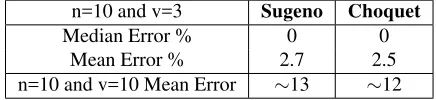
The results are summarized in the table 2.
n=10 and v=3 Sugeno Choquet
Median Error % 0 0
Mean Error % 2.7 2.5
[image:9.595.188.406.140.190.2]n=10 and v=10 Mean Error ∼13 ∼12
Table 2: Scalable multiclassification performance
We noted that combining the whole set of classifiers the mean error was more than 12%. With the selection proposed the mean error using Sugeno FI was 2.7% and 2.5% with Choquet FI, better than the best classifier and better than the combination of the complete ensemble.
5
Conclusions
We have presented a method to design compact multiclassifier systems when a large base of classifiers is given. As we could note, the improvement of overall accuracy can be done when more information is taken from classifiers. The joint decision making using fuzzy integral combination rules can be done under an appropriate selection of classifiers. In fact, an adaptive classifiers selection, to their error pattern, may provide a framework for solving a general scalability problem.
We have utilized a fixed size of classifiers subset. In further works, this value (v) could be opti-mised by means of cross-validation to each data set. Intuitively, we expect that highly compact and monolithic decision making systems, like the ones we are proposing, might exhibit less adaptation capabilities than those based on a completely distributed design. However, computational costs might be also higher.
Experimental results show that a given group of diverse classifiers can improve their individual performance and the global performance with a cautious splitting and selection.
Acknowledgements
This research was supported by Spain (TIC2001-2741) and Argentine (PICT /2003, project 15132).
References
[1] L. Breiman,Bagging predictors, Machine Learning24(1996), no. 2, 123–140.
[2] G. Brown, J. L. Wyatt, R. Harris, and X. Yao, Diversity creation methods: A survey and cate-gorisation, Information Fusion, Elsevier pub.6(1)(2005), 5–20.
[3] P. Bulacio, L. Magdalena, and E. Tapia,Scalable fuzzy multiclassifier system, Fourth Conference of the European Society for Fuzzy Logic and Technology and Eleventh Rencontres Francopho-nes sur la Logique Floue et ses Applications, In Press (2005), 1–6.
[5] G. Choquet,Theory of capacities, Annales de l’Institut Fourier5(1953), 131–295.
[6] Padraig Cunningham and John Carney, Diversity versus quality in classification ensembles based on feature selection, Machine Learning: ECML 2000, 11th European Conference on Machine Learning, Barcelona, Catalonia, Spain, May 31 - June 2, 2000, Proceedings, vol. 1810, Springer, Berlin, 2000, pp. 109–116.
[7] R.P.W. Duin, The combining classifier: to train or not to train?, Pattern Recognition, 2002. Proceedings. 16th International Conference on, vol. 2, 2002, pp. 765–770.
[8] Yoav Freund and R.E. Schapire, A decision-theoretic generalization of on-line learning and an application to boosting, European Conference on Computational Learning Theory, 1995, pp. 23–37.
[9] M. Grabisch, Fuzzy measures and integrals for decision making and pattern recognition, TATRA MOUNTAINS Mathematical Publications13(1997), 7–34.
[10] Tin Kam Ho,The random subspace method for constructing decision forests, IEEE Trans. Pat-tern Anal. Mach. Intell.20(1998), no. 8, 832–844.
[11] J.M. Keller and J. Osborn, Training the fuzzy integral, Int. J. Approx. Reasoning 15 (1996), no. 1, 1–24.
[12] Anders Krogh and Jesper Vedelsby, Neural network ensembles, cross validation, and active learning, Advances in Neural Information Processing Systems (G. Tesauro, D. Touretzky, and T. Leen, eds.), vol. 7, The MIT Press, 1995, pp. 231–238.
[13] L.I. Kuncheva, ‘fuzzy’ vs ‘non-fuzzy’ in combining classifiers: an experimental study, Proc LFA’01, Belgium, 2001, pp. 11–22.
[14] L.I. Kuncheva and C.J. Whitaker, Ten measures of diversity in classifier ensembles: limits for two classifiers, In Proc. IEE Workshop on Intelligent Sensor Processing, Birmingham, IEEE., 2001, pp. 10/1–10/6.
[15] F. Masulli and G. Valentini,Quantitative evaluation of dependence among outputs in ecoc clas-sifiers using mutual information based measures, Proceedings of the IJCNN’01, K. Marko and P. Webos (eds.), IEEE, Piscataway, NJ, USA2(2001).
[16] T. Murofushi and M. Sugeno,Fuzzy measures and integrals: Theory and applications, ch. Fuzzy Measures and Fuzzy Integrals, pp. 3–41, Physica-Verlag, 2000.
[17] N. C. Oza and K. Tumer,Input decimation ensembles: Decorrelation through dimensionality re-duction, In Proc. of the 2 nd International Workshop on Multiple Classifier Systems, Cambridge, UK (2001), 238–247.
[18] D. Partridge and W. B. Yates,Engineering multiversion neural-net systems, Neural Comput. 8
(1996), no. 4, 869–893.
[20] Y. Raviv and N. Intrator, Boostrapping with noise: An effective regularization technique, Con-nection Science, Special issue on Combining Estimators8(3-4)(1996), 355–372.
[21] A. Sharkey and N. Sharkey,Combining diverse neural net, The Knowledge Engineering Review
Vol 12, Issue 3(1997), 231–247.
[22] Amanda J. C. Sharkey, Noel E. Sharkey, Uwe Gerecke, and G. O. Chandroth, The “test and select” approach to ensemble combination, Lecture Notes in Computer Science 1857 (2000), 30–44.
[23] M. Sugeno,Theory of fuzzy integrals and its applications, Ph.D. thesis, Tokio Institute of Tech-nology, 1974.
[24] D. Wang, X. Wang, and J.M. Keller,Determining fuzzy integral densities using a genetic algo-rithm for pattern recognition, Fuzzy Information Processing Society (1997), 263–267.
[25] David H. Wolpert,Stacked generalization, Neural Networks5(1992), no. 2, 241–259.
[26] L. Xu, A. Krzyzak, and C. Y. Suen,Methods of combining multiple classifiers and their appli-cations to hand-written character recognition, IEEE trans. on Systems, Man and Cybernetics