Wireless Networks in industrial
environments: State of the art and Issues
Xavier Carcelle, Tuan Dang, Catherine Devic EDF Research&Development
6, quai Watier – BP 49 78401 Chatou Cedex, France
{xavier.carcelle, tuan.dang, catherine.devic}@edf.fr
Abstract. Wireless is everywhere nowadays and WLAN (i.e. 802.11 standard family) has became used by almost any communications devices in the mass market.
The recent achievements in the fields of modulation techniques, such as Spread Spectrum, coding methods, such as Turbocodes, CDMA2000, and frequencies allocation methods, such as OFDM and Frequency Hopping, has pushed the growing uses of reliable and low-cost wireless technologies. Among them the last standards are: IEEE 802.11 family (i.e. WiFi), HyperLAN and HyperLAN2, IEEE 802.15 (i.e. WPAN), IEEE 802.16 (i.e. WiMAX)…
However, the industrial environments are not taken into consideration in the design of those standards, because its harsh constraints has specific characteristics (reliability, interferences with existing equipments, multi-path propagation, low-power consumption, real-time reconfiguration, security…) that need specific requirements and eventually standards.
1 Introduction
The last past years have been intense in terms of development of wireless standards and wireless applications. Those applications are going from mass market domestic uses including Internet access to industrial usage in the field of wireless sensors networks, wireless interconnection between computer based control devices (DCS, PLC…) and industrial asset management based on pervasive networks indoor or outdoor.
These emerging wireless technologies can give benefits in cost-reduction, and reliability in industrial applications as well as opportunities in improving operational performance. But there is still work in progress to achieve usable technologies which meet industrial requirements. Firstly we will present an overview of the current and future wireless technologies from a standardization point of view. Secondly we will analyze the work to be done in the design and implementation in the industrial environments, such as in the utilities installations (power plants, sub-stations, factories). Finally we will present our current experimentations and future works within hybrid technology networking fields.
2 Overview of wireless communication technologies
2.1 Taxonomy and technical overview
Wireless networking technologies can be divided into three main classes (see Fig). Each class addresses specific requirements and purposes in point-to-point and point-to-multipoint communication.
WPAN addresses Personal Area Network in which most of the time, point-to-point communications are involved. However, point-to-point-to-multipoint-to-point communications are possible with wireless networks protocols such as PicoNET (based on Bluetooth) or ZigBee (based on IEEE 802.15.4b). The range performances are typically from 1 meter to a few dozens meters. The WPAN are designed for low data rate (usually 100-200 kbps). This family gather the following technologies: ZigBee, Bluetooth and UWB.
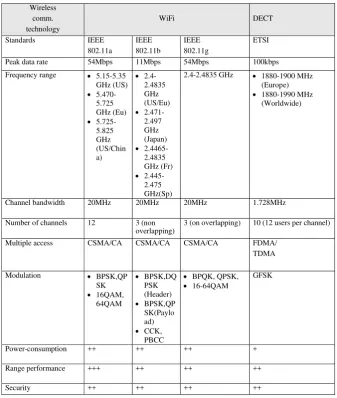
WLAN addresses Wireless Local Area Networks where the main uses are inter-connecting high data rate applications (Multimedia streaming, files sharing…), building easy-to-deploy HotSpot-like networks and lately Ad-Hoc enabled networks such as Mesh Networks. The range performances are typically from a few dozens meters indoor to a few hundred meters outdoor. The WLAN are designed for high data rate (usually 1 to 20 Mbps). This family is composed with WiFi and DECT..
Fig.1. Wireless technologies taxonomy
From a more technical point of view, wireless networks use a lot of underlying mobile communications technologies benefiting from digital signal transmission researches. The following tables present the technical characteristics of the different wireless standards with their respective frequencies and modulation issues. In term of frequency issues, the chapter III will cover the different regulations and the co-existence problems between each wireless technology. It intents to present a brief guideline that may help to make the right choice in industrial applications.
Most of digital transmission system uses advanced channel coding technique to prevent errors in the transmission and to correct them in
the receiver when they happen. Below (see
Fig) is an example [2] of the encoding method for OFDM:
Data input
Channel coding
[image:4.595.162.435.169.353.2]n-QAM or PSK Modulation
Fig.2. OFDM encoder
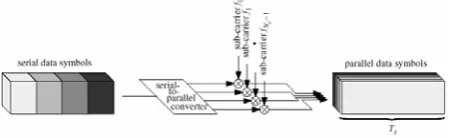
OFDM uses the principle of multi-carrier transmission technique that converts a serial high-rate data stream onto multiple parallel low-rate streams. Each sub-stream is modulated on another sub-carrier. Below is an example of multi-carrier modulation with four sub-channels [3].
[image:4.595.190.416.422.491.2]
Fig.3. Example of multi-carrier modulation
In Spread Spectrum communication, the baseband signal bandwidth is intentionally spread over a larger bandwidth by injecting a higher-frequency signal. So, energy used in transmitting the signal is spread over a wider bandwidth, and appears as noise. Different Spread Spectrum techniques use different manners of injecting Pseudo Noise sequence (code) to distribute the power of the baseband signal. Below is an illustration of Direct Sequence Spread Spectrum technique [4].
Fig.4. Typical DSSS circuit
Following the standardized OSI model for wireless protocols, the physical (PHY) and the medium access (MAC) layers can be seen as below:
Table 1.. PHY and MAC layers for wireless protocols
IEEE 802.3, IEEE 802.13, IEEE 802.15
MAC Multiple Access logic CSMA/CA Spreading, despreading, serial-to-parallel or serial-to-
parallel-to-serial…
Channel coding
or decoding
FEC (block coding, convolutional coding, Turbocode, …) PHY Modulation or Demodulation n-QAM or FSK or PSK… Narr owb a nd tec h niqu e: OFD M S p r e a d-spe c trum t ech ni q u e: FH SS , DS SS… Ch . mu ltipl e a cces s: CD MA , T D M A , FD M A
[image:5.595.131.469.317.556.2]Table 2. Comparison of different digital signal transmission techniques
Transmission
Technique
Advantages Drawbacks
FHSS (Bluetooth,
DECT)
• robust to interference
• strong with jamming
• limited data rate
• higher power consumption
DSSS (IEEE 802.11b,
ZigBee, GSM)
• support variable data rates
• resistance to multi-path
• resistant to narrow-band interferences
• sensitive to jamming
• limited number of same-cell access points
OFDM (IEEE 802.11g, IEEE 802.11a )
Resistance to
• link dispersion
• multi-path
• frequency interference
• burst noise
• higher power consumption
• higher CPU needs
In the following paragraphs, we will analyse the characteristics of each class of wireless networking technologies:
2.2 WPAN (Wireless Personal Area Networks)
Table 3. WPAN technologies Wireless comm. technology Blue tooth Ultra Wid e Ba n d ( H D R ) (O ffi ce s en
vironment) “Z
ig B ee” Ultra Wid e Band (I n d u strial en vironment)
IEEE Standards 802.15.1 802.15.3 (WG a) 802.15.4 (WG b)
802.15.4 (WG a)
Peak data rate 723.2 kbps 480 Mbps • 20 kbps (868 MHz) • 40 kbps (915
MHz) • 250 kbps (2.4
GHz)
1 Mbps
Frequency range 2402-2480 MHz 3.1-4.8 GHz • 2.4-2.4835 MHz • 902-928 MHz
(US) • 868.3 MHz
(Eu)
5.9-10.6 GHz
Channel bandwidth 1 MHz 1.368 GHz or 2.736 GHz or 528 MHz
5MHz 500MHz
Number of channels 79 2 or 13 1 (868 MHz) 10 (915 MHz) 16 (2.4 GHz)
- Multiple access TDMA or CDMA Ternary CDMA or TFI-OFDM CSMA/CA with FDMA and TDMA Impulse Radio Modulation GFSK
• BPSK/QPSK (DS-SS UWB) • QPSK(MB-OFDM) • BPSK (868/915 MHz) • OQPSK (2.4GHz) • TH-PPM • TH-A-PAM
Power-consumption +++ ++ + +
Range performance + + ++ +
Localization performance
++ +++ + +++
Security ++ +++ +++ +++
2.3 WLAN (Wireless Local Area Networks)
of the main features. DECT has been also extremely used in-the-homes and is now used in industrial environment for voice and data over the private phone system. For wide industrial environment, such as big factories, storage areas, docks or power plants, DECT might be a good to have a reliable, robust wireless private phone system but also add to this system data communications and emergency alarms using the worldwide ISM bands. The backbone linking the DECT base stations is usually wired.
Table 4. WLAN technologies
Wireless comm. technology
WiFi DECT
Standards IEEE 802.11a IEEE 802.11b IEEE 802.11g ETSI
Peak data rate 54Mbps 11Mbps 54Mbps 100kbps
Frequency range • 5.15-5.35 GHz (US) • 5.470-5.725 GHz (Eu) • 5.725-5.825 GHz (US/Chin a)
• 2.4-2.4835 GHz (US/Eu) • 2.471-2.497 GHz (Japan) • 2.4465-2.4835 GHz (Fr) •
2.445-2.475 GHz(Sp)
2.4-2.4835 GHz • 1880-1900 MHz (Europe) • 1880-1990 MHz
(Worldwide)
Channel bandwidth 20MHz 20MHz 20MHz 1.728MHz
Number of channels 12 3 (non overlapping)
3 (on overlapping) 10 (12 users per channel)
Multiple access CSMA/CA CSMA/CA CSMA/CA FDMA/ TDMA
Modulation • BPSK,QP SK • 16QAM,
64QAM • BPSK,DQ PSK (Header) • BPSK,QP SK(Paylo ad) • CCK, PBCC
• BPQK, QPSK, • 16-64QAM
GFSK
Power-consumption ++ ++ ++ +
Range performance +++ ++ ++ ++
2.4 WWAN (Wireless Wide Area Networks)
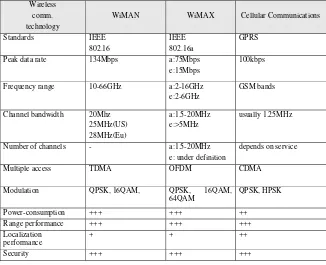
[image:9.595.136.462.294.559.2]WWAN technologies is used mainly for two applications nowadays is cellular phone communications and wide range IP-networks such as inter-cities point to point links. The WiMAN technology for instance is high-data rate with range performances up-to several kilometers and no mobility. Whereas the cellular communications for data transfer are usually low-to-fair data rate with complete mobility in the covered areas with GPRS services. From an industrial point of view, the two cases can be found as applications. A far remote power plant can be connected to the corporate backbone using a long-distance IP-based connection like a 802.16 link retrieving data from a sensors. Also a GPRS modem can help to regularly access a remote sensors or enabling a power plant staff to stay connected to the corporate backbone while off-site for a manual metering or a measurement task.
Table 5. WWAN technologies
Wireless comm. technology
WiMAN WiMAX Cellular Communications
Standards IEEE 802.16
IEEE 802.16a
GPRS
Peak data rate 134Mbps a:75Mbps e:15Mbps
100kbps
Frequency range 10-66GHz a:2-16GHz e:2-6GHz
GSM bands
Channel bandwidth 20Mhz 25MHz(US) 28MHz(Eu)
a:1.5-20MHz e:>5MHz
usually 1.25MHz
Number of channels - a:1.5-20MHz e: under definition
depends on service
Multiple access TDMA OFDM CDMA
Modulation QPSK, 16QAM, QPSK, 16QAM, 64QAM
QPSK, HPSK
Power-consumption +++ +++ ++
Range performance +++ +++ +++
Localization performance
+ + ++
3 Frequency regulations and co-existence issues
3.1Frequency regulations issues
These below tables present a brief overview of the different frequency regulations for the wireless technologies discussed in the previous chapter:
[image:10.595.134.478.255.397.2]3.1.1 WPAN
Table 6. WPAN frequency regulations
Region Bluetooth UWB (office environment)
ZigBee UWB (industrial environment) North America ISM
2.4 GHz
ISM ISM 2.4GHz, 916MHz
FCC 15.209 and FCC 2002
Europe ISM 2.4
GHz
ECC/DECC/(0 6)AA
ISM
2.4GHz, 868MHz
CEPT/ECC/TG3 -41dBm/MHz
Japan ISM 2.4 GHz -41dBm/MHz ISM 2.4GHz 868MHz
-41dBm/MHz
[image:10.595.131.475.427.483.2]3.1.2 WLAN
Table 7. WLAN frequency regulations
Region 802.11a 802.11b 802.11g DECT
North America
ISM ISM ISM ISM
Europe ISM ISM ISM ISM
Japan ISM ISM ISM ISM
3.1.3 WWAN
Table 8. WWAN frequency regulations
Region 802.16 802.16e Cellular North America Licenses Licenses Licenses
Europe Licenses Licenses Licenses
[image:10.595.135.474.528.576.2]3.2 Coexistence issues in the 2.4GHz
[image:11.595.137.435.187.263.2]The Steinbeis-Transfer Centre [5] has been testing the interference between ZigBee data communications (channel 11 to 26) and the other 2.4 GHz technologies. The below table summarizes the main results:
Table 9. Steinbeis-Transfer Centre coexistence tests
Technology Packet loss results
(IEEE 802.15 frames lost) WiFi
(802.11b/f=2437 MHz)
92% lost
Bluetooth 10 % lost
Microwave 1% lost
We can see both the 802.11b and the 802.15.4 are DSSS technologies that can interfere a lot between each other compared to other transmission technique in the same band.
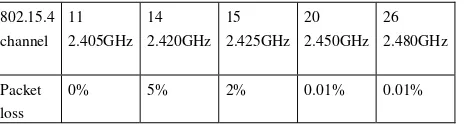
[image:11.595.136.370.381.443.2]Another test of coexistence has been led by the company Crossbow [6] measuring the perturbations of a data communications system with ZigBee technology receiving interferences from Wi-Fi radio frequencies using the 802.11b technology and namely the channel 3 at the frequency of 2.422MHz:
Table 10. Crossbow coexistence tests
802.15.4 channel
11 2.405GHz
14 2.420GHz
15 2.425GHz
20 2.450GHz
26 2.480GHz
Packet loss
0% 5% 2% 0.01% 0.01%
The results show that the nearest is affected by quite an important packet loss that can affect the reliability of a data communications system. This implies the best trade-off between the transmission method chosen and the frequency channel used.
4 What needs to be done to implement industrial wireless
solutions?
4.1 The environment
The industrial environments present some specific issues and requirements. For example, the I&C domain concerns instrumentation, supervisory and control of the processes. I&C focuses mainly on three levels that can be represented as below:
Table 11. Typical I&C architecture
Level 2
[image:11.595.133.362.596.677.2]Level 1 PLC (Programmable Logic Controller)
Level 0
Sensors Actuators
This functional architecture has several level-to-level interfaces requirements that need to be achieved by the communications network. These requirements are:
Level 0 to level 1: real-time control (persistent stable duplex communications links), deterministic data transfer (robustness of the LLC stack), short ranges communications, always-connected, lower data rate communications.
Level 1 to level 2: wide range communications, hybrid-type physical medium, not-always connected, higher data rate communications, possible data aggregation.
4.2 The benefits from going wireless
The benefits one can expect from going wireless for a sensor network in the I&C domain can be listed:
cables cost reduction
mobile points of acquisition
self-healing communications architecture
low-power consumption
adaptable topology (star, tree, mesh)
ad-hoc communications
harsh wiring conditions and difficult environment
[image:12.595.134.358.99.214.2] hand-over between WPAN cells and between WPAN and WLAN architecture (typical uses of wireless networks are shown in in the E.D.F. – Electricité De France - environment)
4.3 What needs to be done?
These benefits can be obtained if the following challenges are fulfilled:
Electro-Magnetic Compatibility satisfied despite persistent EMI (Electro Magnetic Interference) from electric welding/motors, transformers, lightning, switches, ovens, mid and high-voltage lines…
Possible interference from same-band RF devices turned on accidentally or maliciously
Worse large scale path-loss
Worse fading (multipart)
Optimised radio cell distribution
Advanced networks protocols
[image:13.595.136.465.336.517.2]The following table proposes some suggested solutions and optimizations:
Table 12. Suggested solutions and optimizations
Challenges Solutions Optimizations 1 EMI FHSS, retransmission,
UWB
Notches, wide band protocols
2 Same-band RF devices
OFDM, CSMA Random retransmission
3 Path-loss DSSS, MIMO Multiple antennas 4 Fading Repeaters, smart
antennas
Power regulations
5 Radio cell RF expertise, hybrid fixed and mobile bas stations
Radio environment modeling tool
6 Network protocols Proactive and On-demand routing protocol
Energy oriented adaptative protocol, payload balance between nodes
5 The right solutions for the right applications
Once we have gathered all these requirements and technical characteristics of the wireless technologies, one is ready to start designing the right solutions for the right applications. For instance, none technology is perfectly matching the needs of the applications and being aware of the bottlenecks of each one helps the network architect to deploy the optimized solution.
At E.D.F., we have different applications cases of wireless networks in an industrial environment such as:
wireless tele-dosimetry
telecontrol of far-remote power plant sites
geo-localization of biohazard products
The typical applications requirements in the I&C domain can be summarized into these tables:
[image:14.595.136.365.326.451.2]5.1 Control applications
Table 13. Controls applications Vs wireless solutions
Constraints
Range
Real-time Yes Harsh RF Yes Battery life No Mobility No Data rate No Ad-hoc No Security Yes
WPAN WLAN WWAN
(rarely)
5.2 Measure applications
Table 14. Measures applications Vs wireless solutions
Constraints
Range
Real-time No Harsh RF Yes Battery life Yes Mobility Yes Data rate
No
WPAN WLAN WPAN
Short-to-mid range non-beacon WiFi
GPRS
802.16
Bluetooth ZigBee
802.11b
GPRS
802.11g
[image:14.595.134.369.516.649.2]Yes
Ad-hoc Yes Security Yes
Sometimes, we are able to find complete wireless solutions for controls or measures applications. For instance, the EDF R&D EMC laboratory specifies that wireless can interfere with old analog electronic boards.
To overcome such a barrier, we need to hybrid the technologies combining wireless and wired solutions. Concerning the wired solutions, PLC (Power Line Communications) networks can also reduce the cable cost and achieve the needed network requirements by using standardized interfaces.
5.3 Hybrid networks: wireless and power line networks
In the past years, PLC (Power Line Communications) technologies have reached a level of maturity in terms of data rate, standardization, inter-operability with the generalization of IEEE 802.3 standard and security.
That maturity allows its use in the industrial environments, such as power plants and sub-stations, by implementing the last developments in PLC networks.
[image:15.595.136.372.103.167.2]Nowadays PLC Networks technologies can be described by several industrial standard-like:
Table 15. PLC Technologies
Data rate
PLC technology
Low X10 LonWorks CEBus
Homeplug Control and Command (2006) High Homeplug 1.0, AV
DS2 Spidcom
Besides this list of PLC technologies, we don’t look after using Homeplug BPL for industrial applications.
Finally, the cutting-edge industrial networks equipment could be a mix between:
Zigbee and Homeplug Command and Control
802.11 and Homeplug AV
UWB and Homeplug Command and Control
6 Conclusion and future works
The general feedback from our experimentation and test cases in utilities industrial environment is as follows:
For Process Controls applications, IEEE-802.11 family standard needs to be implemented/deployed in one hand with WIPS (Wireless Intrusion Prevention System) and WIDS (Wireless Intrusion Detection System), and in the other hand with non-beacon transmission mode to reduce latency. Moreover, interference with existing analog electronic control devices is a real issue that needs to be carefully detected before any deployment. Thus, we believe that an hybrid communication architecture combining Power Line Communication technology with the IEEE-802.11 family represents a cost-effective and interesting alternative.
For Wireless Measures applications, WPAN technologies like Zigbee and UWB are the technologies of choice as a lot of researches have been done in the area of power consumption optimisation control routing protocol [7]. Of course, careful wireless sensor network design is particularly important in terms of power conservative performance. This is an area we continue to investigate in terms of network modelling, design and deployment engineering tools that must take into account the industrial installations characteristics.
References
[1] Institute of Electrical and Electronics Engineers. IEEE Standard Computer Dictionary: A Compilation of IEEE Standard Computer Glossaries. New York, NY: 1990.
[2] http://www.wikipedia.org/WIKI/ofdm.
[3] K. Fazel and S. Kaiser, “Multi-Carrier and Spread Spectrum Systems”, Wiley Editor, 2003.
[4] J. Meel's (De Nayer Institute), “SS Introduction”, October 1999. [5] http://www.ba-loerrach.de/stzedn
[6] http://www.xbow.com/Products/Product_pdf_files/Wireless_pdf/ZigBeeandWiFiInterfere nce.pdf
[7] Ya Xu, John Hedeimann, Deborah Estrin, “Adaptive Energy-Conserving Routing for Multihop Ad hoc Networks”, USC/ISI Research report 527, October 2000.
[8] J. Karedal et al, “Statistical Analysis of the UWB Channel in an Industrial Environment”, IEEE Vehicular Technology Conference, pp. 81-85, December 2004
[9] M. Andersson, “IEEE 802.11b and Bluetooth in an Industrial Environment”, connectBlue AB, May 2001.