140
ÁGORA PARA LA EF Y EL DEPORTE|
AGORA FOR PE AND SPORT Nº14 (2) mayo – agosto 2012, 140-160 |E-ISSN:1989-7200
re
cib
id
ac
ep
ta
APPLICATION OF HELISSON’S RESPONSIBILITY MODEL IN SOUTH KOREA: A
MULTIPLE CASE STUDY OF ‘AT-RISK’ MIDDLE SCHOOL STUDENTS IN PHYSICAL
EDUCATION
APLICACION DEL MODELO DE ENSEÑANZA DE LA RESPONSABILIDAD DE HELLISON EN COREA DEL SUR: UN
ESTUDIO DE CASOS MÚLTIPLE CON ALUMNOS “EN RIESGO” EN LAS CLASES DE EF DE ENSEÑANZA MEDIA
Jinhong
JUNG
(Northern Illinois University - USA)
1Paul
WRIGHT
(Northern Illinois University - USA)
ABSTRACT
Hellison’s Teaching Personal and Social Responsibility (TPSR) model was developed in the United States
but has been applied in many different countries. However, its application in East Asian cultural
contexts has not been sufficiently examined. The current study describes and interprets the cultural
translation of this value-based instructional model in the physical education program of a South Korean
middle school. A multiple case study design was used to examine the relevance and impact of TPSR
through the experiences and perceptions of six purposefully selected students who had been identified
as at risk of school failure. Multiple data sources indicate that a 20-lesson TPSR unit was well-received
by the students and contributed to numerous positive behavior changes. The core goals and life skills
associated with TPSR appeared relevant and acceptable to case study participants, however, the
concept of self-direction emerged as more challenging for them to understand and enact. This may
relate to differences in cultural schemas and educational norms. Such issues, as well as implications for
research and practice, are discussed. The current study expands the TPSR literature by being one of the
first to examine and make a case for the implementation of TPSR in an East Asian country.
RESUMEN
El modelo de Enseñanza de la Responsabilidad Personal y Social (TPSR) de Hellison fue desarrollado en
los Estados Unidos de América pero se ha aplicado en muchos otros países. Sin embargo, su aplicación
en contextos culturales de Asia oriental no ha sido suficientemente examinada. El presente estudio
describe a interpreta la traducción cultural de dicho modelo de instrucción basado en valores dentro de
un programa de EF en un centro de enseñanza media de Corea del Sur. Se escogió un diseño de estudio
de casos multiple para examinar la relevancia y el impacto del TPSR a través de las experiencias y
percepciones de seis alumnos, escogidos a propósito, que habían sido identificados como ‘en riesgo de
fracaso académico’.
Múltiples fuentes de datos indican que el programa TPSR de 20 lecciones fue bien
recibido por los alumnos y que contribuyó a numerosos cambios positivos de su comportamiento. Los
participantes consideraron relevantes los objetivos centrales y las habilidades para la vida social
asociadas al TPSR; sin embargo, el concepto de auto-direccion emergió como el más difícil de entender y
llevar a cabo
.
Esto puede deberse a las diferencias relativas a los esquemas culturales y a las normas
educativas. Se dicuten aquí estas cuestiones, así como sus implicaciones para la investigación y la
práctica. Este estudio, al ser el primero que examina y propone la aplicación de TPSR en un país de Asia
oriental, amplia la literatura sobre dicho modelo.
KEYWORDS. Personal and social responsibility; Confucian tradition; moral philosophy; culture; cultural translation.
PALABRAS CLAVE. Responsabilidad personal y social; tradición confuciana; filosofía moral; cultura; traducción cultural.
1. INTRODUCTION
During soccer practice in a PE class, Jang intercepts the ball Lee is dribbling. When Lee gets intercepted, he angrily says, “Hey, Jang! Come on! Why did you steal my ball?” He punches Jang’s stomach hard and dribbles the ball away from Jang curling up on the ground in pain.
(Field note from a physical education class in a South Korean middle school)
value-based model in the PE program of a South Korean middle school and considers its relevance for at risk students.
Teaching Personal and Social Responsibility
TPSR was developed by Hellison primarily through his work with troubled youth who had been identified as at risk of dropping out of school and engaging in a host of risky behaviors such as drug abuse and criminal activity (Hellison, 2011). The model was shaped by a democratic and student-centered approach, Hellison’s personal values, and his sense of his students’ developmental needs (Hellison, 1995, 2003, 2011). The model uses sport and physical activity as a vehicle to promote human decency, empower youth, and teach life skills that can be applied or transferred to other contexts (Hellison, 2011). The goals for students are organized into five levels. The first four of these levels can be practiced in the physical activity program and fall under two different constructs, personal and social responsibility (Li, Wright, Rukavina, & Pickering, 2008). Social responsibility goals include respecting the rights and feelings of others (Level 1) and caring (Level 4). Life skills and behaviors associated with these social responsibilities include controlling ones temper, including others, resolving conflicts peacefully, helping others, and teaching others. Personal responsibility goals include self-motivation (Level 2) and self-direction (Level 3). Life skills and behaviors associated with these personal responsibilities include giving good effort, persisting with difficult tasks, setting goals, and working independently. Level 5 in the TPSR model is transfer, i.e. the application of the responsibility goals and life skills practiced in the program to other contexts such as home or other classes.
broader PE curriculum (Escartí, Pascual & Gutiérrez, 2005; Escartí, Gutiérrez, Pascual, Marín, Martínez-Taboada & Chacón 2006; Escartí, Gutiérrez, Pascual & Llopis, 2010a; Escartí, Gutiérrez, Pascual & Marín,2010b).
Cultural Differences and the South Korean Educational Context
While the application of TPSR in the Western countries noted above has required varying degrees of cultural and linguistic translation, many of their dominant cultural values have similar roots, e.g. Christianity and the moral philosophies of ancient Greece and the European Renaissance. The deep roots of East Asian culture, however, have distinct and fundamentally different origins. For example, throughout much of East Asia, Confucianism still represents the dominant framework for moral philosophy and provides explicit definitions of concepts such as respect, honor, and filial piety (Hsueh, Zhou, Cohen, Hundley & Deptula, 2005; Yang & Rosenblatt, 2008). Proper and appropriate behavior in the Confucian tradition is determined in large part by one’s role in hierarchical relationships, i.e. parent-child or teacher-student. Confucianism and long-held beliefs about the value of obedience, learning through repetition, and rote-memorization can still be seen in the educational practices of many East Asian countries including South Korea. According to Shin and Koh (2007), “The core of Confucianism is characterized by its hierarchical human relationships. Thus, educational thoughts and philosophies have naturally reflected in this hierarchical or patriarchal Korean society. Accordingly, teachers’ authority is viewed as an undeniable premise by most Korean students” (p. 305). Other recent studies have indicated that despite attempts at educational reform, both teachers and students in South Korea struggle to break from the habits of content-centered teaching and passive learning (Campbell, Oh, Shin, & Zhang, 2010; McGuire, 2007).
PE in South Korea is guided by the Korean National Curriculum in Physical Education. The latest revision of this curriculum was in 1997 and a major thrust of that revision was to move in the direction of other educational reform efforts, that is, to move away from an entirely top down approach (Yoo & Kim, 2005). However, several reports suggest this change is largely unrealized in practice (Kim & Taggart, 2004; Yoo & Kim, 2005; Yu & Kim, 2010). This seems especially true in urban schools. In a study of the culture of PE in an urban elementary school, Kim and Taggart (2004) noted high levels of student disengagement and reported that many teachers even seemed disengaged with the subject matter and lacked pedagogical knowledge. Yu and Kim (2010) investigated PE programs in elementary, middle, and high schools in Seoul and reported similar findings. Regarding the very traditional role of PE teachers, they stated, “Moreover, teachers were typically viewed as authority figures in Korean physical education classes. The role of the teachers was to command, and the student’s role was to obey respectfully, with corporal punishment frequently used as an effective means of discipline. This traditional value is deeply rooted in Korea’s Confucian culture” (p.31).
& Koh, 2007, 2008). As explained earlier, these problems appear heightened in PE. Although issues related to student disengagement and problematic behavior are noted in the literature, there is a gap regarding attempts to meet the needs of “at risk” students in South Korean PE programs. For all these reasons, an instructional model offering a positive, student-centered approach to behavior management appears relevant and worth exploration in this context. However, the stark contrast between the teaching philosophy and practices of TPSR with the traditional and deeply entrenched approach may make it difficult to apply this alternative curriculum model effectively in South Korean PE. Therefore, the purpose of the current study is to describe and interpret the cultural translation of TPSR in the PE program of a South Korean middle school and consider its relevance for at risk students.
2. METHODS
This study represents a new analysis of data from an action-research project conducted by the first author, Jin, several years ago. The project involved the implementation of a 20-lesson TPSR-based PE unit delivered in a public middle school in Seoul, South Korea, where Jin was a teacher at the time. A qualitative case study design was employed (Merriam, 1998). Qualitative research methods are well-suited for examining cultural issues and also for providing thick descriptions of programs. Case study designs, in particular, are recommended when the intent of a program evaluation is to understand the relevance and potential benefits of a program for individual participants (Patton, 2002). Such methods have proven useful in previous TPSR studies (Martinek, Schilling & Hellison, 2006; Wright, White & Gaebler-Spira, 2004).
Setting
According to the US Department of State (2011):
Korea's population is one of the most ethnically and linguistically homogenous in the world. Except for a small Chinese community (about 20,000), virtually all Koreans share a common cultural and linguistic heritage. With 48.7 million people inhabiting an area roughly the size of Indiana, South Korea has one of the world's highest population densities.
The same source reports that Seoul, South Korea’s capital, has a population of approximately 10.5 million. While the country’s public education system has extremely high retention rates overall (99% for middle school and 95% for high school) and contributes to an impressive literacy rate (98%) nationally, schools in many neighborhoods of Seoul increasingly have problems associated with high population density, high concentrations of poverty, and increases in juvenile delinquency (Shin & Koh, 2007, 2008). The middle school where this TPSR program was delivered is a mid-size school in Seoul with 900 students in the 7th to 9th grades. All students in the school were
Participants
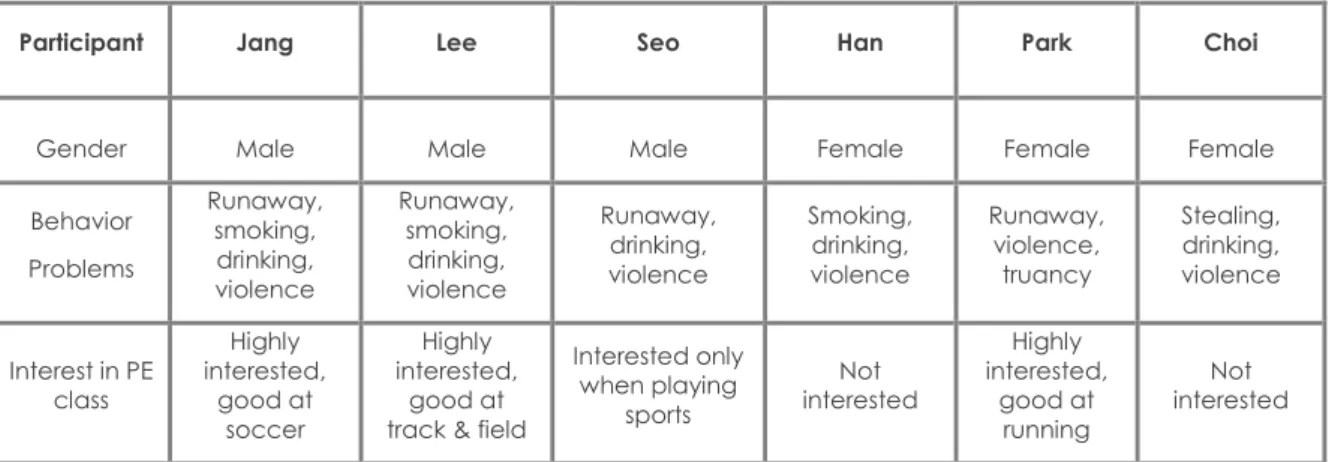
The participants of the study were six 8th grade students (3 males; 3 females). The
participants were all 14 years old at the time of the study. They were purposefully sampled because of frequent problematic behaviors that placed them at risk of academic failure. All six students had frequent conflicts with their peers and were considered by multiple teachers to be problematic. For example, all six participants had engaged in the following behaviors: a) swearing and insulting others, b) using violence, c) bullying, and d) exploitation. Table 1 displays additional information about the individual participants in terms of specific problematic behaviors and their level of interest in PE prior to the study.
Table 1. Individual Participant Information
Participant Jang Lee Seo Han Park Choi
Gender Male Male Male Female Female Female
Behavior Problems Runaway, smoking, drinking, violence Runaway, smoking, drinking, violence Runaway, drinking, violence Smoking, drinking, violence Runaway, violence, truancy Stealing, drinking, violence
Interest in PE class Highly interested, good at soccer Highly interested, good at track & field
Interested only when playing sports Not interested Highly interested, good at running Not interested
Implementation of the TPSR
Lesson plans for 20 class periods (50 minutes for each class) were developed based on the TPSR model but also aligned to the Korean National Curriculum in Physical Education. Major subject matter content included basketball, handball, gymnastics, fitness, vaulting, and free game play. Preliminary lesson plans were developed by the first author, Jin, who was a PE teacher and graduate student at the time, and modified through consultation with three faculty members at a South Korean university who were knowledgeable about the TPSR model. The content of the 20 lesson plans are summarized in the Appendix. These 20 lessons were implemented by Jin for a semester to four 8th grade regular PE classes. The four classes consisted of 160 students, about 40
leadership, student choice in the curriculum, were integrated at strategic points throughout the unit and used to emphasize certain responsibility goals and life skills. In the years since Jin conducted his original action research project, there has been an increased focus on the need to address fidelity in TPSR studies (Pascual, Escartí, Llopis, Gutiérrez, Marín, & Wright, 2011; Wright, 2009; Wright & Craig, 2011). Jin did interpret and adapt the TPSR model to fit his own teaching style, his students’ needs and interests, as well as his cultural context and the external expectations placed on him by the national curriculum. However, Hellison (2003, 2011) encourages teachers to do this, i.e. to make the model “their own”. For example, although Hellison does not present the responsibility levels in a step-by-step progression, he does acknowledge that for teachers who are fairly new to the model, this is one acceptable approach (Hellison, 2003). Moreover, this step-by-step progression has been used in other adaptations of the model with relative success (Pascual et al., 2011). Based on our secondary analysis of the data from the project the case for fidelity rests partly with Jin’s understanding of the model and partly with the specific structures and strategies he employed.
As noted above, Jin was advised in this project by three faculty members who were all familiar with TPSR. Prior to conducting his action research project, Jin read all available materials on the model and even translated the 2003 version of Hellison’s text into Korean. At the same time was studying and reflecting on the TPSR approach, he was exploring its application in his teaching, experimenting with new structures such as peer leadership and goal setting activities one at a time. Hence, by the time Jin designed and implemented the unit described here, he had developed a solid understanding of the underlying assumptions and key themes of the model. As noted earlier, Jin built his unit around the core responsibility levels, used lesson format strategies such as awareness talks and reflection time, and employed a number of empowerment based teaching strategies such as goal-setting and peer teaching. The lack of focus on Level 5: Transfer, represents the largest limitation in terms of fidelity. Nonetheless, the application of so many fundamental TPSR components, delivered by a reflective practitioner committed to sharing responsibility with his students, make a solid case for fidelity to the original model even if the program itself was adapted in some ways. It should be remembered that the TPSR unit described here was delivered by Jin to all his students at the time. Data collection was focused on the case study participants and their experience in this unit, but the implementation of the model, participation in discussions of responsibility, etc., was not restricted to them.
Data Collection
were individually interviewed in depth using semi-structured interview questions three times after school, at the beginning, mid-point, and the end of the semester. Those in-depth interviews lasted 30 minutes on average and probed more deeply on specific examples and topics of interest emerging from Jin’s ongoing observations as well as the individual participants’ responses to previous interviews. Therefore, the content and focus of these interviews varied. Jin was careful throughout the study to be discrete about his focus on the individual case study participants and to make sure the additional attention they received did not distract him from his teaching in general or create divisions between case study participants and their peers. All interviews were audio-taped and transcribed verbatim for analysis.
Field notes for all 20 lessons were recorded by Jin from the perspective of a participant-observer. His objective was to document and understand what was going on in the setting with a particular focus on the six case study participants (Merriam, 1998). Jin wrote these observational field notes in detail in a laptop computer immediately following each observation/lesson. Documents such as the Jin’s unit and lesson plans were retained as well as student self-assessment sheets, reflection papers, contracts, and work sheets collected from the six case study participants.
It should be noted that all original data sources and transcriptions were in Korean and later translated into English. Due to fundamental differences in the structure of these languages, some nuances are lost in the translation process. Because Jin is fluent in Korean and English and also served as the teacher-researcher in the study, we are confident in the integrity of the translated data in terms of meaning and substance. However, we are cognizant that some level of authenticity is lost when quotes from participants, especially youth, are translated culturally and linguistically.
Data Analysis
Given the purpose of the study, the first four levels of Hellison’s (2011) model were used as analytic framework that guided initial coding, categorizations, and thematizing. The interview transcripts, observation notes, and documents were read multiple times and individual units of meaning were coded based on their correspondence to the four levels. More specifically, for each level, all data that had a meaningful connection to the level were organized over time and then open-coded (Glaser & Strauss, 1967) focusing on the six students’ experience with and response to the TPSR lessons. The codes were then grouped into categories by constantly comparing properties across codes within a level and across the levels. Next, all emerging categories were described in terms of properties and dimensions (Glaser & Strauss, 1967) and those categories were contrasted and compared to identify emerging themes.
teacher-researcher in this study and his tacit knowledge of the program was crucial to the analysis. On the contrary, Paul, the second author, was not present when the TPSR unit was implemented so his more removed perspective added a layer of objectivity to the analysis. Jin, who now resides in the US is a native South Korean and was therefore a cultural insider. Paul is a cultural outsider to the South Korean context. However, as an American and protégé of Don Hellison, Paul was able to contribute a deep understanding of the TPSR model and its roots. Together, the two of us were able to bring complimentary experiences and cultural perspectives to the analysis which was essential for a balanced study of this cultural translation of TPSR to the South Korean context.
3. RESULTS
As the TPSR model was implemented, all six case study participants showed positive changes relative to the core personal and social responsibility levels, even though the degree of change was different for individual students. Also, these changes occurred over time and were not dramatic but gradual. What follows is a detailed description of the ways the students responded to and changed with respect to the various levels.
Level One: Respecting the rights and feelings of others
As documented in unit and lesson plans, the first five lessons of the TPSR unit focused on respect (Level One). During those lessons, all his students were provided opportunities to understand and experience the value of respecting the rights and feelings of others through awareness talks, all-touch basketball games, and self-reflection. The instructor, Jin, introduced Level One to students in awareness talks using specific examples. He also reinforced the value of respect during the physical activities and related it to the students’ experiences that day when guiding students through self-reflection time at the end of the lessons. When Level One was first introduced, “Students seemed to be confused because the content and structure of the class was different from typical PE classes they used to have” (Jin’s Field Notes). However, as students in all his classes had learning experiences focusing on Level One with the instructor’s facilitation and reinforcement, they became more familiar with the language and expected behaviors. With time, the case study participants demonstrated significant development in understanding the concept of respect as it was framed in the TPSR lessons. One participant captured this in his written reflections after a lesson:
When we played basketball, Misook missed the ball all the time. Her catching looked weird. I really felt like teasing her, but held it back. We just learned respect and I remembered what the teacher said about it. Making fun of others’ bad performance is bad because we all are different. (Han’s Reflection Journal)
pebbles at the kids in front of me. But then Level One came to my mind and I didn’t do it”. Another example was recorded in Jin’s field notes. Jin observed that Park often teased a particular boy in her class, calling him “Gorilla” at the beginning of the semester. However, as the concept of respect was repeatedly emphasized through various Level One teaching strategies, she came to stop teasing the boy. In his field notes, Jin described an informal conversation with Park in which they discussed this change. She had told Jin, “I realized making fun of someone’s appearance is not alright to do because my appearance could be different from others’ and if someone teased me about the way I look, it would hurt my feelings so bad” (Jin’s Field Notes). By the end of the TPSR unit, Jin stated in his field notes that all six case study participants were misbehaving less frequently than they did prior to implementation of the model. He noted, “They became more patient, self-controlled, and accepting and more likely to look for a peaceful resolution to a conflict”. For example, at the beginning of the semester, when Jang was practicing soccer with other students, he used to insult students whose skills were not as good as his. However, as the semester proceeded, he showed more respect for others. When interviewed after a soccer game, he said:
When I got hit by the ball Zaehee kicked, I wanted to hit him, but I fought the urge. He looked scared when he told me “sorry.” and I said, “It’s okay.” Zaehee isn’t good at soccer but he is good at piano. Now I know everybody is different and everybody can be talented in different things. I am glad I didn’t hit him.
Although the participants exhibited positive changes in terms of respect and self-control, a concern was voiced regarding the way this approach reduced some of the traditional focus on psychomotor development. For example, after participating in the all-touch basketball game, Seo reported that the game did not help him to develop his shooting skills. He said:
The teacher said I had to pass to all kids before I shoot, so I didn’t shoot as much as I could. At the end, I was just standing around waiting for pass. I feel like my basketball skills even got worse. Also, our class time was used for the explanation of the levels. I wish we just played sports.
Unit and lesson plans, as well as Jin’s field notes, indicate that a portion of each lesson was allotted for teaching the TPSR levels that previously probably would have been spent working on sport skills and drills or fitness activities. In this regard, the relative amount of time devoted to affective development was greater during this PE unit than what most of the students were used to.
Level 2: Self-motivation
self-reflection time, group meetings, and the use of different stations to promote student participation and effort. As the implementation of Level Two proceeded, it became evident to Jin that all his students, including the case study participants, came to be more aware of the value of “effort” and “hard work.” This was confirmed by some of the case study participants’ own words. For example, Seo wrote in his reflection journal, “Today was too hot so I didn’t want to move at all. But I remembered the goal of Level Two, effort, and I tried to do my best.” Han also said in an interview after a class on handball, “I think, today, I worked on the stuff as hard as I could. I don’t like physical activities much so I didn’t want to participate. But I tried to practice skills as much as I could, thinking about what you [Jin] said about effort at the beginning of the class”. The participants’ increased awareness of effort was often reflected in their active participation in class activities and voluntary practice outside of the classroom. For instance, over the course of the unit, Lee came to more actively participate in tasks and physical activities in class and even to look for additional challenges. This is explained in the following excerpt from a reflection paper he wrote:
At the beginning, I always gave up in the middle of everything. But now I found myself doing my best in everything. Whenever my friends say, “You worked so hard,” I feel really proud. I never put in this much effort before and I feel good about myself. I don’t care about my grade because I tried my best up to the end. I feel good about myself for completing all the hard work and being patient.
This statement suggests that his understanding of the value of effort not only inspired him to do best but also contributed to a positive self-image.
Besides the participants’ increased awareness of effort and participation, some associated improvement in psychomotor skills with participating in the TPSR model. In particular, they commonly attributed their skill improvement to their increased effort and patience. Lee said:
I was not good at the pommel horse but our team decided to include it in our creative gymnastics. I didn’t like it but I thought I should follow because most of my team mates liked the idea. I practiced a lot by myself for the sake of our team and I think my skill improved a lot.
The participant, Seo, who complained about his decreased involvement in physical activities due to the implementation of the model at Level One, came to more actively participate in class activities based on his heightened awareness of respect and effort. When interviewed about a creative sport project, he said:
than the regular kind of game. After the game, I got all sweaty but it felt good.
This quote also highlights the gradual nature of the improvements observed in this unit. Interestingly, the positive impact on psychomotor skills observed in the other participants was not evident in Choi. She possessed a passive personality and repeatedly said that she was not interested in physical activities. She appeared to develop negative attitudes toward PE classes when presented with tasks that required everybody’s participation, mainly in the lessons focused on Level Two. Also during team projects that highlighted Levels Three and Four, she minimally participated and tried to minimize her responsibility. This tendency is in contrast to the behaviors of Jang and Lee. Both Jang and Lee were highly interested in PE and competitive at physical activities which motivated them to actively participate in the given tasks. Their participation, in turn, facilitated their psychomotor skill development. This was one of several examples suggesting that individual students need different amount of time to move from one level to the next according to their different characteristics, needs, and interests. However, due to the large class sizes, pressures to adhere to the national curriculum, and Jin’s level of experience with the model at the time, students did not receive greatly differentiated instruction.
Level 3: Self-Direction
During Level Three time, students in all Jin’s classes were given opportunities to set up their own learning goals, make personal plans including their own fitness routines, and carry out their planned learning activities independently without the teacher’s direct supervision. Level Three lessons centered on the topics of gymnastics and free games. Specific strategies utilized to help students develop responsible and self-directed behaviors included teacher-student contract, self-assessment, self-reflection, and giving choice for independent work.
Unlike the experience with Level One and Level Two, the case study participants often had difficulty understanding self-direction. Jin wrote in his field notes, “They sometimes limited the concept of self-responsibility to role responsibility”. In other words, they perceived responsibility mostly as playing roles expected by others in given classroom settings. They rarely conceptualized responsibility as self-directed responsibility. In an interview, Jang said, “My friends voted to make me team leader and they expect me to do my best. I don’t want to disappoint them so I’m very concerned about if I am capable to fulfill my responsibility”. Jin reflected in his field notes that the concept of self-directed responsibility seemed “abstract” and more difficult for the participants to understand.
as contributing to the development of positive self-image (Jin’s Field Notes). The following excerpt from the interview with Han captures this:
I wasn’t that responsible of a person. When I had to create dance moves by myself, I was nervous and stressed and I didn’t want to do it. However, as I worked on it, I started to enjoy the process. It was fun to create dance moves only for myself; not for anybody else. Since it‘s for me, I need to take responsibility. I know myself most so nobody can do it for me. I’m very proud of myself because I didn’t think I could do this good of a job.
However, one student, Choi, expressed her discomfort for being self-directed, saying:
I don’t like this dance project because I’ve got to decide everything by myself and I’m responsible for everything. Even though the teacher said we could help each other, everything is my responsibility - I have to make a plan, create moves and practice them. I want the teacher tell me what to do, like other teachers.
A similar sentiment came through in Park’s reflection, she stated, “I don’t understand why the teacher wants us not to practice, but to create a dance. I didn’t know what to do, so I just chatted with my friend, pretending we were talking about our dance moves”. Again, Jin observed that the participants often had difficulty understanding the value of responsibility associated with self-directed learning as it was a different learning mode than they generally experienced. He noted there seemed to be more cultural barriers involved in translating the concept of self-direction as compared to respect, effort, or participation.
Level Four: Caring
Level Four lessons were designed to provide opportunities for all the students in Jin’s classes to cooperate, support, and care about each other to extend their understanding of responsibility beyond themselves. The physical activity topics of Level Four lessons were fitness and free games. The instructor had students participate in group projects more than individual work during this stage.
As the semester was approaching the end when Level 4 was implemented, Jin noted that the case study participants had already started exhibiting caring behaviors. For instance, they cooperated and participated in group work more actively than they had at the beginning of the semester. This change is reflected in one of Choi’s interviews:
Jin also noted, “Their participation in group work seemed better due to their increased respect for others and awareness of the importance of cooperation”. For example, earlier in the semester, Park tried to avoid making contributions to group projects. Jin observed that Park used to passively do the part assigned to her with minimum effort. Accordingly, her classmates did not like having her in their group. However, through class activities emphasizing cooperation, she came to realize the value of cooperation and respect other students. When interviewed after her group presentation of a warm-up program, she said:
I think our presentation went very well because all of us worked hard. When we created this warm-up program, I suggested a few ideas and I felt like they listened to me and took my ideas seriously. I was really happy because they seemed to respect me. This was kind of new for me and I thought I should listen to others too. I practiced hard even though sometimes I didn’t want to, because I knew the others also practiced hard for our group presentation. I didn’t want to ruin our presentation. If we didn’t cooperate, we couldn’t have done the presentation this good.
The students also came to consider the needs and feelings of others and contributed to the class on their own initiative in many ways. For example, Jin had noted that after a class using hula hoops, Seo came to him and asked if he could get a roll of duct tape. Seo had seen some hula hoops’ connecting parts were loose and he wanted to secure them with duct tape. In his journal, Seo reflected on this event as follows:
I wrapped loose parts of the hula hoops with duct tape. It was hard but I feel really great about doing it because the other students could use better hula hoops for gymnastics. I never thought working for others would make me this feel this good.
Jin reflected in his field notes that comments like this from some students seemed to suggest they were taking the concept of caring from a personal level, such as cooperation, to a social level, such as group welfare or service to community.
4. DISCUSSION
at risk. In fact, the increases in case study participants’ self-control, respect, effort, and caring are consistent with those reported in previous TPSR studies conducted in the US (DeBusk & Hellison, 1989; Walsh, Ozaeta, & Wright, 2010; Wright & Burton, 2008) and Spain (Escarti et al., 2006, 2010a, 2010b). In the following paragraphs, we interpret the current findings and discuss their implications for applying TPSR with students, teachers, and PE programs in South Korea and possibly other East Asian countries.
Students. Although Hsueh et al. (2005) have noted subtle differences in the way East Asian and American students interpret respect, the way it was framed and applied in this TPSR program did not appear to pose any cultural conflict or confusion. The same can be said for the TPSR goals of effort and caring. The concept of self-direction, however, did appear more challenging for some of Jin’s at risk students to understand and embrace. He did attribute this in part to how different this concept was from their typical educational experience. It may also link to fundamental cultural differences between East Asian countries where collectivism and filial piety are valued as part of the Confucian tradition as opposed to the US where individualism and autonomy are highly prized (Hsueh et al., 2005).
The increases in student responsibility reported here did take time and some resistance was observed to this alternative approach, especially in the beginning. This may relate in part to the fact that TPSR was so different from what the participants were accustomed to, e.g. self-directed activities and self-reflection time. However, other educational research has shown that South Korean students are able to adapt to alternative and more student-centered teaching styles and structures. For instance, House (2009) reported that among South Korean secondary students more authentic and independent learning experiences in science were related to higher levels of interest. Dong et al. (2008) noted that South Korean students in language arts responded positively to collaborative reasoning, a more student-centered structure than they typically experienced. Shin and Crookes (2005) made similar observations relating to the use of critical dialogue strategies for teaching English to South Korean students. It should also be considered that even in TPSR studies conducted in the US, the pedagogical approach may vary greatly from the content-centered focus and top-down approach to authority that characterize the culture of many urban schools (Lee & Martinek, 2009; Wright & Burton, 2008). In a number of these studies, observed and self-reported increases in student responsibility have taken nearly as long to see, i.e. 20 lessons or more.
American counterparts] to intervene directly in disciplinary procedures, such as student-teacher conferences and verbal and non-verbal warnings. As the power controllers, the Korean teachers appeared to intervene or control student problem behaviors in person without having a third party’s assistance” (Shin & Koh, 2008, p. 24). These observations may reflect deeper cultural beliefs in the Confucian tradition of East Asia about the role of the teacher. Hsueh et al. (2005) point out in a study comparing Chinese and American students’ understanding of respect that “The teacher as an authoritative figure, but not a moral model or leader, has a unique history in the United states, a country which mandates the separation of church and state” (p. 250). They point out that in East Asian culture, instilling such lessons is an essential role for teachers. Therefore, although TPSR is quite different from current educational practices, it may provide structures that would allow teachers in East Asian cultures like South Korea to enact some of their deep commitments related to their role as educators, especially when working with at risk students.
PE Programs. While the alternative structures such as awareness talks and self-reflection time, along with the increased focus on the affective domain were quite different from typical PE lessons in South Korea, the findings reported here indicate that given sufficient time, these aspects of the TPSR model had a positive impact on the learning environment for at risk students. It should be noted that while this approach is not traditional, it is not necessarily in conflict with the Korean National Curriculum in Physical Education. For instance, although in practice there is a much stronger emphasis placed on the psychomotor learning domain, the objectives of the national curriculum do address the cognitive and affective learning domains (Yoo & Kim, 2005). Regarding affective development, the curriculum states students should “learn socially desirable attitudes and culturally valuable norms through physical activity” and that teachers should “promote cooperative team work, self-satisfaction, integrity, and responsibility when teaching physical education” (Yoo & Kim, 2005, p. 21). Given this alignment with the stated curricular objectives and the apparent need to improve the learning environment in many South Korean PE programs, we recommend that TPSR be considered as one viable option for program improvement.
As noted earlier, the literature indicates South Korean teachers increasingly need to deal with problematic student behavior as well as their own disengagement and burn out (Kim, Lee & Kim, 2009; Shin & Koh, 2007, 2008). These problems are especially acute in PE programs (Kim & Taggart, 2004; Yu & Kim, 2010). Not only could TSPR potentially address these issues and revitalize PE programs, it may capitalize on many teachers’ beliefs about the importance of moral education and increase their level of professional engagement. While TPSR can be aligned with the national PE curriculum and broader educational reforms in South Korea, the current emphasis on psychomotor development may present an obstacle. In PE programs that are deeply entrenched in this tradition, it may be necessary for individual teachers and other stakeholders to campaign for such an alternative approach.
analysis of data gathered in a project that was conducted several years ago. Although a case can be made for the fidelity of the TPSR unit to the original model, Jin’s implementation did represent his own interpretation and had to conform to external curriculum guidelines. Also, by not addressing transfer directly, a key aspect of the TPSR model was lacking. With these limitations noted, it appears the findings presented here are sufficient to make a case for the cultural relevance and practical application of TPSR in South Korea and possibly other East Asian countries. We recommend this instructional model be further explored in terms of research and practice as it applies to the East Asian cultural context.
Future studies may first establish whether the positive outcomes reported here can be replicated by other teachers, at various grade levels, and on a larger scale. Also, future researchers may delve more deeply into the cultural schemas around self-direction that appeared to pose obstacles for Jin’s students. Alternative ways to present these concepts and/or adapt the model may be called for to reduce the challenges some students had with understanding and enacting self-direction. Finally, as Jin did not deal directly with TPSR Level Five, Transfer, future research in the East Asian cultural context should examine the cultural translation and application of this concept. In terms of practice, while there is growing awareness of TPSR in East Asia, most teachers have not received any formal training on the model. Therefore, implementation program- or district-wide, in the short term, would require professional development and in-service training for faculty. More long-term change would come from increased exposure during pre-service training in university-based physical education teacher education programs. For implementation of TPSR to become more widely supported and embraced in South Korean schools, it would need to be discussed from multiple perspectives. Ideally, such conversations would include various stakeholders such as policy makers, teacher educators, administrators, curriculum developers, parents, teachers, and students.
REFERENCES
Beaudoin, S. (2010). S’approprier des pratiques visant la responsabilisation par l’actualisation d’une démarche d’autosupervision: une recherche-action en éducation physique et à la santé au primaire. [Taking ownership of practices targeting accountability through self-supervision: An action research in physical education and health in elementary school] Unpublished doctoral dissertation, Université de Sherbrooke, Sherbrooke, Canada.
Campbell, T., Oh, P. S., Shin, M. K. & Zhang, D. (2010). Classroom instruction observed from the perspectives of current reform in science education: Comparisons between Korean and US classrooms. Eurasia Journal of Mathematics, Science & Technology Education, 6, 151-162. Cutforth, N. & Puckett, K. (1999). An investigation into the organization, challenges, and impact of
an urban apprentice teacher program. The Urban Review, 31, 153-172.
DeBusk, M. & Hellison, D. (1989). Implementing a physical education self responsibility model for delinquency prone youth. Journal of Teaching in Physical Education, 8, 104-112.
Dong, T., Anderson, R. C., Kim, I. H., & Li, Y. (2008). Collaborative reasoning in China and Korea.
Reading Research Quarterly, 43, 400-424.
Escartí, A., Gutiérrez, M., Pascual, C., & Llopis, R. (2010a). Implementation of the Personal and Social Responsibility Model to improve self-efficacy during physical education classes for primary school children. International Journal of Psychology and Psychological Therapy, 10, 387-402.
Escartí, A., Gutiérrez, M., Pascual, C. & Marín, D. (2010b). Application of Hellison’s Teaching Personal and Social Responsibility Model in Physical Education to Improve Self-Efficacy for Adolescents at Risk of Dropping-out of School. The Spanish Journal of Psychology, 13, 667-676. Escartí, A.; Gutiérrez, M.; Pascual, C.; Marín, D.; Martínez-Taboada, C., & Chacón, Y. (2006). Enseñando responsabilidad personal y social a un grupo de adolescentes de riesgo: Un estudio observacional [Teaching personal and social responsibility to a group of at-risk adolescents: An «observational» study]. Revista de Educación, 341, 373-396.
Escartí, A., Pascual, C., & Gutiérrez, M. (2005). Responsabilidad personal y social a través de la educación física y el deporte [Personal and social responsibility through physical education and sport]. Barcelona: Graó.
Glaser, B., & Strauss, A. (1967). The discovery of grounded theory: Strategies for qualitative research. Chicago, IL: Aldine.
Gordon, B. (2010). An examination of the responsibility model in a New Zealand secondary school physical education program. Journal of Teaching in Physical Education, 29, 21-37.
Hamilton, S. F., Hamilton, M. A., & Pittman, K. (2004). The Youth Development Handbook: Coming of Age in America. Thousand Oaks: Sage Publications, Inc.
Hellison, D. (1995). Teaching responsibility through physical activity. Champaign, IL: Human Kinetics.
Hellison, D. (2003). Teaching responsibility through physical activity (2nd ed.). Champaign, IL:
Human Kinetics.
Hellison, D. (2011). Teaching responsibility through physical activity (3rd ed.). Champaign, IL:
Human Kinetics.
Hellison, D. & Wright, P. M. (2003). Retention in an urban extended day program: A process-based assessement. Journal of Teaching in Physical Education, 22, 369-381.
House, J. D. (2009). Classroom instructional strategies and science career interest for adolescent students in Korea: Results from the TIMSS 2003 Assessment. Journal of Instructional Psychology, 36, 13-19.
Hsu, L. (2004). Moral thinking, sports rules and education. Sport, Education and Society, 14, 339-352.
Hsueh, Y., Zhou, Z., Cohen, R., Hundley, R. J., & Deptula, D. P. (2005). Knowing and showing respect; Chinese and US children’s understanding of respect and its association with their friendships. Journal of Psychology in Chinese Societies, 6, 229-260.
Jones, C. (2005). Character, virtue and physical education. European Physical Education Review, 11, 139-151.
Kim, M. Y., Lee, J. Y., and Kim, J. (2009). Relationships among burnout, social support, and negative mood regulation expectancies of elementary school teachers in Korea. Asia Pacific Educational Review, 10, 475-482.
Lee, O., & Martinek, T. (2009). Navigating two cultures: An investigation of cultures of a responsibility-based physical activity program and school. Research Quarterly for Exercise and Sport, 80, 230-240.
Li, W., Wright, P. M., Rukavina, P., & Pickering, M. (2008). Measuring students’ perceptions of personal and social responsibility and its relationship to intrinsic motivation in urban physical education. Journal of Teaching in Physical Education, 27, 167-178.
Lincoln, Y., & Guba, E. (1985). Naturalistic Inquiry. Beverly Hills, CA. Sage Publications.
Martinek, T., Shilling, T., & Hellison, D. (2006). The development of compassionate and caring leadership among adolescents. Physical Education and Sport Pedagogy, 11(2): 141-157. Martinek, T., Schilling, T. & Johnson, D. (2001). Evaluation of a sport and mentoring program
designed to foster personal and social responsibility in underserved youth, The Urban Review, 33, 29-45.
McGuire, J. M. (2007). Why has the critical thinking movement not come to Korea? Asia Pacific Education Review, 8, 224-232.
Merriam, S. (1998). Case study research in education: A qualitative approach. San Francisco: Jossey-Bass.
Monteiro, T. R., Pick, R. K., & Valentini, N. C. (2008). Responsabilidade social e pessoal de crianças participantes de um programa de intervenção motorainclusiva. Temas sobre Desenvolvimento, 16, 202-214.
Pascual, C., Escartí, A., Llopis, R., Gutiérrez, M., Marín, D., & Wright, P.M. (2011). Implementation fidelity of a program designed to promote personal and social responsibility through physical education: A comparative case study. Research Quarterly for Exercise and Sport, 82 (3), 499-511.
Patton, M.Q. (2002). Qualitative research & evaluation methods. 3rd Ed. SAGE Publication.
US Department of State (2011). Background Note: South Korea. Online, accessed February 24, 2012, http://www.state.gov/r/pa/ei/bgn/2800.htm.
Schilling, T.A., Martinek, T. & Carson, S. (2007). Youth leaders' perceptions of commitment to a responsibility-based physical activity program. Research Quarterly for Exercise and Sport, 78,
48-60.
Shields, D.L.L. & Bredemeier, B.J.L. (1995). Character development and physical activity.
Champaign, IL: Human Kinetics.
Shin, H. & Crookes, G. (2005). Exploring the possibilities for EFL critical pedagogy in Korea: A two-part case study. Critical Inquiry in Language Studies: An International Journal, 2, 113–136. Shin, S. & Koh, M. S. (2007). A cross-cultural study of teachers’ beliefs and stragegies on classroom
behavior management in urban American and Korean school systems. Education and Urban Society, 39, 286-309.
Shin, S. & Koh, M. (2008). A cross-cultural study of students’ behaviors and classroom management strategies in the USA and Korea. The Journal of the International Association of Special Education, 9, 13-27.
Walsh, D., Ozaeta, J., & Wright, P. M. (2010). Transference of responsibility model goals to the school environment: Exploring the impact of a coaching club program. Physical Education and Sport Pedagogy, 15, 15-28.
Traditions and Future Directions of Research on Teaching and Teacher Education in Physical Education (pp. 289-296). Morgantown, WV: Fitness Information Technology.
Wright, P. M., Burroughs, M. D., & Tollefsen, D. (in press). Doing Moral Philosophy with Youth in Urban Programs: Strategies from the Teaching Personal and Social Responsibility Model and the Philosophy for Children Movement. In S. Harvey and R. Light (Ed.s.). Ethics in Youth Sport. London: Routledge.
Wright, P. M. & Burton, S. (2008). Implementation and outcomes of a responsibility-based physical activity program integrated into an intact high school physical education class. Journal of Teaching in Physical Education, 27, 138-154.
Wright, P. M., & Craig, M. W. (2011). Tool for Assessing Responsibility-Based Education (TARE): Instrument Development and Reliability Testing. Measurement in Physical Education and Exercise Science, 15, 1-16.
Wright, P. M., Li, W., Ding, S. & Pickering, M. (2010). Integrating a Personal-Social Responsibility Program into a Lifetime Wellness Course for Urban High School Students: Assessing Implementation and Educational Outcomes. Sport, Education, and Society, 15, 277-298. Wright, P. M., White, K.,& Gaebler-Spira, D. (2004). Exploring the relevance of the personal and
social responsibility model in adapted physical activity: a collective case study. Journal of Teaching Physical Education, 23, 71-87.
Yang, S. & Rosenblatt, P. C. (2008). Confucian family values and childless couples in South Korea.
Journal of Family Issues, 29, 571-591.
Yoo, S. S. & Kim, H. Y. (2005). Standards and Practice in Korean Physical Education. Journal of Physical Education, Recreation & Dance, 76, 20-24.
Yu, J. H., & Kim, J. K. (2010). Patterns of interactions and behaviors: Physical education in Korean elementary, middle, and high schools. ICHPER-SD Journal of Research, 5, 26-32.
APPENDIX: CONTENT AND ORGANIZATION OF THE 20-LESSON TPSR UNIT
No. Subject
Matter
TPSR
Level TPSR Objectives Sample Activities Equipment/Materials
1 Basketball
1
Self-control Pass, dribble, awareness talks Basketball
2 Basketball Respect All-touched game Basketball
3 Vaulting Respect Floor exercise, Self-reflection time Vaulting
4 Vaulting Respect Floor exercise, Self-reflection time Vaulting
5 Evaluation Self-control &
Respect Evaluation
Teacher-student evaluation sheet
6 Handball
2
Participation Shooting, Awareness talks Handball
7 Handball Participation Running shoot, Self-reflection time Handball
8 Rhythm Effort Hula hoop, Group
meetings Checklists
9 Rhythm Effort Hula hoop, Self-reflection time Checklists
10 Evaluation Participation & Effort Self-assessment Self-assessment sheet
11 Gymnastics
3
Self-direction Select activities by
themselves Contracts
12 Gymnastics Self-direction Select activities by themselves Contracts
13 Free game Responsibility Select activities by themselves Contracts
14 Free game Responsibility Select activities by themselves Contracts, Reflection paper
15 Evaluation Responsibility Evaluation evaluation sheet Teacher-student
16 Fitness
4
Caring Select activities by themselves Contracts
17 Fitness Caring Select activities by themselves Contracts
18 Free game Helping Select activities by themselves Contracts
19 Free game Helping Select activities by
themselves
Contracts, Reflection paper