Safety and efficacy of treatment with
pegylated interferon alpha-2a with ribavirin in
chronic hepatitis C genotype 4
Juan José Urquijo,* Moisés Diago,* Jaume Boadas,† Ramón Planas,‡
Ricard Solá,§ Juan Angel del Olmo,|| Javier Crespo,¶ José Carlos Erdozaín,** María Dolores Antón,†† Carlos Arocena,‡‡ Dolores Suarez,§§ Josep Giné|||| Josep M Barrera,¶¶ Javier García-Samaniego,***
Ricardo Perez,††† Blai Dalmau,‡‡‡ Miguel Montoro§§§
*Consorcio Hospital General Universitario de Valencia, Spain. †Hospital de Terrassa, Barcelona, Spain. ‡Hospital Germans Trias i Pujol, Badalona, Spain. §Hospital del Mar, Barcelona, Spain. ||Hospital Clínico de Valencia, Spain. ¶Hospital Valdecilla, Santander, Spain. **Hospital La Paz, Madrid, Spain.
††Hospital Dr. Peset, Valencia, Spain. ‡‡Fundación Jimenez Diaz, Madrid, Spain. §§Hospital Arquitecto Marcide, Ferrol, Spain. ||||Hospital Verge de la Cinta, Tortosa, Spain. ¶¶Hospital Clinic, Barcelona, Spain. ***Hospital Carlos III, Madrid, Spain. †††Hospital General Universitario, Albacete, Spain. ‡‡‡Hospital Parc Tauli Sabadell, Spain. §§§Hospital San Jorge Huesca, Spain.
ABSTRACT
The hepatitis C virus (HCV) genotype is an important predictive outcome parameter for pegylated interfe-ron plus ribavirin therapy. Most published therapeutic trials to date have enrolled mainly patients with HCV genotypes 1, 2 and 3. Limited studies have focused on genotype 4 patients, who have had a poor re-presentation in pivotal trials. Our aim was to evaluate the efficacy and safety of treatment with standard dose pegylated interferon alfa-2a in combination with weight-based ribavirin in patients with chronic hepa-titis C genotype 4. In this prospective observational study, 198 patients with HCV-4 were included in this study from February 2004 to August 2005,188 patients who received at least 1 dose of drugs were included in the ITT analysis and they were treated with pegylated interferon alfa-2a and ribavirin for 48 weeks. Ba-seline and demographic characteristics, response to treatment at weeks 12, 48 and 72, and the nature and frequency of adverse effects were analyzed. Virological response at week 12 was achieved in 144 patients (76.6%). Virological response at the end of treatment was present in 110 patients (58.5%). At week 72, 99 patients presented SVR (52.7%). The reported adverse events were similar to those found in the literature for treatments of similar dose and duration. In conclusion, combined treatment with pegylated interferon alfa-2a and ribavirin was well tolerated and effective in chronic hepatitis C genotype 4, yielding response rates between those reported for genotype 1 and those of genotypes 2-3.
Key words. Peginterferon. Ribavirin. Sustained viral response.
Correspondence and reprint request: Moisés Diago, MD. C/Dr Gomez Ferrer 11-10a, 46010 Valencia, Spain Tel.: 961972189. Fax: 961972189
E-mail: [email protected]
Manuscript received: May 10, 2012. Manuscript accepted: May 29, 2012.
INTRODUCTION
According to WHO estimates, 130-170 million people are chronically infected worldwide with the hepatitis C virus (HCV) and 3-4 million people are infected with HCV each year.1,2 HCV is a RNA
vi-rus characterized by genetic heterogeneity. It has been classified into 6 different genotypes, with se-veral subtypes, according to the percentages of ho-mologous sequences.3 These genotypes have
different prevalence and geographical distribution. While strains, 2 and 3 are common in Europe and the United States, genotypes 4, 5 and 6 are more frequently found in Middle East and the African continent.1,4 Although genotype differences do not
seem to influence the course of the disease,5 the
HCV strain is one of the many factors that influen-ce the outcome of antiviral therapy,6-8 It has been
estimated that approximately 34 million people are chronically infected by genotype 4 worldwide. This genotype represents more than 80% of hepatitis ca-ses in the Middle East and Africa. Egypt has the highest HCV prevalence (22% in 2011),2 with
HCV-4 responsible in 90% of cases.9 Although the
10-24% in some areas of France, Italy, Greece and Spain.10-13 This increase has been related to
immi-gration and also the movement of parenteral drug abusers across frontiers.9,13,14 Hepatitis patients
with HCV-4 have been generally underrepresented in clinical trials for the registration of drugs usually used to treat hepatitis C, although these pa-tients account for 20% of all chronic hepatitis C in-fection cases in the world.14,15 The availability of
data on G4 patients is limited, although some in-formation can also be extracted from studies perfor-med with HIV and HCV-4 co-infected patients.16
Patients infected with HCV genotypes 1 and 4 have more difficulties in responding to interferon treat-ment, and percentages of response to combined inter-feron and ribavirin therapy are lower in these patients than response rates of those infected with genotypes 3 and 4. In the last few years, continuous improvements in therapies for chronic hepatitis C have considerably improved treatment efficacy.17 The
combination of ribavirin (RBV) with pegylated inter-feron (peginterinter-feron) constituted significant progress, increasing significantly response rates for all genoty-pes,18,19 including these difficult-to-treat genotypes 3
and 4.20 The use of peginterferon-α2a combined with
RBV has shown SVR rates to be two-fold higher than with interferon monotherapy,21,22 and the
combina-tion of peginterferon and RBV produced SVR in 45% of a genotype 4 subgroup compared to 0% achieved with a combination of interferon and RBV.23 Two
studies in Europe and Middle East have reported SVR results between 43 and 70%.24,25 Although this effect
is clearly higher than SVR percentages achieved by genotype-1 patients (42-46%), HCV-4 response is still far from the 76-82% SVR rate reported for chronic he-patitis C genotypes 2 and 3.26 An unexpected finding in
trials performed in Egypt was that HCV-4 patients achieved higher SVR rates than European and African patients, under the same therapeutic conditions.27
Our goal was to verify that the findings of previous studies are reproduced in routine clinical practice with a representative population of Spanish patients infected with genotype 4 who had not been previous-ly treated. We anaprevious-lyzed both efficacy and safety of combination therapy with pegylated interferon alfa-2a and ribavirin in these patients.
MATERIAL AND METHODS
Experimental procedures
• Study design and patients. We performed mul-ticenter, prospective and observational study to
assess the safety and efficacy of combined therapy with pegylated interferon alfa-2a (Pegasys®, Roche, Basel, Switzerland) and ribavirin (Cope-gus®, Roche, Basel, Switzerland) in patients with previously untreated chronic hepatitis C genotype 4. This observational study included pa-tients from 31 participating centers, with the ori-ginal intention of reaching 150 G4 participants. As no comparison was intended, no sample size calculation was performed. Patient enrollment started in February 2004 and the study ended in August 2005. Only patients between 18 and 65 years of age, with a histological hepatitis diagno-sis, HCV seropositive status, detectable HCV-RNA levels in serum (genotype 4) and aspartate transaminase levels higher than 1.5 times nor-mal values during at least 6 months were inclu-ded. Exclusion criteria were any other hepatic disorder, decompensated cirrhosis, viral co-infec-tions, immunodeficiency, drug abuse in the past 6 months before treatment onset, active alcoholism and severe comorbidities (respiratory or renal in-sufficiencies, epilepsy, depression, insomnia). Pregnant or lactating women and patients with abnormal laboratory findings suggesting anemia, altered coagulation or autoimmunity were exclu-ded. Informed, written consent was obtained from all participants, and studies were performed accor-ding to the World Medical Association Declaration of Helsinki. All procedures were approved by the ethics committee of the coordinating center. • Treatment and assessment of efficacy. All
participating patients received combined therapy with peginterferon-α2a (180 µg/week) and weight-adjusted RBV (1,000-1,200 mg/day) for 48 weeks. This regimen was decided according to the revi-sion made by Diago, et al.,28 this being the
could be verified after 48 weeks of treatment. Baseline and demographic characteristics were recorded at the beginning, and efficacy and safety variables at all time points.
Assessment of safety
Routine laboratory tests were scheduled throug-hout the duration of the study, first at 2-week inter-vals in the first months, monthly until 12 weeks of treatment and then every 3 months until the end of treatment. The patients were monitored for ad-verse events and medication compliance. Adad-verse events were graded as mild, moderate, or severe ac-cording to WHO guidelines and treatment suspended or modified according to severity: both drug doses were reduced to 50% in case of moderate and severe ad-verse events and suspended if severe adad-verse events did not disappear. Dosage could be again increased to the original levels if adverse events disappeared.
Statistical analyses
Efficacy analysis was based on intention-to-treat analysis (ITT) with IC 95%, and per-protocol analy-sis (PP) analyanaly-sis was also applied. Patients who dis-continued the study or were lost during the follow-up period were considered non-responders. Response to treatment at different time points in re-lation to different analytical and demographic cha-racteristics were analyzed using Student t-test or Wilcoxon-Mann-Whitney as appropriate and χ2 test
performed for categorical variables. All statistical analyses were carried out using the SAS® software package (version 8.2). Descriptive values are expres-sed as mean ± standard deviation (SD) or percenta-ges. The severity of adverse was classified according
to WHO guidelines and causal association following FDA guidelines to calculate rates within the safety population (SP).
RESULTS AND DISCUSSION
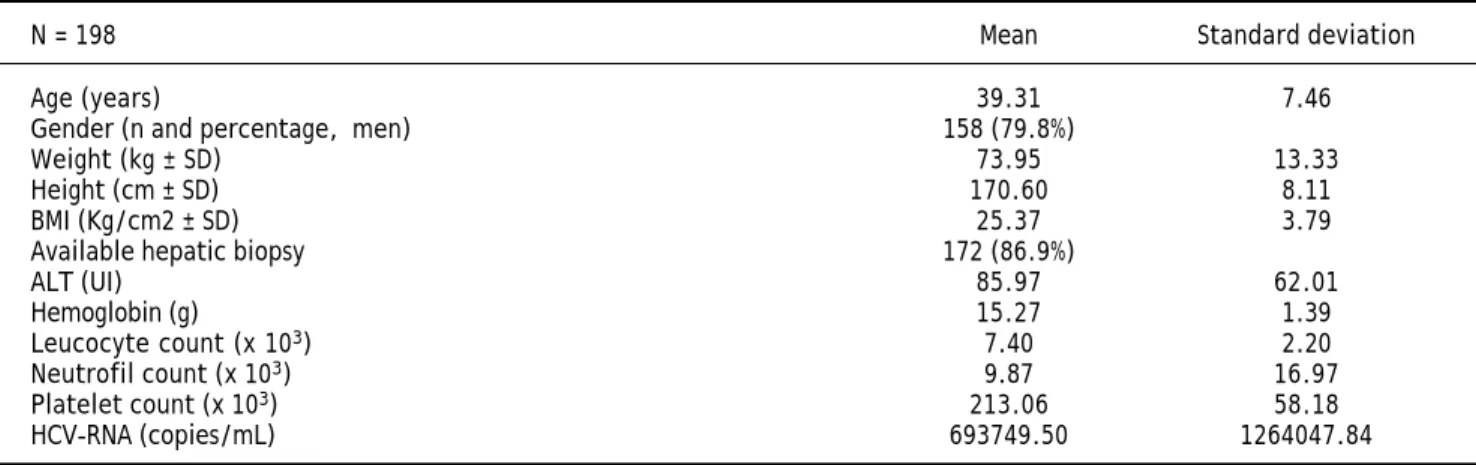
The baseline characteristics of the final 198 Spanish patients included (ITT) are presented in table 1. A total of 63 participants did not finish the study (33.5%): 11 due to patient’s decision; 13 because of adverse events; 35 did not respond to treatment at week twelve. Baseline ALT was 95 IU/mL (SD = 62) and HCV-RNA quantified mean 693,749 copies/mL (SD = 1,264,047).
EVR at week 12, defined as undetectable RNA or a 2-log decrease from the baseline HCV-RNA levels, was achieved in 76.6% (n = 144). Nine patients discontinued before week 12. The 144
res-Table 1. Baseline and demographic characteristics.
N = 198 Mean Standard deviation
Age (years) 39.31 7.46
Gender (n and percentage, men) 158 (79.8%)
Weight (kg ± SD) 73.95 13.33
Height (cm ± SD) 170.60 8.11
BMI (Kg/cm2 ± SD) 25.37 3.79
Available hepatic biopsy 172 (86.9%)
ALT (UI) 85.97 62.01
Hemoglobin (g) 15.27 1.39
Leucocyte count (x 103) 7.40 2.20
Neutrofil count (x 103) 9.87 16.97
Platelet count (x 103) 213.06 58.18
HCV-RNA (copies/mL) 693749.50 1264047.84
Figure 1. Percentages of response to treatment during the study at week 12 (EVR), week 48 (end of treatment) and week 72 (SVR).
Weeks of treatment with pegIFN α2a + RBV
Responding patients (%)
100 90 80 70 60 50 40 30 20 10 0
12 48 72
77%
58%
ponding patients continued treatment and 110 (58.5%) achieved viral response at treatment com-pletion (ETVR) and 27 abandoned between week 12 and week 48 of treatment. Seven of these patients presented only transitory response. SVR (72 weeks from treatment onset) was verified in 52.7% (n = 99), and 9 patients (4.8%) relapsed (Figure 1).
A total of 849 adverse events were observed in 183 patients (92.4%), and 177 (89.4%) were conside-red to be treatment-related. The most prevalent ad-verse events were general disorders such as asthenia (n = 94; 42.93%) and irritability (n = 35; 17.17%), as well as polymyalgia (n = 13; 6.57%) and cephalea (n = 29; 13.13%). Psychiatric disorders in-cluded anxiety (n = 16; 8.08%), depression (n = 20; 8.59%) and insomnia (n = 52; 25.25%). A total of 20 (10.1%) were classified as severe, 19 (9.6%) were treatment-related. The most prevalent severe adver-se events reported included neutropenia (n = 6; 2.53%), anemia, thrombocytopenia, and weight loss (n = 2; 1.01% each).
Our study results, with an SVR rate of 53% in Spain, confirmed the hypothesis that patients with genotype 4, traditionally considered “difficult to treat”,15 can achieve response rates higher than
tho-se of genotype 1 patients under the same conditions. These findings are similar to those described in previous studies. The small genotype-4 patient po-pulation of Fried and Hadziyannis29,30 receiving
doses of 1,000-1,200 mg/day (by weight < 75 kg or > 75 kg) and treated for 48 weeks, achieved the hig-hest SVR rates (79%), but efficacy results of a pre-vious study is lower, with the SVR rates in genotype 4 patients at 43%.20 This study, performed
in a usual clinical practice environment and with a much higher sample size of HCV-4 patients than the aforementioned trials, presents a lower SVR rate, but our SVR results are still higher than sustained response rates of genotype 1 patients.29 Greater
sus-tained response rates are obsus-tained in populations of the Middle East and Egypt, supporting previous observations on the differences in response to treat-ment caused by interindividual characteristics, eth-nicity, viral subtypes and mode of transmission described by several authors.24,31,32 Although the
concept of response-guided therapy has not been va-lidated at present for patients with HCV-4, the kine-tics of viral clearance as shown in previous studies suggest that patients with RVR may be candidates for short treatment at 24 weeks and patients with RVT at 36 weeks.15 Continuation of treatment to 72
weeks can be considered for patients with slow res-ponse.18,19 The percentage of patients who
disconti-nued in our study was slightly higher than in ran-domized trials (20%),33 but dropout rates were
simi-lar or even lower than the usual occurrence in clinical practice.34 Our observations indicate that
the combination of pegylated interferon alfa-2a and ribavirin was well tolerated and adverse effects ap-peared were often in accordance with those previo-usly reported in the literature. Most of these were mild to moderate reported adverse events not unusual nor unexpected.35 This study has the
limi-tation that HCV-RNA levels 4 weeks after treat-ment onset were not collected to assess rapid viral response (RVR), which is a predictive parameter of more recent appearance than the dates of our stu-dy.36,37 Our design was not randomized, so there is
no control group, and at the time recent techniques to detect interleukin 28B, currently offering such good results,38,39 were not available.
A study including a larger number of patients with genotype 4 could be of use in the immediate future, assessing the impact of new treatments for hepatitis C in this genotype, such as protease inhibitors (tela-previr and boce(tela-previr), polymerase and cyclophilin inhibitors (R7128, Debio 025), nitazoxanide, etc.40 In
conclusion, our results show that, although the high SVR rates achieved in randomized trials could not be reproduced in routine clinical practice conditions, pa-tients traditionally considered very difficult to cure could benefit from double therapy with pegylated in-terferon alfa-2a and ribavirin with more success than genotype-1 patients. This is the study with the highe-st number of monoinfected patients with genotype 4 in Spain, and our findings indicate that combination therapy with peginterferon alfa-2a and ribavirin is safe and effective for the treatment of chronic hepati-tis C genotype 4, with rates response between genoty-pe 1 and those of 2-3.
GRANTS AND FINANCIAL SUPPORT
None.
ACKNOWLEDGEMENT
Writing support was provided by Dr. Blanca Piedrafita of Medical Statistics Consulting S.L. and funded by Roche.
ABBREVIATIONS
• SVR: sustained virological response. • RBV: ribavirin.
REFERENCES
1. WHO. Global surveillance and control of hepatitis C. Re-port of a WHO Consultation organized in collaboration with the Viral Hepatitis Prevention Board, Antwerp, Bel-gium. J Viral Hepat 1999: 6: 35-47.
2. WHO. Hepatitis C. WHO Fact sheet Nº 164. Available at: URL.
3. Fried MW, Hoofnagle JH. Therapy of hepatitis C. Semin Li-ver Dis 1995: 15: 82-91.
4. Nguyen MH, Keeffe EB. Prevalence and treatment of hepa-titis C virus genotypes 4, 5, and 6. Clin Gastroenterol He-patol 2005: 3: S97-S101.
5. Booth JC, Foster GR, Levine T, Thomas HC, Goldin RD. The relationship of histology to genotype in chronic HCV infec-tion. Liver 1997: 17: 144-51.
6. Chayama K, Tsubota A, Arase Y, Saitoh S, Ikeda K, Matsu-moto T, HashiMatsu-moto M, et al. Genotype, slow decrease in vi-rus titer during interferon treatment and high degree of sequence variability of hypervariable region are indicati-ve of poor response to interferon treatment in patients with chronic hepatitis type C. J Hepatol 1995: 23: 648-53. 7. el-Zayadi A, Simmonds P, Dabbous H, Prescott L, Selim O, Ahdy A. Response to interferon-alpha of Egyptian patients infected with hepatitis C virus genotype 4. J Viral Hepat
1996; 3: 261-4.
8. Hnatyszyn HJ. Chronic hepatitis C and genotyping: the clinical significance of determining HCV genotypes. Anti-vir Ther 2005; 10: 1-11.
9. Khattab MA, Ferenci P, Hadziyannis SJ, Colombo M, Manns MP, Almasio PL, Esteban R, et al. Management of hepatitis C virus genotype 4: recommendations of an international expert panel. J Hepatol 2011; 54: 1250-62.
10. Fernández-Arcás N, López-Siles J, Trapero S, Ferraro A, Ibáñez A, Orihuela F, Maldonado J, et al. High prevalence of hepatitis C virus subtypes 4c and 4d in Malaga (Spain): phylogenetic and epidemiological analyses. J Med Virol
2006; 78: 1429-35.
11. Martinez SM, Delgado MB, Castroagudin JF, Aguilera A. High rate of infection with hepatitis C virus genotype 4 in a dis-trict of galicia, Spain. J Clin Microbiol 2005; 43: 5403-4. 12. Cenci M, Massi M, Alderisio M, De Soccio G, Recchia O.
Preva-lence of hepatitis C virus (HCV) genotypes and increase of type 4 in central Italy: an update and report of a new me-thod of HCV genotyping. Anticancer Res 2007; 27: 1219-22. 13. Castera L, Morice Y, Grando V, Bon C, Deny P, Roulot D.
Le virus de l’hepatite C de génotype 4. Caracteristiques épidemiologiques et réponse aux traitments antiviraux.
Gastroenterol Clin Biol 2003; 27: 596-604.
14. Antaki N, Craxi A, Kamal S, Moucari R, Van der Merwe S, Haffar S, Gadano A, et al. The neglected hepatitis C virus genotypes 4, 5 and 6: an international consensus report.
Liver Int 2010; 30: 342-55.
15. Kamal SM, Nasser IA. Hepatitis C genotype 4: What we know and what we don’t yet know. Hepatology 2008; 47: 1371-83. 16. Martín-Carbonero L, Puoti M, García-Samaniego J, De Luca A, Losada E, Quinzan G, Bruno R, et al. Response to pegylated interferon plus ribavirin in HIV-infected pa-tients with chronic hepatitis C due to genotype 4. J Viral Hepat 2008; 15: 710-5.
17. Diago-Madrid M. Treatment of genotype 4 patients. Gas-troenterol Hepatol 2006; 29: 5.
18. Ferenci P, Laferl H, Scherzer TM, Gschwantler M, Maieron A, Brunner H, Stauber R, et al. Peginterferon alfa-2a and ribavi-rin for 24 weeks in hepatitis C type 1 and 4 patients with ra-pid virological response. Gastroenterology 2008; 135: 451-8. 19. Ferenci P, Laferl H, Scherzer TM, Maieron A, Hofer H, Stauber R, Gschwantler M, et al. Peginterferon alfa-2a/ri-bavirin for 48 or 72 weeks in hepatitis C genotypes 1 and 4 patients with slow virologic response. Gastroenterology
2010; 138: 503-12, 512 e1.
20. Alfaleh FZ, Hadad Q, Khuroo MS, Aljumah A, Algamedi A, Alashgar H, Al-Ahdal MN, et al. Peginterferon alpha-2b plus ribavirin compared with interferon alpha-2b plus ribavirin for initial treatment of chronic hepatitis C in Saudi pa-tients commonly infected with genotype 4. Liver Int 2004; 24: 568-74.
21. McHutchison JG, Gordon SC, Schiff ER, Shiffman ML, Lee WM, Rustgi VK, Goodman ZD, et al. Interferon alfa-2b alo-ne or in combination with ribavirin as initial treatment for chronic hepatitis C. Hepatitis Interventional Therapy Group. N Engl J Med 1998; 339: 1485-92.
22. Poynard T, Marcellin P, Lee SS, Niederau C, Minuk GS, Ideo G, Bain V, et al. Randomised trial of interferon alpha2b plus ribavirin for 48 weeks or for 24 weeks versus interferon alpha2b plus placebo for 48 weeks for treatment of chro-nic infection with hepatitis C virus. International Hepati-tis Interventional Therapy Group (IHIT). Lancet 1998; 352: 1426-32.
23. Sherman M, Marinos G, Sedarati F. Infection with hepati-tis C virus genotype 4 is associated with a poor response to interferon-alpha. Ann Intern Med 2001; 135: 927-8. 24. Esmat G, Abouzied AM, Abdel-Aziz F, Strickland T. Subjects
with chronic hepatitis C and genotype 4 have a similarly effective response to standard or pegylated interferon in combination with ribavirin. Hepatology 2003; 38.
25. Shobokshi OA, Serebour FE, Skakni L, Al-Saffy YH, Ahdal MN. Hepatitis C genotypes and subtypes in Saudi Arabia. J Med Virol 1999; 58: 44-8.
26. Poynard T, McHutchison J, Goodman Z, Ling MH, Albrecht J. Is an “à la carte” combination interferon alfa-2b plus ri-bavirin regimen possible for the first line treatment in pa-tients with chronic hepatitis C? The ALGOVIRC Project Group. Hepatology 2000; 31: 211-8.
27. El Makhzangy H, Esmat G, Said M, Elraziky M, Shouman S, Refai R, Rekacewicz C, et al. Response to pegylated inter-feron alfa-2a and ribavirin in chronic hepatitis C genotype 4. J Med Virol 2009; 81: 1576-83.
28. Diago M, Hassanein T, Rodes J, Ackrill AM, Sedarati F. Op-timized virologic response in hepatitis C virus genotype 4 with peginterferon-alpha2a and ribavirin. Ann Intern Med
2004; 140: 72-3.
29. Fried MW, Shiffman ML, Reddy KR, Smith C, Marinos G, Gonçales FL Jr, Häussinger D, et al. Peginterferon alfa-2a plus ribavirin for chronic hepatitis C virus infection. N Engl J Med 2002; 347: 975-82.
30. Hadziyannis SJ, Sette H Jr, Morgan TR, Balan V, Diago M, Marcellin P, Ramadori G, et al. Peginterferon-alpha2a and ribavirin combination therapy in chronic hepatitis C: a randomized study of treatment duration and ribavirin dose. Ann Intern Med 2004; 140: 346-55.
31. Asselah T, Estrabaud E, Bieche I, Lapalus M, De Muynck S, Vidaud M, Saadoun D, et al. Hepatitis C: viral and host factors associated with non-response to pegylated in-terferon plus ribavirin. Liver Int 2010; 30: 1259-69. 32. Davis GL, Lau JY. Factors predictive of a beneficial
33. Ogawa E, Furusyo N, Kajiwara E, Takahashi K, Nomura H, Tanabe Y, Satoh T, et al. An evaluation of the adverse effect of premature discontinuation of pegylated interfe-ron alpha-2b and ribavirin treatment for chinterfe-ronic hepatitis C virus infection: Results from Kyushu University Liver Di-sease Study (KULDS). J Gastroenterol Hepatol 2011. 34. Sulkowski MS, Cooper C, Hunyady B, Jia J, Ogurtsov P,
Peck-Radosavljevic M, Shiffman ML, et al. Management of adverse effects of Peg-IFN and ribavirin therapy for hepatitis C. Nat Rev Gastroenterol Hepatol 2011; 8: 212-23.
35. Nogueira Nogueira JB, Santana Sena LC, de Souza Siqueira Quintans J, Guedes da Silva Almeida JR, Vianey Callado Franca A, Quintans Junior LJ. Side Effects of the Therapy With Peginterferon and Ribavirin in Chronic Hepatitis C: A Small Audit. J Pharm Pract 2011.
36. Fried MW, Hadziyannis SJ, Shiffman ML, Messinger D, Zeu-zem S. Rapid virological response is the most important predictor of sustained virological response across
genoty-pes in patients with chronic hepatitis C virus infection. J Hepatol 2011; 55: 69-75.
37. Yu JW, Wang GQ, Sun LJ, Li XG, Li SC. Predictive value of rapid virological response and early virological response on sustained virological response in HCV patients treated with pegylated interferon alpha-2a and ribavirin. J Gas-troenterol Hepatol 2007; 22: 832-6.
38. Gonzalez SA, Keeffe EB. IL-28B As a Predictor of Sustained Virologic Response in Patients with Chronic Hepatitis C Vi-rus Infection. Gastroenterol Hepatol (NY) 2011; 7: 366-73. 39. Thompson AJ, Muir AJ, Sulkowski MS, Ge D, Fellay J, Shianna
KV, Urban T, et al. Interleukin-28B polymorphism improves viral kinetics and is the strongest pretreatment predictor of sustained virologic response in genotype 1 hepatitis C virus. Gastroenterology 2010; 139: 120-9 e18.