Otras secciones de este sitio:
☞ ☞ ☞ ☞
☞ Índice de este número
☞ ☞ ☞ ☞
☞ Más revistas
☞ ☞ ☞ ☞
☞ Búsqueda
Others sections in this web site:
☞ ☞ ☞ ☞
☞ Contents of this number ☞
☞ ☞ ☞
☞ More journals ☞
☞ ☞ ☞ ☞ Search Artículo:
Extrahepatic manifestations of viral hepatitis
Copyright © 2002: Mexican Association of Hepatology
ANNALS OF HEPATOLOGY
Number 4 October-December 2002
Volume 1
Original Article
Extrahepatic manifestations of viral hepatitis
D.N. Amarapurkar,1 A.D. Amarapurkar2
Annals of Hepatology
1Departments of Gastroenterology and Hepatology. 2Bombay Hospital and Medical Research Center and Dept of
Pathology.
BYL Nair Hospital, TN Medical College, Mumbai, India.
Address for correspondence: Dr. D.N. Amarapurkar D 402, Ameya RBI Society New Prabhadevi Road Mumbai 400 025 Fax: 91 22 4368623
Email: [email protected]
Financial assistance was given by Medical research society, Bombay Hospital for purchasing kits for immunohistochemistry for hepatitis B surface and core antigen.
Abstract
Viral hepatitis has been shown to be associated with various extrahepatic manifestations. These can be seen in both acute and chronic liver disease, may precede or follow overt liver disease. Aims and objects: To study the prevalence of extrahepatic manifestations of viral hepa-titis and follow the course of the disease in response to antiviral therapy whenever indicated. Methods: Pro-spectively 448 patients of viral hepatitis were evaluated for extrahepatic manifestations and patients of glomer-ulonephritis (GN), polyarteritis nodosa (PAN) and cryoglobulinemia were tested for viral markers. All pa-tients were investigated for liver and kidney function tests, hematological workup and viral markers such as HBsAg, HBeAg, Anti HBeAg, HCV RNA, IgM anti HAV and IgM anti HEV. Serum electrophoresis and kidney biopsies were done whenever indicated. In 10 cases of hepatitis B glomerulonephritis immunohis-tochemistry was done on kidney biopsies for demon-stration of hepatitis B surface and core antigen. Results: Of total 448 cases 181 (40.4%) had hepatitis B infection, 142 (31.6%) had hepatitis C infection, 86 (19.1%) hepa-titis E and 39 (8.7%) had hepahepa-titis A infection. Extrahe-patic manifestations were seen in 29 (6.4%) cases and these were cases of GN, PAN, cryoglobulinemia, throm-bocytopenia, agranulocytosis, aplastic anemia and pan-creatitis. Patients with hepatitis A with extrahepatic manifestations showed complete recovery in both hepa-titis and extrahepatic manifestations. Six patients with PAN were treated with interferon of which 4 showed
excellent response. Three patients of hepatitis B and hepatitis C related GN were given interferon and 4/6 responded well to treatment. Conclusion: Prevalence of extrahepatic manifestations with viral hepatitis was found to be 6.4%. These manifestations recover com-pletely with recovery from viral hepatitis.
Key words: Viral hepatitis, glomerulonephritis, pol-yarteritis, cryoglobulinemia.
Introduction
Acute and chronic viral hepatitis may be complicated by multiorgan involvement by immune complex deposition at various sites.1-3 The demonstration of circulating immune complexes in patients of viral hepatitis B or C allows us to speculate that they are responsible for extrahepatic mani-festations.4-6 Glomerulonephritis, mixed cryoglobulinemia, polyarteritis nodosa and polyneuritis are some of the estab-lished extrahepatic manifestations of hepatitis B or C virus infection.6 These may contribute at times to significant mortality and morbidity in persistent viral infection.
Aims
To study the prevalence of extrahepatic manifestations of viral hepatitis and follow the course of disease in re-sponse to antiviral therapy whenever indicated.
Material and methods
Total 448 patients of viral hepatitis were included in study prospectively over the period of 3 years. The pa-tients presenting with viral hepatitis were assessed for ex-trahepatic manifestations. Patients of glomerulonephritis, polyarteritis nodosa and cryoglobulinemia were tested for viral markers. All patients were investigated for liver function tests, viral markers such as HBsAg, HBeAg, Anti HBeAg, HCV RNA, IgM anti HAV and IgM anti HEV as indicated. Kidney function tests and hematologi-cal workup was carried out with biopsy whenever re-quired. Serum electrophoresis was done in suspected cas-es of cryoglobulinemia.
rou-D.N. Amarapurkar et al. / Extrahepatic manifestations of viral hepatitis 193
edigraphic.com
tinely. Immunohistochemistry was carried out for demon-stration of hepatitis B surface and core antigen (Dako Corp dilution 1:4000 & 1:2000 respectively). Patients of GN without hepatitis B infection were taken as negative control.
Results
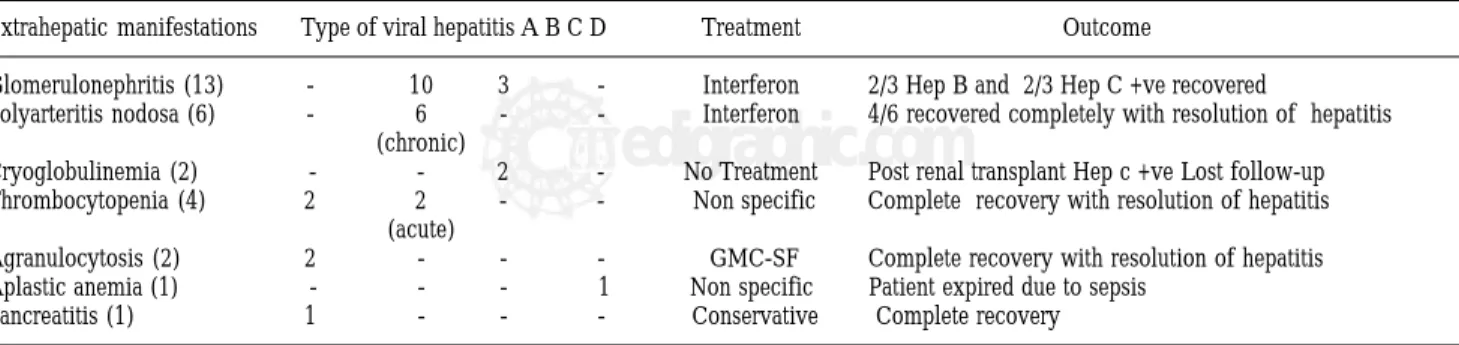
The patients were between age group 4 to 62 years with the male: female ratio of 13:2. Hepatitis B infection (acute and chronic) was found in 181 (40.4%), hepatitis C (chronic) 142 (31.6%), hepatitis E 86 (19.1%), hepatitis A 39 (8.7%) cases (Table I). Extrahepatic manifestations were seen in 29 (6.4%) cases. These were cases of glom-erulonephritis, PAN, cryoglobulinemia, thrombocytope-nia, agranulocytosis, aplastic anemia and pancreatitis
(Ta-ble II). Patients of hepatitis A with extrahepatic
manifes-tations showed complete recovery. Six patients of PAN were treated with interferon of which 4 showed excellent response. Three each of hepatitis B and hepatitis C related
GN were treated with interferon and 4 of then responded to treatment (Table III).
Discussion
Over a period of time, several extrahepatic manifesta-tions of chronic HBV infection have been described and now few of them are well-established.6 As HCV serology testing improved in sensitivity and specificity, the exist-ence and magnitude of extrahepatic associations with HCV were also clarified. Glomerulonephritis is one of those manifestations well documented in literature.7-9 The diagnosis of HBV associated GN is usually established by serologic evidence of HBV antigen or antibody, the pres-ence on kidney biopsy of an immune complex GN and by demonstrating glomerular deposits containing one or more HBV related antigens (HBsAg, HBcAg or HBeAg) by immunohistochemical means.6 The incidence of HBV GN ranges from 0.1 to 25%.10-12 Brazosko et al were the first to suggest that HBV might be involved in the patho-genesis of high percentage of GN and found the incidence 34.6% with various types of glomerular diseases.13 Subse-quently incidences reported were Lagrue14 et al (5.5%), Guardia15 et al (8.5%), Nagy16 et al (34.6%). In our study 13 patients presented with glomerulonephritis, of which 10 were HBV positive and 3 HCV positive patients. From 10 cases of HBV positive GN, 8 showed hepatitis B sur-face and core antigen on the basement membrane and me-sengium of glomeruli.17 Liver histology in all of them were chronic hepatitis (active or persistent). Three pa-tients each of hepatitis B and C received interferon thera-py, of which 2 cases of hepatitis B and 2 of hepatitis C showed disappearance of proteinuria and recovery from hepatitis. Most of the patients of HBV associated GN who receive corticosteroids have either no beneficial effect or experience transient or incomplete remission. Hence most direct approach is to eliminate chronic viral infection by antiviral therapy. Evidence of reversibility of renal dis-ease concomitant with spontaneous clearance of detect-able HBsAg provides the rationale for interferon thera-py.6,18 Lisker-Melman M19 et al, evaluated 7 Caucasian adults with HBV related GN and the nephrotic syndrome. These patients were treated with interferon alpha, daily 5 Table I: Virological profile
N= 448
Hepatitis B (Acute and chronic) 181 (40.4 %) Hepatitis C (Chronic) 142 (31.6%)
Hepatitis E 86 (19.1%)
Hepatitis A 39 (8.7%)
Extrahepatic manifestations 29 (6.4%)
Table III. Outcome of extrahepatic manifestations.
Extrahepatic manifestations Type of viral hepatitis A B C D Treatment Outcome
Glomerulonephritis (13) - 10 3 - Interferon 2/3 Hep B and 2/3 Hep C +ve recovered
Polyarteritis nodosa (6) - 6 - - Interferon 4/6 recovered completely with resolution of hepatitis (chronic)
Cryoglobulinemia (2) - - 2 - No Treatment Post renal transplant Hep c +ve Lost follow-up Thrombocytopenia (4) 2 2 - - Non specific Complete recovery with resolution of hepatitis
(acute)
Agranulocytosis (2) 2 - - - GMC-SF Complete recovery with resolution of hepatitis Aplastic anemia (1) - - - 1 Non specific Patient expired due to sepsis
Pancreatitis (1) 1 - - - Conservative Complete recovery Table II. Profile of extrahepatic manifestations in viral hepatitis.
N Hep A Hep B Hep B Hep C Hep E Acute Chronic Chronic
Glomerulonephritis 13 - - 10 3 -Polyarteritis nodosa 6 - - 6 -
-Cryoglobulinemia 2 - - - 2
-Thrombocytopenia 4 2 2 - -
-Agranulocytosis 2 - - - -
-Aplastic anemia 1 - - - - 1
-million units for 4 months. In 5 of them serum markers of HBV replication disappeared with marked improvement in nephrotic syndrome. This report has been updated by Conjeevaran HS20 et al in 1995. A study from Taiwan have shown favorable treatment of HBV associated MGN in oriental children.21 In their study 40 patients with HBV-MGN were evaluated of which 20 were treated with interferon alpha remaining 20 received supportive thera-py only. All those treated with interferon were free of proteinuria and 40% of them were seroconverted their HBeAg to antibody as against none seroconverted and only 50% had improvement in proteinuria from the sec-ond group receiving supportive therapy.
In 1970, generalized necrotizing vasculitis was first re-ported in association with hepatitis B antigenemia.22,23 Al-though the exact incidence of hepatitis B associated necro-tizing vasculitis is not known; it ranges between 30 to 70 %.24,25 Sergent JS26 et al have reported 9 cases of PAN asso-ciated with hepatitis B infection and have shown that there is no difference in the prognosis as compared to PAN, not associated with HBV infection. We have come across 6 cases of PAN associated with hepatitis B infection. These cases were diagnosed on renal angiography and biopsy. All 6 cases were given interferon therapy. Four out of 6 pa-tients showed recovery with resolution of hepatitis and dis-appearance of lesions on angiography. There is no relation-ship reported between severity of vasculitis and hepatic disease and liver disease is often quiescent. Treatment of PAN associated with HBV infection is limited in the litera-ture; antiviral therapy may be of some use.27
A characteristic clinical syndrome of cryoglobulinemia has been described in hepatitis A, B and C infection.28-30 In general the overall prevalence of mixed cryoglobulinemia is as high as 40-50 % in chronic liver disease with the high-er incidence in hepatitis C as compared to hepatitis B infec-tion.6,28,31 In our study there were only 2 cases of cryoglob-ulinemia, both were HCV-RNA positive. We could not of-fer any treatment because one patient acquired hepatitis C infection post renal transplant and in another there was no follow up available. Gorevic et al28 have followed up 40 patients of mixed cryoglobulinemia of which more than 60% showed serological evidence of hepatitis B infection. Reports on therapy of mixed cryoglobulinemia associated with hepatitis B infection are limited and more experience is necessary before the role of antiviral therapy for mixed cryoglobulinemia syndrome associated with chronic hepa-titis B or C infection.
Hematological manifestations found in our study were 4 cases of thrombocytopenia, 2 agranulocytosis and a case of aplastic anemia. These 7 cases presented first with liver disease and then developed hematological manifes-tations subsequently. All of them were found to be pa-tients of acute viral hepatitis either A, B or E. Leucopoe-nia and thrombocytopeLeucopoe-nia are commonly found in pa-tients with chronic liver disease or cirrhosis.32 This is largely due to hypersplenism but their presence in acute
viral hepatitis may be due to its extrahepatic manifesta-tions. Subsequently bone marrow failure results from im-munologically mediated, tissue specific organ destruc-tion. Aplastic anemia has also been reported to be associ-ated with hepatitis A, B or non-A non-B hepatitis.32-35 It occurs several weeks to months after an episode of acute viral hepatitis. Zeldis et al36 have studied 229 patients of aplastic anemia of which 16 were positive for viral mark-ers. From these, 13 were found to be associated with non-A non-B hepatitis, 1 case was positive for HBsnon-Ag and re-maining two were hepatitis A positive. We have come across a case of acute hepatitis E infection, developing aplastic anemia and expired due to sepsis before giving any specific therapy. Two patients of agranulocytosis were treated with GMC-SF showed complete recovery with resolution of hepatitis. For patients of thrombocy-topenia no any specific treatment was given. Thrombocy-topenia disappeared with recovery from viral hepatitis.
Acute hemorrhagic and necrotising pancreatitis is a fre-quent finding in patients with fulminant hepatic failure at autopsy.37 Association of hepatitis A and acute pancreatitis is very rare.38-40 From our study, a young boy admitted with acute hepatitis A developed acute pancreatitis during hos-pital stay. His IgM anti HAV antibodies were found to be positive. Acute pancreatitis developing in acute viral hepa-titis may be due to a direct cytopathic effect of the viruses or through the patient’s immune response.
In conclusion, extrahepatic manifestations of viral hepatitis are not very uncommon. They should be diag-nosed with suspicion and antiviral therapy may be of great help in majority of them.
Acknowledgement
We are thankful to Medical research society, Bombay hospital for grant in aid for published study.
References
1. Seeff LB. Diagnosis, therapy and prognosis of viral hepatitis. In: Zakim D, Boyer TK, Eds. Hepatology: A textbook of liver disease, 2nd ed. Philadelphia; WB Saunders co, 1990; 981-984.
2. Koff RS. Immunologically mediated extrahepatic manifestations of viral hepatitis. In: Krawitt EL, Wiesner RH Eds. Autoimmune liver diseases. New York: Raven press, 1991; 233-245.
3. Koff RS. Viral hepatitis. In: Schiff L, Schiff ER. Ed. Diseases of the liver, 7th ed. Philadelphia JB Lippincott co. 1993; 535-545.
4. Eigenbrodt E, Wase AJ. Renal involvement in hepatic disease, rheu-matoid arthritis, Sjogren’s syndrome and mixed connective tissue disease. pp 522-547. In renal pathology with clinical & functional correlation, Tisher CC, Brenner BM, 1989, volu I, JB Lippincott company, Philadelphia.
5. Czaja AJ, Carpenter HA, Santrach PJ, et al. Immunologic features and HLA association in chronic viral hepatitis. Gastroenterol 1995; 108: 157-164.
6. Willson RA. Extrahepatic manifestations of chronic viral hepatitis. Am J Gastroenterol 1997; 92: 4-17.
D.N. Amarapurkar et al. / Extrahepatic manifestations of viral hepatitis 195
edigraphic.com
8. Bajtai G, Ambrus M, Paal M, Nagy J, Deak GY. Hepatitis B antigenemia associated with progressive cirrhosis and membranous glomerulonephritis. Lancet 1975; 2: 102-103.
9. Safadi R, Almog Y, Dranitzki- Elhalel M, Rosenmann E, Tur-Kaspa R. Glomerulonephritis associated with acute hepatitis B. Am J Gastroenterol 1996; 91: 138-139.
10. Levy M, Kleinknecht C. Membraneous glomerulonephritis and hepa-titis B virus infection. Nephron 1980; 26: 259-265.
11. Wiggelinkhuizen J, Sinclair-Smith C, Stannard LM, Smuts H. Hepa-titis B virus associated membraneous glomerulonephritis. Archives of Disease in childhood 1983; 58: 488-496.
12. Southwest pediatric nephrology study group. Hepatitis B surface antigenemia in North American children with membraneous glomerulonephropathy. J Pediatr 1985; 106: 571-578.
13. Brazosko WJ, Krawczynski K, Nazarewicz T, et al. Glomerulone-phritis associated with hepatitis B surface antigen immune complexes in children. Lancet 1974; 2: 477-481.
14. Lagrue G, Etievant MF, Sylvestre R, ET Hirbee G. Antigen Australie (Ag-HB) et glomerulonephrities. Nouv Presse Med 1974; 3: 1870-1872.
15. Guardia J, Pedrira JD, Martinez-Vasquez JM, Vidal MT, Vilardell M, Caralps A, Ferrer E, et Bacardi R. Glomerulonephritis chroniques avec antigene Hb. Nouv Presse Med 1975; 4: 2923-2925.
16. Nagy J, Bajtai G, Brasch H, Sule T, Ambrus M, Deak G, Hamori A. The role of hepatitis B surface antigen in the pathogenesis of glom-erulonephritis. Clin Nephrol 1979; 12: 99-110.
17. Amarapurkar DN, Amarapurkar AD, Kirpalani AL. Extrahepatic manifestations of viral hepatitis, hospital based study. J of Gastroenterol and Hepatol 2000; 15 (suppl): F30.
18. Knecht GI, Chisari FV. Reversibility of hepatitis B virus-induced glomerulonephritis and chronic active hepatitis after spontaneous clearance of serum hepatitis B surface antigen. Gastroenterology 1978; 75: 1152-1156.
19. Lisker-Meiman M, Webb D, Di Bisceglie AM, et al. Glomerulonephri-tis caused by chronic hepatiGlomerulonephri-tis B virus infection: treatment with recom-binant human alpha interferon. Ann Intern Med 1989; 111: 479-483. 20. Conjeevaran HS, Hoofnagle JH, Austin HA, et al. Long tern
out-come of hepatitis B virus related glomerulonephritis after therapy with interferon alfa. Gastroenterology 1995; 109: 540-546. 21. Lin CY. Treatment of hepatitis B virus associated membranous
neph-ropathy with recombinant alpha interferon. Kidney Int 1995; 47: 225-230.
22. Gocke DJ, Hsu K, Morgan C, Bombardleri S, Lockshin M, Christian CL. Association between polyarteritis and Australia antigen. Lancet 1970; 2: 1149.
23. Trepo CG, Thivolet J. Antigene Australien hepatite a virus et periarterite noveuse. Presse Med 1970; 78: 1575.
24. Ziff M. Viruses and the connective tissue diseases. Ann Intern Med 1971; 75: 951.
25. Duffy J, Lidsky MD, Sharp JT, et al. Polyarthritis, polyarteritis and hepatitis B. Medicine 1976; 55: 19-37.
26. Sergent JS. Lockshin MD, Christian CL, Gocke DT. Vasculitis with hepatitis B antigenemia. Medicine 1976; 55: 1-18.
27. Guillerin L, Lhote F, Cohen P, et al. Polyarteritis nodosa related to hepatitis B virus. A prospective study with long-term observation of 41 patients. Medicine 1995; 74: 238-253.
28. Gorevic ED, Kassab SJ, Levo E, et al. Mixed cryoglobulinemia: clini-cal aspects and long term follow up of 40 patients. Am J Medicine 1980; 69: 287- 308.
29. Jori GP, Buonanno G, D’Onofiro F, et al. Incidence and immu-nochemical features of serum cryoglobulin in chronic liver disease. Gut 1977; 18: 245-249.
30. Lunel F, Musset L, Cacoub P, et al. Cryoglobulinemia in chronic liver disease: Role of hepatitis C virus and liver damage. Gastroen-terology 1994; 106: 1291-1300.
31. Mc Mahon BJ, Alberts SR, Wainwright RB, et al. Hepatitis B related sequelae: Prospective study in 1400 hepatitis B surface antigen posi-tive Alaska naposi-tive carriers. Arch Intern Med 1990; 150: 1051-1054. 32. Foon KA, Mitsuyasu RT, Schroff RW, et al. Immunologic defects in
young male patients with hepatitis associated aplastic anemia. Ann Int Medicine 1984; 100: 657-662.
33. Young NS, Maciejewski J. The pathophysiology of acquired aplastic anemia. N Engl J med 1997; 336: 1365-1372.
34. Kojima S, Matsuyama K, Kodera Y, Okada J. Circulating activated suppressor T lymphocytes in hepatitis associated aplastic anemia. Ann J of Hematol 1989; 71: 147- 151.
35. Brown KE, Tisdale J, Barrett J, Dunbar CE, Young NS. Hepatitis associated aplastic anemia. N Engl J Med 1997; 336: 1059-1064. 36. Zeldis JB, Dienstag JL, Gale RP. Aplastic anemia and non-A, non-B
hepatitis. Am J medicine 1983; 74: 64-68.
37. Sherilock S. Fulminant hepatic failure in Sherilocks. Ed. Diseases of the liver and biliary system. London, Blackwell scientific publi-cations. 1989: 116-128.
38. Steinberg W, Tenner S. Acute pancreatitis. N Engl J Med 1994; 330: 1198-1210.
39. Lopez Morante A, Rodriguez de hop C, Sam Miguel G, Pons Romero F. Acute pancreatitis in hepatitis A infection. Postgrad Med J 1986; 62: 407-408.