Liver Transplantation for
Hepatocellular Carcinoma:
Impact of Wait Time at a Single Center
William C. Palmer,* David Lee,* Justin Burns,* Kristopher Croome,* Barry Rosser,* Tushar Patel,* Andrew P. Keaveny,* Surakit Pungpapong,* Raj Satyanarayana,* Maria Yataco,* Raouf Nakhleh,** Kaitlyn R. Musto,* Alexandra M. Canabal,*** Alex K. Turnage,*** David O. Hodge,**** Justin H. Nguyen,* Denise M. Harnois*
Departments of *Transplant, **Pathology, ***CRISP Program, ****Department of Health Sciences Research, Mayo Clinic, Jacksonville, Florida, USA. May-June, Vol. 16 No. 3, 2017: 402-411
INTRODUCTION
Liver transplantation (LT) remains the best treatment for carefully selected patients with hepatocellular carcino-ma (HCC). In 1996, Mazzaferro, et al. established the Mi-lan Criteria, which demonstrated that LT recipients with early HCC (as defined by having either a single lesion no > 5 cm or < 3 lesions each ≤ 3 cm) can achieve favorable long term patient survival. In 2001, the UCSF group sug-gested that these guidelines could be extended to include patients with a single lesion ≤ 6.5 cm or no more than 3 le-sions each ≤ 4.5 cm and a total sum of these lesions each ≤
8 cm. Following the introduction of the Model for End-Stage Liver Disease (MELD) system for liver allocation in
February of 2002, there has been considerable debate re-garding LT wait time in patients with cirrhosis and HCC.1-3 Patients were initially assigned a MELD excep-tion score of 29 when they had HCC within Milan crite-ria. The intent was to avoid waitlist mortality or dropout due to tumor progression, as this score was thought to represent a 30% probability of three-month mortality. Subsequent studies suggested this adjusted score provided an unfair advantage to patients listed with HCC.4-6 HCC patients continued to demonstrate survival advantages over waitlist patients with non-malignant disease, despite incre-mental reductions in MELD exception scores being grant-ed.7 A rise in mortality in patients without HCC on the waitlist was observed due to MELD inflation from HCC The Official Journal of the Mexican Association of Hepatology,
the Latin-American Association for Study of the Liver and the Canadian Association for the Study of the Liver
Manuscript received: Manuscript received: Manuscript received: Manuscript received:
Manuscript received: September 20, 2016. Manuscript accepted:Manuscript accepted:Manuscript accepted:Manuscript accepted:Manuscript accepted: October 29, 2016.
DOI:10.5604/16652681.1235483
A B S T R A C T A B S T R A C TA B S T R A C T A B S T R A C T A B S T R A C T
Introduction and aim. Introduction and aim.Introduction and aim. Introduction and aim.
Introduction and aim. Liver transplantation (LT) provides durable survival for hepatocellular carcinoma (HCC). However, there is continuing debate concerning the impact of wait time and acceptable tumor burden on outcomes after LT. We sought to review out-comes of LT for HCC at a single, large U.S. center, examining the influence of wait time on post-LT outout-comes. Material andMaterial andMaterial andMaterial andMaterial and methods.
methods.methods. methods.
methods. We reviewed LT for HCC at Mayo Clinic in Florida from 1/1/2003 until 6/30/2014. Follow up was updated through 8/1/ 2015. Results.Results.Results.Results.Results. From 2003-2014, 978 patients were referred for management of HCC. 376 patients were transplanted for presumed HCC within Milan criteria, and the results of these 376 cases were analyzed. The median diagnosis to LT time was 183 days (8 - 4,337), and median transplant list wait time was 62 days (0 - 1815). There was no statistical difference in recurrence-free or overall survival for those with wait time of less than or greater than 180 days from diagnosis of HCC to LT. The most important predictor of long term survival after LT was HCC recurrence (HR: 18.61, p < 0.001). Recurrences of HCC as well as survival were pre-dicted by factors related to tumor biology, including histopathological grade, vascular invasion, and pre-LT serum alpha-fetoprotein levels. Disease recurrence occurred in 13%. The overall 5-year patient survival was 65.8%, while the probability of 5-year recur-rence-free survival was 62.2%. Conclusions.Conclusions.Conclusions.Conclusions.Conclusions. In this large, single-center experience with long-term data, factors of tumor biology, but not a longer wait time, were associated with recurrence-free and overall survival.
Key words. Key words.Key words. Key words.
exception points combined with inadequate liver donor availability.8,9 Consequently, HCC MELD exception scores have been blamed for an exacerbation of the geo-graphical disparity in access to LT. Further, recent reports have suggested expedited LT for HCC may lead to inferi-or outcomes in these patients.1,2,10 Authors compared HCC patients in different UNOS regions with varying av-erage wait times concluding that wait time rather than transplant center and regional practice variation could ac-count for the differences in post-LT mortality.2,10 Unfor-tunately, most of these data were reliant on registry studies which are limited by incomplete reporting of post-LT HCC recurrence, varied HCC transplant center behavior and listing practices, as well as regional differences in HCC referral and management.11 Despite significant study limitations, UNOS recently implemented a policy of 6-month wait time before HCC MELD exception scores are assigned to reduce any unfair advantage.12
Large single-center experiences with long-term out-comes data are lacking, yet are necessary to exclude the po-tential confounding transplant center effect and to clarify the role of wait time on post-LT outcome. The Mayo Clinic in Florida (MCF) experience provides a unique opportunity to examine the impact of short and long wait times for patients with HCC via a large single-center co-hort with detailed clinical data, along with uniform listing and transplant behavior.13,14 We have observed a steady in-crease in wait times from HCC diagnosis to LT over the seventeen year history of our transplant program, and this increase in wait time allows for a more controlled analysis to examine the influence of time from HCC diagnosis to transplant, waitlist drop off, and post-LT outcome. The purpose of this study was to review survival outcomes and HCC recurrence events in a large consecutive series of pa-tients who underwent LT for HCC at our center, and to determine the role wait time played in the outcomes of HCC patients with an intention-to-treat analysis.
MATERIAL AND METHODS
Cohort selection
Patients undergoing LT for HCC at MCF from January 1, 2003 to June 30, 2014 meeting pre-LT Milan criteria were considered for analysis, with follow up maintained through August 1, 2015. Data on pre and post-LT variables were manually extracted from the patients’ records. All pa-tients were considered for listing based on pre-LT imag-ing that met UNOS class 5 criteria, and/or pathologic diagnosis on biopsy. Patients with recognized metastases or macrovascular invasion on pre transplant imaging stud-ies were excluded from LT. Pre-LT imaging modalitstud-ies included ultrasound, along with intravenous (IV)
trast-enhanced magnetic resonance (MR) and/or IV con-trast-enhanced computerized tomography (CT).14 Pre-LT locoregional treatments were performed in all patients if the timeline permitted, unless contraindicated. Locore-gional treatments included transarterial chemoemboliza-tion (TACE), transarterial yttrium-90 radioembolizachemoemboliza-tion (TARE) and/or radiofrequency ablation (RFA). TACE was performed as part of the clinical protocol as previously re-ported.15 TARE and RFA was selectively performed when indicated. Those patients with HCC outside of Milan cri-teria on pre-LT imaging were excluded from analyses; un-less they were successfully downstaged using approved regional protocols. Patients with incidentally found HCC at explant but no pre-LT evidence of HCC were excluded from the study.
LT was performed using the piggyback technique as described previously.16 All patients in the study were within the MELD era to allow for consistency of analysis. Standard immunosuppression included tacrolimus, myco-phenolate mofetil, and prednisone, with discontinuation of mycophenolate mofetil in the early post-LT period where possible, and attempted discontinuation of pred-nisone within six months of transplant. Alternative agents such as sirolimus and cyclosporin were chosen in select patients who had contraindications to the standard proto-col. Immunosuppressive induction included basiliximab in cases with significant renal impairment.
Post-LT recurrence monitoring involved serum alpha-fetoprotein (AFP) measurements, along with bone scans and cross-sectional imaging at 4, 8, 12, 24, and 36 months after LT. Standard clinical follow up occurred at 4, 8, and 12 months, and then annually thereafter. Phone and email inquiries were made into outcomes of those patients who transferred to other facilities or moved to distant loca-tions.
Definition of HCC groups by pathologic review
criteria,18 and beyond UCSF criteria regardless of tumor grade or vascular involvement. Tumor-Node-Metastasis (TNM) staging was calculated at both pre-LT imaging and explant based on National Comprehensive Cancer Net-work guidelines.17
Wait time was defined as the time from diagnosis to transplant date. Day of diagnosis was defined as the date when the lesion was found on imaging. These lesions ei-ther met UNOS class 5a or 5b criteria or were confirmed on pathology by biopsy. A UNOS class 5a lesion met cri-teria if a given nodule of 1-2 cm in size and meets all qual-itative criteria for HCC on cross-sectional imaging.19 A UNOS class 5b lesion included any lesion between 2-5cm in size and meeting qualitative criteria for HCC on cross-sectional imaging. Focusing on the date of HCC diagnosis to LT time allowed us to account for the time spent on pa-tient referral, relocation, transplant evaluation, and subse-quent listing at our center. This figure potentially limits bias associated with center specific listing practice and re-ferral patterns.
Recurrence-free survival was assigned if the patient died or had a documented HCC recurrence was censored on death without recurrence or last follow-up date. Com-parisons of these groups for overall survival and recur-rence-free survival, as well as risk factors for HCC recurrence, were subsequently undertaken.
Data analysis
All numeric data were reported as median and range, and mean. Comparison between groups was performed using the χ2 test for categorical variables. Continuous vari-ables comparisons were made using the Wilcoxon rank-sum test. Survival time started with the day of LT. Overall and recurrence-free survivals in each group were estimat-ed using the Kaplan-Meier method and groups were com-pared using the log-rank test. Potential risk factors for each of the endpoints were investigated using Cox Pro-portional Hazards models. These relationships were illus-trated with hazard ratios, and 95% confidence intervals for those hazard ratios. Multivariate models were selected us-ing a stepwise selection technique with a retention p-value < 0.1. The patient parameters that were included in the analysis included: age, gender, ethnicity, primary etiology of cirrhosis, hepatitis C (HCV) diagnosis, biologic and listing MELD score, body mass index (BMI), serum AFP, loco-regional treatment prior to LT, and time from HCC diagnosis to LT. Recurrence was related to overall survival by using it as a time-dependent covariate in the Cox pro-portional hazards model. Parameters associated with the donor organ included: age, gender, donor liver mass or weight (DLM), donor risk index (DRI),20 donation after cardiac death (DCD) or donation after brain death
(DBD). Operative data included: warm ischemic time (WIT) in minutes, cold ischemic time (CIT) in hours, transfused packed red blood cells (PRBC), duration of the operation from skin incision to closure. Pre-LT and ex-plant tumor characteristics included: HCC TNM stag-ing,17 tumor number, tumor grade (for those with HCC at explant), largest tumor size, and presence of macro or mi-cro vascular invasion. Statistical analysis was performed using SAS Version 9.3 (SAS Institute Inc., Cary, NC) and STATA (StataCorp, College Station, TX). A statistical sig-nificance was assigned at p value < 0.05.
RESULTS
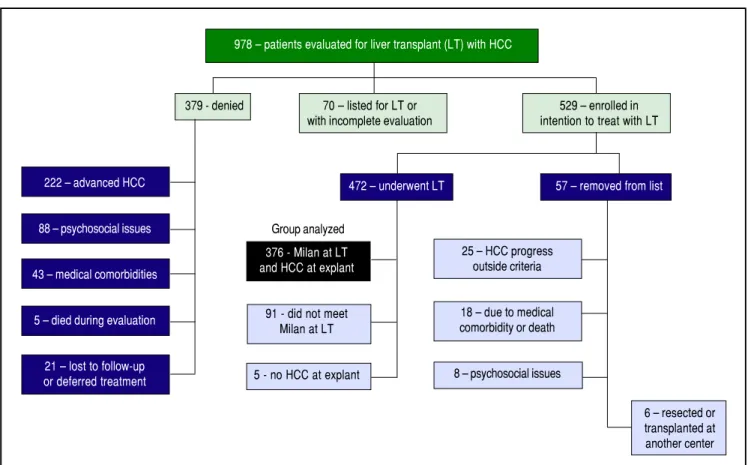
From January 1, 2003 until June 30, 2014, 978 patients with HCC were evaluated for potential LT of HCC (Fig-ure 1). At the time of our analysis, 70 patients were pend-ing listpend-ing for LT and had incomplete evaluations. 379 were denied listing for LT: 222 had advanced HCC, 43 had significant medical comorbidities, 88 had psychoso-cial issues (refractory chemical dependency, poor sopsychoso-cial support, and/or financial constraints), 21 deferred treat-ment or were lost to follow up, and 5 died during the eval-uation.
A total of 529 patients (54.1%) were listed for LT. With a waitlist dropout rate of 10.8%, 57 patients were subse-quently removed from listing for the following reasons: 25 developed HCC progression (4.7%), 18 developed medi-cal issues that precluded LT, 6 patients elected to be re-moved (1 had hepatic resection, 5 were transplanted at other centers), and 8 denied for psycho-social reasons. The remaining 472 patients were transplanted. 96 of these were excluded from our analyses because 5 had no tumor found at explant without previous ablation therapy, and 91 patients had small tumors that did not meet MELD excep-tion points but were transplanted based on MELD score due to advanced liver disease.
at 1, 3, and 5 years was 92.4%, 79.2%, and 65.8%, respective-ly. HCC recurrence occurred in 38 patients. Recurrence-free patient survival over 1, 3, and 5 years was 88.2%, 76.6%, and 62.2%, respectively (Figure 2).
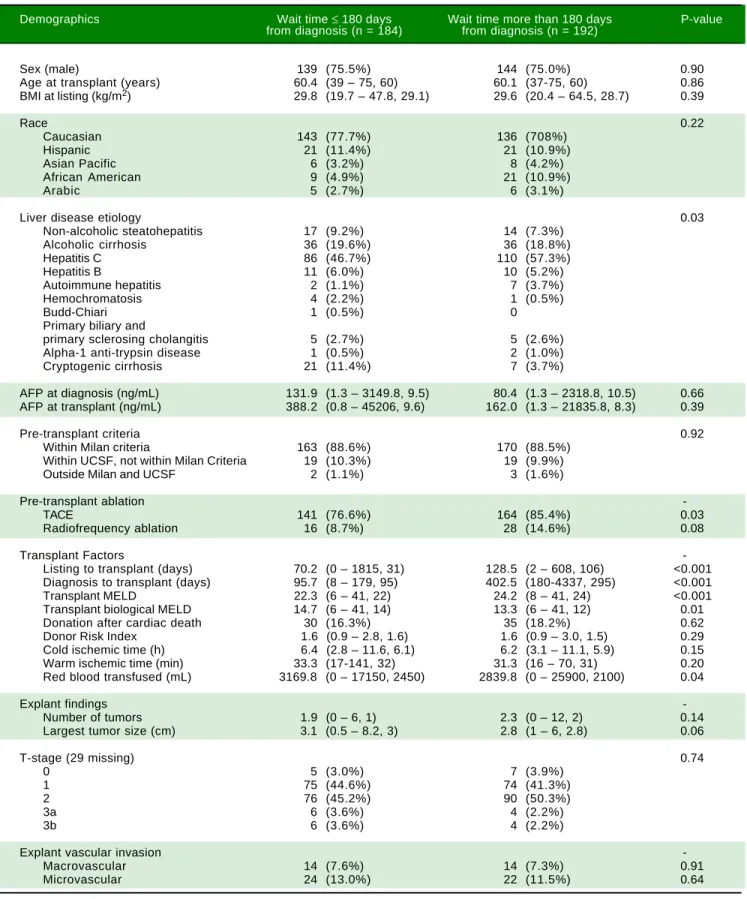
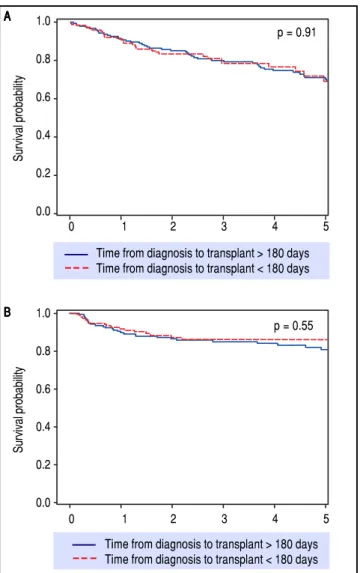
After preliminary analyses, 180 days from HCC diagno-sis until LT was selected as our time-point for statistical analysis, to compare short wait times with longer wait times (Table 1). This not only allowed for nearly equal groups of comparison, but also seemed most relevant in light of the recent UNOS policy change. These two groups had similar patient demographics and etiologies for underlying liver disease. The group waiting less than 180 days had lower MELD at LT, larger average tumor size, but had no difference in overall or recurrence-free surviv-al rates over five years of follow-up (Figure 3).
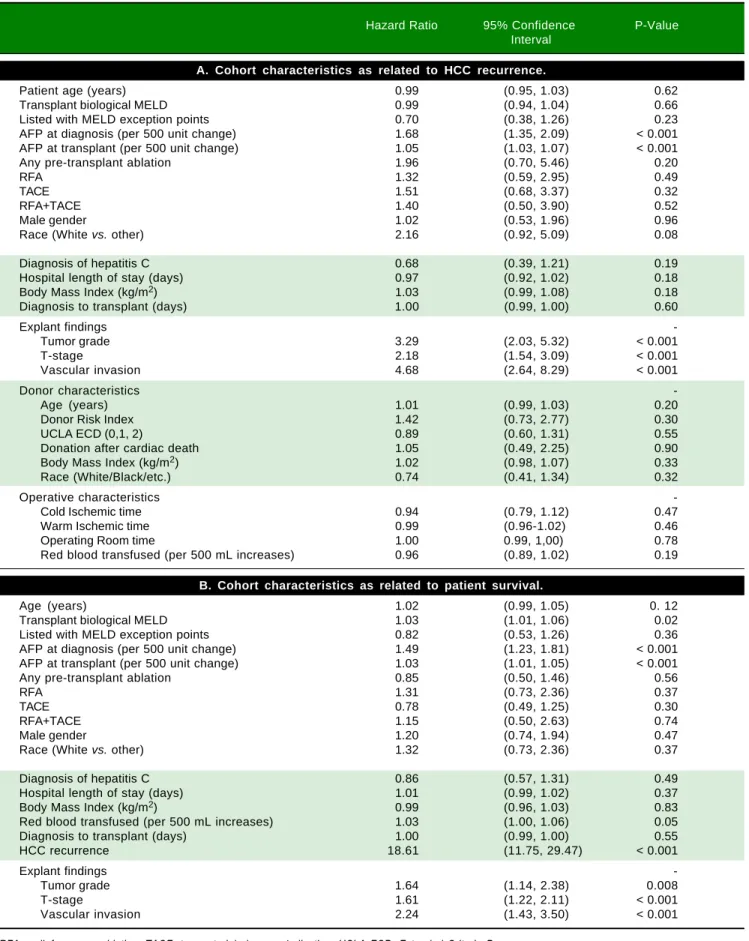
Univariate Cox proportional hazard analyses for varia-bles related to HCC recurrence and survival were per-formed. Serum AFP at diagnosis and LT, and explant findings of TNM staging, histopathological tumor grade, and vascular invasion all statistically predicted HCC re-currence (Table 2A) and overall survival after LT (Table 2B) on univariate analysis. The only predictive pre-LT
Figure 1. Figure 1.Figure 1.
Figure 1.Figure 1. Evaluation algorithm demonstrating all patients evaluated for LT with HCC (n = 978), who were enrolled in intention-to-treat with LT (n = 529), subsequently underwent LT (n = 472), and were found to be inside MC and have confirmed HCC at explant (n = 347).
Figure 2. Figure 2. Figure 2. Figure 2.
Figure 2. Kaplan-Meier survival and recurrence-free survival estimates af-ter LT. Survival and recurrence-free survival afaf-ter LT demonstrating a five-year patient survival rate of 65.8% and five-five-year recurrence-free survival rate of 62.2%.
variable for recurrence was AFP. Using an AFP of > 400 ng/mL at any time prior to LT, we found that recurrence was 43.5% vs. 9.9% in those who had an AFP < 400 ng/mL.
Survival
1.0
0.8
0.6
0.4
0.2
0.0
0 1 2 3 4 5
Years Survival
Recurrence free survival
978 – patients evaluated for liver transplant (LT) with HCC
379 - denied 70 – listed for LT or 529 – enrolled in with incomplete evaluation intention to treat with LT
222 – advanced HCC
88 – psychosocial issues
43 – medical comorbidities
5 – died during evaluation
21 – lost to follow-up or deferred treatment
472 – underwent LT 57 – removed from list
25 – HCC progress outside criteria
18 – due to medical comorbidity or death
8 – psychosocial issues
376 - Milan at LT and HCC at explant
91 - did not meet Milan at LT
5 - no HCC at explant Group analyzed
Table 1. Cohort demographics related to wait time (n = 376).
Demographics Wait time ≤ 180 days Wait time more than 180 days P-value from diagnosis (n = 184) from diagnosis (n = 192)
Sex (male) 139 (75.5%) 144 (75.0%) 0.90
Age at transplant (years) 60.4 (39 – 75, 60) 60.1 (37-75, 60) 0.86
BMI at listing (kg/m2) 29.8 (19.7 – 47.8, 29.1) 29.6 (20.4 – 64.5, 28.7) 0.39
Race 0.22
Caucasian 143 (77.7%) 136 (708%)
Hispanic 21 (11.4%) 21 (10.9%)
Asian Pacific 6 (3.2%) 8 (4.2%)
African American 9 (4.9%) 21 (10.9%)
Arabic 5 (2.7%) 6 (3.1%)
Liver disease etiology 0.03
Non-alcoholic steatohepatitis 17 (9.2%) 14 (7.3%)
Alcoholic cirrhosis 36 (19.6%) 36 (18.8%)
Hepatitis C 86 (46.7%) 110 (57.3%)
Hepatitis B 11 (6.0%) 10 (5.2%)
Autoimmune hepatitis 2 (1.1%) 7 (3.7%)
Hemochromatosis 4 (2.2%) 1 (0.5%)
Budd-Chiari 1 (0.5%) 0
Primary biliary and
primary sclerosing cholangitis 5 (2.7%) 5 (2.6%)
Alpha-1 anti-trypsin disease 1 (0.5%) 2 (1.0%)
Cryptogenic cirrhosis 21 (11.4%) 7 (3.7%)
AFP at diagnosis (ng/mL) 131.9 (1.3 – 3149.8, 9.5) 80.4 (1.3 – 2318.8, 10.5) 0.66 AFP at transplant (ng/mL) 388.2 (0.8 – 45206, 9.6) 162.0 (1.3 – 21835.8, 8.3) 0.39
Pre-transplant criteria 0.92
Within Milan criteria 163 (88.6%) 170 (88.5%)
Within UCSF, not within Milan Criteria 19 (10.3%) 19 (9.9%)
Outside Milan and UCSF 2 (1.1%) 3 (1.6%)
Pre-transplant ablation
-TACE 141 (76.6%) 164 (85.4%) 0.03
Radiofrequency ablation 16 (8.7%) 28 (14.6%) 0.08
Transplant Factors
-Listing to transplant (days) 70.2 (0 – 1815, 31) 128.5 (2 – 608, 106) <0.001 Diagnosis to transplant (days) 95.7 (8 – 179, 95) 402.5 (180-4337, 295) <0.001
Transplant MELD 22.3 (6 – 41, 22) 24.2 (8 – 41, 24) <0.001
Transplant biological MELD 14.7 (6 – 41, 14) 13.3 (6 – 41, 12) 0.01
Donation after cardiac death 30 (16.3%) 35 (18.2%) 0.62
Donor Risk Index 1.6 (0.9 – 2.8, 1.6) 1.6 (0.9 – 3.0, 1.5) 0.29
Cold ischemic time (h) 6.4 (2.8 – 11.6, 6.1) 6.2 (3.1 – 11.1, 5.9) 0.15
Warm ischemic time (min) 33.3 (17-141, 32) 31.3 (16 – 70, 31) 0.20
Red blood transfused (mL) 3169.8 (0 – 17150, 2450) 2839.8 (0 – 25900, 2100) 0.04
Explant findings
-Number of tumors 1.9 (0 – 6, 1) 2.3 (0 – 12, 2) 0.14
Largest tumor size (cm) 3.1 (0.5 – 8.2, 3) 2.8 (1 – 6, 2.8) 0.06
T-stage (29 missing) 0.74
0 5 (3.0%) 7 (3.9%)
1 75 (44.6%) 74 (41.3%)
2 76 (45.2%) 90 (50.3%)
3a 6 (3.6%) 4 (2.2%)
3b 6 (3.6%) 4 (2.2%)
Explant vascular invasion
-Macrovascular 14 (7.6%) 14 (7.3%) 0.91
Microvascular 24 (13.0%) 22 (11.5%) 0.64
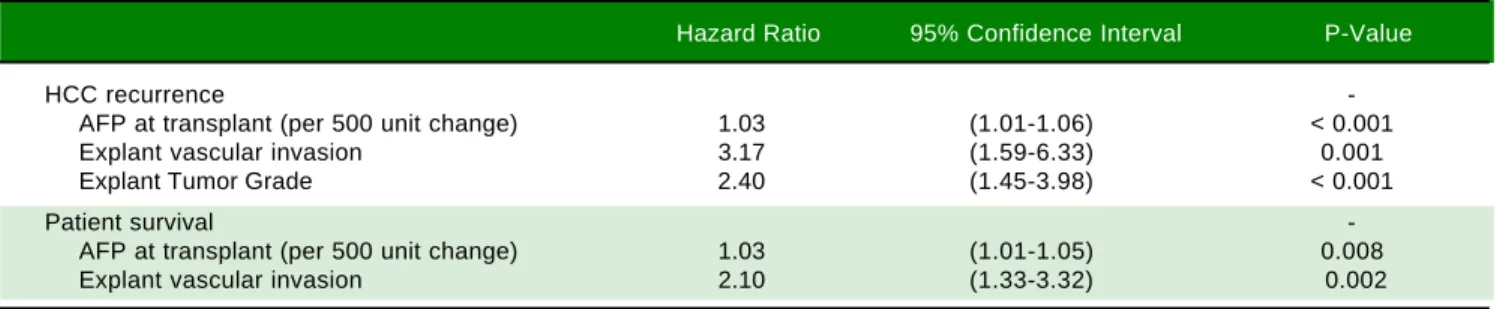
Using a multivariate backwards stepwise Cox proportion-al hazard model for HCC recurrence and patient survivproportion-al, we found similar associations (Table 3). AFP at Trans-plant (HR: 1.03, CI: 1.01-1.06, p < 0.001), exTrans-plant vascular invasion (HR: 3.17, CI: 1.59-6.33, p = 0.001), and explant tumor grade (HR: 2.40, CI: 1.45-3.98, p < 0.001) were all independently associated with increased risk for recur-rence. Only AFP at transplant (HR: 1.03, CI: 1.01-1.05, p = 0.008) and explant vascular invasion (HF: 2.10, CI: 1.33-3.32, p = 0.002) were associated with decreased sur-vival. Figure 4 displays the rate of waitlist drop-out over time, which is found to be 1% at 3 months, 4% at 6 months and 15% at 1 year. The median time to dropout for patients who dropped out was 9.6 months.
DISCUSSION
LT provides the most robust survival for selected pa-tients with non-metastatic HCC.21-23 The decision to list a patient for LT must balance the individual’s desire for po-tentially curative surgery with the need to provide the maximal survival benefit for all patients on the waiting list with considerations for appropriate organ utilization.24
Herein, we present a large single center experience of 529 patients who enrolled with an intention-to-treat analy-sis with LT for HCC, with 472 successfully undergoing LT (89%). Of these 472 patients, 376 met the study’s inclu-sion criteria. The median time from diagnosis to trans-plant was 183 days while the median time on the UNOS waitlist was 62 days. We chose time from diagnosis to transplant as a reflection of “wait” time, because we felt that this time would more accurately indicate the real world response to the diagnosis of HCC as well as be more universally applicable by eliminating the confound-ers of transplant center wait-listing behavior. Thus, this analysis has a unique perspective compared to the registry reports which are limited to UNOS wait time only.
In our experience, overall survival and recurrence-free survival at 5 years were 65.8% and 62.2%, respectively. 47 of our 376 patients (12.5%) developed HCC recurrence which is comparable to similar studies.25-33 HCC recur-rence played a key role in determining overall survival with a strong statistical association (HR 18.61, p < 0.001), making pre-LT identification of patients at risk for recur-rence critical to improve future outcomes. Our data high-light similar findings to previously published single and multi-center analyses of LT for HCC that describe signif-icant associations between outcomes and factors related to tumor biology, including AFP kinetics, macro and micro-vascular invasion, and tumor grade.34-36 Staging systems that incorporated vascular invasion have demonstrated su-perior prediction of outcomes.31 In our study, we found that elevated serum AFP was highly predictive for HCC recurrence and reduced survival after LT. An initially ele-vated or quickly rising serum AFP level during LT evalu-ation should be considered a concerning feature for potential disease recurrence. A serum AFP level > 400 ng/ mL at any time prior to LT predicted post-LT disease re-currence and reduced survival.
Regarding wait-time, we demonstrated no difference in survival or HCC recurrence for patients who were trans-planted either more or less than 180 days from diagnosis, which is consistent with a previously published experi-ence.37 Several recent studies have hypothesized that there may be intrinsic value in increased wait-times for certain HCC patients by selecting for HCC disease that is less likely to recur post-LT. Controversy around HCC excep-tion scores continue, as the transplant community balances
0 1 2 3 4 5
Figure 3. Figure 3. Figure 3. Figure 3.
Figure 3. Kaplan-Meier survival (p = 0.91) and recurrence-free survival (p = 0.55) analyses depicting no difference in outcomes after LT when strati-fying for diagnosis-to-transplant wait time of greater or less than 180 days. Survival (AAAAA) and recurrence-free survival (BBBBB) for > 180 days and < 180 days wait time.
B B B B B
Survival probability
1.0
0.8
0.6
0.4
0.2
0.0
0 1 2 3 4 5
p = 0.55
Time from diagnosis to transplant > 180 days Time from diagnosis to transplant < 180 days A
A A A A
Survival probability
1.0
0.8
0.6
0.4
0.2
0.0
p = 0.91
Table 2. Univariate model of HCC recurrence and patient survival.
Hazard Ratio 95% Confidence P-Value Interval
A. Cohort characteristics as related to HCC recurrence.
Patient age (years) 0.99 (0.95, 1.03) 0.62
Transplant biological MELD 0.99 (0.94, 1.04) 0.66
Listed with MELD exception points 0.70 (0.38, 1.26) 0.23
AFP at diagnosis (per 500 unit change) 1.68 (1.35, 2.09) < 0.001 AFP at transplant (per 500 unit change) 1.05 (1.03, 1.07) < 0.001
Any pre-transplant ablation 1.96 (0.70, 5.46) 0.20
RFA 1.32 (0.59, 2.95) 0.49
TACE 1.51 (0.68, 3.37) 0.32
RFA+TACE 1.40 (0.50, 3.90) 0.52
Male gender 1.02 (0.53, 1.96) 0.96
Race (White vs. other) 2.16 (0.92, 5.09) 0.08
Diagnosis of hepatitis C 0.68 (0.39, 1.21) 0.19
Hospital length of stay (days) 0.97 (0.92, 1.02) 0.18
Body Mass Index (kg/m2) 1.03 (0.99, 1.08) 0.18
Diagnosis to transplant (days) 1.00 (0.99, 1.00) 0.60
Explant findings
-Tumor grade 3.29 (2.03, 5.32) < 0.001
T-stage 2.18 (1.54, 3.09) < 0.001
Vascular invasion 4.68 (2.64, 8.29) < 0.001
Donor characteristics
-Age (years) 1.01 (0.99, 1.03) 0.20
Donor Risk Index 1.42 (0.73, 2.77) 0.30
UCLA ECD (0,1, 2) 0.89 (0.60, 1.31) 0.55
Donation after cardiac death 1.05 (0.49, 2.25) 0.90
Body Mass Index (kg/m2) 1.02 (0.98, 1.07) 0.33
Race (White/Black/etc.) 0.74 (0.41, 1.34) 0.32
Operative characteristics
-Cold Ischemic time 0.94 (0.79, 1.12) 0.47
Warm Ischemic time 0.99 (0.96-1.02) 0.46
Operating Room time 1.00 0.99, 1,00) 0.78
Red blood transfused (per 500 mL increases) 0.96 (0.89, 1.02) 0.19
B. Cohort characteristics as related to patient survival.
Age (years) 1.02 (0.99, 1.05) 0. 12
Transplant biological MELD 1.03 (1.01, 1.06) 0.02
Listed with MELD exception points 0.82 (0.53, 1.26) 0.36
AFP at diagnosis (per 500 unit change) 1.49 (1.23, 1.81) < 0.001 AFP at transplant (per 500 unit change) 1.03 (1.01, 1.05) < 0.001
Any pre-transplant ablation 0.85 (0.50, 1.46) 0.56
RFA 1.31 (0.73, 2.36) 0.37
TACE 0.78 (0.49, 1.25) 0.30
RFA+TACE 1.15 (0.50, 2.63) 0.74
Male gender 1.20 (0.74, 1.94) 0.47
Race (White vs. other) 1.32 (0.73, 2.36) 0.37
Diagnosis of hepatitis C 0.86 (0.57, 1.31) 0.49
Hospital length of stay (days) 1.01 (0.99, 1.02) 0.37
Body Mass Index (kg/m2) 0.99 (0.96, 1.03) 0.83
Red blood transfused (per 500 mL increases) 1.03 (1.00, 1.06) 0.05
Diagnosis to transplant (days) 1.00 (0.99, 1.00) 0.55
HCC recurrence 18.61 (11.75, 29.47) < 0.001
Explant findings
-Tumor grade 1.64 (1.14, 2.38) 0.008
T-stage 1.61 (1.22, 2.11) < 0.001
Vascular invasion 2.24 (1.43, 3.50) < 0.001
Figure 4. Figure 4.Figure 4.
Figure 4.Figure 4. Probability of waitlist dropout for reasons other than LT, shown to increase from 1% at 3 months, to 16% at 12 months, up to 44% at 24 months.
1.0
0.8
0.6
0.4
0.2
0.0
Probability of dropout
0 5 10 15 20 25
Months on waitlist
the risk of waitlist drop out from tumor progression vs. complications with unacceptable post-LT outcomes. Some groups have demonstrated improved outcomes in those patients waiting longer for LT by reviewing national registry data. Delaying LT with a longer wait-time is thought to allow patients with more aggressive HCC biol-ogy to self-select, along with improving organ allocation equity.1,38 However, the applicability of these conclusions is limited by the challenges that face all registry data: het-erogeneous data sampling, underreporting of tumor recur-rence, the lack of uniform programs for patient selection, pre-LT ablation, imaging standards, and inconsistent fol-low up. Thorough analysis of patients who dropped off the wait list was also lacking. Across our cohort, wait time did not impact disease recurrence or long-term outcomes. We believe that an aggressive approach to proceed with LT in patients with HCC can be justified and may even be superior to longer wait times. It is clear that better under-standing of tumor biology prior to LT will be critical to identifying patients most likely to do well after LT for HCC. Regardless, prolonged wait time does not appear to
be universally beneficial. Our analysis of patient dropout while on the transplant list (Figure 4) demonstrates the probability of dropout increases rapidly as a patient remains listed, in particular 12 to 24 months after diagnosis. In light of the recent changes to UNOS policy, patients are likely to wait longer for LT, allowing for increasing wait list dropout.
Our study strengths include the large and comprehen-sive data set from a single center and extended length of follow-up. A high percentage of patients enrolled in the intention-to-treat arm provide evidence for the applica-bility of the findings across populations. Every attempt was made to collect complete and accurate outcome data, even from those patients transferred to other centers after LT. Patients found to have cholangiocarcinoma (CCA) or mixed HCC/CCA at explant were included, as they had an empiric diagnosis of HCC pre-LT based on radiography. The decision to use a diagnosis to LT interval for stratify-ing our cohort likely limits bias and produces more trans-latable findings. Limitations in our study include lack of randomization, the inherent deficiencies of a retrospective review, and the unmeasured changes in pre-LT imaging and ablative therapies over the long period of study. Of note, HCC recurrence was not included in the multivari-ate analysis as relmultivari-ated to survival as it is confounded by be-ing a time-dependent covariate.
In conclusion, we demonstrate through a large single center experience that post-LT survival and HCC recur-rence is not impacted if a patient is transplanted within 6 months after diagnosis or after 6 months after diagnosis; and yet waitlist drop off worsens significantly as time on the waitlist increases. More importantly, we found that tu-mor biology, not wait time, was the primary factor for both recurrence and survival, and should likely be the fo-cus of any future adjustments to regional and national algo-rithms in allocating liver allografts for HCC.
ABBREVIATIONS
• AFP: Alpha-fetoprotein.
• HCC: Hepatocellular carcinoma.
Table 3. Multivariate model of HCC recurrence and patient survival. Analysis of variables related to patient survival.
Hazard Ratio 95% Confidence Interval P-Value
HCC recurrence
-AFP at transplant (per 500 unit change) 1.03 (1.01-1.06) < 0.001
Explant vascular invasion 3.17 (1.59-6.33) 0.001
Explant Tumor Grade 2.40 (1.45-3.98) < 0.001
Patient survival
-AFP at transplant (per 500 unit change) 1.03 (1.01-1.05) 0.008
Explant vascular invasion 2.10 (1.33-3.32) 0.002
AFP: alpha-feto protein.
• HCV: Hepatitis C. • LT: Liver transplantation. • MC: Milan Criteria.
• MELD: Model of End Stage Liver Disease. • RFA: Radiofrequency ablation.
• TACE: Transarterial Chemoembolization.
• UCSF: University of California in San Francisco Criteria.
CONFLICT OF INTEREST
No study funding. The authors declare no conflicts of interest.
ACKNOWLEDGEMENT
The authors acknowledge the contributions from our allied health staffs and the colleagues from various subspe-cialties including anesthesiology, infectious disease, blood bank, pulmonary, cardiology, hematology/oncology, ne-phrology, critical care, and radiation oncology at MCF. Specifically, the authors express the gratitude to our previ-ous and current surgical and Hepatology colleagues in-cluding Jeffery L. Steers, Lena Sibulesky, James Spivey, C. Burcin Taner and Darren Willingham. We thank Jefree Shalev for managing the transplant database.
REFERENCES
1. Samoylova ML, Dodge JL, Yao FY, Roberts JP. Time to transplantation as a predictor of hepatocellular carcinoma recurrence after liver transplantation. Liver Transplant
2014; 20: 937-44.
2. Schlansky B, Chen Y, Scott DL, Austin D, Naugler WE. Wait-ing time predicts survival after liver transplantation for hepa-tocellular carcinoma: a cohort study using the United Network for Organ Sharing registry. Liver Transplant 2014; 20: 1045-56.
3. Wiesner R, Edwards E, Freeman R, Harper A, Kim R, Kamath P, Kremers W, et al. Model for end-stage liver disease (MELD) and allocation of donor livers. Gastroenterology
2003; 124: 91-6.
4. Barbara L, Benzi G, Gaiani S, Fusconi F, Zironi G, Siringo S, Rigamonti A, et al. Natural history of small untreated hepato-cellular carcinoma in cirrhosis: a multivariate analysis of prognostic factors of tumor growth rate and patient survival.
Hepatology 1992; 16: 132-7.
5. Sharma P, Balan V, Hernandez JL, Harper AM, Edwards EB, Rodriguez-Luna H, Byrne T, et al. Liver transplantation for hepatocellular carcinoma: the MELD impact. Liver Transplant
2004; 10: 36-41.
6. Sharma P, Harper AM, Hernandez JL, Heffron T, Mulligan DC, Wiesner RH, Balan V. Reduced priority MELD score for hepatocellular carcinoma does not adversely impact candi-date survival awaiting liver transplantation. Am J Transplant
2006; 6: 1957-62.
7. Washburn K, Edwards E, Harper A, Freeman R. Hepatocellular carcinoma patients are advantaged in the current liver trans-plant allocation system. Am J Transplant 2010; 10: 1643-8.
8. Goldberg D, French B, Abt P, Feng S, Cameron AM. Increas-ing disparity in waitlist mortality rates with increased model for end-stage liver disease scores for candidates with hepatocellular carcinoma versus candidates without hepato-cellular carcinoma. Liver Transplantat 2012; 18: 434-43. 9. Northup PG, Intagliata NM, Shah NL, Pelletier SJ, Berg CL,
Argo CK. Excess mortality on the liver transplant waiting list: unintended policy consequences and Model for End-Stage Liver Disease (MELD) inflation. Hepatology 2015; 61: 285-91.
10. Halazun KJ, Patzer RE, Rana AA, Verna EC, Griesemer AD, Parsons RF, Samstein B, et al. Standing the test of time: out-comes of a decade of prioritizing patients with hepatocellu-lar carcinoma, results of the UNOS natural geographic experiment. Hepatology 2014; 60: 1957-62.
11. Hyder O, Dodson RM, Nathan H, Herman JM, Cosgrove D, Kamel I, Geschwind JF, et al. Referral patterns and treatment choices for patients with hepatocellular carcinoma: a United States population-based study. J Am College Surg 2013; 217: 896-906.
12. Heimbach JK, Hirose R, Stock PG, Schladt DP, Xiong H, Liu J, Olthoff KM, et al. Delayed hepatocellular carcinoma model for end-stage liver disease exception score improves disparity in access to liver transplant in the United States. Hepatology
2015; 61: 1643-50.
13. US Department of Health and Human Services Transplant Program Awards. 2012. Available from: http:// www.hrsa.gov/about/news/2012tables/121004transplant awards.html.
14. Lee DD, Croome KP, Perry DK, Burns JM, Nguyen JH, Keav-eny AP, Taner CB. Liver Transplantation at Mayo Clinic Flori-da. Clin Transplants 2014; 83-90.
15. Harnois DM, Steers J, Andrews JC, Rubin JC, Pitot HC, Burgart L, Wiesner RH, et al. Preoperative hepatic artery chemoembolization followed by orthotopic liver transplanta-tion for hepatocellular carcinoma. Liv Transplant Surg
1999; 5: 192-9.
16. Nguyen JH, Dickson RC, Harnois DM. A decade of liver transplantation at Mayo Clinic in Florida. Clin Transplants
2008; 127-35.
17. Available from: http://www.cap.org/apps/docs/committees/ c a n c e r / c a n c e r _ p r o t o c o l s / 2 0 0 9 / H e p a t o c e l l u l a r _ 0 9 protocol.pdf.
18. Yao FY, Ferrell L, Bass NM, Watson JJ, Bacchetti P, Venook A, Ascher NL, et al. Liver transplantation for hepatocellular carcinoma: expansion of the tumor size limits does not ad-versely impact survival. Hepatology 2001; 33: 1394-403. 19. Wald C, Russo MW, Heimbach JK, Hussain HK, Pomfret EA,
Bruix J. New OPTN/UNOS policy for liver transplant alloca-tion: standardization of liver imaging, diagnosis, classifica-tion, and reporting of hepatocellular carcinoma. Radiology
2013; 266: 376-82.
20. Feng S, Goodrich NP, Bragg-Gresham JL, Dykstra DM, Punch JD, DebRoy MA, Greenstein SM, et al. Characteristics associated with liver graft failure: the concept of a donor risk index. Am J Transplant 2006; 6: 783-90.
21. EASL-EORTC clinical practice guidelines: management of hepatocellular carcinoma. J Hepatol 2012; 56: 908-43. 22. Bruix J, Sherman M. Management of hepatocellular
carcino-ma: an update. Hepatology 2011; 53: 1020-2.
23. Naugler WE, Alsina AE, Frenette CT, Rossaro L, Sellers MT. Building the Multidisciplinary Team for Management of Pa-tients With Hepatocellular Carcinoma. Clin Gastroenterol Hepatol 2014.
Unintended policy consequences and MELD Inflation. Hepa-tology 2014.
25. Duffy JP, Vardanian A, Benjamin E, Watson M, Farmer DG, Ghobrial RM, Lipshutz G, et al. Liver transplantation criteria for hepatocellular carcinoma should be expanded: a 22-year experience with 467 patients at UCLA. Ann Surg 2007; 246: 502-9; discussion 509-511.
26. Huang J, Zeng Y. Current clinical uses of the biomarkers for hepatocellular carcinoma. Drug discoveries & therapeutics
2014; 8: 98-9.
27. Ramanathan R, Sharma A, Lee DD, Behnke M, Bornstein K, Stravitz RT, Sydnor M, et al. Multimodality therapy and liver transplantation for hepatocellular carcinoma: a 14-year pro-spective analysis of outcomes. Transplantation 2014; 98: 100-6.
28. Sharma P, Welch K, Hussain H, Pelletier SJ, Fontana RJ, Mar-rero J, Merion RM. Incidence and risk factors of hepatocellu-lar carcinoma recurrence after liver transplantation in the MELD era. Digestive diseases and sciences 2012; 57: 806-12.
29. Kim JM, Kwon CH, Joh JW, Park JB, Lee JH, Kim GS, Kim SJ, et al. Expanded criteria for liver transplantation in patients with hepatocellular carcinoma. Transplantation proceedings
2014; 46: 726-9.
30. Mazzaferro V, Regalia E, Doci R, Andreola S, Pulvirenti A, Bozzetti F, Montalto F, et al. Liver transplantation for the treatment of small hepatocellular carcinomas in patients with cirrhosis. New Engl J Med 1996; 334: 693-9.
31. Vauthey JN, Ribero D, Abdalla EK, Jonas S, Bharat A, Schu-macher G, Lerut J, et al. Outcomes of liver transplantation in 490 patients with hepatocellular carcinoma: validation of a uniform staging after surgical treatment. J Am College Surg
2007; 204: 1016-27; discussion 1027-8.
32. Yao FY, Kerlan RK, Jr., Hirose R, Davern TJ, 3rd, Bass NM, Feng S, Peters M, et al. Excellent outcome following
down-staging of hepatocellular carcinoma prior to liver transplanta-tion: an intention-to-treat analysis. Hepatology 2008; 48: 819-27.
33. Yao FY, Xiao L, Bass NM, Kerlan R, Ascher NL, Roberts JP. Liver transplantation for hepatocellular carcinoma: validation of the UCSF-expanded criteria based on preoperative imag-ing. Am J Transplant 2007; 7: 2587-96.
34. Hemming AW, Cattral MS, Reed AI, Van Der Werf WJ, Greig PD, Howard RJ. Liver transplantation for hepatocellular car-cinoma. Ann Surg 2001; 233: 652-9.
35. Jonas S, Bechstein WO, Steinmuller T, Herrmann M, Radke C, Berg T, Settmacher U, et al. Vascular invasion and his-topathologic grading determine outcome after liver transplan-tation for hepatocellular carcinoma in cirrhosis. Hepatology
2001; 33: 1080-6.
36. Xu Y, Fan J, Zhou J, Qiu SJ, Wu ZQ, Yu Y, Hang XW, et al. Influence of tumor characteristics on the outcome of liver transplantation among patients with hepatocellular carcino-ma. Zhonghua yi xue za zhi 2007; 87: 2101-4.
37. Bittermann T, Hoteit MA, Abt PL, Forde KA, Goldberg D. Waiting time and explant pathology in transplant recipients with hepatocellular carcinoma: a novel study using national data. Am J Transplant 2014; 14: 1657-63.
38. Schlansky B, Chen Y, Scott DL, Austin D, Naugler WE. Wait-ing time predicts survival after liver transplantation for hepa-tocellular carcinoma: A cohort study in the UNOS registry.
Liver Transplant 2014.
Correspondence and reprint request:
David Lee, M.D. Mayo Clinic
4500 San Pablo Road. Jacksonville, Florida 32224. USA. Tel.: 904-953-2000. Fax: 904-953-7366