Patterns of viral load in chronic hepatitis B patients in
Brazil and their association with ALT levels and HBeAg status
Marcelo Eidi Nita,* Nelson Gaburo Jr., Hugo Cheinquer, Gilbert LItalien,§
Evaldo Stanislau Affonso de Araujo,|| Patricia Mantilla,* Nancy Cure Bolt,¶ Paulo A. Lotufo**
* Global Development and Medical Affairs, Bristol-Myers Squibb (BMS), São Paulo, Brazil.
Diagnósticos da América S/A (DASA), Department of Molecular Diagnostics and Development, São Paulo, Brazil. Associate Professor of Gastroenterology and Hepatology, Federal University of Rio Grande do Sul, Porto Alegre, Brazil.
§ Global Epidemiology and Outcome Research, Bristol-Myers Squibb, Wallingford, USA and Adjunct Assistant Professor, Yale University School of Medicine, New Haven CT, USA.
|| LIM-47, Department of Infectious Diseases, University of São Paulo, School of Medicine, São Paulo, Brazil. ¶ Global Development and Medical Affairs, Bristol-Myers Squibb, Princeton, USA.
** Professor of Epidemiology and Internal Medicine, University of São Paulo, School of Medicine, São Paulo, Brazil.
ABSTRACT
Serum hepatitis B virus (HBV) DNA level is a predictor of the development of cirrhosis and hepatocellular carcinoma in chronic hepatitis B patients. Nevertheless, the distribution of viral load levels in chronic HBV patients in Brazil has yet to be described. This cross-sectional study included 564 participants selected in nine Braziliancities located in four of the five regions of the country using the database of a medical diag-nostics company. Admission criteria included hepatitis B surface antigen seropositivity, availability of HBV viral load samples and age ≥ 18 years.Males comprised 64.5% of the study population. Mean age was 43.7 years. Most individuals (62.1%) were seronegative for the hepatitis B e antigen (HBeAg). Median serum ALT level was 34 U/L. In 58.5% of the patients HBV-DNA levels ranged from 300 to 99,999 copies/mL; however, in 21.6% levels were undetectable. Median HBV-DNA level was 2,351 copies/mL. Over 60% of the patients who tested negative for HBeAg and in whom ALT level was less than 1.5 times the upper limit of the normal ran-ge had HBV-DNA levels > 2,000 IU/mL, which has been considered a cut-off point for indicating a liver biop-sy and/or treatment. In conclusion,HBV-DNA level identified a significant proportion of Brazilian individuals with chronic hepatitis B at risk of disease progression. Furthermore, this tool enables those individuals with high HBV-DNA levels who are susceptible to disease progression to be identified among patients with nor-mal or slightly elevated ALT.
Key words. Hepatitis B virus. Seropositivity. Liver biopsy.
Correpondence and reprint request: Marcelo Eidi Nita Bristol-Myers Squib Farmacêuticas S/A.
Rua Carlos Gomes, 924
04743-903 Santo Amaro, SP, Brazil. Tel.: +(5511) 3882-2370. E-mail: [email protected]
Manuscript received: June 29, 2009. Manuscript accepted: November 4, 2009. INTRODUCTION
Despite the fact that chronic hepatitis B (CHB) is a preventable disease, more than 2 billion people around the world are infected with the hepatitis B virus (HBV) and more than 350 million people have chronic hepatitis B.1 Patients with chronic
hepatitis B are at an increased risk of developing cirrhosis of the liver and hepatocellular carcinoma (HCC).2 Moreover, there is recent evidence
indica-ting a relationship between the development of the-se complications and bathe-seline HBV-DNA level.3,4
With regard to progression to cirrhosis, the Risk Evaluation of Viral Load Elevation and Associated Liver Disease/Cancer-Hepatitis B Virus (REVEAL-HBV) study found that the cumulative incidence of liver cirrhosis increased as a function of HBV-DNA levels, ranging from approximately 5% when viral load was undetectable (< 300 copies/mL) to 36% with ≥ 106 copies/mL irrespective of alanine
amino-transferase (ALT) or hepatitis B e antigen (HBeAg) status.3 Similar results have been reported with
respect to the risk of developing hepatocellular car-cinoma. Cumulative incidences were 1.3% with < 300 copies/mL and 14.9% with ≥ 106 copies/mL.
The true prevalence of CHB in Brazil is unk-nown. Data from the Brazilian Ministry of Health indicate that at least 1% of the population is chroni-cally infected with HBV,5 particularly in the major
urban areas; however, there is a distinct risk of un-derestimation. Many regional studies have been ca-rried out to evaluate the prevalence of the disease, but none on a nationwide scale.6-9 The majority of
these findings are derived from studies conducted in small communities, specific population groups or blood-bank samples.10-14 These studies indicate that
there are areas of high endemicity in which the pre-valence of chronically ill hepatitis B patients ranges from 8% to 25%, while the prevalence of anti-HBs positivity is 60-85%. The areas in which prevalence is higher are typically found in the Amazon region in the north of the country. Areas with intermediate HBV prevalence in which the rate of chronic carria-ge rancarria-ges from 2% to 7% are located in the western part of the state of Santa Catarina and in southwest Paraná in the south of the country and in the state of Espírito Santo in the southeastern region of Bra-zil. Finally, most of the regions of the country, in-cluding the state capital cities, are known to be areas of low endemicity in which the prevalence of chronic patients is below 2%. In contrast with the genotypes identified in Asian countries, A, D and F are the genotypes most frequently found in Brazil, with other genotypes only rarely being described.
The aim of this study was to evaluate viral load le-vels in serum samples of Brazilian patients diagnosed with chronic hepatitis B. Secondary objectives were to assess ALT levels and HBeAg status, stratified ac-cording to the different serum HBV-DNA levels.
METHODS
Study subjects and laboratory tests
Diagnósticos da América (DASA) is a private me-dical diagnostics company with branches in all the major urban areas of Brazil with the exception of the northern region: in the south (in the state of Paraná), in the southeast (in São Paulo and Rio de Janeiro), in the northeast (in the state of Ceará) and in the Midwest (in the state of Goiás and in Brasilia, the Federal District). DASA receives sam-ples from patients with private health insurance (about 30% of the Brazilian population has access to private health insurance) and is not a service provi-der for the public healthcare system. In the present study, the DASA database was used to analyze the results of samples collected between July and
Dec-ember 2007 as part of the routine evaluation of CHB patients. Of the samples analyzed, measurements were performed on the same day in 510 cases, while the samples from the remaining 54 patients were analyzed within 1 month of HBV viral load sam-pling. When several samples were available for the same patient, the first available result was selected. This diagnostics company does not register any data regarding treatment. Eligibility criteria included age ≥ 18 years, hepatitis B (HBsAg positive) diagnosed more than six months previously, and availability of HBV-DNA samples. The study was approved by the Institutional Review Board of the Heliópolis Hospi-tal, São Paulo, Brazil.
Demographic information obtained with respect to the patients included age, gender, city and region of origin, and ethnicity. Serological tests included ALT (alanine aminotransferase) and AST (aspartate amino-transferase) performed using enzyme immunoassay (Synemed, Benicia, US); HBsAg, HBeAg and HBeAb performed by chemiluminescence (Abbott Laboratories, North Chicago, IL); and viral DNA detected using real-time polymerase chain reaction (RT-PCR) and va-lidated with a commercially approved RT-PCR - Taq-Man® (Roche) with intra and inter-assay ranges within acceptable limits. With this technique, a fluo-rescent signal is detected each time a copy of DNA is synthesized. The absolute quantification of the sample is compared to a standard curve in each assay. The methodology sensitivity is 75 copies/mL and linearity is between 75 and 75,000,000 copies/mL. The equip-ment used was an Applied Biosystems Real time PCR: SDS 7000/7500/7500 fast (Applied Biosystems, Foster City, CA, USA). The College of American Pathologists (CAP) proficiency assay is performed every 4 months and the Clinical Laboratory Accreditation Program (Programa de Acreditação para Laboratórios Clínico -PALC) is completed every 3 months as DASAs quality control standard. All tests were performed in local faci-lities with the exception of HBV-DNA, which was per-formed at a central laboratory.
A subset analysis was carried out in which the cli-nically significant15 level of HBV replication was
defi-ned as a viral load of 10,000 copies/mL (approximately 2,000 IU/mL), reflecting a consequently high risk of developing liver complications. In this group of pa-tients, the relationship between different HBV-DNA le-vels and HBeAg status and ALT lele-vels was analyzed.
Statistical analysis
means were performed using the t-test or Mann-Whitney test, according to the underlying distribu-tion of the variables. The reladistribu-tionships between HBV-DNA level (DNA copies/mL), ALT (IU/L) level, gender and HBeAg were assessed using analysis of variance (ANOVA) with rank transformation for HBV-DNA level as a continuous variable and the chi-square test for HBV-DNA as a categorical varia-ble (categories defined as < 300 (undetectavaria-ble); 300-9,999; 10,000-9300-9,999; 100,000-99300-9,999; and ≥ 1 million). Both ALT (normal, defined according to gender as 10-40 IU/L for males and 7-35 IU/L for fe-males versus abnormal, defined as any value outside the normal range) and HBeAg (negative versus posi-tive) were categorized for analysis. Missing values for these variables were not considered in the analy-sis. In all cases, the level of statistical significance was set at 0.05 (two-tailed).
RESULTS
Study population
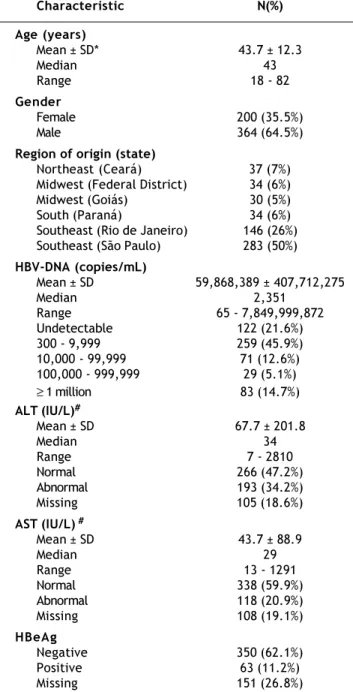
A total of 2,050 consecutive patients who had tes-ted positive for HBsAg were considered for this stu-dy. Of these, 27% (564) individuals were eligible for inclusion. The baseline characteristics and the dis-tribution of serum HBV-DNA levels at admission to the study are shown in Table 1. In 122 study partici-pants (21.6%), HBV-DNA levels were undetectable (< 300 copies/mL), while 112 participants (19.8%) had a level ≥ 100,000 copies/mL. No statistically sig-nificant correlation was found between HBV-DNA levels and the patients place of origin; however, fe-males had lower HBV-DNA levels (median 1472.5) compared to males (median 2815), p < 0.0001.
HBeAg-positive patients had significantly higher ALT levels (mean 170.3 ± 391 IU/L) compared to HBeAg-negative patients (mean 53.9 ± 169.4 IU/L), p < 0.0001 (Table 2). HBV-DNA levels were signifi-cantly higher in HBeAg-positive individuals and in those with elevated ALT levels compared to HBeAg-negative patients and those with normal ALT levels (p < 0.0001 for both comparisons) (Table 3).
Subset analyses of individuals with clinically sig-nificant15 HBV-DNA levels (≥ 10,000 copies/mL),
stratified according to whether or not ALT values were less than 1.5 times the ULN (upper limit of the normal range), are shown for the combined group of HBeAgpositive and HBeAg-negative patients toge-ther (Table 4) and for HBeAg-negative patients alo-ne (Table 5). Analysis showed that 63.2% of HBeAg-negative patients with HBV-DNA levels >
10,000 copies/mL had ALT levels less than 1.5 times the ULN (Table 5).
DISCUSSION
This study provides a cross-sectional view of CHB in selected regions of Brazil, a country in
whi-Table 1. Baseline characteristics of the 564 chronic hepatitis
B patients comprising the study sample.
Characteristic N(%)
Age (years)
Mean ± SD* 43.7 ± 12.3
Median 43
Range 18 - 82
Gender
Female 200 (35.5%)
Male 364 (64.5%)
Region of origin (state)
Northeast (Ceará) 37 (7%)
Midwest (Federal District) 34 (6%)
Midwest (Goiás) 30 (5%)
South (Paraná) 34 (6%)
Southeast (Rio de Janeiro) 146 (26%)
Southeast (São Paulo) 283 (50%)
HBV-DNA (copies/mL)
Mean ± SD 59,868,389 ± 407,712,275
Median 2,351
Range 65 - 7,849,999,872
Undetectable 122 (21.6%)
300 - 9,999 259 (45.9%)
10,000 - 99,999 71 (12.6%)
100,000 - 999,999 29 (5.1%)
≥ 1 million 83 (14.7%)
ALT (IU/L)#
Mean ± SD 67.7 ± 201.8
Median 34
Range 7 - 2810
Normal 266 (47.2%)
Abnormal 193 (34.2%)
Missing 105 (18.6%)
AST (IU/L) #
Mean ± SD 43.7 ± 88.9
Median 29
Range 13 - 1291
Normal 338 (59.9%)
Abnormal 118 (20.9%)
Missing 108 (19.1%)
HBeAg
Negative 350 (62.1%)
Positive 63 (11.2%)
Missing 151 (26.8%)
* SD: Standard Desviation. ALT: Alanine transaminase. AST: Aspartate transaminase. HbeAg: Hepatitis B e antigen. HBV: Hepatitis B virus.
# Normal values: ALT: Males: 10-40 U/L; Females: 7 - 35 U/L; AST: Males:
ch approximately 2 million people are estimated to be HBV carriers.5 Although in some areas of Brazil,
such as the western Amazon basin, prevalence rates are as high as 16%,16 endemicity in the country as a
whole is considered intermediate, ranging from 1% to 8%.8,17
The primary objective of this study was to identi-fy the distribution of viral load levels in Brazilian CHB patients living in six states which, together, contain almost half the countrys total population.18
HBV-DNA levels were undetectable in 21.6% of
par-ticipants, while 58.5% had levels ranging from 300 to 99,999 copies/mL and 19.8% had levels ≥ 100,000 copies/mL. More importantly, the present study de-monstrates that the viral load levels in Brazilian CHB patients are comparable to those described in studies conducted in Taiwan3,4 in which HBV-DNA
levels were undetectable in 23.9% of study partici-pants, while 26.7% had levels ≥ 100,000 copies/mL. Nevertheless, it is difficult to compare the present study with these other earlier studies due to the di-fferences in HBV genotypes between Asia and Latin
Table 4. Relationship between HBV-DNA and ALT levels (the combined group of HBeAg-positive and negative patients together).
HBV-DNA (DNA copies/mL) ALT ≤ 1.5X ULN ALT > 1.5X ULN Total
10,000 - 100,000 30 (33.7%) 7 (7.9%) 37 (41.6%)
> 100,000 18 (20.2%) 34 (38.2%) 52 (58.4%)
Total 48 (53.9%) 41 (46.1%) 89 (100%)
P-value < 0.0001.
Table 5. Relationship between HBV-DNA and ALT levels in HBeAg-negative patients.
HBV-DNA (DNA copies/mL) ALT ≤ 1.5X ULN ALT >1.5X ULN Total
10,000 to 100,000 30 (39.5%) 5 (6.6%) 35 (46.1%)
> 100,000 18 (23.7%) 23 (30.3%) 41 (53.9%)
Total 48 (63.2%) 28 (36.8%) 76 (100%)
P-value = 0.0002. ALT: Alanine transaminase. HbeAg: Hepatitis B e antigen. HBV: Hepatitis B virus.
Table 2. ALT levels according to HBeAg status.
Characteristics ALT (IU/L)
N Mean ± SD Median p-value*
HbeAg
Negative 295 53.9 ± 169.4 33 <0.0001
Positive 60 170.3 ± 391 55
HbeAg: Hepatitis B e antigen.
Table 3. HBV-DNA levels according to HBeAg status and ALT categories.
Characteristics HBV-DNA (DNA copies/mL)
N Mean ± SD Median P-value
HBeAg
Negative 350 23,800,970 ± 152,158,336 1,789 < 0.0001
Positive 63 343,094,176 ± 1,110,062,023 72,924
ALT (IU/L)*
Normal 266 14,563,884 ± 173,076,480 985 < 0.0001
Abnormal 193 149,705,616 ± 657,935,892 19,226
America. In agreement with current literature,3,4 in
the present study viral load levels were lower in the population of HBeAg-negative patients compa-red to the HBeAg-positive patients, patients with abnormal ALT levels usually having a higher viral load level.
The present study also assessed the relationship between HBV-DNA levels and ALT levels and HBe-Ag status. In accordance with previous reports on ALT and HbeAg,19,20 this study has shown that
HBV-DNA levels are significantly higher in HBeAg-positive individuals and in those with abnormal ALT levels. HBeAg was positive in 15.3% of individuals for whom these results were available, a proportion that is almost identical to that observed in the RE-VEAL-HBV study. In the latter study, individuals were seronegative for antibodies against the hepati-tis C virus at study entry; on the other hand, no data regarding hepatitis C virus antibodies were available in the present study, which precludes eva-luation of a possible role of a comorbid hepatitis C infection as a factor contributing to liver damage. Furthermore, it is conceivable that ALT levels in the Brazilian patients included in this study reflec-ted the absence of antiviral treatment in many ca-ses, since information on such treatment was unavailable.
Current hepatitis B treatment guidelines genera-lly recommend no treatment for HBeAg-negative pa-tients with normal or only slightly elevated ALT levels (i.e. ≤ twice the ULN), since they are not con-sidered to have the active disease.21
However, when our subset analysis focused on such individuals, a relatively large proportion was found to have HBV-DNA levels > 10,000 copies/mL. This threshold was used since the effect of treat-ment in this population is unknown, making it im-possible to distinguish those patients in whom low HBV-DNA levels are a result of therapy and sero-conversion from those patients in whom the disease is inactive. By excluding those individuals with low viral load levels from this analysis, our objective was to assess the prevalence of a high viral load and to evaluate ALT, since it would be expected that most patients with high ALT levels would have the active disease.22,23
In Brazil, tests for the evaluation of HBV-DNA le-vels are not generally available within the public healthcare system; therefore, in HBeAg-negative pa-tients with normal ALT levels the disease may be wrongly classified as inactive. Consequently, the cnical follow-up of these patients will not include li-ver biopsy or any form of treatment. This study
identified a number of patients with this profile and it is probable that patients in similar conditions would be missed within the public healthcare sys-tem, in which HBV-DNA testing is not routinely performed. Furthermore, in the absence of serial HBV-DNA measurement, physicians caring for CHB HBeAg-negative patients may find it difficult to deci-de when to perform biopsy and/or initiate antiviral therapy. Furthermore, studies published in the literature24,26 report that patients with elevated
HBV-DNA levels are more prone to disease progres-sion. For example, Yuen, et al. showed that age, gender, core promoter mutation, HBV-DNA and cirrhosis, but not ALT levels, are predictive of the development of HCC. Nevertheless, Feld, et al. carried out a prospective study and showed that HBV-DNA levels > 10,000 copies/mL in HBeAg-ne-gative patients with normal ALT levels was a rele-vant predictor of elevated ALT levels at future follow-up visits.22,27 Considering the evidence that
viral load levels > 10,000 copies/mL are associated with an increasing probability of cirrhosis of the li-ver3 and HCC,4,18,24 we believe that there is growing
evidence that patients with high HBV-DNA levels and low ALT levels should be considered to be har-boring the active infection and to be at an increased risk of complications. These patients, therefore, de-mand to be followed-up more closely.
admi-nistered to these patients. While some measures were taken to identify treatment-naive patients in the database and since analysis of the subset of patients with > 10,000 copies/mL was also aimed at excluding those patients with low viral loads probably indicative of ongoing treatment, it is im-possible, however, to guarantee the treatment sta-tus of patients and to be certain whether viral load levels are a consequence of the disease or the treatment.
Despite the potential limitations outlined abo-ve, the database used in this study offered an uni-que opportunity to evaluate several aspects of chronic hepatitis B in Brazil. Furthermore, corre-lating this data with various papers published in the literature on the evaluation of HBV-DNA le-vels and disease progression3,4,24-26 may provide at
least a rough estimate regarding the risk of pro-gression to HCC in this Brazilian sample of chro-nic HBV patients, provided other differences such as age, ethnicity, genotype and the lack of data re-garding antiviral treatment, among other issues, are taken into account. The advent of new, effecti-ve therapies for HBV has provided the physician treating these patients with a greater possibility of controlling the disease in many HBV-infected patients. The findings of the present study may contribute towards further studies designed to re-ach a better definition of the population at risk and may help increase awareness with respect to the prevalence of the principal factors that seem to affect the risk of disease progression in the Bra-zilian population.
ACKNOWLEDGEMENT
The authors would like to express their gratitude to the investigators and reviewers, including Drs. UH Iloeje, DL Butcher and BC Donato, among others, who collaborated in the preparation of this manuscript and in conducting the study.
ABBREVIATIONS
HBV: Hepatitis B Virus. HBeAg: Hepatitis B e Antigen. ALT: Alanine aminotransferase. CHB: Chronic hepatitis B. HCC: Hepatocellular carcinoma. DASA: Diagnósticos da América. AST: Aspartate aminotransferase.
RT-PCR: Real-time polymerase chain reaction. ULN: Upper limit of the normal range.
LIST OF FINANCIAL SUPPORT
This study was supported by a research grant from Bristol-Myers Squibb, Co.
Marcelo Eidi Nita, Gilbert LItalien, Patricia Mantilla and Nancy Cure-Bolt are all employees of Bristol-Myers Squibb.
Nelson Gaburo Jr. is an employee of DASA. Hugo Cheinquer, Evaldo Stanislau Affonso de Araujo and Paulo Andrade Lotufo have all participa-ted in clinical research studies and all received ho-noraria for their participation as investigators in this study.
REFERENCES
1. Lee WM. Hepatitis B virus infection. N Engl J Med 1997; 337: 1733-45.
2. Beasley RP. Hepatitis B virus. The major etiology of hepa-tocellular carcinoma. Cancer 1988; 61: 1942-56.
3. Iloeje UH, Yang HI, Su J, Jen CL, You SL, Chen CJ; Risk Evaluation of Viral Load Elevation and Associated Liver Disease/Cancer-In HBV (the REVEAL-HBV) Study Group. Predicting cirrhosis risk based on the level of circula-ting hepatitis B viral load. Gastroenterology 2006; 130: 678-86.
4. Chen CJ, Yang HI, Su J, Jen CL, You SL, Lu SN, Huang GT, et al. Risk of hepatocellular carcinoma across a biological gradient of serum hepatitis B virus DNA level. JAMA 2006; 295: 65-73.
5. Ministério da Saúde, Brasil. Programa Nacional de Hepati-tes Virais. Avaliação da Assistência às HepatiHepati-tes Virais no Brasil. Brasília, 2002.
6. Almeida Neto C, Strauss E, Sabino EC, Sucupira MCA, Cha-mone D. Significance of isolated hepatitis B core antibody in blood donors from São Paulo. Rev Inst Med Trop São Pau-lo 2001; 43: 203-8.
7. Braga WS, Silva EB, Souza RA, Tosta CE. [Seroprevalence of hepatitis B and malaria infection in Lábrea, Brazilian western Amazon: estimates of coinfection rates]. Rev Soc Bras Med Trop 2005; 38: 218-23.
8. Fonseca JC, Simonetti SR, Schatzmayr HG, Castejón MJ, Cesário AL, Simonetti JP. Prevalence of infection with he-patitis delta virus (HDV) among carriers of hehe-patitis B sur-face antigen in Amazonas State, Brazil. Trans R Soc Trop Med Hyg 1988; 82: 469-71.
9. Rosini N, Mousse D, Spada C, Treitinger A. Seroprevalence of HbsAg, Anti-HBc and anti-HCV in Southern Brazil, 1999-2001. Braz J Infect Dis 2003; 7: 262-7.
10. Bertolini DA, Pinho JR, Saraceni CP, Moreira RC, Granato CF, Carrilho FJ. Prevalence of serological markers of he-patitis B virus in pregnant women from Paraná State, Bra-zil. Braz J Med Biol Res 2006; 39: 1083-90.
11. Carrilho FJ, Ono-Nita SK, Cardoso RA, Cancado EL, Pinho JR, Alves VA, Da Silva LC. A prospective study of hepatitis B virus markers in patients with chronic HBV infection from Brazilian families of Western and Asian origin. Braz J Med Biol Res 2005; 38: 1399-408.
12. Ono-Nita SK, Carrilho FJ, Cardoso RA, Nita ME, da Silva LC. Searching for chronic hepatitis B patients in a low preva-lence area role of racial origin. BMC Fam Pract 2004; 5: 7 13. Paraná R, Almeida D. HBV epidemiology in Latin America. J
14. Tanaka J. Hepatitis B epidemiology in Latin America. Vacci-ne 2000;18(Suppl. 1): S17-9.
15. European Association for the Study of the Liver. EASL Cli-nical Practice Guidelines: management of chronic hepati-tis B. J Hepatol 2009; 50: 227-42.
16. de Paula VS, Arruda ME, Vitral CL, Gaspar AM. Seropreva-lence of viral hepatitis in riverine communities from the Western Region of the Brazilian Amazon Basin. Mem Inst Oswaldo Cruz 2001; 96: 1123-8.
17. Silveira TR, da Fonseca JC, Rivera L, Fay OH, Tapia R, San-tos JI, Urdeneta E, et al. Hepatitis B seroprevalence in Latin America. Rev Panam Salud Publica 1999;6:378-83 18. Liu CJ, Chen BF, Chen PJ, Lai MY, Huang WL, Kao JH, Chen
DS. Role of hepatitis B viral load and basal core promoter mutation in hepatocellular carcinoma in hepatitis B ca-rriers. J Infect Dis 2006; 193: 1258-65.
19. Lin CL, Liao LY, Liu CJ, Yu MW, Chen PJ, Lai MY, Chen DS, et al. Hepatitis B viral factors in HBeAg-negative carriers with persistently normal serum alanine aminotransferase levels. Hepatology 2007; 45: 1193-8.
20. Shao J, Wei L, Wang H, Sun Y, Zhang LF, Li J, Dong JQ. Re-lationship between hepatitis B virus DNA levels and liver histology in patients with chronic hepatitis B. World J Gastroenterol 2007; 13: 2104-7.
21. Lok AS, McMahon BJ. Practice Guidelines Committee, Ame-rican Association for the Study of Liver Diseases (AASLD).
Chronic hepatitis B: update of recommendations. Hepato-logy 2004; 39: 857-61.
22. Feld JJ, Ayers M, El-Ashry D, Mazzulli T, Tellier R, Heathco-te EJ. Hepatitis B virus DNA prediction rules for hepatitis B e antigen-negative chronic hepatitis B. Hepatology
2007; 46: 1057-70.
23. Lai CL, Yuen MF. The natural history and treatment of chronic hepatitis B: a critical evaluation of standard treatment criteria and end points. Ann Intern Med 2007; 147: 58-61.
24. Chan HL, Tse CH, Mo F, Koh J, Wong VW, Wong GL, Lam Chan S, et al. High viral load and hepatitis B virus subgeno-type ce are associated with increased risk of hepatocellu-lar carcinoma. J Clin Oncol 2008; 26: 177-82.
25. Yu MW, Yeh SH, Chen PJ, Liaw YF, Lin CL, Liu CJ, Shih WL, et al. Hepatitis B virus genotype and DNA level and hepa-tocellular carcinoma: a prospective study in men. J Natl Cancer Inst 2005; 97: 265-72.
26. Chen G, Lin W, Shen F, Iloeje UH, London WT, Evans AA. Past HBV viral load as predictor of mortality and morbidity from HCC and chronic liver disease in a prospective study.
Am J Gastroenterol 2006; 101: 1797-803.